
What is a GMO genetically modified organism GMO



- Slides: 31
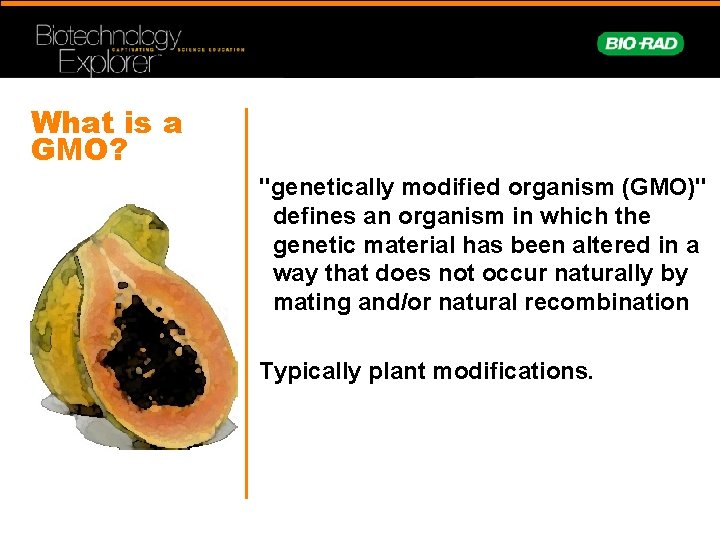
What is a GMO? "genetically modified organism (GMO)" defines an organism in which the genetic material has been altered in a way that does not occur naturally by mating and/or natural recombination Typically plant modifications.
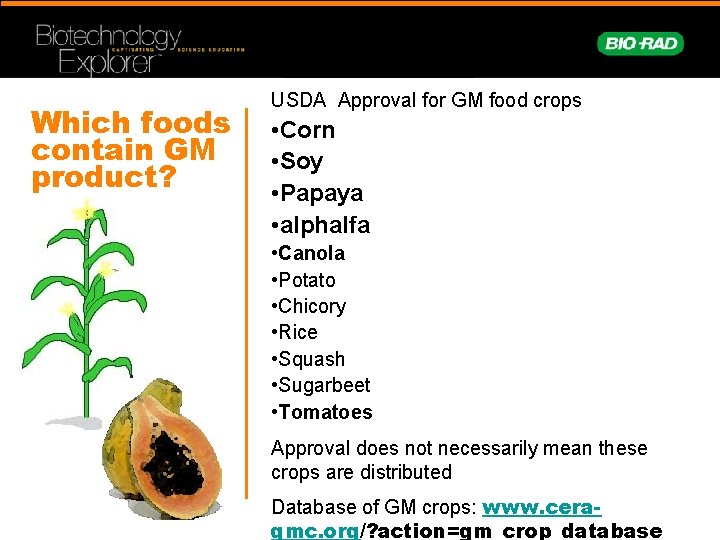
Which foods contain GM product? USDA Approval for GM food crops • Corn • Soy • Papaya • alphalfa • Canola • Potato • Chicory • Rice • Squash • Sugarbeet • Tomatoes Approval does not necessarily mean these crops are distributed Database of GM crops: www. ceragmc. org/? action=gm_crop_database
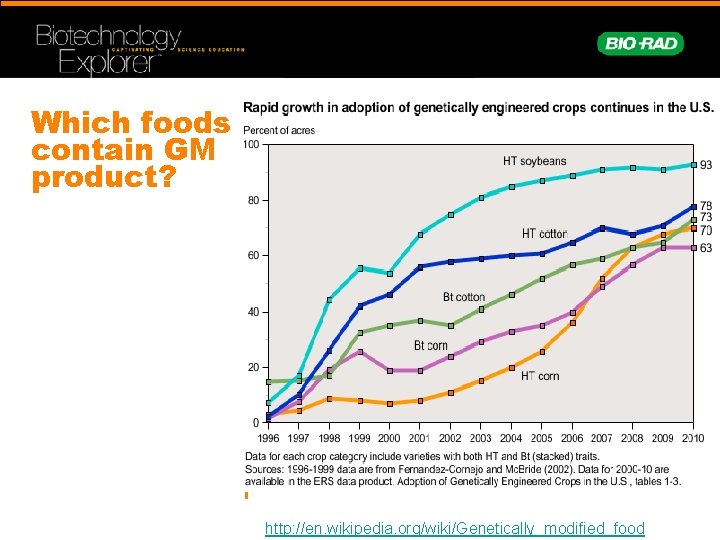
Which foods contain GM product? Sources: 1996 -1999 Fernandez and Mc. Bride, 2000 -2004: USDA, National Agriculture Statistics Service, Acreage. http: //en. wikipedia. org/wiki/Genetically_modified_food
Why test for GMO’s? • Legislation – US: food labeled “GM-Free” <5% GM – EU: food labeled “GM” if >1% GM – Japan: food labeled “GM” if >5% – No requirement to identify food as GMO in Canada or US. – Required to note nutritional information not whether GMO (US and Canada) • Export • What about unlabeled food?
Why have GM crops? • Growing human population • Loss of farmable land • Remediation of soil • Enrich nutrient content
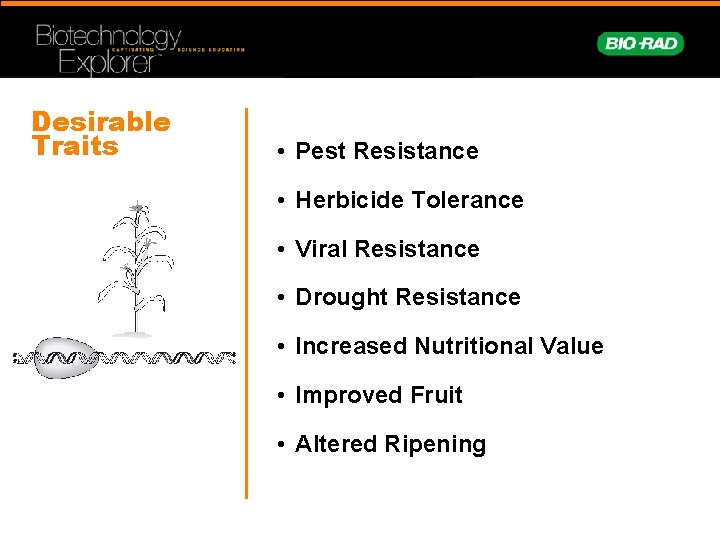
Desirable Traits • Pest Resistance • Herbicide Tolerance • Viral Resistance • Drought Resistance • Increased Nutritional Value • Improved Fruit • Altered Ripening
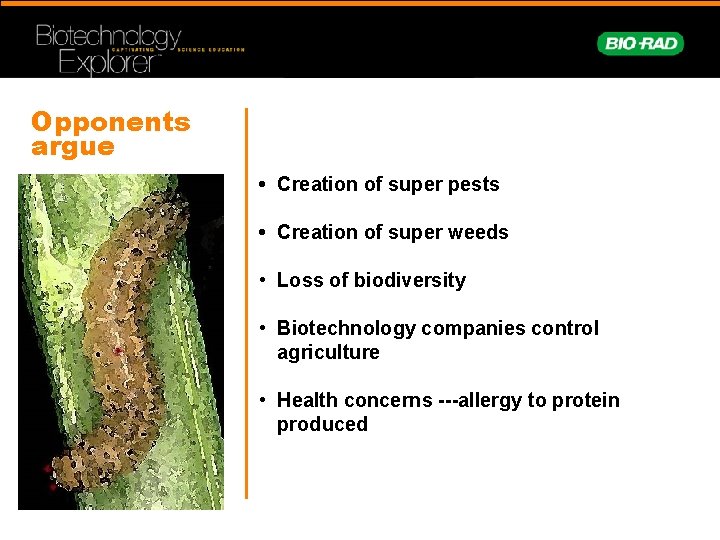
Opponents argue • Creation of super pests • Creation of super weeds • Loss of biodiversity • Biotechnology companies control agriculture • Health concerns ---allergy to protein produced
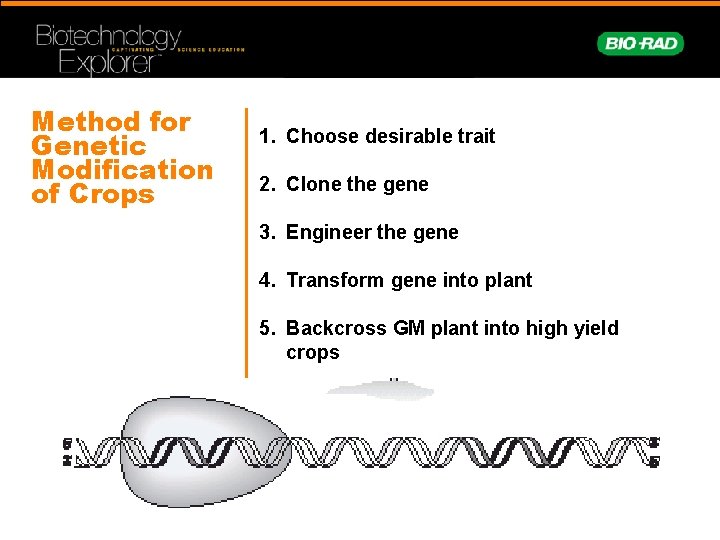
Method for Genetic Modification of Crops 1. Choose desirable trait 2. Clone the gene 3. Engineer the gene 4. Transform gene into plant 5. Backcross GM plant into high yield crops
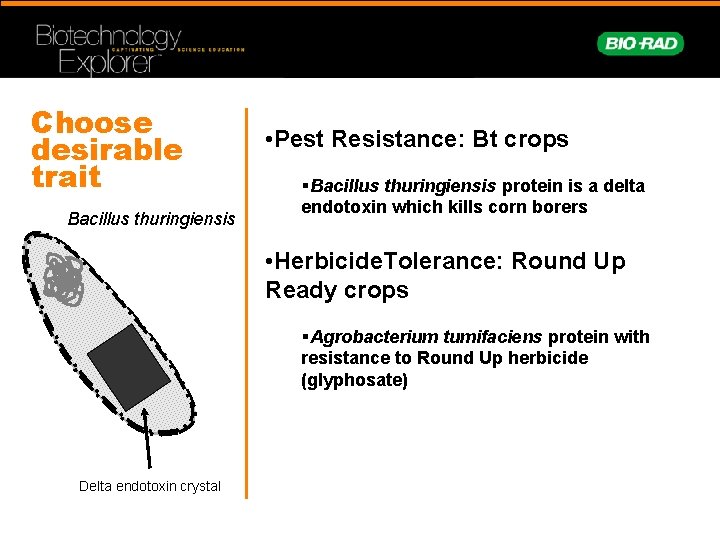
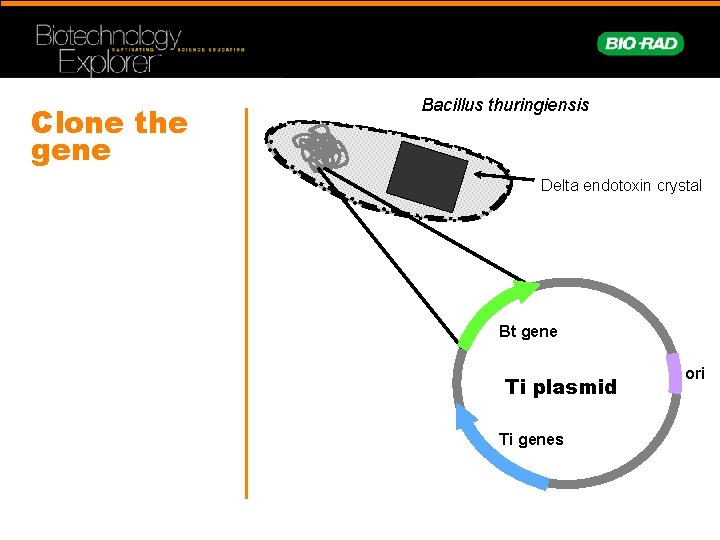
Choose desirable trait Bacillus thuringiensis • Pest Resistance: Bt crops §Bacillus thuringiensis protein is a delta endotoxin which kills corn borers • Herbicide. Tolerance: Round Up Ready crops §Agrobacterium tumifaciens protein with resistance to Round Up herbicide (glyphosate) Delta endotoxin crystal
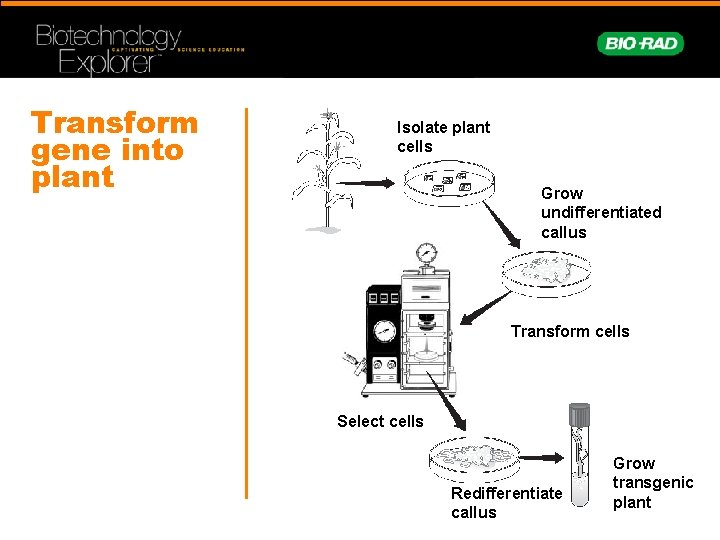
Transform gene into plant Isolate plant cells Grow undifferentiated callus Transform cells Select cells Redifferentiate callus Grow transgenic plant
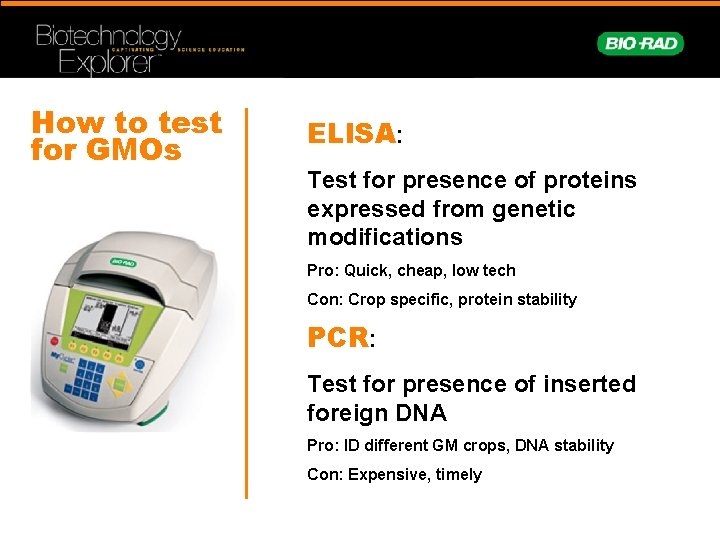
How to test for GMOs ELISA: Test for presence of proteins expressed from genetic modifications Pro: Quick, cheap, low tech Con: Crop specific, protein stability PCR: Test for presence of inserted foreign DNA Pro: ID different GM crops, DNA stability Con: Expensive, timely
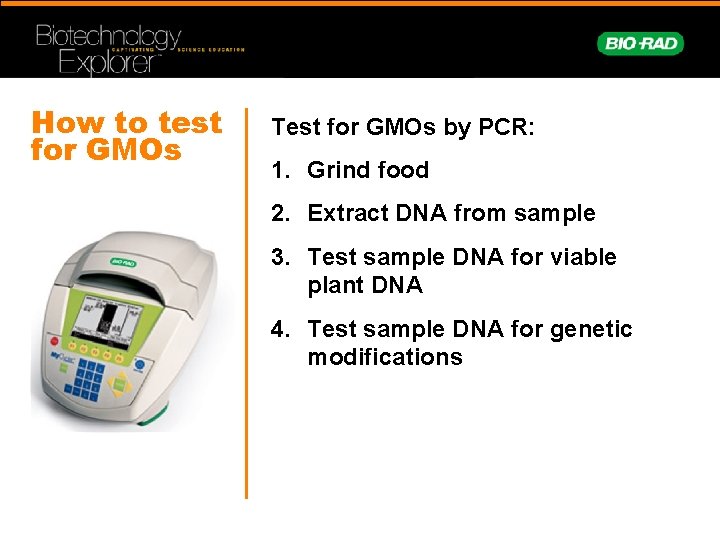
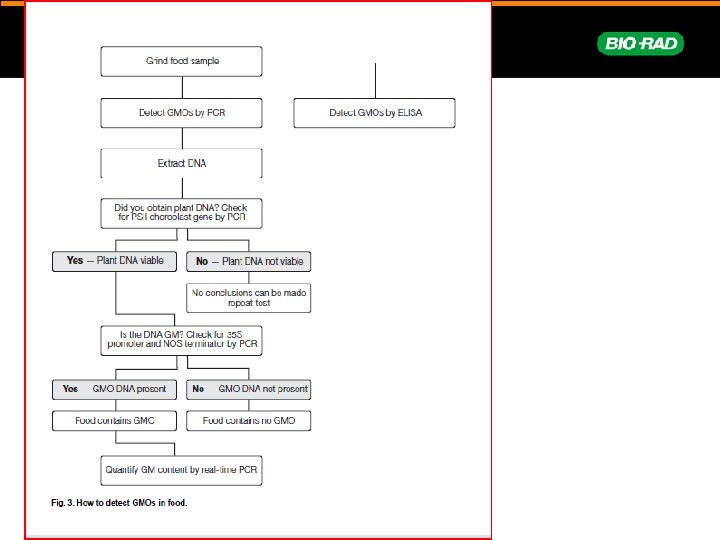
How to test for GMOs Test for GMOs by PCR: 1. Grind food 2. Extract DNA from sample 3. Test sample DNA for viable plant DNA 4. Test sample DNA for genetic modifications
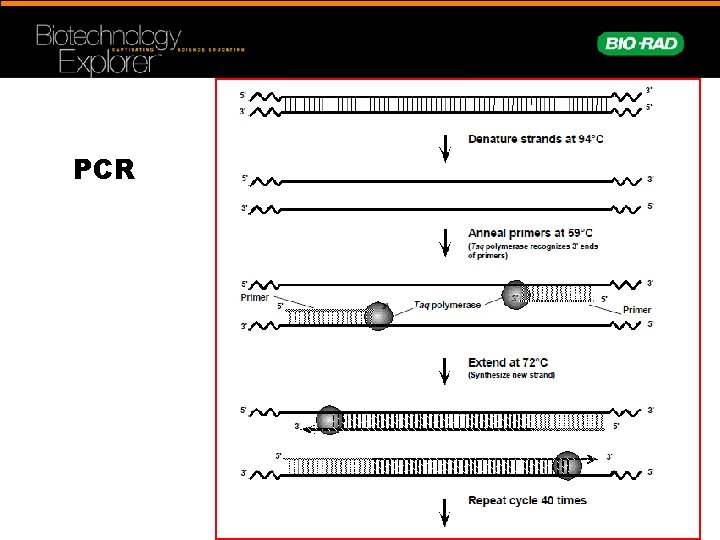
PCR
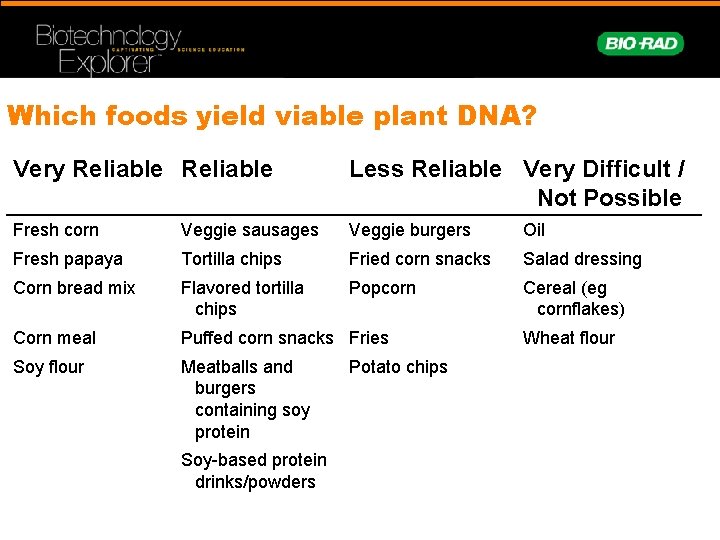
Which foods yield viable plant DNA? Very Reliable Less Reliable Very Difficult / Not Possible Fresh corn Veggie sausages Veggie burgers Oil Fresh papaya Tortilla chips Fried corn snacks Salad dressing Corn bread mix Flavored tortilla chips Popcorn Cereal (eg cornflakes) Corn meal Puffed corn snacks Fries Soy flour Meatballs and burgers containing soy protein Soy-based protein drinks/powders Potato chips Wheat flour
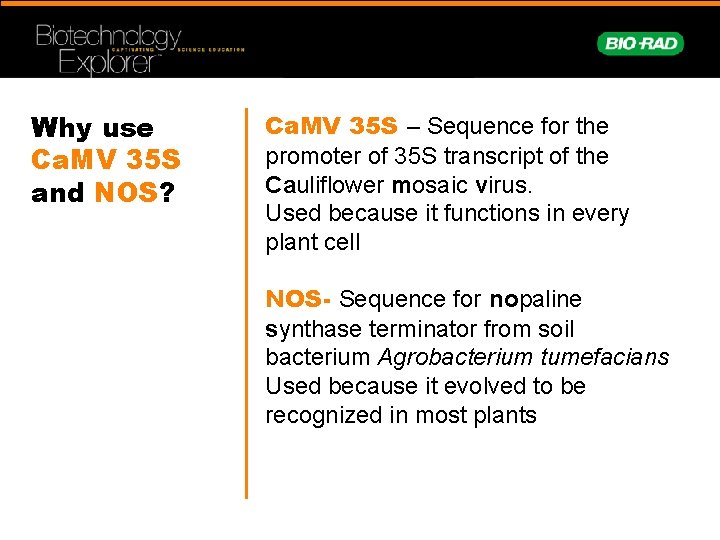
Why use Ca. MV 35 S and NOS? Ca. MV 35 S – Sequence for the promoter of 35 S transcript of the Cauliflower mosaic virus. Used because it functions in every plant cell NOS- Sequence for nopaline synthase terminator from soil bacterium Agrobacterium tumefacians Used because it evolved to be recognized in most plants
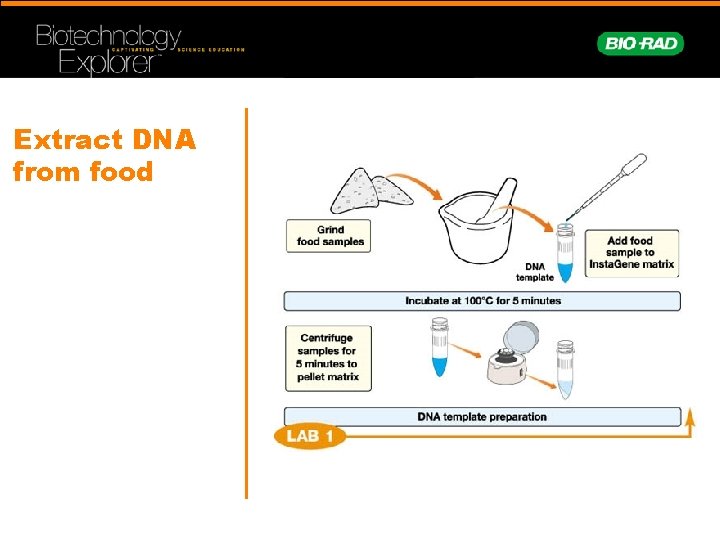
Extract DNA from food
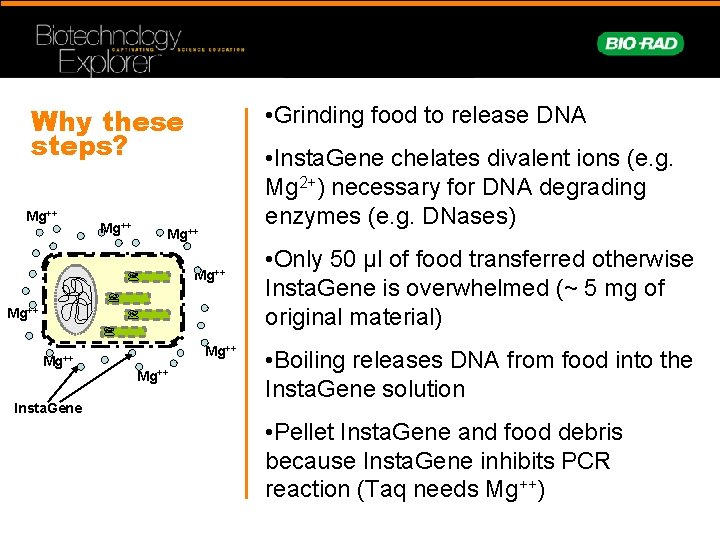
• Grinding food to release DNA Why these steps? Mg++ • Insta. Gene chelates divalent ions (e. g. Mg 2+) necessary for DNA degrading enzymes (e. g. DNases) Mg++ Insta. Gene Mg++ • Only 50 μl of food transferred otherwise Insta. Gene is overwhelmed (~ 5 mg of original material) • Boiling releases DNA from food into the Insta. Gene solution • Pellet Insta. Gene and food debris because Insta. Gene inhibits PCR reaction (Taq needs Mg++)
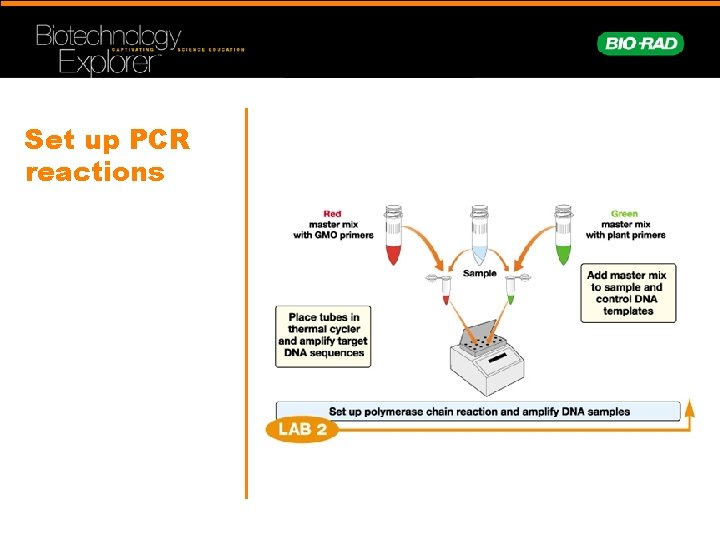
Set up PCR reactions
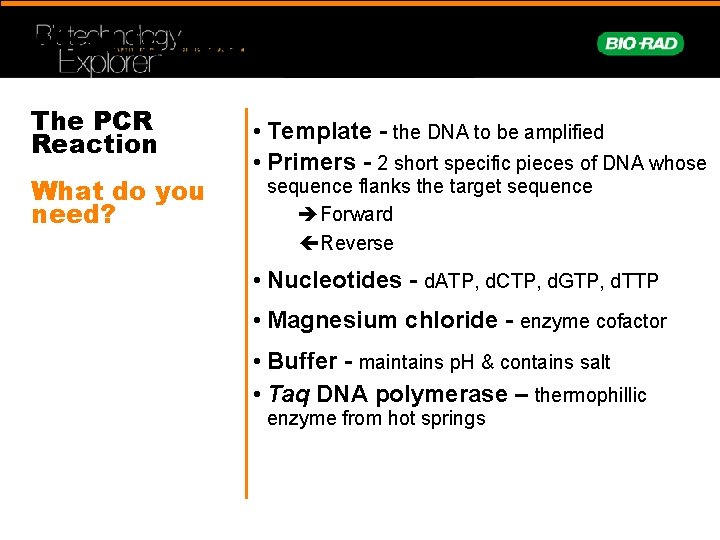
What is needed for PCR? The PCR Reaction What do you need? • Template - the DNA to be amplified • Primers - 2 short specific pieces of DNA whose sequence flanks the target sequence èForward çReverse • Nucleotides - d. ATP, d. CTP, d. GTP, d. TTP • Magnesium chloride - enzyme cofactor • Buffer - maintains p. H & contains salt • Taq DNA polymerase – thermophillic enzyme from hot springs
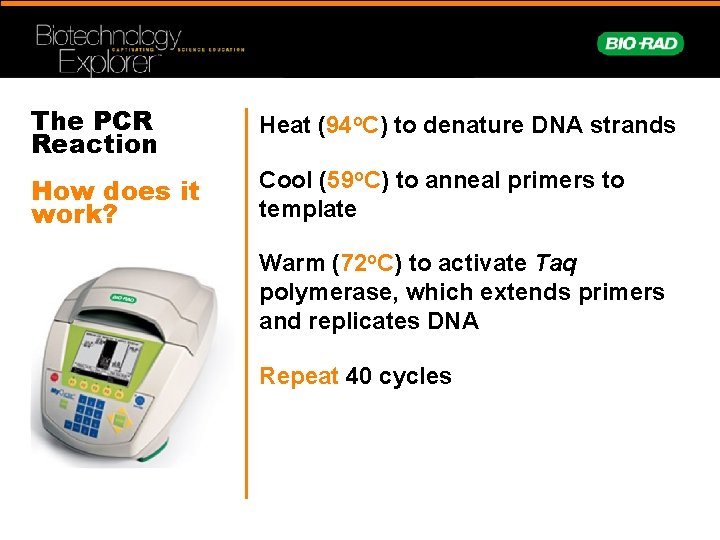
The PCR Reaction Heat (94 o. C) to denature DNA strands How does it work? Cool (59 o. C) to anneal primers to template Warm (72 o. C) to activate Taq polymerase, which extends primers and replicates DNA Repeat 40 cycles
Clone the gene Bacillus thuringiensis Delta endotoxin crystal Bt gene Ti plasmid Ti genes ori
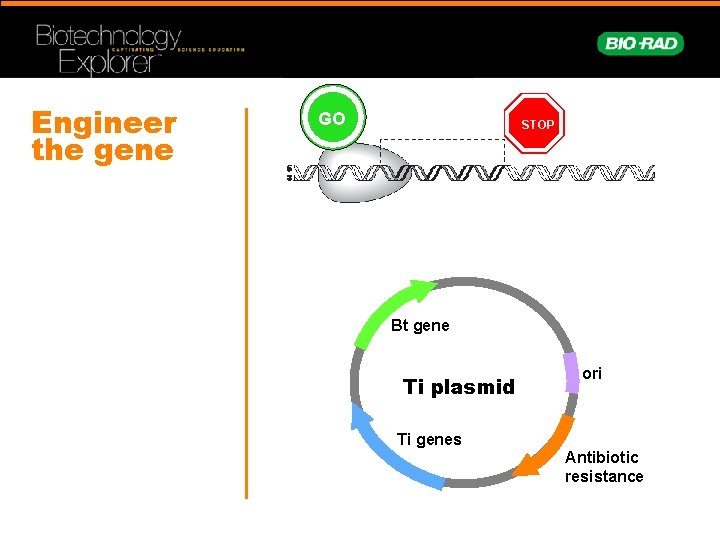
Engineer the gene GO STOP Bt gene Ti plasmid ori Ti genes Antibiotic resistance
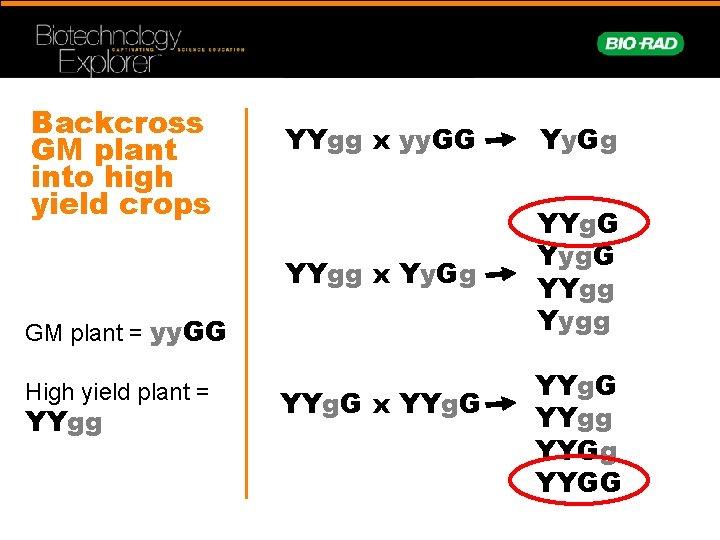
Backcross GM plant into high yield crops YYgg x yy. GG Yy. Gg YYgg x Yy. Gg YYg. G Yyg. G YYgg Yygg GM plant = yy. GG High yield plant = YYgg YYg. G x YYg. G YYgg YYGG
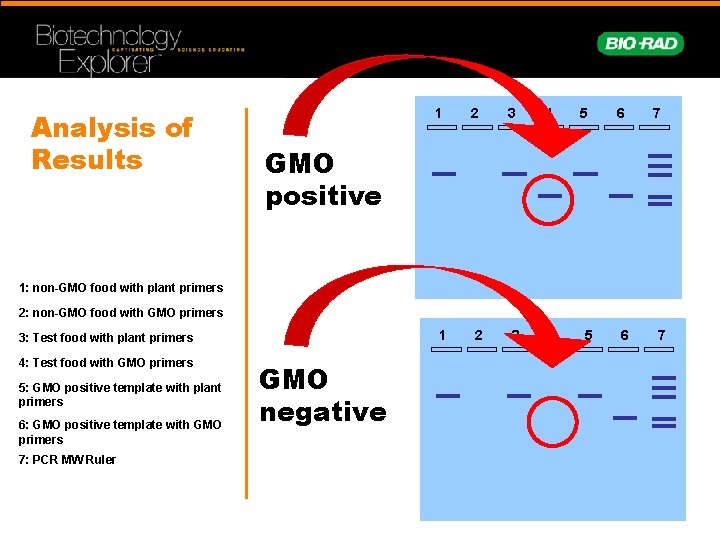
Analysis of Results 1 2 3 4 5 6 7 GMO positive 1: non-GMO food with plant primers 2: non-GMO food with GMO primers 1 3: Test food with plant primers 4: Test food with GMO primers 5: GMO positive template with plant primers 6: GMO positive template with GMO primers 7: PCR MW Ruler GMO negative 2 3 4 5 6 7
GMO Investigator Kit Lab Extensions • Independent studies • Data Mining/Bioinformatics for specific genes – E. g. Design primers to the cry genes in Bt corn • Testing for blended foods
Trouble shooting • False Positives –Contamination-sterile technique; 10% bleach to clean pipette barrels, mortars & pestles, bench tops; barrier tips for all steps. • False Negatives –No DNA extracted –Possible food type or possibly primers do not work on that plant species –Insta. Gene matrix transferred to PCR reactions
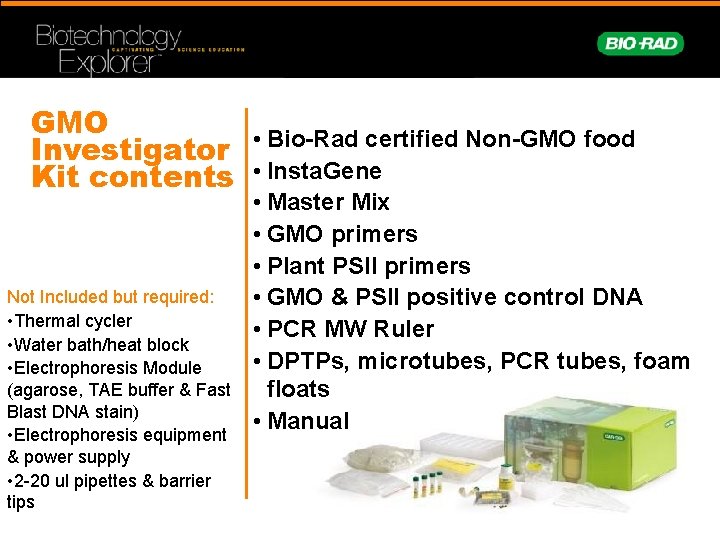
GMO Investigator • Bio-Rad certified Non-GMO food Kit contents • Insta. Gene Not Included but required: • Thermal cycler • Water bath/heat block • Electrophoresis Module (agarose, TAE buffer & Fast Blast DNA stain) • Electrophoresis equipment & power supply • 2 -20 ul pipettes & barrier tips • Master Mix • GMO primers • Plant PSII primers • GMO & PSII positive control DNA • PCR MW Ruler • DPTPs, microtubes, PCR tubes, foam floats • Manual