
What is a fossil A fossil is the

- Slides: 23
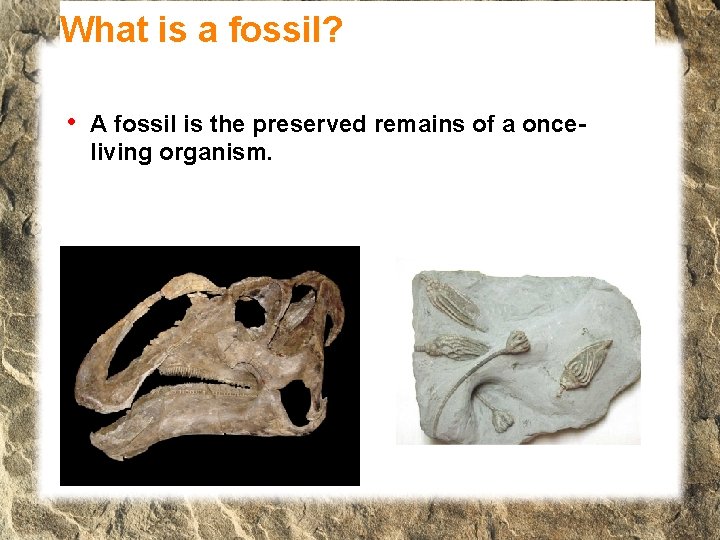
What is a fossil? • A fossil is the preserved remains of a onceliving organism.
What do fossils tell us? 1. help scientists determine the age of the earth Biodiversity
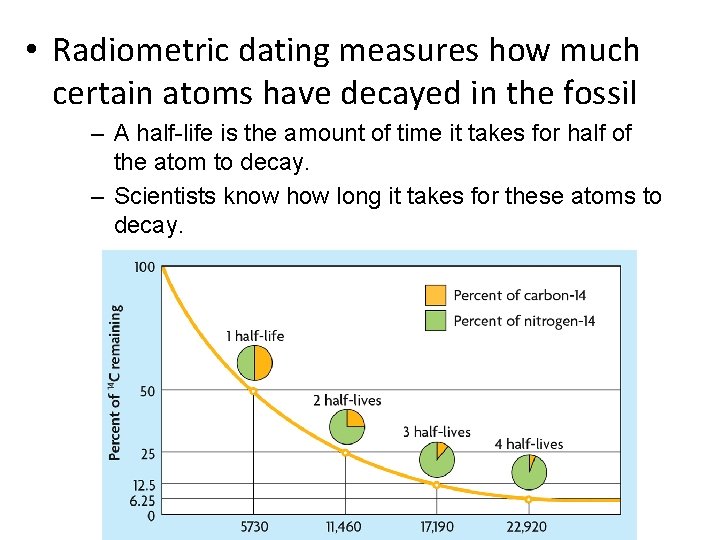
• Radiometric dating measures how much certain atoms have decayed in the fossil – A half-life is the amount of time it takes for half of the atom to decay. – Scientists know how long it takes for these atoms to decay.
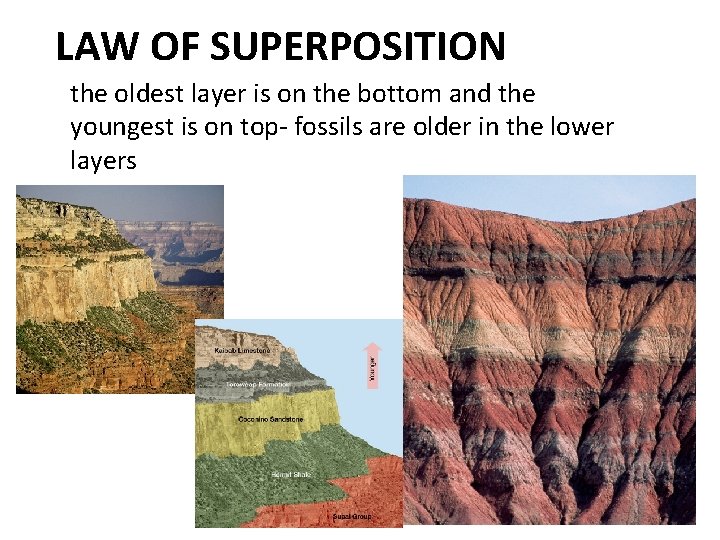
LAW OF SUPERPOSITION the oldest layer is on the bottom and the youngest is on top- fossils are older in the lower layers
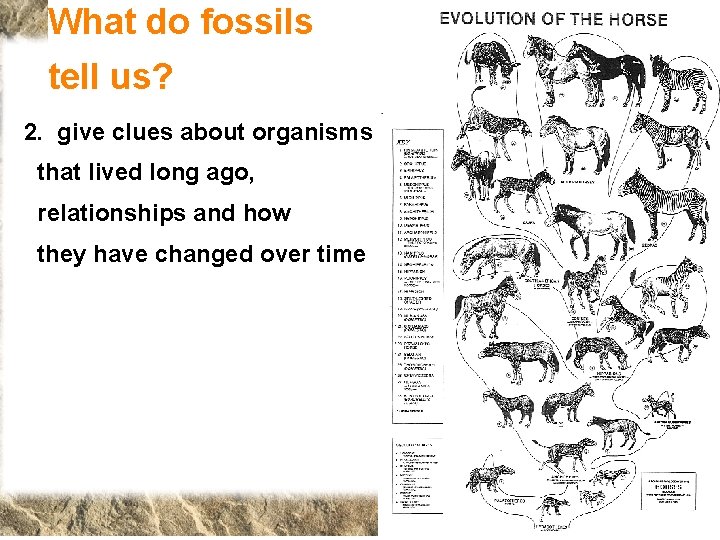
What do fossils tell us? 2. give clues about organisms that lived long ago, relationships and how they have changed over time Biodiversity
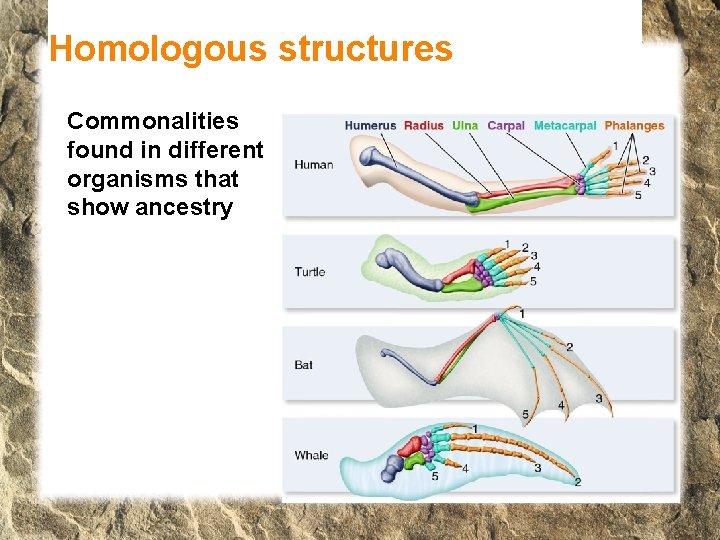
Homologous structures Commonalities found in different organisms that show ancestry
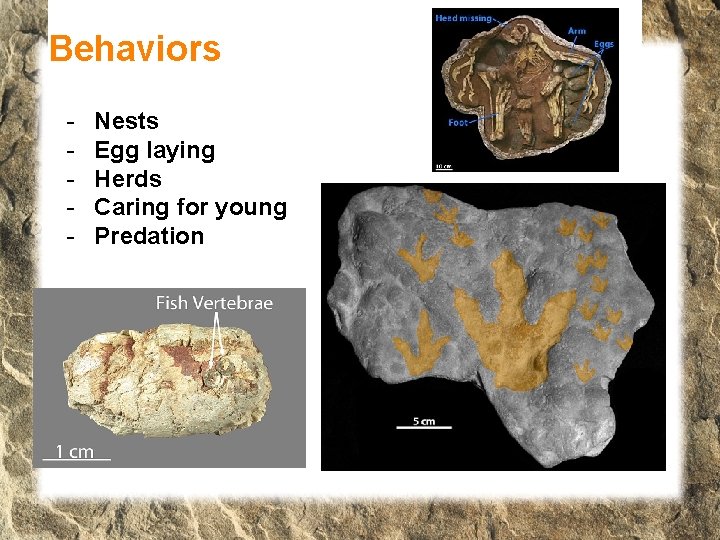
Behaviors - Nests Egg laying Herds Caring for young Predation
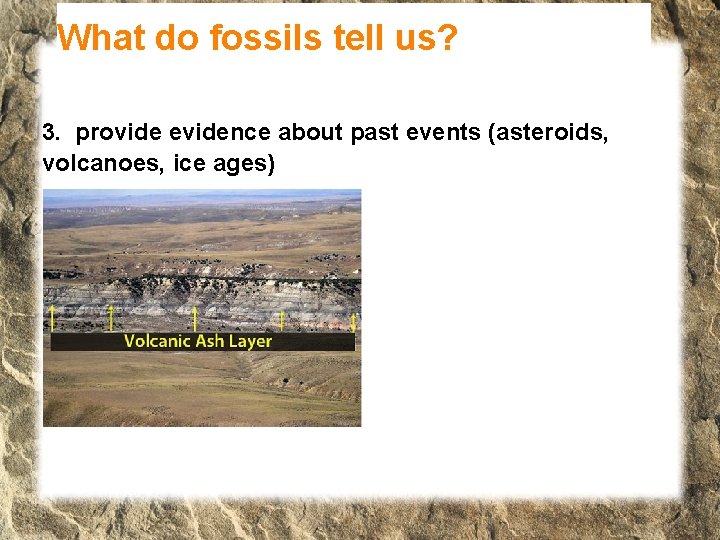
What do fossils tell us? 3. provide evidence about past events (asteroids, volcanoes, ice ages) Biodiversity
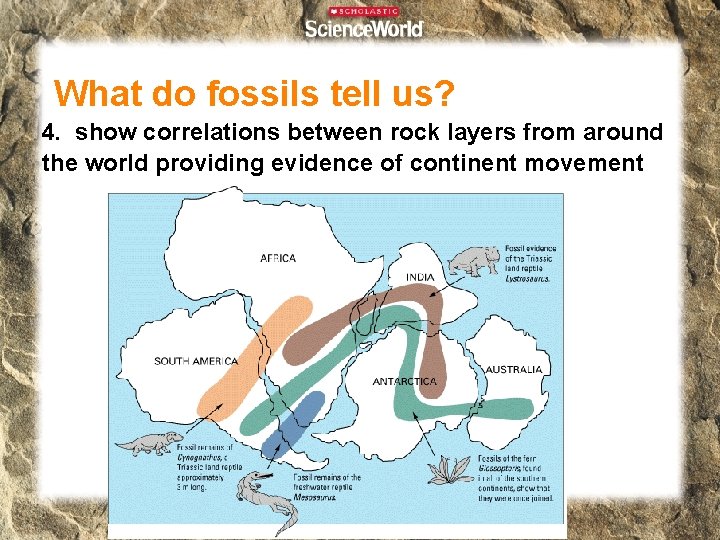
What do fossils tell us? 4. show correlations between rock layers from around the world providing evidence of continent movement Biodiversity
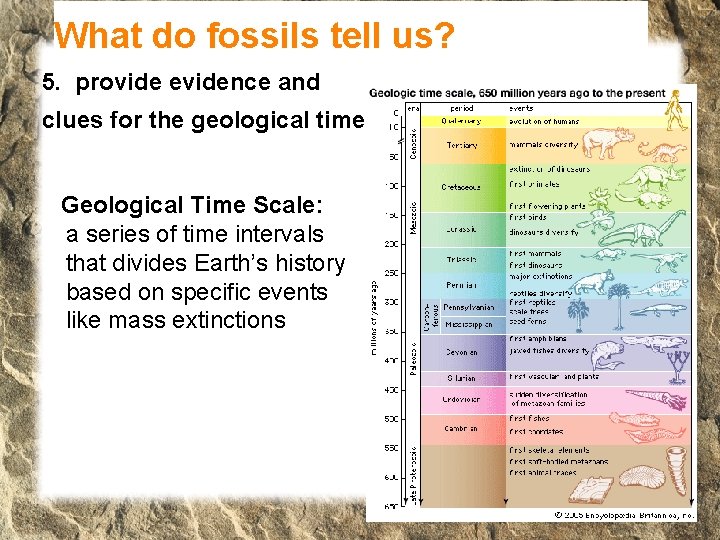
What do fossils tell us? 5. provide evidence and clues for the geological time scale Biodiversity Geological Time Scale: a series of time intervals that divides Earth’s history based on specific events like mass extinctions
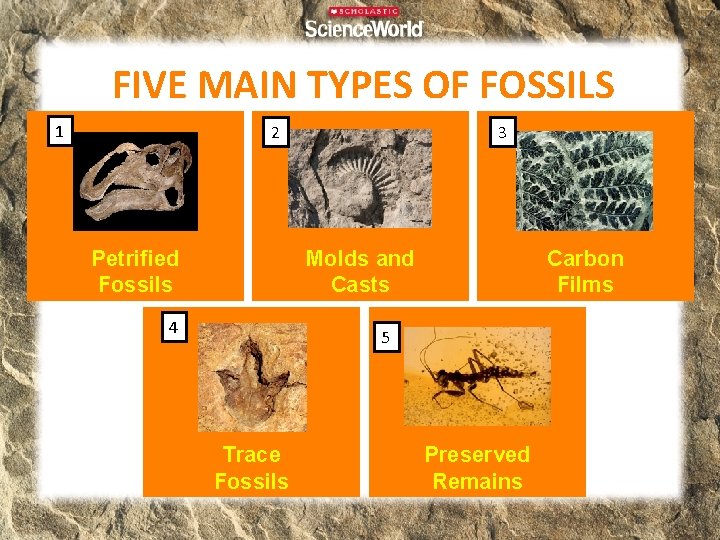
FIVE MAIN TYPES OF FOSSILS 1 2 3 Molds and Casts Petrified Fossils 4 Carbon Films 5 Trace Fossils Preserved Remains
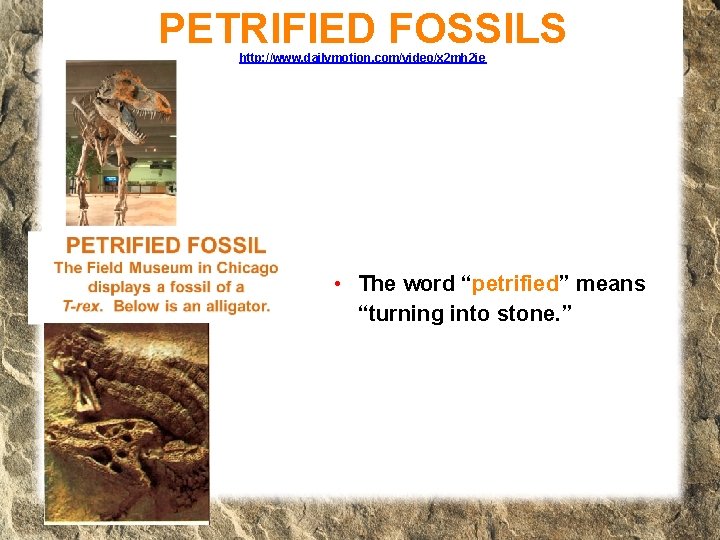
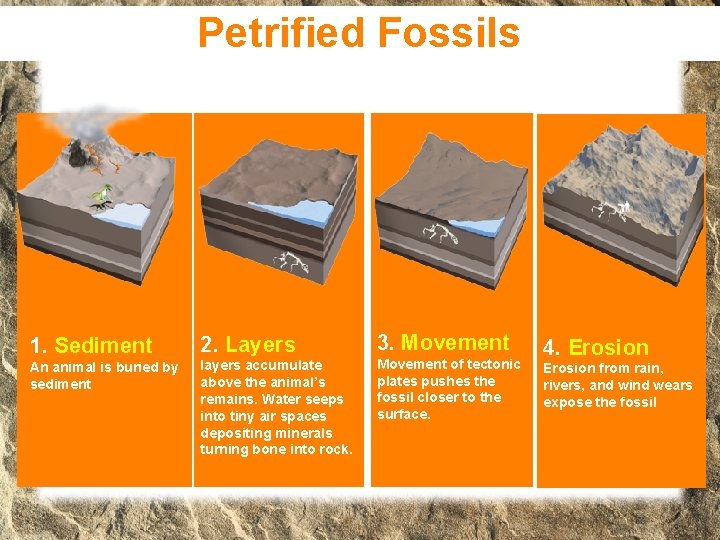
PETRIFIED FOSSILS http: //www. dailymotion. com/video/x 2 mh 2 ie • The word “petrified” means “turning into stone. ”
Petrified Fossils 1. Sediment An animal is buried by sediment 2. Layers layers accumulate above the animal’s remains. Water seeps into tiny air spaces depositing minerals turning bone into rock. 3. Movement of tectonic plates pushes the fossil closer to the surface. 4. Erosion from rain, rivers, and wind wears expose the fossil
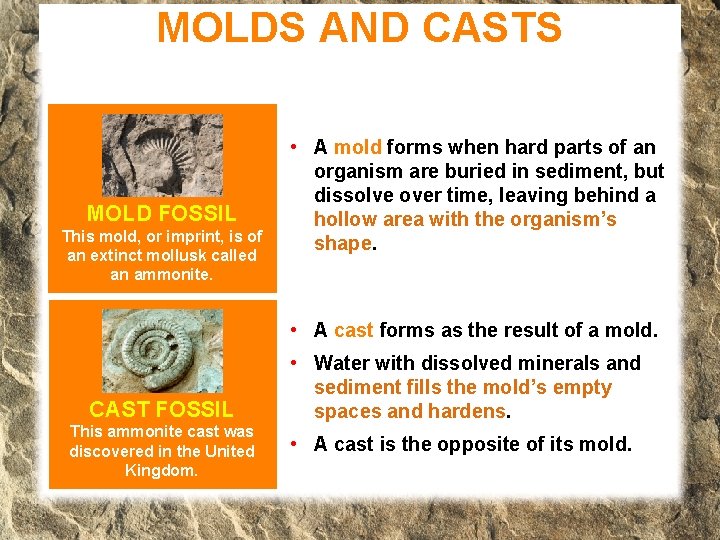
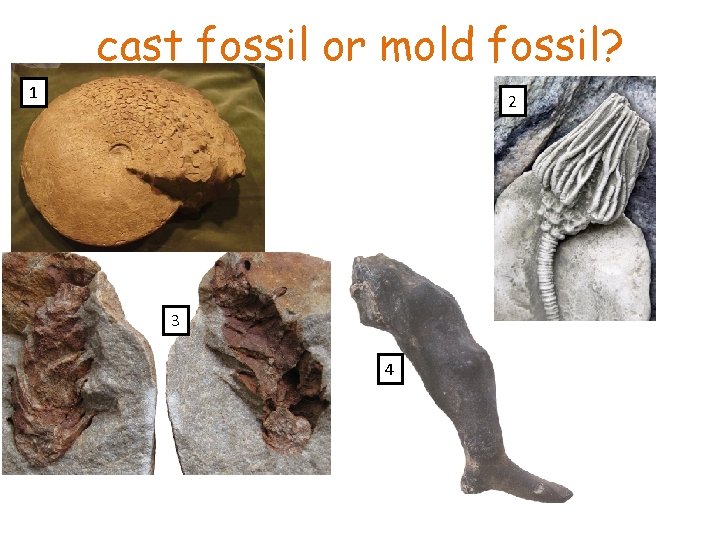
MOLDS AND CASTS MOLD FOSSIL This mold, or imprint, is of an extinct mollusk called an ammonite. • A mold forms when hard parts of an organism are buried in sediment, but dissolve over time, leaving behind a hollow area with the organism’s shape. • A cast forms as the result of a mold. CAST FOSSIL This ammonite cast was discovered in the United Kingdom. • Water with dissolved minerals and sediment fills the mold’s empty spaces and hardens. • A cast is the opposite of its mold.
cast fossil or mold fossil? 1 2 3 4
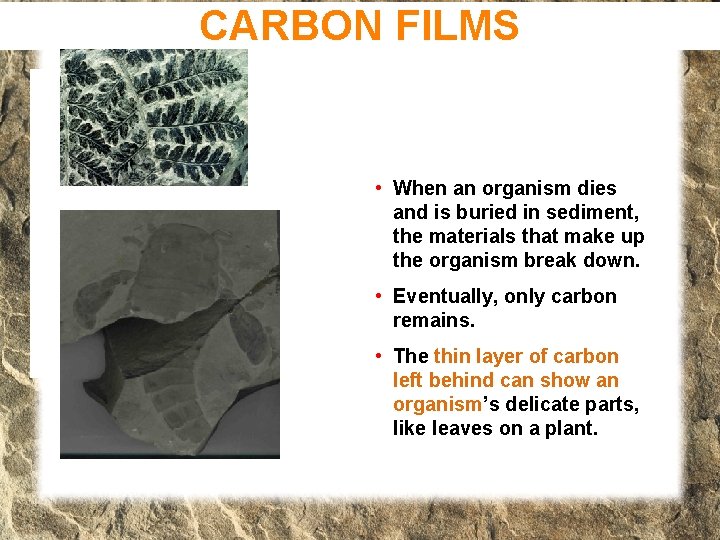
CARBON FILMS • When an organism dies and is buried in sediment, the materials that make up the organism break down. • Eventually, only carbon remains. • The thin layer of carbon left behind can show an organism’s delicate parts, like leaves on a plant.
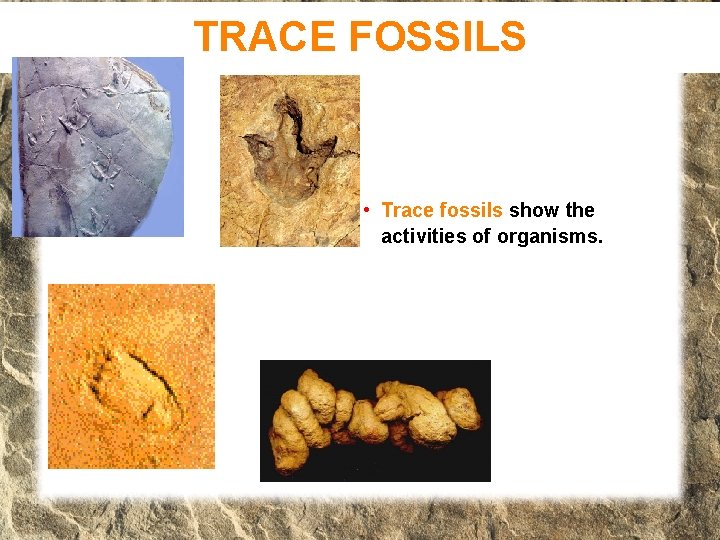
TRACE FOSSILS • Trace fossils show the activities of organisms.
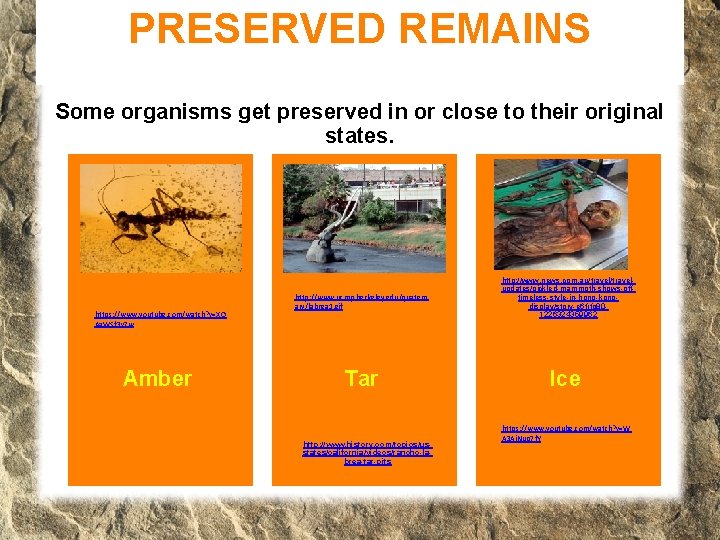
PRESERVED REMAINS Some organisms get preserved in or close to their original states. https: //www. youtube. com/watch? v=XQ Aa. WSf 3 v. Zw Amber http: //www. ucmp. berkeley. edu/quatern ary/labrea 1. gif Tar http: //www. history. com/topics/usstates/california/videos/rancho-labrea-tar-pits http: //www. news. com. au/travelupdates/pickled-mammoth-shows-offtimeless-style-in-hong-kongdisplay/story-e 6 frfq 801226324359962 Ice https: //www. youtube. com/watch? v=W A 3 Ai. Nup 7 f. Y
Maybe you will find a fossil? • http: //www. huffingtonpost. com/2015/04/08/4 -year-old-dinosaur-bonestexas_n_7022842. html AND NOW AN ACTIVITY FOR YOU!
• Spread the cards on the table. • The cards represent rock layers. • The letters represent fossils. • Find the card with TC on it. • This is the oldest layer of rock. • Figure out the order of the rest of the layers.
Answer the following questions with your group 1. Which layer is the most recent layer of rock? 2. Which fossil is oldest- X or M? 3. Which fossil is the oldest- B or N? 4. Find a fossil that went extinct? 5. Which fossil lived the longest amount of time? 6. What do we call this idea that we can date fossils based on the layer of rock they are found?
Activity 2 Work in the same group as yesterday Place your cards on the table Each card is a layer of earth The oldest layer is “M” (ignore the rest of the letters) • Figure out the order of the rest of the layers. • •
Use your rock layers to answer the following questions. 7. Write the sequence of letters from the youngest layer to the oldest layer 8. Name the fossils found in multiple layers. 9. Name the fossils found in only one layer. 10. What can be said about fossils found in only one layer and fossils found in more than one? 11. What could be said about the environment from these time periods? 12. Which is older- the trilobite or the placoderm?