
WHAT IS A FLATWORM Acoelomates Thin solid bodies
* *WHAT IS A FLATWORM? *Acoelomates *Thin, solid bodies *Can be 1 mm to several meters *14, 500 species *Marine and freshwater and moist habitats on land *3 true cell layer: endoderm, ectoderm, & mesoderm *Ex. Tapeworms, flukes, planarians
* *Some have a nerve net, others have a primitive central nervous system. *Ganglia concentrated in the cephalic area *Cephalization: nerve cells concentrated in the head region *Enables flatworms to respond to stimuli
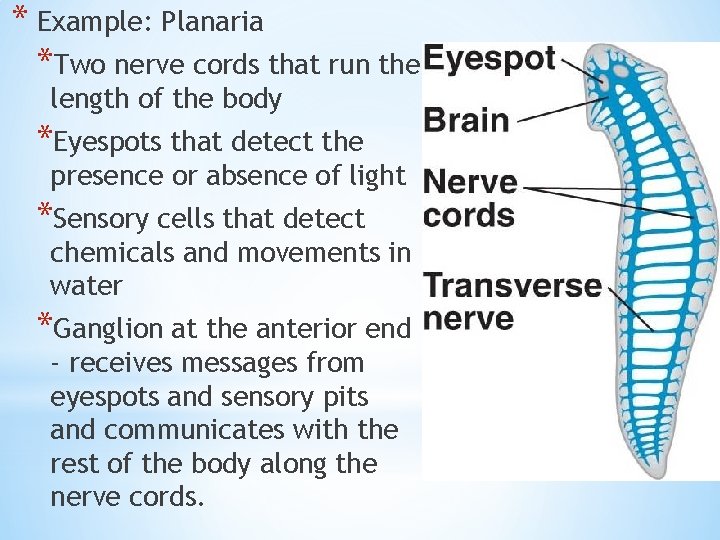
* Example: Planaria *Two nerve cords that run the length of the body *Eyespots that detect the presence or absence of light *Sensory cells that detect chemicals and movements in water *Ganglion at the anterior end - receives messages from eyespots and sensory pits and communicates with the rest of the body along the nerve cords.
* *o Hermaphrodites *o Sexual reproduction *Individual planarians exchange sperm *Fertilization occurs internally *Zygotes are released in capsules into the water where they hatch into tiny planarians *o Asexual reproduction: *Ability to regenerate new body parts through cell divisions *If cut horizontally, each half will grow a new tail/head
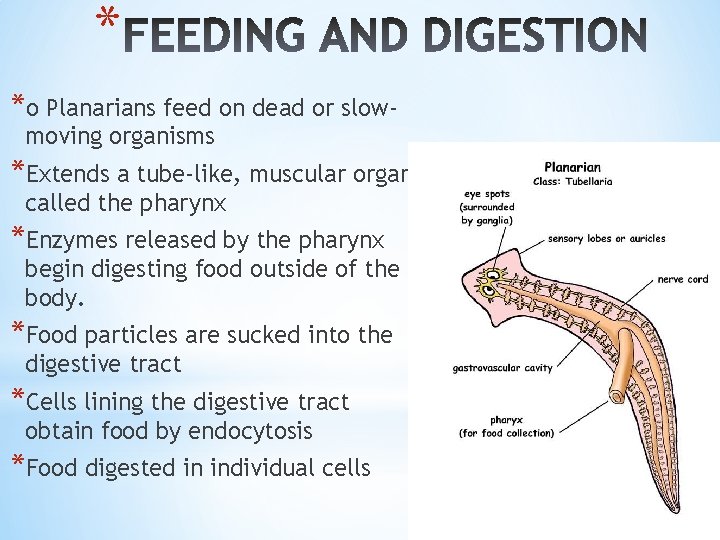
* *o Planarians feed on dead or slowmoving organisms *Extends a tube-like, muscular organ called the pharynx *Enzymes released by the pharynx begin digesting food outside of the body. *Food particles are sucked into the digestive tract *Cells lining the digestive tract obtain food by endocytosis *Food digested in individual cells
*o Parasitic flatworms obtain food from inside the bodies of a host * • Have mouthparts with hooks * • Do not have complex nervous or muscular tissue (don’t need to move)
* *o Exhibit Cephalization: Concentration of sensory organs and nervous tissue at the anterior end of the body (head). *o Well-developed third tissue layer called the mesoderm between the ectoderm and endoderm.
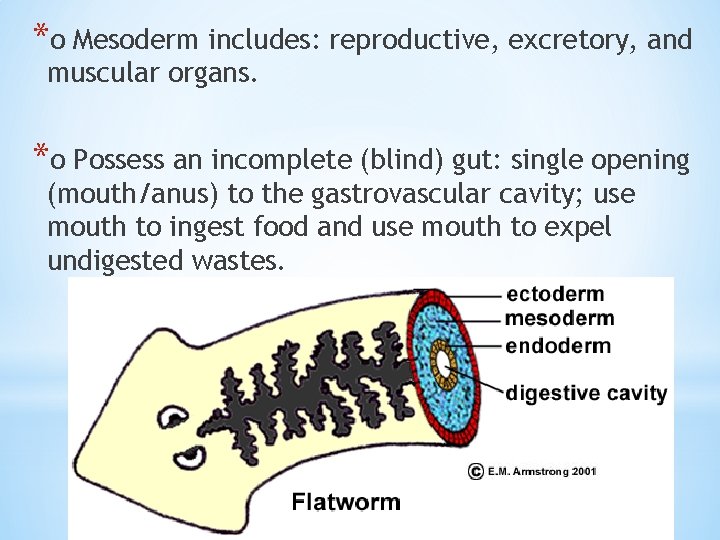
*o Mesoderm includes: reproductive, excretory, and muscular organs. *o Possess an incomplete (blind) gut: single opening (mouth/anus) to the gastrovascular cavity; use mouth to ingest food and use mouth to expel undigested wastes.
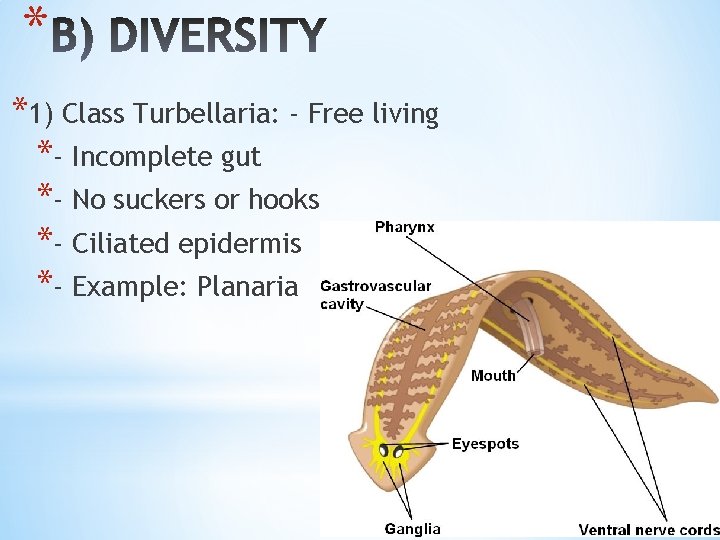
* *1) Class Turbellaria: - Free living *- Incomplete gut *- No suckers or hooks *- Ciliated epidermis *- Example: Planaria
* *- Incomplete gut *- Suckers *- Outer cuticle (tegument) *- Example: Flukes
* *- No gut *- Suckers and hooks together form a scolex for attachment to host *- Body consists of repeating sections called proglottids *- Example: Tapeworms
* *1. Parasitic flatworms often have suckers and hooks for attachments, form a structure called a scolex. *2. Outer cuticle (tegument) for protection so as not to be digested or destroyed by the host. *3. Loss of digestive system in some (tapeworms) – these will absorb nutrients through ectoderm *4. Complicated life cycle with the production of many eggs and/or offspring and use of many hosts to ensure transfer.
* *i. PLANARIA *a. Digestion: Feed on small animals and the remains of larger dead animals * • Mouth/pharynx is located mid-way along the ventral surface (not near the head) it acts to push food into the gastrovascular cavity * • Digestive glands are present in the pharynx and gastrovascular cavity (they secrete enzymes to digest food) * • Gastrovascular cavity will also circulate nutrients and oxygen to various parts of the body. * • Indigestible wastes are eliminated out of the mouth.
*b. Nervous: Most primitive animal with a real nervous system. * • A pair of ventral (along the belly) nerve cords run the legth of a nervous system. * • Connect to a pair of small brains or ganglia (a group of nerve cells) at the anterior end. * • Show cephalisation with a variety of sensory cells. * • Sensory cells are sensitive to touch, light, and various chemicals.
*c. Muscles: three layers of true muscle are located below the ectoderm. * • The outer layer of circular muscle that constrict the worm, making it longer and thinner. * • Next layer uses longitudinal muscles to shorten the worm. * • There is also a third layer that runs dorso-ventral (back to belly) and makes the worm a little flatter.
*d. Locomotion: body moves by co-ordinating its muscles and gliding over a mucous trail that it secretes from glands in the epidermis *Cilia on the ventral epidermis assist in gliding
*ii. FLUKES *a. Digestion: they are parasitic, usually in the blood, liver, or intestine of a variety of animals. * • Mouth present in the middle of the anterior (oral) sucker. * • The pharynx swallows the hosts tissues and bodily fluids (blood) into its gastrovascular cavity.
*b. Circulation and Respiration: * • Gastrovascular cavity for circulation and respiration * • They live in tissues that are well supplied with nutrients and oxygen by the hosts blood. *c. Nervous: * • Similar to Planaria, but lack most of the special sensory cells found in Planaria *d. Muscle: * • Similar to Planaria, but lack cilia on the ventral epidermis
*iii. TAPEWORMS *a. Digestion * • Have no mouth or gastrovascular cavity. * • Attach themselves to the lining of the hosts intestine by suckers and hooks (Scolex) * • Worm feeds by absorbing digested food * • Has a modified epidermis called a Tegument, this thicker skin prevents them from being digested *b. Circulation * • Receive oxygen from blood vessels in the hosts intestine * • When oxygen is not available, they can live without it.
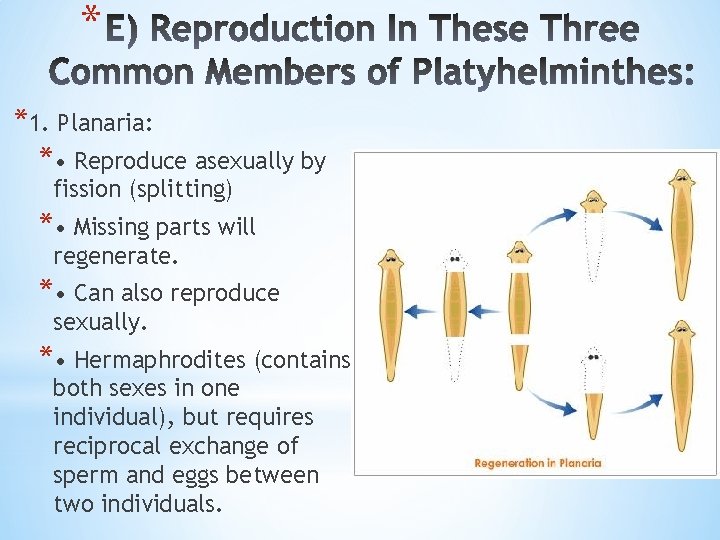
* *1. Planaria: * • Reproduce asexually by fission (splitting) * • Missing parts will regenerate. * • Can also reproduce sexually. * • Hermaphrodites (contains both sexes in one individual), but requires reciprocal exchange of sperm and eggs between two individuals.
*2. Flukes: * • Also hermaphrodites. * • Complex life cycle with numerous larval stages that infect a number of hosts.
*3. Tapeworms: *Constantly budding new body sections (proglottids) posterior to its scolex. *Each proglottid contains both male and female reproductive organs. *Mature proglottids with fertilized eggs detach and pass out of the host with the feces. *Often have larval stages that infect a number of different hosts
* *1. Platyhelminthes have their tissues organized into organs and even have some simple systems. *2. Unlike the previous two Phyla (Porifera and Cnidaria), the Platyhelmithes have 3 embryonic layers with the development of the middle layer (the mesoderm). The mesoderm has also provided for better muscle development and thus has resulted in an animal that moves around more efficiently.
*3) As a result of moving around, platyhelminthes have further developed cephalization. *4) Cnidarians had a nerve net for conducting impulses, but the platyhelminthes have centralized the nervous system into two longitudinal nerve cords. (faster transmission of nerve impulses).
* *ROUND WORMS *Nematodes are a diverse animal phylum that can occupy a broad range of environments. *They exist in every ecological niche, marine, freshwater, terrestrial, parasitic. *Over 25, 000 species have been identified, more than half of those are parasitic, the total number is estimated to be over a million.
*The most numerous multicellular animals. A single rotting apple can hold as many as 90, 000 roundworms!!! *Nematodes are the first to have a tubular digestive system, meaning it has two openings at both ends, a mouth and an anus.
*Microscopic to almost a meter long *Bilateral symmetry *3 cell layers (endoderm, ectoderm, mesoderm) *Pseudocoelom
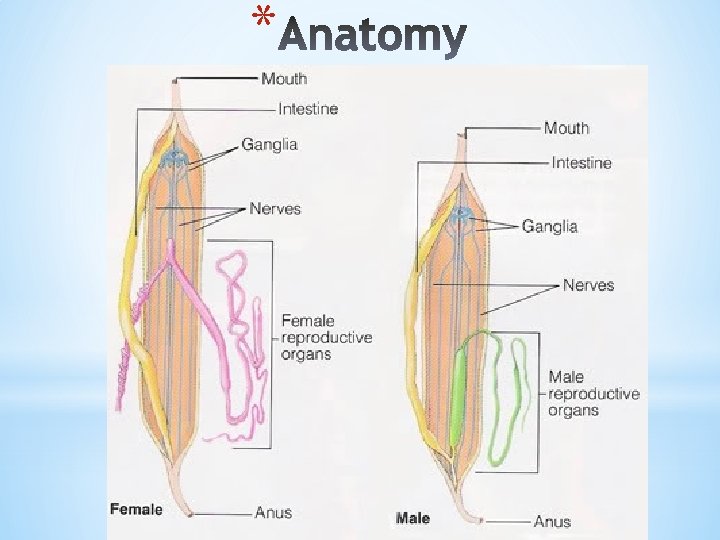
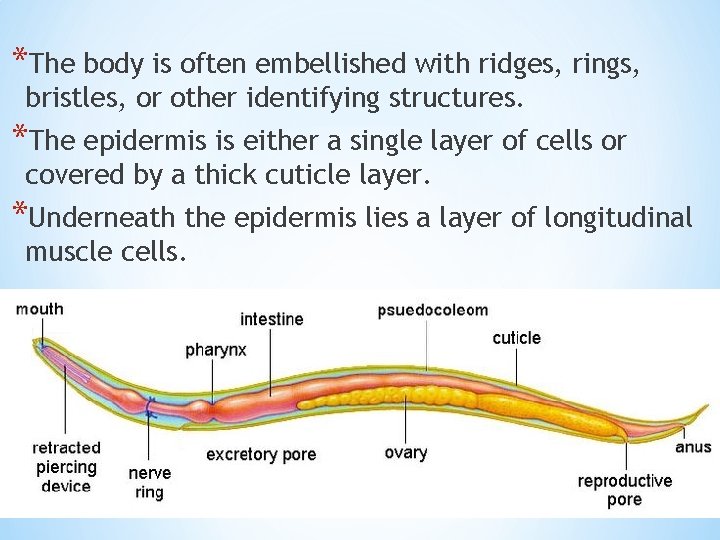
*The body is often embellished with ridges, rings, bristles, or other identifying structures. *The epidermis is either a single layer of cells or covered by a thick cuticle layer. *Underneath the epidermis lies a layer of longitudinal muscle cells.
* *One of the first animals to have a complete, one way digestive system with two openings (mouth & anus) *Mouth, pharynx, long intestine, anus *There is no stomach. The pharynx connects directly to a muscleless intestine that forms most of the length of the gut.
*Nutrients are broken down and absorbed through here. *Movement of the food through the digestive system is because of body movements of the worm.
* *Muscles run in strips down the length of the body wall *Pseudocoelom acts as a hydrostatic skeleton. *Enables movement due to the pressure of the fluid filled cavity acting against the muscles. *Have a rigid cuticle *Able to shed cuticle as organism grows *Known as molting (molt 4 times before adult)
* *Sexually only *Either male or female *Some hermaphroditic *Fertilization occurs in female, who are often much smaller than males. *Males typically have a bent tail for holding onto the females *Development inside or outside the nematode *Females release approximately 240, 000 eggs per day
* *�Simple nervous system *Nerve ganglion in the head region (NOT a brain) *Ventral and dorsal nerve cord extend the length of the body *Nerves transmit sensory information and control movement *Bodies of nematodes are covered in sense organs, such as bristles, and papillae that together provide a sense of touch. Other sense organs on the surface detect chemicals given off by prey or hosts
* *�No internal transport system *�Breathe and excrete through their body walls *�Depend on diffusion to carry nutrients and wastes through their body.
* Parasitic or free-living FREE-LIVING *Free-living species found in all climates (soil, salt flats, aquatic sediments, polar regions, tropics, fresh water, oceans, hot springs) *Different species feed on materials such as algae, fungi, small animals, fecal matter, dead organisms, and living tissues.
*PARASITIC *Parasitic species live within a host *Found within plants and animals *EXAMPLE OF PARASITIC NEMATODES: Ascaris *Adults live in the intestines *Eggs leave in feces and eaten by another host *Eggs hatch in intestines of new host *Larvae enter blood stream *Enter into lungs *Coughed up into the mouth *Ingested into the intestines where they mature into adults *Can threaten humans health by compromising nutritional status, affect cognitive processes if larvae make it to the brain, and can also be responsible for intestinal obstruction, which can be fatal.
* *Most unsegmented worms do not affect humans at all. *Important decomposers in the soil *Break down and recycle nutrients in marine environments, and are sensitive to changes in environment caused by pollution.
*Parasitic roundworms affect humans: *Directly: human parasites *Indirectly: destruction of agricultural crops
* *Ascaris, Hookworms(live in intestines, bore through the skin of feet), Trichinosis (live in muscles, from eating undercooked pork), Elephantitis, Pinworm(itchy anus). *Uncinariasis, caused by hookworms. They dig in the intestinal wall and suck blood from the host. Causes weakness and poor growth. 25% of people in the world affected.
*Trichinosis, cause by Trichinella. Eggs travel through bloodstream and burrow into organs and tissues. The larvae form cysts in muscle tissue.
*Elephantitis, caused by filarial worms. Live in blood and lymph vessels. Affected part of body swells enormously.
* *General Characteristics *A. k. a. Segmented worms *Definition of an Annelid: round, wormlike animal, that has long segmented body. *They have a huge range in size, from a few centimeters up to 3 meters in length!!! *The segments of their body are often separated by internal walls called septa.
*Some segments are modified to perform special functions: *Some posses sense organs, others have 2 or more eyes, others have antennae etc.
*Characterized by the presence of bristles (i. e. setae) and/or leg-like structures (i. e. parapodia) *3 cell layers *True organs *Bilateral symmetry *Coelom
* *Digestive tract is a tube-within-a-tube, where food enters the mouth and waste exits the anus. *They’ve evolved structures that allow them to eat variety of foods. *Pharynx: many extend from mouth and sharp jaw attaches to food & pulls it back to mouth. *In other worms, it acts as a pump to suck soil and blood into digestive tract.
*Esophagus: transportation. *Crop: stores food. *Gizzard: grinds food into smaller pieces. *Intestine: digestion.
* *Aquatic: often breath through gills. *Soil-dwelling: take-in O 2 and give off CO 2 through skin. *Secrete a protective coating called a cuticle to hold in moisture to facilitate gas exchange.
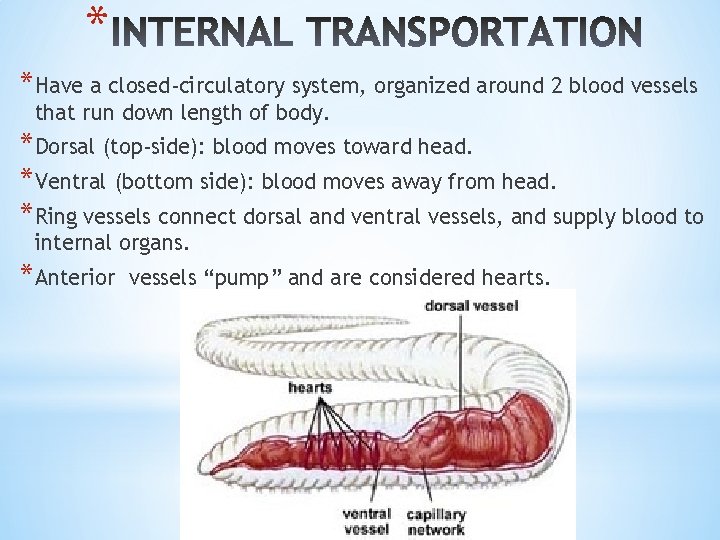
* *Have a closed-circulatory system, organized around 2 blood vessels that run down length of body. *Dorsal (top-side): blood moves toward head. *Ventral (bottom side): blood moves away from head. *Ring vessels connect dorsal and ventral vessels, and supply blood to internal organs. *Anterior vessels “pump” and are considered hearts.
* *Two types of waste: *1) Solid waste excreted through anus. *2) Cellular/metabolic wastes eliminated from nephridia. Takes waste products from body fluids and carries them outside.
* *Two major muscle groups: *Longitudinal: runs from front of the worm to the rear. Makes worms shorter. *Circular: runs in circles around body. Make worms skinnier.
* *Well developed nervous system. *Brain sits on top of gut at front end of body. *Ventral nerve cord runs entire length of body. *Sense organs best developed in free-living marine species: *Sensory tentacles. *Statocycts. *Chemical receptors *2 or more pairs of eyes. *Usually light detectors but some perceive objects.
* *Some asexually by budding. *Sexually: separate sexes and external fertilization. *Females lay eggs and males release sperm. *Some like leeches are hermaphrodites and undergo internal fertilization. *Once egg is fertilized, clitellum secretes mucous ring, and ring slips off the body to protect eggs.
* *1) Class Oligochaeta *Live in soil/fresh H 2 O. *Bristles are felt as roughness on ventral side of earthworm. *Hermaphrodites. *Have setae *No parapodia Ex. Earthworm
* * • Bristles marine worms * • Paired paddle-like appendages on their body segments. * • Live through seabed. In coral reefs etc * • Many setae * • Pair of parapodia on each body segment Ex. Clamworms, Bristleworms and Sandworms
* * • This class includes leeches. * • Some tropical species are as long as 30 cm!!! * • Drink blood and body fluid. * • Suckers at both ends of body * • Pharynx sucks blood, releases enzymes to prevent blood from clotting. * • Can swallow up to 10 x its body weight!!! * • No setae * • No parapodia
* *Movement *Two sets of muscles (circular and longitudinal) *Moves by anchoring the posterior setae and contracting the circular muscles *Anterior end moves forward *Setae anchor anterior end, longitudinal muscles contract *Body pulls forward
* *One-way digestive tract *When a worm burrows, it actually eats the soil *Pharynx draws soil into the mouth, through the esophagus, and passes it to the crop (i. e. a temporary storage organ) *The soil moves to the gizzard where it is ground up, freeing the organic matter and breaking it down *The organic matter is digested in the long, straight intestine *Wastes are passed out the anus as feces
* *No respiration structures *Gases diffuse across skin *Tiny vessels carry blood close to the skin’s surface *Must stay moist to allow the diffusion of gases across its skin *Wastes excrete through long tubules called nephridia *Pair of nephridia in most segments
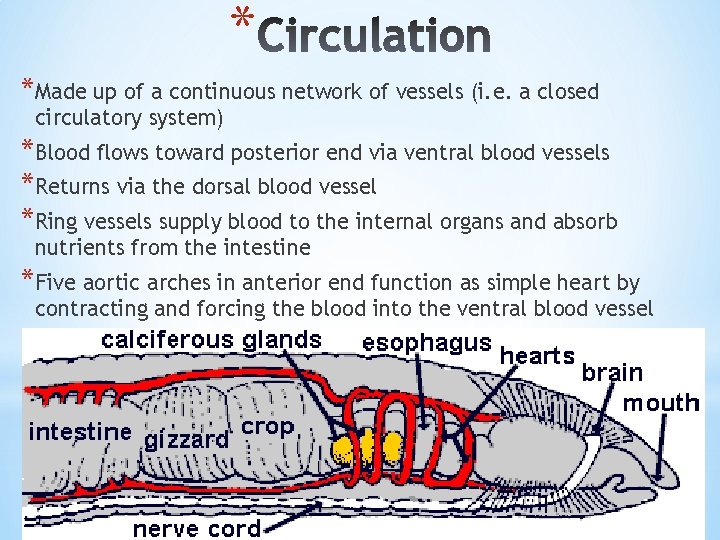
* *Made up of a continuous network of vessels (i. e. a closed circulatory system) *Blood flows toward posterior end via ventral blood vessels *Returns via the dorsal blood vessel *Ring vessels supply blood to the internal organs and absorb nutrients from the intestine *Five aortic arches in anterior end function as simple heart by contracting and forcing the blood into the ventral blood vessel
* *Small brain made up of fused ganglia at the anterior end *Controls activity of the entire body *Connected to a ventral nerve cord which sends messages out to the segments *Sensory receptors in skin to detect *Light *Temperature *Moisture *Vibrations *Chemicals
* *Sexual reproduction *Hermaphrodites but cannot fertilize their own eggs *1. Join head and tail with mate *2. Secrete a mucus covering from the clitellum *3. Both release sperm into a special sac(seminal receptacle) in the other worm *4. Separate *5. After several days each worm secretes a cocoon *6. Worm exits the cocoon leaving eggs and sperm behind *7. Fertilization occurs in cocoon *8. After 2 -3 weeks worms hatch out of cocoon
* *Means “many bristles” *Primarily marine organisms *Pair of parapodia on most body segments *Bundles of setae usually stick out from the parapodia *Often mistaken as plants because their sessile nature
*Parapodia are used for: *Locomotion *Anchoring their bodies in burrows and tubes *Respiratory structures * • Allowing gas exchange across their surface * • Must stay moist for gas exchange to occur
*Distinct head with sense organs and mouthparts *Two nephridia in each segments that collect wastes and transport them through the coelom and out of the body *Closed circulatory system *Separate sexes and only reproduce sexually *Eggs and sperm are released into the seawater where fertilization takes place
* *Leeches are the only annelids that have neither setae nor parapodia *Some are predators or scavengers *Most are parasitic and freshwater organisms *Nephridia to excrete wastes *Closed circulatory system *Simple nervous system *Hermaphrodites (can’t fertilize themselves)
*Parasitic leeches have an anterior and posterior sucker *Used for attachment to host *Anterior contains jaws with teeth that pierce the host’s skin *Blood is sucked in *Secretes chemicals (anesthetics and anticoagulants) into the wound to reduce pain and prevent the blood from clotting *Ensures that leech has a long, full meal
* *Coelom: body cavity lined with mesoderm, filled with fluid *Advantages: * 1. Separates muscle of the body wall from muscle of the food tube * Movement of food not affected by general body motion * 2. Fluid in coelom may circulate substances (e. g. wastes, food & dissolved gases) * 3. Provides a space where a true circulatory system can function * No interference from other organs
* * • Sources of food for many species like fish and birds, etc. * • Earthworm help to aerate the soil. * • Leeches have been used medicinally for thousands of years as we’ve just seen
- Slides: 69