
What is a fair test in a multicultural
- Slides: 11
What is a fair test in a multi-cultural society? ALTE 52 nd Conference Salamanca, 23 November 2018 Gordon Stobart Emeritus Professor of Education Institute of Education, University of London g. stobart@ioe. ac. uk
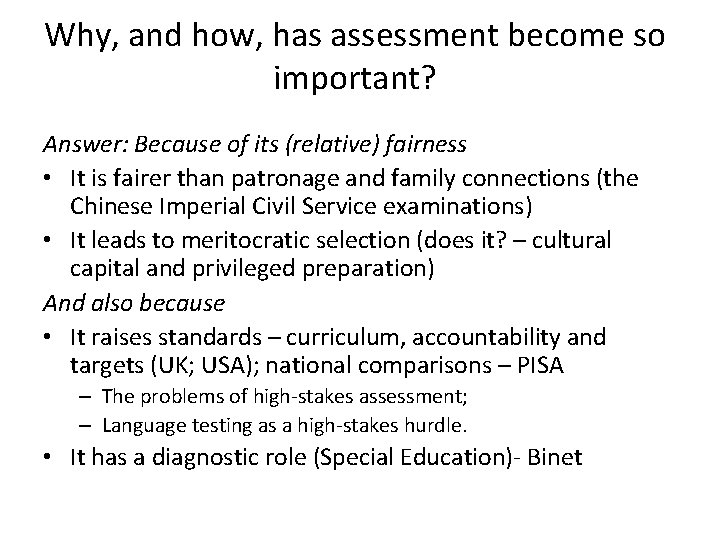
Why, and how, has assessment become so important? Answer: Because of its (relative) fairness • It is fairer than patronage and family connections (the Chinese Imperial Civil Service examinations) • It leads to meritocratic selection (does it? – cultural capital and privileged preparation) And also because • It raises standards – curriculum, accountability and targets (UK; USA); national comparisons – PISA – The problems of high-stakes assessment; – Language testing as a high-stakes hurdle. • It has a diagnostic role (Special Education)- Binet
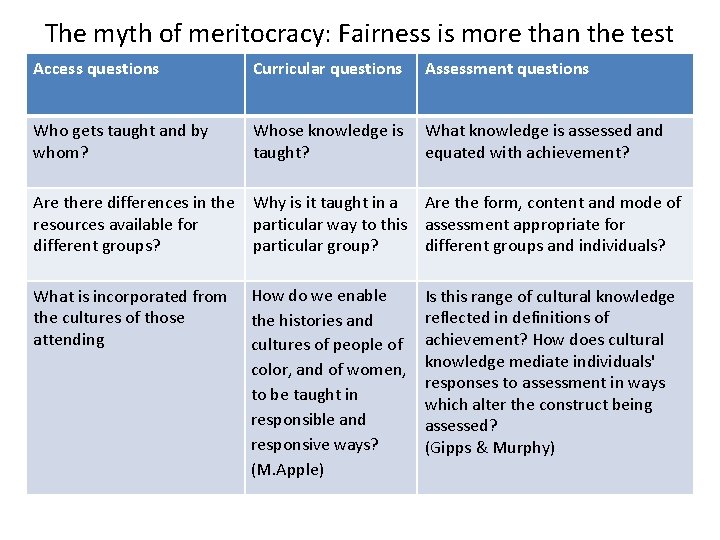
The myth of meritocracy: Fairness is more than the test Access questions Curricular questions Assessment questions Who gets taught and by whom? Whose knowledge is taught? What knowledge is assessed and equated with achievement? Are there differences in the resources available for different groups? Why is it taught in a Are the form, content and mode of particular way to this assessment appropriate for particular group? different groups and individuals? What is incorporated from the cultures of those attending How do we enable the histories and cultures of people of color, and of women, to be taught in responsible and responsive ways? (M. Apple) Is this range of cultural knowledge reflected in definitions of achievement? How does cultural knowledge mediate individuals' responses to assessment in ways which alter the construct being assessed? (Gipps & Murphy)
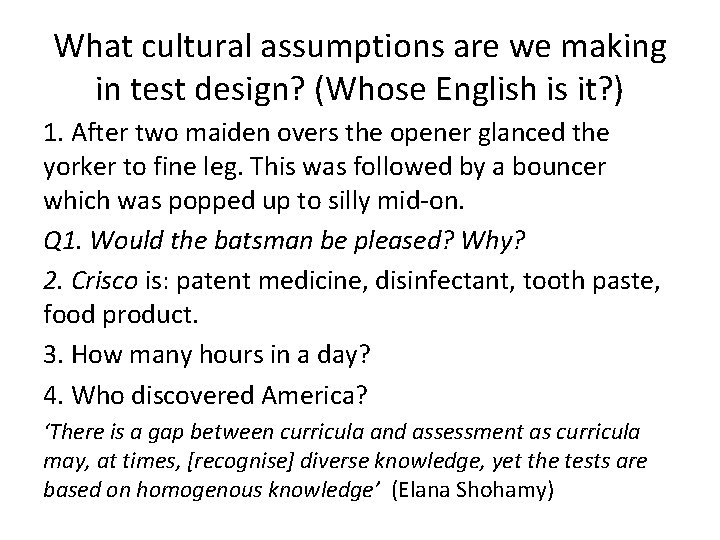
What cultural assumptions are we making in test design? (Whose English is it? ) 1. After two maiden overs the opener glanced the yorker to fine leg. This was followed by a bouncer which was popped up to silly mid-on. Q 1. Would the batsman be pleased? Why? 2. Crisco is: patent medicine, disinfectant, tooth paste, food product. 3. How many hours in a day? 4. Who discovered America? ‘There is a gap between curricula and assessment as curricula may, at times, [recognise] diverse knowledge, yet the tests are based on homogenous knowledge’ (Elana Shohamy)
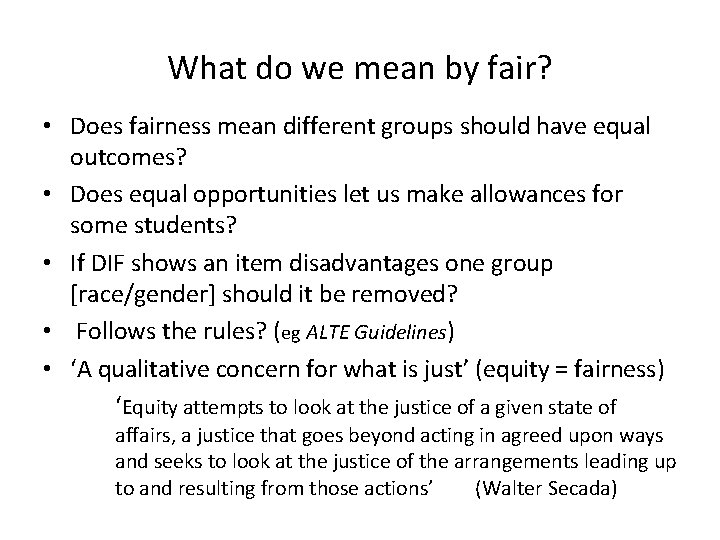
What do we mean by fair? • Does fairness mean different groups should have equal outcomes? • Does equal opportunities let us make allowances for some students? • If DIF shows an item disadvantages one group [race/gender] should it be removed? • Follows the rules? (eg ALTE Guidelines) • ‘A qualitative concern for what is just’ (equity = fairness) ‘Equity attempts to look at the justice of a given state of affairs, a justice that goes beyond acting in agreed upon ways and seeks to look at the justice of the arrangements leading up to and resulting from those actions’ (Walter Secada)
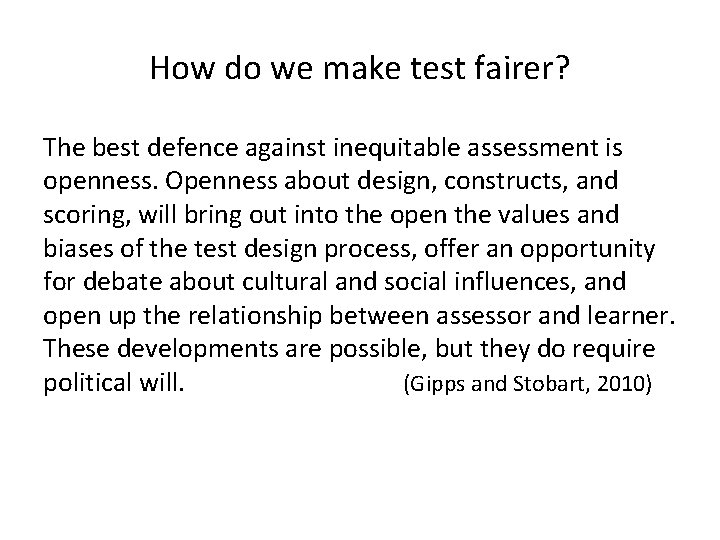
How do we make test fairer? The best defence against inequitable assessment is openness. Openness about design, constructs, and scoring, will bring out into the open the values and biases of the test design process, offer an opportunity for debate about cultural and social influences, and open up the relationship between assessor and learner. These developments are possible, but they do require political will. (Gipps and Stobart, 2010)
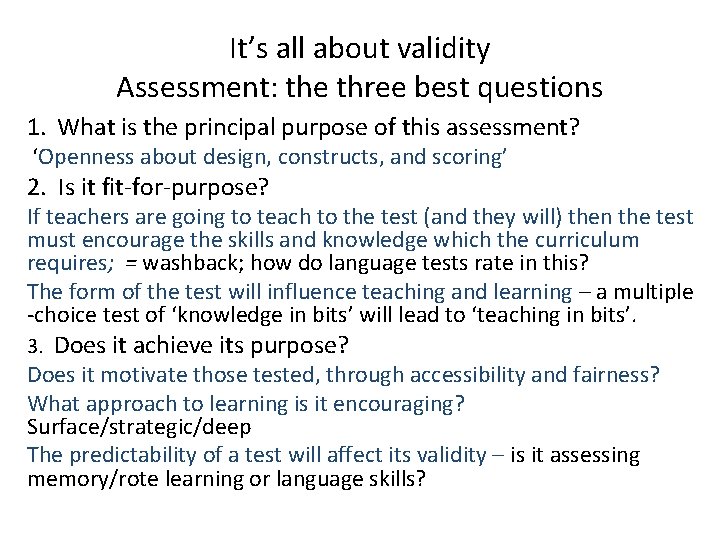
It’s all about validity Assessment: the three best questions 1. What is the principal purpose of this assessment? ‘Openness about design, constructs, and scoring’ 2. Is it fit-for-purpose? If teachers are going to teach to the test (and they will) then the test must encourage the skills and knowledge which the curriculum requires; = washback; how do language tests rate in this? The form of the test will influence teaching and learning – a multiple -choice test of ‘knowledge in bits’ will lead to ‘teaching in bits’. 3. Does it achieve its purpose? Does it motivate those tested, through accessibility and fairness? What approach to learning is it encouraging? Surface/strategic/deep The predictability of a test will affect its validity – is it assessing memory/rote learning or language skills?
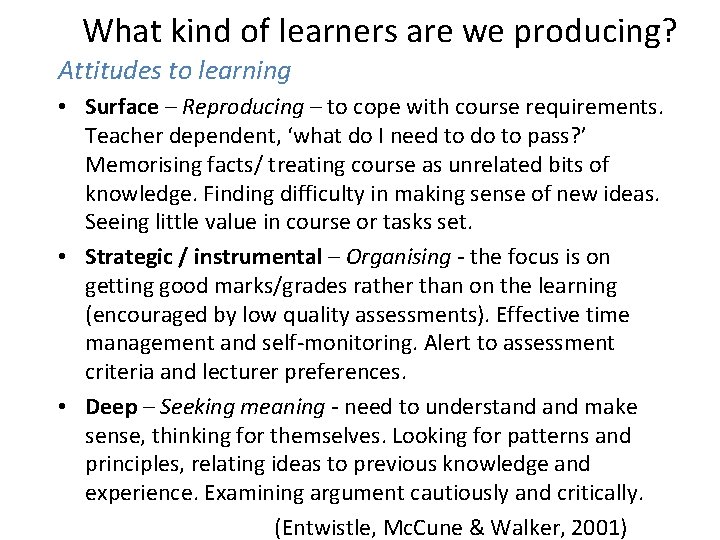
What kind of learners are we producing? Attitudes to learning • Surface – Reproducing – to cope with course requirements. Teacher dependent, ‘what do I need to do to pass? ’ Memorising facts/ treating course as unrelated bits of knowledge. Finding difficulty in making sense of new ideas. Seeing little value in course or tasks set. • Strategic / instrumental – Organising - the focus is on getting good marks/grades rather than on the learning (encouraged by low quality assessments). Effective time management and self-monitoring. Alert to assessment criteria and lecturer preferences. • Deep – Seeking meaning - need to understand make sense, thinking for themselves. Looking for patterns and principles, relating ideas to previous knowledge and experience. Examining argument cautiously and critically. (Entwistle, Mc. Cune & Walker, 2001)
Approaches to learning: the case of Ruth Learning the formula for each exam and practising it endlessly. I got an A 1 in English because I knew exactly what was required in each question. I learned off the sample answers provided by the examiners and I knew how much information was required and in what format in every section of the paper. That’s how you do well in these examinations… There’s no point in knowing about stuff that is not going to come up in the exams. I was always frustrated by teachers who would say ‘You don’t need to know this for the exams but I’ll tell you anyway’. I wanted my A 1 – what’s the point of learning material that won’t come up in the exams? Is this form of backwash familiar in language testing? The problem of predictability and ‘construct irrelevant variance’.
How can teachers increase fairness in classroom assessment? • Avoid mimicking past papers and focus on the broader purposes of the course using more imaginative questions – moving from ‘when you…’ to ‘what if…’ approaches. • Offer a wider range of content and modes of learning – keep the work as authentic as possible; • Use ‘repeated (and varied) measures’ rather than standardisation to gain a dependable assessment of the learner. Students have learned if ‘they are able to do something they could not do before on demand, independently and well’ (Royce Sadler, 2007)
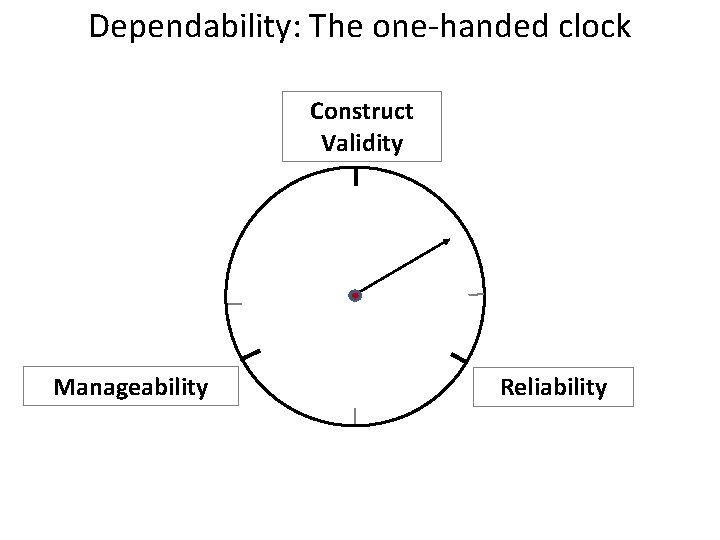
Dependability: The one-handed clock Construct Validity Manageability Reliability