
What is a Critique A critique is not
- Slides: 20
What is a Critique? • A critique is not just a response but a close look at the quality of an argument someone else has made. • A critique is a written evaluation of some kind of performance. • Examples of this genre, or kind of writing, are reviews, such as book or concert reviews, and evalutions, such as the terminal comments a teacher might write at the end paper when assigning a grade.
How a critique differs from a reaction • Critical thinking is the difference between reacting and critiquing. • People use the term critical distance to describe the space between a first reaction, which may be hot, and a cooler, more studied analysis.
Analysis of Argument • Analysis is the examination of an argumentative situation for its claims and opposing claims to discover the issues and what arguments and support (evidence, values, credibility) are most important. – Argumentative situation: • Exigency: what are the bases of argument? Why is the argument necessary at this time? What are the key “points of stasis” between the different parties? • Audience: in what sphere is the argument taking place? Who are the relevant decision makers? • Constraints: what are the constraints on decision and action?
Analysis of Argument • The purpose of analysis is to identify – what needs to be argued and – what it will take to gain adherence. • Analysis is composed of two processes – Critical analysis to find a proposition • Develop claims from questions that arise when you realize that some problem requires resolution but you are not sure what that resolution is • The goal is to develop a proposition that addresses the problem you identify – Critical analysis to develop a case • Identify the best arguments and support for a given proposition • Arrange those arguments in such a way that it will gain the adherence of decision makers
Analysis of Argument • What does the process of analysis include? – Systematic evaluations in advance of presenting arguments – Not just gaining knowledge, analysis determines: • What needs to be argued • What it will take to gain adherence – Developing effective arguments supported by evidence, values, and credibility – Learning about others with whom you will argue • Analysis, therefore, requires that you examine you own and opposing arguments with equal care
Analysis of Argument • Critical Analysis to Find a Proposition – Feeling of doubt that arises from the realization of a problem – Critical decision making can help you discover the proposition you will argue • Eight Steps to Find a Proposition
Steps to Finding a Proposition • Step One: Identify the Question – State the problem as a question. – Evaluate several alternatives. – What are the key questions being asked about Planned Parenthood? • Step Two: Survey Objectives and Values – Establish Criteria • What problems need addressing? • What does the ideal solution look like? • What values should the solution embody? – What are the problems, values, and solutions that surround Planned Parenthood?
Steps to Finding a Proposition • Step Three: Canvass Alternative Decisions – Evaluate the widest range of alternatives – Don’t accept • • Easy fits Favorites Limited criteria Etc. – What are some of the possible alternatives for Planned Parenthood? • Step Four: Weigh the Costs and Risks – What are the potential good and consequences? • Costs – money, values, and goods sacrificed by selecting one versus another alternative • Risk – includes degree of uncertainty and the strength/likelihood of worst case scenarios – What are the risk and costs of some of the different alternatives we just identified?
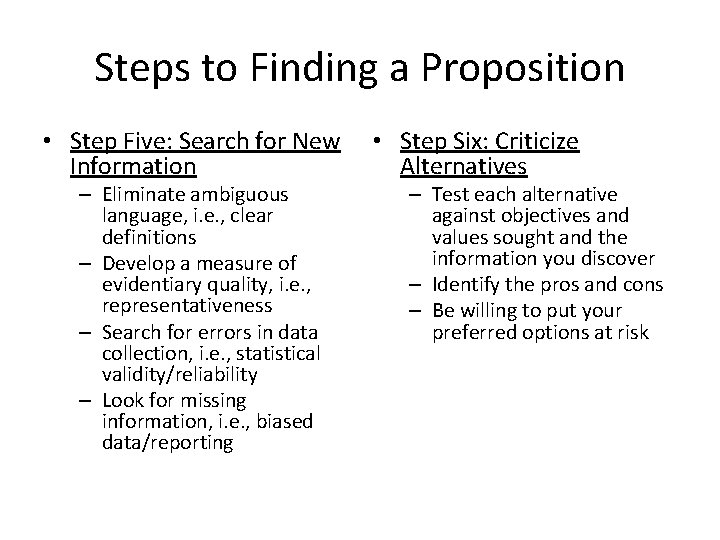
Steps to Finding a Proposition • Step Five: Search for New Information – Eliminate ambiguous language, i. e. , clear definitions – Develop a measure of evidentiary quality, i. e. , representativeness – Search for errors in data collection, i. e. , statistical validity/reliability – Look for missing information, i. e. , biased data/reporting • Step Six: Criticize Alternatives – Test each alternative against objectives and values sought and the information you discover – Identify the pros and cons – Be willing to put your preferred options at risk
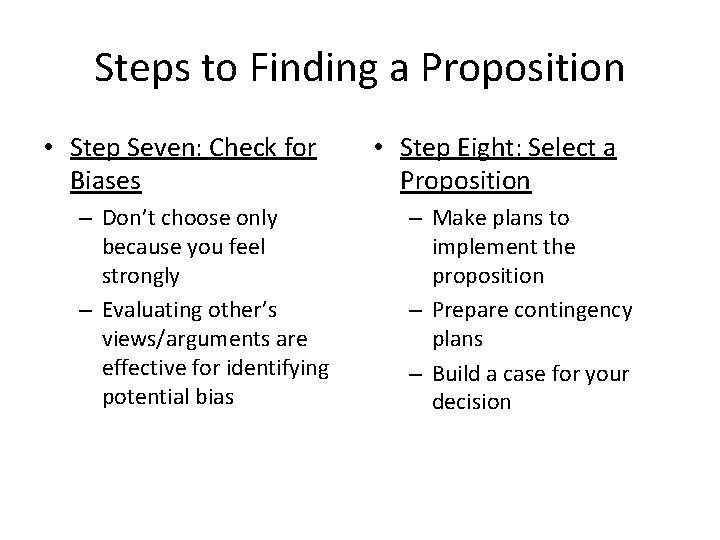
Steps to Finding a Proposition • Step Seven: Check for Biases – Don’t choose only because you feel strongly – Evaluating other’s views/arguments are effective for identifying potential bias • Step Eight: Select a Proposition – Make plans to implement the proposition – Prepare contingency plans – Build a case for your decision
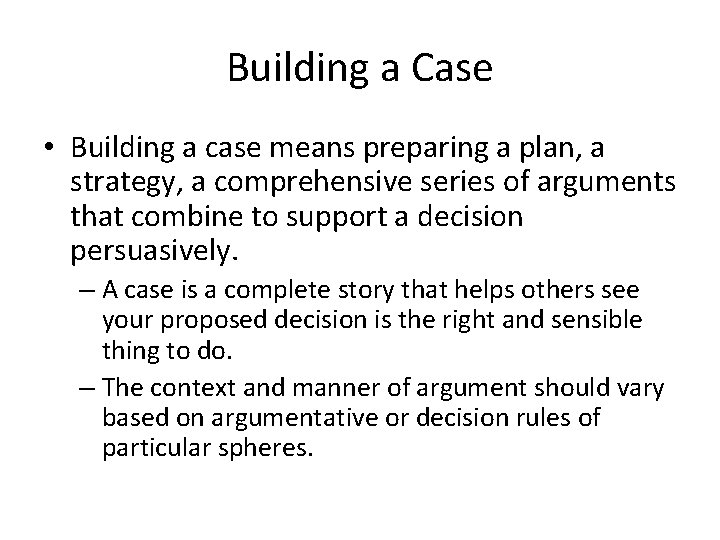
Building a Case • Building a case means preparing a plan, a strategy, a comprehensive series of arguments that combine to support a decision persuasively. – A case is a complete story that helps others see your proposed decision is the right and sensible thing to do. – The context and manner of argument should vary based on argumentative or decision rules of particular spheres.
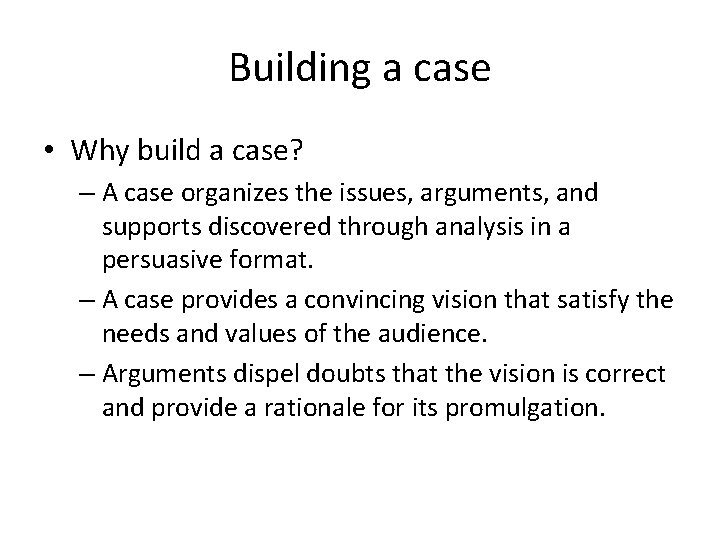
Building a case • Why build a case? – A case organizes the issues, arguments, and supports discovered through analysis in a persuasive format. – A case provides a convincing vision that satisfy the needs and values of the audience. – Arguments dispel doubts that the vision is correct and provide a rationale for its promulgation.
Building a Case • Follow the critical decision making process. – Have available the strongest possible statement of your case. – Have a realistic knowledge of the strengths and weaknesses of other alternatives. – Be able to modify your position to avoid weaknesses and maximize strengths. – Be willing to abandon your position entirely if you find it not worthy of your support.
Building a Case • Assess Presumptions and Burden of Proof – Presumption is the preoccupation of ground which implies that it must stand till some sufficient reason is adduced against it. • In most cases, presumption favors the status quo. • In other cases, presumption is one of the issues debated. – Burden of proof identifies the responsibility to initiate an argument and set out a case sufficient in argumentative strength to move decision makers to action.
Building a Case • A prima facie case provides sufficient argument to justify adherence to its proposition if no counterargument occurs. • A prima facie case shifts the argumentative burden to the party that was protected by presumption – They now have the burden of rejoinder, which allows them to supply a counterargument to stay in contention.
Building a Case • Problem/Solution: a case structure in which you – consider a problem, – propose a solution, – and identify the results. • Criteria – Establish adherence to a set of criteria – Establish adherence to claims of fact relevant to the criteria – Use the criteria to gain adherence to a value judgment about the factual claims
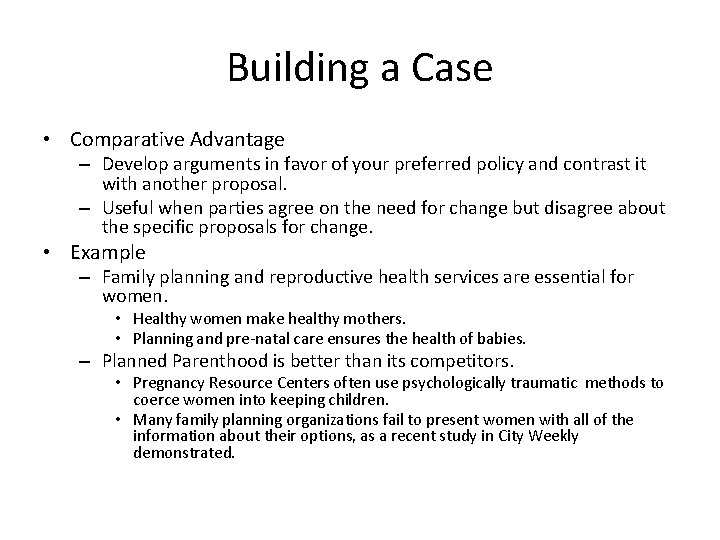
Building a Case • Comparative Advantage – Develop arguments in favor of your preferred policy and contrast it with another proposal. – Useful when parties agree on the need for change but disagree about the specific proposals for change. • Example – Family planning and reproductive health services are essential for women. • Healthy women make healthy mothers. • Planning and pre-natal care ensures the health of babies. – Planned Parenthood is better than its competitors. • Pregnancy Resource Centers often use psychologically traumatic methods to coerce women into keeping children. • Many family planning organizations fail to present women with all of the information about their options, as a recent study in City Weekly demonstrated.
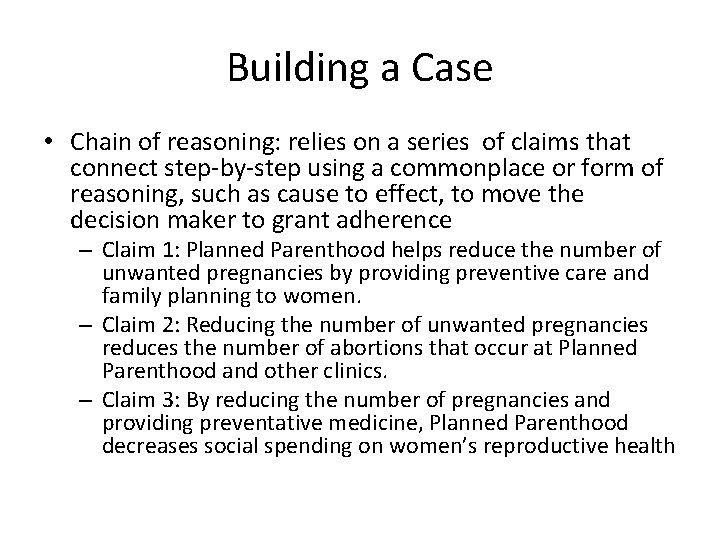
Building a Case • Chain of reasoning: relies on a series of claims that connect step-by-step using a commonplace or form of reasoning, such as cause to effect, to move the decision maker to grant adherence – Claim 1: Planned Parenthood helps reduce the number of unwanted pregnancies by providing preventive care and family planning to women. – Claim 2: Reducing the number of unwanted pregnancies reduces the number of abortions that occur at Planned Parenthood and other clinics. – Claim 3: By reducing the number of pregnancies and providing preventative medicine, Planned Parenthood decreases social spending on women’s reproductive health
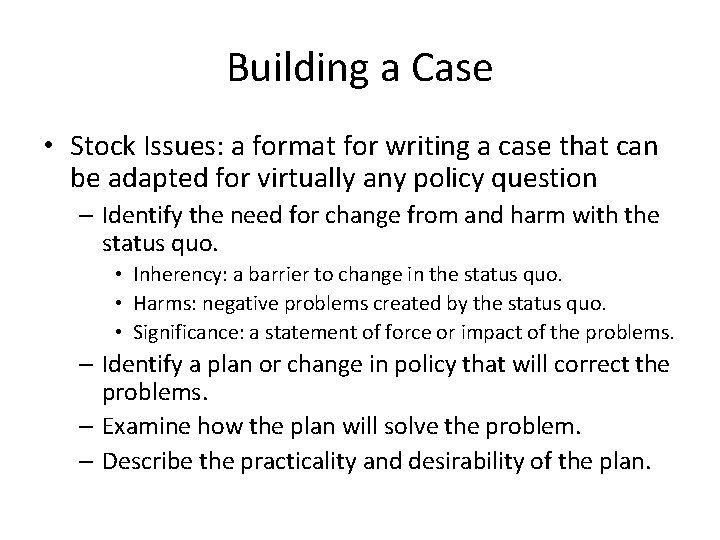
Building a Case • Stock Issues: a format for writing a case that can be adapted for virtually any policy question – Identify the need for change from and harm with the status quo. • Inherency: a barrier to change in the status quo. • Harms: negative problems created by the status quo. • Significance: a statement of force or impact of the problems. – Identify a plan or change in policy that will correct the problems. – Examine how the plan will solve the problem. – Describe the practicality and desirability of the plan.
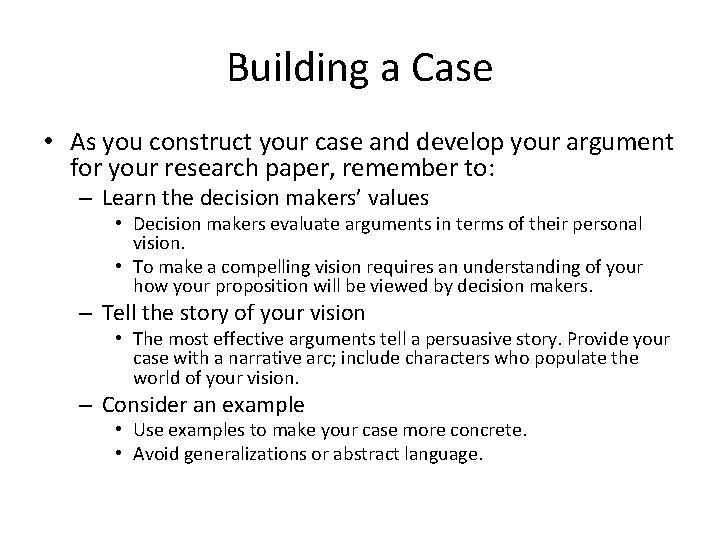
Building a Case • As you construct your case and develop your argument for your research paper, remember to: – Learn the decision makers’ values • Decision makers evaluate arguments in terms of their personal vision. • To make a compelling vision requires an understanding of your how your proposition will be viewed by decision makers. – Tell the story of your vision • The most effective arguments tell a persuasive story. Provide your case with a narrative arc; include characters who populate the world of your vision. – Consider an example • Use examples to make your case more concrete. • Avoid generalizations or abstract language.