
What Is a Corporation 7 2 Notes Corporation
- Slides: 9
What Is a Corporation? 7. 2 Notes
Corporation • Corporation – a business that is registered by a state and operates apart from its owners. ▫ Lives on after the owners have sold their interests or passed away ▫ Ownership is represented by shares of stock �Shareholders are the owners of the corp. ▫ ▫ Required to have a board of directors Can purchase goods Sue & be sued Conduct any type of business transaction
Three Major Types • C-corporation – an entity pays taxes on earnings ▫ Shareholders pay taxes ▫ Most common ▫ Protects the entrepreneur from being sued for the actions and debts of the corp. • Sub-chapter S Corporation – is taxed like a partnership ▫ Advantages �Profits are taxed only once, at the shareholders tax rate �Is not a taxpaying entity ▫ Disadvantages �No more than 75 stockholders, who have to be U. S. citizens �Only one class of stock �If business shows a large taxable profit but has not generated enough cash to cover the taxes, the owners must pay the taxes out of their personal earnings
Three Major Types • Nonprofit Corporation – legal entity that makes money for reasons other than the owners’ profit. Profits must remain within the company and not be distributed to shareholders ▫ Charity – include feeding the hungry and providing job training for the unemployed ▫ Public Benefit – created to advance science, education, and the arts ▫ Mutual Benefit – trade assoc. , amateur sports leagues, and political groups are formed to benefit a specific group
Advantages of Corps. • • • Status Limited liability The ability to raise investment money Perpetual existence – continuous life Employee benefits Tax advantages – can deduct certain expenses from their reportable income
Disadvantages of Corps. • Expensive to set up • Income is more heavily taxed • Can be subjected to double taxation on its earnings • Pays taxes on profits; stockholders pay taxes on dividends they receive from those earnings
Limited Liability • Shareholders have limited liability; liable only up to the amount of their investment • Some banks require corporate officers to personally guarantee the debts • Can raise money by issuing stock
Limited Liability Company • Company whose owners and managers enjoy limited liability and some tax benefits, but it avoids some restrictions associated with Subchapter S corporations. ▫ Is simpler to set up than a corp. ▫ Allows for the flexibility of a partnership structure ▫ Protects its owners with the limited liability of a corp. Members are not liable for company debts. ▫ Not subject to double taxation. Provided the pass-through tax advantages of a partnership ▫ Profits are taxed personally, and shareholders are taxed only once ▫ No limitations on the number of members or their status ▫ Examples: law firms, medical firms
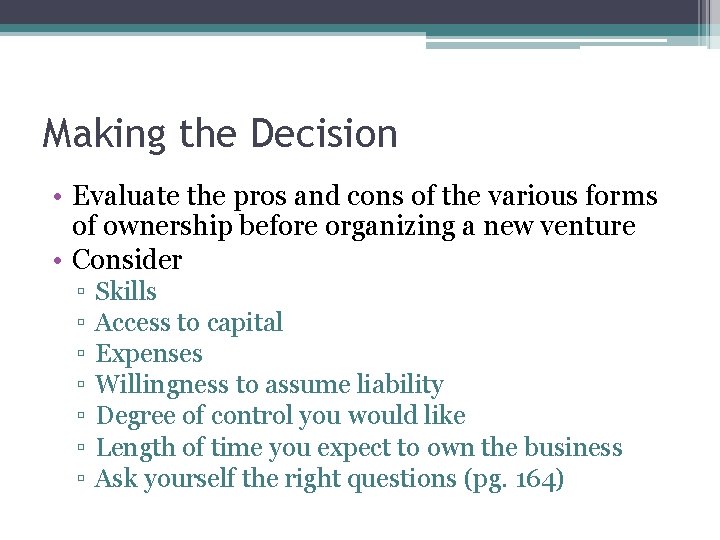
Making the Decision • Evaluate the pros and cons of the various forms of ownership before organizing a new venture • Consider ▫ ▫ ▫ ▫ Skills Access to capital Expenses Willingness to assume liability Degree of control you would like Length of time you expect to own the business Ask yourself the right questions (pg. 164)