
What is a Claim A Resource for Use
- Slides: 11
What is a Claim? A Resource for Use with CRWP Mini-Units and Materials Jean Wolph NWP College-Ready Writers Program
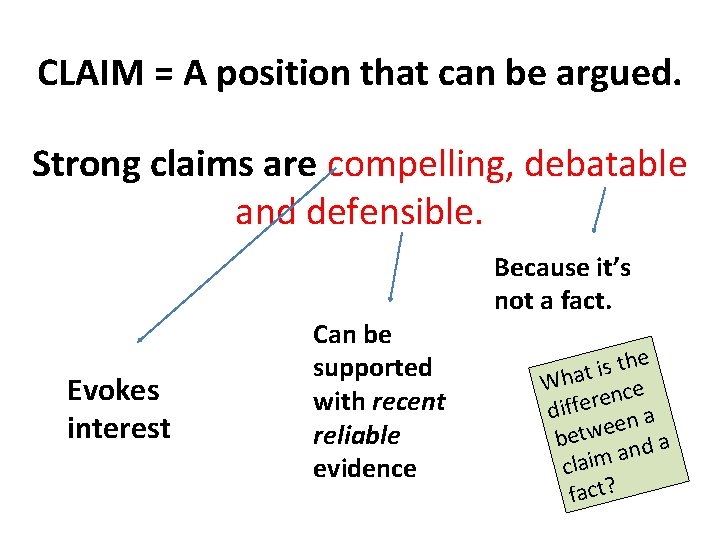
CLAIM = A position that can be argued. Strong claims are compelling, debatable and defensible. Evokes interest Can be supported with recent reliable evidence Because it’s not a fact. e h t s i What nce e differ n a ee w t e b a d n a claim fact?
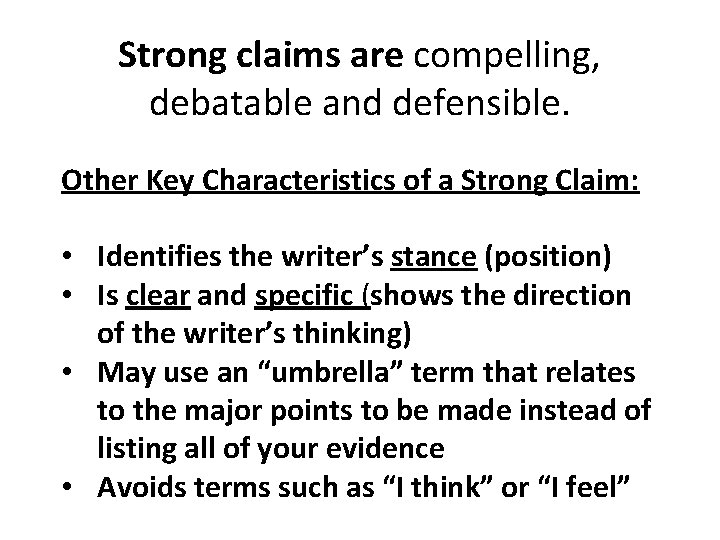
Strong claims are compelling, debatable and defensible. Other Key Characteristics of a Strong Claim: • Identifies the writer’s stance (position) • Is clear and specific (shows the direction of the writer’s thinking) • May use an “umbrella” term that relates to the major points to be made instead of listing all of your evidence • Avoids terms such as “I think” or “I feel”
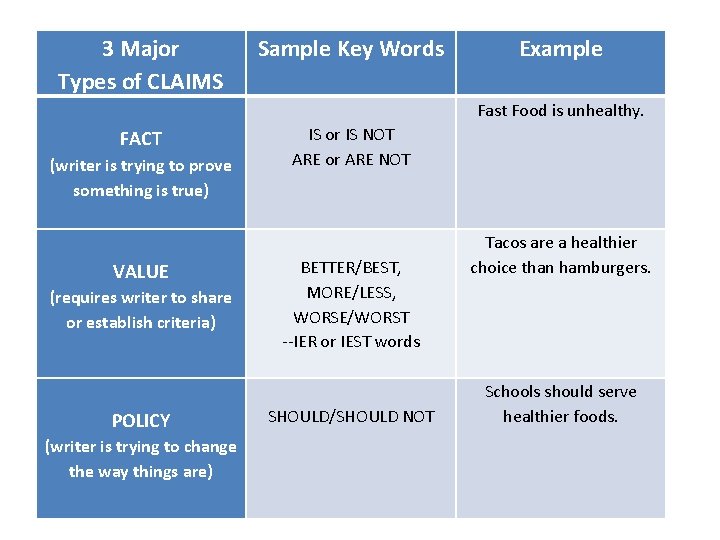
3 Major Types of CLAIMS Sample Key Words Example FACT IS or IS NOT ARE or ARE NOT Fast Food is unhealthy. BETTER/BEST, MORE/LESS, WORSE/WORST --IER or IEST words SHOULD/SHOULD NOT Tacos are a healthier choice than hamburgers. (writer is trying to prove something is true) VALUE (requires writer to share or establish criteria) POLICY (writer is trying to change the way things are) Schools should serve healthier foods.
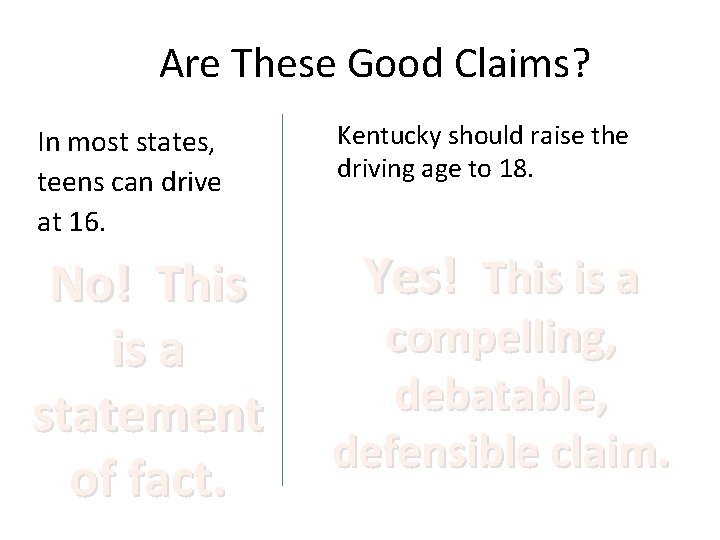
Are These Good Claims? In most states, teens can drive at 16. No! This is a statement of fact. Kentucky should raise the driving age to 18. Yes! This is a compelling, debatable, defensible claim.
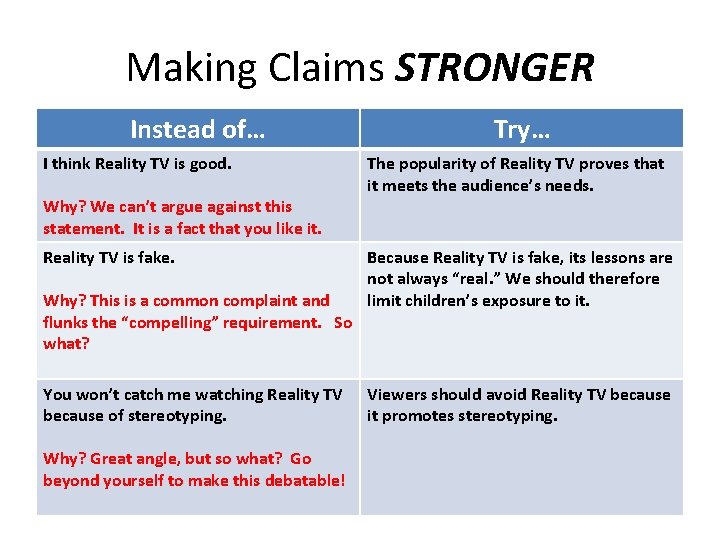
Making Claims STRONGER Instead of… I think Reality TV is good. Why? We can’t argue against this statement. It is a fact that you like it. Reality TV is fake. Why? This is a common complaint and flunks the “compelling” requirement. So what? You won’t catch me watching Reality TV because of stereotyping. Why? Great angle, but so what? Go beyond yourself to make this debatable! Try… The popularity of Reality TV proves that it meets the audience’s needs. Because Reality TV is fake, its lessons are not always “real. ” We should therefore limit children’s exposure to it. Viewers should avoid Reality TV because it promotes stereotyping.
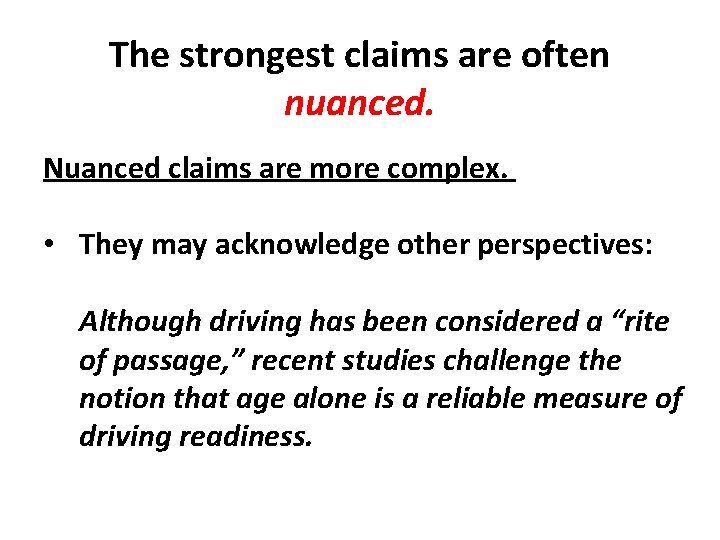
The strongest claims are often nuanced. Nuanced claims are more complex. • They may acknowledge other perspectives: Although driving has been considered a “rite of passage, ” recent studies challenge the notion that age alone is a reliable measure of driving readiness.
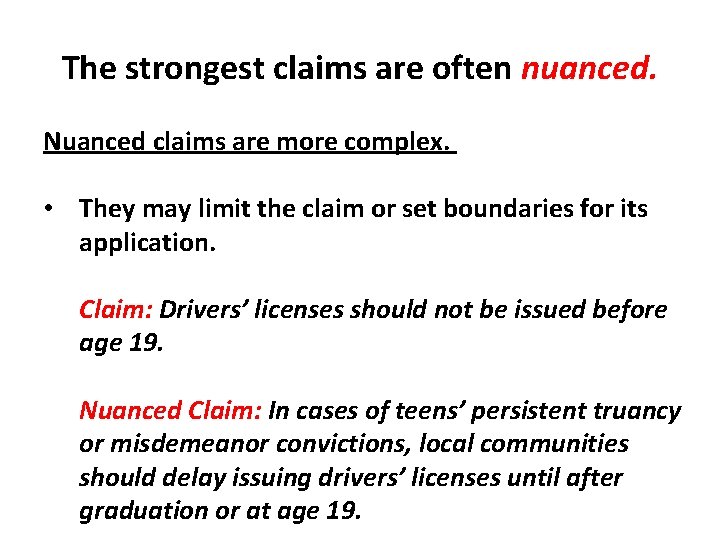
The strongest claims are often nuanced. Nuanced claims are more complex. • They may limit the claim or set boundaries for its application. Claim: Drivers’ licenses should not be issued before age 19. Nuanced Claim: In cases of teens’ persistent truancy or misdemeanor convictions, local communities should delay issuing drivers’ licenses until after graduation or at age 19.
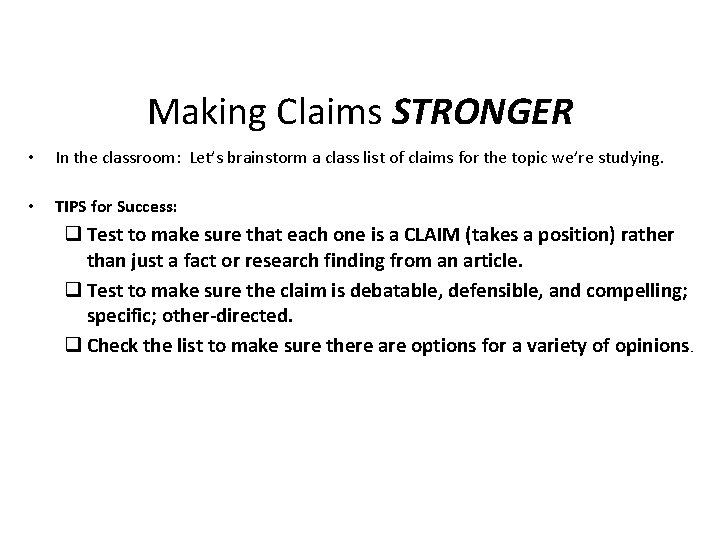
Making Claims STRONGER • In the classroom: Let’s brainstorm a class list of claims for the topic we’re studying. • TIPS for Success: q Test to make sure that each one is a CLAIM (takes a position) rather than just a fact or research finding from an article. q Test to make sure the claim is debatable, defensible, and compelling; specific; other-directed. q Check the list to make sure there are options for a variety of opinions .
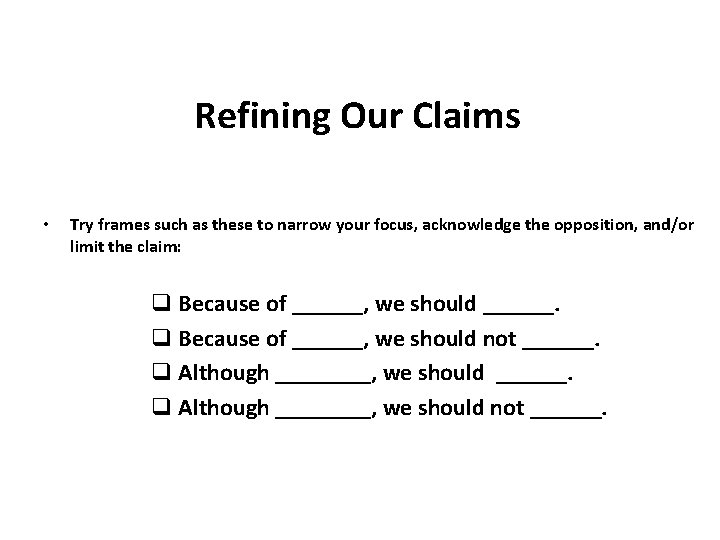
Refining Our Claims • Try frames such as these to narrow your focus, acknowledge the opposition, and/or limit the claim: q Because of ______, we should ______. q Because of ______, we should not ______. q Although ________, we should not ______.
Making Claims NUANCED Let’s test our claims and revise, if needed: q Test to see whether we can refine the claim by acknowledging an opposing position and/or limiting the claim to particular situations or audiences.