
What Is a Causal Connection Activities Results What
- Slides: 15
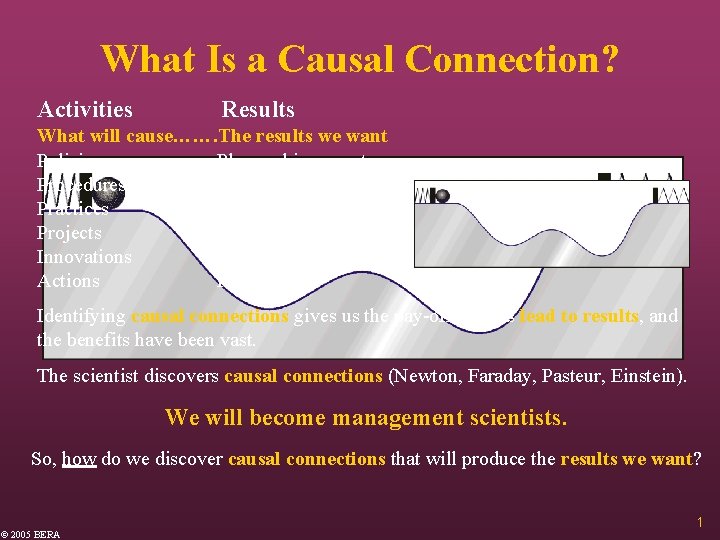
What Is a Causal Connection? Activities Results What will cause……. The results we want Policies Plans achievement Procedures Goals achievement Practices Standards met Projects High profits Innovations Growth Actions IPO Identifying causal connections gives us the pay-off; causes lead to results, and the benefits have been vast. The scientist discovers causal connections (Newton, Faraday, Pasteur, Einstein). We will become management scientists. So, how do we discover causal connections that will produce the results we want? © 2005 BERA 1
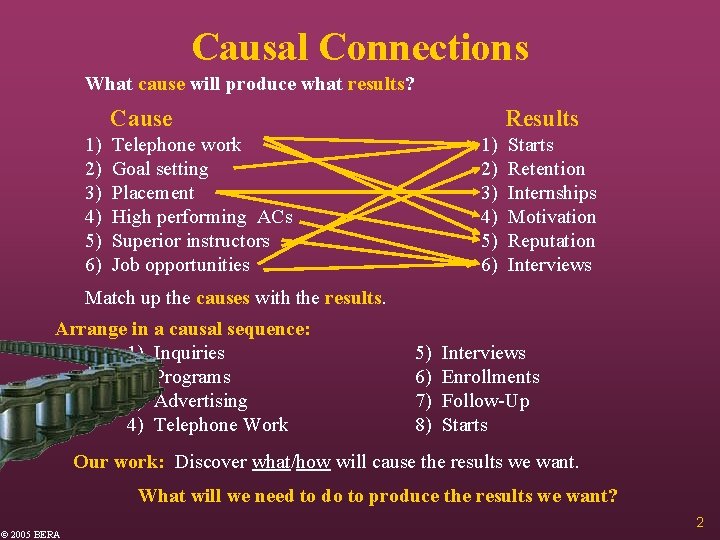
Causal Connections What cause will produce what results? Cause 1) 2) 3) 4) 5) 6) Results Telephone work Goal setting Placement High performing ACs Superior instructors Job opportunities 1) 2) 3) 4) 5) 6) Starts Retention Internships Motivation Reputation Interviews Match up the causes with the results. Arrange in a causal sequence: 1) Inquiries 2) Programs 3) Advertising 4) Telephone Work 5) 6) 7) 8) Interviews Enrollments Follow-Up Starts Our work: Discover what/how will cause the results we want. What will we need to do to produce the results we want? © 2005 BERA 2
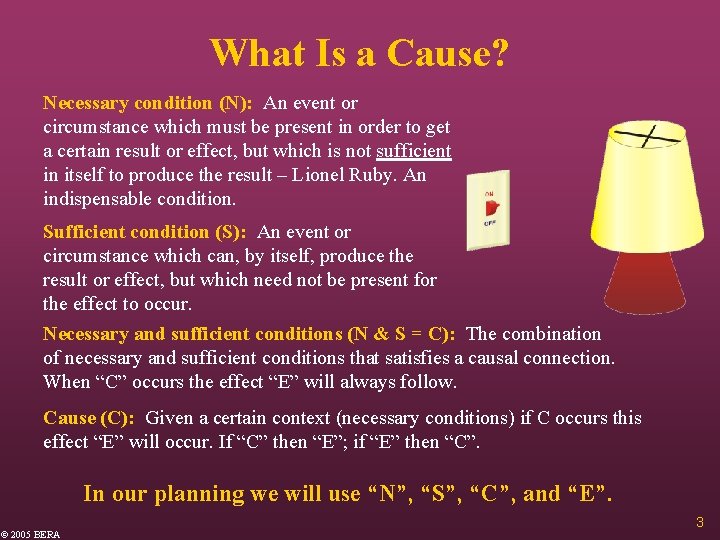
What Is a Cause? Necessary condition (N): An event or circumstance which must be present in order to get a certain result or effect, but which is not sufficient in itself to produce the result – Lionel Ruby. An indispensable condition. Sufficient condition (S): An event or circumstance which can, by itself, produce the result or effect, but which need not be present for the effect to occur. Necessary and sufficient conditions (N & S = C): The combination of necessary and sufficient conditions that satisfies a causal connection. When “C” occurs the effect “E” will always follow. Cause (C): Given a certain context (necessary conditions) if C occurs this effect “E” will occur. If “C” then “E”; if “E” then “C”. In our planning we will use “N”, “S”, “C”, and “E”. © 2005 BERA 3
What Are the Necessary & Sufficient Causes for Retention? What is “N”? What is “S”? What “C” will cause “E”? © 2005 BERA 4
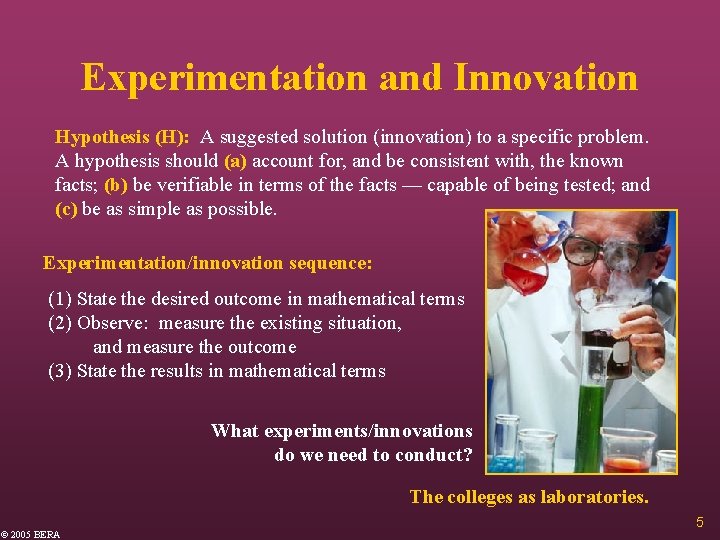
Experimentation and Innovation Hypothesis (H): A suggested solution (innovation) to a specific problem. A hypothesis should (a) account for, and be consistent with, the known facts; (b) be verifiable in terms of the facts — capable of being tested; and (c) be as simple as possible. Experimentation/innovation sequence: (1) State the desired outcome in mathematical terms (2) Observe: measure the existing situation, and measure the outcome (3) State the results in mathematical terms What experiments/innovations do we need to conduct? The colleges as laboratories. © 2005 BERA 5
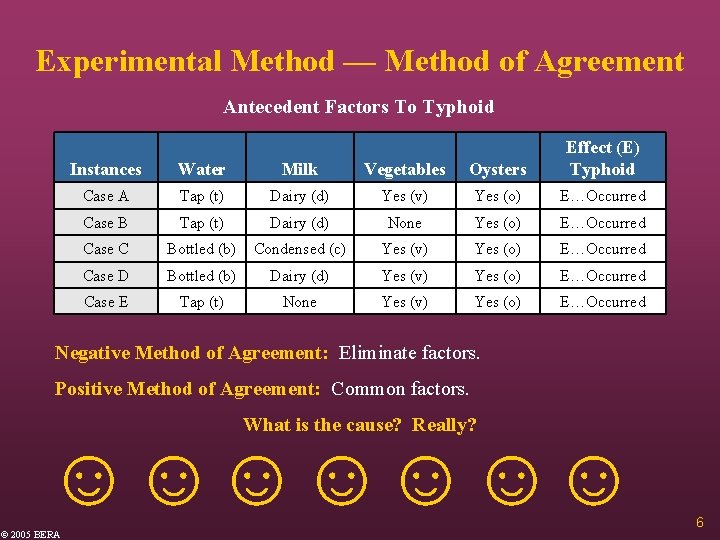
Experimental Method — Method of Agreement Antecedent Factors To Typhoid Instances Water Milk Vegetables Oysters Effect (E) Typhoid Case A Tap (t) Dairy (d) Yes (v) Yes (o) E…Occurred Case B Tap (t) Dairy (d) None Yes (o) E…Occurred Case C Bottled (b) Condensed (c) Yes (v) Yes (o) E…Occurred Case D Bottled (b) Dairy (d) Yes (v) Yes (o) E…Occurred Case E Tap (t) None Yes (v) Yes (o) E…Occurred Negative Method of Agreement: Eliminate factors. Positive Method of Agreement: Common factors. What is the cause? Really? ☺☺☺☺☺☺☺ © 2005 BERA 6
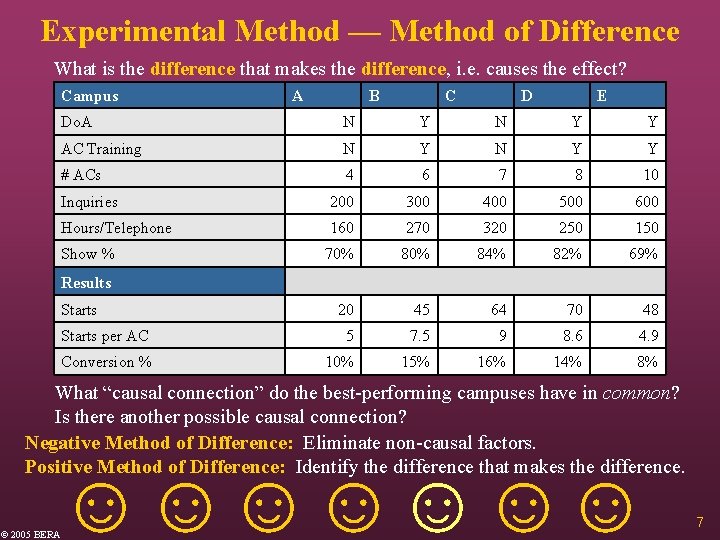
Experimental Method — Method of Difference What is the difference that makes the difference, i. e. causes the effect? Campus A B C D E Do. A N Y Y AC Training N Y Y # ACs 4 6 7 8 10 Inquiries 200 300 400 500 600 Hours/Telephone 160 270 320 250 150 70% 84% 82% 69% 20 45 64 70 48 Starts per AC 5 7. 5 9 8. 6 4. 9 Conversion % 10% 15% 16% 14% 8% Show % Results Starts What “causal connection” do the best-performing campuses have in common? Is there another possible causal connection? Negative Method of Difference: Eliminate non-causal factors. Positive Method of Difference: Identify the difference that makes the difference. ☺☺☺☺☺☺☺ © 2005 BERA 7
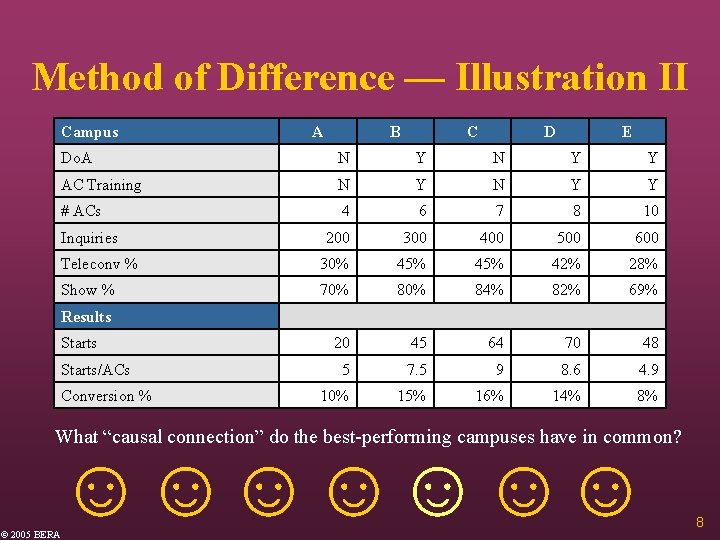
Method of Difference — Illustration II Campus A B C D E Do. A N Y Y AC Training N Y Y # ACs 4 6 7 8 10 200 300 400 500 600 Teleconv % 30% 45% 42% 28% Show % 70% 84% 82% 69% 20 45 64 70 48 5 7. 5 9 8. 6 4. 9 10% 15% 16% 14% 8% Inquiries Results Starts/ACs Conversion % What “causal connection” do the best-performing campuses have in common? ☺☺☺☺☺☺☺ © 2005 BERA 8
Experimental Method — Joint, Concomitant Variations, Residues Joint Method: When there are two possible factors, eliminate one by the negative method of difference. Concomitant Variations: The cause varies concomitantly with variations in the effect. Method of Residues: Apart from the normal known factors, what is causing the difference, the effect? © 2005 BERA 9
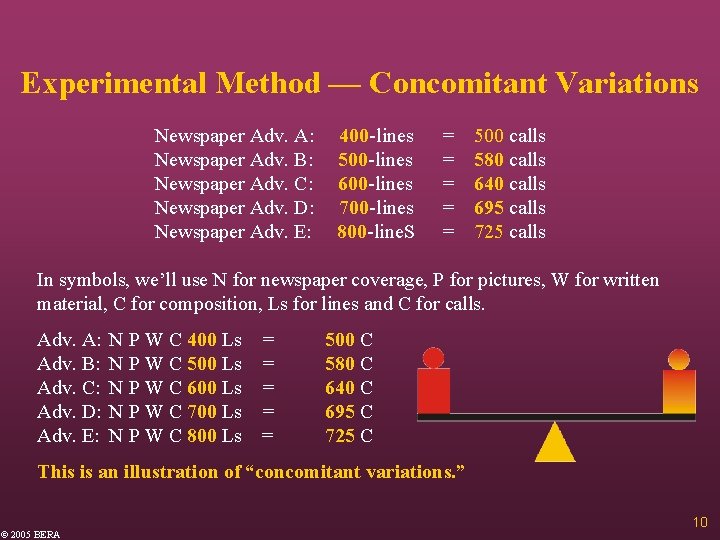
Experimental Method — Concomitant Variations Newspaper Adv. A: Newspaper Adv. B: Newspaper Adv. C: Newspaper Adv. D: Newspaper Adv. E: 400 -lines 500 -lines 600 -lines 700 -lines 800 -line. S = = = 500 calls 580 calls 640 calls 695 calls 725 calls In symbols, we’ll use N for newspaper coverage, P for pictures, W for written material, C for composition, Ls for lines and C for calls. Adv. A: Adv. B: Adv. C: Adv. D: Adv. E: N P W C 400 Ls N P W C 500 Ls N P W C 600 Ls N P W C 700 Ls N P W C 800 Ls = = = 500 C 580 C 640 C 695 C 725 C This is an illustration of “concomitant variations. ” © 2005 BERA 10
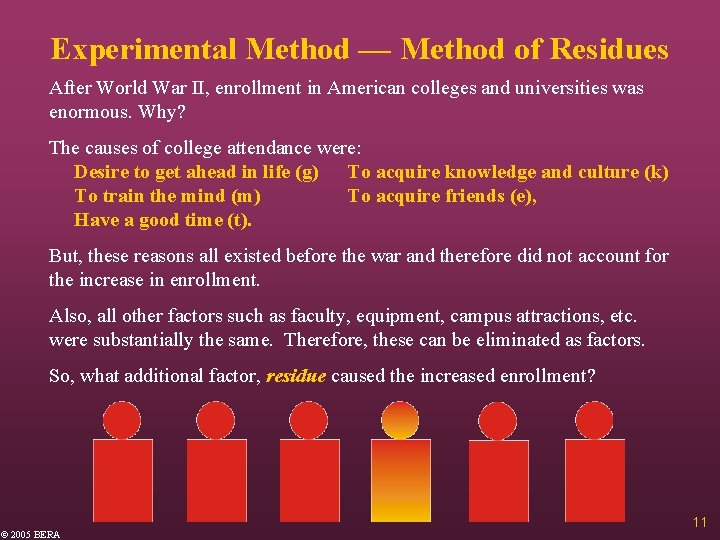
Experimental Method — Method of Residues After World War II, enrollment in American colleges and universities was enormous. Why? The causes of college attendance were: Desire to get ahead in life (g) To acquire knowledge and culture (k) To train the mind (m) To acquire friends (e), Have a good time (t). But, these reasons all existed before the war and therefore did not account for the increase in enrollment. Also, all other factors such as faculty, equipment, campus attractions, etc. were substantially the same. Therefore, these can be eliminated as factors. So, what additional factor, residue caused the increased enrollment? © 2005 BERA 11
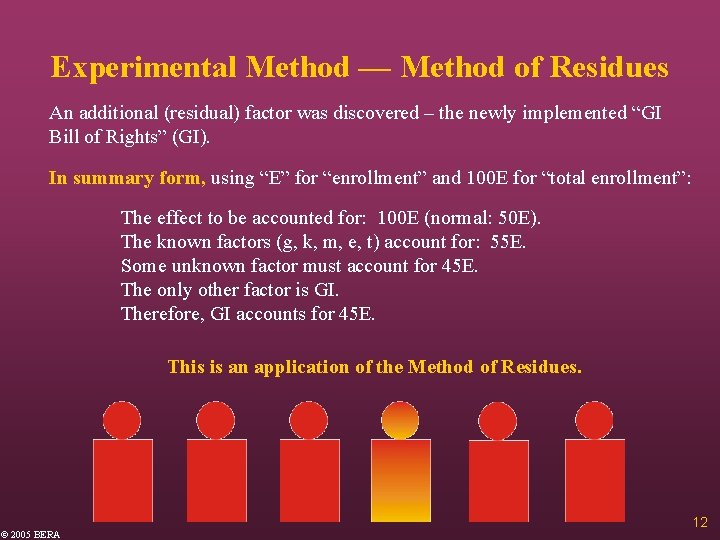
Experimental Method — Method of Residues An additional (residual) factor was discovered – the newly implemented “GI Bill of Rights” (GI). In summary form, using “E” for “enrollment” and 100 E for “total enrollment”: The effect to be accounted for: 100 E (normal: 50 E). The known factors (g, k, m, e, t) account for: 55 E. Some unknown factor must account for 45 E. The only other factor is GI. Therefore, GI accounts for 45 E. This is an application of the Method of Residues. © 2005 BERA 12
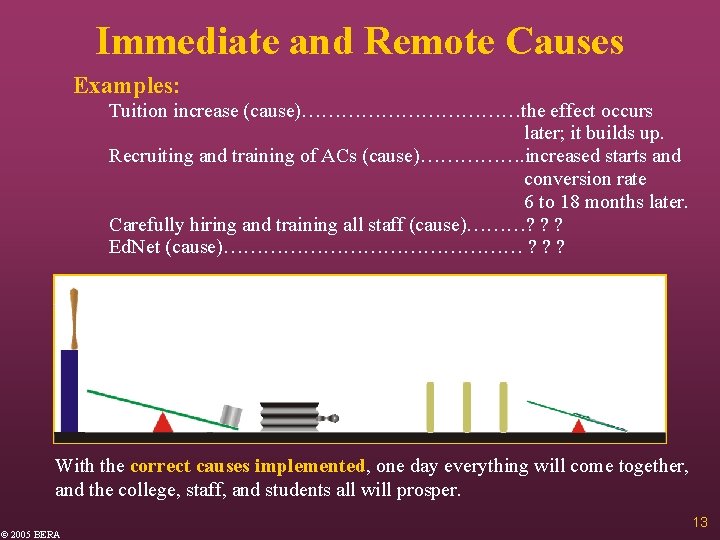
Immediate and Remote Causes Examples: Tuition increase (cause)………………the effect occurs later; it builds up. Recruiting and training of ACs (cause)……………. increased starts and conversion rate 6 to 18 months later. Carefully hiring and training all staff (cause)………? ? ? Ed. Net (cause)…………………… ? ? ? With the correct causes implemented, one day everything will come together, and the college, staff, and students all will prosper. © 2005 BERA 13
Fallacies Fallacy: An error in thinking; a logical error; reasoning that does not follow the rules of inference or that violates them. There are formal and informal fallacies. 1. 2. 3. 4. Post Hoc Cause versus necessary condition Irrelevant factors Reversal of cause and effect There are dozens of other fallacies; however, for our purposes the above four may be useful. 2+2=4+1 © 2005 BERA 14
Summary of Causal Connection 1. What will cause (C) the results (R) we want? 2. Necessary conditions; sufficient conditions; necessary and sufficient conditions = cause (C). 3. What are the necessary and sufficient conditions for starts and for retention? 4. Experimentation: From a hypothesis measure and test and measure again. 5. Experimental method of agreement. 6. Experimental method of difference. 7. Immediate and remote causation. 8. Fallacies. Planning: After going to the store and using math, identify the few key causes (C) that will produce significant results, effects (E). © 2005 BERA 15