
What is a bus Slow vehicle well true
What is a bus? � Slow vehicle – well, true. . . �A that many people ride together bunch of wires. . . Datorteknik F 1 bild 1
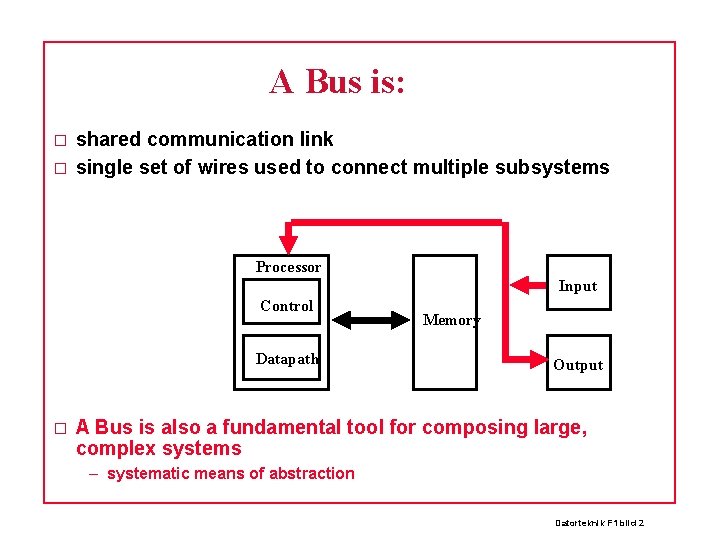
A Bus is: � � shared communication link single set of wires used to connect multiple subsystems Processor Input Control Datapath � Memory Output A Bus is also a fundamental tool for composing large, complex systems – systematic means of abstraction Datorteknik F 1 bild 2
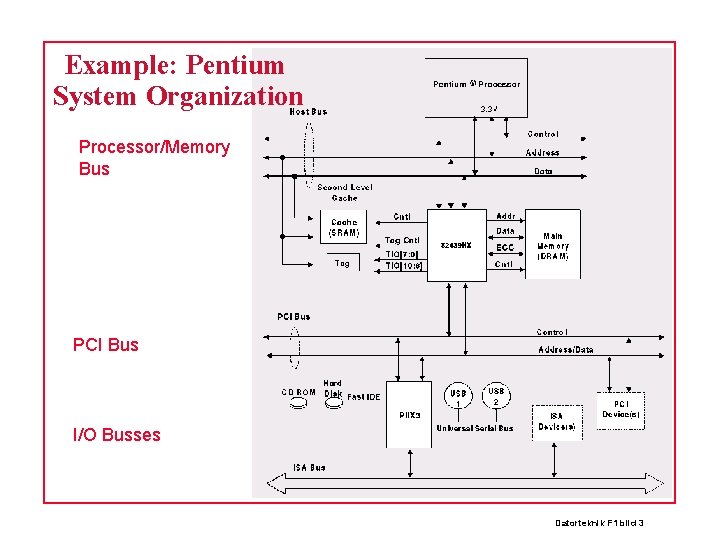
Example: Pentium System Organization Processor/Memory Bus PCI Bus I/O Busses Datorteknik F 1 bild 3
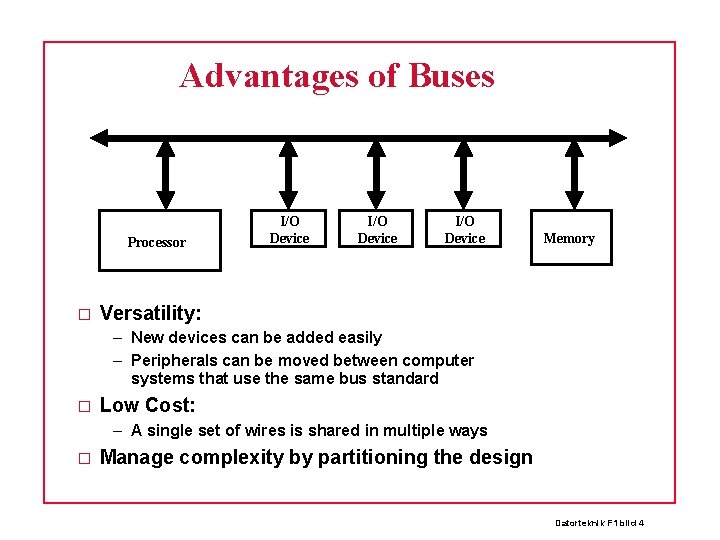
Advantages of Buses Processor � I/O Device Memory Versatility: – New devices can be added easily – Peripherals can be moved between computer systems that use the same bus standard � Low Cost: – A single set of wires is shared in multiple ways � Manage complexity by partitioning the design Datorteknik F 1 bild 4
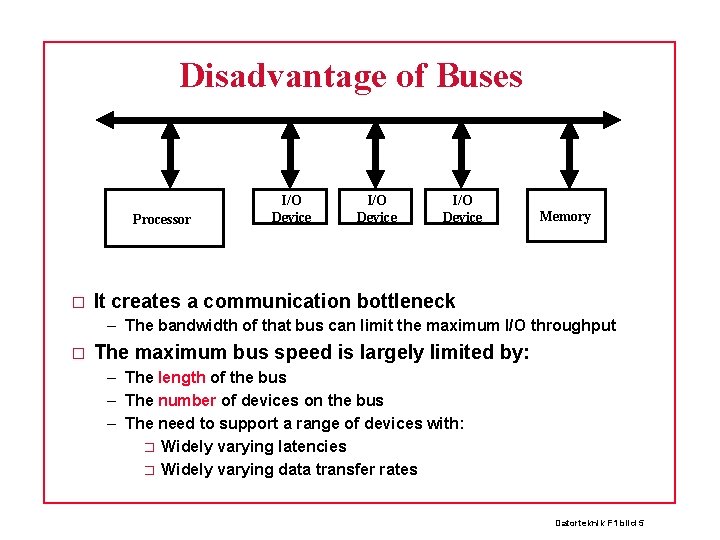
Disadvantage of Buses Processor � I/O Device Memory It creates a communication bottleneck – The bandwidth of that bus can limit the maximum I/O throughput � The maximum bus speed is largely limited by: – The length of the bus – The number of devices on the bus – The need to support a range of devices with: � Widely varying latencies � Widely varying data transfer rates Datorteknik F 1 bild 5
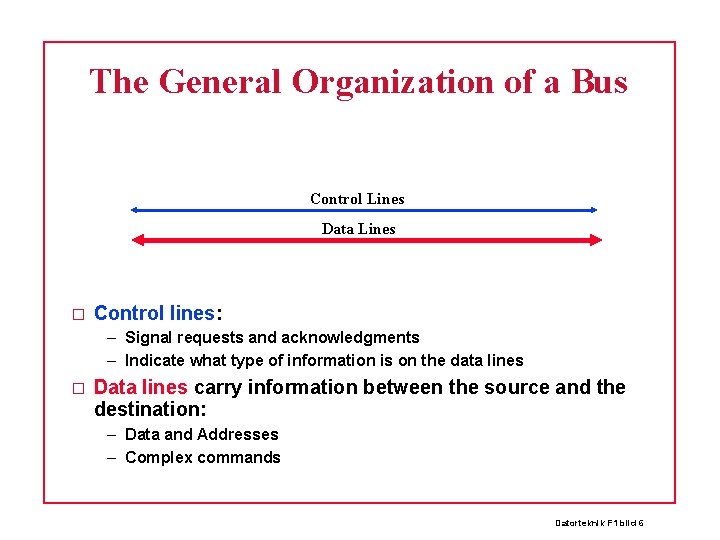
The General Organization of a Bus Control Lines Data Lines � Control lines: – Signal requests and acknowledgments – Indicate what type of information is on the data lines � Data lines carry information between the source and the destination: – Data and Addresses – Complex commands Datorteknik F 1 bild 6
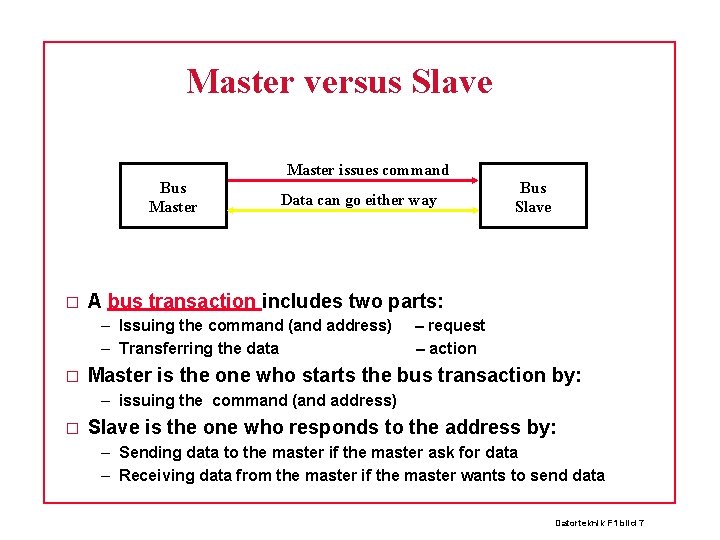
Master versus Slave Master issues command Bus Master � Data can go either way A bus transaction includes two parts: – Issuing the command (and address) – Transferring the data � Bus Slave – request – action Master is the one who starts the bus transaction by: – issuing the command (and address) � Slave is the one who responds to the address by: – Sending data to the master if the master ask for data – Receiving data from the master if the master wants to send data Datorteknik F 1 bild 7
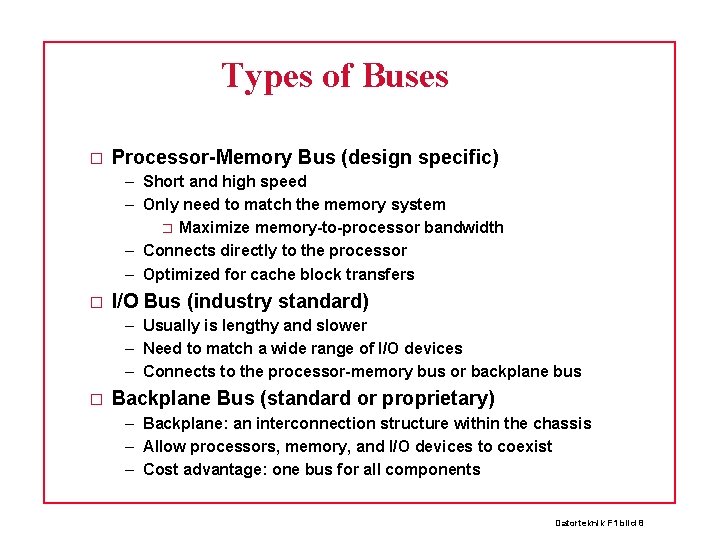
Types of Buses � Processor-Memory Bus (design specific) – Short and high speed – Only need to match the memory system � Maximize memory-to-processor bandwidth – Connects directly to the processor – Optimized for cache block transfers � I/O Bus (industry standard) – Usually is lengthy and slower – Need to match a wide range of I/O devices – Connects to the processor-memory bus or backplane bus � Backplane Bus (standard or proprietary) – Backplane: an interconnection structure within the chassis – Allow processors, memory, and I/O devices to coexist – Cost advantage: one bus for all components Datorteknik F 1 bild 8

A Computer System with One Bus: Backplane Bus Processor Memory I/O Devices � A single bus (the backplane bus) is used for: – Processor to memory communication – Communication between I/O devices and memory � � � Advantages: Simple and low cost Disadvantages: slow and the bus can become a major bottleneck Example: IBM PC - AT Datorteknik F 1 bild 9
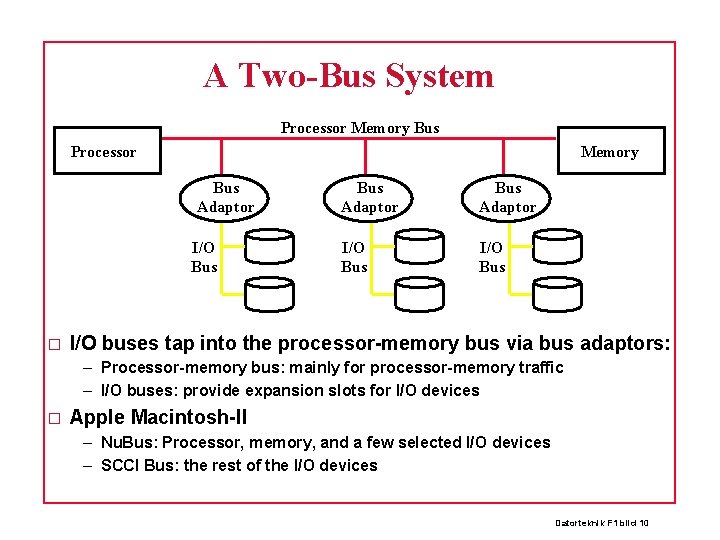
A Two-Bus System Processor Memory Bus Adaptor I/O Bus � Bus Adaptor I/O Bus I/O buses tap into the processor-memory bus via bus adaptors: – Processor-memory bus: mainly for processor-memory traffic – I/O buses: provide expansion slots for I/O devices � Apple Macintosh-II – Nu. Bus: Processor, memory, and a few selected I/O devices – SCCI Bus: the rest of the I/O devices Datorteknik F 1 bild 10
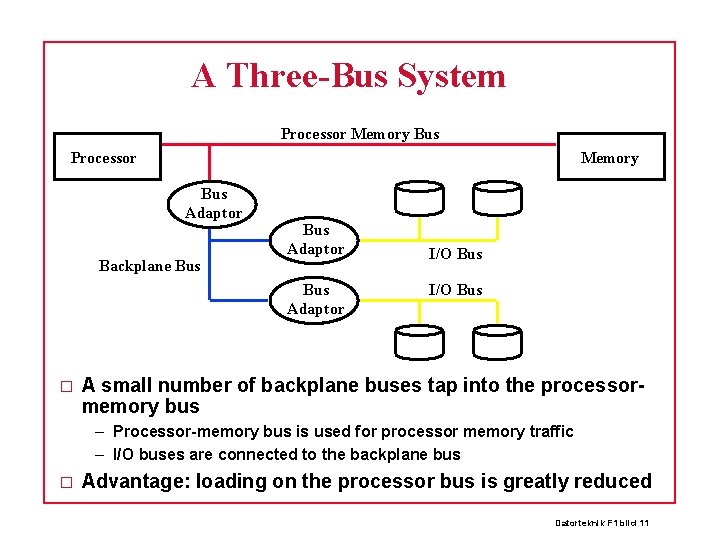
A Three-Bus System Processor Memory Bus Adaptor Backplane Bus Adaptor � I/O Bus A small number of backplane buses tap into the processormemory bus – Processor-memory bus is used for processor memory traffic – I/O buses are connected to the backplane bus � Advantage: loading on the processor bus is greatly reduced Datorteknik F 1 bild 11
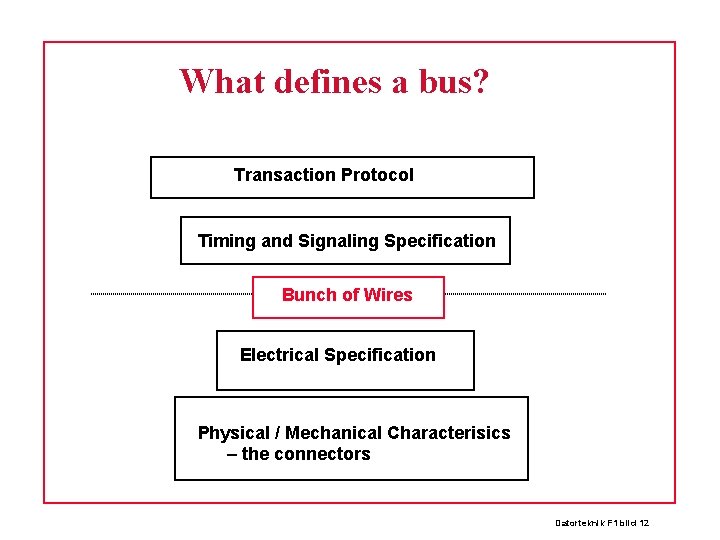
What defines a bus? Transaction Protocol Timing and Signaling Specification Bunch of Wires Electrical Specification Physical / Mechanical Characterisics – the connectors Datorteknik F 1 bild 12
Synchronous and Asynchronous Bus � Synchronous Bus: – – � Includes a clock in the control lines A fixed protocol for communication that is relative to the clock Advantage: involves very little logic and can run very fast Disadvantages: � Every device on the bus must run at the same clock rate � To avoid clock skew, they cannot be long if they are fast Asynchronous Bus: – – It is not clocked It can accommodate a wide range of devices It can be lengthened without worrying about clock skew It requires a handshaking protocol Datorteknik F 1 bild 13
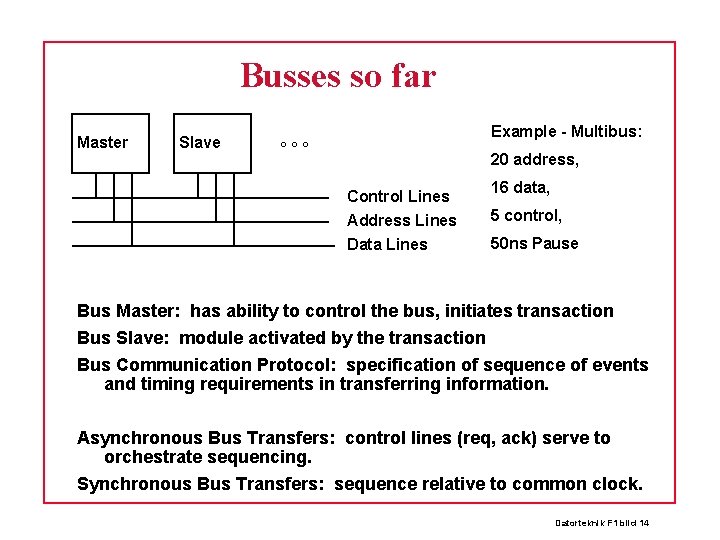
Busses so far Master Slave Example - Multibus: °°° 20 address, Control Lines Address Lines Data Lines 16 data, 5 control, 50 ns Pause Bus Master: has ability to control the bus, initiates transaction Bus Slave: module activated by the transaction Bus Communication Protocol: specification of sequence of events and timing requirements in transferring information. Asynchronous Bus Transfers: control lines (req, ack) serve to orchestrate sequencing. Synchronous Bus Transfers: sequence relative to common clock. Datorteknik F 1 bild 14
Bus Transaction � Arbitration � Request � Action Datorteknik F 1 bild 15
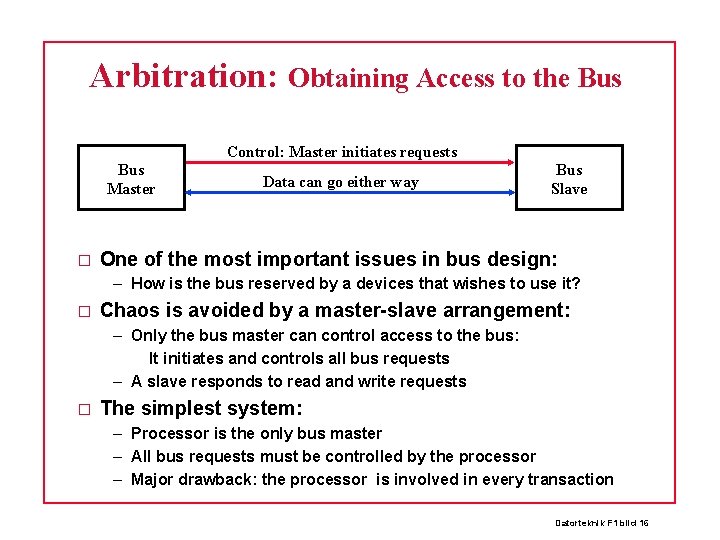
Arbitration: Obtaining Access to the Bus Control: Master initiates requests Bus Master � Data can go either way Bus Slave One of the most important issues in bus design: – How is the bus reserved by a devices that wishes to use it? � Chaos is avoided by a master-slave arrangement: – Only the bus master can control access to the bus: It initiates and controls all bus requests – A slave responds to read and write requests � The simplest system: – Processor is the only bus master – All bus requests must be controlled by the processor – Major drawback: the processor is involved in every transaction Datorteknik F 1 bild 16
Multiple Potential Bus Masters: the Need for Arbitration � Bus arbitration scheme: – A bus master wanting to use the bus asserts the bus request – A bus master cannot use the bus until its request is granted – A bus master must signal to the arbiter after finish using the bus � Bus arbitration schemes usually try to balance two factors: – Bus priority: the highest priority device should be serviced first – Fairness: Even the lowest priority device should never be completely locked out from the bus � Bus arbitration schemes can be divided into four broad classes: – Daisy chain arbitration: single device with all request lines. – Centralized, parallel arbitration: see next-next slide – Distributed arbitration by self-selection: each device wanting the bus places a code indicating its identity on the bus. – Distributed arbitration by collision detection: Ethernet uses this. Datorteknik F 1 bild 17
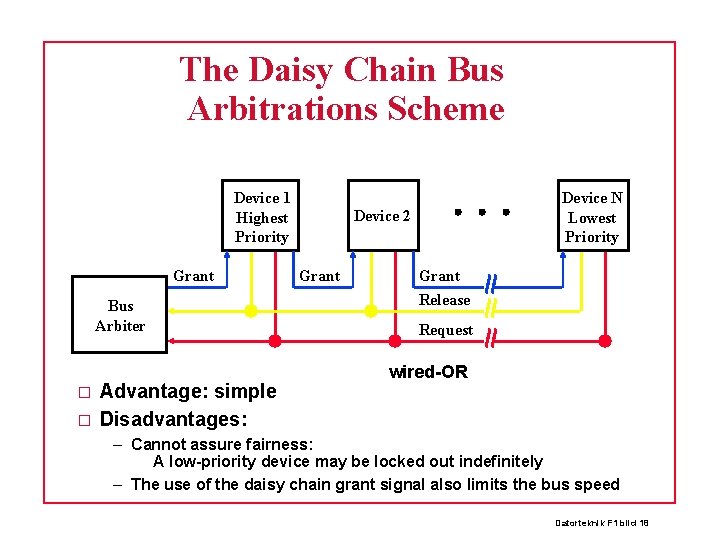
The Daisy Chain Bus Arbitrations Scheme Device 1 Highest Priority Grant Bus Arbiter � � Advantage: simple Disadvantages: Device N Lowest Priority Device 2 Grant Release Request wired-OR – Cannot assure fairness: A low-priority device may be locked out indefinitely – The use of the daisy chain grant signal also limits the bus speed Datorteknik F 1 bild 18
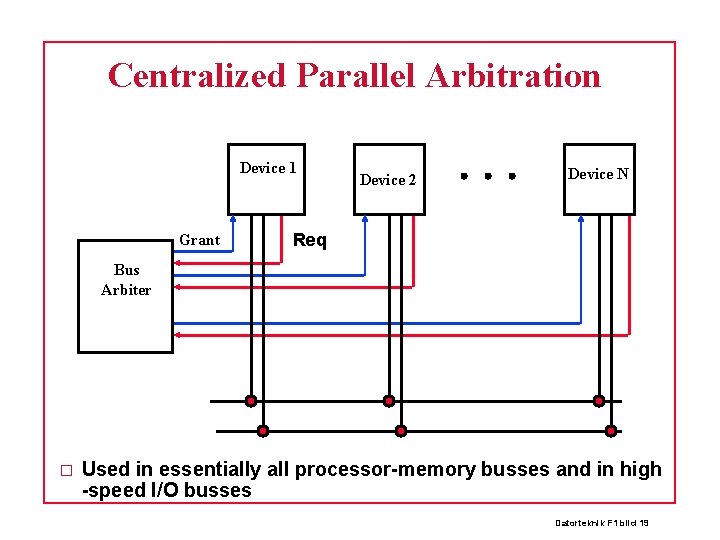
Centralized Parallel Arbitration Device 1 Grant Device 2 Device N Req Bus Arbiter � Used in essentially all processor-memory busses and in high -speed I/O busses Datorteknik F 1 bild 19
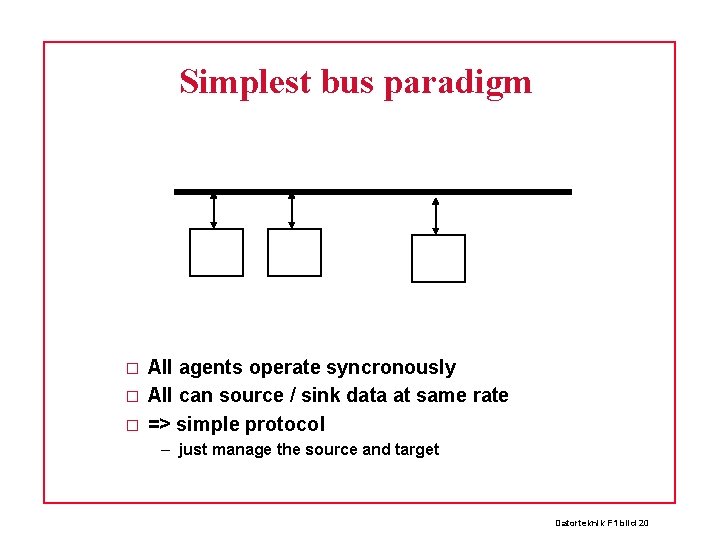
Simplest bus paradigm � � � All agents operate syncronously All can source / sink data at same rate => simple protocol – just manage the source and target Datorteknik F 1 bild 20
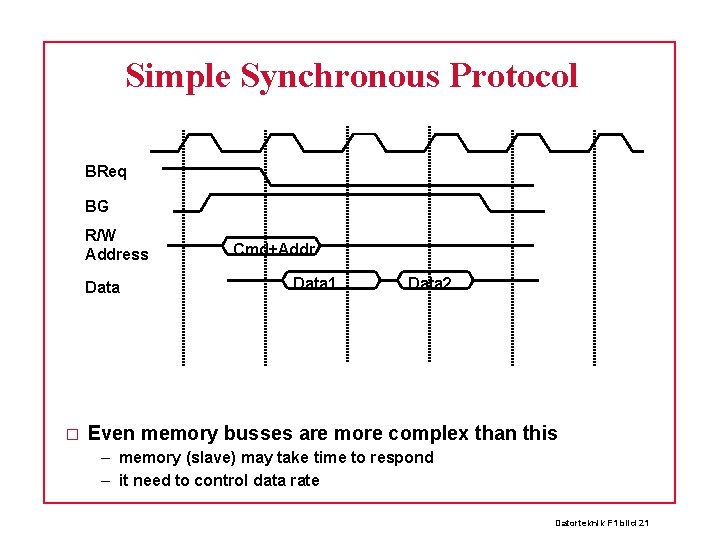
Simple Synchronous Protocol BReq BG R/W Address Data � Cmd+Addr Data 1 Data 2 Even memory busses are more complex than this – memory (slave) may take time to respond – it need to control data rate Datorteknik F 1 bild 21
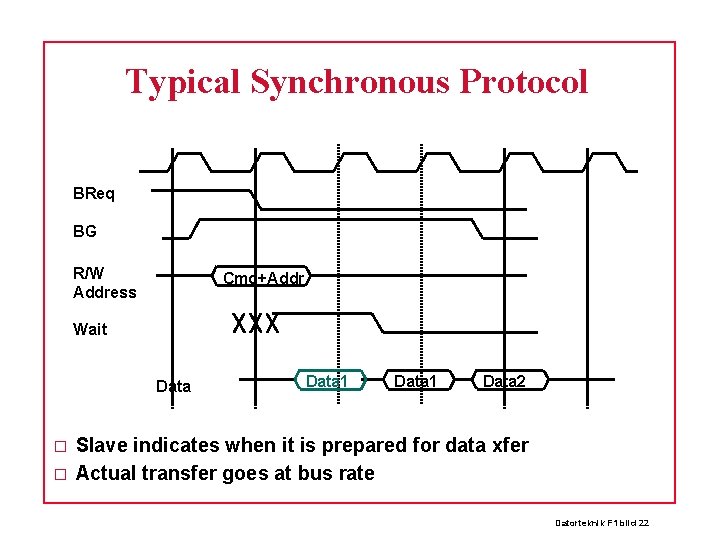
Typical Synchronous Protocol BReq BG R/W Address Cmd+Addr Wait Data � � Data 1 Data 2 Slave indicates when it is prepared for data xfer Actual transfer goes at bus rate Datorteknik F 1 bild 22
Increasing the Bus Bandwidth � Separate versus multiplexed address and data lines: – Address and data can be transmitted in one bus cycle if separate address and data lines are available – Cost: (a) more bus lines, (b) increased complexity � Data bus width: – By increasing the width of the data bus, transfers of multiple words require fewer bus cycles – Example: SPARCstation 20’s memory bus is 128 bit wide – Cost: more bus lines � Block transfers: – – Allow the bus to transfer multiple words in back-to-back bus cycles Only one address needs to be sent at the beginning The bus is not released until the last word is transferred Cost: (a) increased complexity (b) increased response time (latency) for request Datorteknik F 1 bild 23
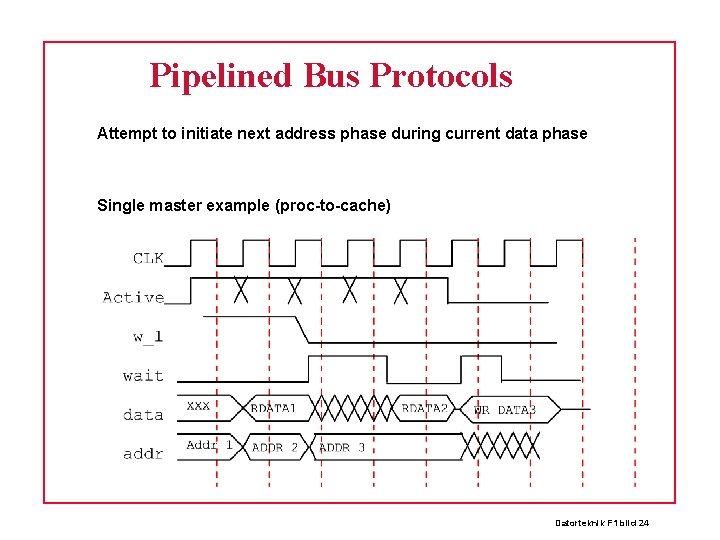
Pipelined Bus Protocols Attempt to initiate next address phase during current data phase Single master example (proc-to-cache) Datorteknik F 1 bild 24
Increasing Transaction Rate on Multimaster Bus � Overlapped arbitration – perform arbitration for next transaction during current transaction � Bus parking – master can holds onto bus and performs multiple transactions as long as no other master makes request � Overlapped address / data phases (prev. slide) – requires one of the above techniques � Split-phase (or packet switched) bus – completely separate address and data phases – arbitrate separately for each – address phase yield a tag which is matched with data phase � ”All of the above” in most modern mem busses Datorteknik F 1 bild 25
The I/O Bus Problem � Designed to support wide variety of devices – full set not know at design time � Allow data rate match between arbitrary speed deviced – fast processor – slow I/O – slow processor – fast I/O Datorteknik F 1 bild 26
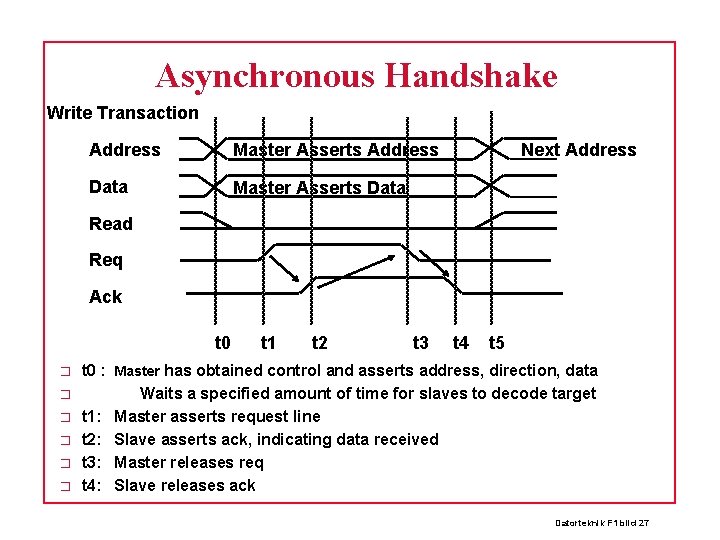
Asynchronous Handshake Write Transaction Address Master Asserts Address Data Master Asserts Data Next Address Read Req Ack t 0 � � � t 1 t 2 t 3 t 4 t 5 t 0 : Master has obtained control and asserts address, direction, data Waits a specified amount of time for slaves to decode target t 1: Master asserts request line t 2: Slave asserts ack, indicating data received t 3: Master releases req t 4: Slave releases ack Datorteknik F 1 bild 27
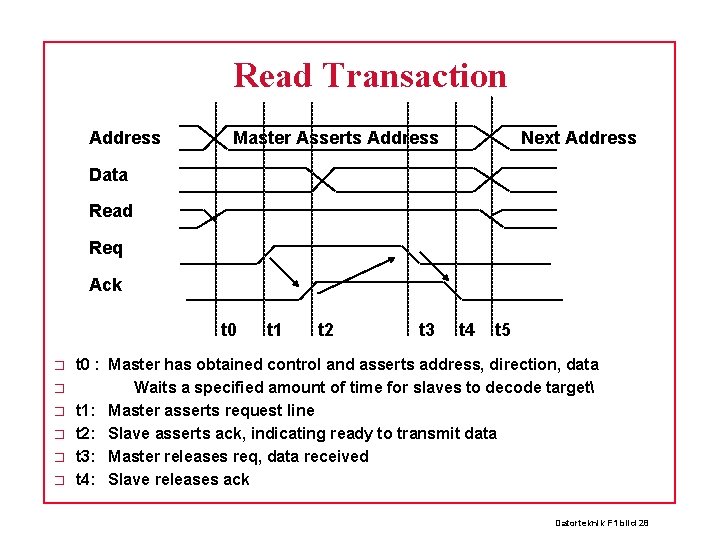
Read Transaction Address Master Asserts Address Next Address Data Read Req Ack t 0 � � � t 1 t 2 t 3 t 4 t 5 t 0 : Master has obtained control and asserts address, direction, data Waits a specified amount of time for slaves to decode target t 1: Master asserts request line t 2: Slave asserts ack, indicating ready to transmit data t 3: Master releases req, data received t 4: Slave releases ack Datorteknik F 1 bild 28
High Speed I/O Bus � Examples – graphics – fast networks � � � Limited number of devices Data transfer bursts at full rate DMA transfers important – small controller spools stream of bytes to or from memory � Either side may need to squelch transfer – buffers fill up Datorteknik F 1 bild 29
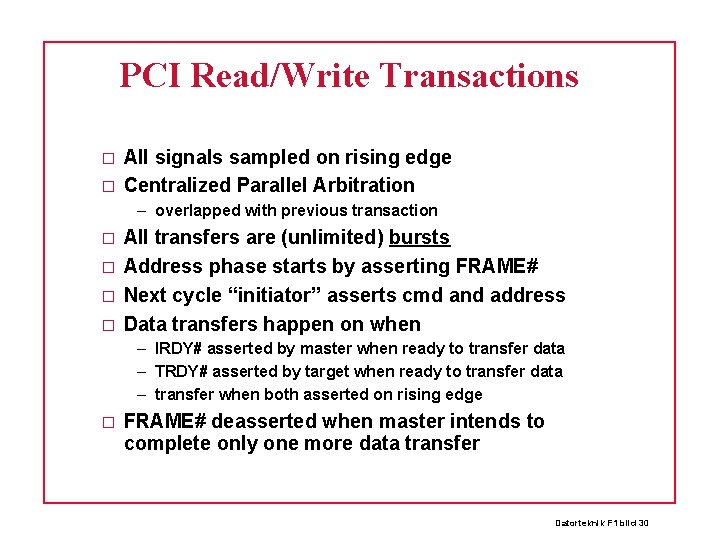
PCI Read/Write Transactions � � All signals sampled on rising edge Centralized Parallel Arbitration – overlapped with previous transaction � � All transfers are (unlimited) bursts Address phase starts by asserting FRAME# Next cycle “initiator” asserts cmd and address Data transfers happen on when – IRDY# asserted by master when ready to transfer data – TRDY# asserted by target when ready to transfer data – transfer when both asserted on rising edge � FRAME# deasserted when master intends to complete only one more data transfer Datorteknik F 1 bild 30
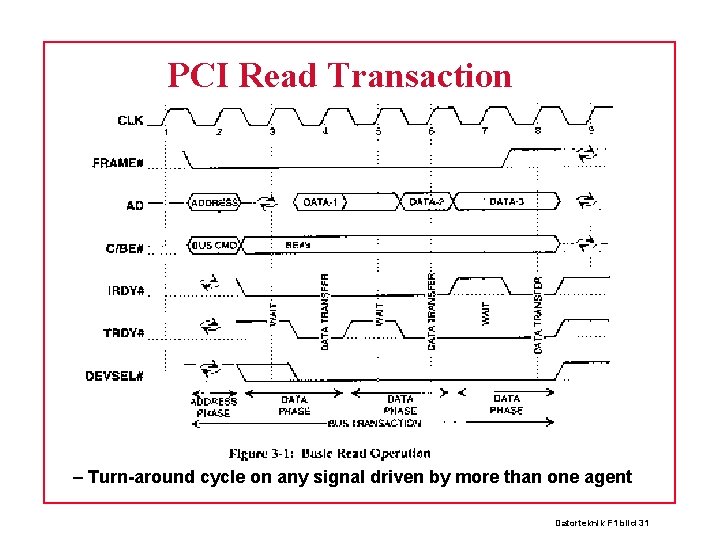
PCI Read Transaction – Turn-around cycle on any signal driven by more than one agent Datorteknik F 1 bild 31
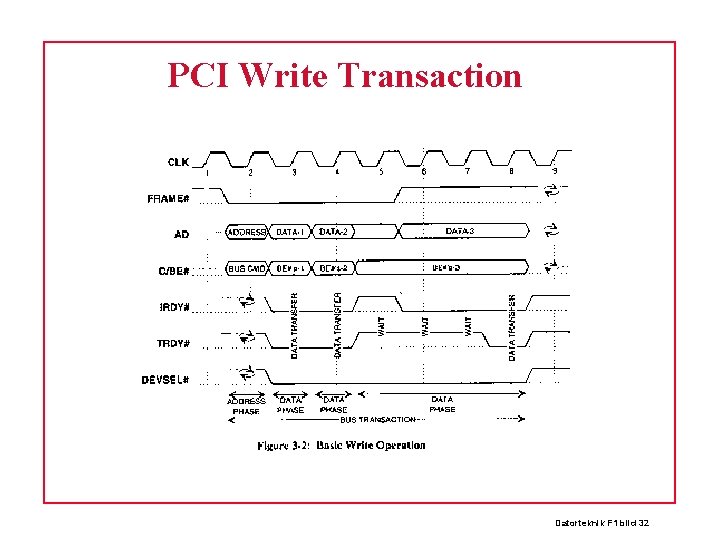
PCI Write Transaction Datorteknik F 1 bild 32
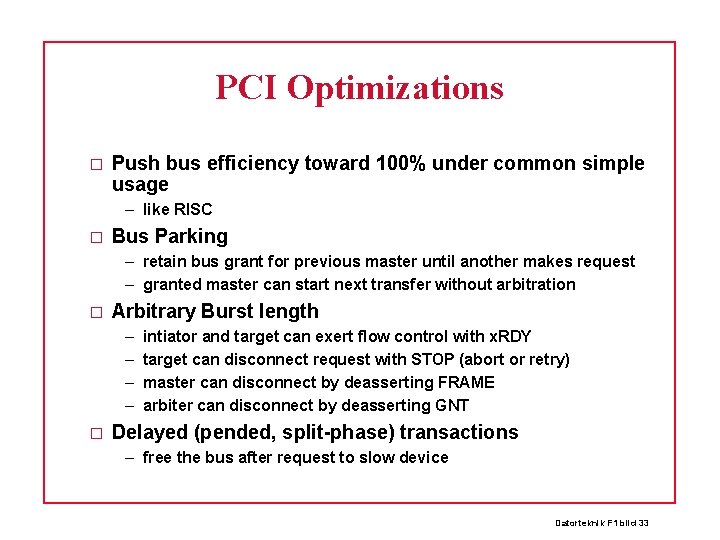
PCI Optimizations � Push bus efficiency toward 100% under common simple usage – like RISC � Bus Parking – retain bus grant for previous master until another makes request – granted master can start next transfer without arbitration � Arbitrary Burst length – – � intiator and target can exert flow control with x. RDY target can disconnect request with STOP (abort or retry) master can disconnect by deasserting FRAME arbiter can disconnect by deasserting GNT Delayed (pended, split-phase) transactions – free the bus after request to slow device Datorteknik F 1 bild 33
Additional PCI Issues � � Interrupts: support for controlling I/O devices Cache coherency: – support for I/O and multiprocessors � Locks: – support timesharing, I/O, and MPs � Configuration Address Space Datorteknik F 1 bild 34
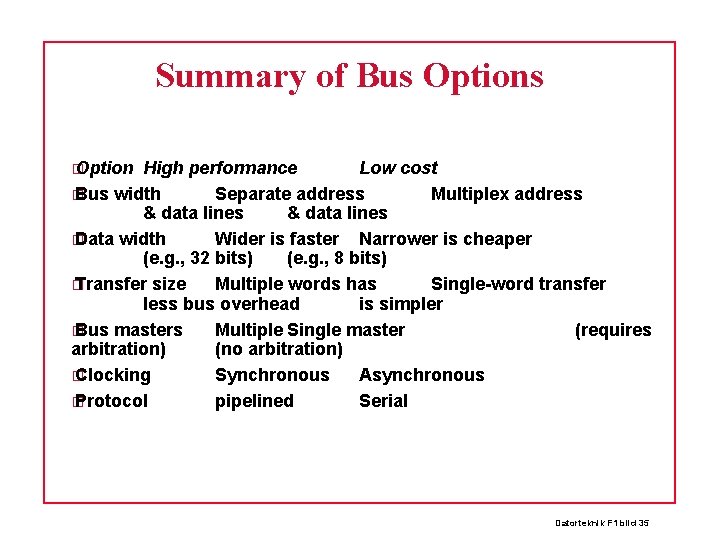
Summary of Bus Options � Option High performance Low cost � Bus width Separate address Multiplex address & data lines � Data width Wider is faster Narrower is cheaper (e. g. , 32 bits) (e. g. , 8 bits) � Transfer size Multiple words has Single-word transfer less bus overhead is simpler � Bus masters Multiple Single master (requires arbitration) (no arbitration) � Clocking Synchronous Asynchronous � Protocol pipelined Serial Datorteknik F 1 bild 35
- Slides: 35