
What is a Biome n n Definition major
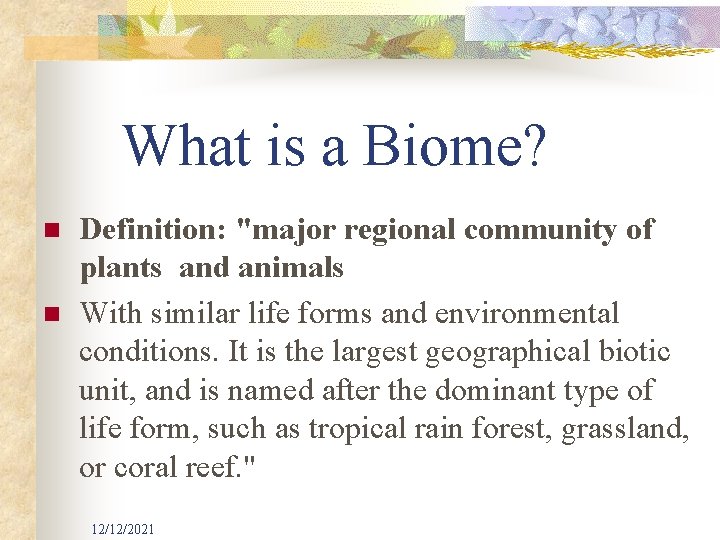
What is a Biome? n n Definition: "major regional community of plants and animals With similar life forms and environmental conditions. It is the largest geographical biotic unit, and is named after the dominant type of life form, such as tropical rain forest, grassland, or coral reef. " 12/12/2021
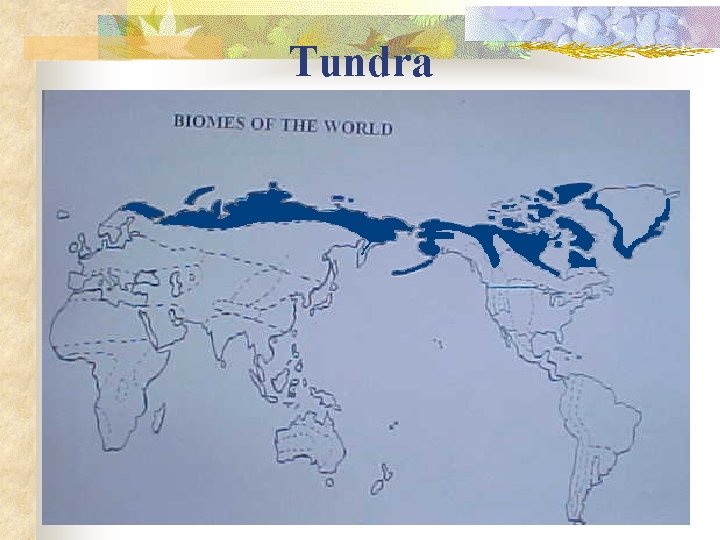
Tundra
Taiga
Temperate Deciduous Forest
Chaparral

Temperate Grassland
Desert
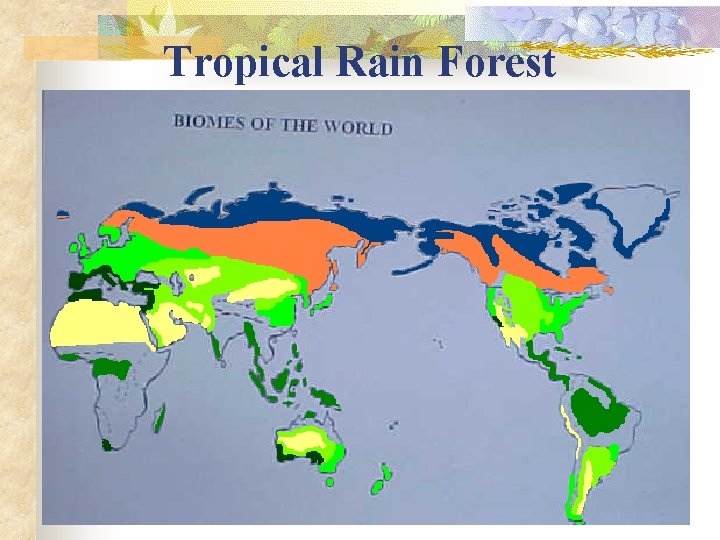
Tropical Rain Forest
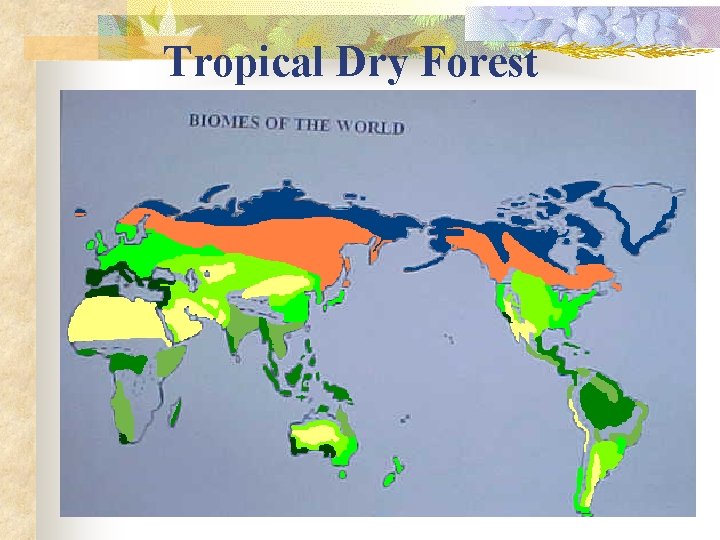
Tropical Dry Forest
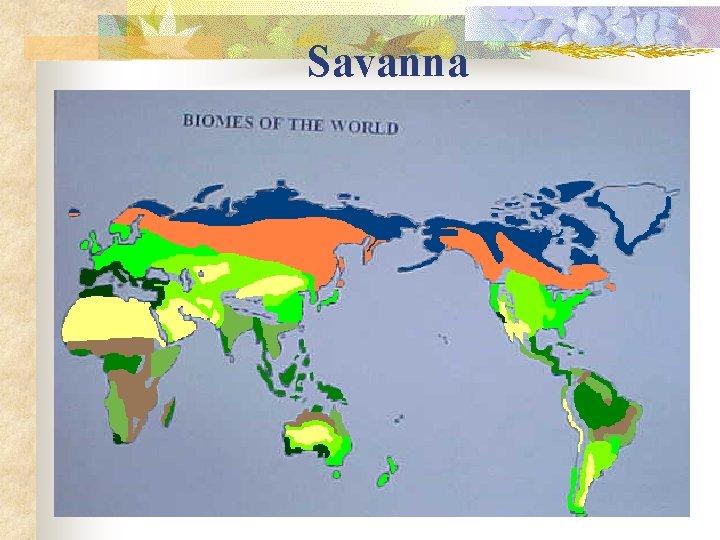
Savanna
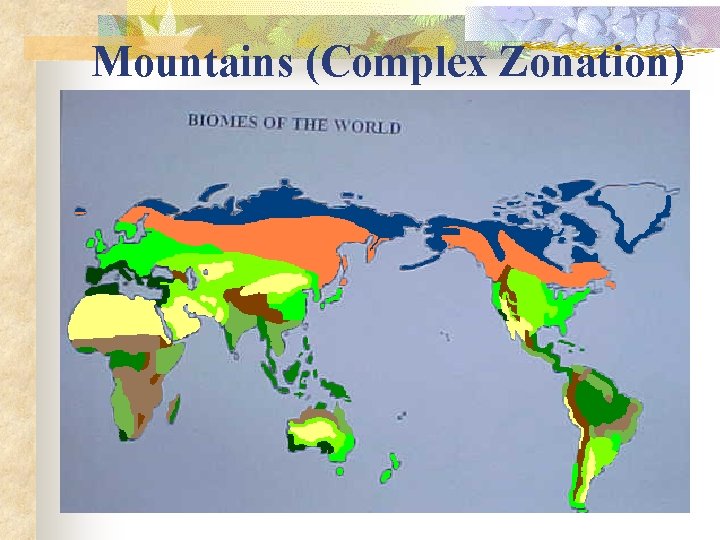
Mountains (Complex Zonation)
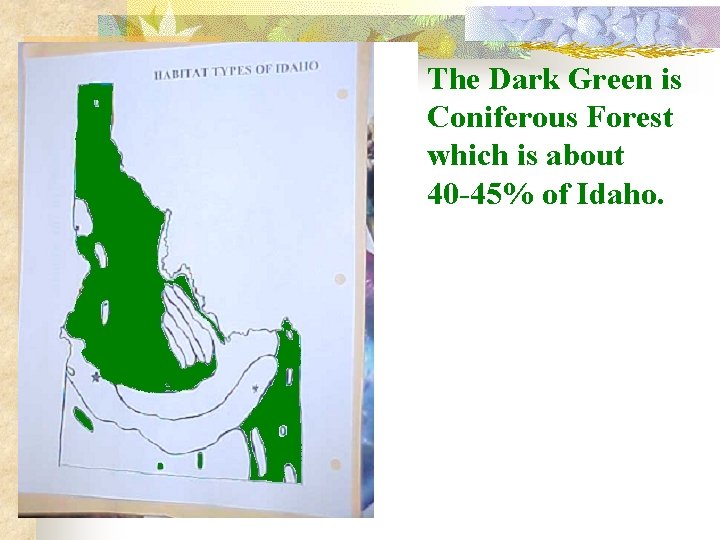
n The Dark Green is Coniferous Forest which is about 40 -45% of Idaho.
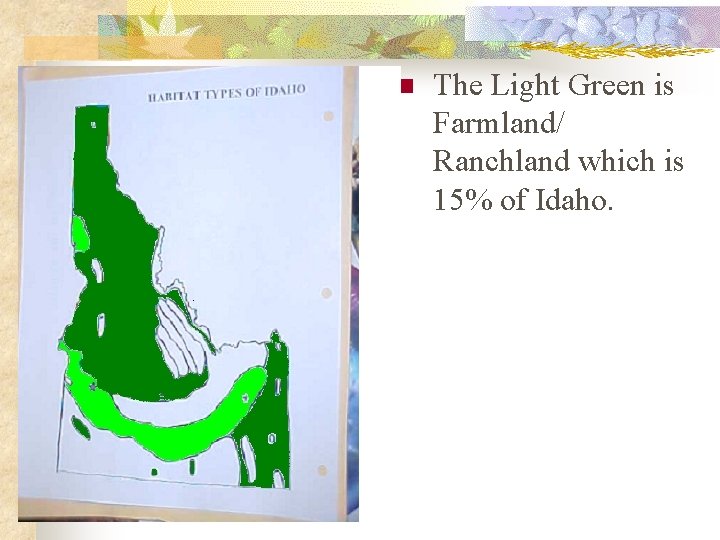
n The Light Green is Farmland/ Ranchland which is 15% of Idaho.
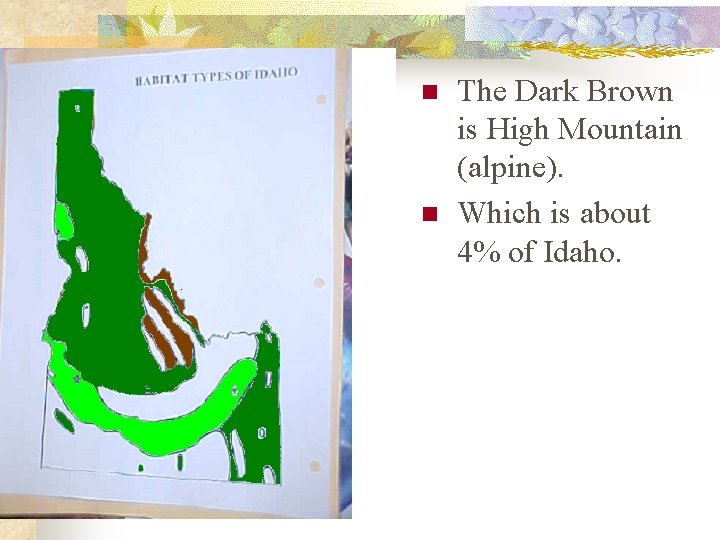
n n The Dark Brown is High Mountain (alpine). Which is about 4% of Idaho.

n Light Brown is Sagebrush/Grassland 34 -40%
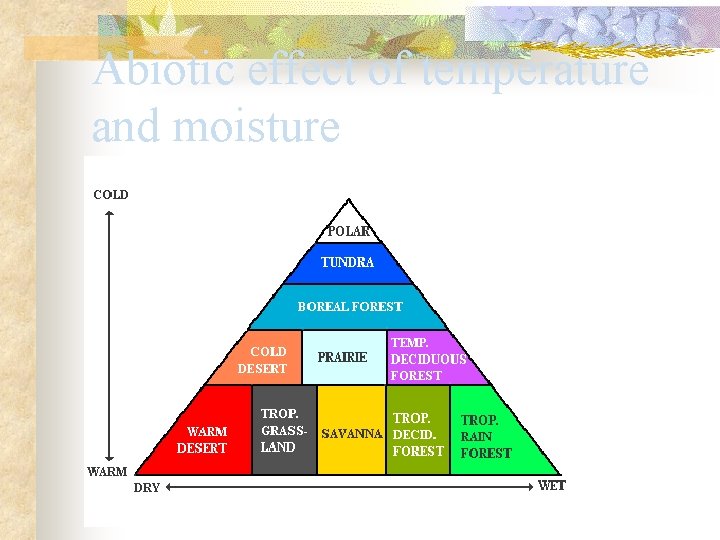
Abiotic effect of temperature and moisture

Forests • Boreal(Taiga) • Temperate Rain • Temperate Woodlands • Tropical Rain forest • Tropical/Seasonal Grasslands • Temperate Grasslands • Savannas • Prairies • Tropical scrub Chaparral Tundra • Artic/Ice Deserts
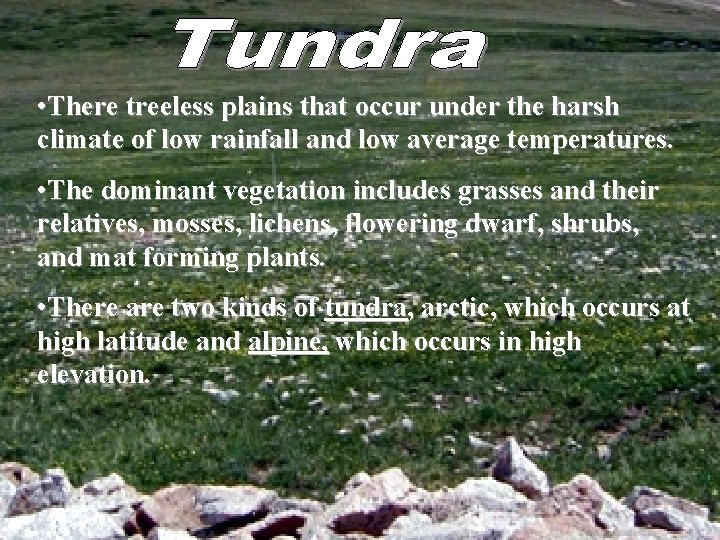
• There treeless plains that occur under the harsh climate of low rainfall and low average temperatures. • The dominant vegetation includes grasses and their relatives, mosses, lichens, flowering dwarf, shrubs, and mat forming plants. • There are two kinds of tundra, arctic, which occurs at high latitude and alpine, which occurs in high elevation.

n n A treeless land with long summer days and short periods of winter sunlight has a layer of permanently frozen ground called permafrost. Home to animals such as weasels, arctic foxes, snowshoe hares and caribou. Ecologically very fragile because it takes a lot of time to go back to normal 12/12/2021
Forest Biomes n Temperate n Boreal/Taiga n Temperate Rain n n Tropical Rain Temperate Woodlands n Tropical/Seasonal
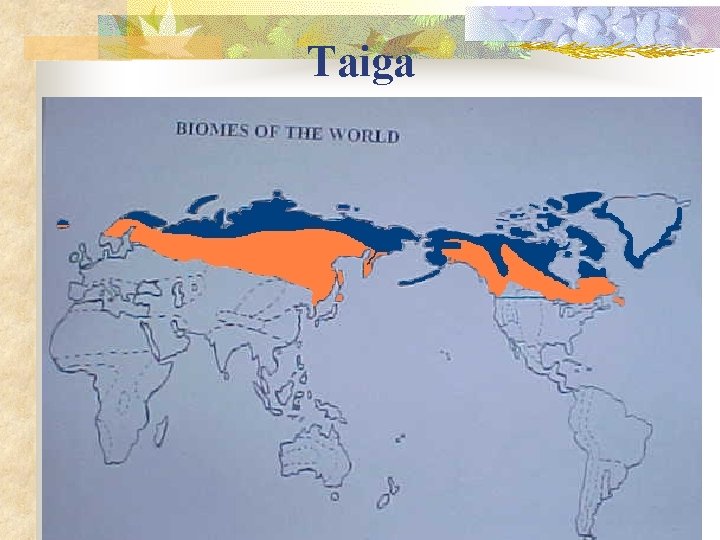
Taiga n n n Land of mixed pine, fir, hemlock, and spruce trees. Waterlogged soil in the summer, and full of snow in the winter. Has many rabbits and moose.

n n n Cold climates of high altitudes & latitudes. Land of mixed pine, fir, hemlock, and spruce trees. Dense with relatively small trees usually 30 m and under. Supply wood & paper pulp. Fires and environmental disturbances are common.
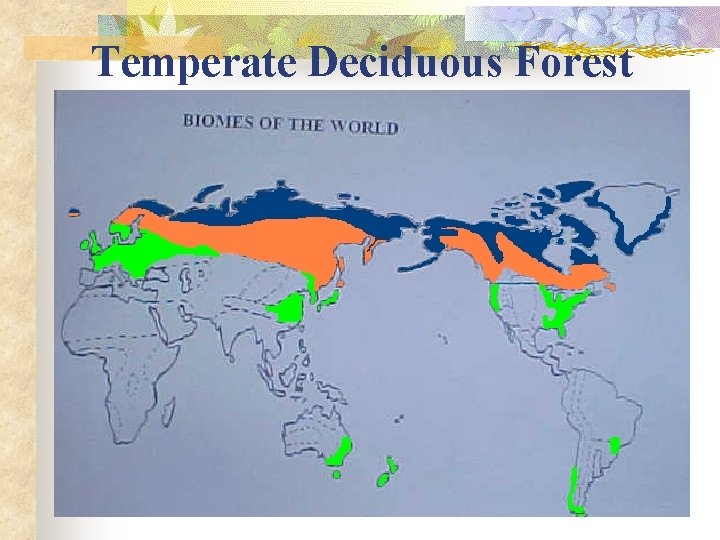
Temperate Forest n n Mostly broad leafed hard wood trees that lose leaves annually Have a wide variety of animals including squirrels deer bears and birds.

• These forest occur throughout North America, Eurasia and Japan and have many genera in common. • Dominant vegetation: deciduous trees; maples, beeches, oak, hickories and chestnuts. • Temperate deciduous forests are among the biomes most changed by human beings.
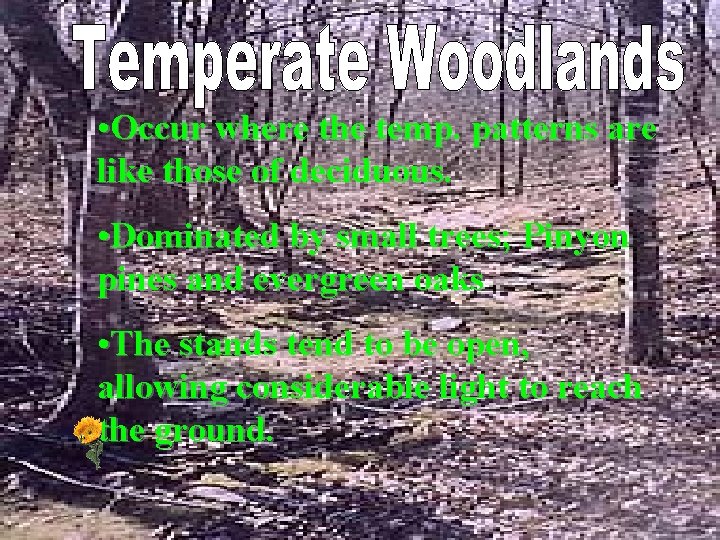
• Occur where the temp. patterns are like those of deciduous. • Dominated by small trees; Pinyon pines and evergreen oaks • The stands tend to be open, allowing considerable light to reach the ground.

Temperate woodlands n Temperate woodlands have much more hills and rock faces than other forests and usually different animals such as mountain goat.
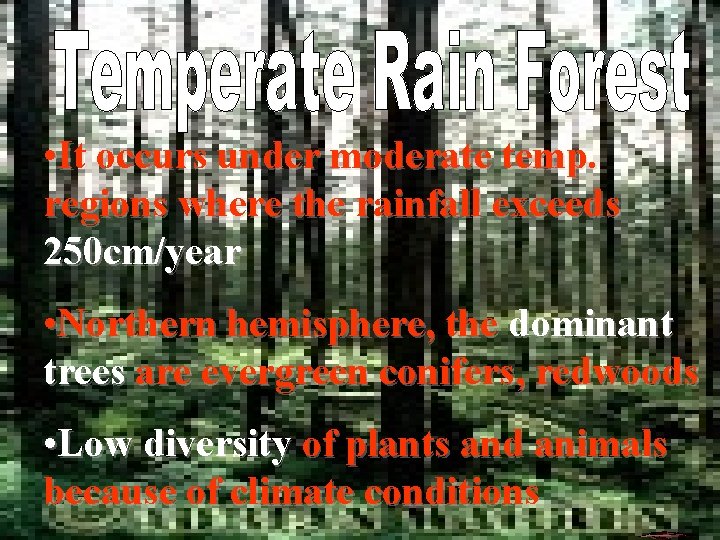
• It occurs under moderate temp. regions where the rainfall exceeds 250 cm/year • Northern hemisphere, the dominant trees are evergreen conifers, redwoods • Low diversity of plants and animals because of climate conditions
Tropical Rain Forest n n A region or uniformly warm, wet weather dominated by lush plant growth. Usually in the equatorial regions of the world. 200 cm of rainfall annually temperatures remain about 25 C Has a wide range of animals. 12/12/2021

• Temperature is high and relatively constant through the years. • Climates with rainfall distributed through the year are found in the tropical rain forest of South and Central America. • Most chemical elements(nutrients) are held in the living vegetation.

Rain Forests n Rain forests have a wide variety of plants and animals this is where many medicines like aspirin , caffeine and also many poisonous plants

• Occur where rainfall is high but very seasonal, in India and southeast Asia, Africa and South and Central America. • These include the savannas of Africa along with the grasslands. • Disturbances, including fires and the impact of herbivory on the vegetation.
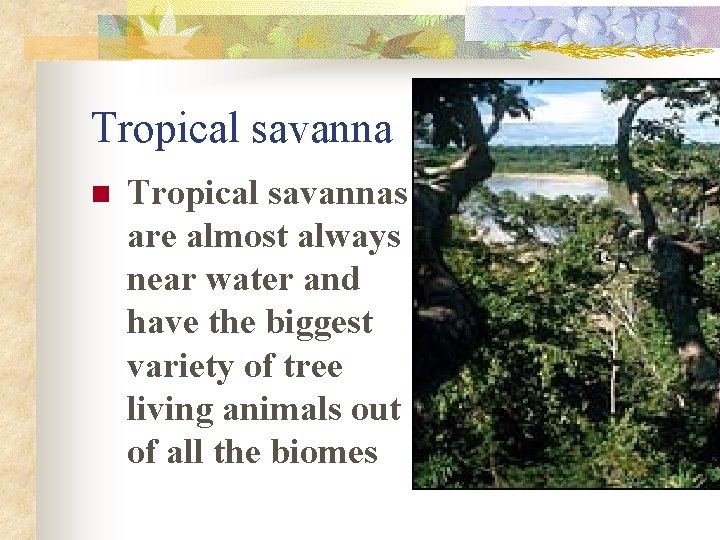
Tropical savanna n Tropical savannas are almost always near water and have the biggest variety of tree living animals out of all the biomes

• Occurs in regions too dry forests and too moist for deserts • A major biome in terms of area covered these grasslands include the great North American prairies. Contains the most large animals of any biome. • Soils often have a deep organic layer.

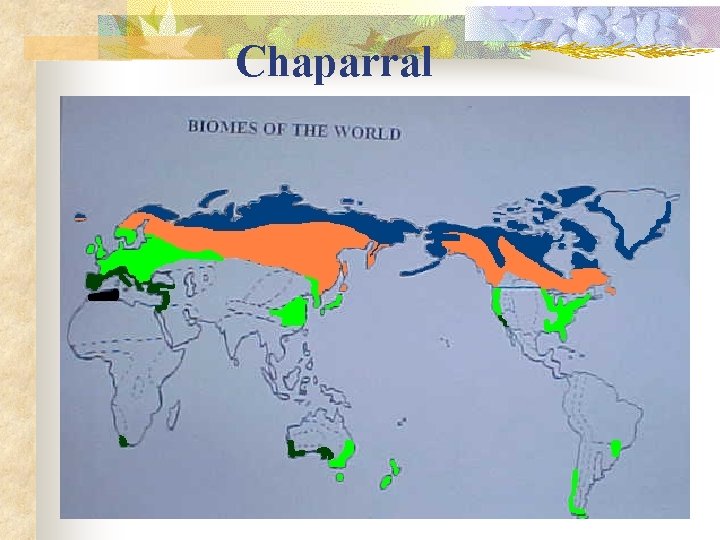
Temperate Shrub lands n n n Occur in still dry climates. Contain chaparral - mini woodland. Very small trees. Found on CA coast, in Chile, South Africa & the Mediterranean region. Aromatic veg. like sage. Important for watersheds and erosion control. Fires common from dryness.

• Contain chaparral - mini woodland. Very small trees. • Found on CA coast, in Chile, South Africa & the Mediterranean region. • Aromatic veg. like sage. Important for watersheds and erosion control. • Fires common from dryness • Aromatic veg. like sage

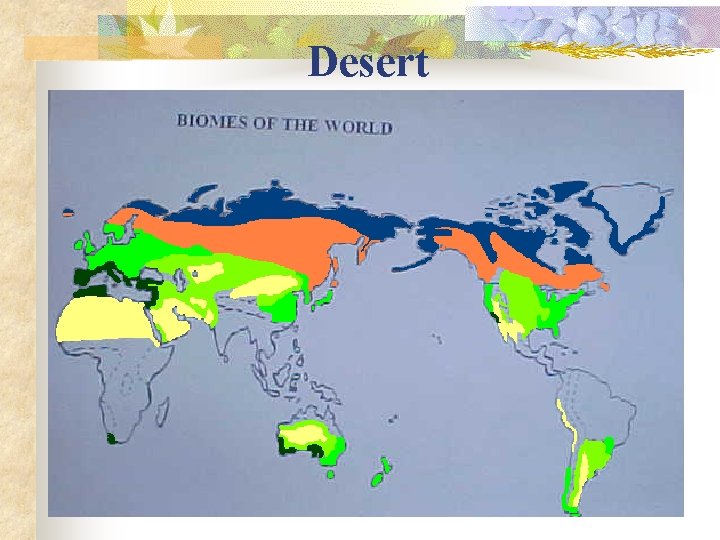
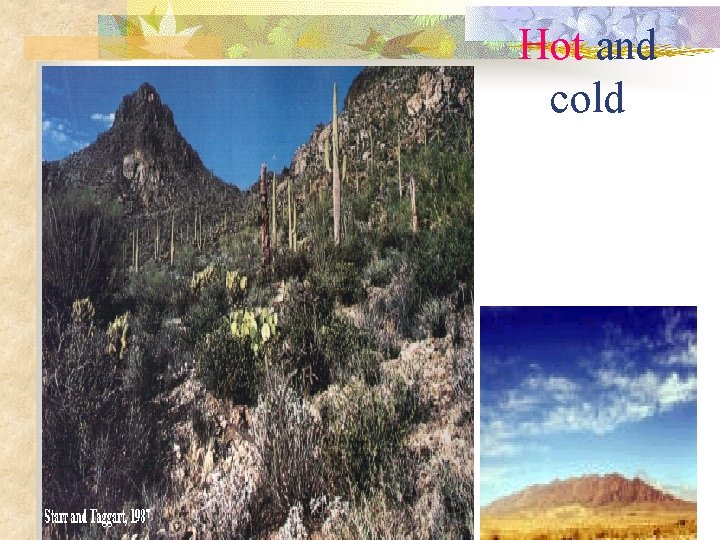
• Occur where the rainfall is less than 50/cm a year. • Most deserts have considerable amount of specialized vegetation. • Soils often have abundant nutrients but little or no organic matter and need only water to become very productive.

n n An arid region with sparse to almost nonexistence plant life. Very little animals live in the desert such as the kangaroo rat and the scorpion.
Hot and cold
Questions n n n Where is a temperate forest usually located? What kind of trees usually dominate in a temperate forest? What 4 letter word explains the desert area, hint starts with a A_ _ _ ?
- Slides: 42