
What inspires me Learning Cycle Karplus Their 1967

- Slides: 64
What inspires me? “Learning Cycle” (Karplus & Their, 1967; Renner &Stafford, 1972) l Learning for Use (Edelson, 2001) l http: //earth. geos. ntnu. edu. tw/
Learning Cycle Discovery Exploration Invention http: //earth. geos. ntnu. edu. tw/
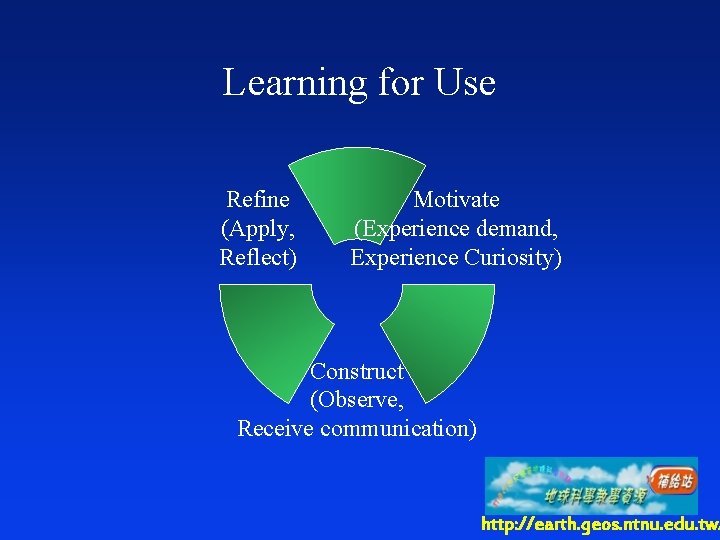
Learning for Use Refine (Apply, Reflect) Motivate (Experience demand, Experience Curiosity) Construct (Observe, Receive communication) http: //earth. geos. ntnu. edu. tw/
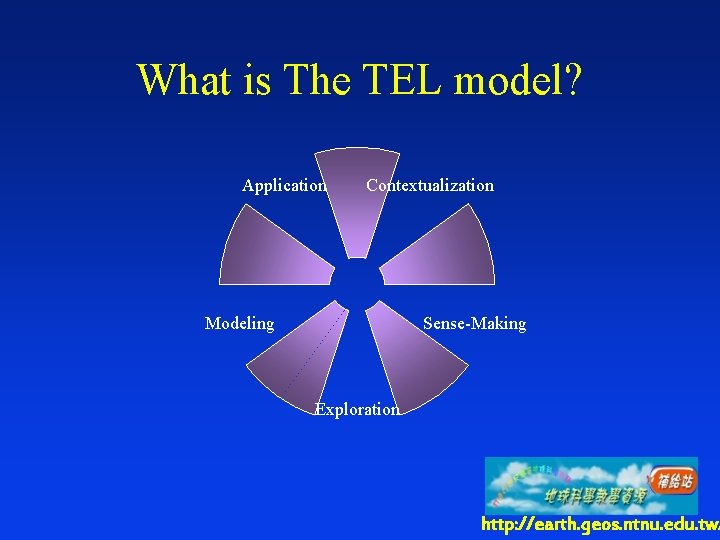
What is The TEL model? Application Contextualization Modeling Sense-Making Exploration http: //earth. geos. ntnu. edu. tw/
What is The TEL model? l Framework of “Technology Enhanced Learning” Model http: //earth. geos. ntnu. edu. tw/
Why do I propose a Model? l l Most science lesson plans and learning activities do not start from actual life experience. It is therefore not surprising that a majority of students cannot apply their school knowledge to solve problems in real-life situations. 能應用於真實情境中 The goal of the TEL model is to foster students’ acquisition of synthetic knowledge through meaningful learning by integrating technology into an inquiry-based learning environment. 透過科技引導學生進行科學探 究,而發展出統整性高的知識 http: //earth. geos. ntnu. edu. tw/
Why do I propose a Model? l l What are the most important cognitive processes in science learning? - Instead of focusing on how teachers should deliver information, this model emphasizes students’ active participation in learning activities in which they must develop and apply ideas. 提供學生可以主動學習和應用觀念的學習環境 What features and learning tools should be included in the model in order to engage students in the cognitive processes? 提供一個可增進學生認知發展的科技輔助學習活動 之設計架構 http: //earth. geos. ntnu. edu. tw/
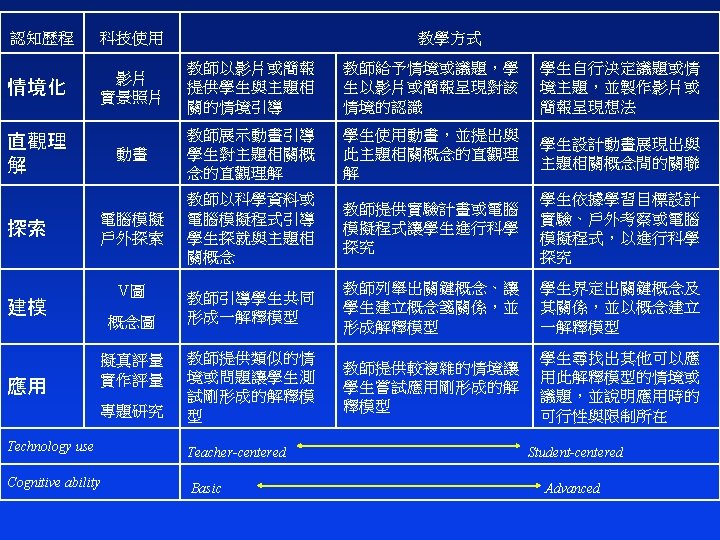
How to use TEL model? l Variations to use the TEL model http: //earth. geos. ntnu. edu. tw/
Using the TEL model for Conceptual Change l Computer-based simulations, animations and modeling tools have been used to promote conceptual change (Barnea & Dori, 1999; Dori & Barak, 2001; Monaghan & Clement, 1999; Tao & Gunstone, 1999; Whitelock, Feast, & Catchpole, 1991; Windschitl & Andre, 1998). http: //earth. geos. ntnu. edu. tw/
Background Most students have alternative conceptions related to seasons because they learn them from life experiences or books with incomplete explanations (Baxter, 1989). l In Taiwan, the topic of seasons is typically covered in fifth, sixth, tenth and eleventh grade textbooks. l http: //earth. geos. ntnu. edu. tw/
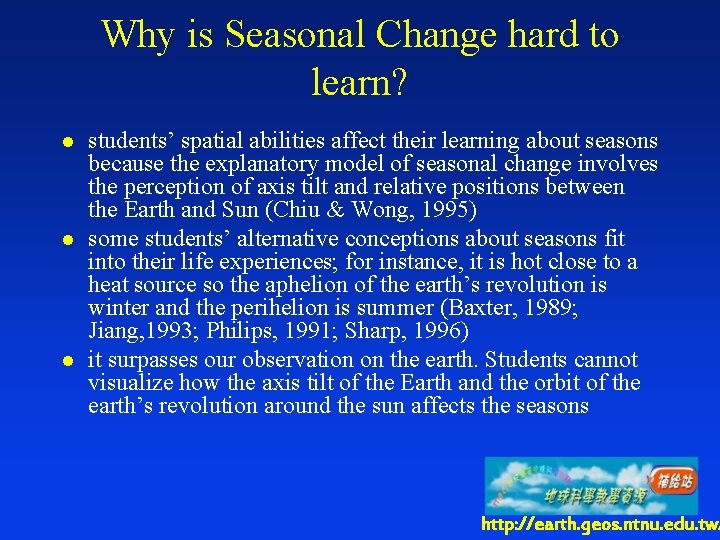
Why is Seasonal Change hard to learn? l l l students’ spatial abilities affect their learning about seasons because the explanatory model of seasonal change involves the perception of axis tilt and relative positions between the Earth and Sun (Chiu & Wong, 1995) some students’ alternative conceptions about seasons fit into their life experiences; for instance, it is hot close to a heat source so the aphelion of the earth’s revolution is winter and the perihelion is summer (Baxter, 1989; Jiang, 1993; Philips, 1991; Sharp, 1996) it surpasses our observation on the earth. Students cannot visualize how the axis tilt of the Earth and the orbit of the earth’s revolution around the sun affects the seasons http: //earth. geos. ntnu. edu. tw/
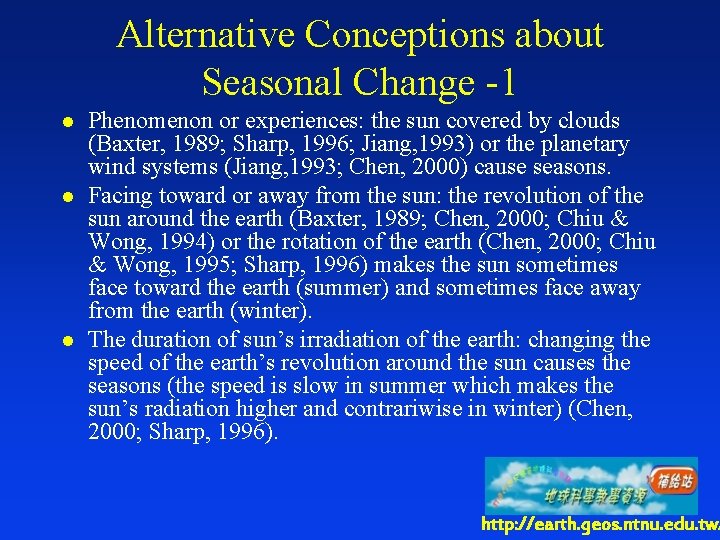
Alternative Conceptions about Seasonal Change -1 l l l Phenomenon or experiences: the sun covered by clouds (Baxter, 1989; Sharp, 1996; Jiang, 1993) or the planetary wind systems (Jiang, 1993; Chen, 2000) cause seasons. Facing toward or away from the sun: the revolution of the sun around the earth (Baxter, 1989; Chen, 2000; Chiu & Wong, 1994) or the rotation of the earth (Chen, 2000; Chiu & Wong, 1995; Sharp, 1996) makes the sun sometimes face toward the earth (summer) and sometimes face away from the earth (winter). The duration of sun’s irradiation of the earth: changing the speed of the earth’s revolution around the sun causes the seasons (the speed is slow in summer which makes the sun’s radiation higher and contrariwise in winter) (Chen, 2000; Sharp, 1996). http: //earth. geos. ntnu. edu. tw/
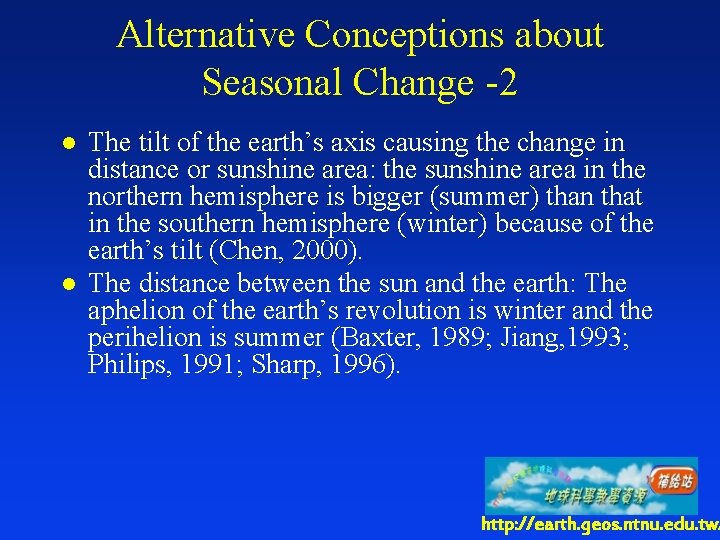
Alternative Conceptions about Seasonal Change -2 l l The tilt of the earth’s axis causing the change in distance or sunshine area: the sunshine area in the northern hemisphere is bigger (summer) than that in the southern hemisphere (winter) because of the earth’s tilt (Chen, 2000). The distance between the sun and the earth: The aphelion of the earth’s revolution is winter and the perihelion is summer (Baxter, 1989; Jiang, 1993; Philips, 1991; Sharp, 1996). http: //earth. geos. ntnu. edu. tw/
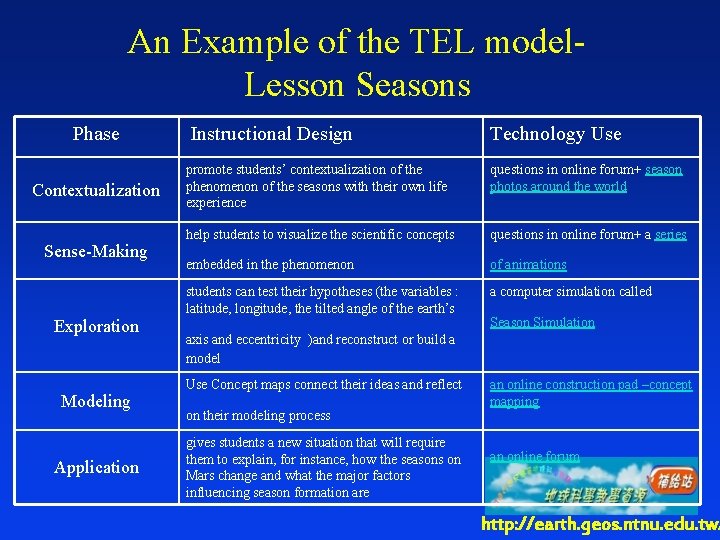
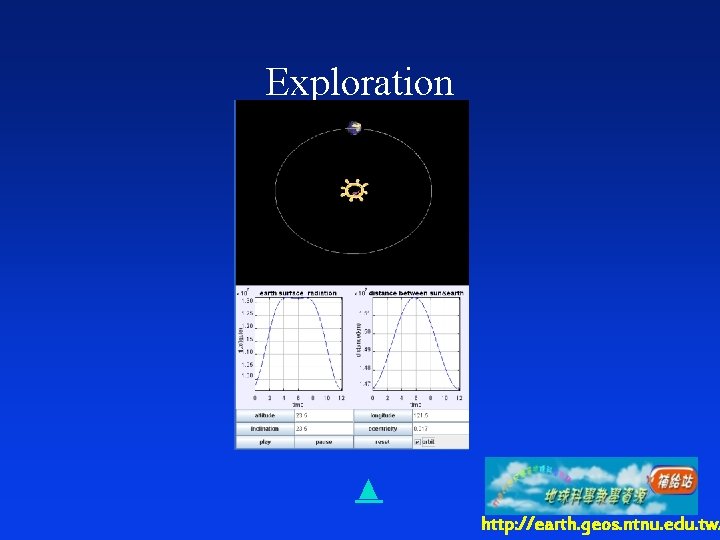
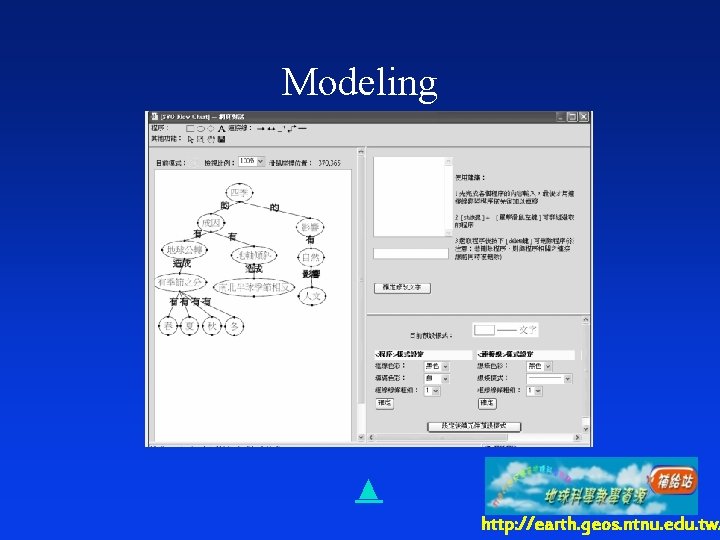
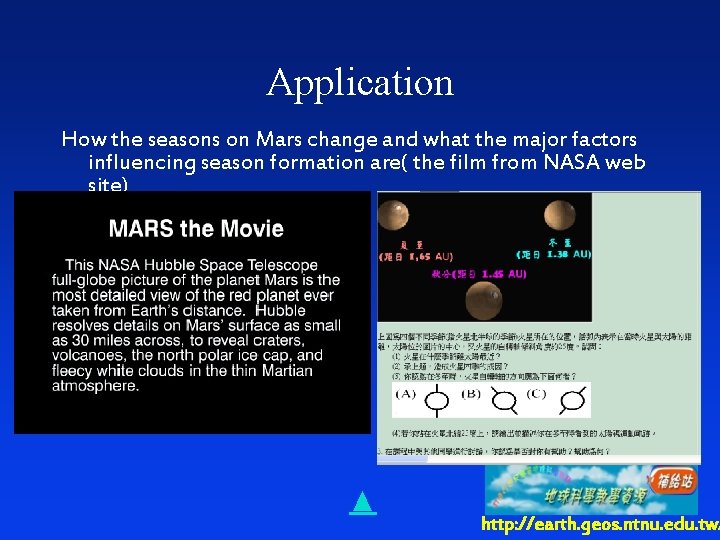
An Example of the TEL model. Lesson Seasons Phase Contextualization Sense-Making Exploration Modeling Application Instructional Design Technology Use promote students’ contextualization of the phenomenon of the seasons with their own life experience questions in online forum+ season photos around the world help students to visualize the scientific concepts questions in online forum+ a series embedded in the phenomenon of animations students can test their hypotheses (the variables : latitude, longitude, the tilted angle of the earth’s a computer simulation called Season Simulation axis and eccentricity )and reconstruct or build a model Use Concept maps connect their ideas and reflect on their modeling process gives students a new situation that will require them to explain, for instance, how the seasons on Mars change and what the major factors influencing season formation are an online construction pad –concept mapping an online forum http: //earth. geos. ntnu. edu. tw/
系列研究 l l l Identify students’ alternative frameworks (Misconceptions) Integrate teaching strategies into the TEL model based on students’ alternative frameworks examine the efforts of the TEL model in conceptual change (RISE) Identify certain characteristics in teaching and learning and examine them using experimental design investigate the effects of these learning activities on cognitive growth in different instructional stages: intuitive understanding stage (contextualization and sense-making) and relation construction stage (exploration and modeling). (Science Education) between a teacher-guided (TG) class (with whole-class presentations) and a student-centered (SC) class http: //earth. geos. ntnu. edu. tw/
Study I: The TEL model vs. Conceptual Change Purpose: Explore how a TEL environment promotes students’ conceptual understanding about reasons for the seasons l Research Question: What conceptions about the seasonal change do student have before and after learning with the Lessons Seasons? l http: //earth. geos. ntnu. edu. tw/
Method 76 grade 11 senior high school students at a public senior high school located in the north of Taiwan l used a pre-test/post-test (concept mapping) design associated with semi-structured interviews l http: //earth. geos. ntnu. edu. tw/
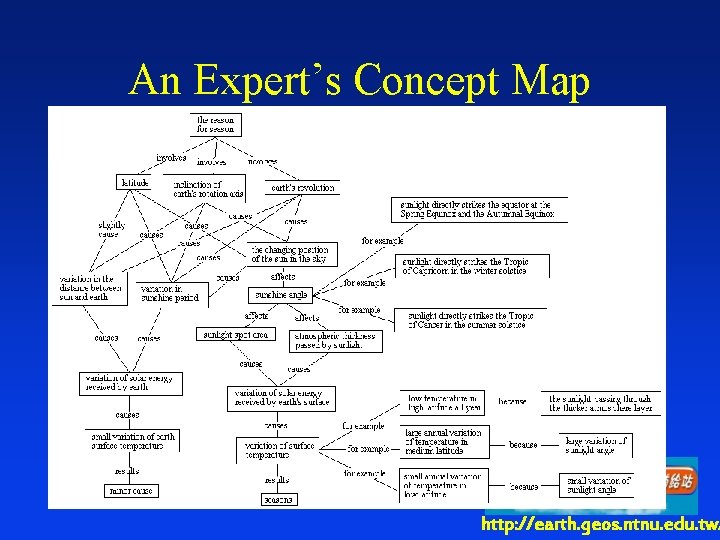
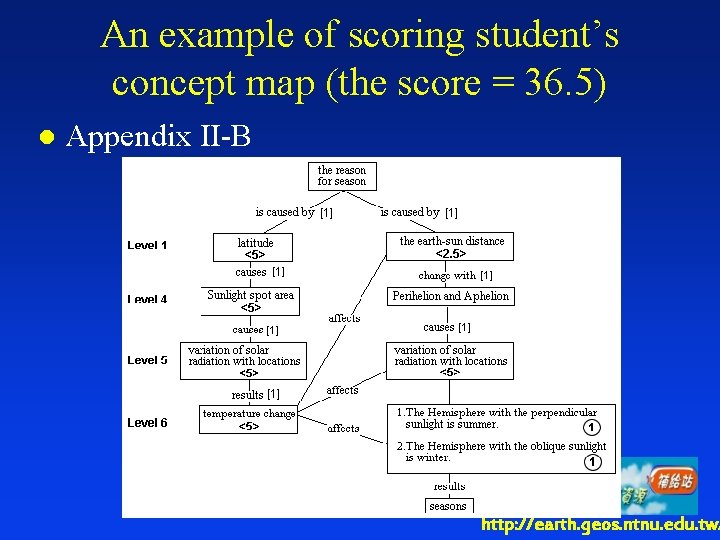
Scoring Concept Maps l l l Students’ concept maps were scored by comparing them with an expert’s concept map The scoring rules ( Novak & Gowin, 1984) on propositions, hierarchy, cross links and examples: – 1 point for each correct proposition and 0. 5 point for an unclear proposition using indefinite linkages or vague concepts. – Each correct hierarchy scored 5 points. If a hierarchy included a correct node, a student would earn 1 point but lose an extra 2 points for each wrong node. – Each meaningful cross link scored 10 points and each correct example scored 1 point. The inter-person reliability of the concept map scoring was. 84. http: //earth. geos. ntnu. edu. tw/
An Expert’s Concept Map http: //earth. geos. ntnu. edu. tw/
An example of scoring student’s concept map (the score = 36. 5) l Appendix II-B http: //earth. geos. ntnu. edu. tw/
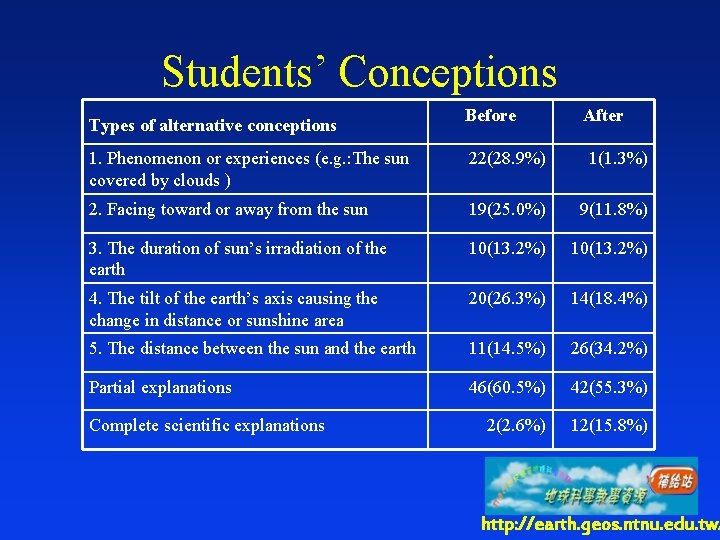
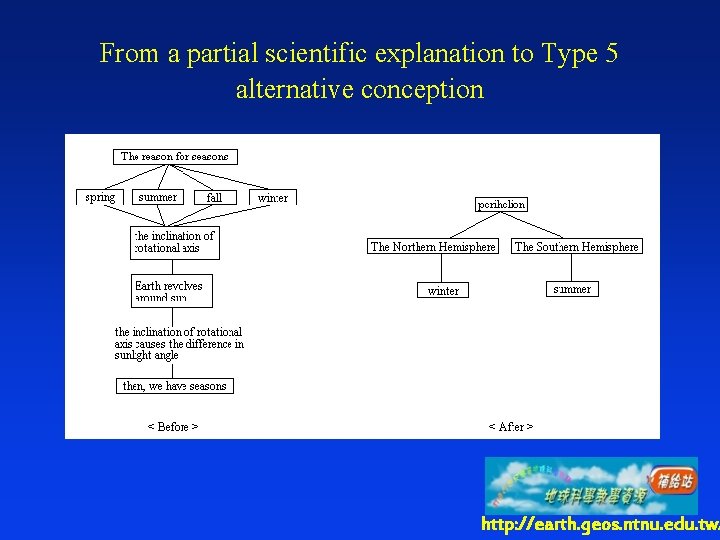
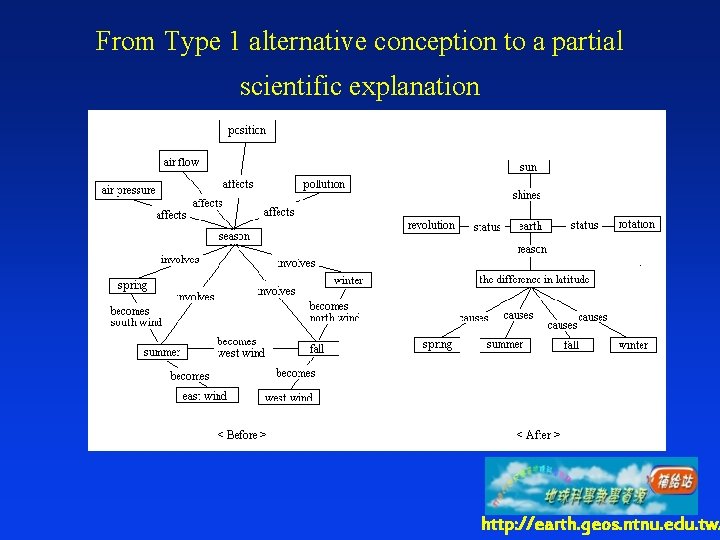
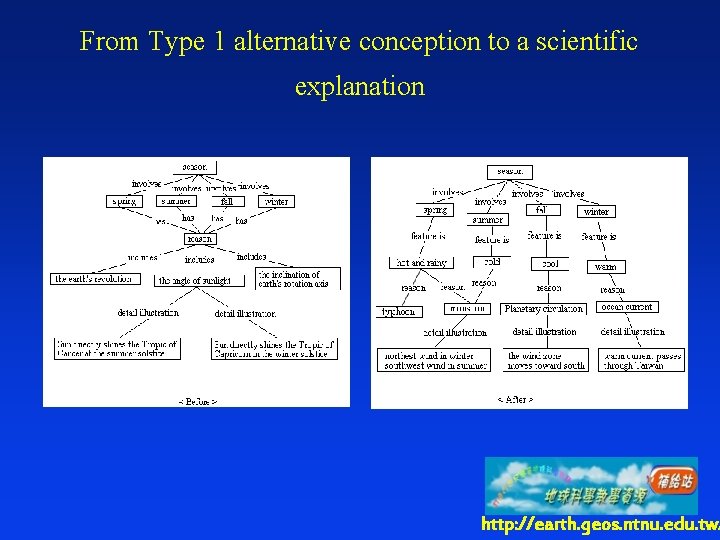
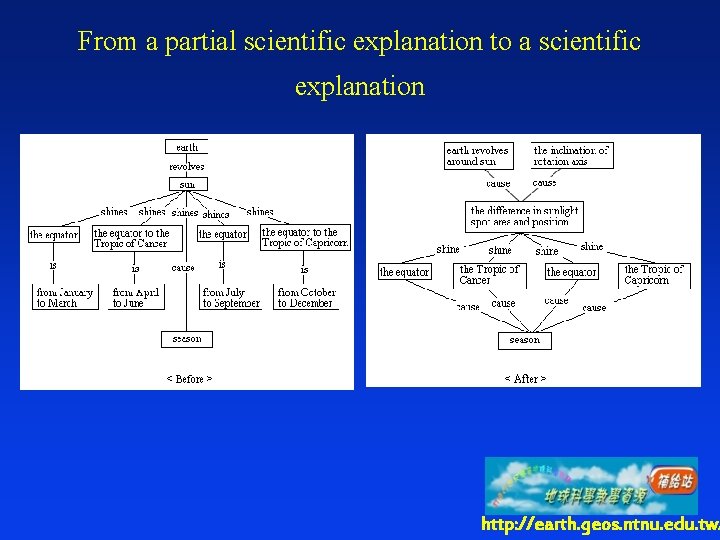
Students’ Conceptions Types of alternative conceptions Before After 1. Phenomenon or experiences (e. g. : The sun covered by clouds ) 22(28. 9%) 1(1. 3%) 2. Facing toward or away from the sun 19(25. 0%) 9(11. 8%) 3. The duration of sun’s irradiation of the earth 10(13. 2%) 4. The tilt of the earth’s axis causing the change in distance or sunshine area 20(26. 3%) 14(18. 4%) 5. The distance between the sun and the earth 11(14. 5%) 26(34. 2%) Partial explanations 46(60. 5%) 42(55. 3%) 2(2. 6%) 12(15. 8%) Complete scientific explanations http: //earth. geos. ntnu. edu. tw/
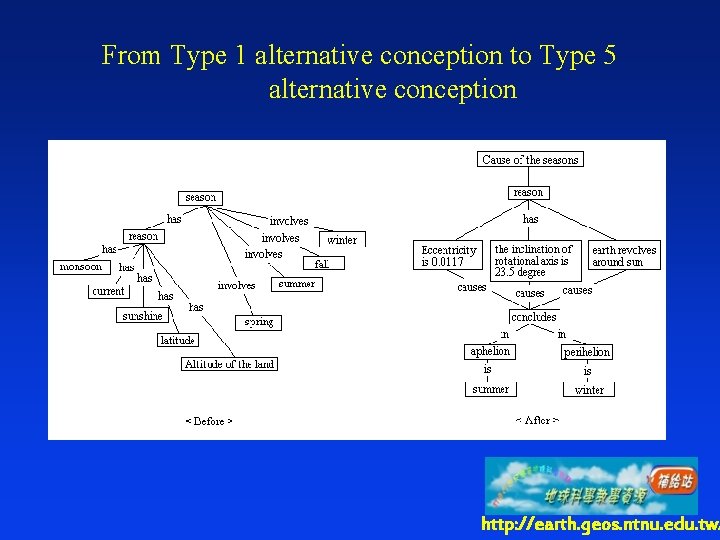
From Type 1 alternative conception to Type 5 alternative conception http: //earth. geos. ntnu. edu. tw/
From a partial scientific explanation to Type 5 alternative conception http: //earth. geos. ntnu. edu. tw/
From Type 1 alternative conception to a partial scientific explanation http: //earth. geos. ntnu. edu. tw/
From Type 1 alternative conception to a scientific explanation http: //earth. geos. ntnu. edu. tw/
From a partial scientific explanation to a scientific explanation http: //earth. geos. ntnu. edu. tw/
Results l l l The number of alternative conceptions held by students were reduced except for the incorrect concepts of “the length of sunshine” and “the distance between the sun and the earth. ” The unsuccessful students could not remediate their alternative conceptions without explicit guidance and scaffolding. Future research can then be focused on understanding how to provide proper scaffoldings for removing some alternative concepts which are highly resistant to change. http: //earth. geos. ntnu. edu. tw/
Study II: Comparison Study Among Teaching Approaches: Seasons l Purpose: This study attempted to explore the ways in which two different instructional approaches in technology-enhanced environments including teacher-guided and student-centered approaches affect or impact on students’ conceptual understanding of seasons as commonly taught in Earth Science classes. http: //earth. geos. ntnu. edu. tw/
Research Questions l l What conceptual changes do students move through, in trying to understand the reasons for seasons, when presented with various instructional approaches in technology–enhanced learning environments? What are the effects of the instructional design on students’ conceptual change, as they try to understand the reasons for seasons? http: //earth. geos. ntnu. edu. tw/
Participants included 83 eleventh-grade senior high-school students attending earth science classes at a public senior high school located in the north region of Taiwan. These students were typical of eleventh graders, with a mean age of 17. l 44 for TG (10 males and 34 females), and 43 for SC mode (12 males and 31 females). l http: //earth. geos. ntnu. edu. tw/
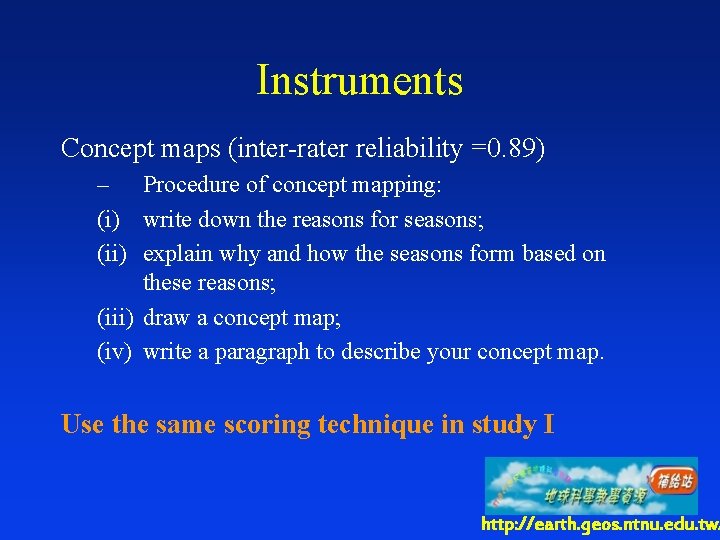
Instruments Concept maps (inter-rater reliability =0. 89) – Procedure of concept mapping: (i) write down the reasons for seasons; (ii) explain why and how the seasons form based on these reasons; (iii) draw a concept map; (iv) write a paragraph to describe your concept map. Use the same scoring technique in study I http: //earth. geos. ntnu. edu. tw/
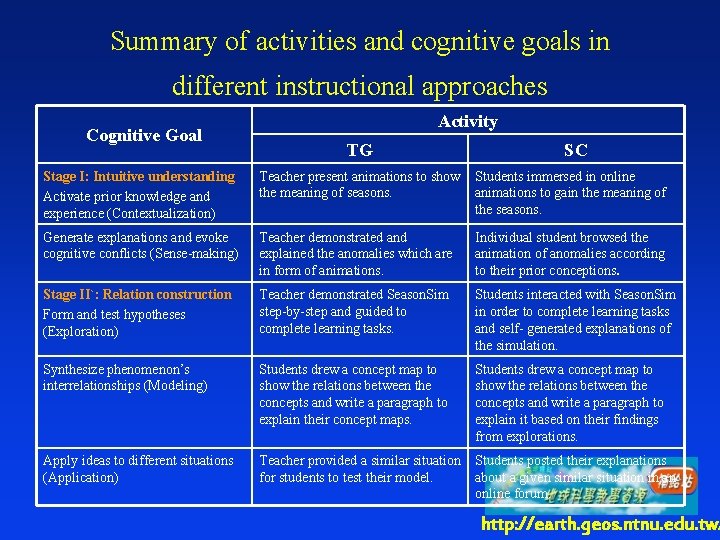
Summary of activities and cognitive goals in different instructional approaches Cognitive Goal Activity TG SC Stage I: Intuitive understanding Activate prior knowledge and experience (Contextualization) Teacher present animations to show the meaning of seasons. Students immersed in online animations to gain the meaning of the seasons. Generate explanations and evoke cognitive conflicts (Sense-making) Teacher demonstrated and explained the anomalies which are in form of animations. Individual student browsed the animation of anomalies according to their prior conceptions. Stage II`: Relation construction Form and test hypotheses (Exploration) Teacher demonstrated Season. Sim step-by-step and guided to complete learning tasks. Students interacted with Season. Sim in order to complete learning tasks and self- generated explanations of the simulation. Synthesize phenomenon’s interrelationships (Modeling) Students drew a concept map to show the relations between the concepts and write a paragraph to explain their concept maps. Students drew a concept map to show the relations between the concepts and write a paragraph to explain it based on their findings from explorations. Apply ideas to different situations (Application) Teacher provided a similar situation for students to test their model. Students posted their explanations about a given similar situation in an online forum. http: //earth. geos. ntnu. edu. tw/
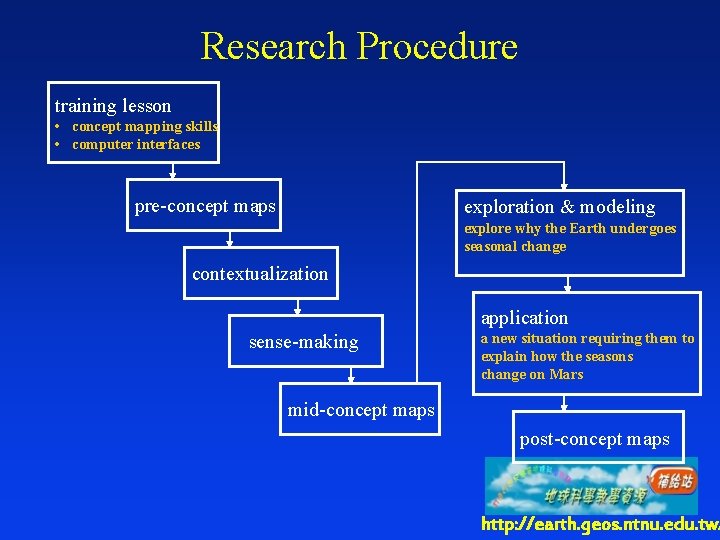
Research Procedure training lesson • concept mapping skills • computer interfaces pre-concept maps exploration & modeling explore why the Earth undergoes seasonal change contextualization application sense-making a new situation requiring them to explain how the seasons change on Mars mid-concept maps post-concept maps http: //earth. geos. ntnu. edu. tw/
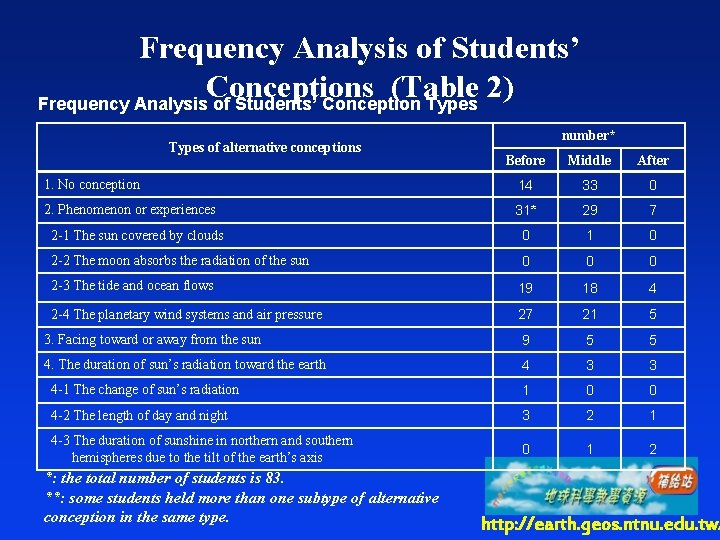
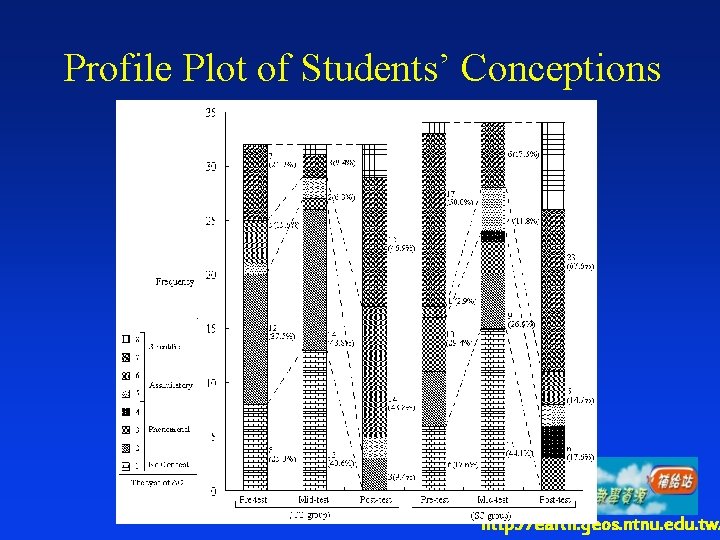
Frequency Analysis of Students’ Conceptions (Table 2) Frequency Analysis of Students’ Conception Types of alternative conceptions number* Before Middle After 1. No conception 14 33 0 2. Phenomenon or experiences 31* 29 7 2 -1 The sun covered by clouds 0 1 0 2 -2 The moon absorbs the radiation of the sun 0 0 0 2 -3 The tide and ocean flows 19 18 4 2 -4 The planetary wind systems and air pressure 27 21 5 3. Facing toward or away from the sun 9 5 5 4. The duration of sun’s radiation toward the earth 4 3 3 4 -1 The change of sun’s radiation 1 0 0 4 -2 The length of day and night 3 2 1 4 -3 The duration of sunshine in northern and southern hemispheres due to the tilt of the earth’s axis 0 1 2 *: the total number of students is 83. **: some students held more than one subtype of alternative conception in the same type. http: //earth. geos. ntnu. edu. tw/
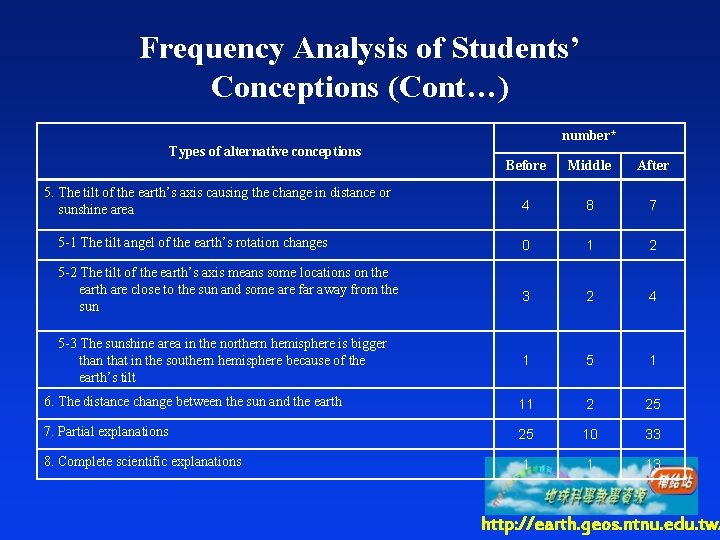
Frequency Analysis of Students’ Conceptions (Cont…) number* Types of alternative conceptions Before Middle After 4 8 7 5 -1 The tilt angel of the earth’s rotation changes 0 1 2 5 -2 The tilt of the earth’s axis means some locations on the earth are close to the sun and some are far away from the sun 3 2 4 5 -3 The sunshine area in the northern hemisphere is bigger than that in the southern hemisphere because of the earth’s tilt 1 5 1 6. The distance change between the sun and the earth 11 2 25 7. Partial explanations 25 10 33 8. Complete scientific explanations 1 1 13 5. The tilt of the earth’s axis causing the change in distance or sunshine area http: //earth. geos. ntnu. edu. tw/
Profile Plot of Students’ Conceptions http: //earth. geos. ntnu. edu. tw/
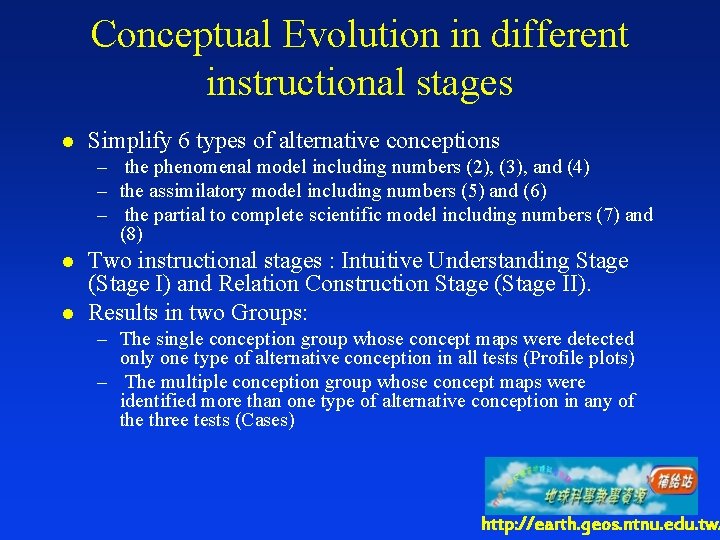
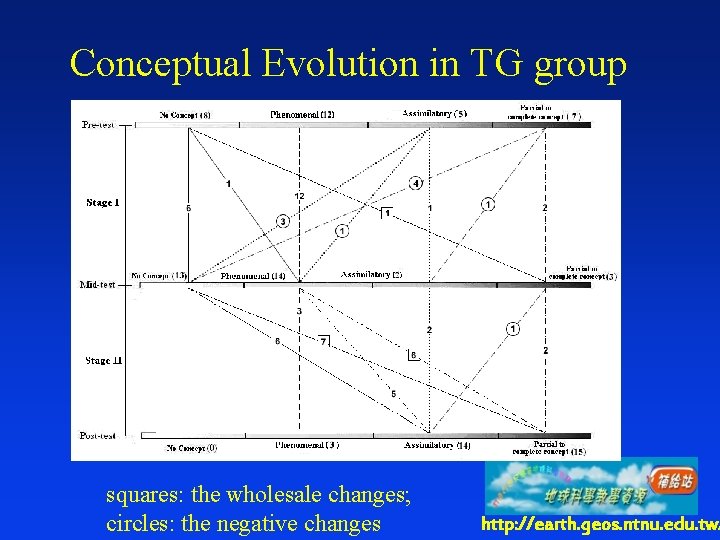
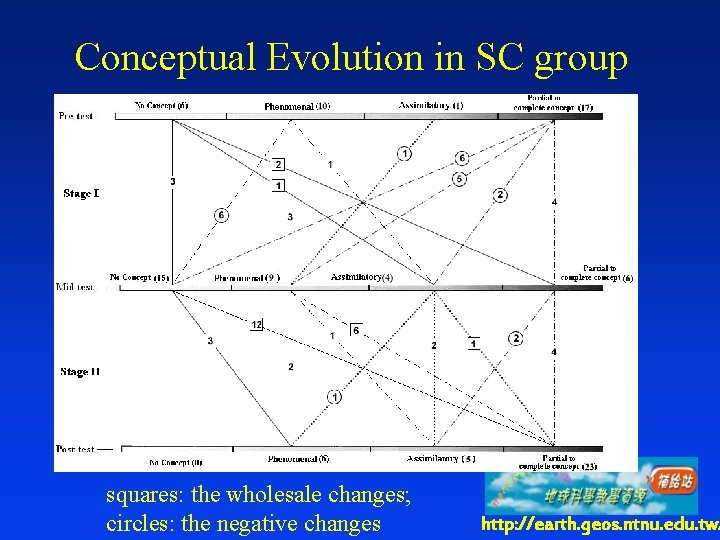
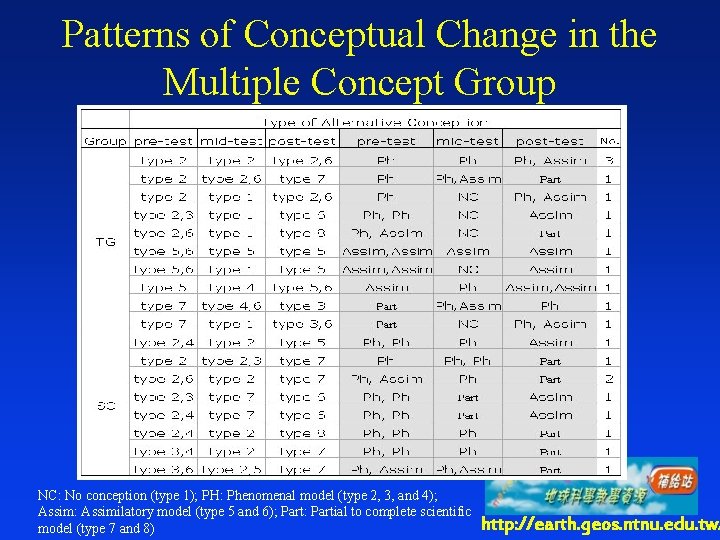
Conceptual Evolution in different instructional stages l Simplify 6 types of alternative conceptions – the phenomenal model including numbers (2), (3), and (4) – the assimilatory model including numbers (5) and (6) – the partial to complete scientific model including numbers (7) and (8) l l Two instructional stages : Intuitive Understanding Stage (Stage I) and Relation Construction Stage (Stage II). Results in two Groups: – The single conception group whose concept maps were detected only one type of alternative conception in all tests (Profile plots) – The multiple conception group whose concept maps were identified more than one type of alternative conception in any of the three tests (Cases) http: //earth. geos. ntnu. edu. tw/
Conceptual Evolution in TG group squares: the wholesale changes; circles: the negative changes http: //earth. geos. ntnu. edu. tw/
Conceptual Evolution in SC group squares: the wholesale changes; circles: the negative changes http: //earth. geos. ntnu. edu. tw/
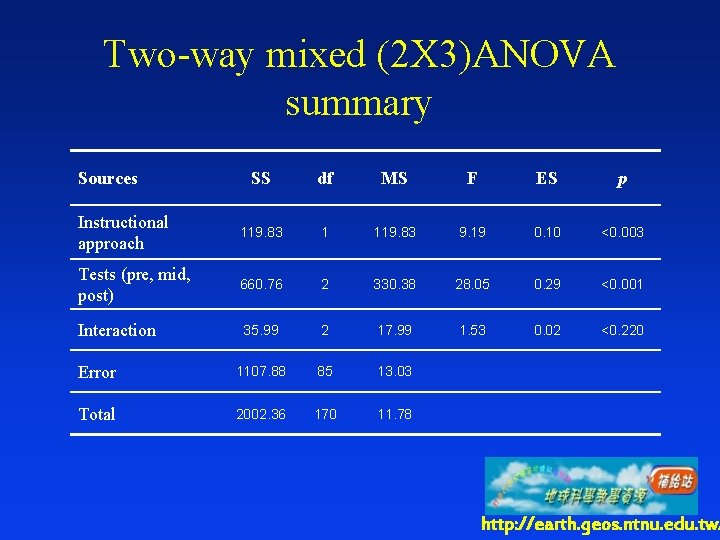
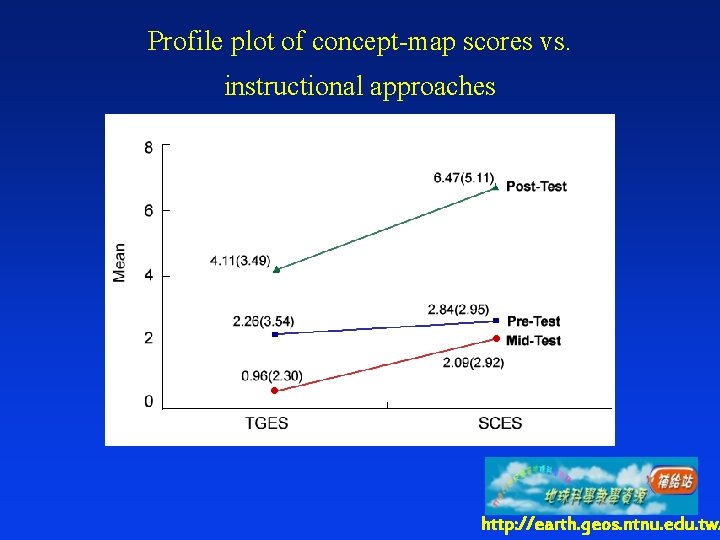
Two-way mixed (2 X 3)ANOVA summary Sources SS df MS F ES p Instructional approach 119. 83 1 119. 83 9. 19 0. 10 <0. 003 Tests (pre, mid, post) 660. 76 2 330. 38 28. 05 0. 29 <0. 001 Interaction 35. 99 2 17. 99 1. 53 0. 02 <0. 220 Error 1107. 88 85 13. 03 Total 2002. 36 170 11. 78 http: //earth. geos. ntnu. edu. tw/
Profile plot of concept-map scores vs. instructional approaches http: //earth. geos. ntnu. edu. tw/
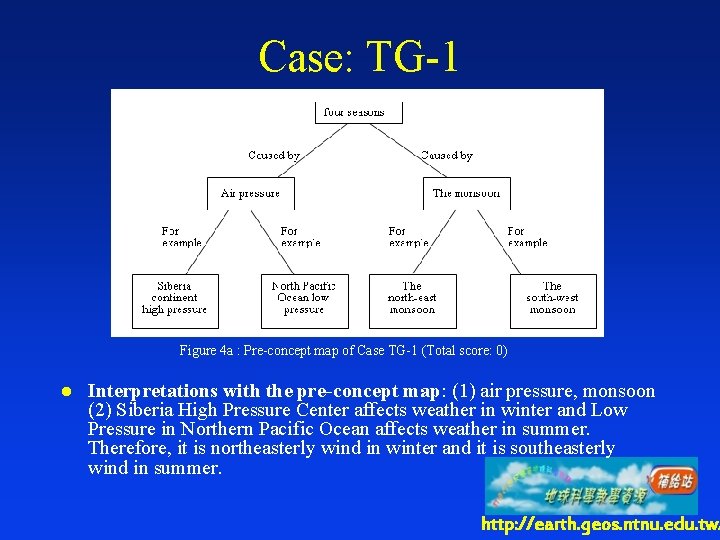
Case: TG-1 Figure 4 a : Pre-concept map of Case TG-1 (Total score: 0) l Interpretations with the pre-concept map: (1) air pressure, monsoon (2) Siberia High Pressure Center affects weather in winter and Low Pressure in Northern Pacific Ocean affects weather in summer. Therefore, it is northeasterly wind in winter and it is southeasterly wind in summer. http: //earth. geos. ntnu. edu. tw/
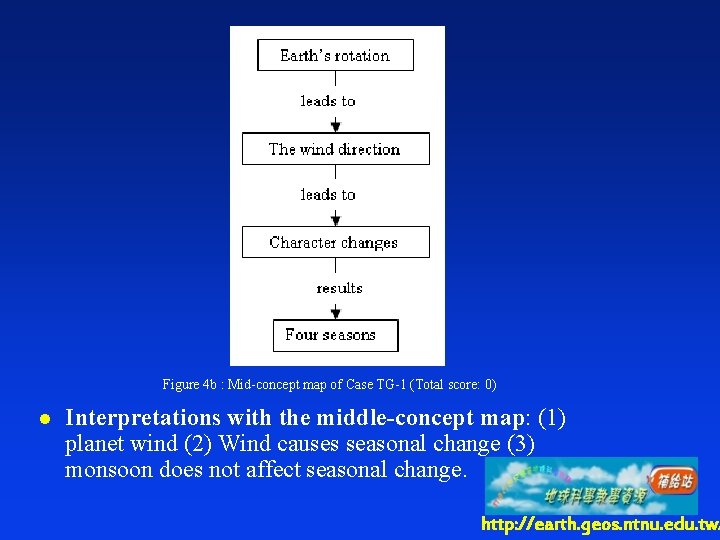
Figure 4 b : Mid-concept map of Case TG-1 (Total score: 0) l Interpretations with the middle-concept map: (1) planet wind (2) Wind causes seasonal change (3) monsoon does not affect seasonal change. http: //earth. geos. ntnu. edu. tw/
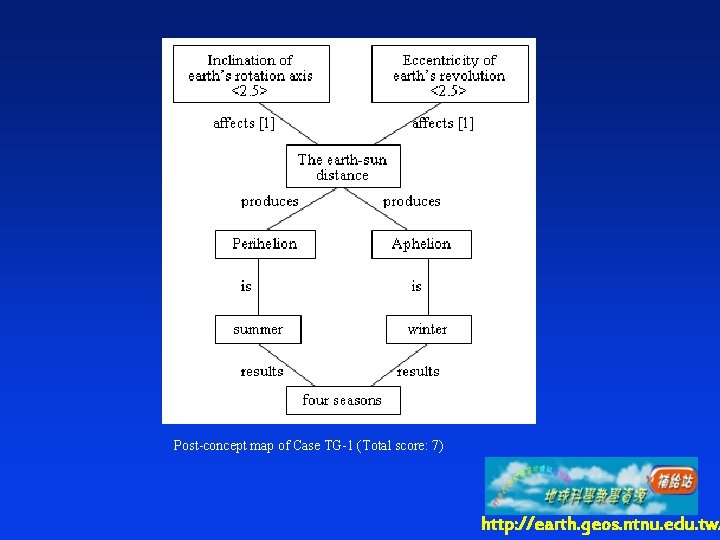
Post-concept map of Case TG-1 (Total score: 7) http: //earth. geos. ntnu. edu. tw/
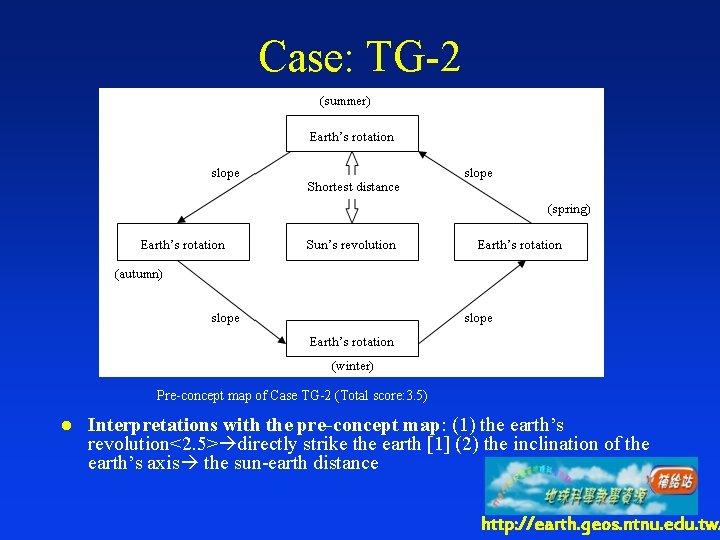
Case: TG-2 Pre-concept map of Case TG-2 (Total score: 3. 5) l Interpretations with the pre-concept map: (1) the earth’s revolution<2. 5> directly strike the earth [1] (2) the inclination of the earth’s axis the sun-earth distance http: //earth. geos. ntnu. edu. tw/
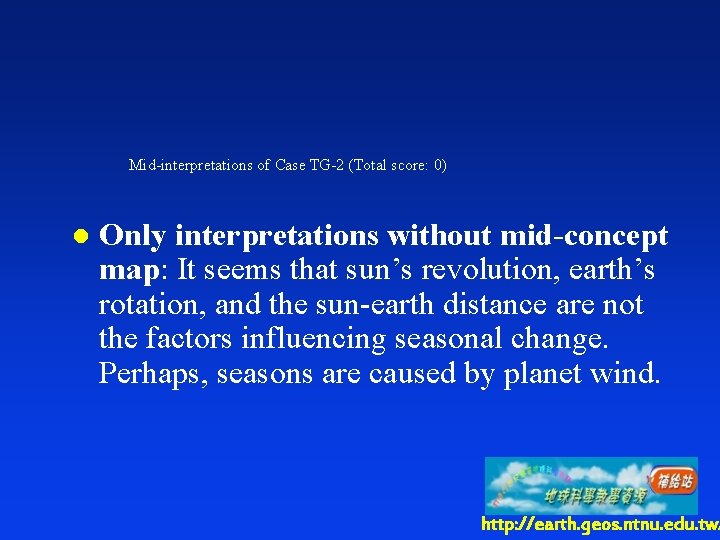
Mid-interpretations of Case TG-2 (Total score: 0) l Only interpretations without mid-concept map: It seems that sun’s revolution, earth’s rotation, and the sun-earth distance are not the factors influencing seasonal change. Perhaps, seasons are caused by planet wind. http: //earth. geos. ntnu. edu. tw/
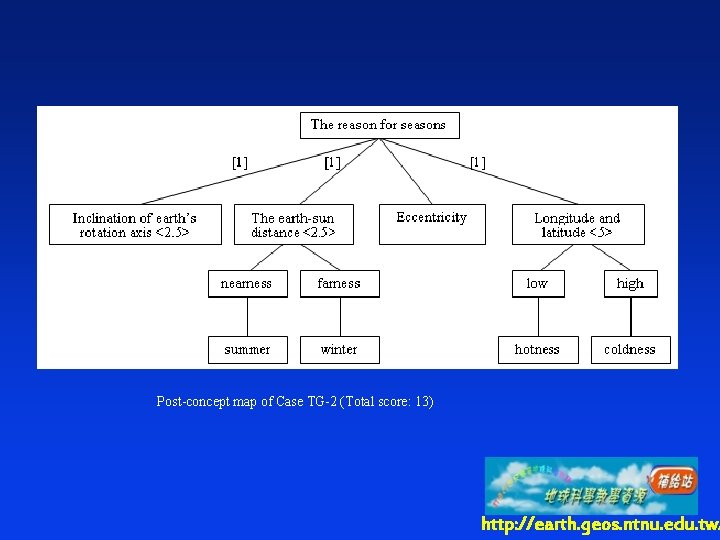
Post-concept map of Case TG-2 (Total score: 13) http: //earth. geos. ntnu. edu. tw/
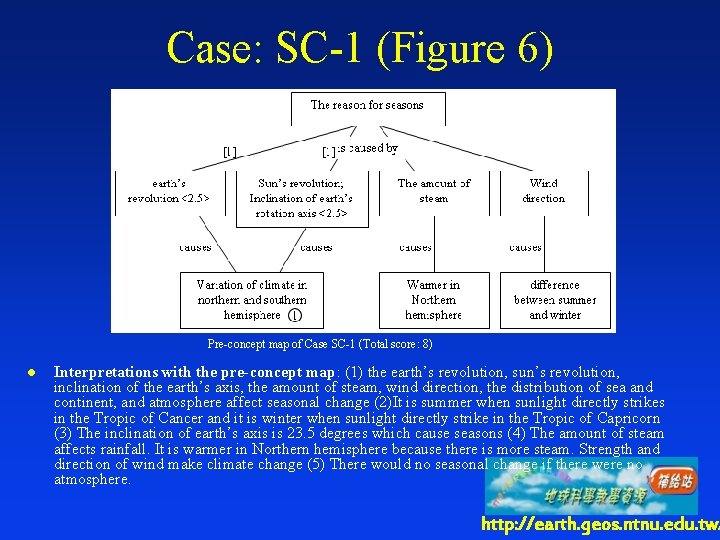
Case: SC-1 (Figure 6) Pre-concept map of Case SC-1 (Total score: 8) l Interpretations with the pre-concept map: (1) the earth’s revolution, sun’s revolution, inclination of the earth’s axis, the amount of steam, wind direction, the distribution of sea and continent, and atmosphere affect seasonal change (2)It is summer when sunlight directly strikes in the Tropic of Cancer and it is winter when sunlight directly strike in the Tropic of Capricorn (3) The inclination of earth’s axis is 23. 5 degrees which cause seasons (4) The amount of steam affects rainfall. It is warmer in Northern hemisphere because there is more steam. Strength and direction of wind make climate change (5) There would no seasonal change if there were no atmosphere. http: //earth. geos. ntnu. edu. tw/
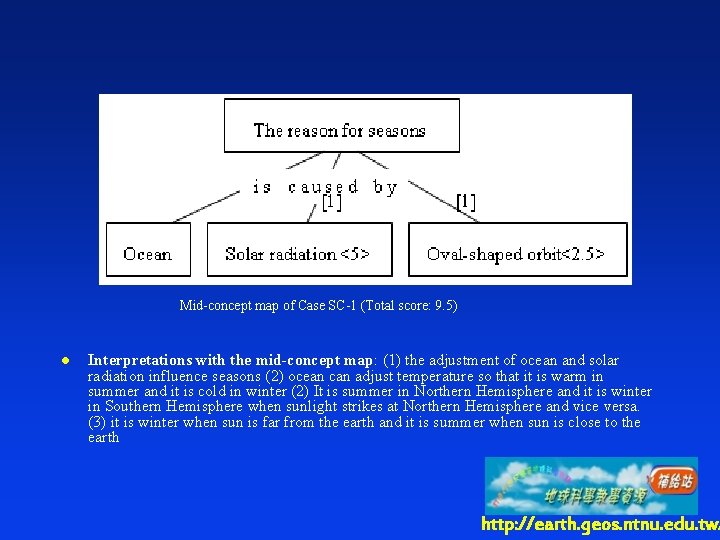
Mid-concept map of Case SC-1 (Total score: 9. 5) l Interpretations with the mid-concept map: (1) the adjustment of ocean and solar radiation influence seasons (2) ocean can adjust temperature so that it is warm in summer and it is cold in winter (2) It is summer in Northern Hemisphere and it is winter in Southern Hemisphere when sunlight strikes at Northern Hemisphere and vice versa. (3) it is winter when sun is far from the earth and it is summer when sun is close to the earth http: //earth. geos. ntnu. edu. tw/
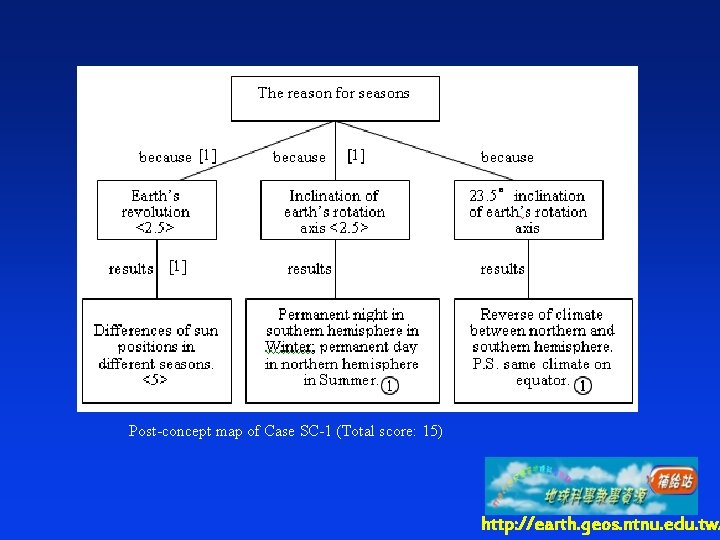
Post-concept map of Case SC-1 (Total score: 15) http: //earth. geos. ntnu. edu. tw/
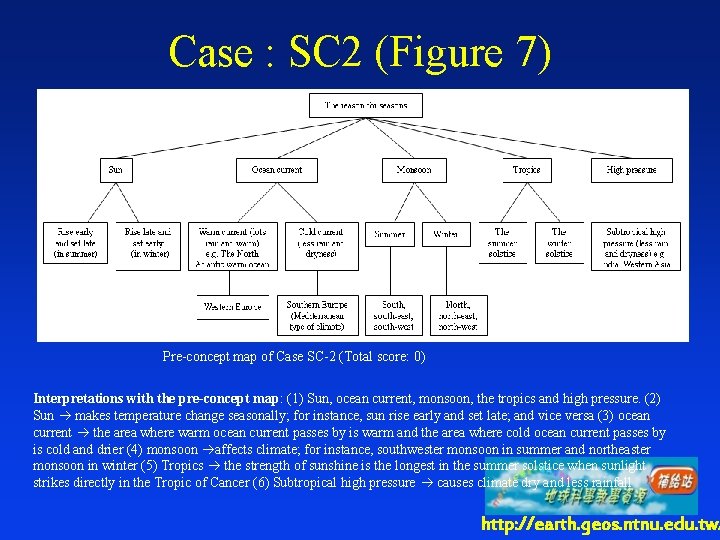
Case : SC 2 (Figure 7) Pre-concept map of Case SC-2 (Total score: 0) Interpretations with the pre-concept map: (1) Sun, ocean current, monsoon, the tropics and high pressure. (2) Sun makes temperature change seasonally; for instance, sun rise early and set late; and vice versa (3) ocean current the area where warm ocean current passes by is warm and the area where cold ocean current passes by is cold and drier (4) monsoon affects climate; for instance, southwester monsoon in summer and northeaster monsoon in winter (5) Tropics the strength of sunshine is the longest in the summer solstice when sunlight strikes directly in the Tropic of Cancer (6) Subtropical high pressure causes climate dry and less rainfall http: //earth. geos. ntnu. edu. tw/
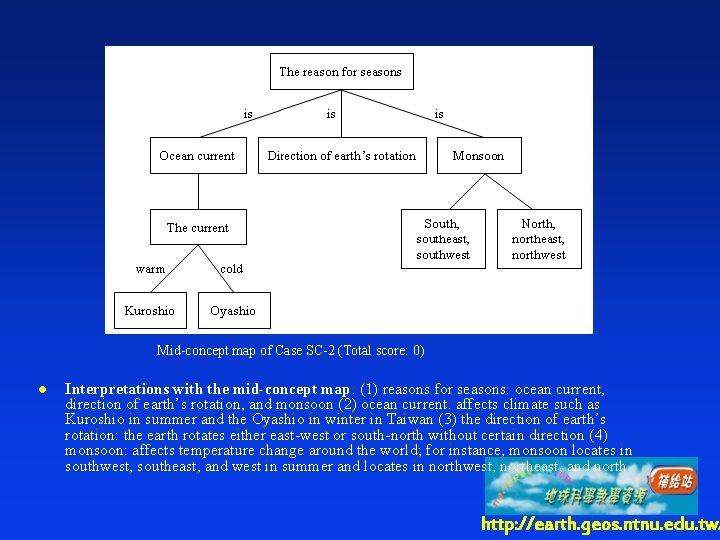
Mid-concept map of Case SC-2 (Total score: 0) l Interpretations with the mid-concept map: (1) reasons for seasons: ocean current, direction of earth’s rotation, and monsoon (2) ocean current: affects climate such as Kuroshio in summer and the Oyashio in winter in Taiwan (3) the direction of earth’s rotation: the earth rotates either east-west or south-north without certain direction (4) monsoon: affects temperature change around the world; for instance, monsoon locates in southwest, southeast, and west in summer and locates in northwest, northeast, and north http: //earth. geos. ntnu. edu. tw/
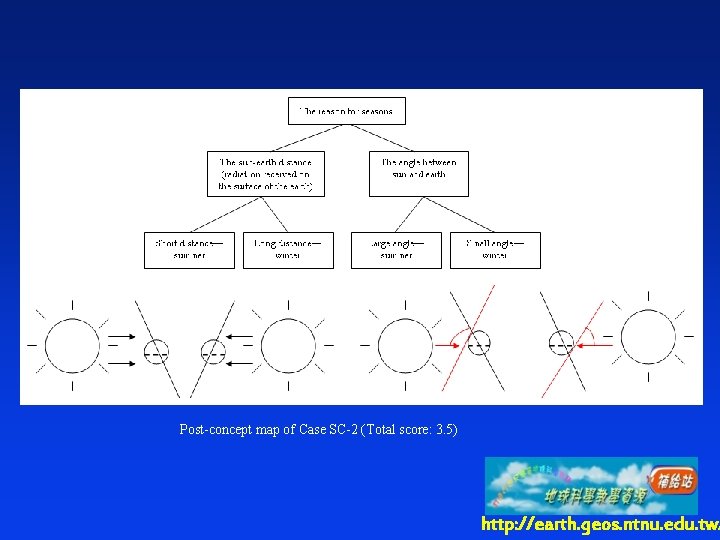
Post-concept map of Case SC-2 (Total score: 3. 5) http: //earth. geos. ntnu. edu. tw/
Patterns of Conceptual Change in the Multiple Concept Group NC: No conception (type 1); PH: Phenomenal model (type 2, 3, and 4); Assim: Assimilatory model (type 5 and 6); Part: Partial to complete scientific model (type 7 and 8) http: //earth. geos. ntnu. edu. tw/
Discussion & Conclusion I l Student-centered approach was more effective in altering students’ alternative conceptions than teacher-guided approach in technology enhanced learning environment. Student-centered approach allows students to more freely test their own hypotheses, and thus more easily reflect on their own cognitive conflicts and move from assimilatory to properly scientific explanations. http: //earth. geos. ntnu. edu. tw/
Discussion & Conclusion II l The number of students holding either alternative conceptions or no conception increased after intuitive understanding instruction (Stage I), especially those holding assimilatory types of alternative conceptions. Students who underwent contextualization and sense-making in stage I tended to experience cognitive conflicts, and started to be dissatisfied with their prior conceptions, but still did not develop reasonable explanations for the causes of the seasons. The latter approach, we reasoned, provides an opportunity for students to explore the phenomena and construct their own mental models by manipulating simulations, changing parameters and visualizing the simulated results immediately. After visualizing the phenomena, students can then re-explain their ideas, discard their alternative conceptions, and generate scientific explanations thus achieving wholesale conceptual change. The interesting point here is of course also that the teacher-guided approach actually “blocks” in certain ways these potential student strategies. http: //earth. geos. ntnu. edu. tw/
Discussion & Conclusion III Comparing the TG and SC groups, the SC instructional approach seemed to cause fewer students to generate or keep type 6 alternative conceptions; thus this approach facilitated students’ incremental conceptual change in the direction of fully scientific conceptions or explanations. we may conjecture that while students guided by their teachers changed their alternative conceptions incrementally into scientific conceptions, they might not have easily discarded their old ideas without freely exploring and modeling by themselves. The value of the student-centered approach in a technology-enhanced environment is that it provides an opportunity for students to make wholesale changes in the learning of difficult concepts such as “the reason for the seasons. ” l http: //earth. geos. ntnu. edu. tw/
Thank you so much for your listening! http: //earth. geos. ntnu. edu. tw/
Exploration ▲ http: //earth. geos. ntnu. edu. tw/
Modeling ▲ http: //earth. geos. ntnu. edu. tw/
Application How the seasons on Mars change and what the major factors influencing season formation are( the film from NASA web site) ▲ http: //earth. geos. ntnu. edu. tw/