
What Information Do Stakeholders Want Selecting Key Performance












- Slides: 51
What Information Do Stakeholders Want? Selecting Key Performance Indicators Kathryn Graham, Ph. D. Heidi Chorzempa, MSc. Performance Management & Evaluation AEA 2013 Conference Transforming health and wellbeing through research and innovation
Session Objectives 1. Advance knowledge of practices to analyze stakeholders and select key performance indicators (KPIs) 2. Build capacity through exercises: § § analyzing stakeholders selecting KPIs
So what? q Analyzing stakeholders & selecting KPIs Why are these important skills to know?
Session Outline q Overview steps in developing M&E systems q Practice applying skills from steps 1 -3 q q q Stakeholder analysis Selecting indicators Wrap up: Discussion q q How such practices inform reporting results and encourage use by stakeholders Q&A
But before we begin… Transforming health and wellbeing through research and innovation
A Bit About Us… Transform Health and Well-being through Research and Innovation
And a Bit About You… The 10 second intro: q q Who you are… What you do… What brought you here today… Your key expectation of the session…
Let’s get started
Monitoring Defined… “A continuing function that aims primarily to provide managers and main stakeholders with regular feedback and early indications of progress or lack thereof in the achievement of intended results. Monitoring tracks the actual performance or situation against what was planned or expected…. Monitoring generally involves collecting and analyzing data on implementation processes, strategies and results, and recommending corrective measures. ” Source: Evaluation Office, United Nations Development Programme (2002)
Evaluation Defined… “Involves the systematic collection of information about the activities, characteristics, and outcomes of programs, personnel, and products…. to reduce uncertainties, improve effectiveness and make decisions with regard to what those programs, personnel or products are doing and affecting. ” Patten, M. Q. (1982) Practical Evaluation. Beverly Hills, CA: Sage Publications Inc.
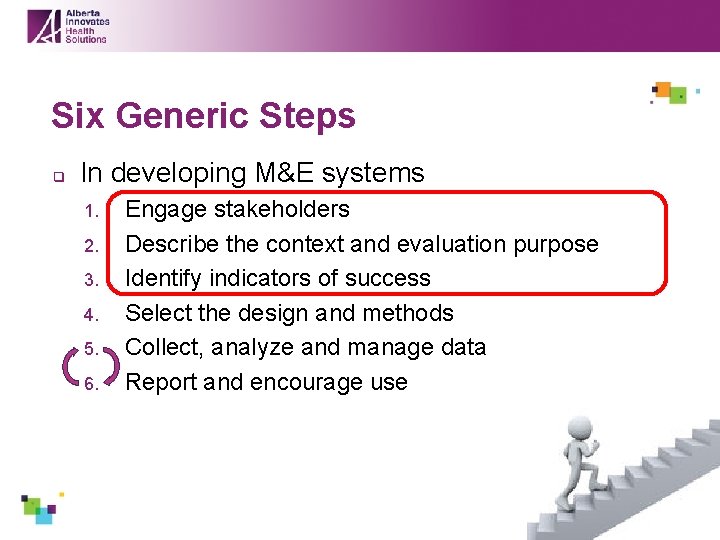
Six Generic Steps q In developing M&E systems 1. 2. 3. 4. 5. 6. Engage stakeholders Describe the context and evaluation purpose Identify indicators of success Select the design and methods Collect, analyze and manage data Report and encourage use
“The starting point of any evaluation should be intended use by intended users” Patton, Utilization-Focused Evaluation (U-FE) Checklist
Step 1: Engage Stakeholders q q Identify stakeholders with the greatest stake or vested interest in the evaluation Who are your stakeholders? Includes those who: q q q will use the results (e. g. , clients, community groups, elected officials) support or maintain the program (e. g. , program staff, partners, management, funders, coalition members) are affected by the program activities or evaluation (e. g. , persons served, families or the general public)
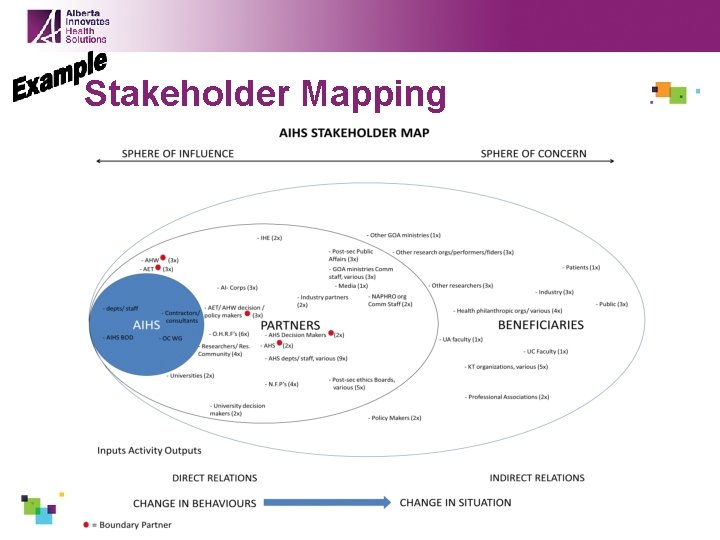
Stakeholder Mapping
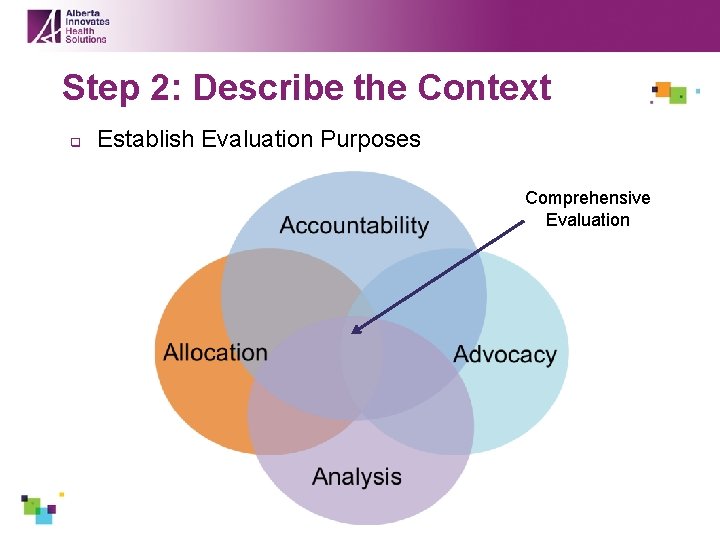
Step 2: Describe the Context q Establish Evaluation Purposes Comprehensive Evaluation
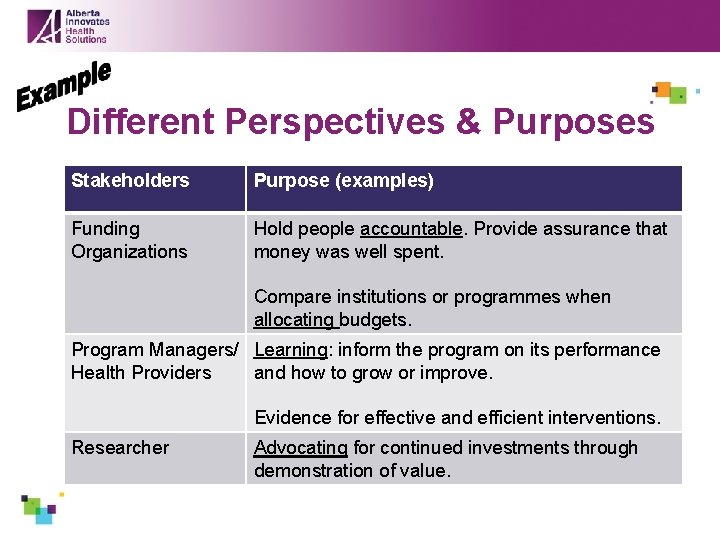
Different Perspectives & Purposes Stakeholders Purpose (examples) Funding Organizations Hold people accountable. Provide assurance that money was well spent. Compare institutions or programmes when allocating budgets. Program Managers/ Learning: inform the program on its performance Health Providers and how to grow or improve. Evidence for effective and efficient interventions. Researcher Advocating for continued investments through demonstration of value.
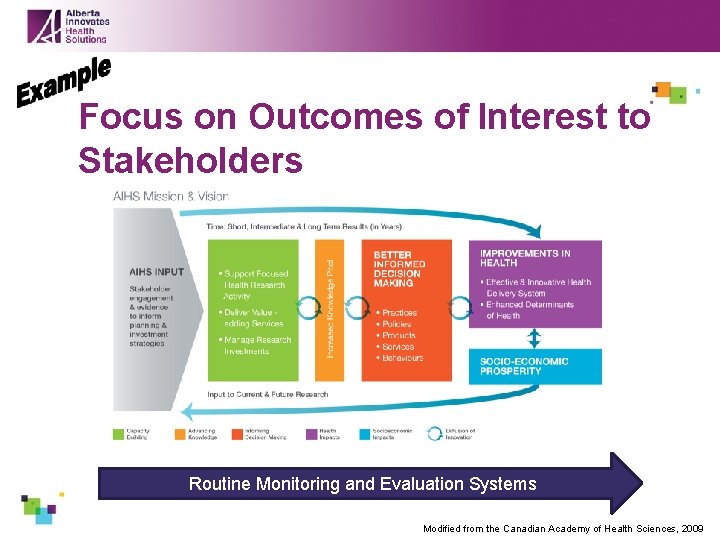
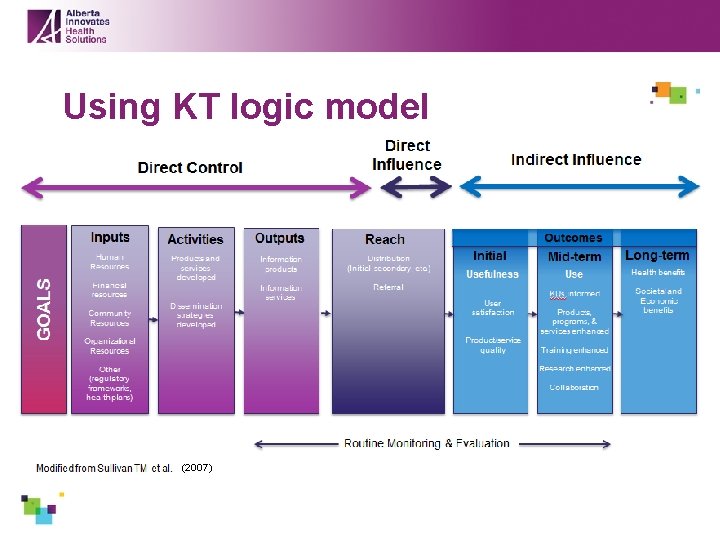
Focus on Outcomes of Interest to Stakeholders Routine Monitoring and Evaluation Systems Modified from the Canadian Academy of Health Sciences, 2009
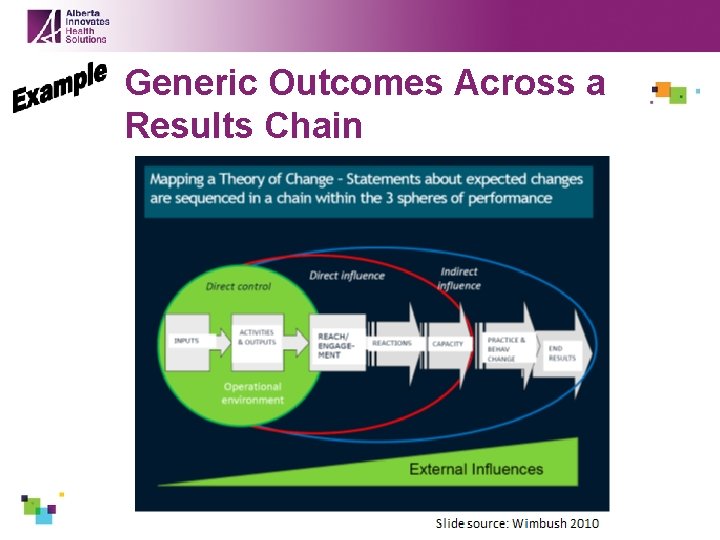
Generic Outcomes Across a Results Chain
Your Turn!
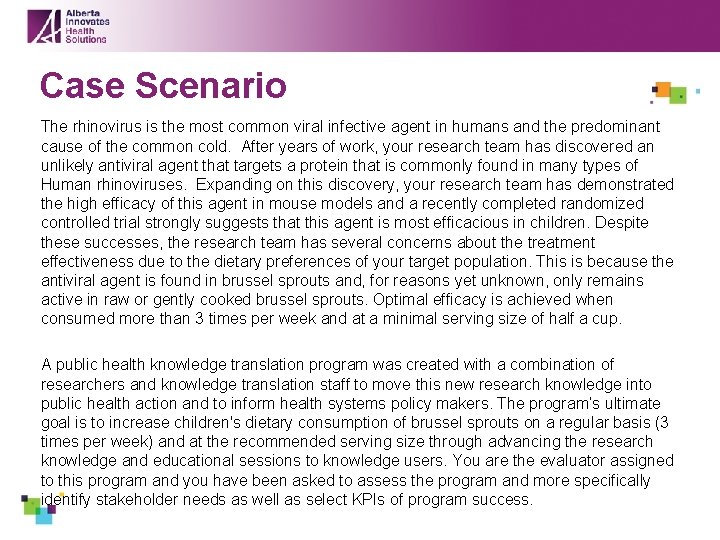
Case Scenario The rhinovirus is the most common viral infective agent in humans and the predominant cause of the common cold. After years of work, your research team has discovered an unlikely antiviral agent that targets a protein that is commonly found in many types of Human rhinoviruses. Expanding on this discovery, your research team has demonstrated the high efficacy of this agent in mouse models and a recently completed randomized controlled trial strongly suggests that this agent is most efficacious in children. Despite these successes, the research team has several concerns about the treatment effectiveness due to the dietary preferences of your target population. This is because the antiviral agent is found in brussel sprouts and, for reasons yet unknown, only remains active in raw or gently cooked brussel sprouts. Optimal efficacy is achieved when consumed more than 3 times per week and at a minimal serving size of half a cup. A public health knowledge translation program was created with a combination of researchers and knowledge translation staff to move this new research knowledge into public health action and to inform health systems policy makers. The program’s ultimate goal is to increase children's dietary consumption of brussel sprouts on a regular basis (3 times per week) and at the recommended serving size through advancing the research knowledge and educational sessions to knowledge users. You are the evaluator assigned to this program and you have been asked to assess the program and more specifically identify stakeholder needs as well as select KPIs of program success.
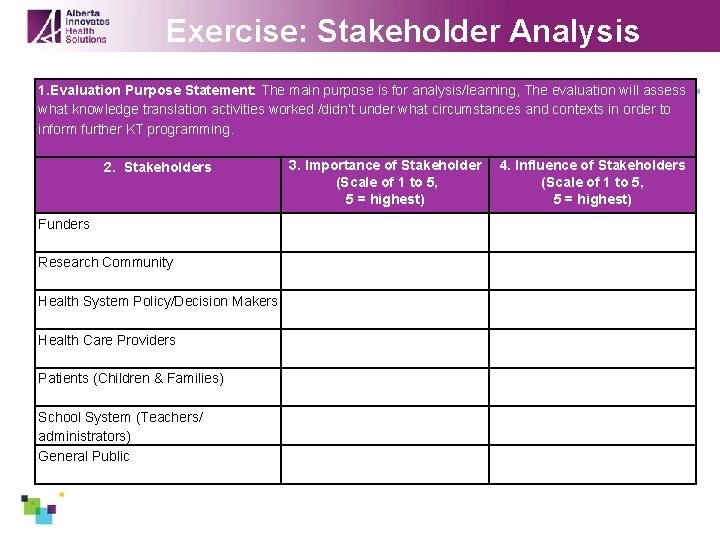
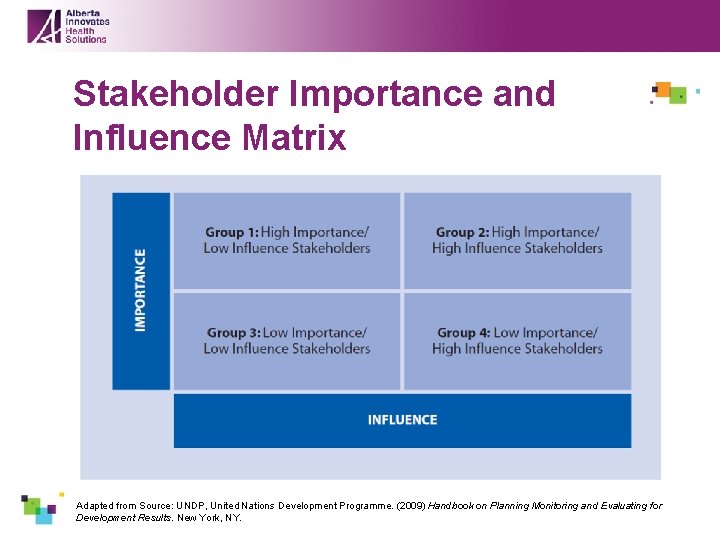
Exercise: Stakeholder Analysis 1. Evaluation Purpose Statement: The main purpose is for analysis/learning, The evaluation will assess what knowledge translation activities worked /didn’t under what circumstances and contexts in order to inform further KT programming. 2. Stakeholders Funders Research Community Health System Policy/Decision Makers Health Care Providers Patients (Children & Families) School System (Teachers/ administrators) General Public 3. Importance of Stakeholder (Scale of 1 to 5, 5 = highest) 4. Influence of Stakeholders (Scale of 1 to 5, 5 = highest)
Stakeholder Importance and Influence Matrix Adapted from Source: UNDP, United Nations Development Programme. (2009) Handbook on Planning Monitoring and Evaluating for Development Results. New York, NY.
Checkpoint At this point we have: q q q Identified key stakeholders Established the purposes of the evaluation Analyzed our stakeholders
Step 3: Identify and Select Indicators of Success
What’s Covered in this Step q Review approaches and best practices in indicators q Select KPIs
Using KT logic model (2007)
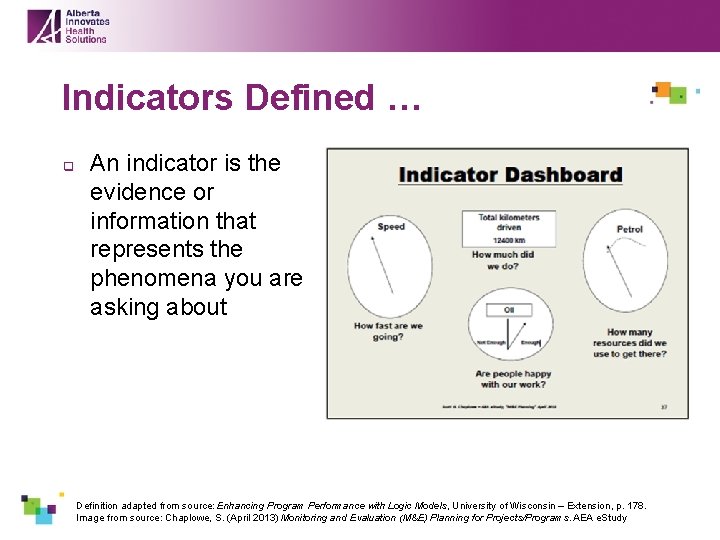
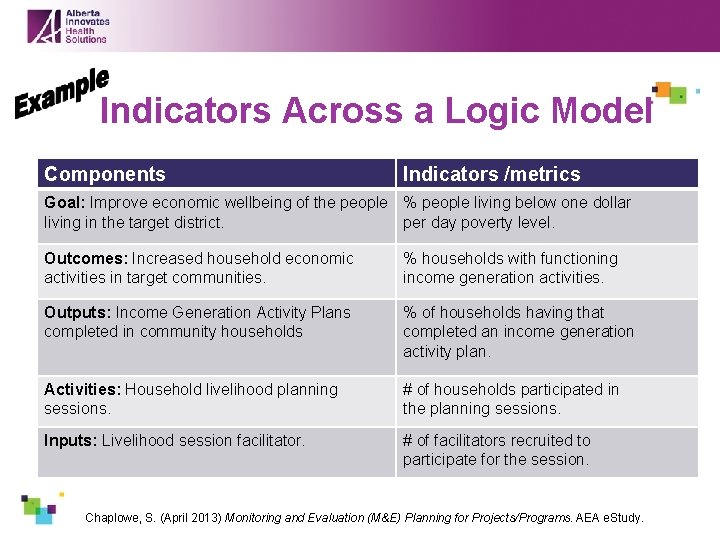
Indicators Defined … q An indicator is the evidence or information that represents the phenomena you are asking about Definition adapted from source: Enhancing Program Performance with Logic Models, University of Wisconsin – Extension, p. 178. Image from source: Chaplowe, S. (April 2013) Monitoring and Evaluation (M&E) Planning for Projects/Programs. AEA e. Study
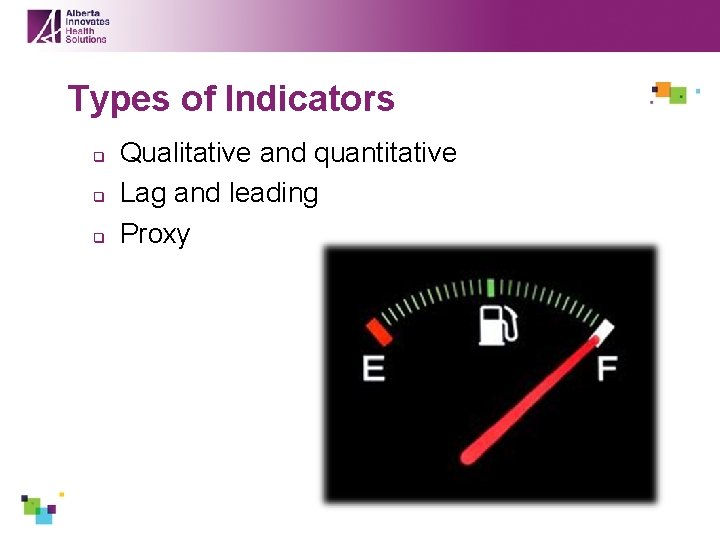
Types of Indicators q q q Qualitative and quantitative Lag and leading Proxy
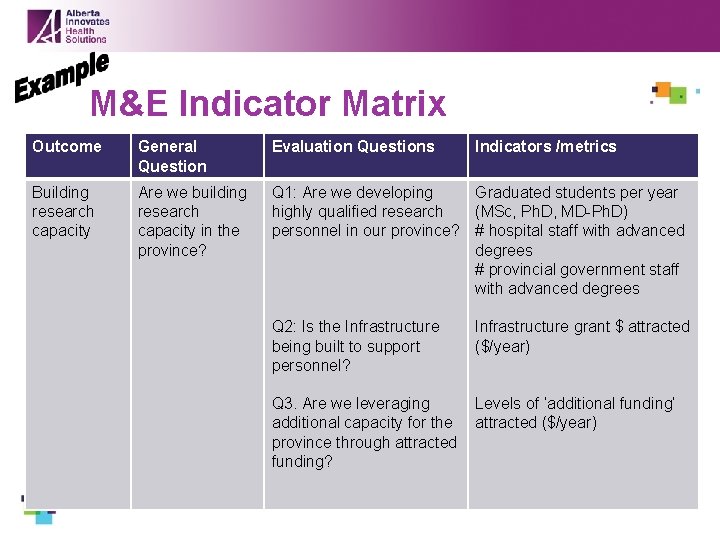
M&E Indicator Matrix Outcome General Question Evaluation Questions Building research capacity Are we building research capacity in the province? Q 1: Are we developing Graduated students per year highly qualified research (MSc, Ph. D, MD-Ph. D) personnel in our province? # hospital staff with advanced degrees # provincial government staff with advanced degrees Q 2: Is the Infrastructure being built to support personnel? Indicators /metrics Infrastructure grant $ attracted ($/year) Q 3. Are we leveraging Levels of ‘additional funding’ additional capacity for the attracted ($/year) province through attracted funding?
Indicators Across a Logic Model Components Indicators /metrics Goal: Improve economic wellbeing of the people % people living below one dollar living in the target district. per day poverty level. Outcomes: Increased household economic activities in target communities. % households with functioning income generation activities. Outputs: Income Generation Activity Plans completed in community households % of households having that completed an income generation activity plan. Activities: Household livelihood planning sessions. # of households participated in the planning sessions. Inputs: Livelihood session facilitator. # of facilitators recruited to participate for the session. Chaplowe, S. (April 2013) Monitoring and Evaluation (M&E) Planning for Projects/Programs. AEA e. Study.
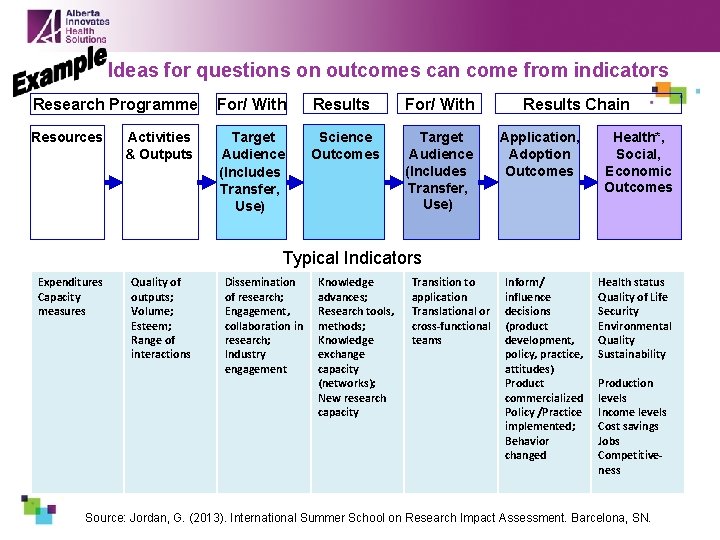
Ideas for questions on outcomes can come from indicators Research Programme For/ With Results For/ With Resources Target Audience (Includes Transfer, Use) Science Outcomes Target Audience (Includes Transfer, Use) Activities & Outputs Results Chain Application, Adoption Outcomes Health*, Social, Economic Outcomes Typical Indicators Expenditures Capacity measures Quality of outputs; Volume; Esteem; Range of interactions Dissemination of research; Engagement, collaboration in research; Industry engagement Knowledge advances; Research tools, methods; Knowledge exchange capacity (networks); New research capacity Transition to application Translational or cross-functional teams Inform/ influence decisions (product development, policy, practice, attitudes) Product commercialized Policy /Practice implemented; Behavior changed Health status Quality of Life Security Environmental Quality Sustainability Production levels Income levels Cost savings Jobs Competitiveness Source: Jordan, G. (2013). International Summer School on Research Impact Assessment. Barcelona, SN.
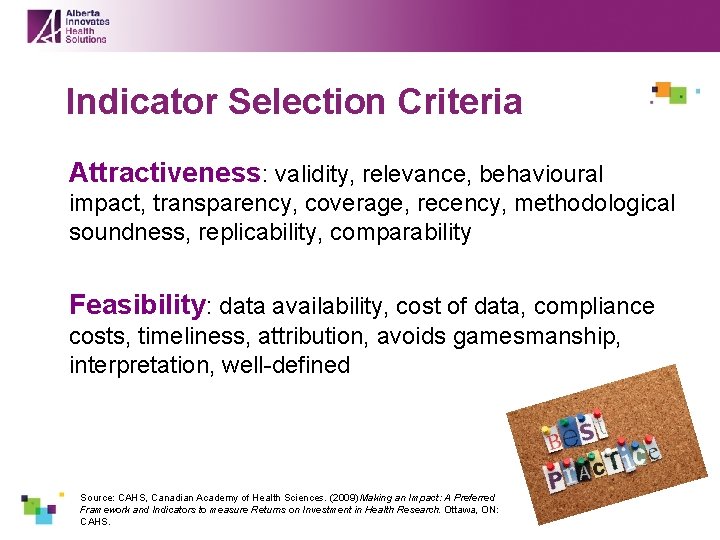
Indicator Selection Criteria Attractiveness: validity, relevance, behavioural impact, transparency, coverage, recency, methodological soundness, replicability, comparability Feasibility: data availability, cost of data, compliance costs, timeliness, attribution, avoids gamesmanship, interpretation, well-defined Source: CAHS, Canadian Academy of Health Sciences. (2009) Making an Impact: A Preferred Framework and Indicators to measure Returns on Investment in Health Research. Ottawa, ON: CAHS.
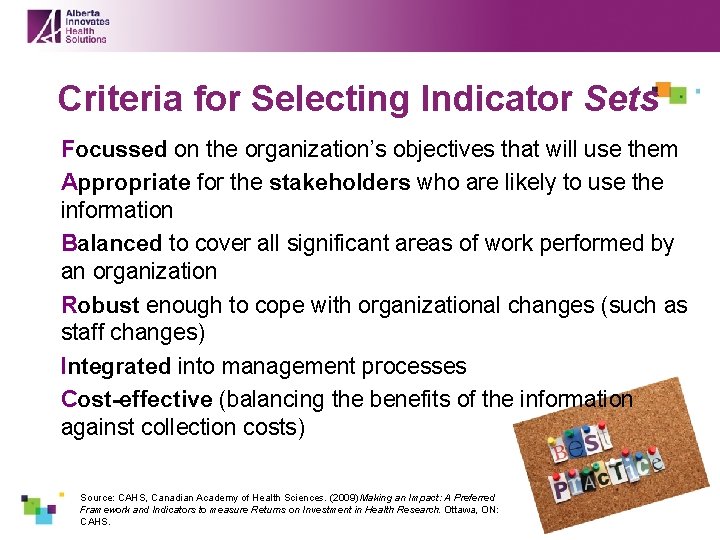
Criteria for Selecting Indicator Sets Focussed on the organization’s objectives that will use them Appropriate for the stakeholders who are likely to use the information Balanced to cover all significant areas of work performed by an organization Robust enough to cope with organizational changes (such as staff changes) Integrated into management processes Cost-effective (balancing the benefits of the information against collection costs) Source: CAHS, Canadian Academy of Health Sciences. (2009) Making an Impact: A Preferred Framework and Indicators to measure Returns on Investment in Health Research. Ottawa, ON: CAHS.
Examples of Tools for Indicator Selection
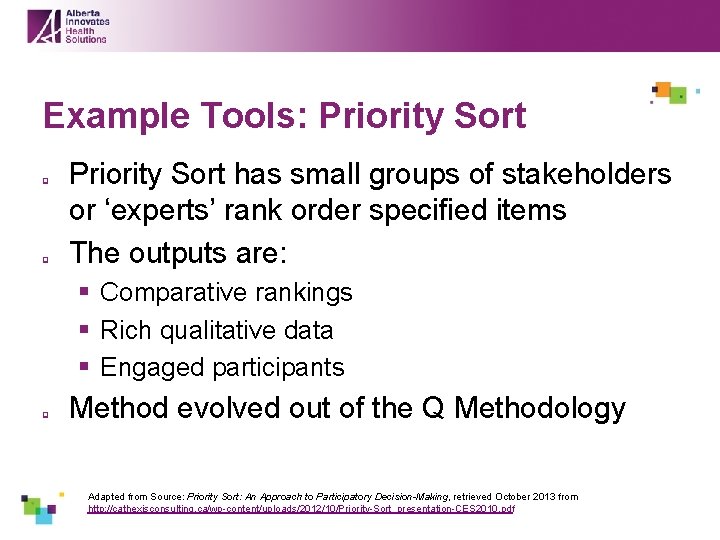
Example Tools: Priority Sort q q Priority Sort has small groups of stakeholders or ‘experts’ rank order specified items The outputs are: § Comparative rankings § Rich qualitative data § Engaged participants q Method evolved out of the Q Methodology Adapted from Source: Priority Sort: An Approach to Participatory Decision-Making, retrieved October 2013 from http: //cathexisconsulting. ca/wp-content/uploads/2012/10/Priority-Sort_presentation-CES 2010. pdf
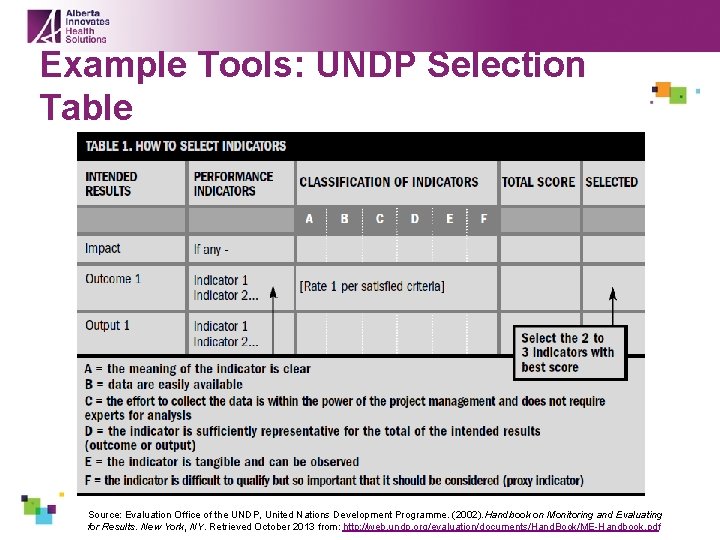
Example Tools: UNDP Selection Table Source: Evaluation Office of the UNDP, United Nations Development Programme. (2002). Handbook on Monitoring and Evaluating for Results. New York, NY. Retrieved October 2013 from: http: //web. undp. org/evaluation/documents/Hand. Book/ME-Handbook. pdf
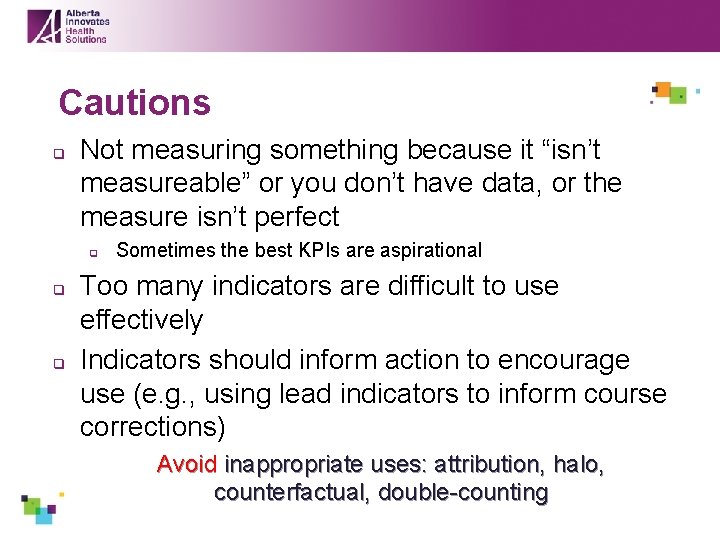
Cautions q Not measuring something because it “isn’t measureable” or you don’t have data, or the measure isn’t perfect q q q Sometimes the best KPIs are aspirational Too many indicators are difficult to use effectively Indicators should inform action to encourage use (e. g. , using lead indicators to inform course corrections) Avoid inappropriate uses: attribution, halo, counterfactual, double-counting
Your Turn!
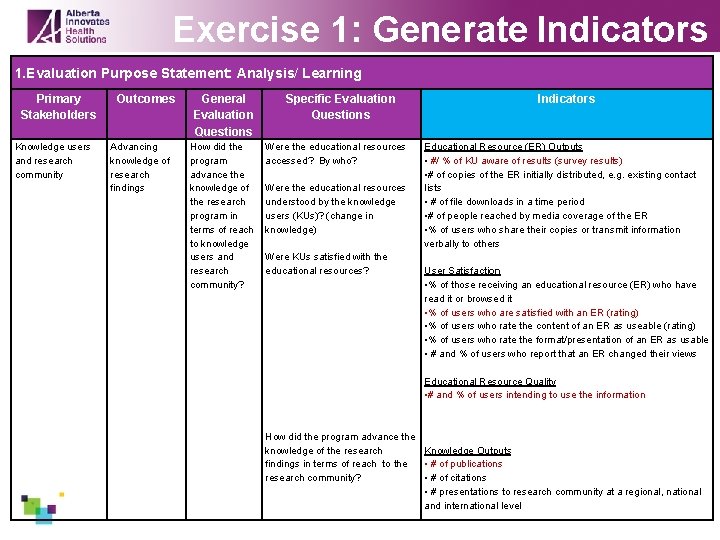
Exercise 1: Generate Indicators 1. Evaluation Purpose Statement: Analysis/ Learning Primary Stakeholders Knowledge users and research community Outcomes Advancing knowledge of research findings General Evaluation Questions How did the program advance the knowledge of the research program in terms of reach to knowledge users and research community? Specific Evaluation Questions Were the educational resources accessed? By who? Were the educational resources understood by the knowledge users (KUs)? (change in knowledge) Were KUs satisfied with the educational resources? Indicators Educational Resource (ER) Outputs • #/ % of KU aware of results (survey results) • # of copies of the ER initially distributed, e. g. existing contact lists • # of file downloads in a time period • # of people reached by media coverage of the ER • % of users who share their copies or transmit information verbally to others User Satisfaction • % of those receiving an educational resource (ER) who have read it or browsed it • % of users who are satisfied with an ER (rating) • % of users who rate the content of an ER as useable (rating) • % of users who rate the format/presentation of an ER as usable • # and % of users who report that an ER changed their views Educational Resource Quality • # and % of users intending to use the information How did the program advance the knowledge of the research Knowledge Outputs findings in terms of reach to the • # of publications research community? • # of citations • # presentations to research community at a regional, national and international level
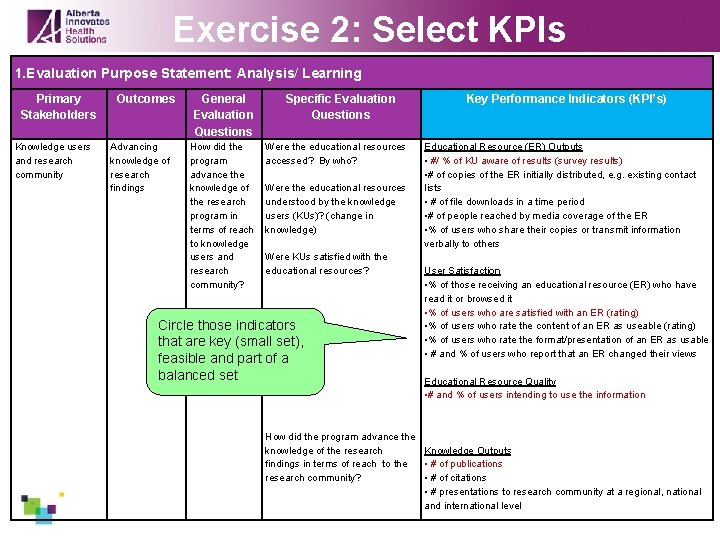
Exercise 2: Select KPIs 1. Evaluation Purpose Statement: Analysis/ Learning Primary Stakeholders Knowledge users and research community Outcomes Advancing knowledge of research findings General Evaluation Questions How did the program advance the knowledge of the research program in terms of reach to knowledge users and research community? Specific Evaluation Questions Were the educational resources accessed? By who? Were the educational resources understood by the knowledge users (KUs)? (change in knowledge) Were KUs satisfied with the educational resources? Circle those indicators that are key (small set), feasible and part of a balanced set Key Performance Indicators (KPI’s) Educational Resource (ER) Outputs • #/ % of KU aware of results (survey results) • # of copies of the ER initially distributed, e. g. existing contact lists • # of file downloads in a time period • # of people reached by media coverage of the ER • % of users who share their copies or transmit information verbally to others User Satisfaction • % of those receiving an educational resource (ER) who have read it or browsed it • % of users who are satisfied with an ER (rating) • % of users who rate the content of an ER as useable (rating) • % of users who rate the format/presentation of an ER as usable • # and % of users who report that an ER changed their views Educational Resource Quality • # and % of users intending to use the information How did the program advance the knowledge of the research Knowledge Outputs findings in terms of reach to the • # of publications research community? • # of citations • # presentations to research community at a regional, national and international level
Checkpoint At this point we have: q q Reviewed potential indicators Selected KPIs according to evaluation purpose and stakeholder needs
Reporting and Encourage Use by Stakeholders
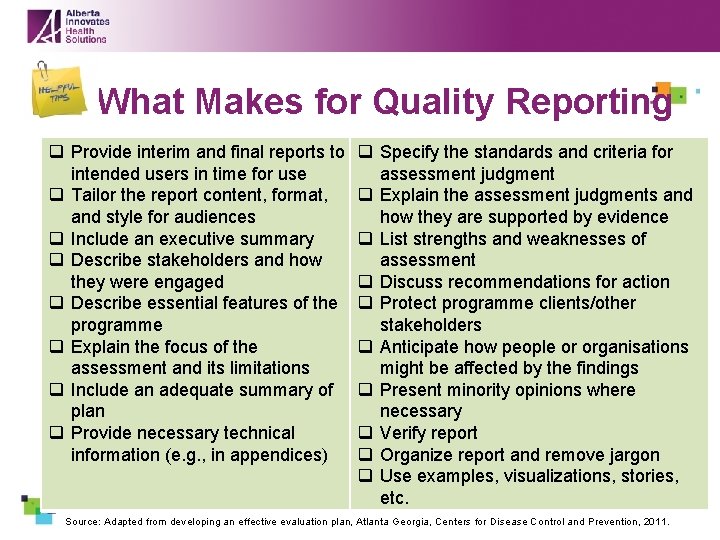
What Makes for Quality Reporting q Provide interim and final reports to intended users in time for use q Tailor the report content, format, and style for audiences q Include an executive summary q Describe stakeholders and how they were engaged q Describe essential features of the programme q Explain the focus of the assessment and its limitations q Include an adequate summary of plan q Provide necessary technical information (e. g. , in appendices) q Specify the standards and criteria for assessment judgment q Explain the assessment judgments and how they are supported by evidence q List strengths and weaknesses of assessment q Discuss recommendations for action q Protect programme clients/other stakeholders q Anticipate how people or organisations might be affected by the findings q Present minority opinions where necessary q Verify report q Organize report and remove jargon q Use examples, visualizations, stories, etc. Source: Adapted from developing an effective evaluation plan, Atlanta Georgia, Centers for Disease Control and Prevention, 2011.
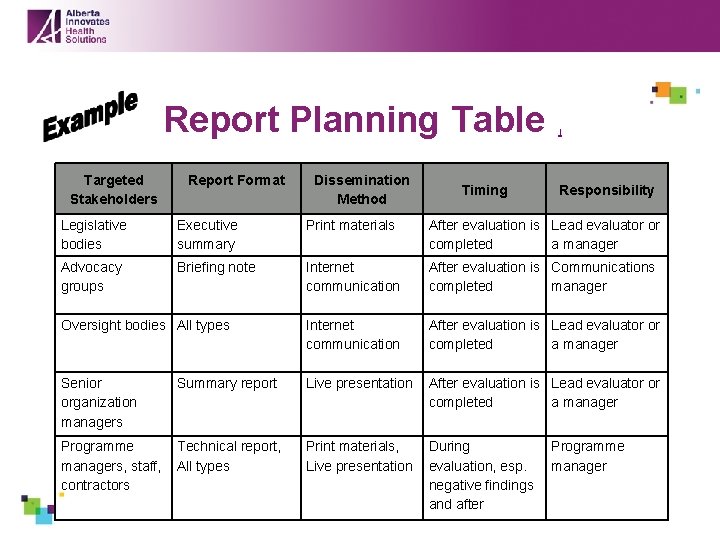
Report Planning Table Targeted Stakeholders Report Format Dissemination Method Timing [ Responsibility Legislative bodies Executive summary Print materials After evaluation is Lead evaluator or completed a manager Advocacy groups Briefing note Internet communication After evaluation is Communications completed manager Oversight bodies All types Internet communication After evaluation is Lead evaluator or completed a manager Senior organization managers Live presentation After evaluation is Lead evaluator or completed a manager Print materials, Live presentation During evaluation, esp. negative findings and after Summary report Programme Technical report, managers, staff, All types contractors Programme manager
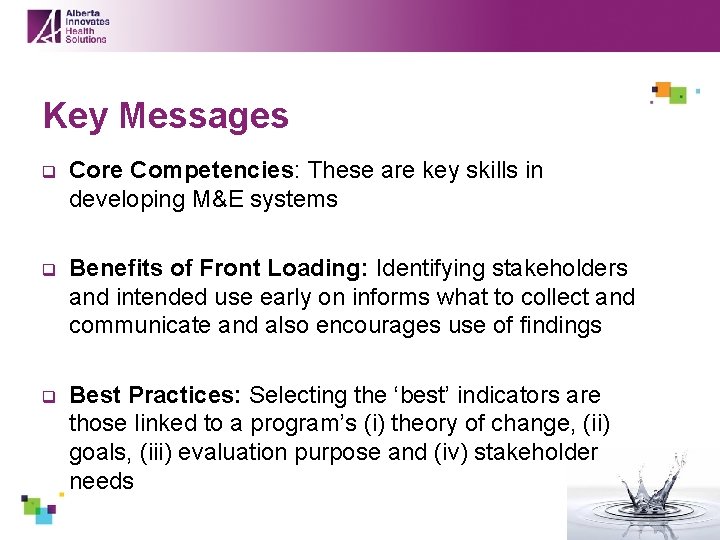
Key Messages q Core Competencies: These are key skills in developing M&E systems q Benefits of Front Loading: Identifying stakeholders and intended use early on informs what to collect and communicate and also encourages use of findings q Best Practices: Selecting the ‘best’ indicators are those linked to a program’s (i) theory of change, (ii) goals, (iii) evaluation purpose and (iv) stakeholder needs
Your Experience… q What will you take away? q Utility in practice? q Comments or suggestions?
Thank you! (and enjoy your brussel sprouts!) Kathryn. graham@albertainnovates. ca Director of Performance Management and Evaluation – AIHS Heidi. Chorzempa@albertainnovates. ca Manager of Performance Management and Evaluation – AIHS http: //www. aihealthsolutions. ca/performance-management/ Transforming health and wellbeing through research and innovation
References § § § United Nations Development Programme, Evaluation Office. (2002). Handbook on monitoring and evaluating for results. Retrieved from http: //web. undp. org/evaluation/documents/Hand. Book/ME-Handbook. pdf Patten, M. Q. (1982). Practical evaluation. Beverly Hills, CA: Sage Publications Inc. Patton, M. Q. (2002). Utilization-focused evaluation (U-FE) Checklist. Retrieved from http: //www. wmich. edu/evalctr/archive_checklists/ufe. pdf United Nations Development Programme. (2009). Handbook on planning, monitoring and evaluating for development results. Retrieved from http: //web. undp. org/evaluation/handbook/ Sullivan, T. M. , Strachan, M. , and Timmons, B. K. (2007). Guide to Monitoring and Evaluating Health Information Products and Services. Baltimore, Maryland: Center for Communication Programs, Johns Hopkins Bloomberg School of Public Health; Washington, D. C. : Constella Futures; Cambridge, Massachusetts: Management Sciences for Health Retrieved from: https: //www. msh. org/sites/msh. org/files/MEGUIDE 2007. pdf University of Wisconsin-Extension. (2003). Enhancing program performance with logic models. Retrieved from http: //www. uwex. edu/ces/pdande/evaluation/pdf/lmcourseall. pdf Chaplowe, S. (2013). Monitoring and evaluation (M&E) planning for projects/programs. AEA e. Study. Jordan, G. (2013). International Summer School on Research Impact Assessment. Barcelona, SN. Taylor-Powell, E. (2002). Water Quality Program: Logic model, evaluation questions, indicators. Retrieved from http: //www. uwex. edu/ces/pdande/evaluation/pdf/Water. Quality. Program. pdf Canadian Academy of Health Sciences. (2009). Making an Impact: A preferred framework and indicators to measure returns on investment in health research. Ottawa, ON: CAHS. Retrieved from http: //www. cahs-acss. ca/making-animpact-a-preferred-framework-and-indicators-to-measure-returns-on-investment-in-health-research-8/ Zorzi, R, et. Al. (2010). Priority sort: An approach to participatory decision-making. CES Presentation. Retrieved from http: //cathexisconsulting. ca/wp-content/uploads/2012/10/Priority-Sort_presentation-CES 2010. pdf § Centers for Disease Control and Prevention, National Center for Chronic Disease Prevention and Health Promotion, Office on Smoking and Health; Division of Nutrition, Physical Activity, and Obesity. (2011). Developing an effective evaluation plan. Retrieved from http: //www. cdc. gov/obesity/downloads/cdc-evaluation-workbook-508. pdf