
What impact did Vladimir Lenin have on Russia
- Slides: 23
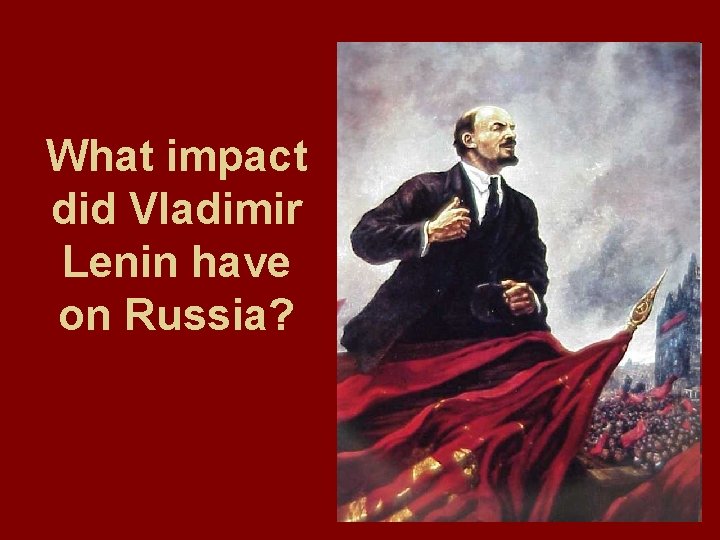
What impact did Vladimir Lenin have on Russia?
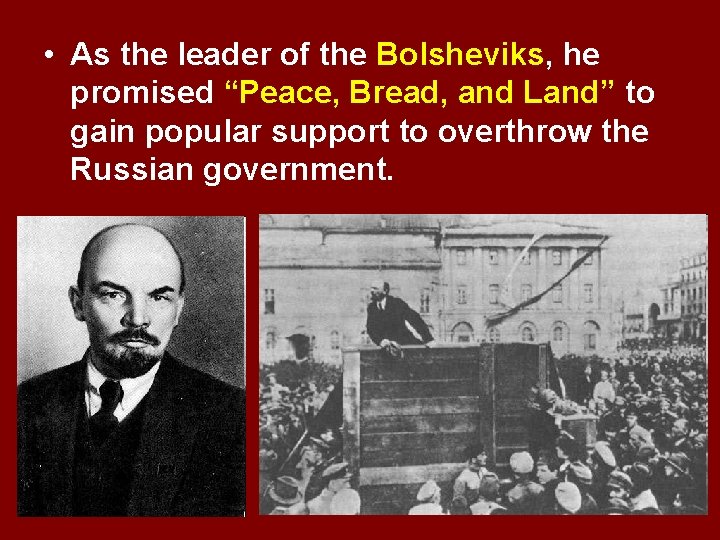
• As the leader of the Bolsheviks, he promised “Peace, Bread, and Land” to gain popular support to overthrow the Russian government.
One Government out, the next one in • The Provisional Government fell in November 1917, workers took control of the government • Bolsheviks in Power • Lenin gives land to peasants, puts workers in control of factories
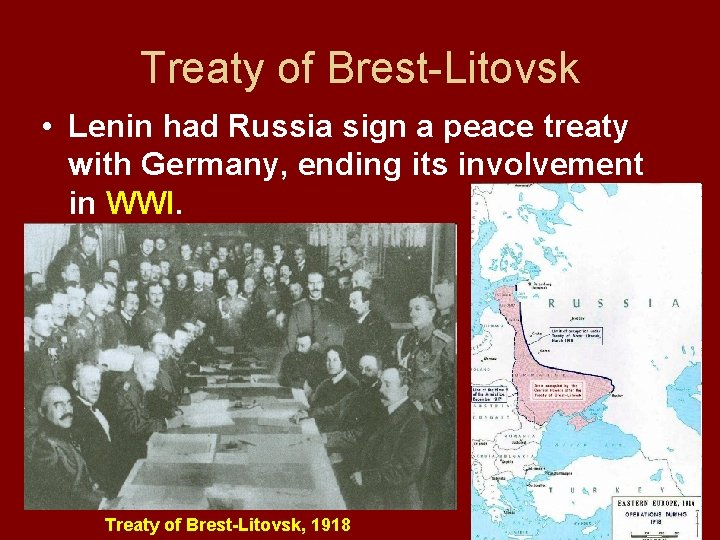
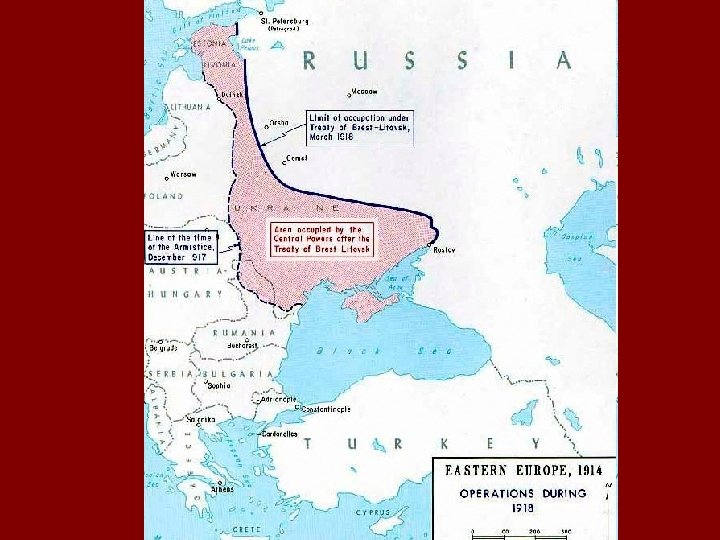
Treaty of Brest-Litovsk • Lenin had Russia sign a peace treaty with Germany, ending its involvement in WWI. Treaty of Brest-Litovsk, 1918
Civil War Rages in Russia • Civil War between Bolsheviks’ Red Army and the White Army which supported the Czar • Red Army wins three-year war that leaves 14 million dead • www. youtube. com/watch? v=xz. Pqd. Cgg. OH 8
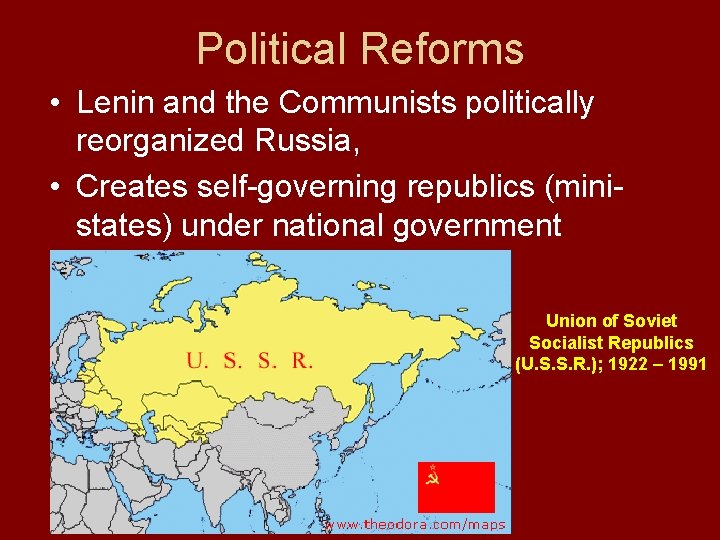
Political Reforms • Lenin and the Communists politically reorganized Russia, • Creates self-governing republics (ministates) under national government Union of Soviet Socialist Republics (U. S. S. R. ); 1922 – 1991
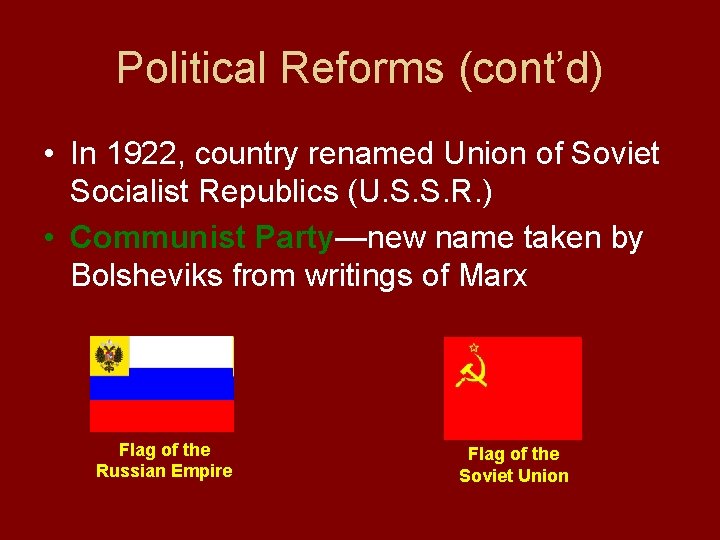
Political Reforms (cont’d) • In 1922, country renamed Union of Soviet Socialist Republics (U. S. S. R. ) • Communist Party—new name taken by Bolsheviks from writings of Marx Flag of the Russian Empire Flag of the Soviet Union
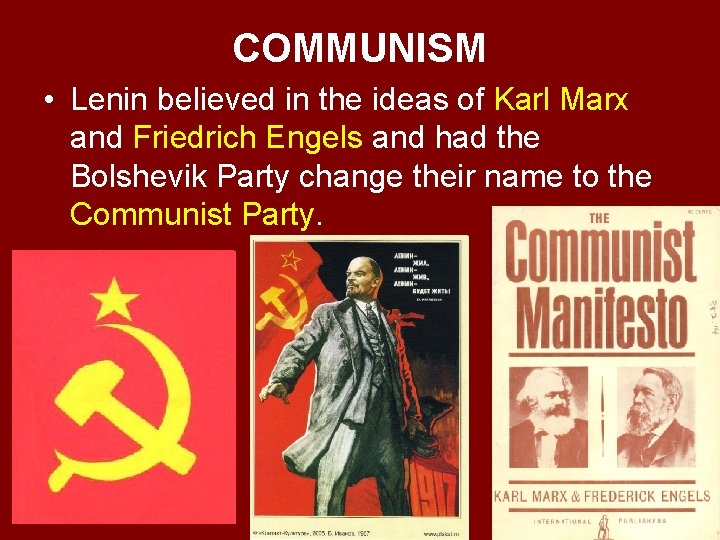
COMMUNISM • Lenin believed in the ideas of Karl Marx and Friedrich Engels and had the Bolshevik Party change their name to the Communist Party.
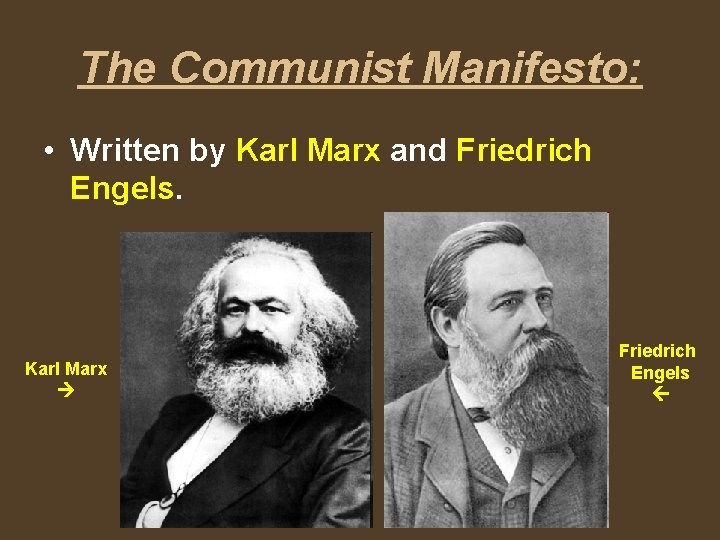
The Communist Manifesto: • Written by Karl Marx and Friedrich Engels. Karl Marx Friedrich Engels
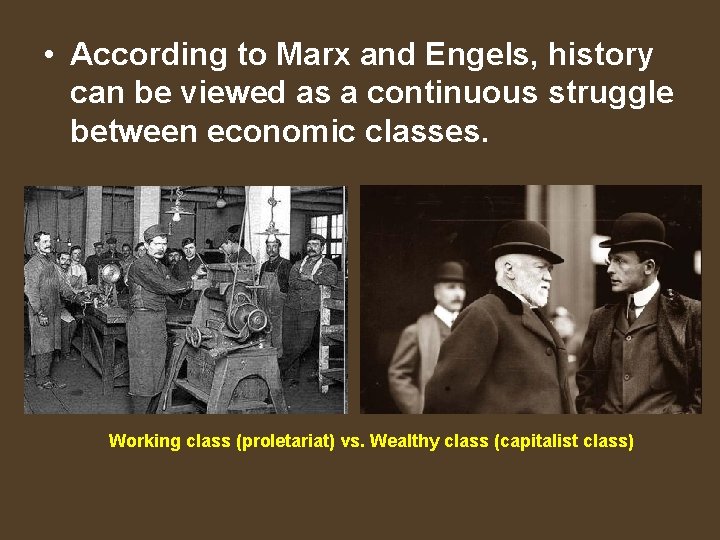
• According to Marx and Engels, history can be viewed as a continuous struggle between economic classes. Working class (proletariat) vs. Wealthy class (capitalist class)
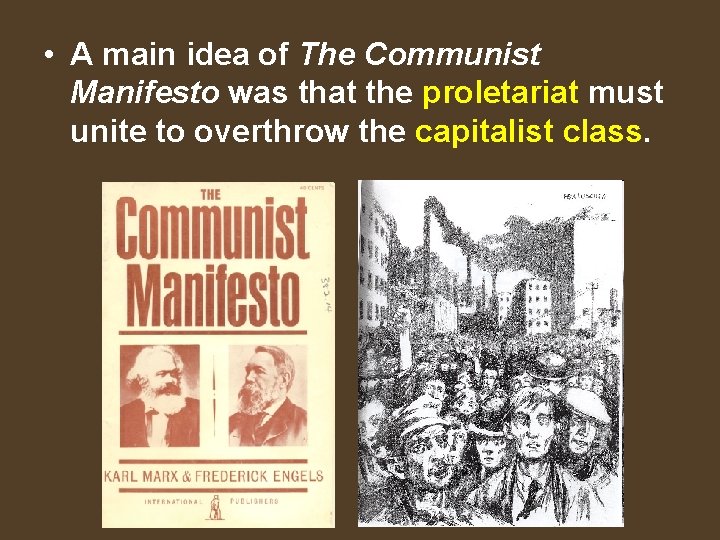
• A main idea of The Communist Manifesto was that the proletariat must unite to overthrow the capitalist class.
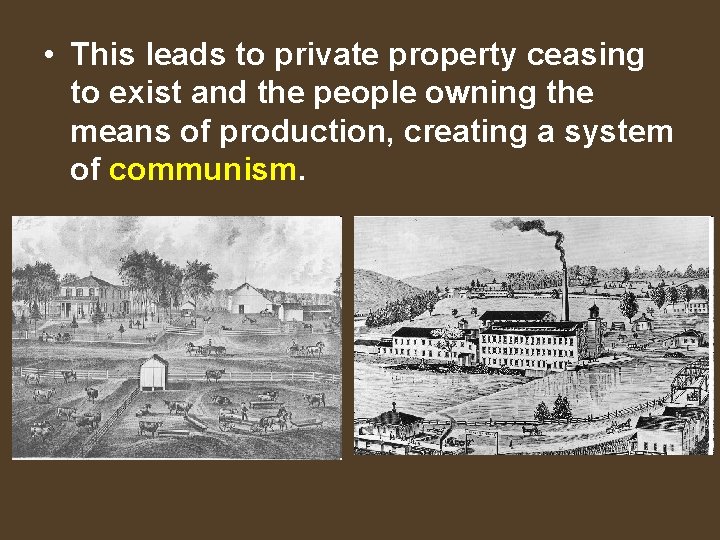
• This leads to private property ceasing to exist and the people owning the means of production, creating a system of communism.
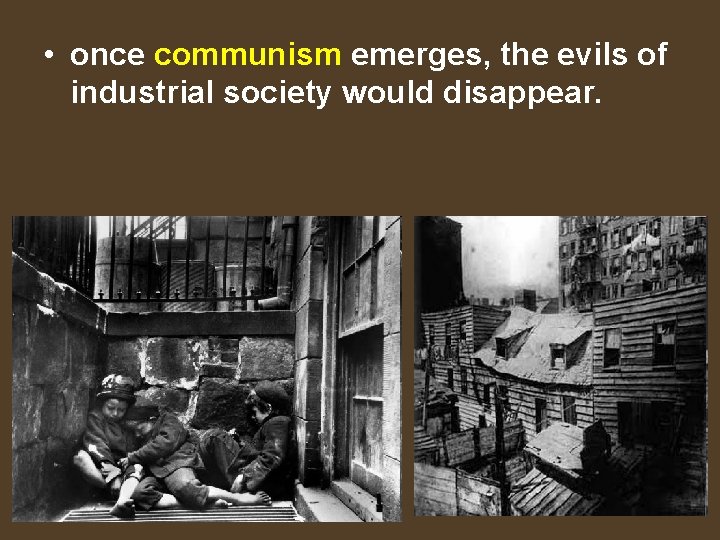
• once communism emerges, the evils of industrial society would disappear.
New Economic Policy • In March 1921, Lenin launches New Economic Policy, which had some capitalist elements • NEP and peace restored the economy shattered by war and revolution • By 1928, Russia’s farms, factories were productive again
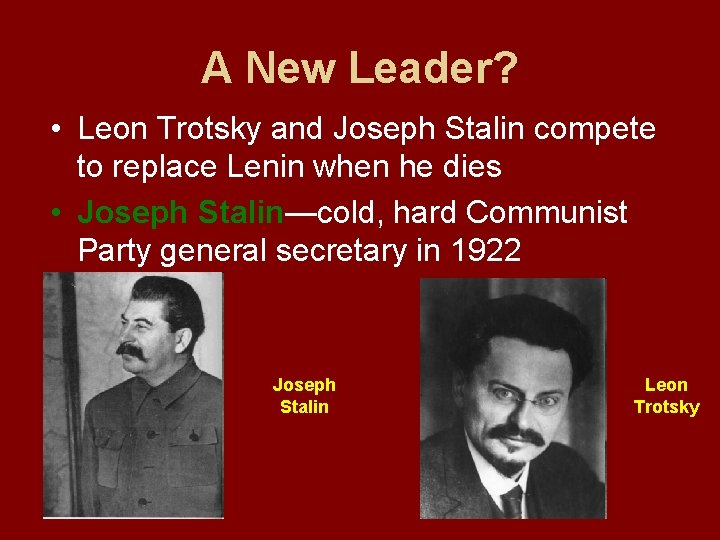
A New Leader? • Leon Trotsky and Joseph Stalin compete to replace Lenin when he dies • Joseph Stalin—cold, hard Communist Party general secretary in 1922 Joseph Stalin Leon Trotsky
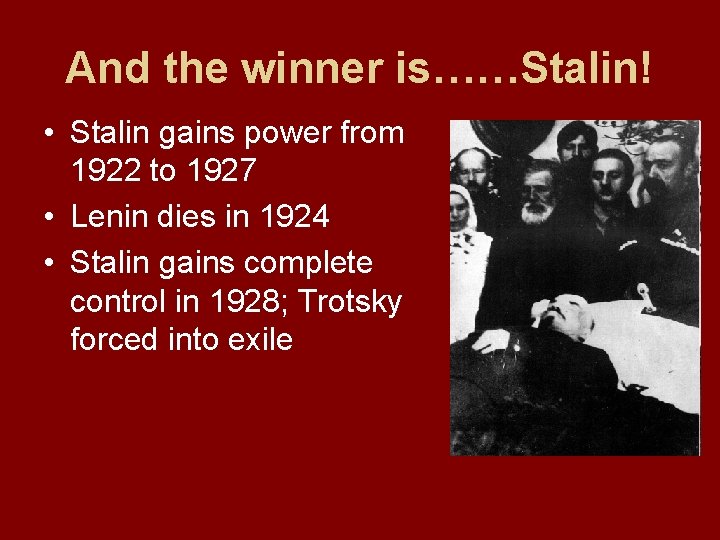
And the winner is……Stalin! • Stalin gains power from 1922 to 1927 • Lenin dies in 1924 • Stalin gains complete control in 1928; Trotsky forced into exile
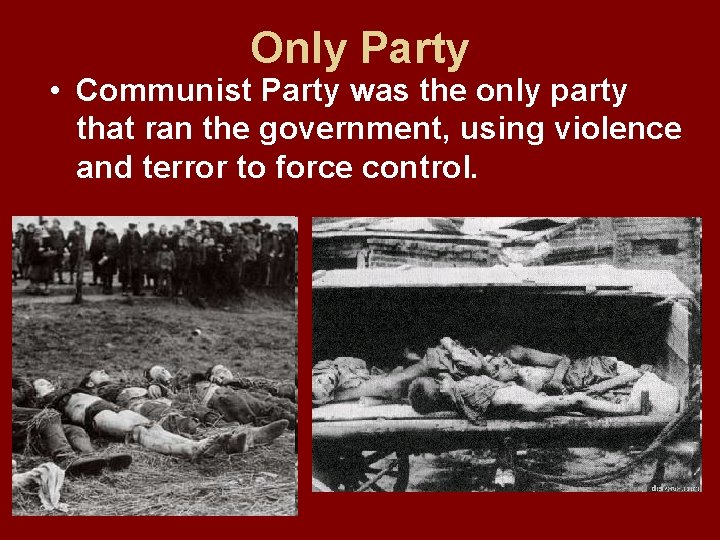
Only Party • Communist Party was the only party that ran the government, using violence and terror to force control.
USSR Under Stalin Command Economy • Planned to make the USSR a modern industrial power • Immediately removed the New Economic Plan initiated by Lenin as being anti. Communist
5 Year Plan INDUSTRY High production rates Heavy industry Transportation
5 Year Plan Agriculture Collective farms – Peasants gave up small farms – Lived on state-owned collective farms – Collective owned all farms animals/equipment – Government controlled prices, supplies, quotas
RESULTS OF PLANS • INDUSTRY – Consumer goods neglected – Citizens remained poor – Low standard of living • AGRICULTURE – Farmers resisted – Killed farms animals – Destroyed tools and crops – Farmers who resisted were sent to labor camps – Government seized grain causing a famine – 5+ Million died due to starvation
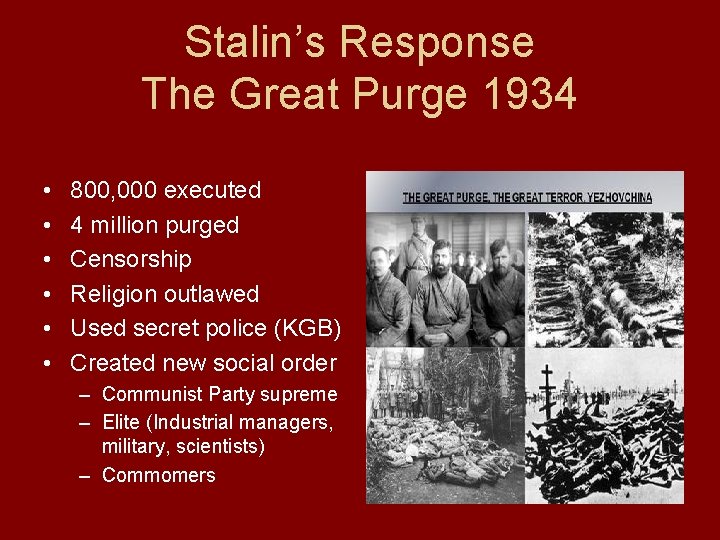
Stalin’s Response The Great Purge 1934 • • • 800, 000 executed 4 million purged Censorship Religion outlawed Used secret police (KGB) Created new social order – Communist Party supreme – Elite (Industrial managers, military, scientists) – Commomers