
What impact did geography economy and foreign relations


- Slides: 20
What impact did geography, economy and foreign relations have on the war? 2 J America: A Nation Divided, c 1845– 1877
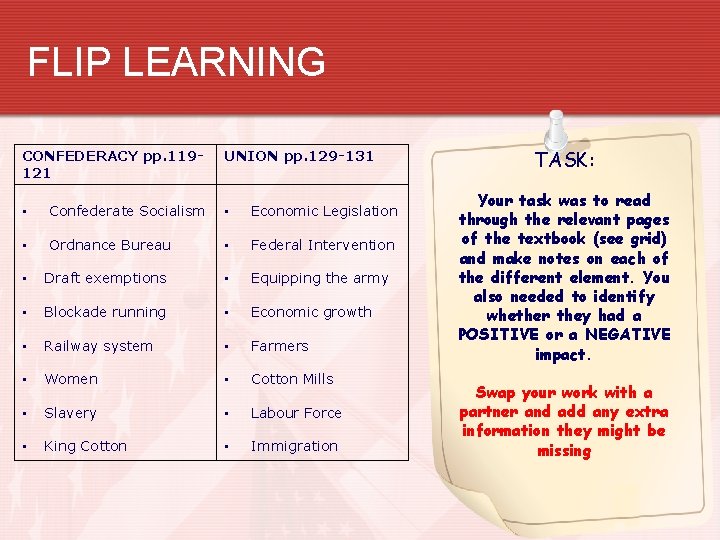
FLIP LEARNING CONFEDERACY pp. 119121 UNION pp. 129 -131 • Confederate Socialism • Economic Legislation • Ordnance Bureau • Federal Intervention • Draft exemptions • Equipping the army • Blockade running • Economic growth • Railway system • Farmers • Women • Cotton Mills • Slavery • Labour Force • King Cotton • Immigration TASK: Your task was to read through the relevant pages of the textbook (see grid) and make notes on each of the different element. You also needed to identify whether they had a POSITIVE or a NEGATIVE impact. Swap your work with a partner and add any extra information they might be missing
https: //create. kahoot. it/#user/02978 d 17 -8 b 9 e-4 c 25 -b 0 d 76 bcf 2 c 77 b 842/kahoots/created
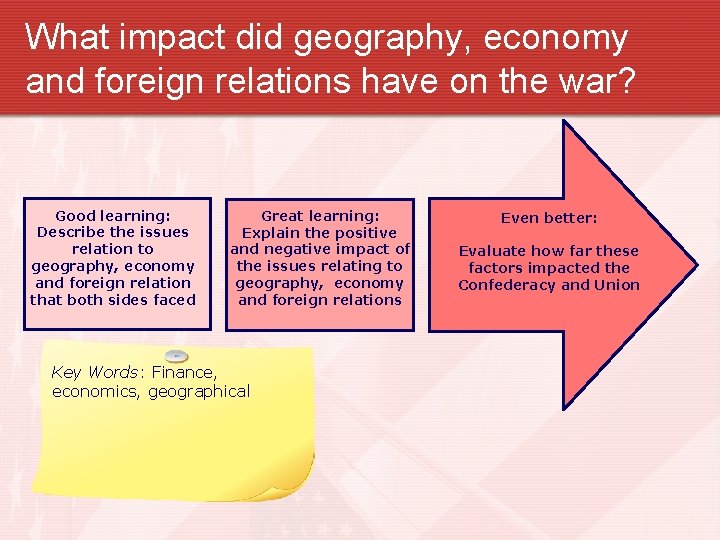
What impact did geography, economy and foreign relations have on the war? Good learning: Describe the issues relation to geography, economy and foreign relation that both sides faced Great learning: Explain the positive and negative impact of the issues relating to geography, economy and foreign relations Key Words: Finance, economics, geographical Even better: Evaluate how far these factors impacted the Confederacy and Union
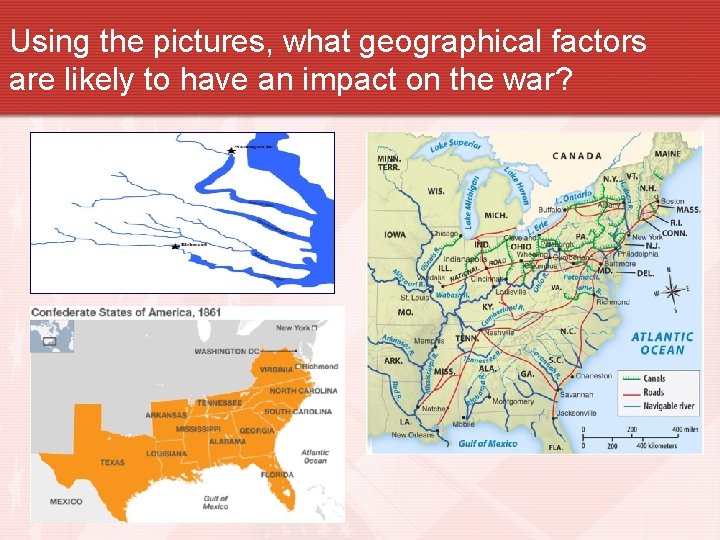
Using the pictures, what geographical factors are likely to have an impact on the war?
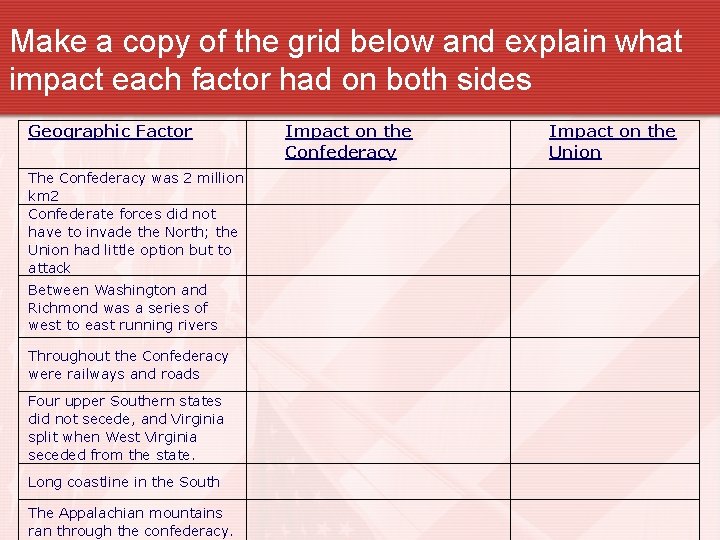
Make a copy of the grid below and explain what impact each factor had on both sides Geographic Factor The Confederacy was 2 million km 2 Confederate forces did not have to invade the North; the Union had little option but to attack Between Washington and Richmond was a series of west to east running rivers Throughout the Confederacy were railways and roads Four upper Southern states did not secede, and Virginia split when West Virginia seceded from the state. Long coastline in the South The Appalachian mountains ran through the confederacy. Impact on the Confederacy Impact on the Union
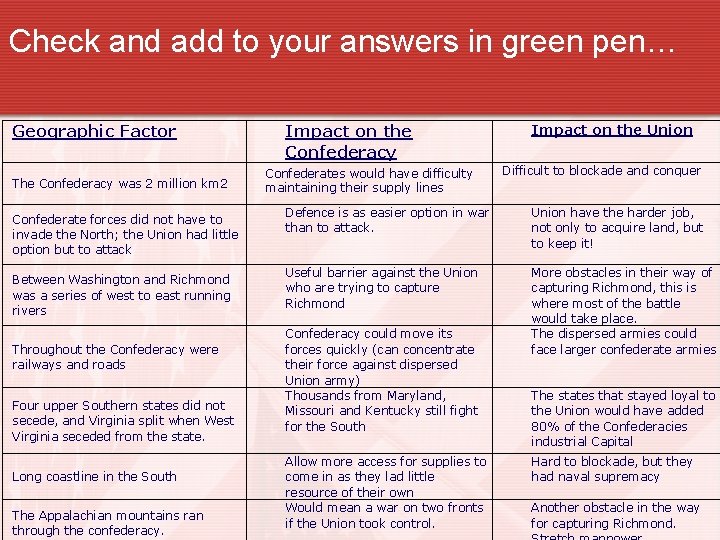
Check and add to your answers in green pen… Geographic Factor The Confederacy was 2 million km 2 Confederate forces did not have to invade the North; the Union had little option but to attack Between Washington and Richmond was a series of west to east running rivers Throughout the Confederacy were railways and roads Four upper Southern states did not secede, and Virginia split when West Virginia seceded from the state. Long coastline in the South The Appalachian mountains ran through the confederacy. Impact on the Confederacy Confederates would have difficulty maintaining their supply lines Impact on the Union Difficult to blockade and conquer Defence is as easier option in war than to attack. Union have the harder job, not only to acquire land, but to keep it! Useful barrier against the Union who are trying to capture Richmond More obstacles in their way of capturing Richmond, this is where most of the battle would take place. The dispersed armies could face larger confederate armies Confederacy could move its forces quickly (can concentrate their force against dispersed Union army) Thousands from Maryland, Missouri and Kentucky still fight for the South Allow more access for supplies to come in as they lad little resource of their own Would mean a war on two fronts if the Union took control. The states that stayed loyal to the Union would have added 80% of the Confederacies industrial Capital Hard to blockade, but they had naval supremacy Another obstacle in the way for capturing Richmond.
What impact did geographic factors have on the Union and the Confederacy? NEGATIVE POSITIVE
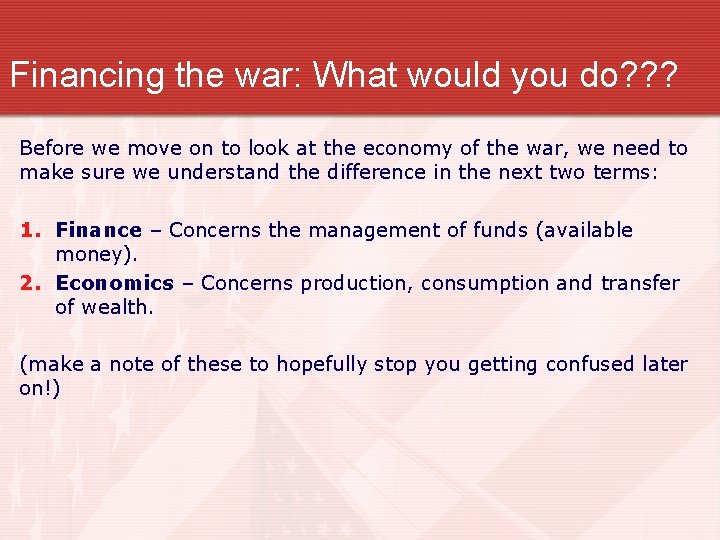
Financing the war: What would you do? ? ? Before we move on to look at the economy of the war, we need to make sure we understand the difference in the next two terms: 1. Finance – Concerns the management of funds (available money). 2. Economics – Concerns production, consumption and transfer of wealth. (make a note of these to hopefully stop you getting confused later on!)
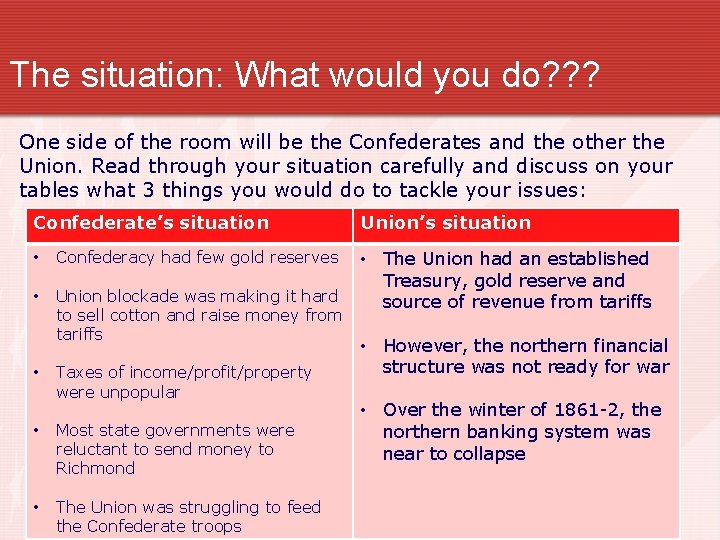
The situation: What would you do? ? ? One side of the room will be the Confederates and the other the Union. Read through your situation carefully and discuss on your tables what 3 things you would do to tackle your issues: Confederate’s situation • Confederacy had few gold reserves • Union blockade was making it hard to sell cotton and raise money from tariffs • Taxes of income/profit/property were unpopular • Most state governments were reluctant to send money to Richmond • The Union was struggling to feed the Confederate troops Union’s situation • The Union had an established Treasury, gold reserve and source of revenue from tariffs • However, the northern financial structure was not ready for war • Over the winter of 1861 -2, the northern banking system was near to collapse
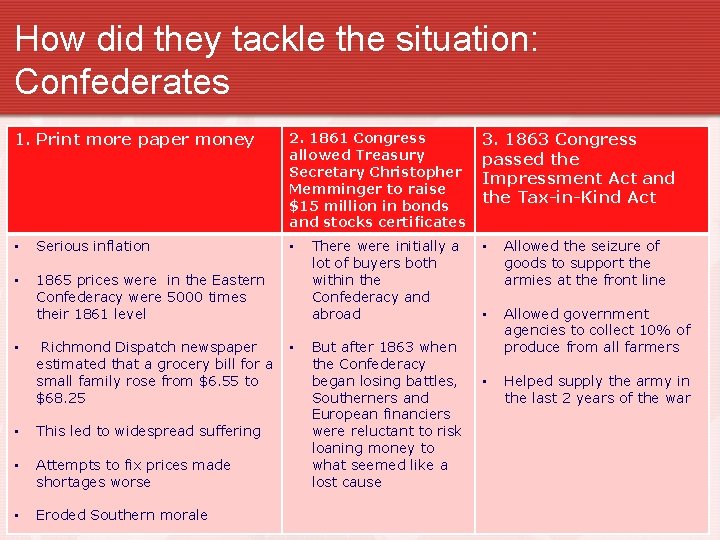
How did they tackle the situation: Confederates 1. Print more paper money • Serious inflation • 1865 prices were in the Eastern Confederacy were 5000 times their 1861 level • Richmond Dispatch newspaper estimated that a grocery bill for a small family rose from $6. 55 to $68. 25 • This led to widespread suffering • Attempts to fix prices made shortages worse • Eroded Southern morale 2. 1861 Congress allowed Treasury Secretary Christopher Memminger to raise $15 million in bonds and stocks certificates • • There were initially a lot of buyers both within the Confederacy and abroad But after 1863 when the Confederacy began losing battles, Southerners and European financiers were reluctant to risk loaning money to what seemed like a lost cause 3. 1863 Congress passed the Impressment Act and the Tax-in-Kind Act • Allowed the seizure of goods to support the armies at the front line • Allowed government agencies to collect 10% of produce from all farmers • Helped supply the army in the last 2 years of the war
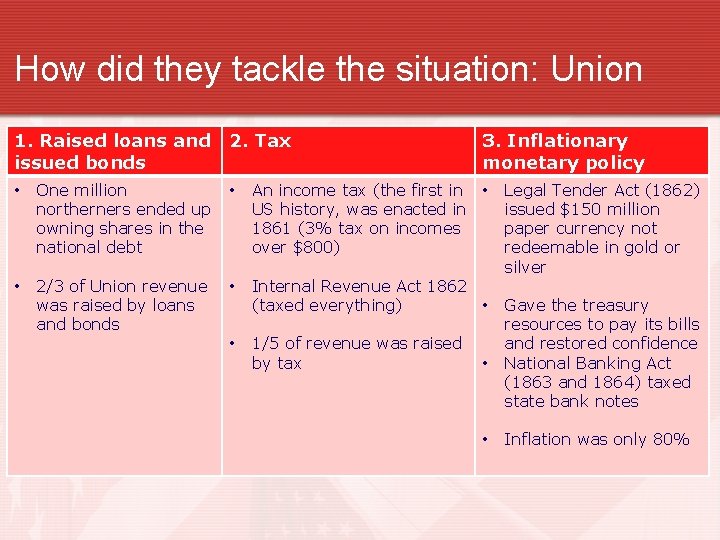
How did they tackle the situation: Union 1. Raised loans and issued bonds 2. Tax 3. Inflationary monetary policy • One million northerners ended up owning shares in the national debt • An income tax (the first in • US history, was enacted in 1861 (3% tax on incomes over $800) • 2/3 of Union revenue was raised by loans and bonds • Internal Revenue Act 1862 (taxed everything) • • 1/5 of revenue was raised by tax • • Legal Tender Act (1862) issued $150 million paper currency not redeemable in gold or silver Gave the treasury resources to pay its bills and restored confidence National Banking Act (1863 and 1864) taxed state bank notes Inflation was only 80%
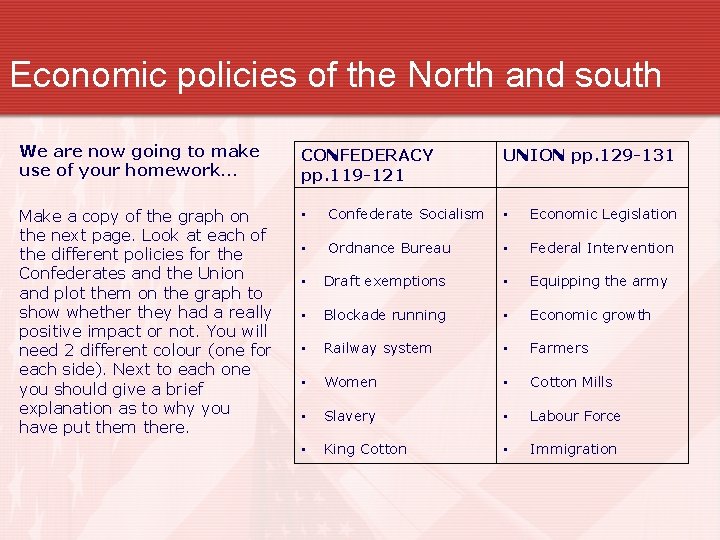
Economic policies of the North and south We are now going to make use of your homework… CONFEDERACY pp. 119 -121 Make a copy of the graph on the next page. Look at each of the different policies for the Confederates and the Union and plot them on the graph to show whether they had a really positive impact or not. You will need 2 different colour (one for each side). Next to each one you should give a brief explanation as to why you have put them there. • Confederate Socialism • Economic Legislation • Ordnance Bureau • Federal Intervention UNION pp. 129 -131 • Draft exemptions • Equipping the army • Blockade running • Economic growth • Railway system • Farmers • Women • Cotton Mills • Slavery • Labour Force • King Cotton • Immigration
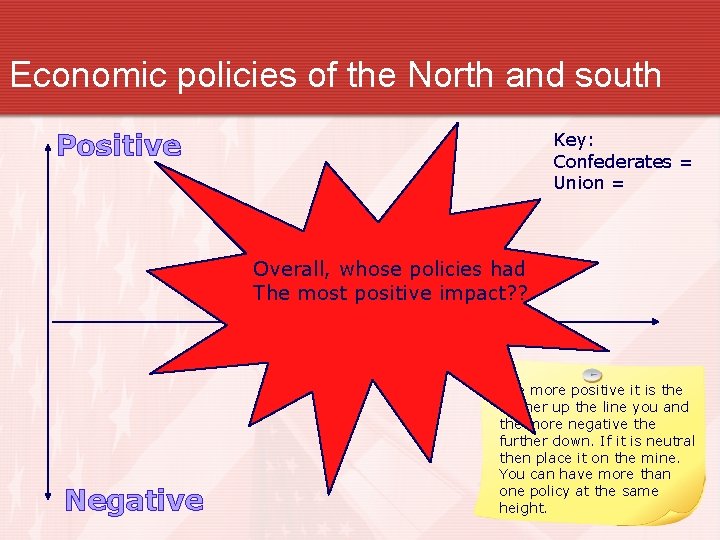
Economic policies of the North and south Positive Key: Confederates = Union = Overall, whose policies had The most positive impact? ? Negative The more positive it is the further up the line you and the more negative the further down. If it is neutral then place it on the mine. You can have more than one policy at the same height.
Foreign relations
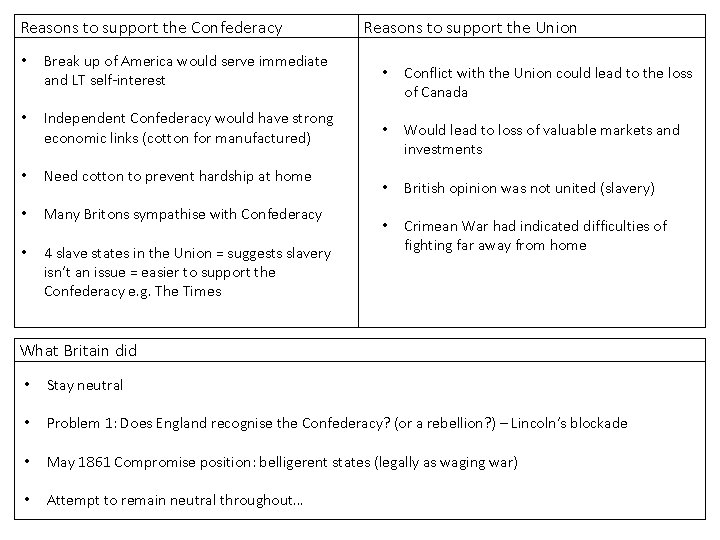
Reasons to support the Confederacy Reasons to support the Union • Break up of America would serve immediate and LT self-interest • Conflict with the Union could lead to the loss of Canada • Independent Confederacy would have strong economic links (cotton for manufactured) • Would lead to loss of valuable markets and investments • Need cotton to prevent hardship at home • British opinion was not united (slavery) • Many Britons sympathise with Confederacy • • 4 slave states in the Union = suggests slavery isn’t an issue = easier to support the Confederacy e. g. The Times Crimean War had indicated difficulties of fighting far away from home What Britain did • Stay neutral • Problem 1: Does England recognise the Confederacy? (or a rebellion? ) – Lincoln’s blockade • May 1861 Compromise position: belligerent states (legally as waging war) • Attempt to remain neutral throughout…
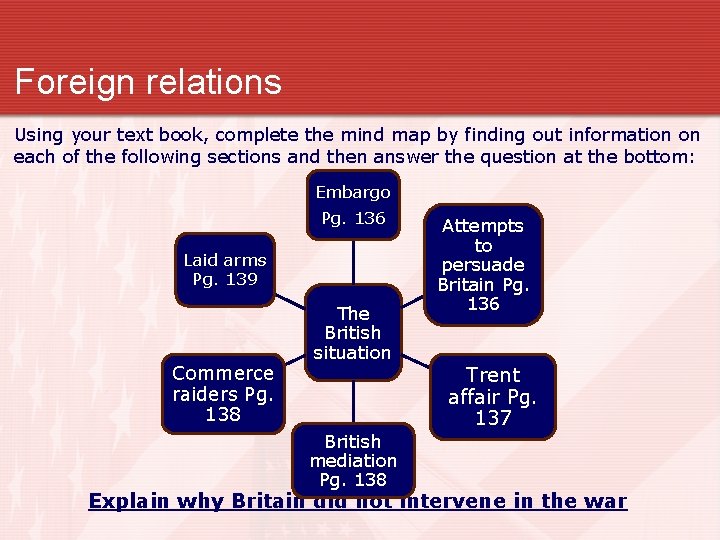
Foreign relations Using your text book, complete the mind map by finding out information on each of the following sections and then answer the question at the bottom: Embargo Pg. 136 Laid arms Pg. 139 Commerce raiders Pg. 138 The British situation British mediation Pg. 138 Attempts to persuade Britain Pg. 136 Trent affair Pg. 137 Explain why Britain did not intervene in the war
Geography Economy Foreign relations
Geography Economy Foreign relations
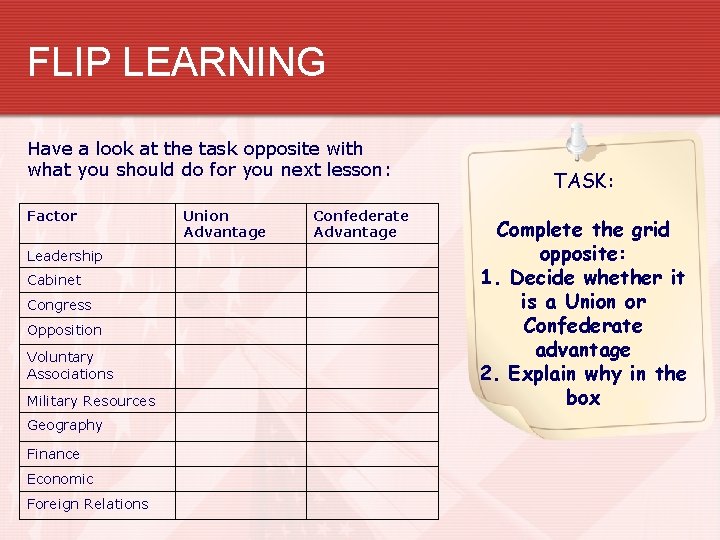
FLIP LEARNING Have a look at the task opposite with what you should do for you next lesson: Factor Leadership Cabinet Congress Opposition Voluntary Associations Military Resources Geography Finance Economic Foreign Relations Union Advantage Confederate Advantage TASK: Complete the grid opposite: 1. Decide whether it is a Union or Confederate advantage 2. Explain why in the box