
What if you didnt need Detergent Bleach Fabric
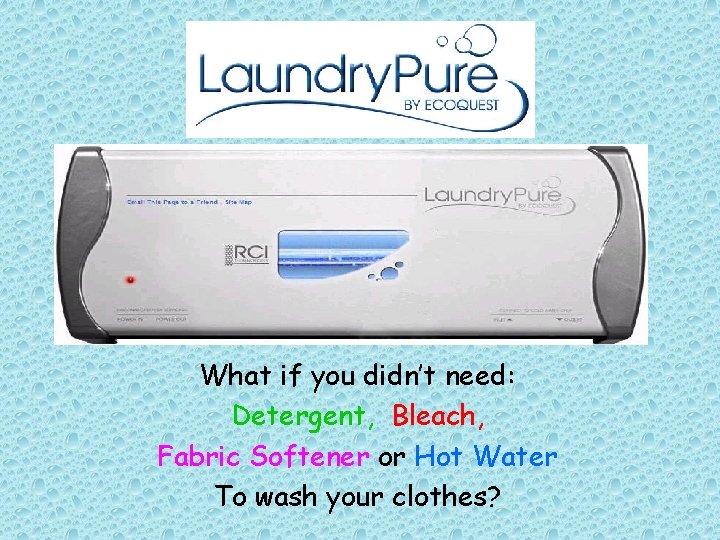
What if you didn’t need: Detergent, Bleach, Fabric Softener or Hot Water To wash your clothes?
Eco. Quest Laundry. Pure The Problem: Traditional Detergents Embed Themselves Into The Fabric Resulting In: • Possible allergic reactions - chemical soup of phosphates, chlorines and perfumes • Weighing down of the fabric (loss of volume) • Dulling of the colors • Creation of a sticky surface from residual detergents that acts as a magnet for grime and contaminants • Phosphate and chlorine pollution of our water resources
We Spend 6 Billion Dollars A Year On Laundry Detergent ($6, 000, 000)
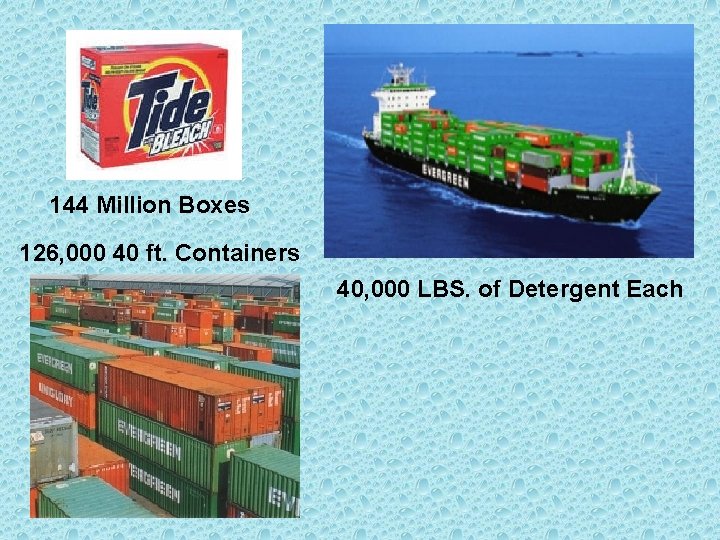
144 Million Boxes 126, 000 40 ft. Containers 40, 000 LBS. of Detergent Each

That Equals 126, 000 Trucks Each Hauling a 40 ft. Container Put Bumper To Bumper from Vancouver to L. A. For 1, 260 Miles You could spend 21 HRS. OF NON-STOP DRIVING @ 60 MPH, PASSING THESE TRUCKS LOADED to the GILLS, with DETERGENT THAT IS 6 BILLION DOLLARS WORTH OF LAUNDRY DETERGENT
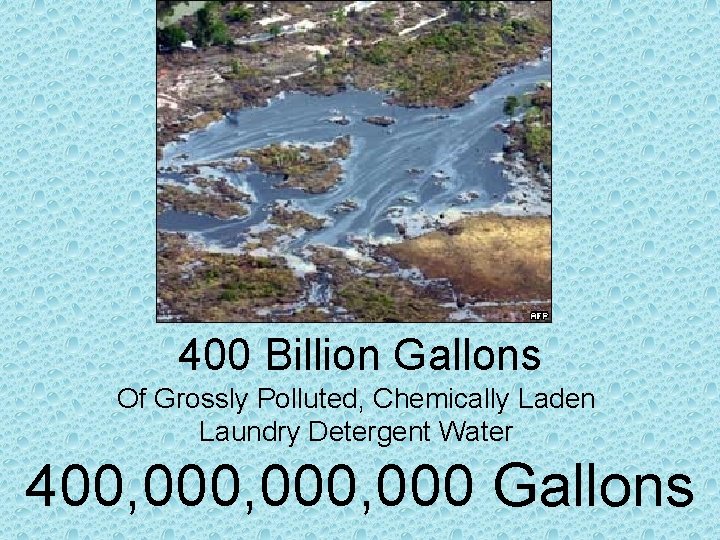
400 Billion Gallons Of Grossly Polluted, Chemically Laden Laundry Detergent Water 400, 000, 000 Gallons
Announcing The “No. Suds Revolution” Free From The World’s Oldest Pollution Stop the usage of Laundry Detergent And the POLLUTION IT CREATES from Every home in AMERICA
So What’s In All Those Laundry Detergents?
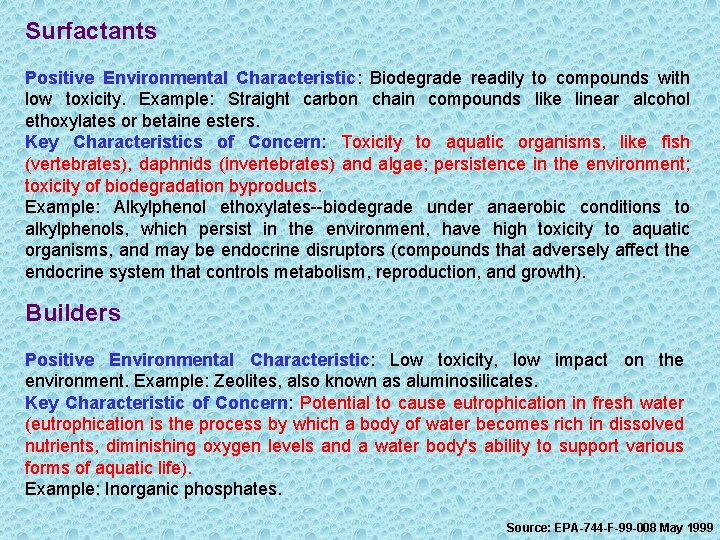
Surfactants Positive Environmental Characteristic: Biodegrade readily to compounds with low toxicity. Example: Straight carbon chain compounds like linear alcohol ethoxylates or betaine esters. Key Characteristics of Concern: Toxicity to aquatic organisms, like fish (vertebrates), daphnids (invertebrates) and algae; persistence in the environment; toxicity of biodegradation byproducts. Example: Alkylphenol ethoxylates--biodegrade under anaerobic conditions to alkylphenols, which persist in the environment, have high toxicity to aquatic organisms, and may be endocrine disruptors (compounds that adversely affect the endocrine system that controls metabolism, reproduction, and growth). Builders Positive Environmental Characteristic: Low toxicity, low impact on the environment. Example: Zeolites, also known as aluminosilicates. Key Characteristic of Concern: Potential to cause eutrophication in fresh water (eutrophication is the process by which a body of water becomes rich in dissolved nutrients, diminishing oxygen levels and a water body's ability to support various forms of aquatic life). Example: Inorganic phosphates. Source: EPA-744 -F-99 -008 May 1999
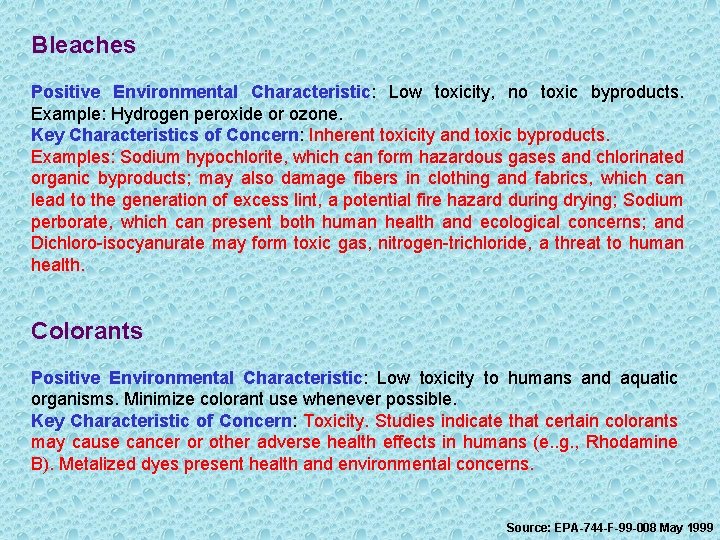
Bleaches Positive Environmental Characteristic: Low toxicity, no toxic byproducts. Example: Hydrogen peroxide or ozone. Key Characteristics of Concern: Inherent toxicity and toxic byproducts. Examples: Sodium hypochlorite, which can form hazardous gases and chlorinated organic byproducts; may also damage fibers in clothing and fabrics, which can lead to the generation of excess lint, a potential fire hazard during drying; Sodium perborate, which can present both human health and ecological concerns; and Dichloro-isocyanurate may form toxic gas, nitrogen-trichloride, a threat to human health. Colorants Positive Environmental Characteristic: Low toxicity to humans and aquatic organisms. Minimize colorant use whenever possible. Key Characteristic of Concern: Toxicity. Studies indicate that certain colorants may cause cancer or other adverse health effects in humans (e. . g. , Rhodamine B). Metalized dyes present health and environmental concerns. Source: EPA-744 -F-99 -008 May 1999
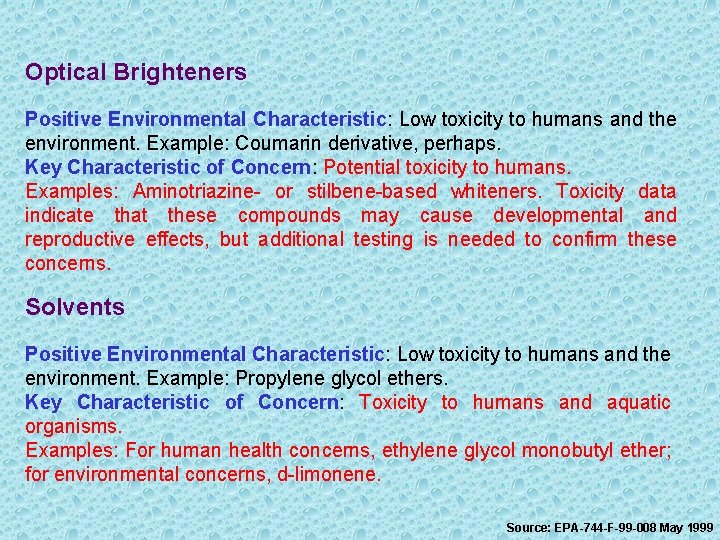
Optical Brighteners Positive Environmental Characteristic: Low toxicity to humans and the environment. Example: Coumarin derivative, perhaps. Key Characteristic of Concern: Potential toxicity to humans. Examples: Aminotriazine- or stilbene-based whiteners. Toxicity data indicate that these compounds may cause developmental and reproductive effects, but additional testing is needed to confirm these concerns. Solvents Positive Environmental Characteristic: Low toxicity to humans and the environment. Example: Propylene glycol ethers. Key Characteristic of Concern: Toxicity to humans and aquatic organisms. Examples: For human health concerns, ethylene glycol monobutyl ether; for environmental concerns, d-limonene. Source: EPA-744 -F-99 -008 May 1999
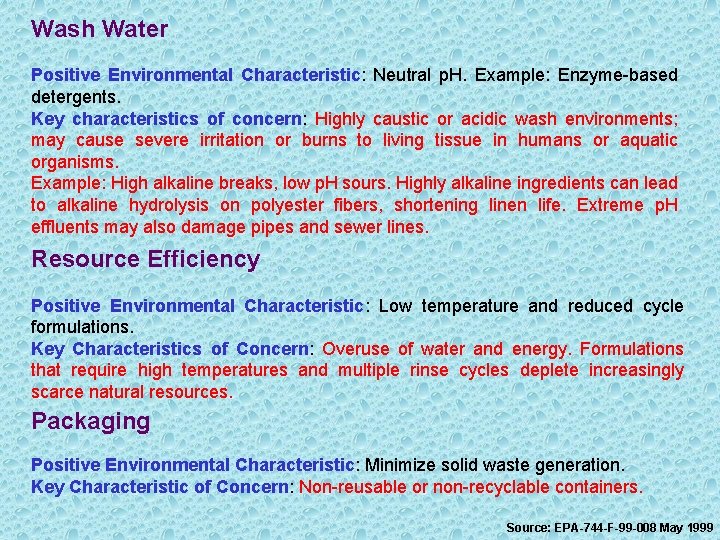
Wash Water Positive Environmental Characteristic: Neutral p. H. Example: Enzyme-based detergents. Key characteristics of concern: Highly caustic or acidic wash environments; may cause severe irritation or burns to living tissue in humans or aquatic organisms. Example: High alkaline breaks, low p. H sours. Highly alkaline ingredients can lead to alkaline hydrolysis on polyester fibers, shortening linen life. Extreme p. H effluents may also damage pipes and sewer lines. Resource Efficiency Positive Environmental Characteristic: Low temperature and reduced cycle formulations. Key Characteristics of Concern: Overuse of water and energy. Formulations that require high temperatures and multiple rinse cycles deplete increasingly scarce natural resources. Packaging Positive Environmental Characteristic: Minimize solid waste generation. Key Characteristic of Concern: Non-reusable or non-recyclable containers. Source: EPA-744 -F-99 -008 May 1999
Chemicals that are sometimes found in fabric softeners and dryer sheets: • Benzyl acetate: Linked to pancreatic cancer • Benzyl Alcohol: Upper respiratory tract irritant • Ethanol: On Environmental Protection Agency's (EPA) Hazardous Waste list and can cause central nervous system disorders • Limonene: Known carcinogen • A-Terpineol: Can cause respiratory problems, including fatal edema, and central nervous system damage • Ethyl Acetate: A narcotic on the EPA's Hazardous Waste list • Camphor: Causes central nervous system disorders • Chloroform: Neurotoxic, anesthetic and carcinogenic • Linalool: A narcotic that causes central nervous system disorders • Pentane: A chemical known to be harmful if inhaled Fabric softeners and dryer sheets with scents like April Fresh and Summer Orchard add toxic chemicals to your laundry and, consequently, your body.
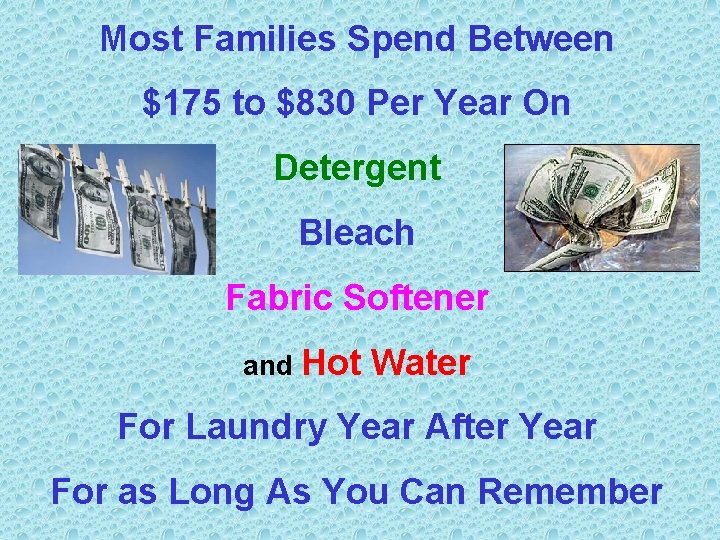
Most Families Spend Between $175 to $830 Per Year On Detergent Bleach Fabric Softener and Hot Water For Laundry Year After Year For as Long As You Can Remember
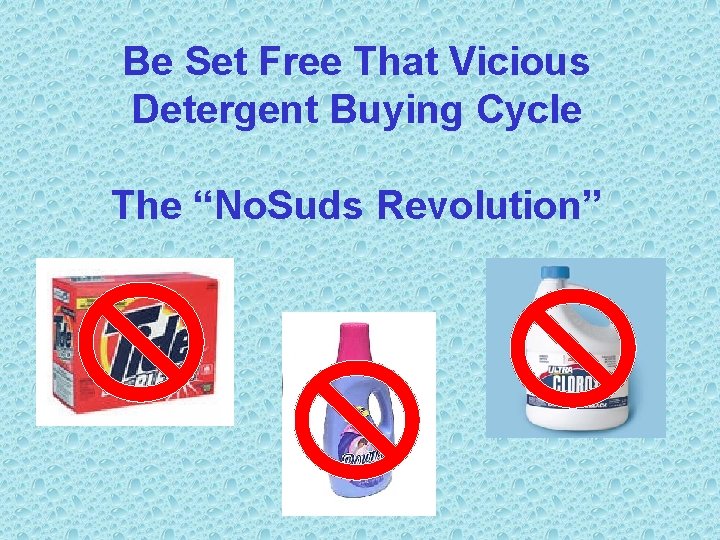
Be Set Free That Vicious Detergent Buying Cycle The “No. Suds Revolution”

You Can Leave The Detergent On The Shelf And The Money in your Pocket No More Heavy Boxes and Jugs To Lug Home
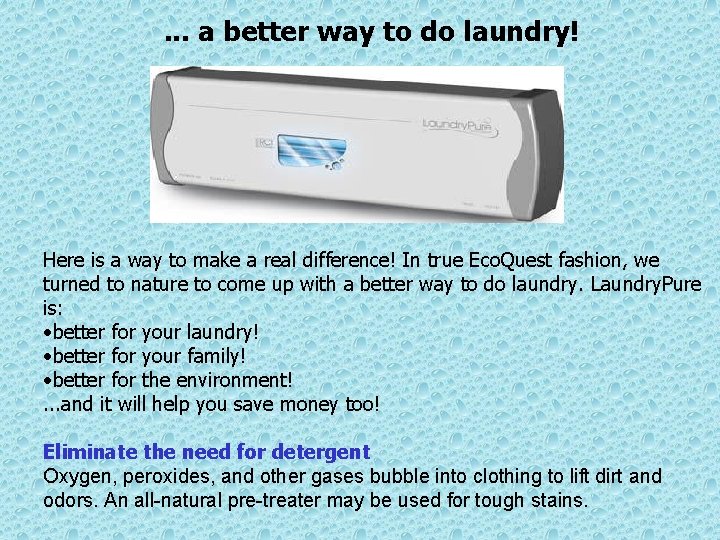
. . . a better way to do laundry! Here is a way to make a real difference! In true Eco. Quest fashion, we turned to nature to come up with a better way to do laundry. Laundry. Pure is: • better for your laundry! • better for your family! • better for the environment!. . . and it will help you save money too! Eliminate the need for detergent Oxygen, peroxides, and other gases bubble into clothing to lift dirt and odors. An all-natural pre-treater may be used for tough stains.
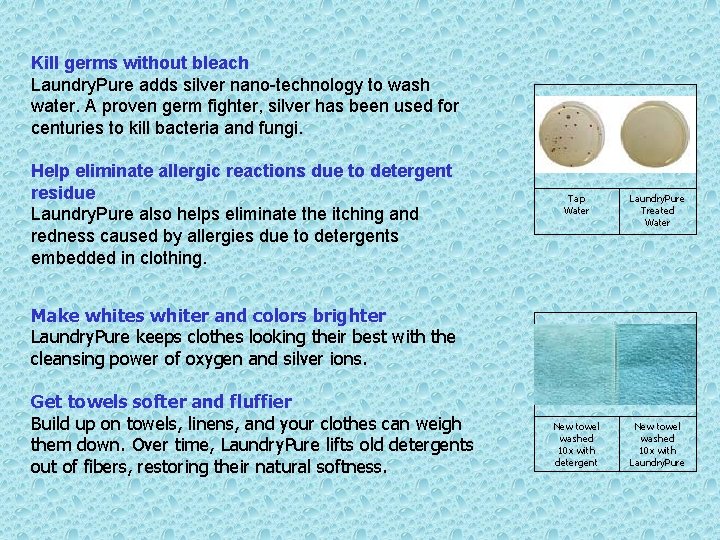
Kill germs without bleach Laundry. Pure adds silver nano-technology to wash water. A proven germ fighter, silver has been used for centuries to kill bacteria and fungi. Help eliminate allergic reactions due to detergent residue Laundry. Pure also helps eliminate the itching and redness caused by allergies due to detergents embedded in clothing. Make whites whiter and colors brighter Laundry. Pure keeps clothes looking their best with the cleansing power of oxygen and silver ions. Get towels softer and fluffier Build up on towels, linens, and your clothes can weigh them down. Over time, Laundry. Pure lifts old detergents out of fibers, restoring their natural softness. Tap Water Laundry. Pure Treated Water New towel washed 10 x with detergent New towel washed 10 x with Laundry. Pure
Save money - no need for hot water! Laundry. Pure eliminates the need for hot water cycles. Silver kills germs and oxidation cleans clothes. This means less energy, less pollution, and more money in your pocketbook. The technology in Laundry. Pure has been successfully used for over a decade in hospitals, hotels, and commercial laundromats. Now you can save money and get cleaner laundry at home. Laundry washed in Laundry. Pure is softer, fluffier, and lasts longer!
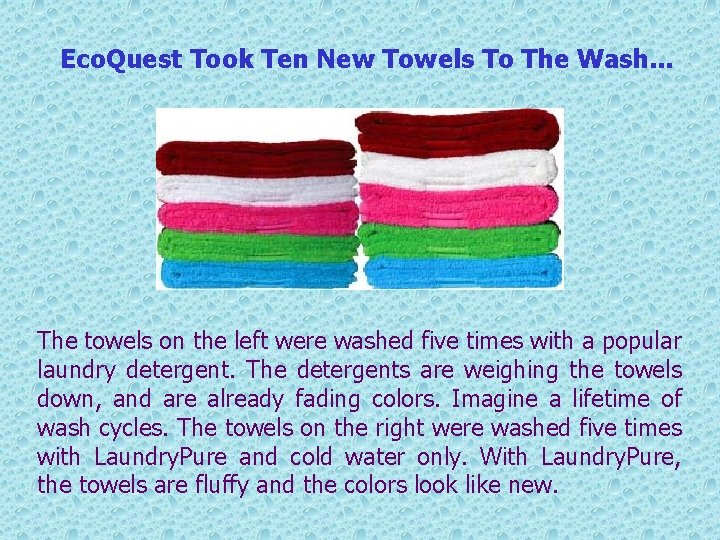
Eco. Quest Took Ten New Towels To The Wash. . . The towels on the left were washed five times with a popular laundry detergent. The detergents are weighing the towels down, and are already fading colors. Imagine a lifetime of wash cycles. The towels on the right were washed five times with Laundry. Pure and cold water only. With Laundry. Pure, the towels are fluffy and the colors look like new.
How Does It Work? RCI Technology Using a technology developed by NASA and improved by Eco. Quest, the “RCI Cell” produces millions of tiny oxygenated air bubbles that are injected into the water, which clean your clothes without the use of harsh chemicals. Laundry. Pure also incorporates other processes, including Silver Nano Ions, which provides odor protection for your clothes. The Laundry. Pure Experience • Better for your Clothes. . . and your skin • Money Savings • Bacteria Killing • Environmentally Friendly • Makes Doing Laundry EASIER!
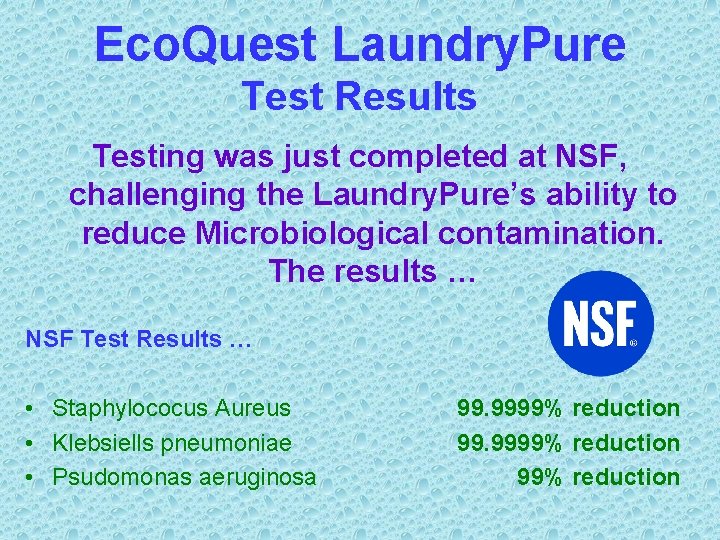
Eco. Quest Laundry. Pure Test Results Testing was just completed at NSF, challenging the Laundry. Pure’s ability to reduce Microbiological contamination. The results … NSF Test Results … • Staphylococus Aureus • Klebsiells pneumoniae • Psudomonas aeruginosa 99. 9999% reduction 99% reduction
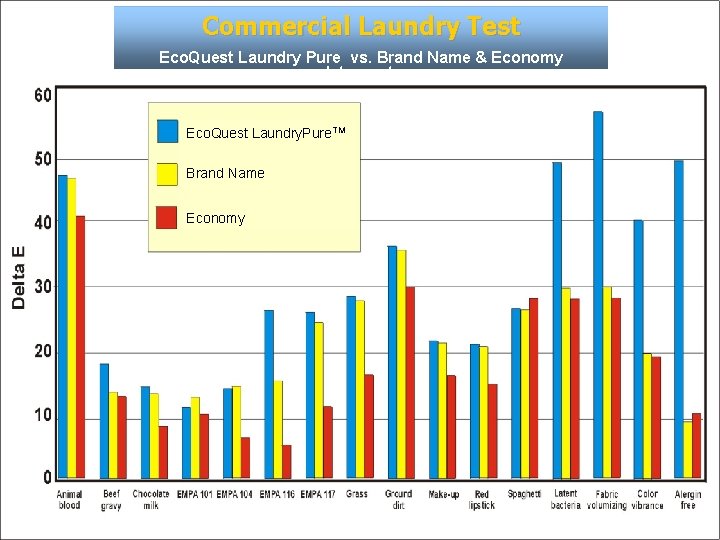
Commercial Laundry Test Eco. Quest Laundry Pure vs. Brand Name & Economy detergents Eco. Quest Laundry. Pure. TM Brand Name Economy
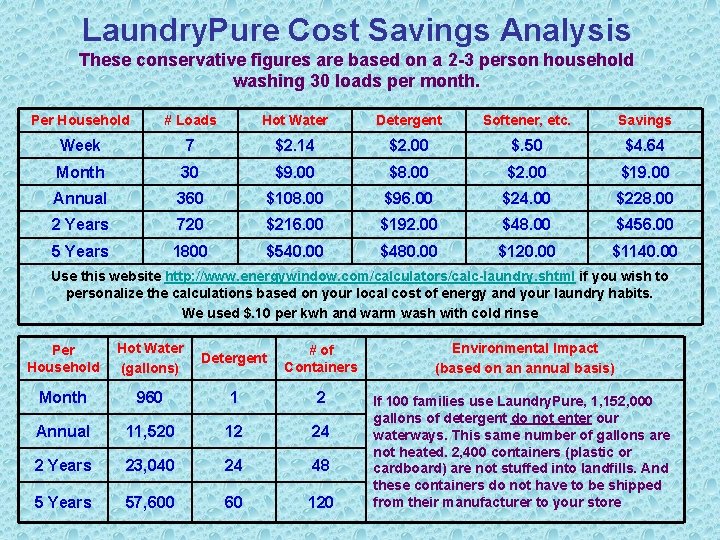
Laundry. Pure Cost Savings Analysis These conservative figures are based on a 2 -3 person household washing 30 loads per month. Per Household # Loads Hot Water Detergent Softener, etc. Savings Week 7 $2. 14 $2. 00 $. 50 $4. 64 Month 30 $9. 00 $8. 00 $2. 00 $19. 00 Annual 360 $108. 00 $96. 00 $24. 00 $228. 00 2 Years 720 $216. 00 $192. 00 $48. 00 $456. 00 5 Years 1800 $540. 00 $480. 00 $120. 00 $1140. 00 Use this website http: //www. energywindow. com/calculators/calc-laundry. shtml if you wish to personalize the calculations based on your local cost of energy and your laundry habits. We used $. 10 per kwh and warm wash with cold rinse Per Household Hot Water (gallons) Detergent # of Containers Environmental Impact (based on an annual basis) Month 960 1 2 Annual 11, 520 12 24 2 Years 23, 040 24 48 5 Years 57, 600 60 120 If 100 families use Laundry. Pure, 1, 152, 000 gallons of detergent do not enter our waterways. This same number of gallons are not heated. 2, 400 containers (plastic or cardboard) are not stuffed into landfills. And these containers do not have to be shipped from their manufacturer to your store
Laundry. Pure Stain Test It never has been easy to rid laundry of stains. The published article in slides 4 & 5 proves that it is not an easy task. Everyone must remember Laundry. Pure does what it is meant to do, but the stains are up to you. We chose Eco-H as our stain solution in two of our test shirts. All shirts were purchased at the same time, same place and of the same manufacturer.
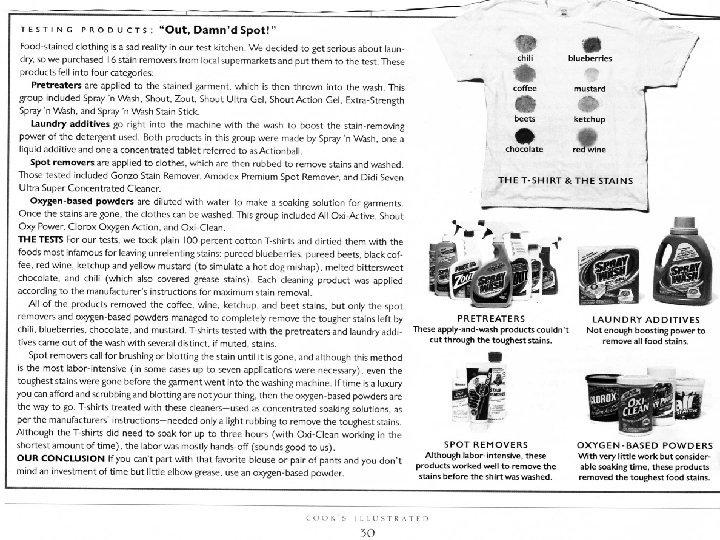
Purpose: The purpose of this presentation is to show that the Laundry. Pure system is effective in removing most stains. The tougher stains need the help of Eco-H pre-treatment. We set up our test to mimic the test done in Cook’s Illustrated Magazine. Copies of the magazine cover and test we performed are in the next two slides. We copied the test performed in the magazine exactly only using Eco-H.

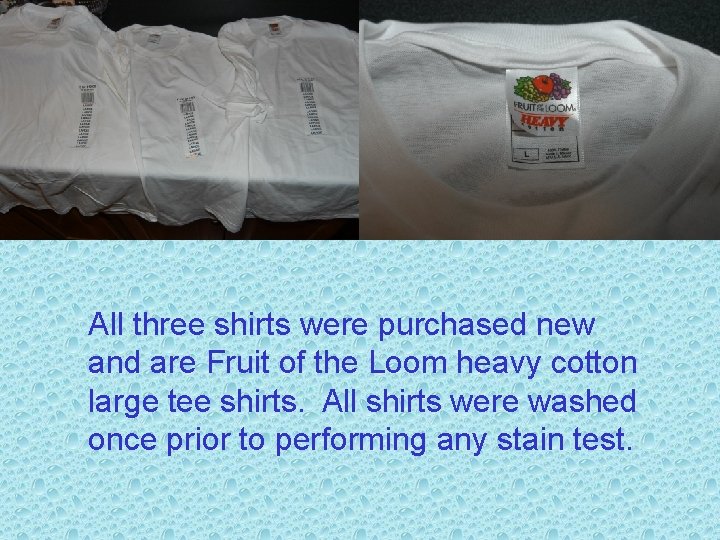
All three shirts were purchased new and are Fruit of the Loom heavy cotton large tee shirts. All shirts were washed once prior to performing any stain test.
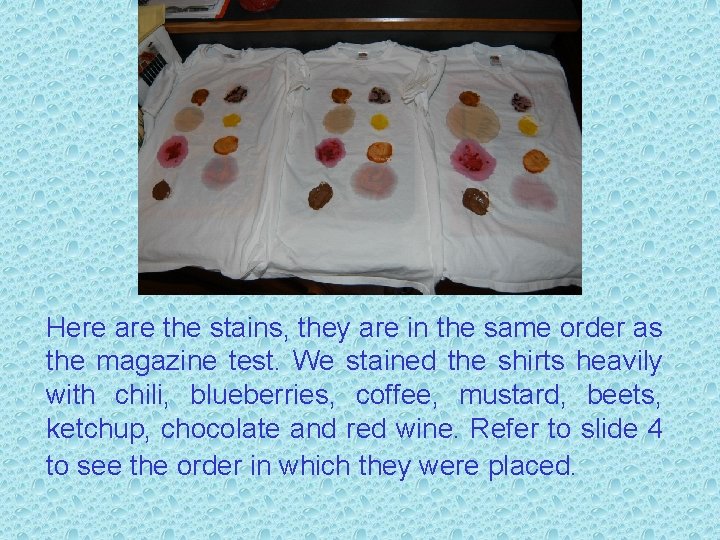
Here are the stains, they are in the same order as the magazine test. We stained the shirts heavily with chili, blueberries, coffee, mustard, beets, ketchup, chocolate and red wine. Refer to slide 4 to see the order in which they were placed.
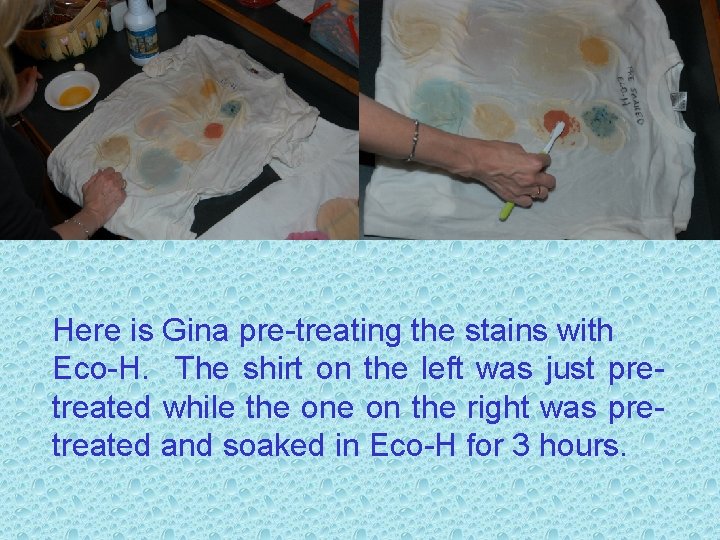
Here is Gina pre-treating the stains with Eco-H. The shirt on the left was just pretreated while the on the right was pretreated and soaked in Eco-H for 3 hours.
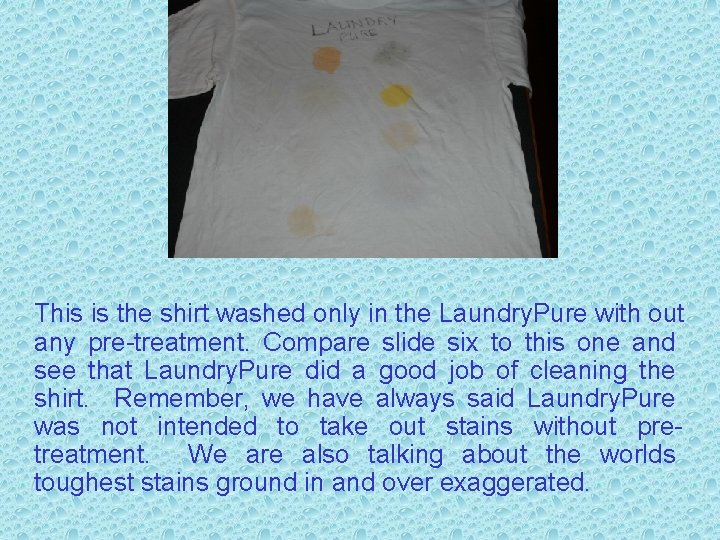
This is the shirt washed only in the Laundry. Pure with out any pre-treatment. Compare slide six to this one and see that Laundry. Pure did a good job of cleaning the shirt. Remember, we have always said Laundry. Pure was not intended to take out stains without pretreatment. We are also talking about the worlds toughest stains ground in and over exaggerated.
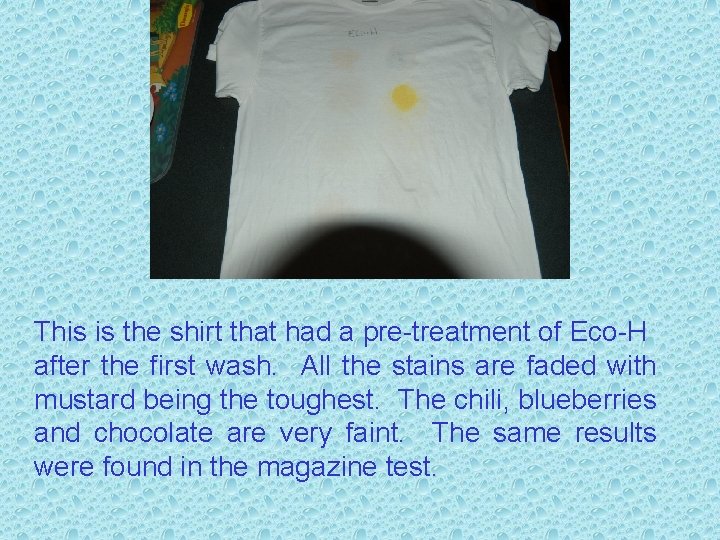
This is the shirt that had a pre-treatment of Eco-H after the first wash. All the stains are faded with mustard being the toughest. The chili, blueberries and chocolate are very faint. The same results were found in the magazine test.
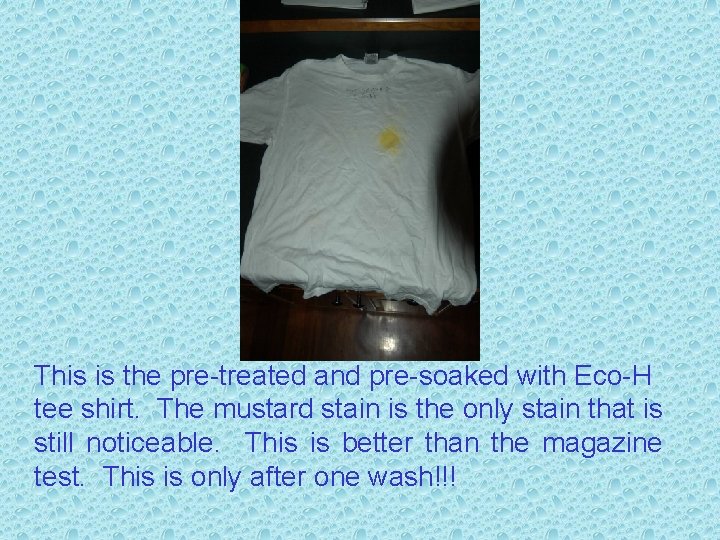
This is the pre-treated and pre-soaked with Eco-H tee shirt. The mustard stain is the only stain that is still noticeable. This is better than the magazine test. This is only after one wash!!!
The Problem: Eco-H was very effective at removing all the stains except the mustard stain. No matter how many times we applied the Eco-H, it did not remove the mustard. It did take it to a faint state. It must be noted that mustard is one of the hardest stains to remove. Gina also put enough mustard to season six hot dogs at the Worlds Fair. We decided to try Oxi -Clean, as a last resort, which is an oxygen based cleaner that was rated best in the magazine article.
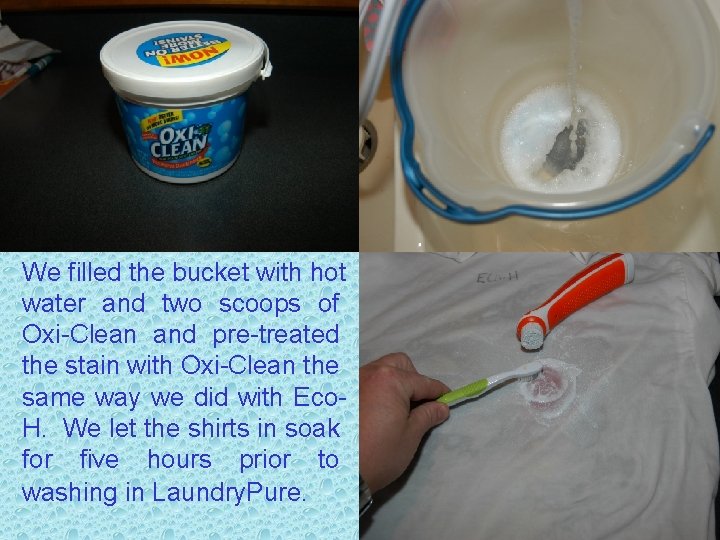
We filled the bucket with hot water and two scoops of Oxi-Clean and pre-treated the stain with Oxi-Clean the same way we did with Eco. H. We let the shirts in soak for five hours prior to washing in Laundry. Pure.
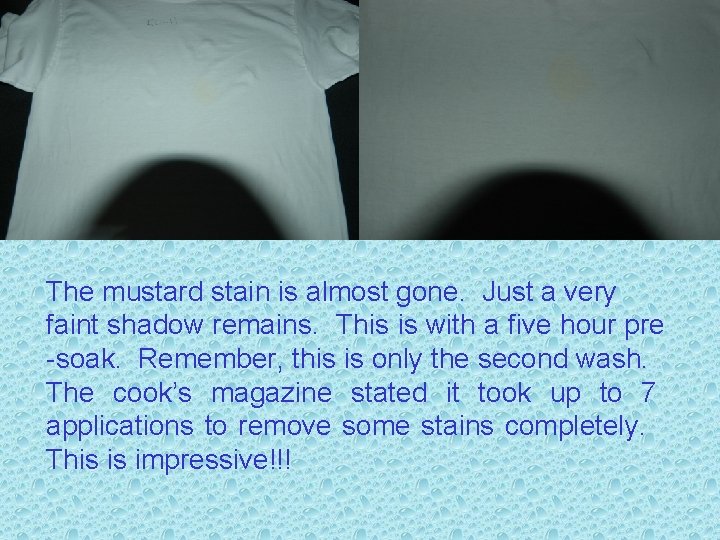
The mustard stain is almost gone. Just a very faint shadow remains. This is with a five hour pre -soak. Remember, this is only the second wash. The cook’s magazine stated it took up to 7 applications to remove some stains completely. This is impressive!!!
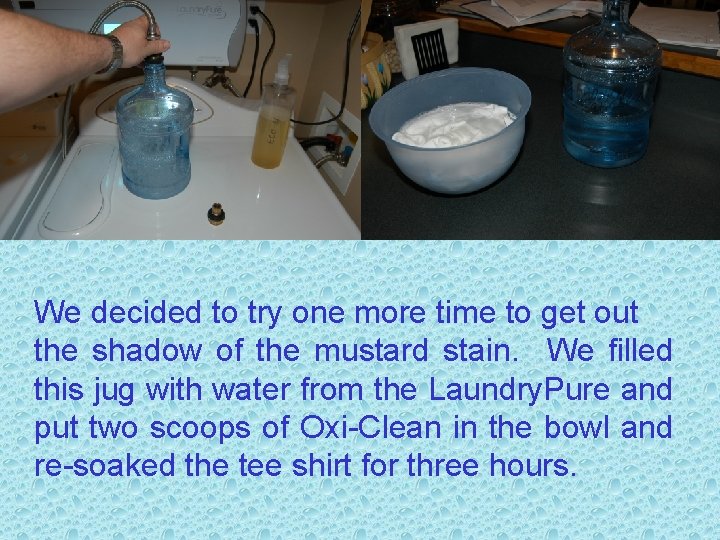
We decided to try one more time to get out the shadow of the mustard stain. We filled this jug with water from the Laundry. Pure and put two scoops of Oxi-Clean in the bowl and re-soaked the tee shirt for three hours.
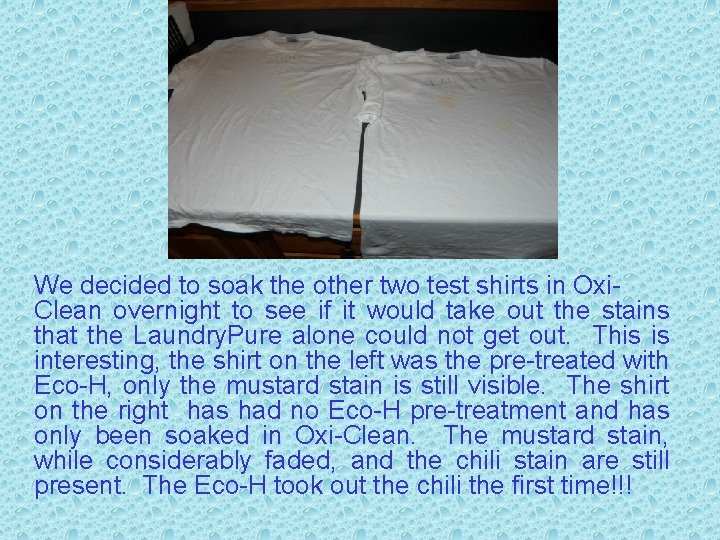
We decided to soak the other two test shirts in Oxi. Clean overnight to see if it would take out the stains that the Laundry. Pure alone could not get out. This is interesting, the shirt on the left was the pre-treated with Eco-H, only the mustard stain is still visible. The shirt on the right has had no Eco-H pre-treatment and has only been soaked in Oxi-Clean. The mustard stain, while considerably faded, and the chili stain are still present. The Eco-H took out the chili the first time!!!
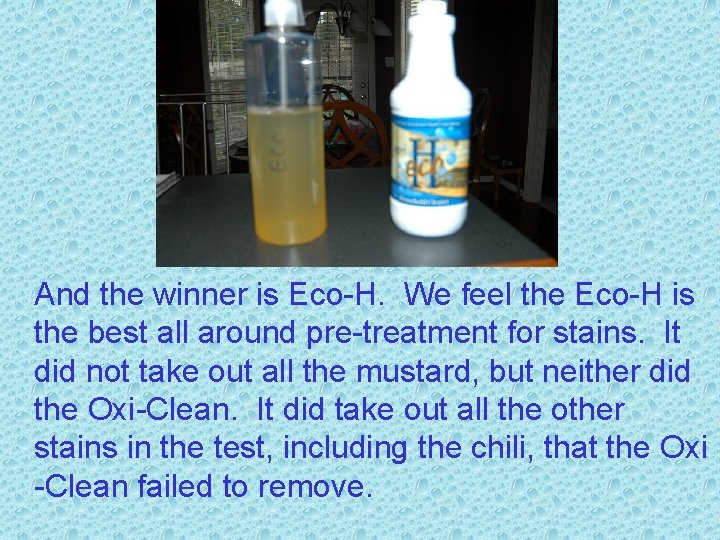
And the winner is Eco-H. We feel the Eco-H is the best all around pre-treatment for stains. It did not take out all the mustard, but neither did the Oxi-Clean. It did take out all the other stains in the test, including the chili, that the Oxi -Clean failed to remove.
Conclusion: Stains are a part of life. The fact is there is not one fix all cleaner that will remove 100% of all stains. The Eco-H proved to be the best pre-treatment in our test. Oxi-Clean removed more of the mustard stain than the Eco-H did, but failed to remove the chili stain. It must be noted, this test was a worst case scenario with stains that were put on heavy and ground into the fabric. The Bottom Line We recommend the use of Eco-H as the primary pretreatment for stains. However, it would be a good idea to keep a tub of Oxi-Clean on hand for those special, hard to get out with Eco- H, kind of stain’s.
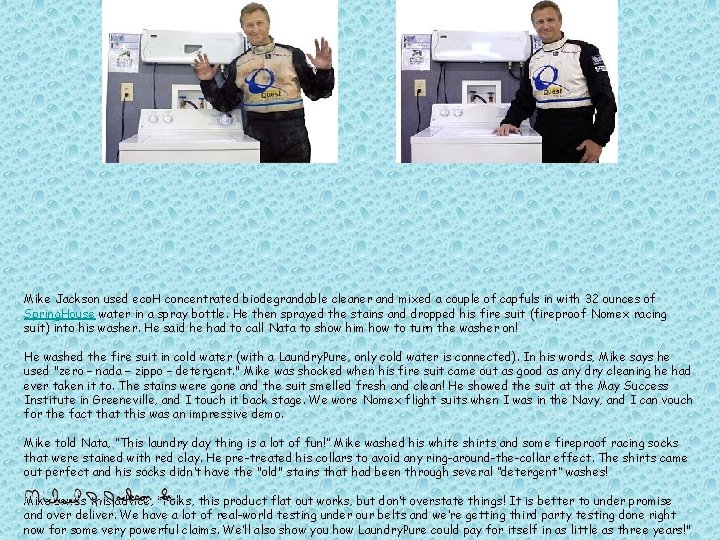
Mike Jackson used eco. H concentrated biodegrandable cleaner and mixed a couple of capfuls in with 32 ounces of Spring. House water in a spray bottle. He then sprayed the stains and dropped his fire suit (fireproof Nomex racing suit) into his washer. He said he had to call Nata to show him how to turn the washer on! He washed the fire suit in cold water (with a Laundry. Pure, only cold water is connected). In his words, Mike says he used "zero – nada – zippo – detergent. " Mike was shocked when his fire suit came out as good as any dry cleaning he had ever taken it to. The stains were gone and the suit smelled fresh and clean! He showed the suit at the May Success Institute in Greeneville, and I touch it back stage. We wore Nomex flight suits when I was in the Navy, and I can vouch for the fact that this was an impressive demo. Mike told Nata, “This laundry day thing is a lot of fun!” Mike washed his white shirts and some fireproof racing socks that were stained with red clay. He pre-treated his collars to avoid any ring-around-the-collar effect. The shirts came out perfect and his socks didn’t have the "old" stains that had been through several “detergent” washes! Mike sends this advice, "Folks, this product flat out works, but don’t overstate things! It is better to under promise and over deliver. We have a lot of real-world testing under our belts and we’re getting third party testing done right now for some very powerful claims. We’ll also show you how Laundry. Pure could pay for itself in as little as three years!"
Laundry. Pure is a safe alternative for our environment and our families! Laundry. Pure eliminates the need for hot water cycles. Silver kills germs and oxidation cleans clothes. This means less energy and less pollution. The technology in Laundry. Pure has been successfully used for over a decade in hospitals, hotels, and commercial Laundromats. Just think, if every household in the U. S. got rid of just one 100 oz. bottle of ultra petroleum-based liquid laundry detergent, we could save 220, 000 barrels of oil. That’s enough to heat and cool over 11, 000 U. S. homes for a year.
Eco. Quest Laundry. Pure The Benefits: • • Increased fabric life Reduced bacteria counts Increased fabric volume Eliminate harmful detergents – Phosphates Saves hot water $ Saves on Detergent $ Eliminates allergies caused by detergents The elimination of trapped detergents make color more vibrant

With Knowledge Comes Responsibility Now that you know about Landry. Pure It Comes Down To One Simple Decision. Choose To Join Us In The No. Suds Revolution Or Choose Not To Join Us …. AND CONTINUE TO BE A POLLUTER!
- Slides: 47