
What I s Design Pattern Christopher Alexander says
- Slides: 25
What I s Design Pattern? * Christopher Alexander says, "Each pattern describes a problem which occurs over and over again in our environment, and then describes the core of the solution to that problem, in such away that you ca n use this solution a million times over, without ever doing it the same way twice“
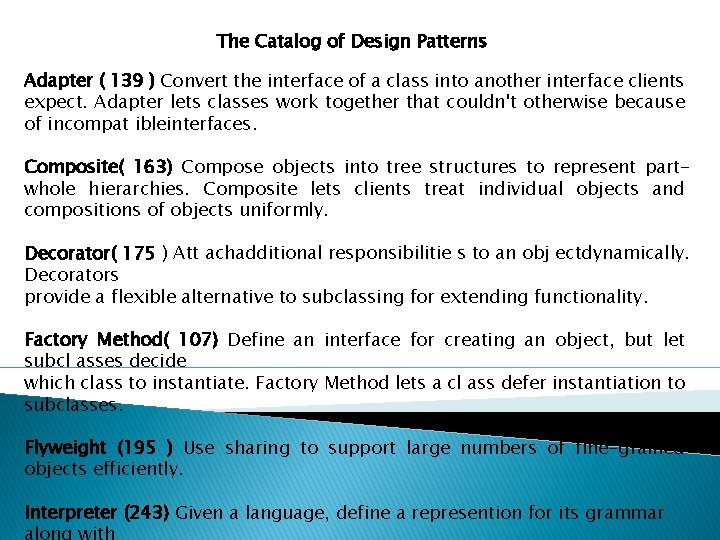
The Catalog of Design Patterns Adapter ( 139 ) Convert the interface of a class into another interface clients expect. Adapter lets classes work together that couldn't otherwise because of incompat ibleinterfaces. Composite( 163) Compose objects into tree structures to represent partwhole hierarchies. Composite lets clients treat individual objects and compositions of objects uniformly. Decorator( 175 ) Att achadditional responsibilitie s to an obj ectdynamically. Decorators provide a flexible alternative to subclassing for extending functionality. Factory Method( 107) Define an interface for creating an object, but let subcl asses decide which class to instantiate. Factory Method lets a cl ass defer instantiation to subclasses. Flyweight (195 ) Use sharing to support large numbers of fine-grained objects efficiently. Interpreter (243) Given a language, define a represention for its grammar
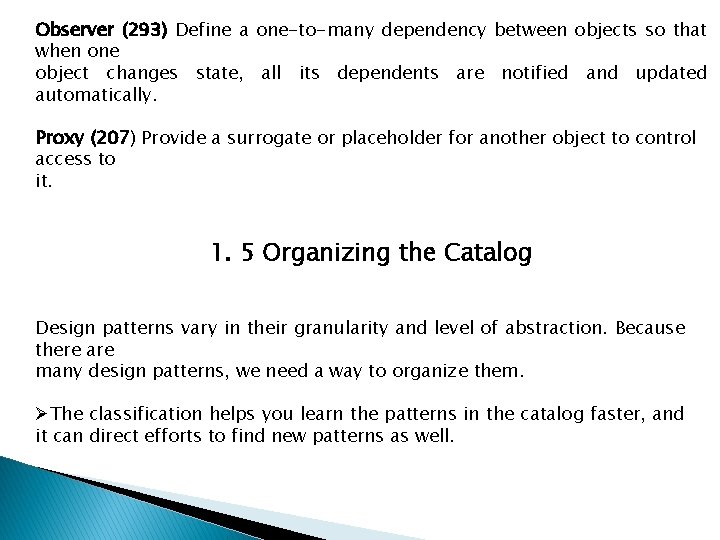
Observer (293) Define a one-to-many dependency between objects so that when one object changes state, all its dependents are notified and updated automatically. Proxy (207) Provide a surrogate or placeholder for another object to control access to it. 1. 5 Organizing the Catalog Design patterns vary in their granularity and level of abstraction. Because there are many design patterns, we need a way to organize them. ØThe classification helps you learn the patterns in the catalog faster, and it can direct efforts to find new patterns as well.
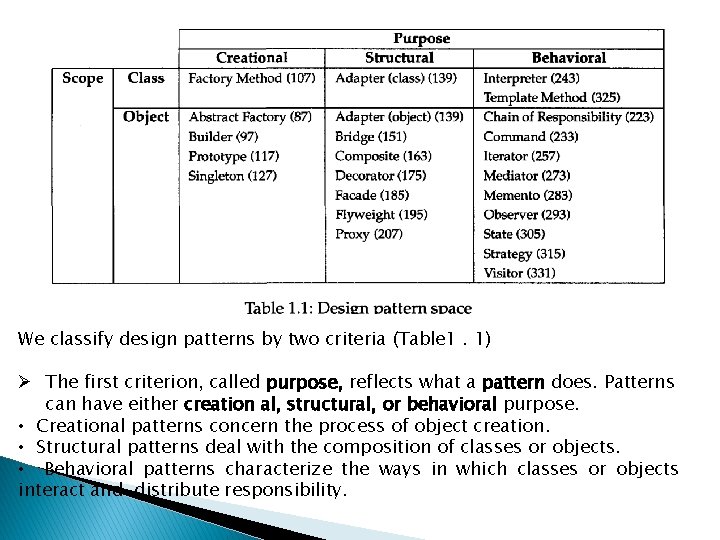
We classify design patterns by two criteria (Table 1. 1) Ø The first criterion, called purpose, reflects what a pattern does. Patterns can have either creation al, structural, or behavioral purpose. • Creational patterns concern the process of object creation. • Structural patterns deal with the composition of classes or objects. • Behavioral patterns characterize the ways in which classes or objects interact and distribute responsibility.
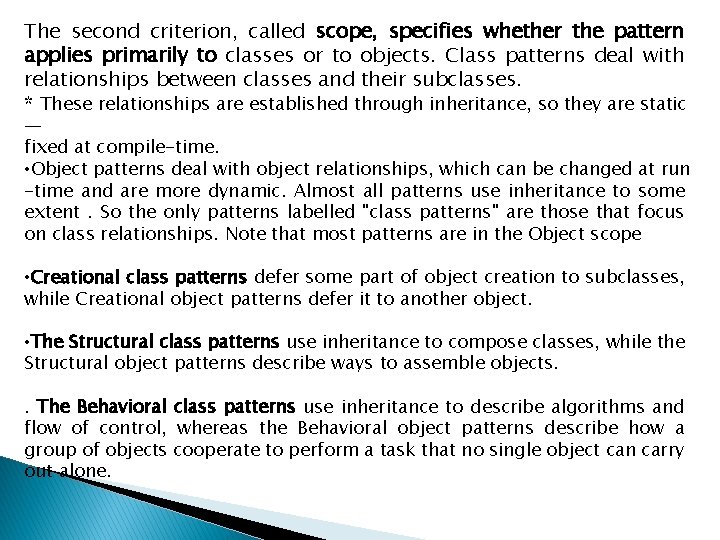
The second criterion, called scope, specifies whether the pattern applies primarily to classes or to objects. Class patterns deal with relationships between classes and their subclasses. * These relationships are established through inheritance, so they are static — fixed at compile-time. • Object patterns deal with object relationships, which can be changed at run -time and are more dynamic. Almost all patterns use inheritance to some extent. So the only patterns labelled "class patterns" are those that focus on class relationships. Note that most patterns are in the Object scope • Creational class patterns defer some part of object creation to subclasses, while Creational object patterns defer it to another object. • The Structural class patterns use inheritance to compose classes, while the Structural object patterns describe ways to assemble objects. . The Behavioral class patterns use inheritance to describe algorithms and flow of control, whereas the Behavioral object patterns describe how a group of objects cooperate to perform a task that no single object can carry out alone.
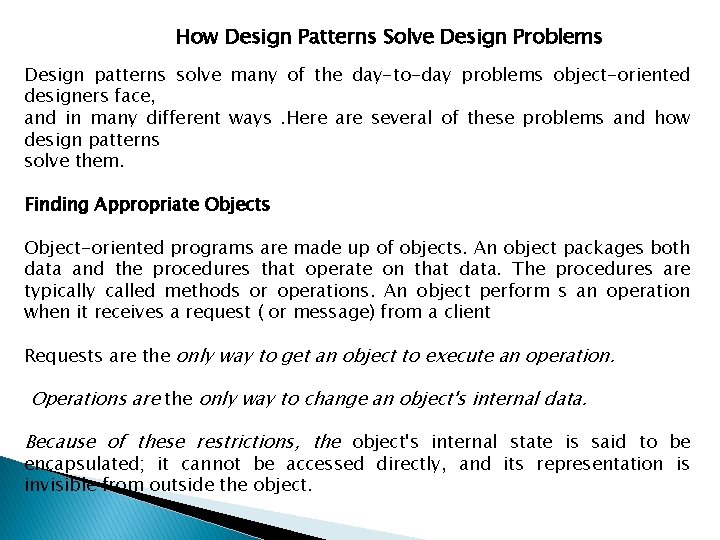
How Design Patterns Solve Design Problems Design patterns solve many of the day-to-day problems object-oriented designers face, and in many different ways. Here are several of these problems and how design patterns solve them. Finding Appropriate Objects Object-oriented programs are made up of objects. An object packages both data and the procedures that operate on that data. The procedures are typically called methods or operations. An object perform s an operation when it receives a request ( or message) from a client Requests are the only way to get an object to execute an operation. Operations are the only way to change an object's internal data. Because of these restrictions, the object's internal state is said to be encapsulated; it cannot be accessed directly, and its representation is invisible from outside the object.
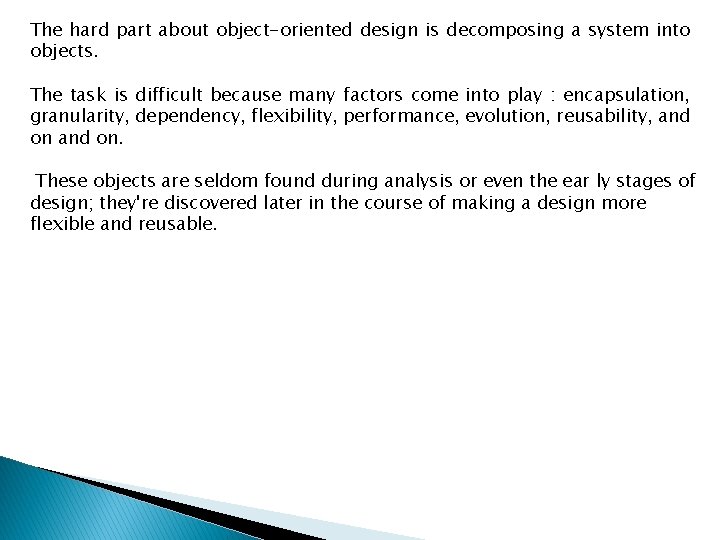
The hard part about object-oriented design is decomposing a system into objects. The task is difficult because many factors come into play : encapsulation, granularity, dependency, flexibility, performance, evolution, reusability, and on. These objects are seldom found during analysis or even the ear ly stages of design; they're discovered later in the course of making a design more flexible and reusable.
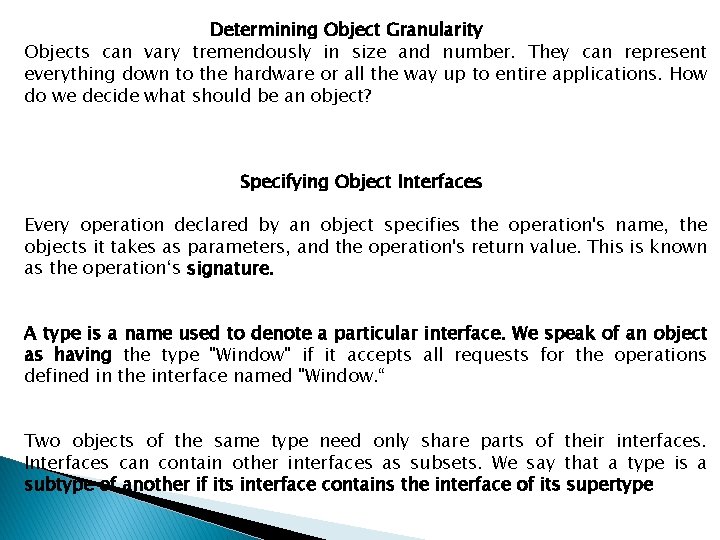
Determining Object Granularity Objects can vary tremendously in size and number. They can represent everything down to the hardware or all the way up to entire applications. How do we decide what should be an object? Specifying Object Interfaces Every operation declared by an object specifies the operation's name, the objects it takes as parameters, and the operation's return value. This is known as the operation‘s signature. A type is a name used to denote a particular interface. We speak of an object as having the type "Window" if it accepts all requests for the operations defined in the interface named "Window. “ Two objects of the same type need only share parts of their interfaces. Interfaces can contain other interfaces as subsets. We say that a type is a subtype of another if its interface contains the interface of its supertype
** An object's interface says nothing about its implementation— different objects are free to implement requests differently. ** When a request is sent to an object, the particular operation that's performed depends on both the request and the receiving object. ** The run-time association of a request to an object and one of its operations is known as dynamic binding. ** Moreover, dynamic binding lets you substitute objects that have identical interfaces for each other at run-time. This substitutability is known as polymorphism,
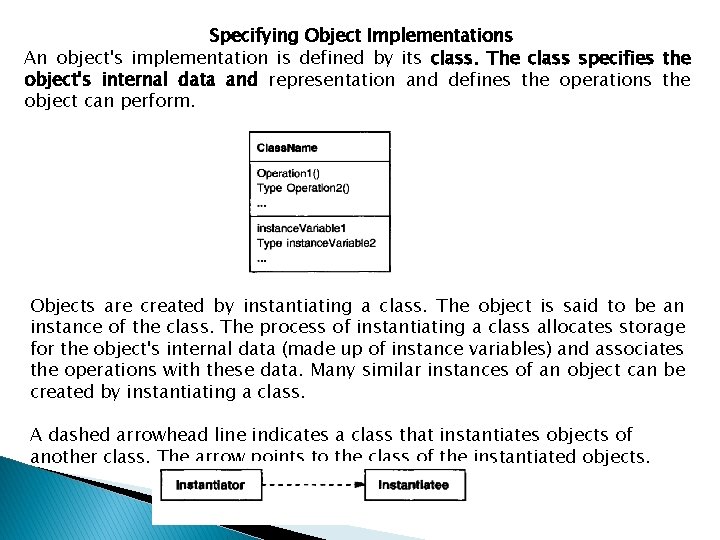
Specifying Object Implementations An object's implementation is defined by its class. The class specifies the object's internal data and representation and defines the operations the object can perform. Objects are created by instantiating a class. The object is said to be an instance of the class. The process of instantiating a class allocates storage for the object's internal data (made up of instance variables) and associates the operations with these data. Many similar instances of an object can be created by instantiating a class. A dashed arrowhead line indicates a class that instantiates objects of another class. The arrow points to the class of the instantiated objects.
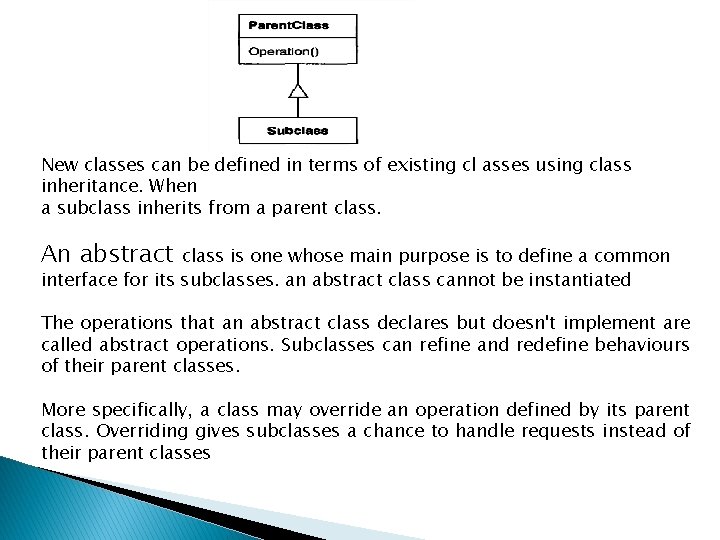
New classes can be defined in terms of existing cl asses using class inheritance. When a subclass inherits from a parent class. An abstract class is one whose main purpose is to define a common interface for its subclasses. an abstract class cannot be instantiated The operations that an abstract class declares but doesn't implement are called abstract operations. Subclasses can refine and redefine behaviours of their parent classes. More specifically, a class may override an operation defined by its parent class. Overriding gives subclasses a chance to handle requests instead of their parent classes
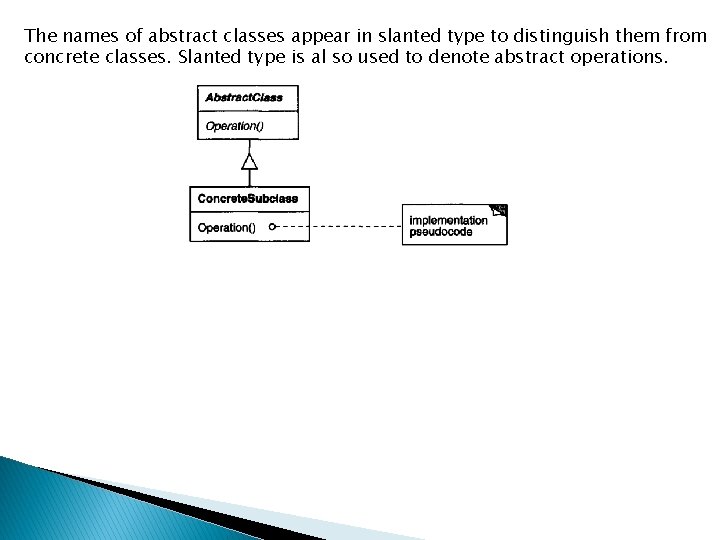
The names of abstract classes appear in slanted type to distinguish them from concrete classes. Slanted type is al so used to denote abstract operations.
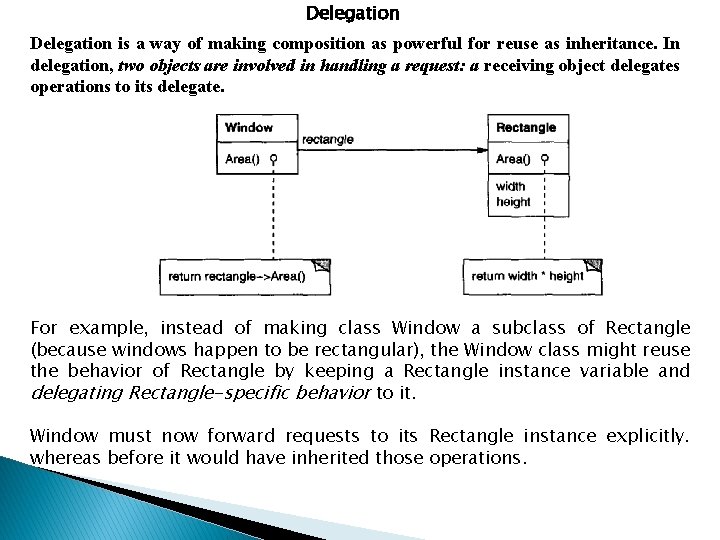
Delegation is a way of making composition as powerful for reuse as inheritance. In delegation, two objects are involved in handling a request: a receiving object delegates operations to its delegate. For example, instead of making class Window a subclass of Rectangle (because windows happen to be rectangular), the Window class might reuse the behavior of Rectangle by keeping a Rectangle instance variable and delegating Rectangle-specific behavior to it. Window must now forward requests to its Rectangle instance explicitly. whereas before it would have inherited those operations.
A diagram may include pseudocode for an operation's implementation; if so, the code will appear in a diamond shaped box connected by a dashed line to the operation it implements. A plain arrowhead line indicates that a class keeps a reference to an instance of another class. The reference has an optional name, "rectangle" in this case. The main advantage of delegation is that it makes it easy to compose behaviors at run-time and to change the way they're composed. Delegation has a disadvantage it shares with other techniques that make software more flexible through object composition.
Designing for Change The key to maximizing reuse lies in anticipating new requirements and changes to existing requirements, and in designing your systems so that they can evolve accordingly. A design that doesn't take change into account risks major redesign in the future. Those changes might involve class redefinition and reimplementation, client modification, and retesting. Redesign affects many parts of the software system , and unanticipated changes a re invariably expensive. Here are some common causes of redesign along with the design pattern( s) that address them: 1. Creating an object by specifying a class explicitly. Specifying a class name when you create an object commits you to a particular implementation instead of a particular interface.
2 Dependence on specific operations. When you specify a particular operation, you commit to one way of satisfying a request. By avoiding hard-coded requests, you make it easier to change the way a request gets satisfied both at compile-time and at run-time. 3 Dependence on hardware and software platform. External operating system interfaces and application programming interfaces (APIs) are different on different hardware and software platforms. Software that depends on a particular platform will be harder to port to other platforms. It may even be difficult to keep it up to date on its native platform. It's important therefore to design your system to limit its platform dependencies 4) Dependence on object representations or implementations. Clients that know how an object is represented, stored, located, or implemented might need to be changed when the object changes. Hiding this information from clients keeps changes from cascading. 5) Algorithmic dependencies. Algorithms are often extended, optimized, and replaced during development and reuse. Objects that depend on an algorithm will have to change when the algorithm changes. Therefore algorithms that are likely to change should be isolated.
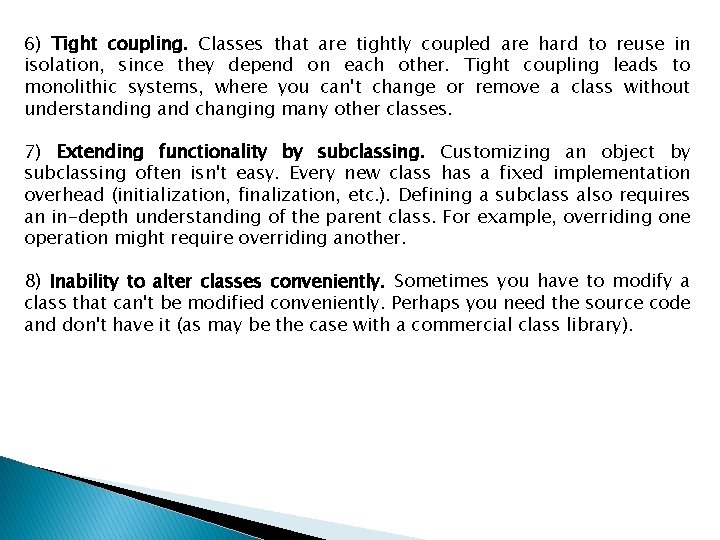
6) Tight coupling. Classes that are tightly coupled are hard to reuse in isolation, since they depend on each other. Tight coupling leads to monolithic systems, where you can't change or remove a class without understanding and changing many other classes. 7) Extending functionality by subclassing. Customizing an object by subclassing often isn't easy. Every new class has a fixed implementation overhead (initialization, finalization, etc. ). Defining a subclass also requires an in-depth understanding of the parent class. For example, overriding one operation might require overriding another. 8) Inability to alter classes conveniently. Sometimes you have to modify a class that can't be modified conveniently. Perhaps you need the source code and don't have it (as may be the case with a commercial class library).
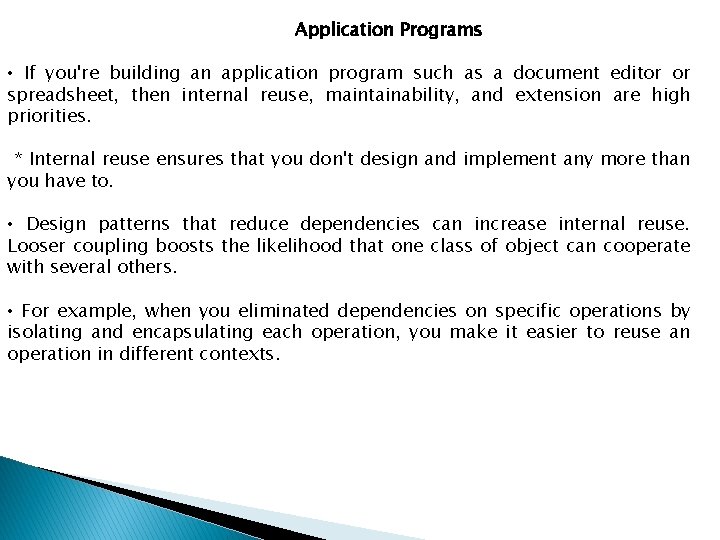
Application Programs • If you're building an application program such as a document editor or spreadsheet, then internal reuse, maintainability, and extension are high priorities. * Internal reuse ensures that you don't design and implement any more than you have to. • Design patterns that reduce dependencies can increase internal reuse. Looser coupling boosts the likelihood that one class of object can cooperate with several others. • For example, when you eliminated dependencies on specific operations by isolating and encapsulating each operation, you make it easier to reuse an operation in different contexts.
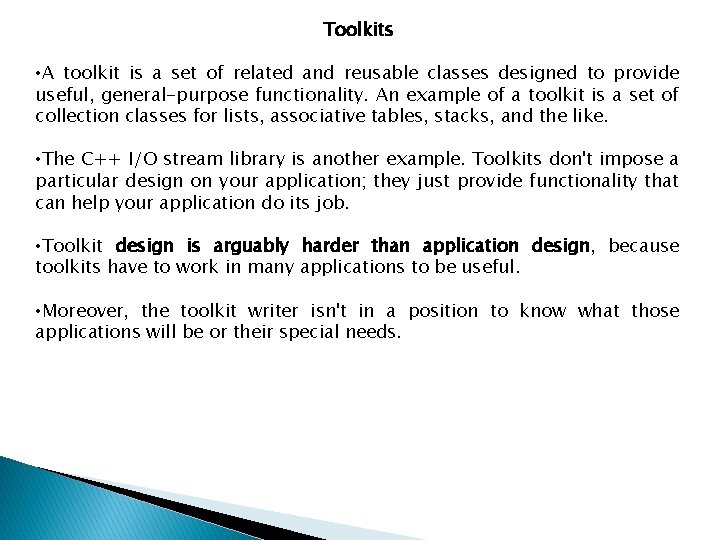
Toolkits • A toolkit is a set of related and reusable classes designed to provide useful, general-purpose functionality. An example of a toolkit is a set of collection classes for lists, associative tables, stacks, and the like. • The C++ I/O stream library is another example. Toolkits don't impose a particular design on your application; they just provide functionality that can help your application do its job. • Toolkit design is arguably harder than application design, because toolkits have to work in many applications to be useful. • Moreover, the toolkit writer isn't in a position to know what those applications will be or their special needs.
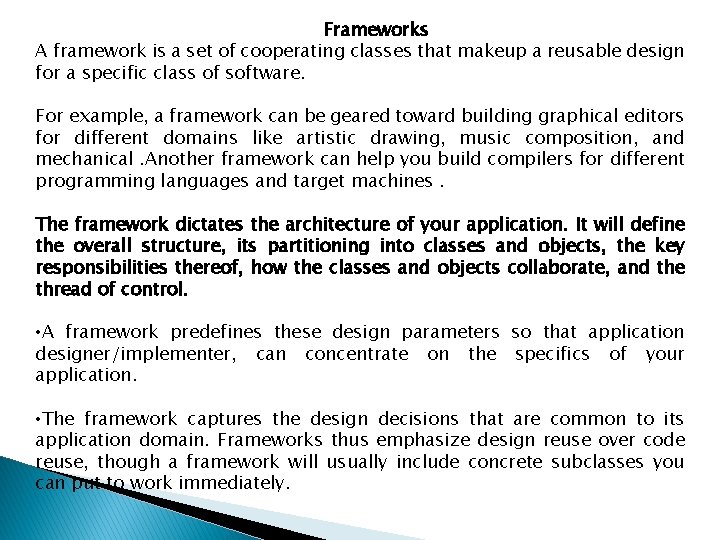
Frameworks A framework is a set of cooperating classes that makeup a reusable design for a specific class of software. For example, a framework can be geared toward building graphical editors for different domains like artistic drawing, music composition, and mechanical. Another framework can help you build compilers for different programming languages and target machines. The framework dictates the architecture of your application. It will define the overall structure, its partitioning into classes and objects, the key responsibilities thereof, how the classes and objects collaborate, and the thread of control. • A framework predefines these design parameters so that application designer/implementer, can concentrate on the specifics of your application. • The framework captures the design decisions that are common to its application domain. Frameworks thus emphasize design reuse over code reuse, though a framework will usually include concrete subclasses you can put to work immediately.
* An added benefit comes when the framework is documented with the design patterns it uses. • People who know the patterns gain insight into the framework faster. Even people who don't know the patterns can benefit from the structure they lend to the framework's documentation. Enhancing documentation is important for all types of software, but it's particularly important for frameworks. Frameworks often pose a steep learning curve that must be overcome before they're useful.
Because patterns and frameworks have some similarities, people often wonder how or even if they differ. They are different in three major ways: 1. Design patterns are more abstract than frameworks. Frameworks can be embodied in code, but only examples of patterns can be embodied in code. A strength of frameworks is that they can be written down in programming languages and not only studied but executed and reused directly. In contrast, the design patterns in this book have to be implemented each time they're used. Design patterns also explain the intent, trade-offs, and consequences of a design. 2. Design patterns are smaller architectural elements than frameworks. A typical framework contains several design patterns, but the reverse is never true. 3. Design patterns are less specialized than frameworks. Frameworks always have a particular application domain. A graphical editor framework might be used in a factory simulation, but it won't be mistaken for a simulation framework. In contrast, the design patterns in this catalog can be used in nearly any kind of application.
How to Select a Design Pattern With more than 20 design patterns in the catalog to choose from, it might be hard to find the one that addresses a particular design problem, especially if the catalog is new and unfamiliar to you. Here are several different approaches to finding the design pattern that's right for your problem: **Consider how design patterns solve design problems. Section 1. 6 discusses how design patterns help you find appropriate objects, determine object granularity, specify object interfaces, and several other ways in which design patterns solve design problems. Referring to these discussions can help guide your search for the right pattern. ** Scan Intent sections. Section 1. 4 (page 8)lists the Intent sections from all the patterns in the catalog. Read through each pattern's intent to find one or more that sound relevant to your problem. You can use the classification scheme presented in Table 1. 1 (page 10)to narrow your search. ** Study how patterns interrelate. Figure 1. 1 (page 12)shows relationships between design patterns graphically. Studying these relationships can help direct you to the right pattern or group of patterns.
** Study patterns of like purpose. The catalog (page 79) has three chapters, one for creational patterns, another for patterns, and a third for behavioral patterns. Each chapter starts off with introductory comments on the patterns and concludes with a section that compares and contrasts them. These sections give you insight into the similarities and differences between patterns of like purpose. ** Examine a cause of redesign. Look at the causes of redesign starting on page 24 to see if your problem involves one or more of them. Then look at the patterns that help you avoid the causes of redesign. **Consider what should be variable in your design. This approach is the opposite of focusing on the causes of redesign. Instead of considering what might force a change to a design, consider what you want to be able to change without redesign. The focus here is on encapsulating the concept that varies, a theme of many design patterns. Table 1. 2 lists the design aspect(s) that design patterns let you vary independently, thereby letting you change them without redesign.
How to Use a Design Pattern Once you've picked a design pattern, how do you use it? Here's a step-bystep approach to applying a design pattern effectively: 1. Read the pattern once through for an overview. Pay particular attention to the Applicability and Consequences sections to ensure the pattern is right for your problem. 2. Go back and study the Structure, Participants, and Collaborations sections. Make sure you understand the classes and objects in the pattern and how they relate to one another. 3. Look at the Sample Code section to see a concrete example of the pattern in code. Studying the code helps you learn how to implement the pattern. 4. Choose names for pattern participants that are meaningful in the application context. The names for participants in design patterns are usually too abstract to appear directly in an application. Nevertheless, it's useful to incorporate the participant name into the name that appears in the application. That helps make the pattern more explicit in the implementation. 5. Define the classes. Declare their interfaces, establish their inheritance relationships, and define the instance variables that represent data and object references. Identify existing classes in your application that the pattern will affect, and modify them accordingly.