
What have we learned about time Time Instants
What have we learned about time?
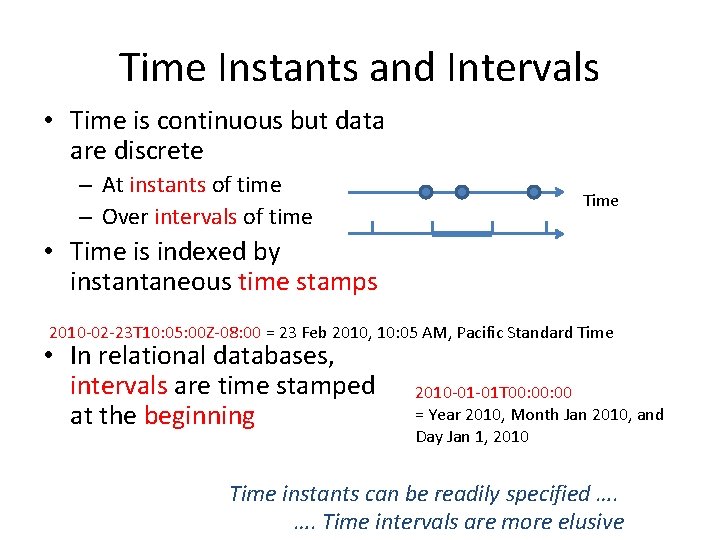
Time Instants and Intervals • Time is continuous but data are discrete – At instants of time – Over intervals of time Time • Time is indexed by instantaneous time stamps 2010 -02 -23 T 10: 05: 00 Z-08: 00 = 23 Feb 2010, 10: 05 AM, Pacific Standard Time • In relational databases, intervals are time stamped at the beginning 2010 -01 -01 T 00: 00 = Year 2010, Month Jan 2010, and Day Jan 1, 2010 Time instants can be readily specified …. …. Time intervals are more elusive
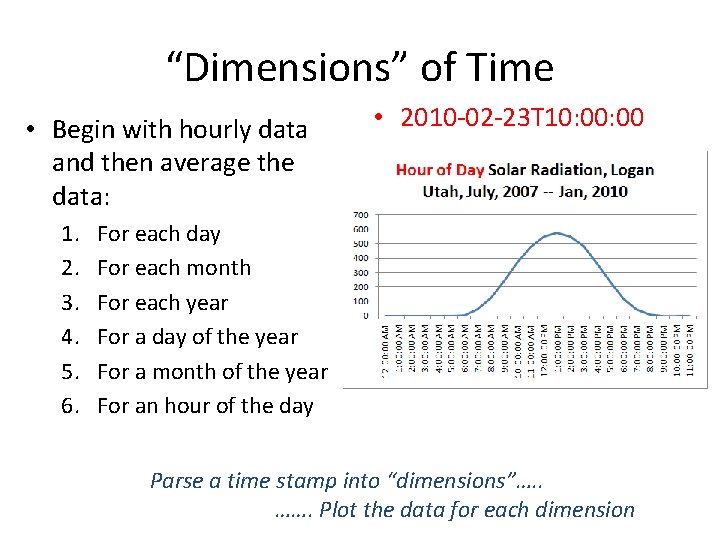
“Dimensions” of Time • Begin with hourly data and then average the data: 1. 2. 3. 4. 5. 6. • 2010 -02 -23 T 10: 00 For each day For each month For each year For a day of the year For a month of the year For an hour of the day Parse a time stamp into “dimensions”…. . ……. Plot the data for each dimension
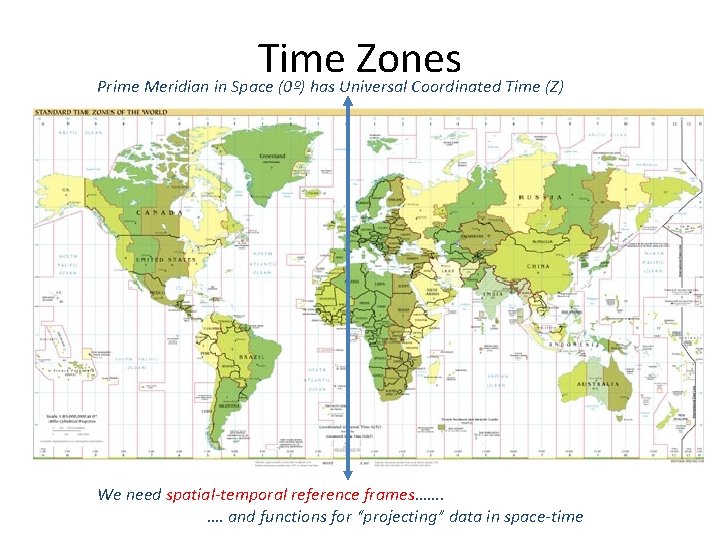
Time Zones Prime Meridian in Space (0º) has Universal Coordinated Time (Z) We need spatial-temporal reference frames……. …. and functions for “projecting” data in space-time
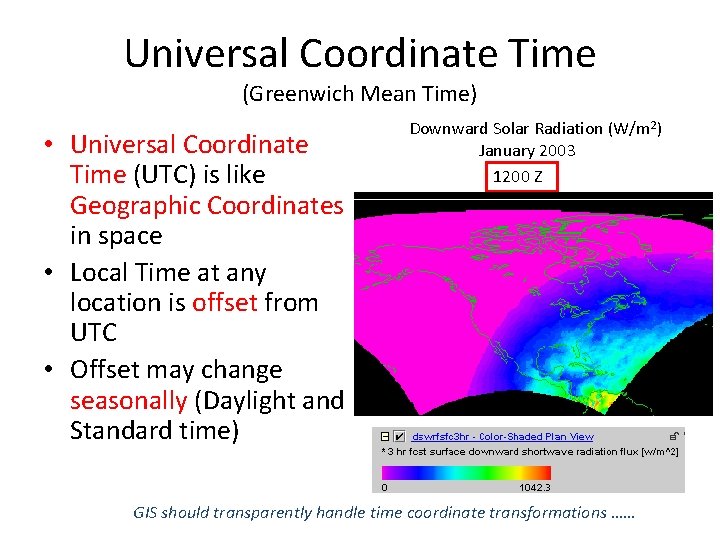
Universal Coordinate Time (Greenwich Mean Time) • Universal Coordinate Time (UTC) is like Geographic Coordinates in space • Local Time at any location is offset from UTC • Offset may change seasonally (Daylight and Standard time) Downward Solar Radiation (W/m 2) January 2003 1200 Z GIS should transparently handle time coordinate transformations ……
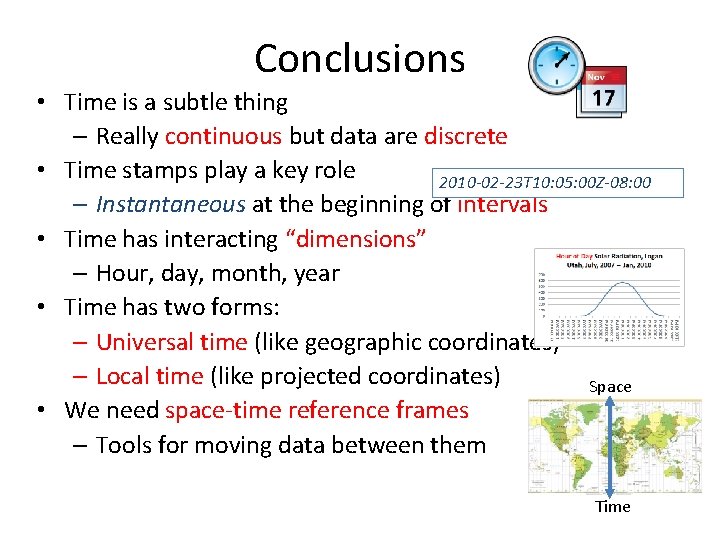
Conclusions • Time is a subtle thing – Really continuous but data are discrete • Time stamps play a key role 2010 -02 -23 T 10: 05: 00 Z-08: 00 – Instantaneous at the beginning of intervals • Time has interacting “dimensions” – Hour, day, month, year • Time has two forms: – Universal time (like geographic coordinates) – Local time (like projected coordinates) Space • We need space-time reference frames – Tools for moving data between them Time
- Slides: 6