
What have EIA and SEA ever done for

- Slides: 25
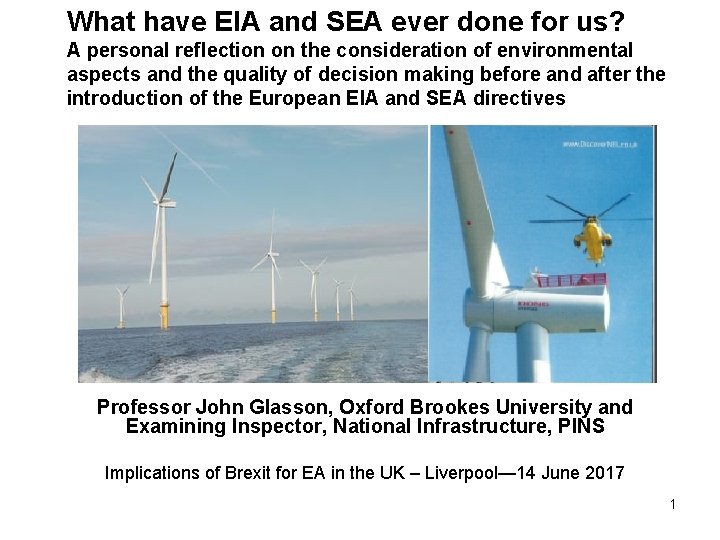
What have EIA and SEA ever done for us? A personal reflection on the consideration of environmental aspects and the quality of decision making before and after the introduction of the European EIA and SEA directives Better intro illustration Professor John Glasson, Oxford Brookes University and Examining Inspector, National Infrastructure, PINS Implications of Brexit for EA in the UK – Liverpool— 14 June 2017 1
Structure of presentation 1. 2. 3. 4. 5. 6. 7. Intro - wider concern than EIA and SEA IA decision making before the Directives The EIA Directive – a force for good The SEA Directive - still finding its feet? Impact of EIA and SEA on decision making Impact of EIA and SEA on our environment Conclusions - a proactive future? 2
1. Intro—much wider concern than EIA and SEA • learning from the past, for the future • what have EIA and SEA ever done for us? • to be active or passive? • my overview approach, linking to the specialist contributions to follow • focus on IA—but set in wider environmental context 3
Add illustrations of Other Directives 4
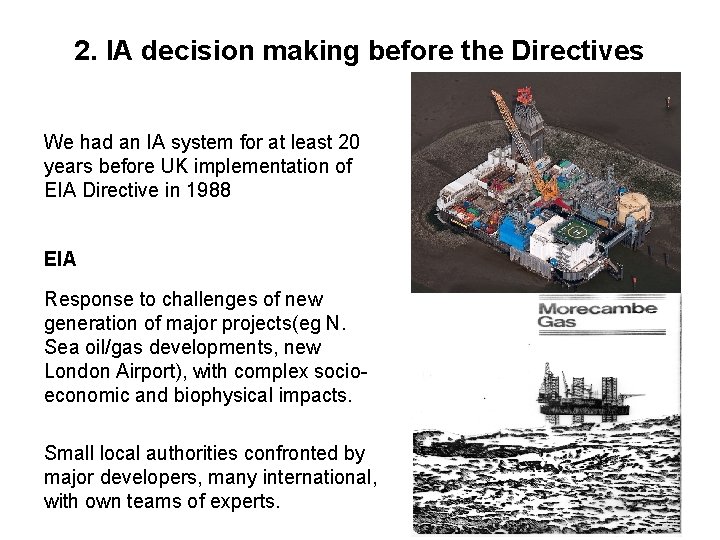
2. IA decision making before the Directives We had an IA system for at least 20 years before UK implementation of EIA Directive in 1988 • Illustrations of those projects EIA Response to challenges of new generation of major projects(eg N. Sea oil/gas developments, new London Airport), with complex socioeconomic and biophysical impacts. Small local authorities confronted by major developers, many international, with own teams of experts. 5
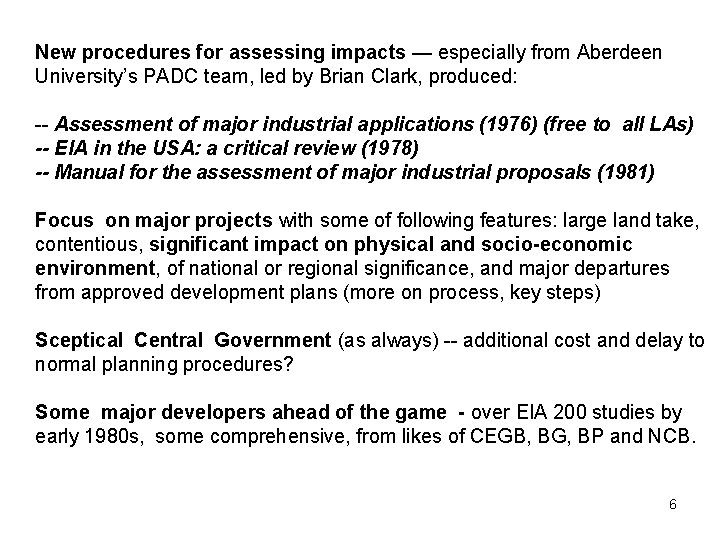
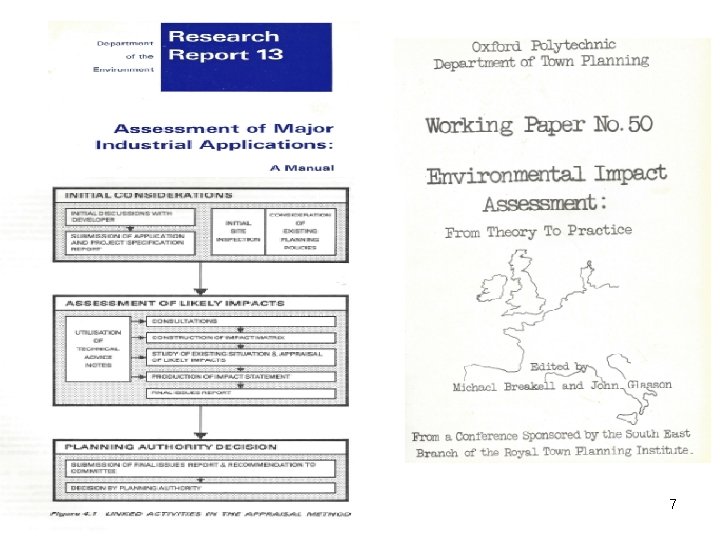
New procedures for assessing impacts — especially from Aberdeen University’s PADC team, led by Brian Clark, produced: -- Assessment of major industrial applications (1976) (free to all LAs) -- EIA in the USA: a critical review (1978) -- Manual for the assessment of major industrial proposals (1981) Focus on major projects with some of following features: large land take, contentious, significant impact on physical and socio-economic environment, of national or regional significance, and major departures from approved development plans (more on process, key steps) Sceptical Central Government (as always) -- additional cost and delay to normal planning procedures? Some major developers ahead of the game - over EIA 200 studies by early 1980 s, some comprehensive, from likes of CEGB, BG, BP and NCB. 6
Early report illustrations/examples of charts 7
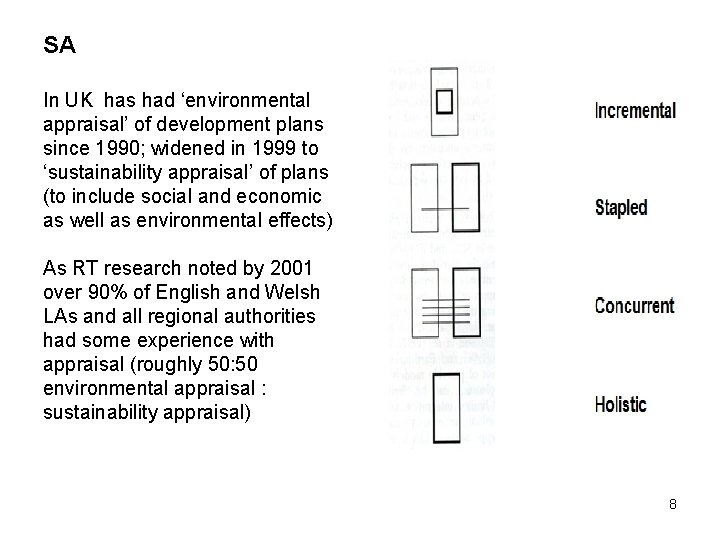
SA In UK has had ‘environmental appraisal’ of development plans since 1990; widened in 1999 to ‘sustainability appraisal’ of plans (to include social and economic as well as environmental effects) As RT research noted by 2001 over 90% of English and Welsh LAs and all regional authorities had some experience with appraisal (roughly 50: 50 environmental appraisal : sustainability appraisal) 8
3. The EIA Directive – a force for good Why the Directive? • concern about environmental deterioration and level economic playing field); over 20 drafts to reconcile conflicting needs of key stakeholders UK perspectives on initial Directive • UK government acceptance, but concern about bureaucratic hurdles and possible litigation • RTPI support, but some interesting observations on draft (1980) - plead for greater flexibility to avoid excessive codification of procedures - too narrow a view of the environment - danger of Directive preempting decisions in favour of physical environmental issues - welcomes possibility of extending to policies contained in plans - EIA must not represent an alternative method of reaching a decision, but be integrated into the existing decision-making process 9
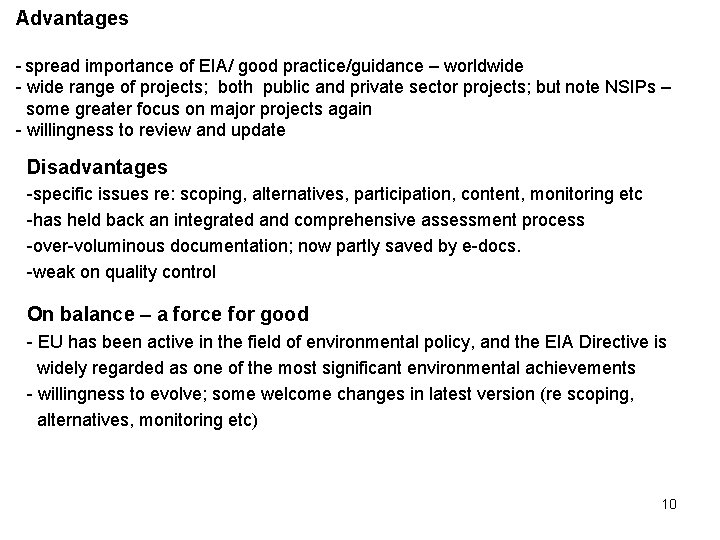
Advantages - spread importance of EIA/ good practice/guidance – worldwide - wide range of projects; both public and private sector projects; but note NSIPs – some greater focus on major projects again - willingness to review and update Disadvantages -specific issues re: scoping, alternatives, participation, content, monitoring etc -has held back an integrated and comprehensive assessment process -over-voluminous documentation; now partly saved by e-docs. -weak on quality control On balance – a force for good - EU has been active in the field of environmental policy, and the EIA Directive is widely regarded as one of the most significant environmental achievements - willingness to evolve; some welcome changes in latest version (re scoping, alternatives, monitoring etc) 10
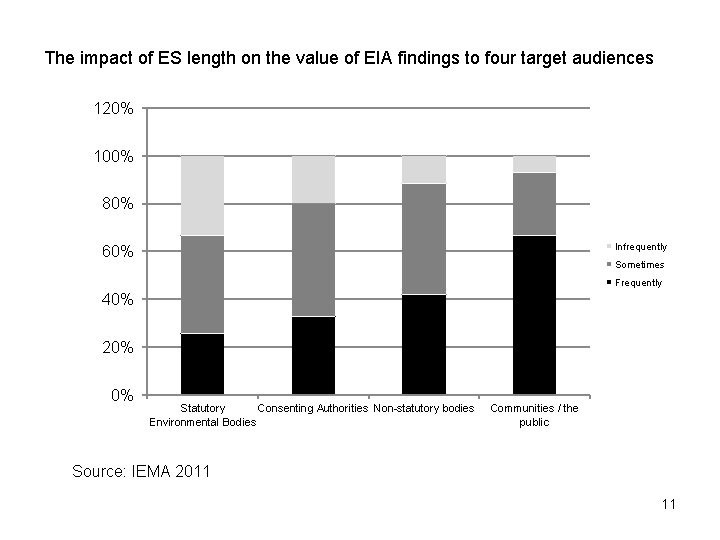
The impact of ES length on the value of EIA findings to four target audiences 120% 100% 80% Infrequently 60% Sometimes Frequently 40% 20% 0% Statutory Consenting Authorities Non-statutory bodies Environmental Bodies Communities / the public Source: IEMA 2011 11
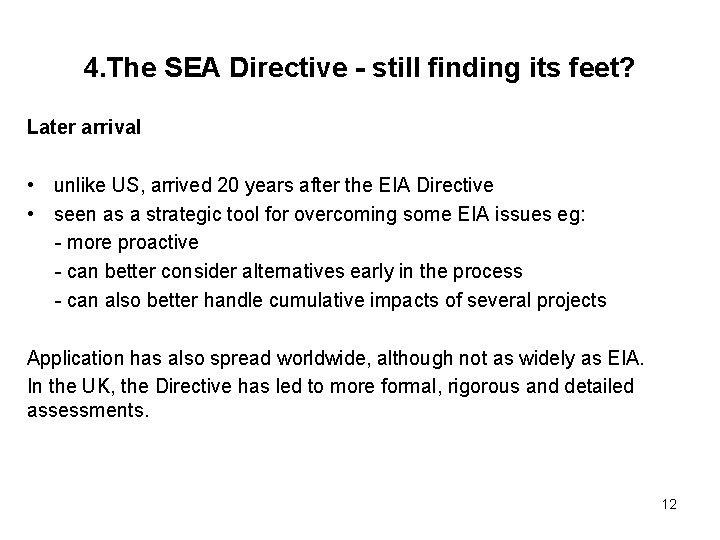
4. The SEA Directive - still finding its feet? Later arrival • unlike US, arrived 20 years after the EIA Directive • seen as a strategic tool for overcoming some EIA issues eg: - more proactive - can better consider alternatives early in the process - can also better handle cumulative impacts of several projects Application has also spread worldwide, although not as widely as EIA. In the UK, the Directive has led to more formal, rigorous and detailed assessments. 12
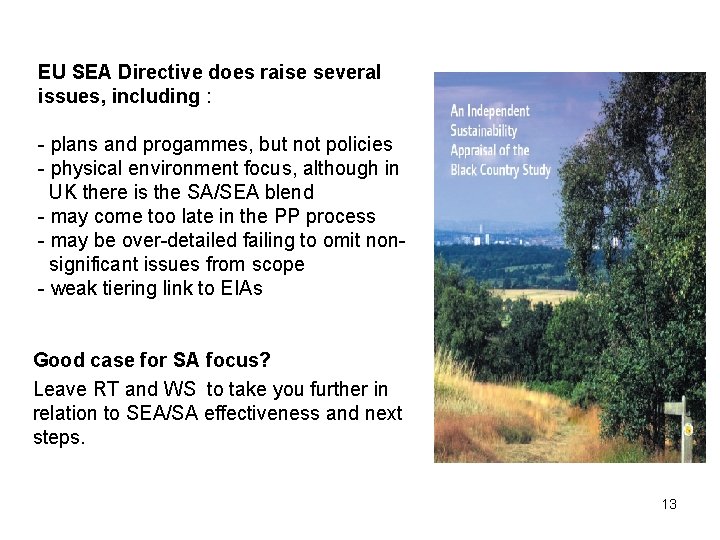
EU SEA Directive does raise several issues, including : - plans and progammes, but not policies - physical environment focus, although in UK there is the SA/SEA blend - may come too late in the PP process - may be over-detailed failing to omit nonsignificant issues from scope - weak tiering link to EIAs Good case for SA focus? Leave RT and WS to take you further in relation to SEA/SA effectiveness and next steps. 13
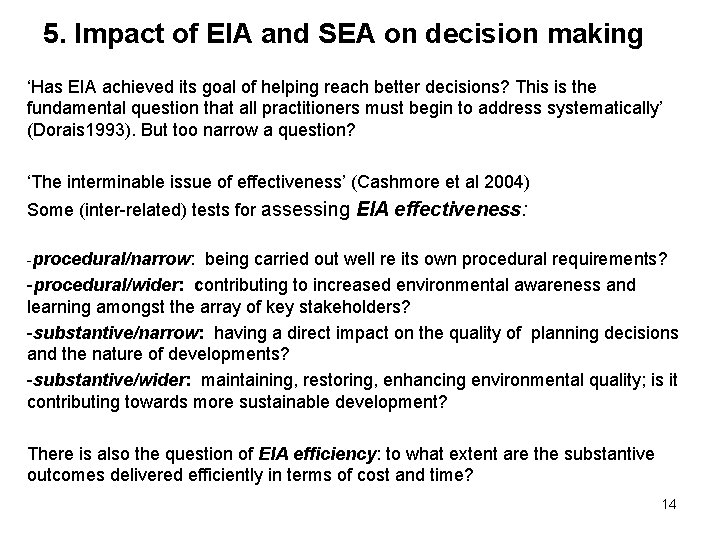
5. Impact of EIA and SEA on decision making ‘Has EIA achieved its goal of helping reach better decisions? This is the fundamental question that all practitioners must begin to address systematically’ (Dorais 1993). But too narrow a question? ‘The interminable issue of effectiveness’ (Cashmore et al 2004) Some (inter-related) tests for assessing EIA effectiveness: -procedural/narrow: being carried out well re its own procedural requirements? -procedural/wider: contributing to increased environmental awareness and learning amongst the array of key stakeholders? -substantive/narrow: having a direct impact on the quality of planning decisions and the nature of developments? -substantive/wider: maintaining, restoring, enhancing environmental quality; is it contributing towards more sustainable development? There is also the question of EIA efficiency: to what extent are the substantive outcomes delivered efficiently in terms of cost and time? 14
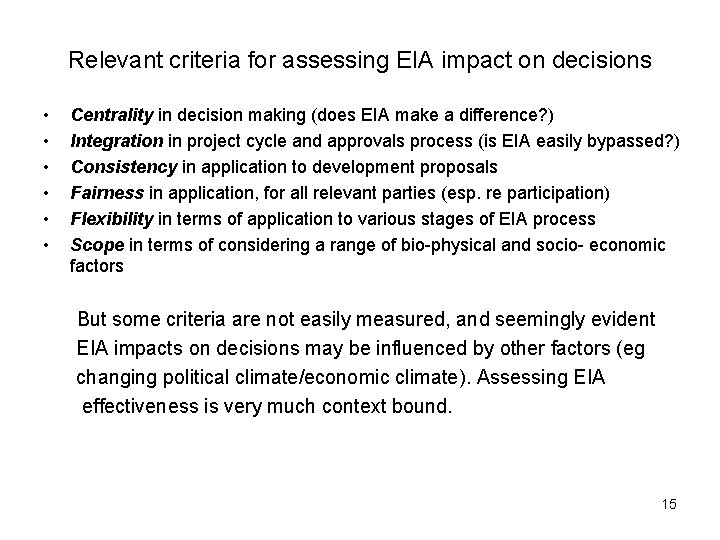
Relevant criteria for assessing EIA impact on decisions • • • Centrality in decision making (does EIA make a difference? ) Integration in project cycle and approvals process (is EIA easily bypassed? ) Consistency in application to development proposals Fairness in application, for all relevant parties (esp. re participation) Flexibility in terms of application to various stages of EIA process Scope in terms of considering a range of bio-physical and socio- economic factors But some criteria are not easily measured, and seemingly evident EIA impacts on decisions may be influenced by other factors (eg changing political climate/economic climate). Assessing EIA effectiveness is very much context bound. 15
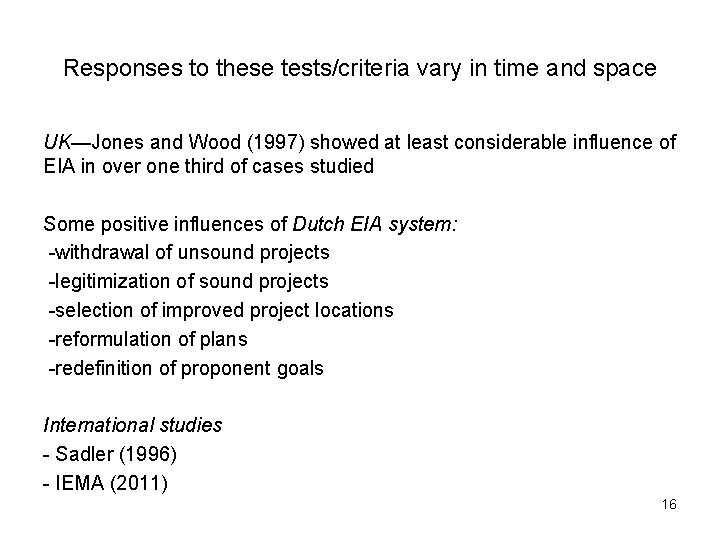
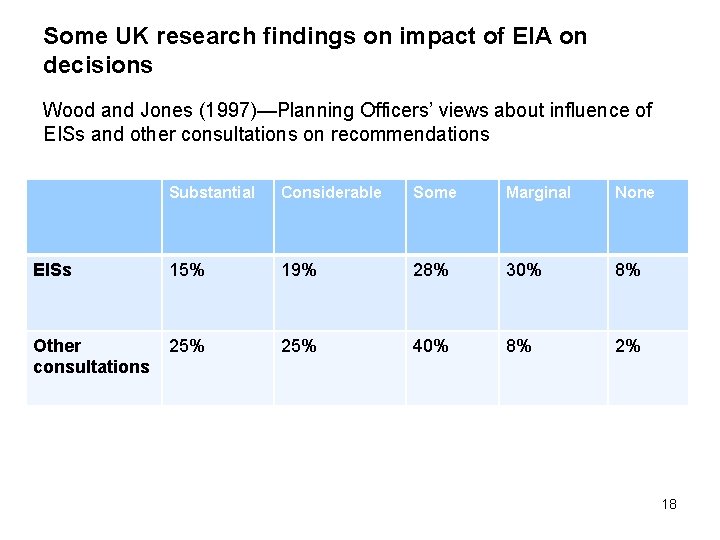
Responses to these tests/criteria vary in time and space UK—Jones and Wood (1997) showed at least considerable influence of EIA in over one third of cases studied Some positive influences of Dutch EIA system: -withdrawal of unsound projects -legitimization of sound projects -selection of improved project locations -reformulation of plans -redefinition of proponent goals International studies - Sadler (1996) - IEMA (2011) 16
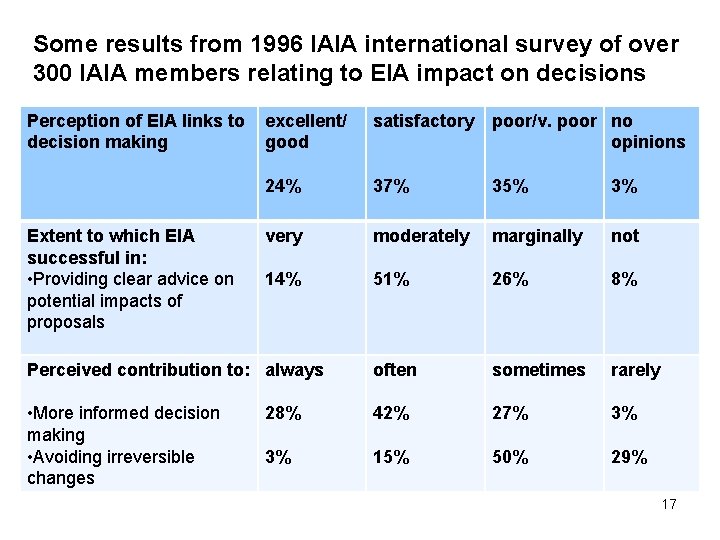
Some results from 1996 IAIA international survey of over 300 IAIA members relating to EIA impact on decisions Perception of EIA links to decision making excellent/ good satisfactory poor/v. poor no opinions 24% 37% 35% 3% very moderately marginally not 14% 51% 26% 8% Perceived contribution to: always often sometimes rarely • More informed decision making • Avoiding irreversible changes 28% 42% 27% 3% 3% 15% 50% 29% Extent to which EIA successful in: • Providing clear advice on potential impacts of proposals 17
Some UK research findings on impact of EIA on decisions Wood and Jones (1997)—Planning Officers’ views about influence of EISs and other consultations on recommendations Substantial Considerable Some Marginal None EISs 15% 19% 28% 30% 8% Other consultations 25% 40% 8% 2% 18
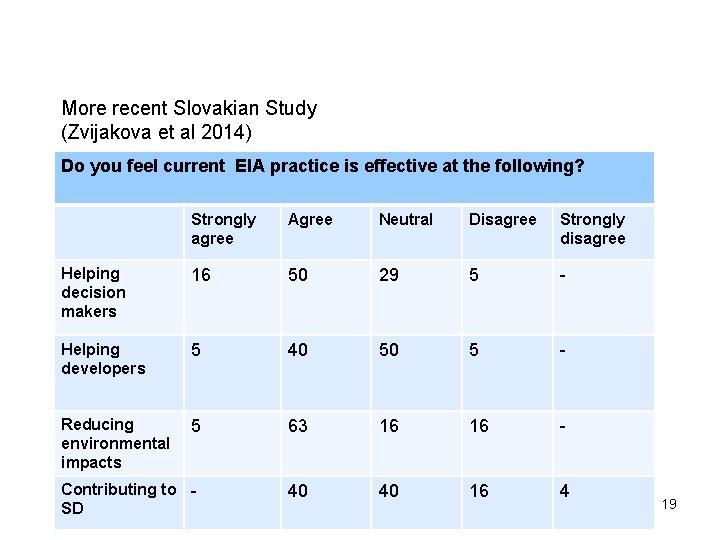
More recent Slovakian Study (Zvijakova et al 2014) Do you feel current EIA practice is effective at the following? Strongly agree Agree Neutral Disagree Strongly disagree Helping decision makers 16 50 29 5 - Helping developers 5 40 50 5 - Reducing environmental impacts 5 63 16 16 - Contributing to SD 40 40 16 4 19
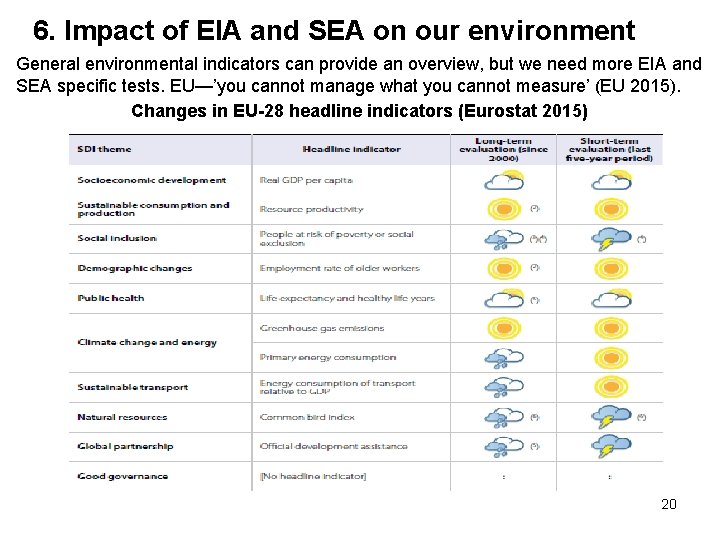
6. Impact of EIA and SEA on our environment General environmental indicators can provide an overview, but we need more EIA and SEA specific tests. EU—’you cannot manage what you cannot measure’ (EU 2015). Changes in EU-28 headline indicators (Eurostat 2015) 20
Vital role of project and plan specific monitoring/follow-up, and Environmental Management Plans 21
7. Conclusions - a proactive future? Protecting the environment/environmental legislation -diverse views • Government has pledged to leave environment in better state than when it found it and ‘to ensure that the whole body of existing EU environmental law continues to have effect in UK law’. • But only 11 lines in the White Paper for a Bill that needs to transpose 11, 000 pieces of EU environmental legislation into UK law. Little coverage in recent general election. • ‘Brexit is an opportunity to get rid of legislation which protects these birds’. M. Gove referring to SPA/SAC re Thames Basin Heaths, and use of adjacent land for housing (‘i’ 040417) 22
• We need ‘a new Environmental Protection Act to replace EU legislation’ (Caroline Lucas). ‘The environment has been worryingly absent from the Brexit debate and the Government must also create an independent body with teeth to make sure that the rules which protect nature and the environment are upheld’. • ‘With regard to EIA, our TCP system was capable of being adjusted without the need for the Regs and the vast industry required to operate under them ---But don’t knock too much – it has a rigour to it that we had not developed -- but no evidence that anyone reads the documents comprehensively’ (David Lock) • ‘We have a nation out of tune with the present; out of tune with Europe; out of tune with itself. It is time to wake up from this island position’. (Janice Morphet) 23
EIA and SEA specific legislation Keep calm and carry on – likely that most things will stay the same • Known unknowns--many European treaties are not EU-based but linked to international conventions UNECE (eg Espoo (1991), Aarhus (1998)). Brexit does not remove us from such conventions, which means that the UK’s commitments to EIA will remain intact largely as currently drafted. • ‘Transposition light’ of 2014 EIA Directive, and ‘copyout’ to reduce transposition errors • Challenge to screening thresholds? But – opportunity to improve EIA and SEA legislation/procedures? • Chance for more consolidated legislation – of 22 sets of regulations? • Do we need all the IA tools? Case for more EIA-integrated assessment; and SA—integrated assessment. • Proportionate ES (see IEMA 2015) • New Environmental Protection Act? 24
Thankyou for your attention 25