
What genetic principles account for the passing of

- Slides: 67
What genetic principles account for the passing of traits from parents to offspring?
LECTURE PRESENTATIONS For CAMPBELL BIOLOGY, NINTH EDITION Jane B. Reece, Lisa A. Urry, Michael L. Cain, Steven A. Wasserman, Peter V. Minorsky, Robert B. Jackson Chapter 14 Mendel and the Gene Idea Lectures by Erin Barley Kathleen Fitzpatrick © 2011 Pearson Education, Inc.
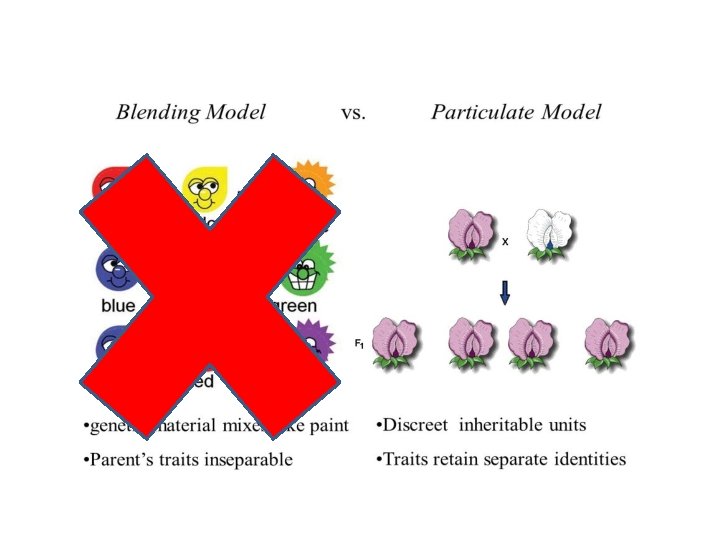
Background • The earliest hypothesis to inheritance was the “blending hypothesis” that stated that we are a blend of our parents. Imagine mixing black and white paint in order to get grey. Would it EVER be possible to keep mixing the “offspring” to get white paint again? No- This hypothesis was shown to be incorrect.
Background • The next hypothesis and is called the “Particulate (or gene) idea”. - Parents pass on heritable units (“particles”- or genes) - Was introduced by Gregor Mendel (Father of Genetics) after his work with pea plants. - Looked at characters (such as color) and traits (such as white or red)
Gregor Mendel Animation
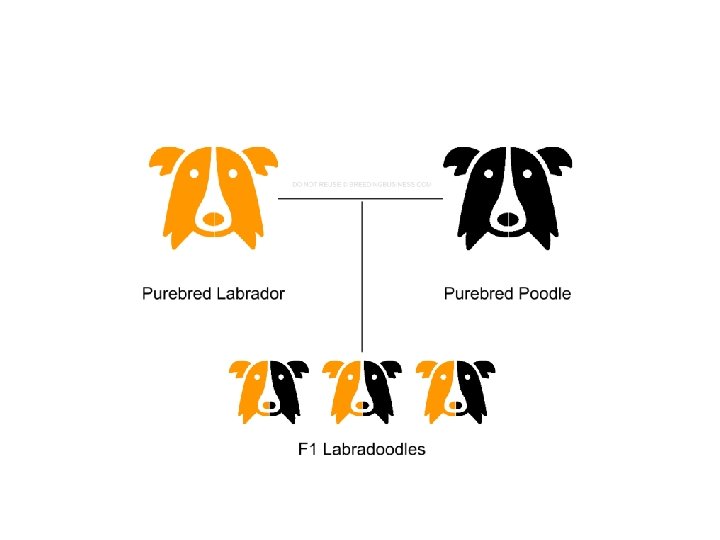
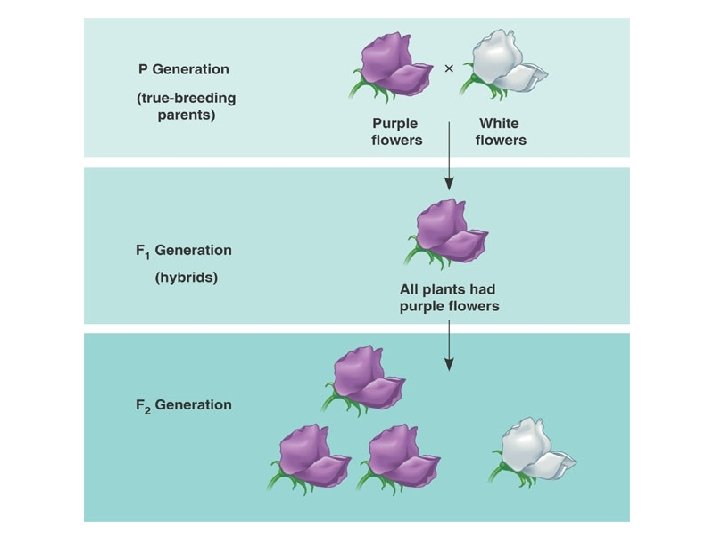
Important Terms • True breeding- When true breeding plants self pollinate, offspring are ALWAYS the same as the parents. – IE- Plant AA self pollinates and produces another AA “PURE BREEDS” - Mix a true breeding red with a true breeding white to produce a hybrid (mix)
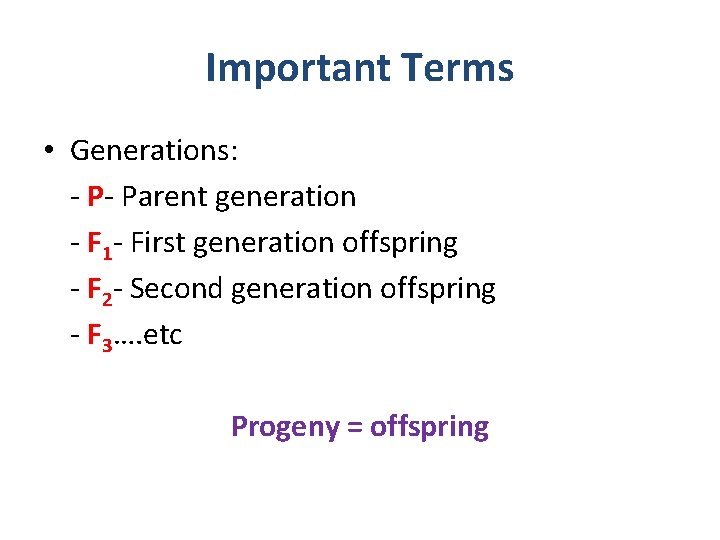
Important Terms • Generations: - P- Parent generation - F 1 - First generation offspring - F 2 - Second generation offspring - F 3…. etc Progeny = offspring
Mendel’s Rules Ted Ed Animation • Rules Mendel established 1) Alternative versions of genes account for variations in inherited characters (purple or white flowers on peas). The alternative versions of these genes are called alleles. *Think of TRAITS as CATEGORIES and ALLELES as OPTIONS within each category! Ex. Hair color= trait; Alleles = Red allele, blonde allele, black allele, brown allele, etc.
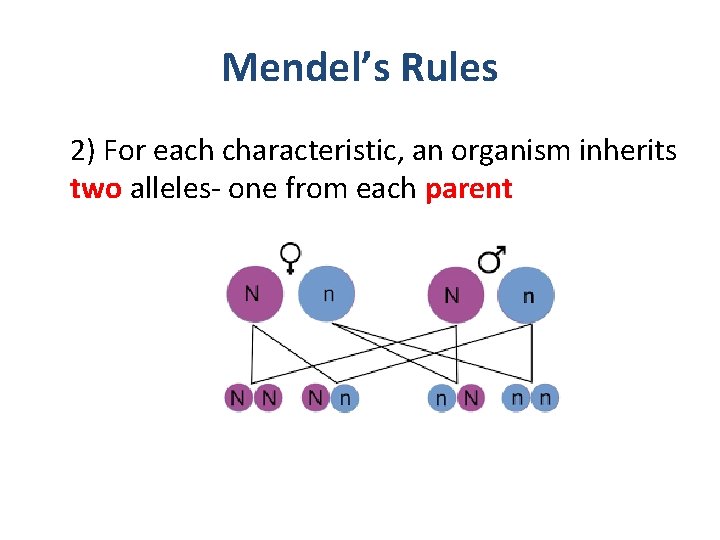
Mendel’s Rules 2) For each characteristic, an organism inherits two alleles- one from each parent
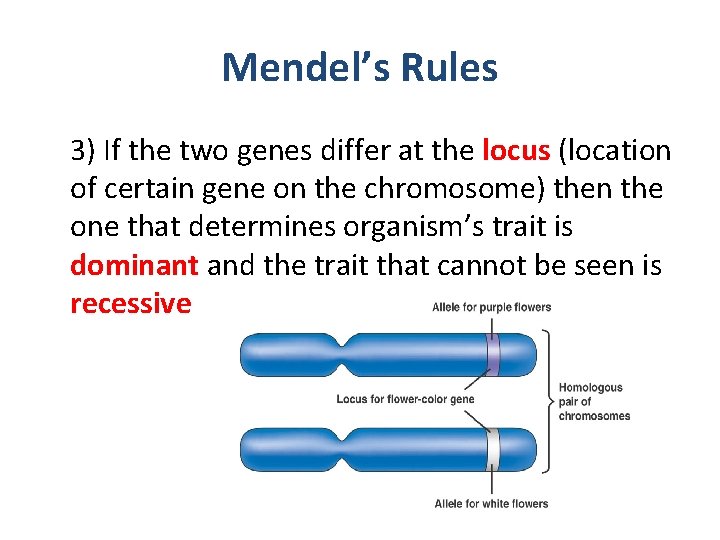
Mendel’s Rules 3) If the two genes differ at the locus (location of certain gene on the chromosome) then the one that determines organism’s trait is dominant and the trait that cannot be seen is recessive
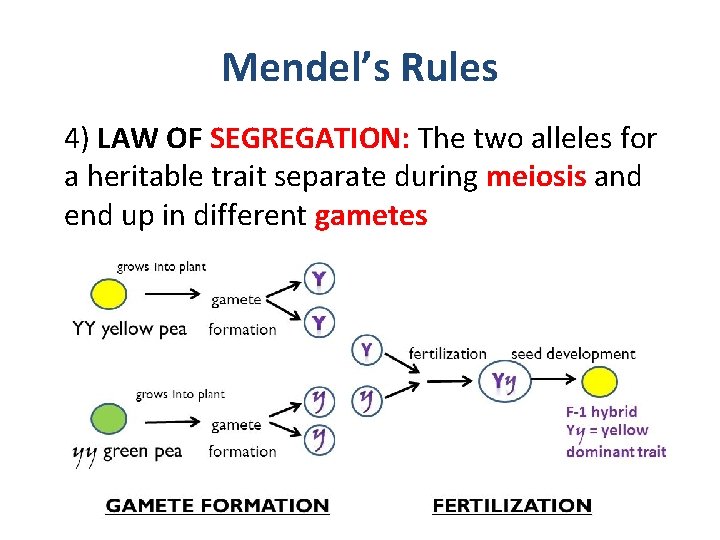
Mendel’s Rules 4) LAW OF SEGREGATION: The two alleles for a heritable trait separate during meiosis and end up in different gametes
Punnett Squares • We can illustrate likelihood of inheritance by completing a Punnett square (probability square) - Dominant trait will be shown as uppercase letters - Recessive trait will be shown as lowercase letters *Same letter for one trait! R= yellow peas, r=green peas USED “R” for both because still one trait of PEA COLOR! Letter doesn’t matter
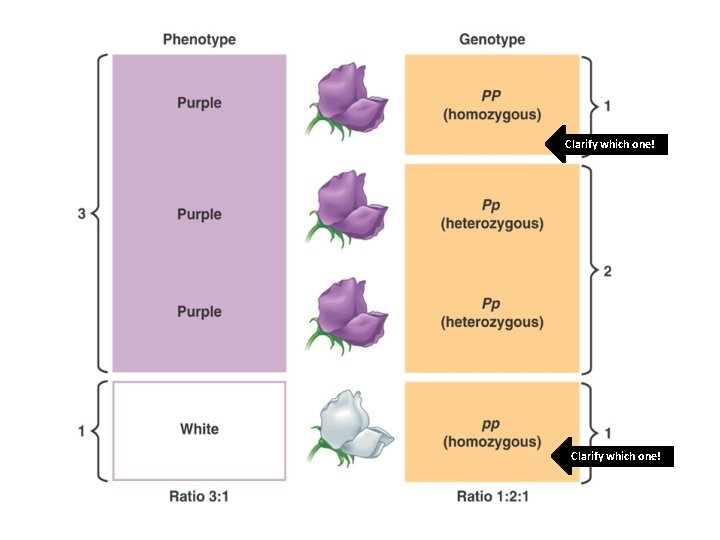
Other vocab. you need to know • Homozygous- Identical alleles (AA or aa) prefix homo = “same”; MUST CLARIFY homozygous dominant or homozygous recessive • Heterozygous- Differing alleles (Aa) prefix hetero = “different” • Phenotype- “Visible” trait (cannot ALWAYS be actually seen with the eyes) *physical look • Genotype- Genetic makeup *allele letter combinations
Clarify which one!
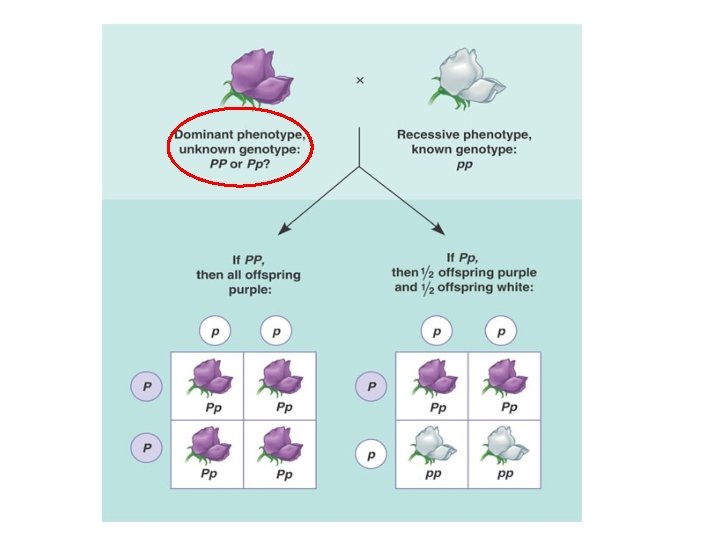
Punnett Squares • Test cross- A test completed to see if a parent is homozygous dominant or heterozygous. Cross parent in question with a homozygous recessive to determine parent’s genotype.
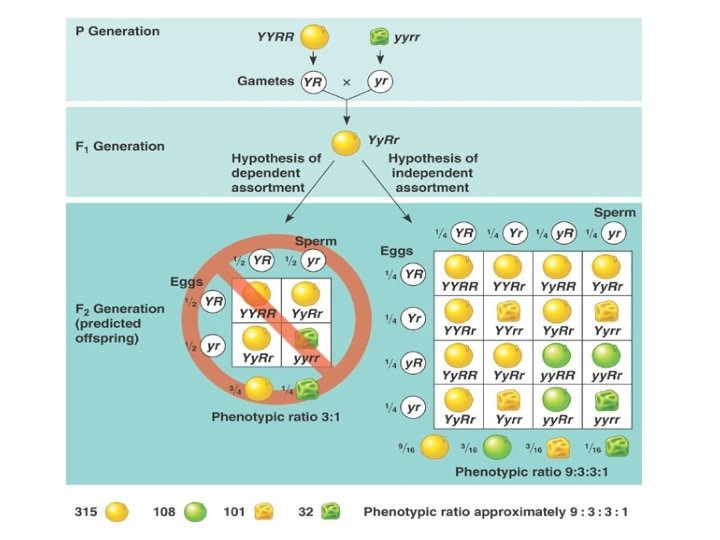
Punnett Squares and the Law of Independent Assortment - In a monohybrid cross, only one trait will be looked at. IE- cross AA with aa - In a dihybrid cross, two traits will be looked at. IE- cross AABB with Aa. Bb *2 different letters, 2 different traits (A’s for pea color, B’s for pea shape)
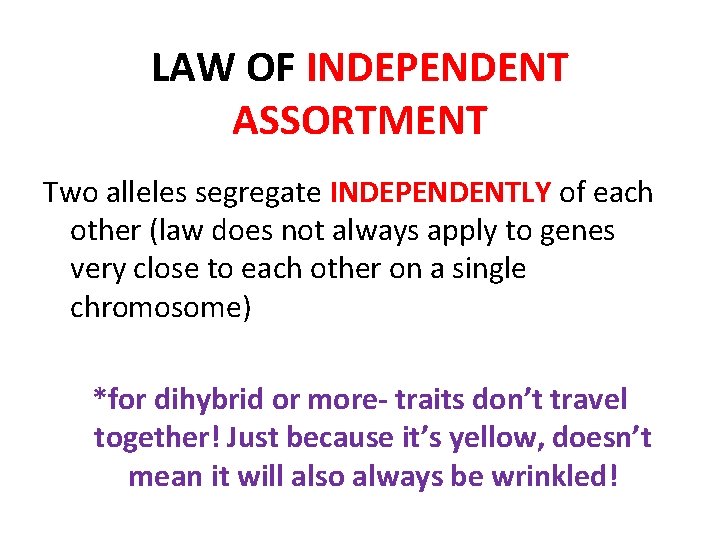
LAW OF INDEPENDENT ASSORTMENT Two alleles segregate INDEPENDENTLY of each other (law does not always apply to genes very close to each other on a single chromosome) *for dihybrid or more- traits don’t travel together! Just because it’s yellow, doesn’t mean it will also always be wrinkled!
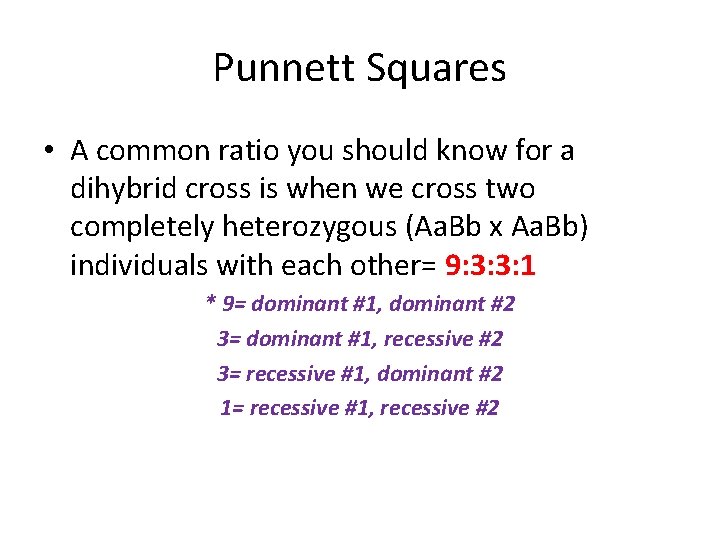
Punnett Squares • A common ratio you should know for a dihybrid cross is when we cross two completely heterozygous (Aa. Bb x Aa. Bb) individuals with each other= 9: 3: 3: 1 * 9= dominant #1, dominant #2 3= dominant #1, recessive #2 3= recessive #1, dominant #2 1= recessive #1, recessive #2
Let’s Practice!
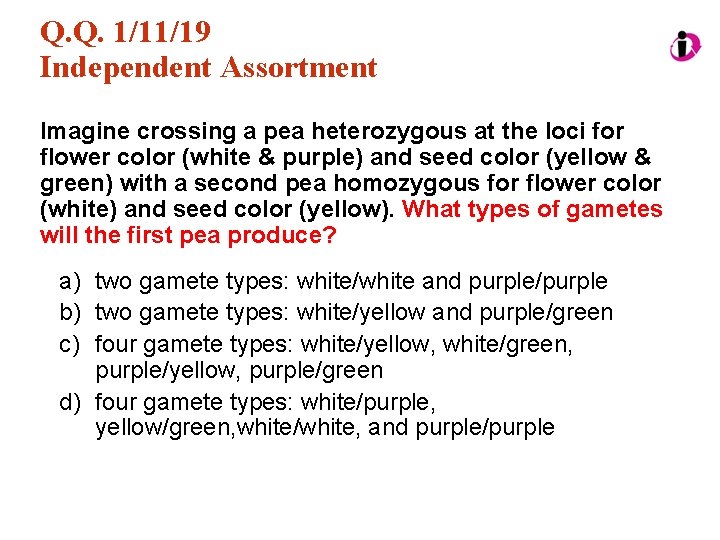
Q. Q. 1/11/19 Independent Assortment Imagine crossing a pea heterozygous at the loci for flower color (white & purple) and seed color (yellow & green) with a second pea homozygous for flower color (white) and seed color (yellow). What types of gametes will the first pea produce? a) two gamete types: white/white and purple/purple b) two gamete types: white/yellow and purple/green c) four gamete types: white/yellow, white/green, purple/yellow, purple/green d) four gamete types: white/purple, yellow/green, white/white, and purple/purple
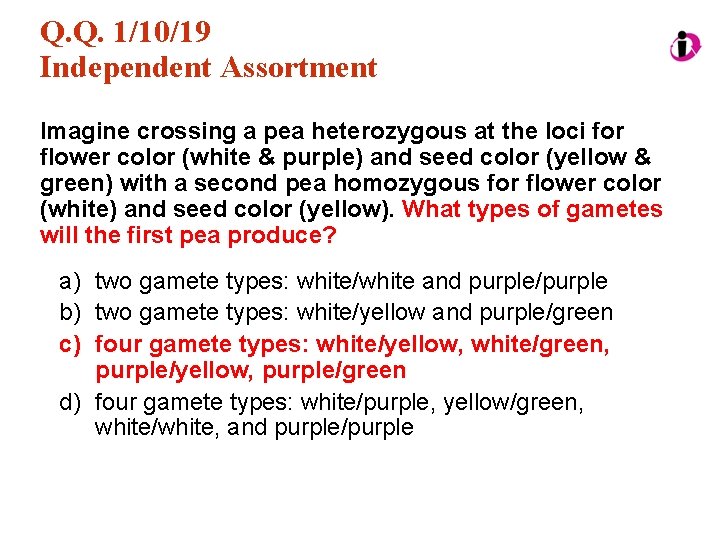
Q. Q. 1/10/19 Independent Assortment Imagine crossing a pea heterozygous at the loci for flower color (white & purple) and seed color (yellow & green) with a second pea homozygous for flower color (white) and seed color (yellow). What types of gametes will the first pea produce? a) two gamete types: white/white and purple/purple b) two gamete types: white/yellow and purple/green c) four gamete types: white/yellow, white/green, purple/yellow, purple/green d) four gamete types: white/purple, yellow/green, white/white, and purple/purple
Genetics Notes – PART 2
Genetics Videos to watch! • Bozeman Science– Law of Multiplication and addition • Mendelian Genetics- overview
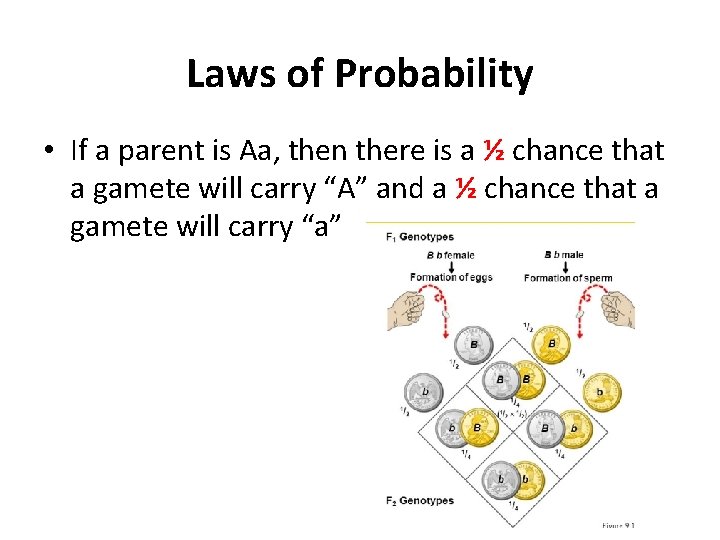
Laws of Probability • If a parent is Aa, then there is a ½ chance that a gamete will carry “A” and a ½ chance that a gamete will carry “a”
Probability • Multiplication rule- To find out what the outcome is when I flip two coins at the same time (let’s say both land heads up) then we must multiply ½ x ½ = ¼ chance of both being heads up.
Practice Problem! - Cross Yy. Rr with Yy. Rr by using probability ONLY -Think of this as doing 2 monohybrid crosses
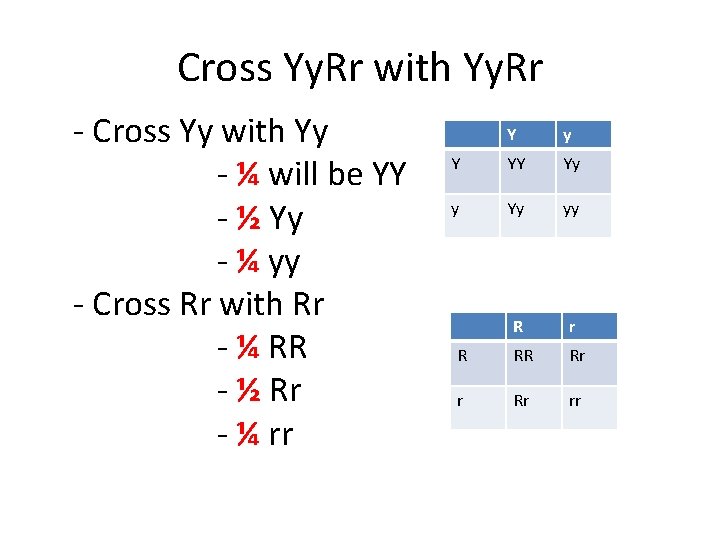
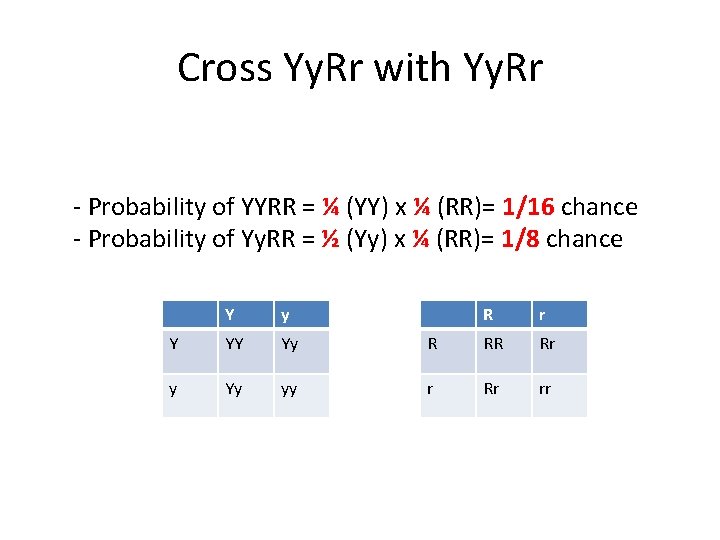
Cross Yy. Rr with Yy. Rr - Cross Yy with Yy - ¼ will be YY - ½ Yy - ¼ yy - Cross Rr with Rr - ¼ RR - ½ Rr - ¼ rr Y y Y YY Yy yy R r R RR Rr rr
Cross Yy. Rr with Yy. Rr - Probability of YYRR = ¼ (YY) x ¼ (RR)= 1/16 chance - Probability of Yy. RR = ½ (Yy) x ¼ (RR)= 1/8 chance Y y Y YY Yy yy R r R RR Rr rr
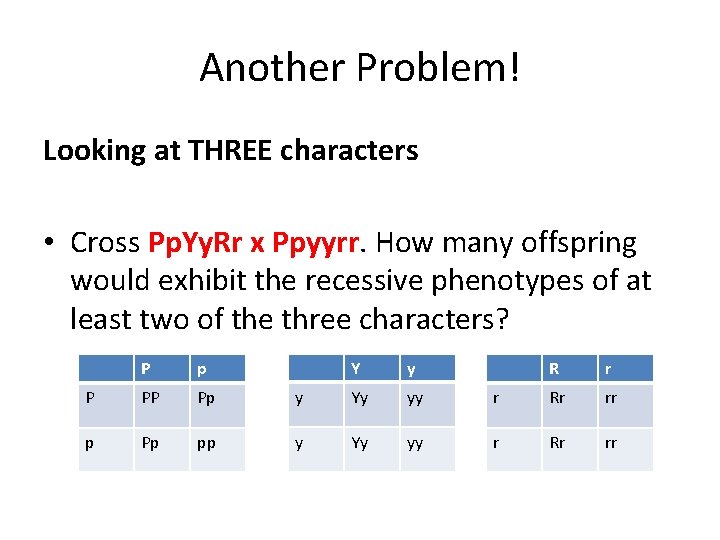
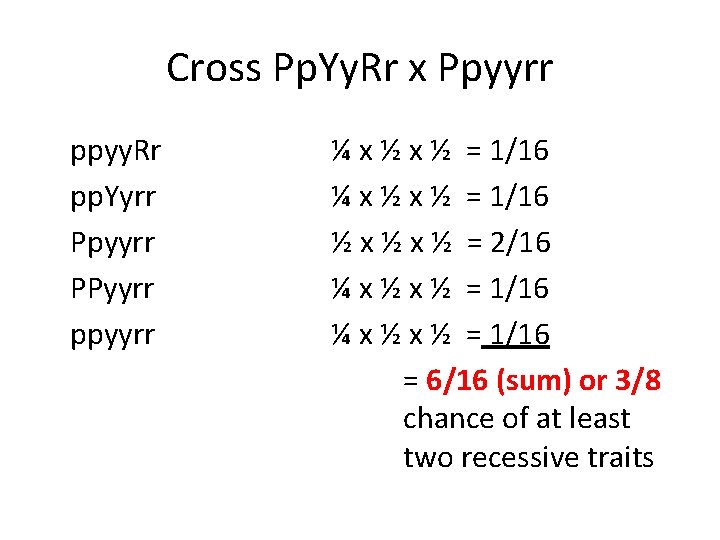
Another Problem! Looking at THREE characters • Cross Pp. Yy. Rr x Ppyyrr. How many offspring would exhibit the recessive phenotypes of at least two of the three characters? P p P PP Pp pp Y y y Yy yy R r r Rr rr
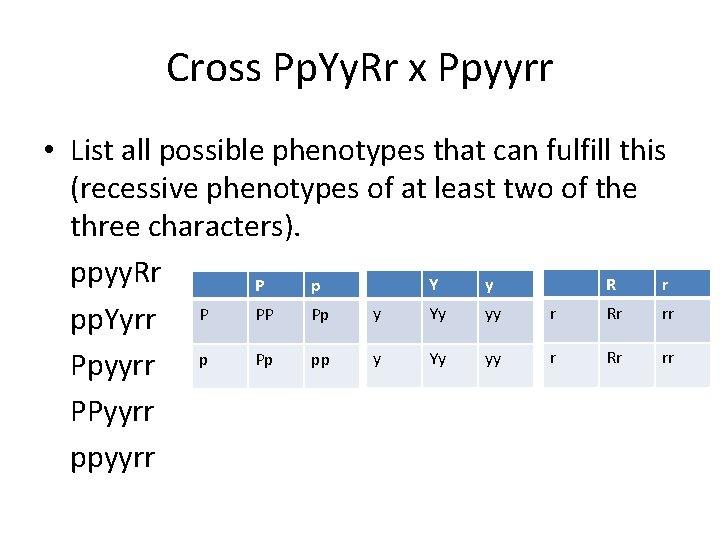
Cross Pp. Yy. Rr x Ppyyrr • List all possible phenotypes that can fulfill this (recessive phenotypes of at least two of the three characters). ppyy. Rr R r Y y P p r Rr rr pp. Yyrr P PP Pp y Yy yy r Rr rr Ppyyrr p Pp pp y Yy yy PPyyrr ppyyrr
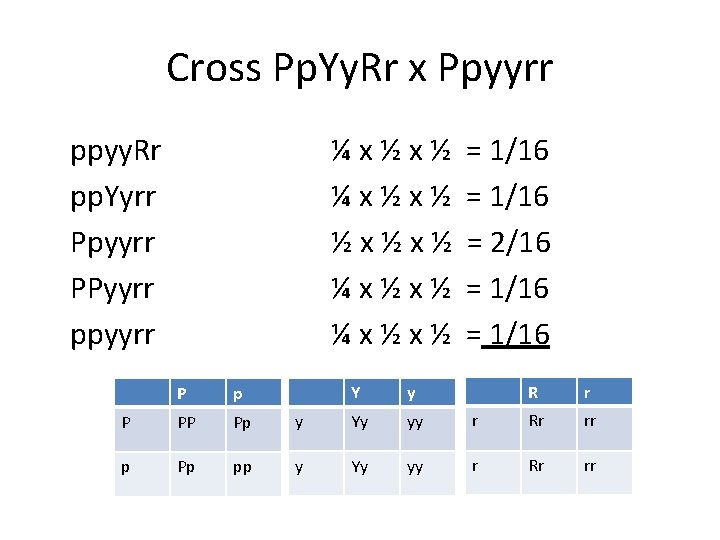
Cross Pp. Yy. Rr x Ppyyrr ppyy. Rr pp. Yyrr Ppyyrr PPyyrr ppyyrr ¼x½x½ ½x½x½ ¼x½x½ P p P PP Pp pp Y y y Yy yy = 1/16 = 2/16 = 1/16 R r r Rr rr
Cross Pp. Yy. Rr x Ppyyrr ppyy. Rr pp. Yyrr Ppyyrr PPyyrr ppyyrr ¼ x ½ x ½ = 1/16 ½ x ½ = 2/16 ¼ x ½ x ½ = 1/16 = 6/16 (sum) or 3/8 chance of at least two recessive traits
Let’s Practice! • Ch. 14 Review Packet of Questions (turn to BACK; last page) ü#5 complete the chart ü#7 ü#8
Exceptions to Mendel’s Rules! Non-Mendelian genetics or complex patterns of inheritance *AKA what Mendel didn’t figure out!
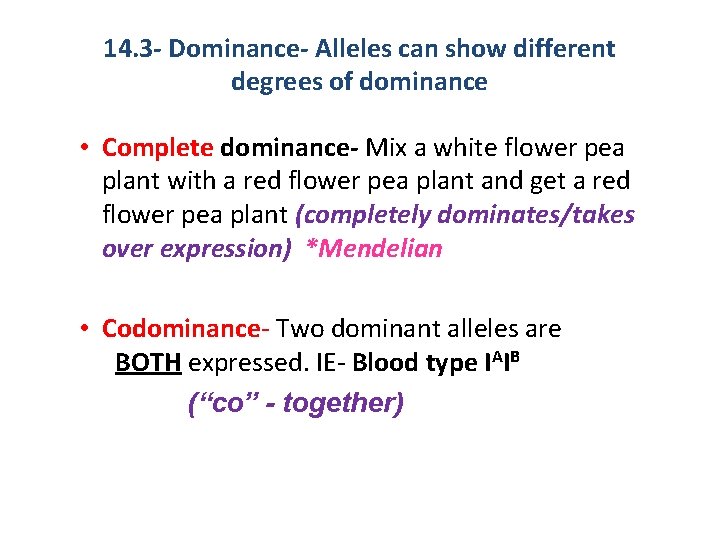
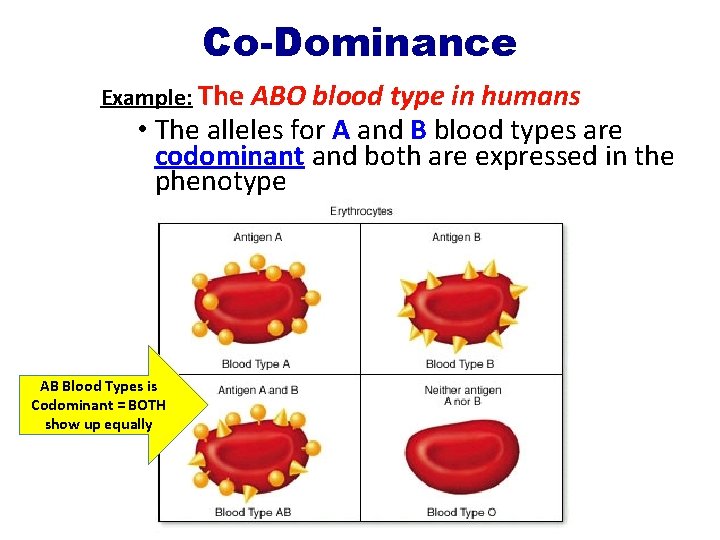
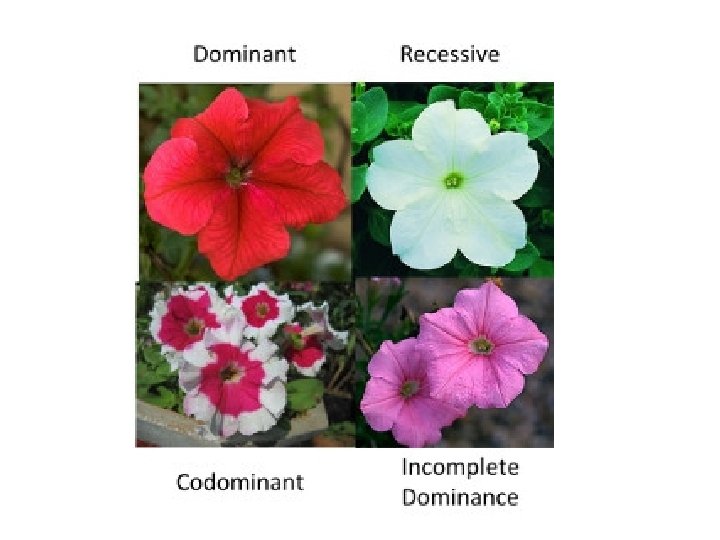
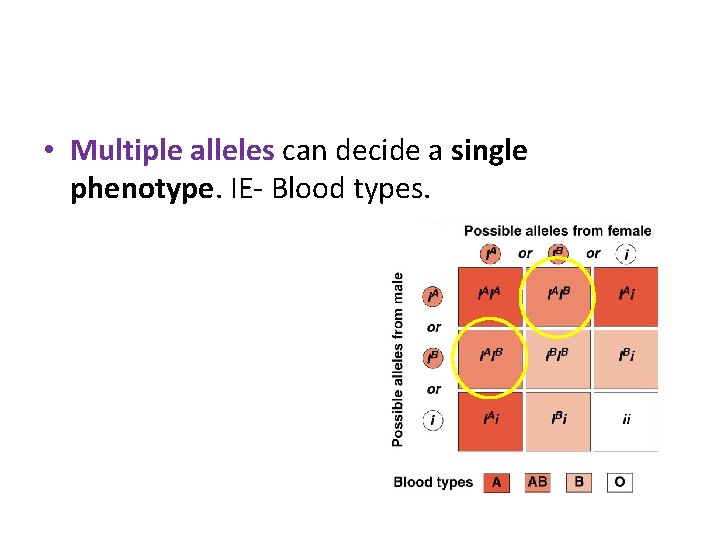
14. 3 - Dominance- Alleles can show different degrees of dominance • Complete dominance- Mix a white flower pea plant with a red flower pea plant and get a red flower pea plant (completely dominates/takes over expression) *Mendelian • Codominance- Two dominant alleles are BOTH expressed. IE- Blood type IAIB (“co” - together)
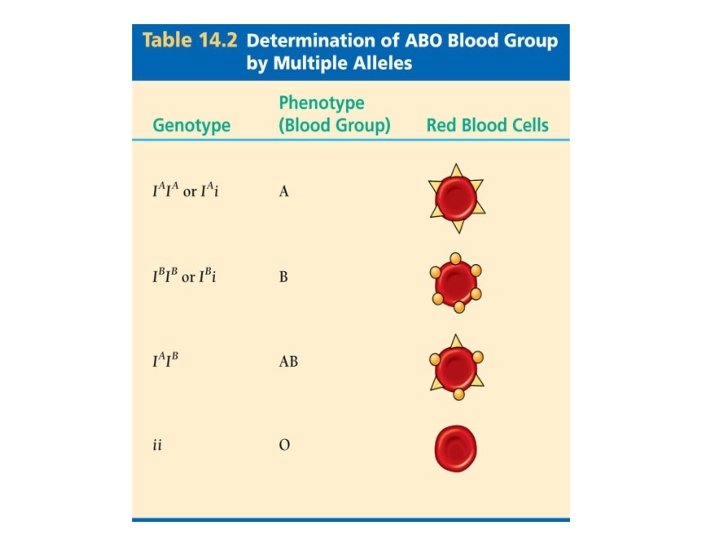
Co-Dominance Example: The ABO blood type in humans • The alleles for A and B blood types are codominant and both are expressed in the phenotype AB Blood Types is Codominant = BOTH show up equally
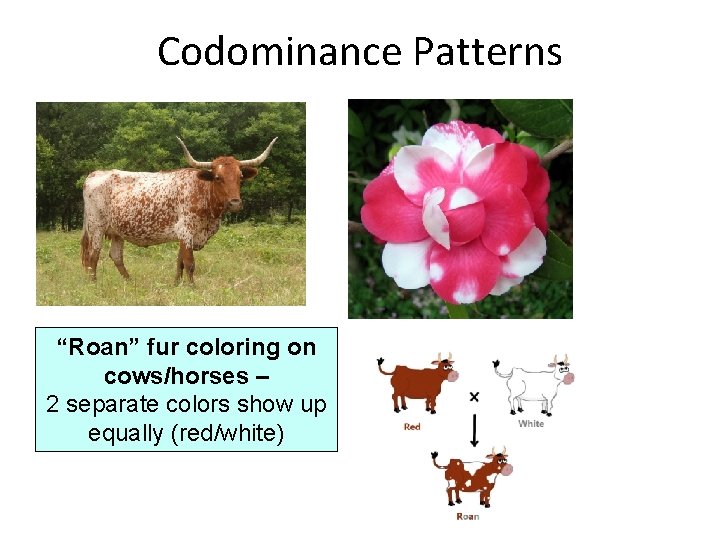
Codominance Patterns “Roan” fur coloring on cows/horses – 2 separate colors show up equally (red/white)
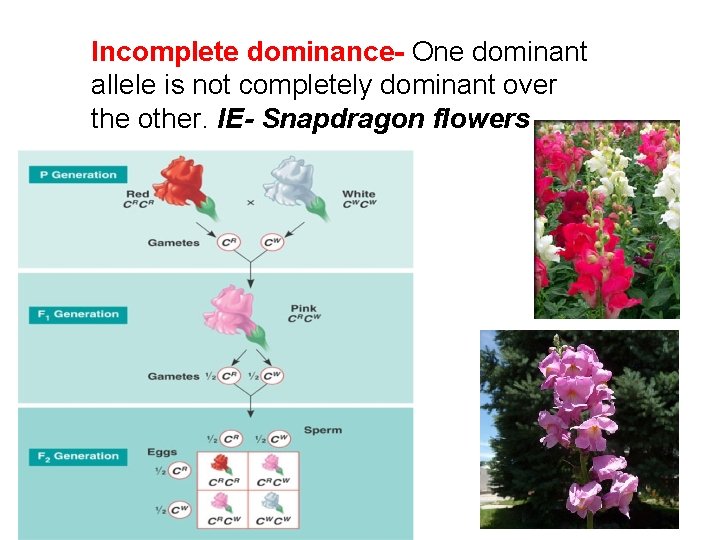
Incomplete dominance- One dominant allele is not completely dominant over the other. IE- Snapdragon flowers
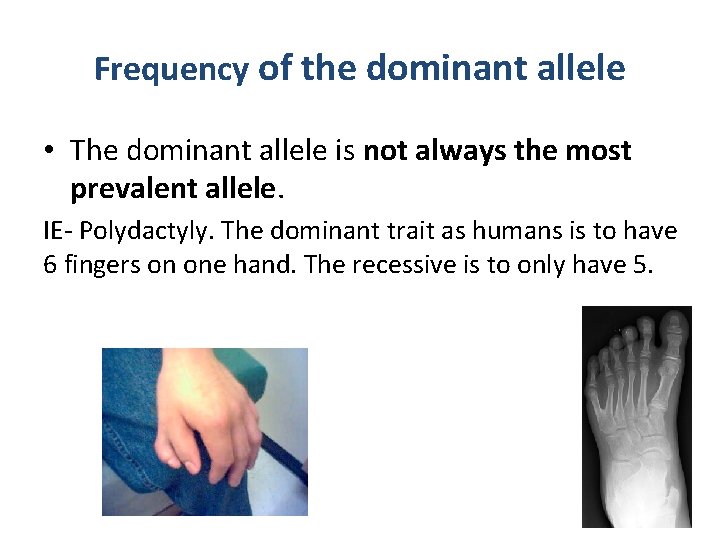
Frequency of the dominant allele • The dominant allele is not always the most prevalent allele. IE- Polydactyly. The dominant trait as humans is to have 6 fingers on one hand. The recessive is to only have 5.
• Multiple alleles can decide a single phenotype. IE- Blood types.
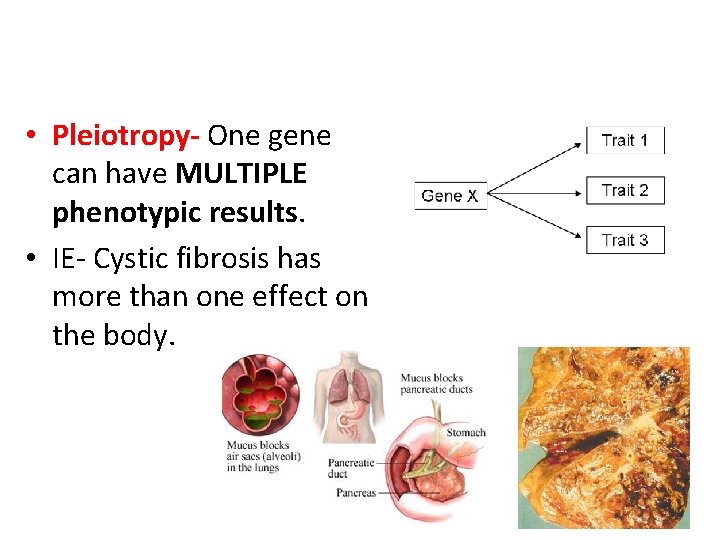
• Pleiotropy- One gene can have MULTIPLE phenotypic results. • IE- Cystic fibrosis has more than one effect on the body.
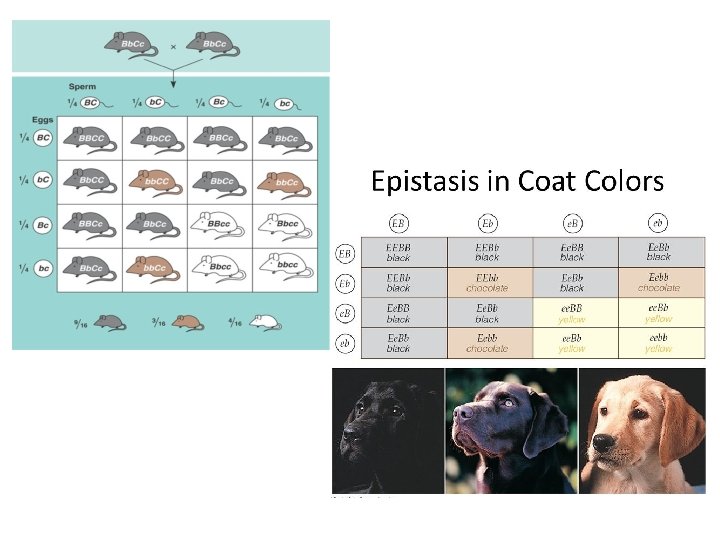
Epistasis- One gene can affect another gene. IE- Mouse color. Two traits being looked at. 1) Color: Black = Dominant (BB or Bb) or Brown = recessive (bb) 2) Pigment deposited: Normal= Dominant (CC or Cc) or None (albino) = rec. (cc) The “pigment deposited” gene decides if any pigment at all will be seen. If the offspring has the recessive “pigment deposited” gene then the mouse will be albino.
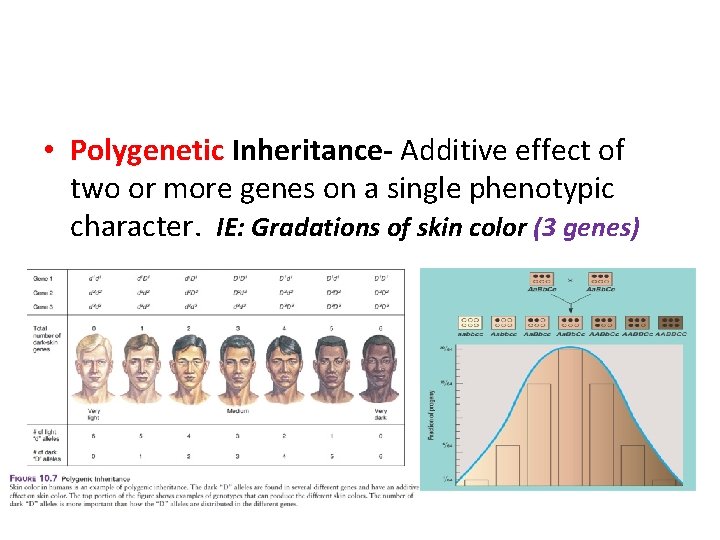
• Polygenetic Inheritance- Additive effect of two or more genes on a single phenotypic character. IE: Gradations of skin color (3 genes)
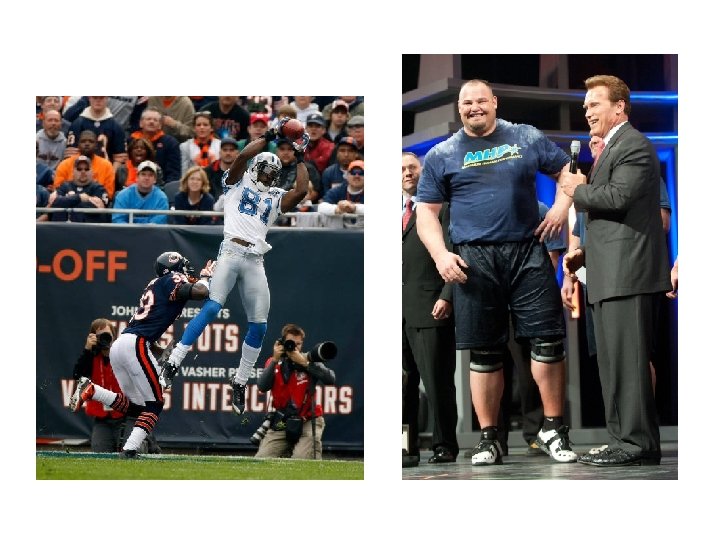
Nature vs. Nurture • Nature vs. Nurture- What really decides a phenotype? Is it the genotype or what is done to the body (such as overeating)? – “Norm of Reaction” for a genotype- A genotype has a range of possible phenotypic outcomes. • Not all traits have this, such as blood type (no phenotypic range)
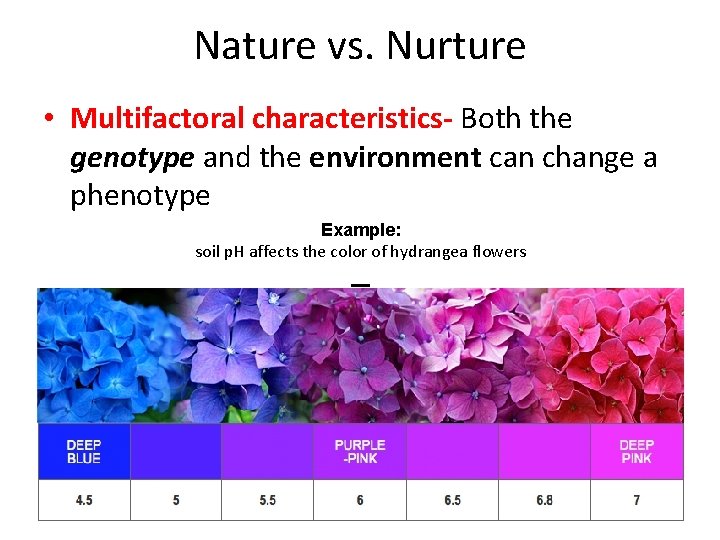
Nature vs. Nurture • Multifactoral characteristics- Both the genotype and the environment can change a phenotype Example: soil p. H affects the color of hydrangea flowers –
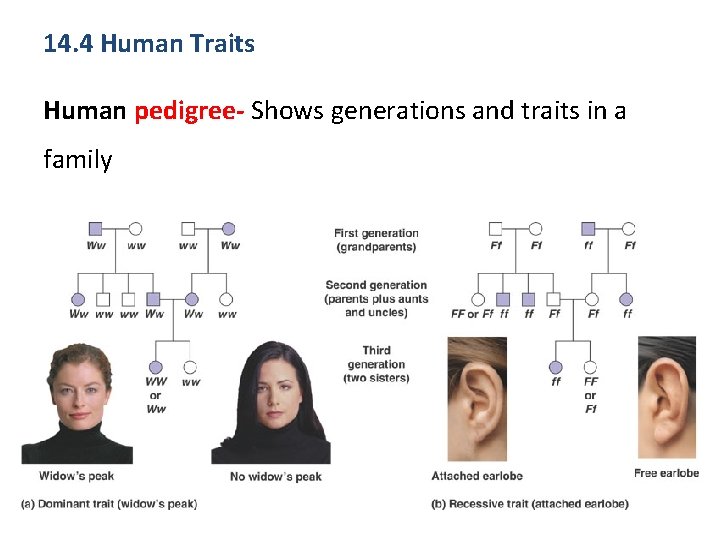
14. 4 Human Traits Human pedigree- Shows generations and traits in a family
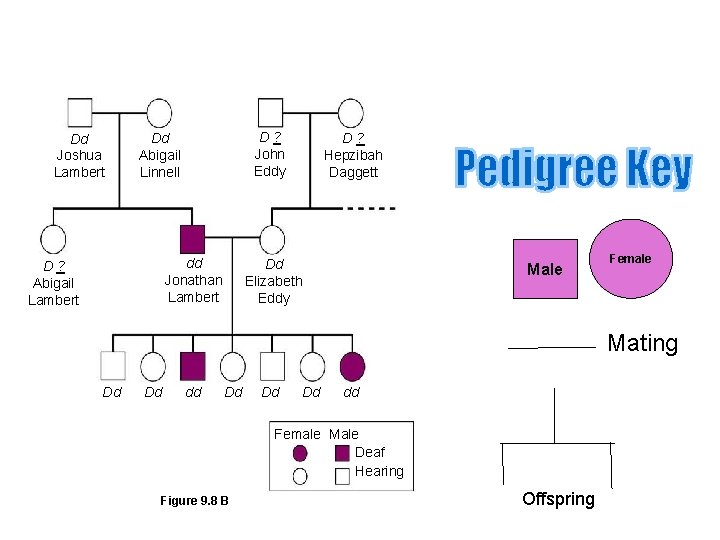
Dd Joshua Lambert D? John Eddy Dd Abigail Linnell dd Jonathan Lambert D? Abigail Lambert D? Hepzibah Daggett Dd Elizabeth Eddy Male Female Mating Dd Dd dd Dd Dd Dd dd Female Male Deaf Hearing Figure 9. 8 B Offspring
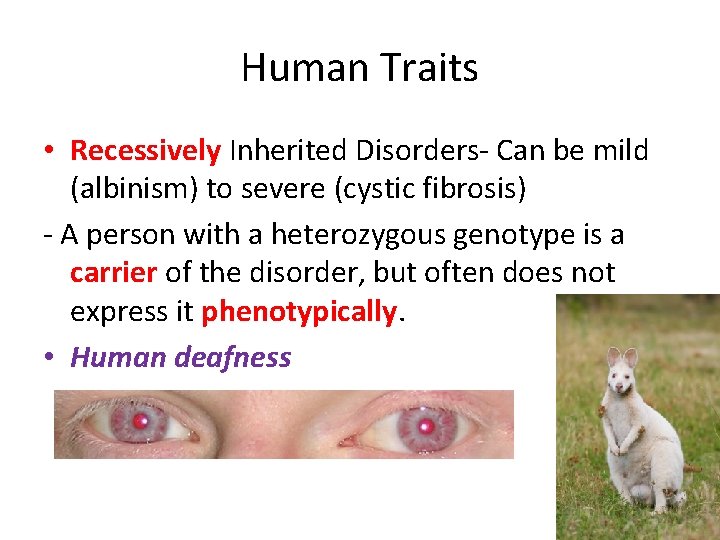
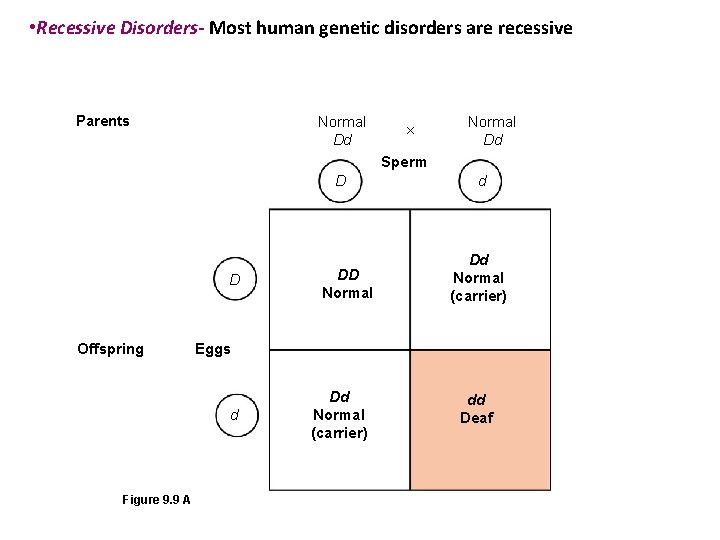
Human Traits • Recessively Inherited Disorders- Can be mild (albinism) to severe (cystic fibrosis) - A person with a heterozygous genotype is a carrier of the disorder, but often does not express it phenotypically. • Human deafness
• Recessive Disorders- Most human genetic disorders are recessive Parents Normal Dd Sperm D D Offspring Dd Normal (carrier) Eggs d Figure 9. 9 A DD Normal d Dd Normal (carrier) dd Deaf
Human Traits - Individuals with these disorders often times do not produce offspring (with exceptions) - These disorders are NOT spread equally among populations - Cystic fibrosis- Most common in European descent individuals. - Sickle cell anemia- Most common in African descent individuals.
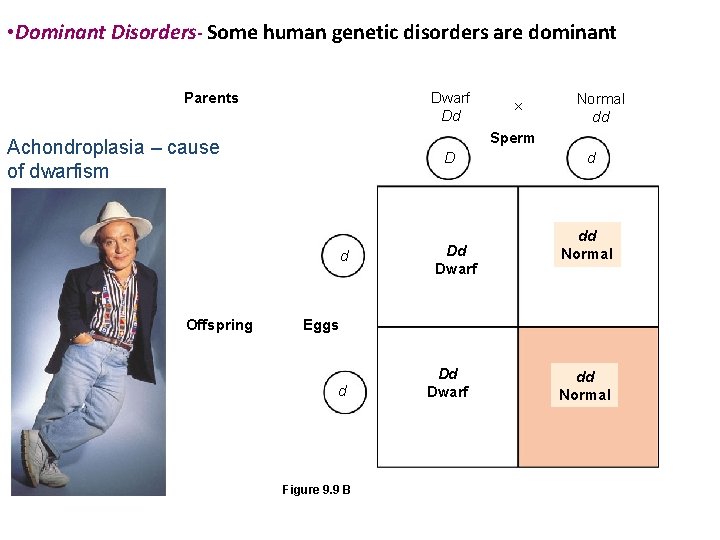
Human Traits • Dominantly Inherited Disorders- Individuals with dominant phenotype have disorder. - Achondroplasia- Dwarfism. Effects apparent at birth. - Huntington’s Disease- No effects until age 35 -40. If a parent has this disorder, there is a 50% chance that their offspring will also have it. (Aa x aa)
• Dominant Disorders- Some human genetic disorders are dominant Parents Dwarf Dd Normal dd Sperm Achondroplasia – cause of dwarfism D d Offspring Dd Dwarf d dd Normal Eggs d Figure 9. 9 B Dd Dwarf dd Normal
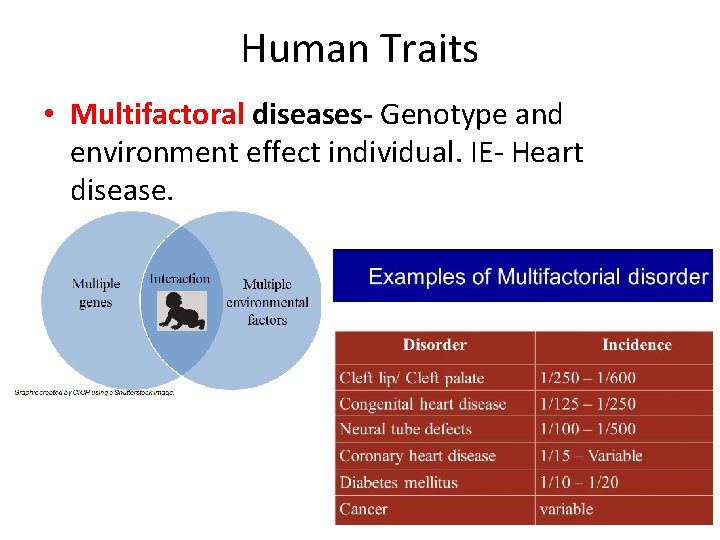
Human Traits • Multifactoral diseases- Genotype and environment effect individual. IE- Heart disease.
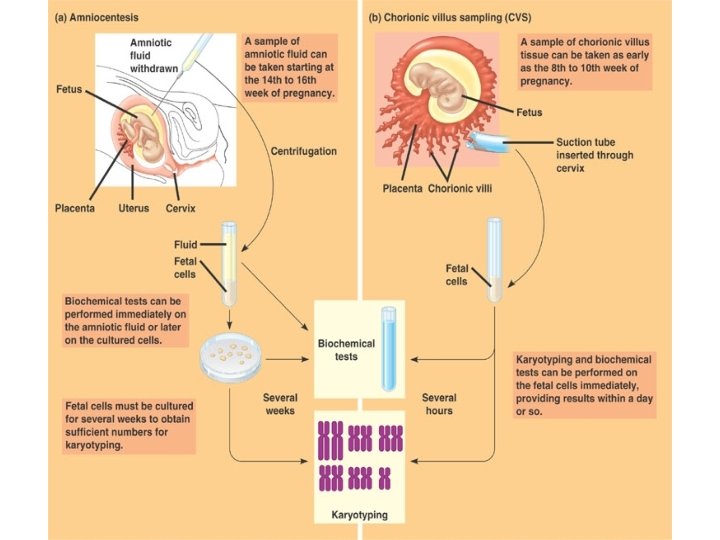
Genetic Testing - Amniocentesis- The removal of about 10 ml of amniotic fluid to test for certain genetic disorders. Considered time consuming and somewhat dangerous. *Animation - CVS (Chorionic villus sampling)- Tissue is removed from the placenta. Rapid results via karyotyping. *Animation
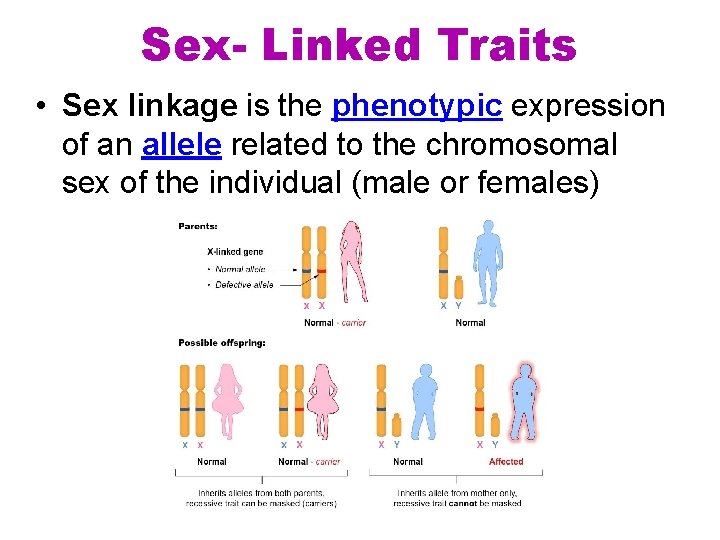
Sex- Linked Traits • Sex linkage is the phenotypic expression of an allele related to the chromosomal sex of the individual (male or females)
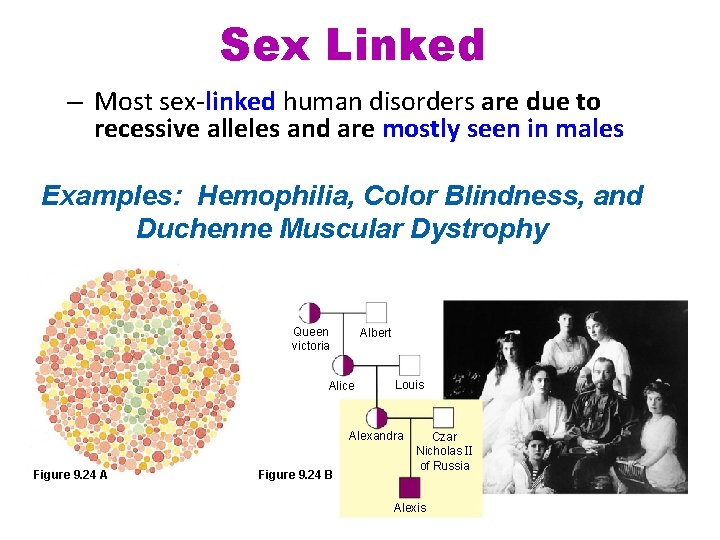
Sex Linked – Most sex-linked human disorders are due to recessive alleles and are mostly seen in males Examples: Hemophilia, Color Blindness, and Duchenne Muscular Dystrophy Queen victoria Albert Alice Louis Alexandra Figure 9. 24 A Figure 9. 24 B Czar Nicholas II of Russia Alexis
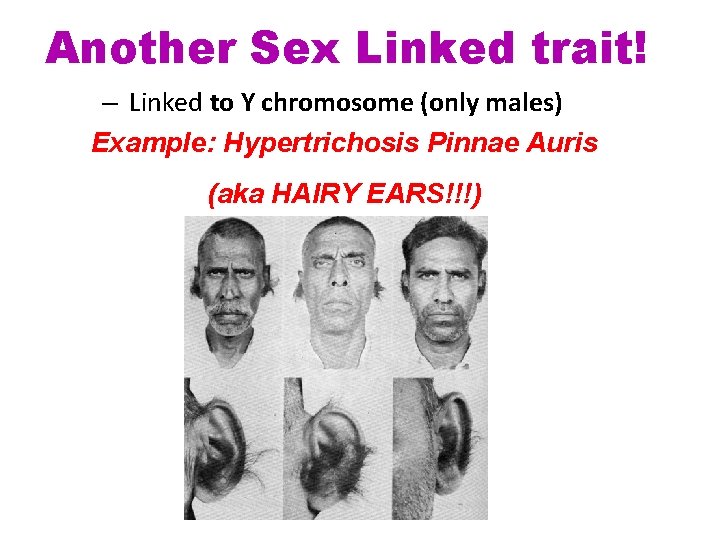
Another Sex Linked trait! – Linked to Y chromosome (only males) Example: Hypertrichosis Pinnae Auris (aka HAIRY EARS!!!)