
WHAT FACTORS LEAD TO CRIME Profiling Certain people
- Slides: 14
WHAT FACTORS LEAD TO CRIME?
Profiling • Certain people, in certain circumstances are more likely than others to get involved in criminal conduct. • Law enforcements make generalizations about people. • Must of course, also have evidence. • Not to be confused with racial profiling which is illegal. • Certain characteristics, do indicate that someone may be more likely to get involved with criminal activity
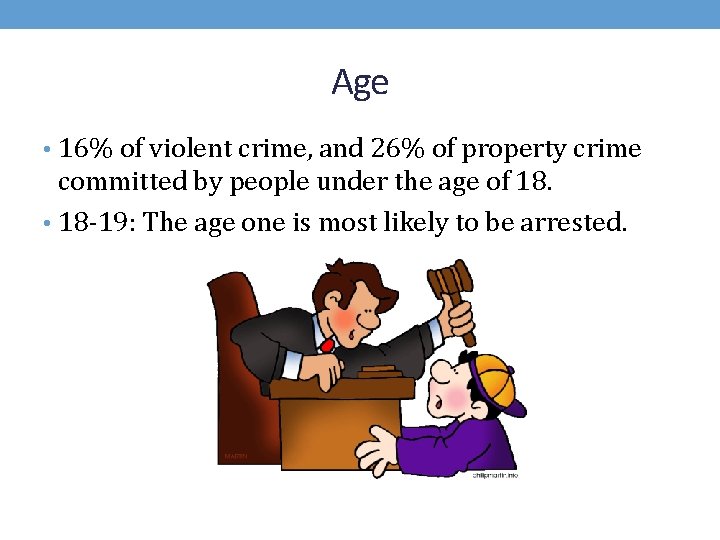
Age • 16% of violent crime, and 26% of property crime committed by people under the age of 18. • 18 -19: The age one is most likely to be arrested.
Why are young people more likely to commit crime? • They have more energy. • They find it difficult to delay gratification or resist temptation. • Make poor choices because their brains are still undergoing significant development. • Brain is not fully developed until age 22 -25. • Older people are more likely to have families, which demand responsibility.
Gender • 75% of all arrests involve men. • 83% of violent crime and 67% of property crime. • Female rates to appear to be on the rise.
Why men? • Generally physically bigger and more aggressive. • Less compassionate, empathetic, nurturing. • Raised differently • Boys taught to be physical, dominant, and aggressive. • Girls rewarded for exhibiting stereotypical feminine virtues.
Income • People from lower income areas commit more crime. Why? • Police spend more time in poor areas. • Higher rates of drug use. • Quality of schools is lower – low education often relates to higher crime rates. • Can’t afford the things they need/want. • People with poor impulse control live in poor neighborhoods because they can’t keep jobs.
Race • In the United States, African- American and Hispanic citizens continue to be arrested for a disproportionate number of crimes. • Institutionalized racism? • A simple reflection of their offense rate?
Cultural Challenges Facing Minority Groups • Larger number of single parents • Lack of a second parent can have a large impact: • Income, educational opportunities, discipline. • Single parent families more likely to live in impoverished areas where crime rates are high.
Education • The more education one has, the less likely they are to commit a crime. • It is not education itself, but what education affords people • Better jobs • Better neighborhoods with better schools • Less exposure to delinquents • Bonds or social connection that students make at school correlate with lower crime rates.
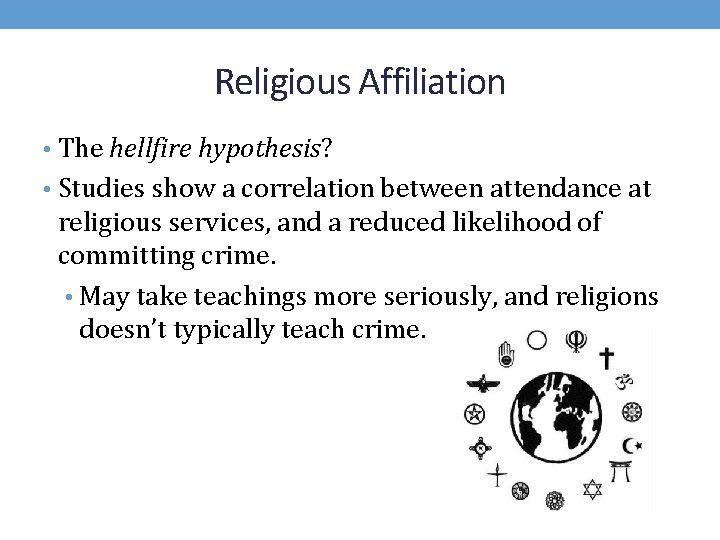
Religious Affiliation • The hellfire hypothesis? • Studies show a correlation between attendance at religious services, and a reduced likelihood of committing crime. • May take teachings more seriously, and religions doesn’t typically teach crime.
The Impact of Societal Conditions on Crime • Pop Culture • Average child will see 18, 000 murders, and 250, 000 violent acts on TV and in movies before they graduate. • Some suggested we are becoming desensitized to violence. • Some may see violence as an appropriate way to resolve conflict.
The Impact of Societal Conditions on Crime • Bad Economy • When times are tough, do crime rates go up? • Two opposing views: • Unemployed people, especially men, who have more free time, get into trouble. • During severe economic downturns, families are brought closer together, resulting in a decrease in crime.
Time of Year • More crime occurs during the summer. Why? • Kids are out of school and have free time. • More people outside interacting with each other. • Vacations leave homes vulnerable. • Hot weather may lead to increase in domestic violence as tempers are short. • Extremely hot weather though may actually cause a decrease. • Robberies are more likely to occur in the winter.