
What Evidence would YOU Collect 1 FORENSIC SCIENCE
- Slides: 29
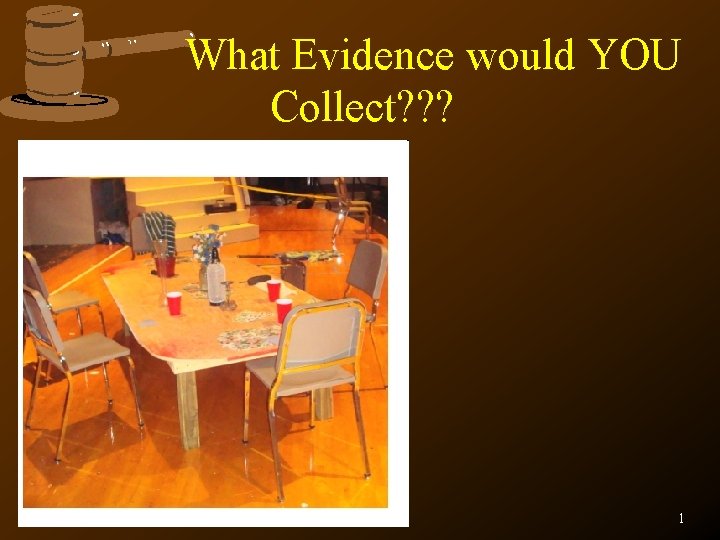
What Evidence would YOU Collect? ? ? 1
FORENSIC SCIENCE Collecting Evidence and The Law!
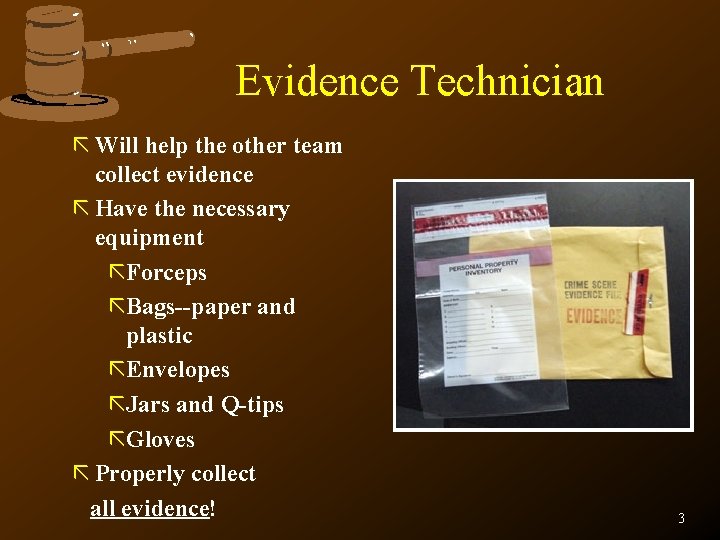
Evidence Technician ã Will help the other team collect evidence ã Have the necessary equipment ãForceps ãBags--paper and plastic ãEnvelopes ãJars and Q-tips ãGloves ã Properly collect all evidence! 3
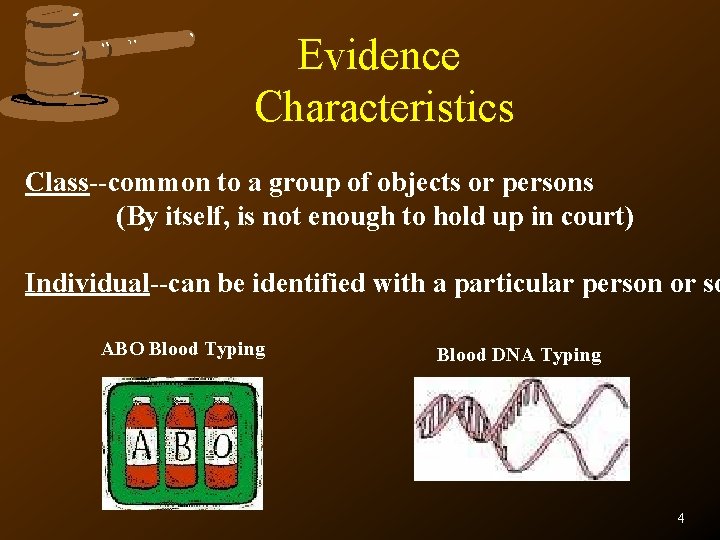
Evidence Characteristics Class--common to a group of objects or persons (By itself, is not enough to hold up in court) Individual--can be identified with a particular person or so ABO Blood Typing Blood DNA Typing 4
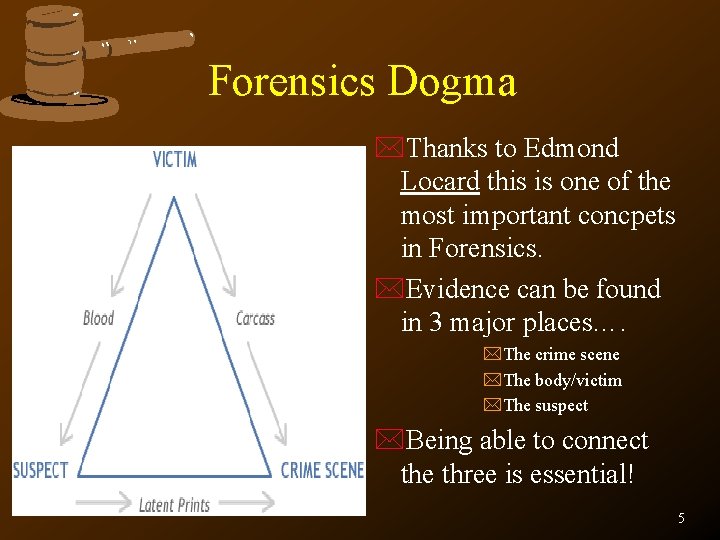
Forensics Dogma *Thanks to Edmond Locard this is one of the most important concpets in Forensics. *Evidence can be found in 3 major places…. *The crime scene *The body/victim *The suspect *Being able to connect the three is essential! 5
Physical Evidence Transient Evidence--temporary; ã ã easily changed or lost; usually observed by the first officer at the scene Odor--putrefaction, perfume, gasoline, urine, burning, explosives, cigarette or cigar smoke Temperature--of room, car hood, coffee, water in a bathtub; cadaver Imprints and indentations-footprints; teeth marks in perishable foods; tire marks on certain surfaces Markings 6
Biological Evidence âBlood âSemen âSaliva âSweat/Tears âHair âBone âTissues âUrine âFeces âAnimal Material âInsects âBacterial/Fungal 7
Chemical Evidence â Fibers â Glass â Soil â Gunpowder â Metal â Mineral â Narcotics â Drugs âPaper âInk âCosmetics âPaint âPlastic âLubricants âFertilizer 8
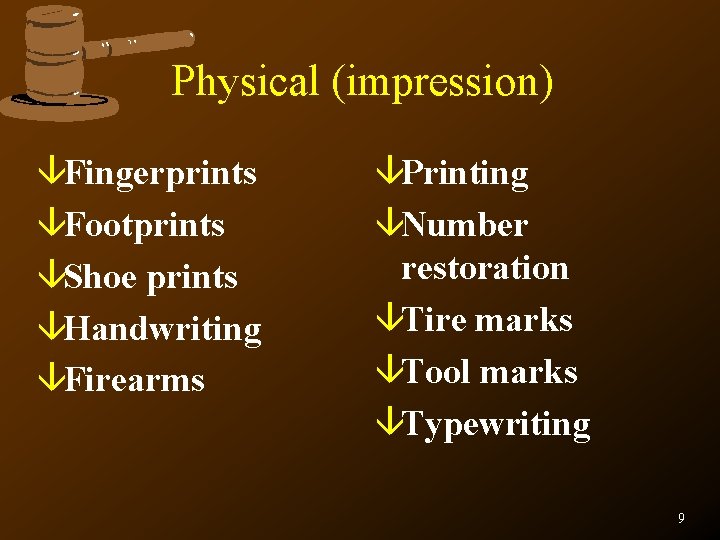
Physical (impression) âFingerprints âFootprints âShoe prints âHandwriting âFirearms âPrinting âNumber restoration âTire marks âTool marks âTypewriting 9
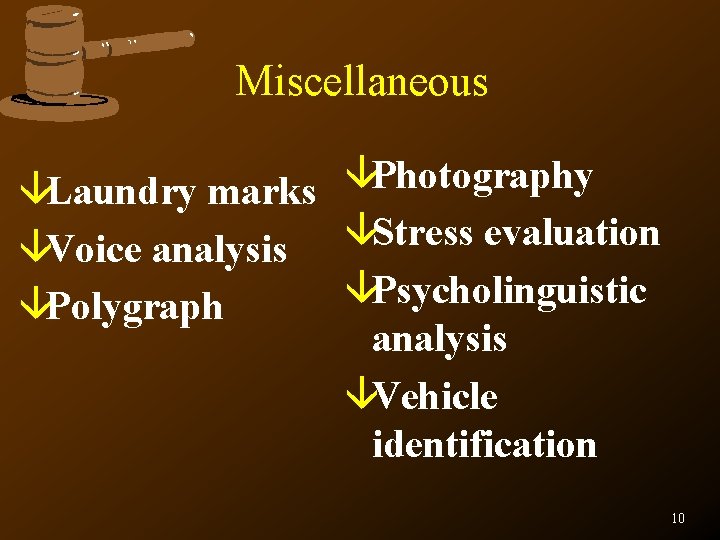
Miscellaneous â Photography âLaundry marks â Stress evaluation âVoice analysis â Psycholinguistic âPolygraph analysis âVehicle identification 10
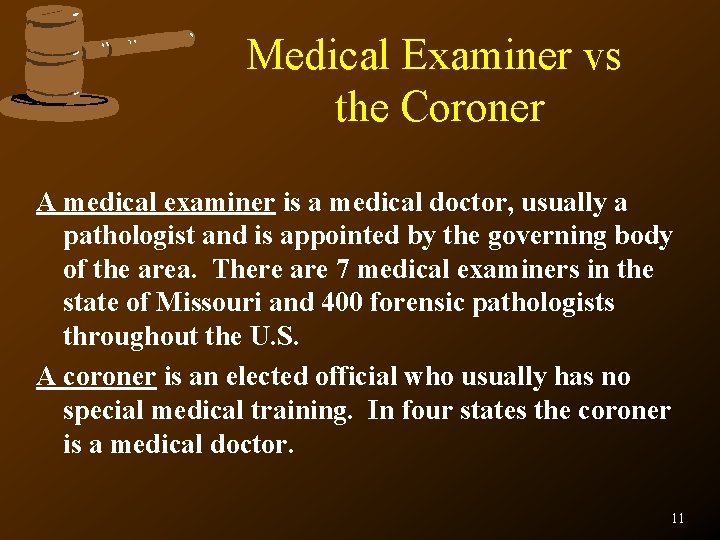
Medical Examiner vs the Coroner A medical examiner is a medical doctor, usually a pathologist and is appointed by the governing body of the area. There are 7 medical examiners in the state of Missouri and 400 forensic pathologists throughout the U. S. A coroner is an elected official who usually has no special medical training. In four states the coroner is a medical doctor. 11
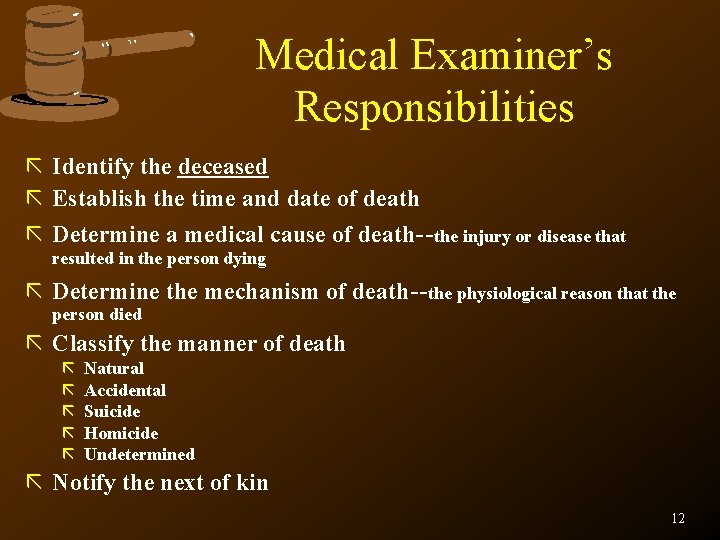
Medical Examiner’s Responsibilities ã Identify the deceased ã Establish the time and date of death ã Determine a medical cause of death--the injury or disease that resulted in the person dying ã Determine the mechanism of death--the physiological reason that the person died ã Classify the manner of death ã ã ã Natural Accidental Suicide Homicide Undetermined ã Notify the next of kin 12
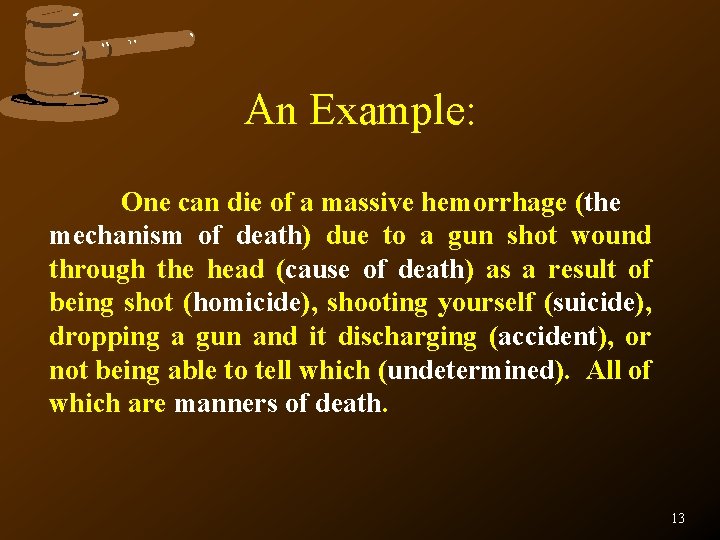
An Example: One can die of a massive hemorrhage (the mechanism of death) due to a gun shot wound through the head (cause of death) as a result of being shot (homicide), shooting yourself (suicide), dropping a gun and it discharging (accident), or not being able to tell which (undetermined). All of which are manners of death. 13
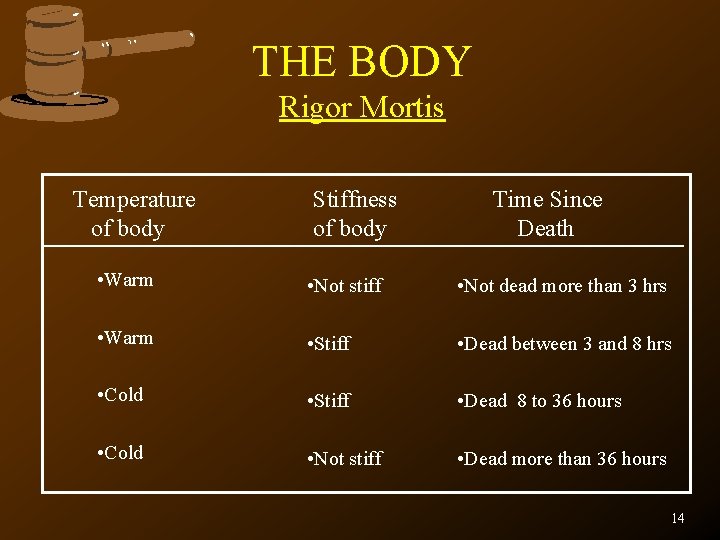
THE BODY Rigor Mortis Temperature of body Stiffness of body Time Since Death • Warm • Not stiff • Not dead more than 3 hrs • Warm • Stiff • Dead between 3 and 8 hrs • Cold • Stiff • Dead 8 to 36 hours • Cold • Not stiff • Dead more than 36 hours 14
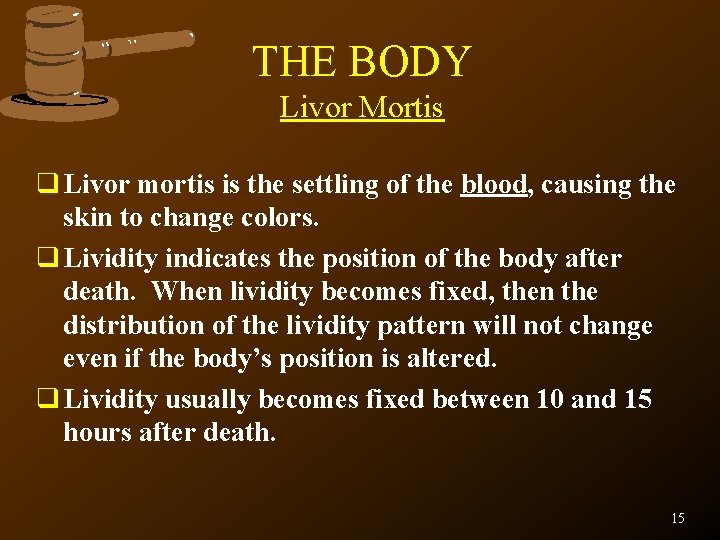
THE BODY Livor Mortis q Livor mortis is the settling of the blood, causing the skin to change colors. q Lividity indicates the position of the body after death. When lividity becomes fixed, then the distribution of the lividity pattern will not change even if the body’s position is altered. q Lividity usually becomes fixed between 10 and 15 hours after death. 15
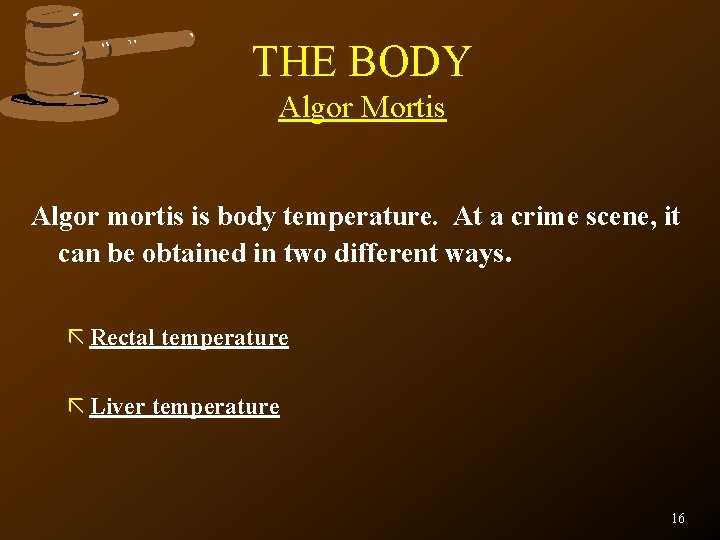
THE BODY Algor Mortis Algor mortis is body temperature. At a crime scene, it can be obtained in two different ways. ã Rectal temperature ã Liver temperature 16
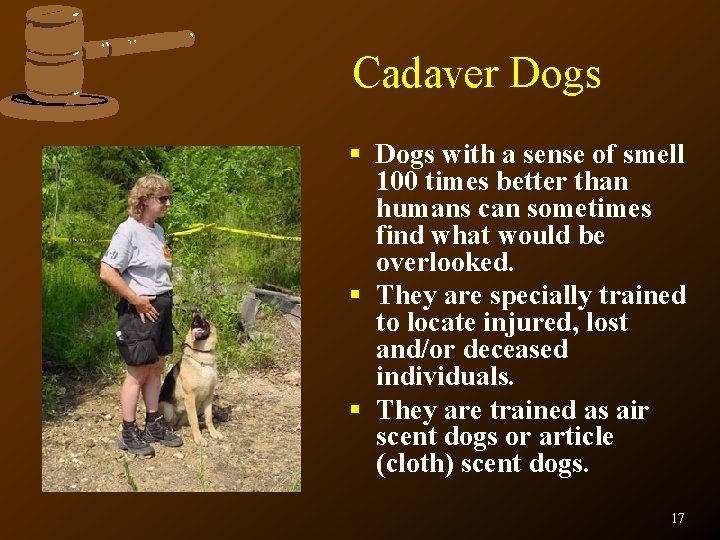
Cadaver Dogs § Dogs with a sense of smell 100 times better than humans can sometimes find what would be overlooked. § They are specially trained to locate injured, lost and/or deceased individuals. § They are trained as air scent dogs or article (cloth) scent dogs. 17
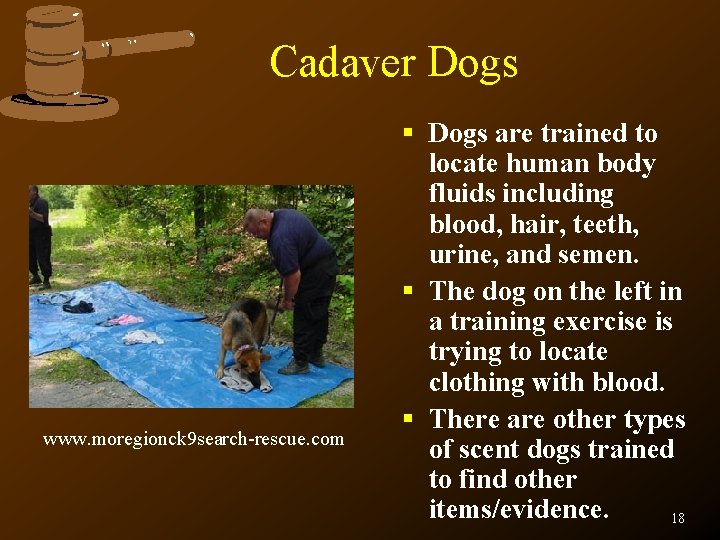
Cadaver Dogs www. moregionck 9 search-rescue. com § Dogs are trained to locate human body fluids including blood, hair, teeth, urine, and semen. § The dog on the left in a training exercise is trying to locate clothing with blood. § There are other types of scent dogs trained to find other items/evidence. 18
MAINTAINING THE CHAIN OF CUSTODY? * CONTINUITY OF POSSESSION (chain of custody) must be established whenever evidence will be presented in court *Every person who handled the evidence must be accounted for! * Collector’s initials, * date of collection * Location * Record of a transfer whenever it occurs * Should be kept to a minimum 19
Back at the lab - CONTROLS? *WHEN POSSIBLE, any collected evidence should be compared with a control (known sample) from the actual crime scene. *One example, bloodstain evidence must be accompanied by whole blood or buccal swab controls from all relevant crime scene participants. 20
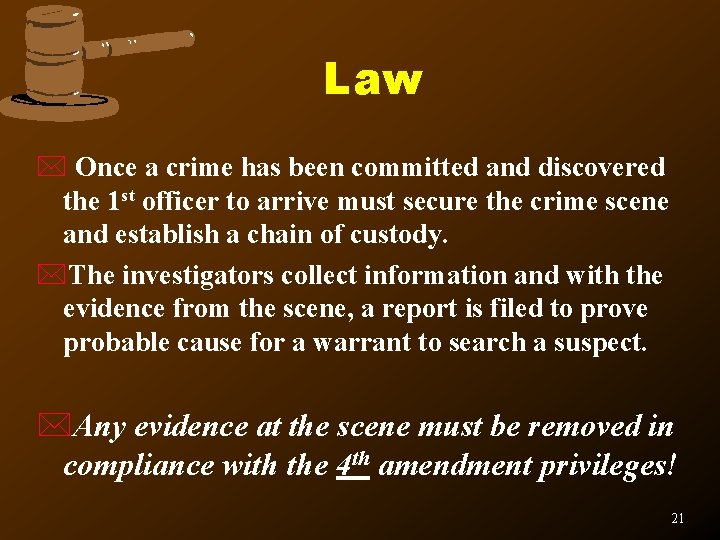
Law * Once a crime has been committed and discovered the 1 st officer to arrive must secure the crime scene and establish a chain of custody. *The investigators collect information and with the evidence from the scene, a report is filed to prove probable cause for a warrant to search a suspect. *Any evidence at the scene must be removed in compliance with the 4 th amendment privileges! 21
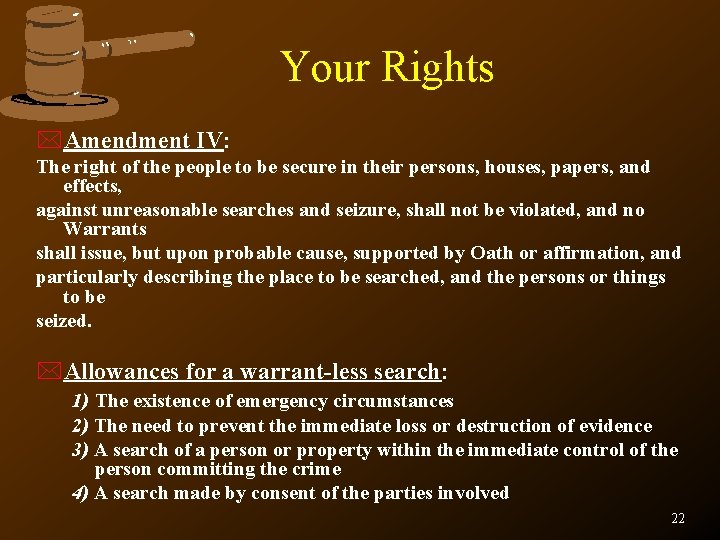
Your Rights *Amendment IV: The right of the people to be secure in their persons, houses, papers, and effects, against unreasonable searches and seizure, shall not be violated, and no Warrants shall issue, but upon probable cause, supported by Oath or affirmation, and particularly describing the place to be searched, and the persons or things to be seized. *Allowances for a warrant-less search: 1) The existence of emergency circumstances 2) The need to prevent the immediate loss or destruction of evidence 3) A search of a person or property within the immediate control of the person committing the crime 4) A search made by consent of the parties involved 22
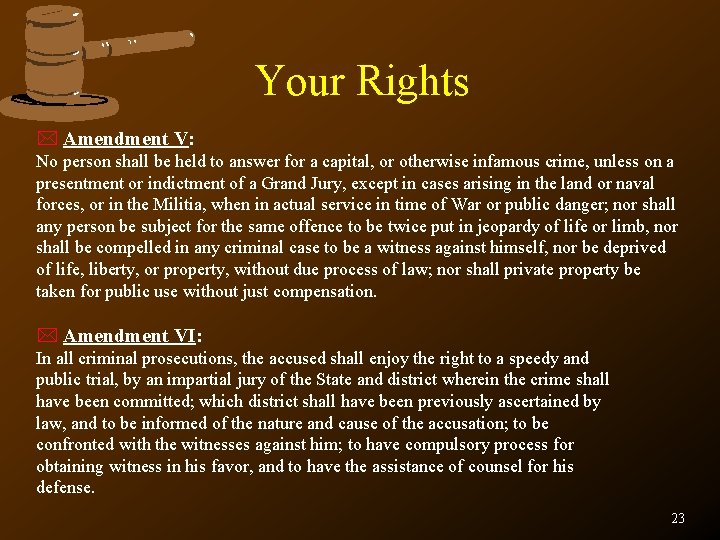
Your Rights * Amendment V: No person shall be held to answer for a capital, or otherwise infamous crime, unless on a presentment or indictment of a Grand Jury, except in cases arising in the land or naval forces, or in the Militia, when in actual service in time of War or public danger; nor shall any person be subject for the same offence to be twice put in jeopardy of life or limb, nor shall be compelled in any criminal case to be a witness against himself, nor be deprived of life, liberty, or property, without due process of law; nor shall private property be taken for public use without just compensation. * Amendment VI: In all criminal prosecutions, the accused shall enjoy the right to a speedy and public trial, by an impartial jury of the State and district wherein the crime shall have been committed; which district shall have been previously ascertained by law, and to be informed of the nature and cause of the accusation; to be confronted with the witnesses against him; to have compulsory process for obtaining witness in his favor, and to have the assistance of counsel for his defense. 23
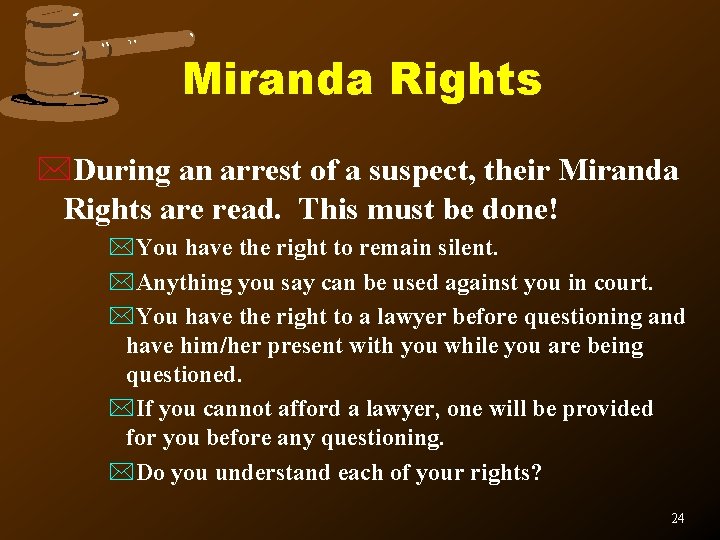
Miranda Rights *During an arrest of a suspect, their Miranda Rights are read. This must be done! *You have the right to remain silent. *Anything you say can be used against you in court. *You have the right to a lawyer before questioning and have him/her present with you while you are being questioned. *If you cannot afford a lawyer, one will be provided for you before any questioning. *Do you understand each of your rights? 24
What is Good Evidence for Court? *It proves that a crime has been committed *It corroborates testimony *It links a suspect with a victim and/or with a crime scene *It establishes the identity of persons associated with a crime *It allows reconstruction of events of a crime 25
Rules of Evidence *Those Rules of Evidence define what is acceptable (admissible) and how it can be used in court. *Evidence must be relevant (probative) and address the issue of the crime (material). *Evidence is admissible if it is reliable and the presenter of such evidence is credible and competent (thru background, experience, and credentials). 26
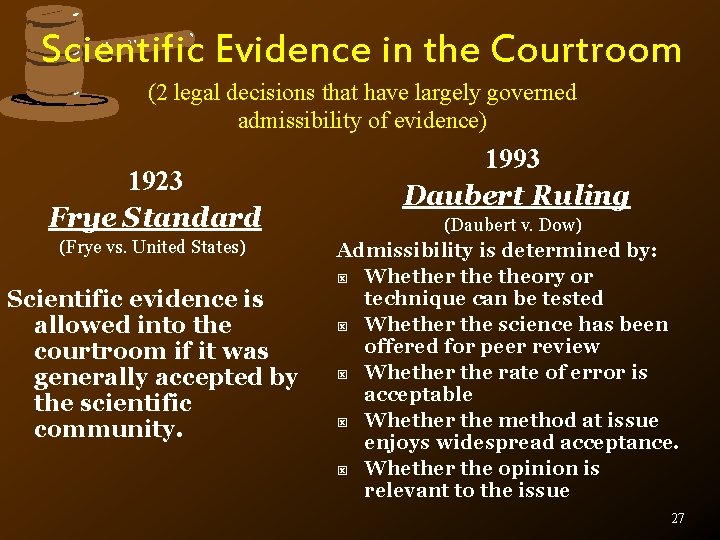
Scientific Evidence in the Courtroom (2 legal decisions that have largely governed admissibility of evidence) 1923 Frye Standard (Frye vs. United States) Scientific evidence is allowed into the courtroom if it was generally accepted by the scientific community. 1993 Daubert Ruling (Daubert v. Dow) Admissibility is determined by: ý Whether theory or technique can be tested ý Whether the science has been offered for peer review ý Whether the rate of error is acceptable ý Whether the method at issue enjoys widespread acceptance. ý Whether the opinion is relevant to the issue 27
who? Mincey v. Arizona * undercover officer killed during pretext of buying drugs * 4 days they gathered evidence w/o warrant * Mincey appealed & court agreed that they had time to get a warrant since Mincey was in custody Michigan v. Tyler * Fire in evening – police couldn’t search due to smoke and darkness, … * Police searched the next morning, collected and removed evidence * 4, 7, 25 days later – more evidence w/o warrant * Convicted Tyler and partner of arson * Supreme Court overturned – 1 st evid. OK, but all other evid. NOT 28
PHYSICAL EVIDENCE You can lead a jury to the truth but you can’t make them believe it. Physical evidence cannot be intimidated. It does not forget. It doesn’t get excited at the moment something is happening-like people do. It sits there and waits to be detected, preserved, evaluated and explained. This is what physical evidence is all about. In the course of the trial, defense and prosecuting attorneys may lie, witnesses may lie, the defendant certainly may lie. Even the judge may lie. Only the evidence never lies. --Herbert Leon Mac. Donell, The Evidence Never Lies 29