
What Every Surgeon Needs To Know About Pulmonary
What Every Surgeon Needs To Know About Pulmonary Issues in EOS Gregory J. Redding, MD Chief, Pulmonary and Sleep Medicine Seattle Children’s Hospital University of Washington School of Medicine
Disclosures Editor for Pediatric Pulmonary section of Up. To. Date.

Pulmonary Features of Early Onset Scoliosis Low Lung Volumes* Chest Wall Distensibility and Excursion Respiratory Muscle Force and Movement Hypoxemia Poor sleep Cor pulmonale Work Tachypnea + Poor Growth Exercise Tolerance Respiratory Failure
General Principles of Care • Progressive deformity leads to decline in respiratory function. • Current surgical interventions preserve but do not restore lung function. • Early intervention (surgical vs nonsurgical) to prevent deformity will likely improve potential for lung development and growth.
More Principles • Age at fusion impairs further growth of the thorax, and hence lung function. • Lung function declines as adults age. • Pulmonary status (and loss of reserve) will likely influence life span and quality of life.
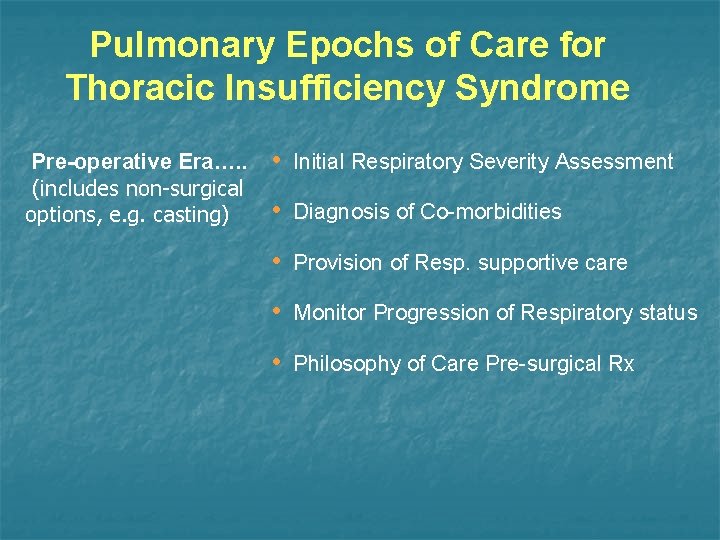
Pulmonary Epochs of Care for Thoracic Insufficiency Syndrome Pre-operative Era…. . (includes non-surgical options, e. g. casting) • Initial Respiratory Severity Assessment • Diagnosis of Co-morbidities • Provision of Resp. supportive care • Monitor Progression of Respiratory status • Philosophy of Care Pre-surgical Rx
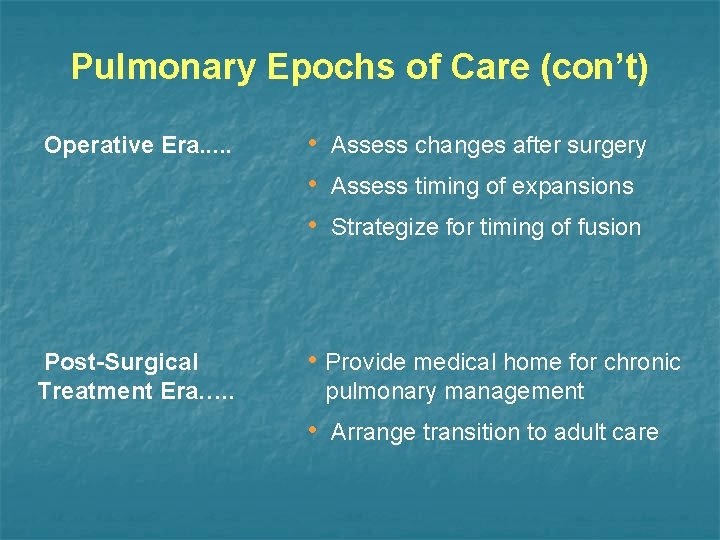
Pulmonary Epochs of Care (con’t) Operative Era. . . Post-Surgical Treatment Era…. . • • • Assess changes after surgery Assess timing of expansions Strategize for timing of fusion • Provide medical home for chronic pulmonary management • Arrange transition to adult care
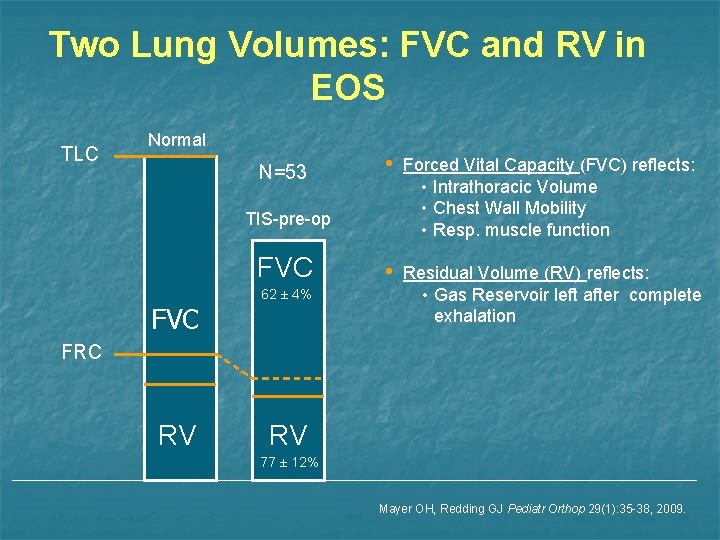
Two Lung Volumes: FVC and RV in EOS TLC Normal N=53 • Forced Vital Capacity (FVC) reflects: • Intrathoracic Volume • Chest Wall Mobility • Resp. muscle function • Residual Volume (RV) reflects: • Gas Reservoir left after complete exhalation TIS-pre-op FVC 62 ± 4% FRC RV RV 77 ± 12% Mayer OH, Redding GJ Pediatr Orthop 29(1): 35 -38, 2009.
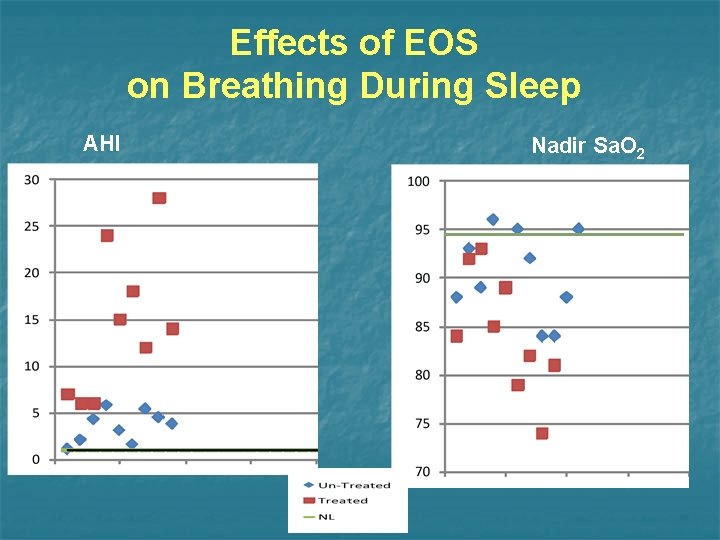
Effects of EOS on Breathing During Sleep AHI Nadir Sa. O 2
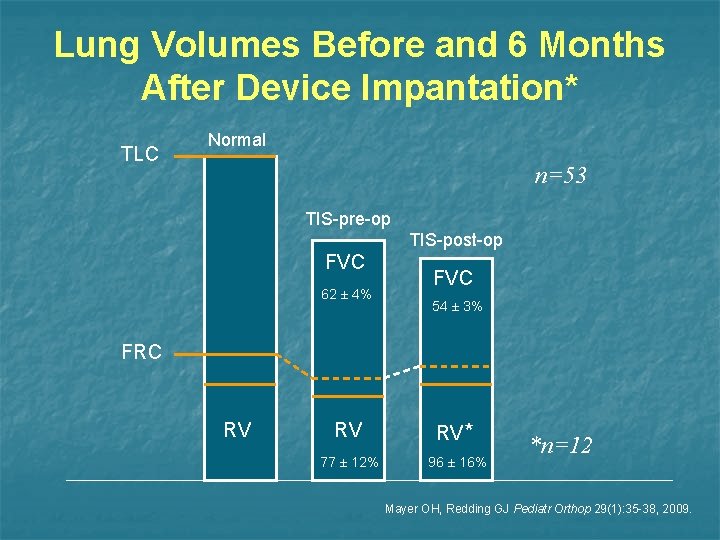
Lung Volumes Before and 6 Months After Device Impantation* TLC Normal n=53 TIS-pre-op TIS-post-op FVC 62 ± 4% FVC 54 ± 3% FRC RV RV RV* 77 ± 12% 96 ± 16% *n=12 Mayer OH, Redding GJ Pediatr Orthop 29(1): 35 -38, 2009.
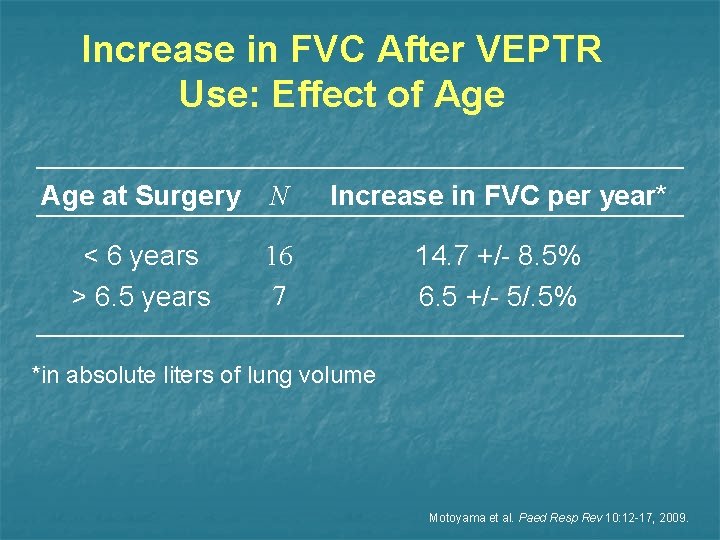
Increase in FVC After VEPTR Use: Effect of Age at Surgery N Increase in FVC per year* < 6 years > 6. 5 years 16 7 14. 7 +/- 8. 5% 6. 5 +/- 5/. 5% *in absolute liters of lung volume Motoyama et al. Paed Resp Rev 10: 12 -17, 2009.
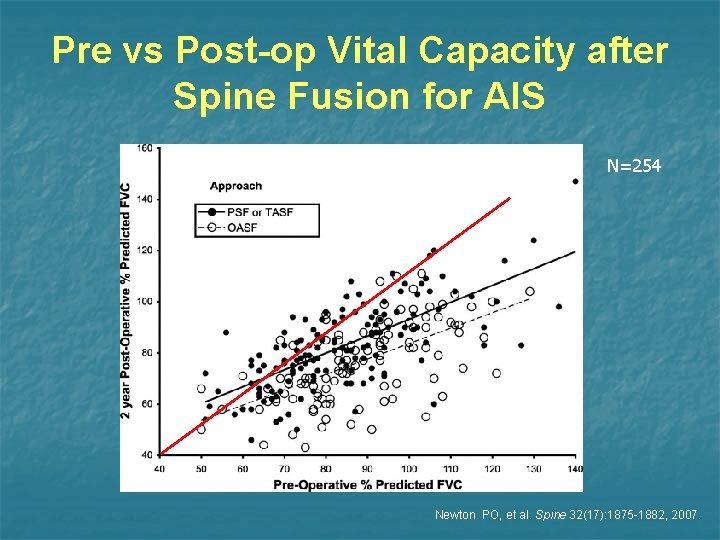
Pre vs Post-op Vital Capacity after Spine Fusion for AIS N=254 Newton PO, et al. Spine 32(17): 1875 -1882, 2007.
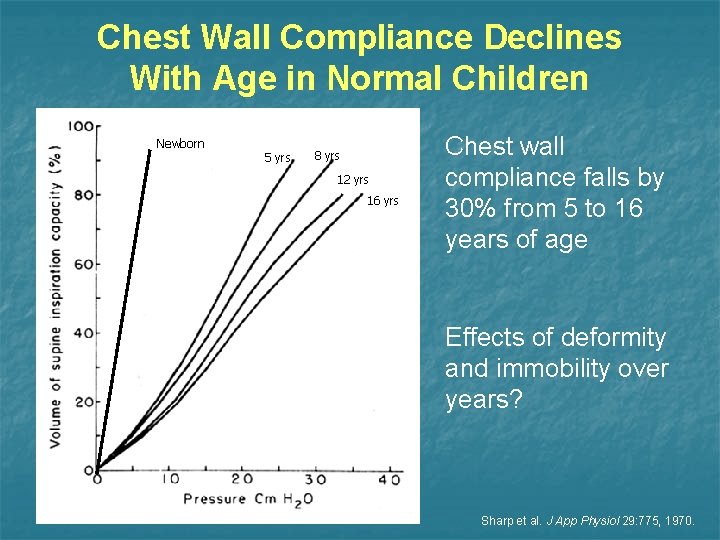
Chest Wall Compliance Declines With Age in Normal Children Newborn 5 yrs 8 yrs 12 yrs 16 yrs Chest wall compliance falls by 30% from 5 to 16 years of age Effects of deformity and immobility over years? Sharp et al. J App Physiol 29: 775, 1970.
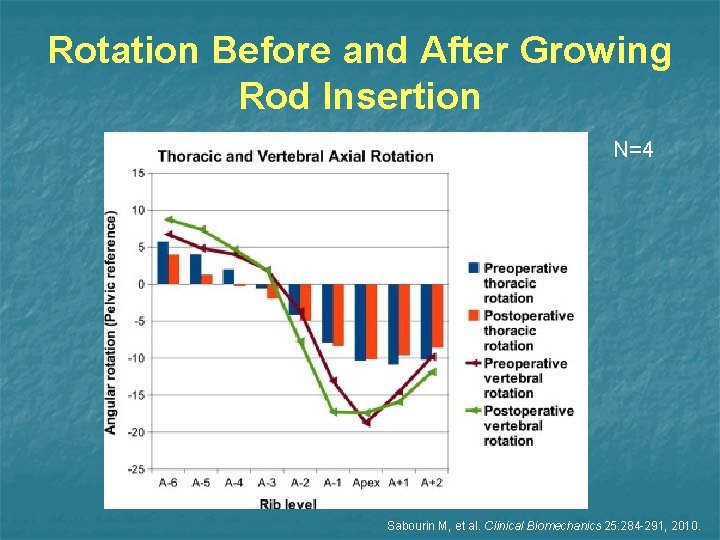
Rotation Before and After Growing Rod Insertion N=4 Sabourin M, et al. Clinical Biomechanics 25: 284 -291, 2010.
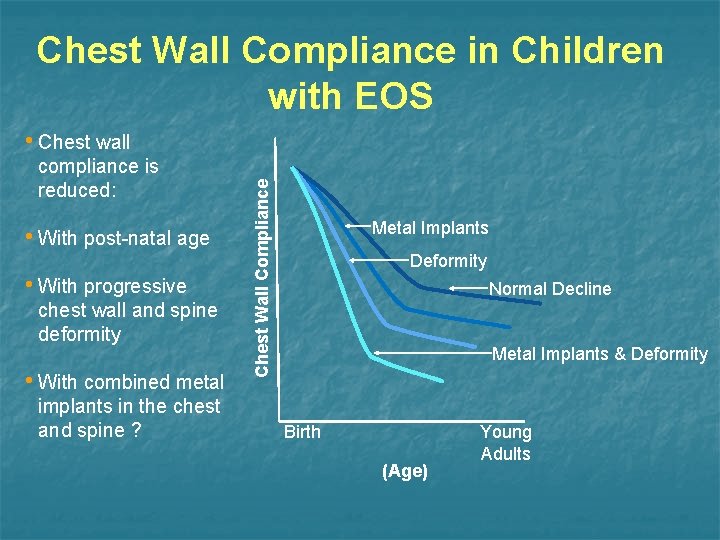
Chest Wall Compliance in Children with EOS compliance is reduced: • With post-natal age • With progressive chest wall and spine deformity • With combined metal implants in the chest and spine ? Chest Wall Compliance • Chest wall Metal Implants Deformity Normal Decline Metal Implants & Deformity Birth (Age) Young Adults
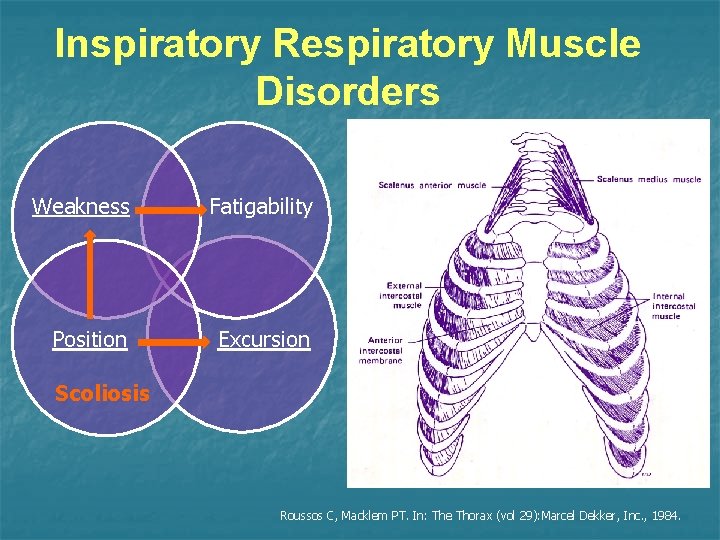
Inspiratory Respiratory Muscle Disorders Weakness Fatigability Position Excursion Scoliosis Roussos C, Macklem PT. In: The Thorax (vol 29): Marcel Dekker, Inc. , 1984.
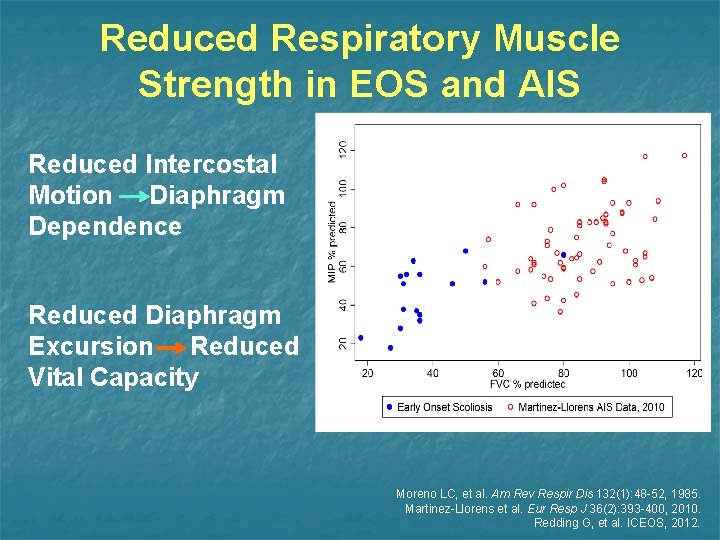
Reduced Respiratory Muscle Strength in EOS and AIS Reduced Intercostal Motion Diaphragm Dependence Reduced Diaphragm Excursion Reduced Vital Capacity Moreno LC, et al. Am Rev Respir Dis 132(1): 48 -52, 1985. Martinez-Llorens et al. Eur Resp J 36(2): 393 -400, 2010. Redding G, et al. ICEOS, 2012.
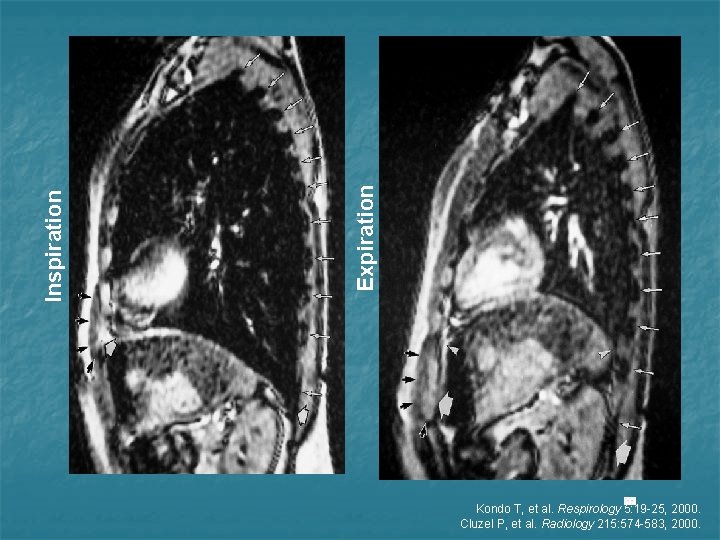
Inspiration Expiration Kondo T, et al. Respirology 5: 19 -25, 2000. Cluzel P, et al. Radiology 215: 574 -583, 2000.
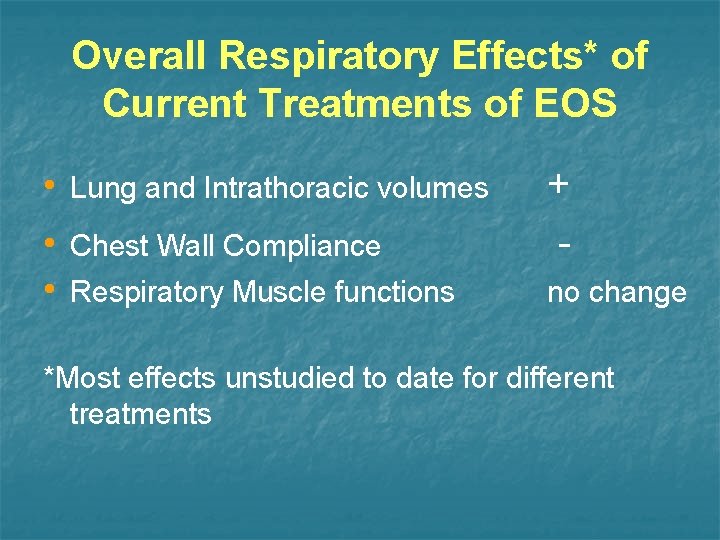
Overall Respiratory Effects* of Current Treatments of EOS • Lung and Intrathoracic volumes • • Chest Wall Compliance + - Respiratory Muscle functions no change *Most effects unstudied to date for different treatments
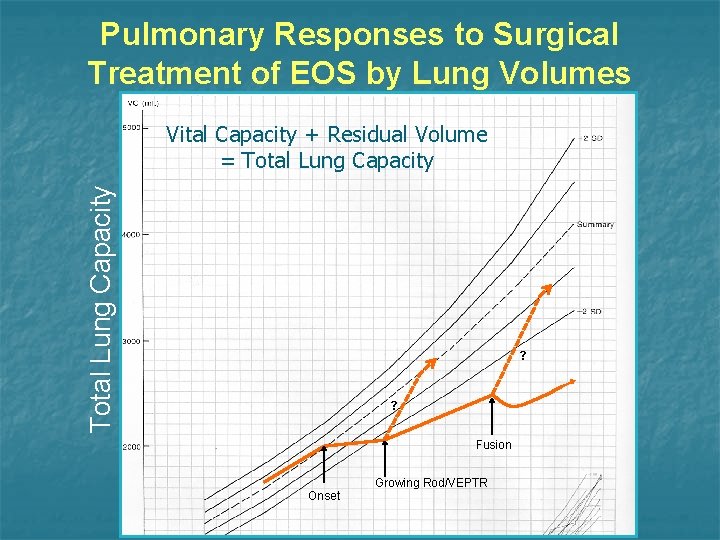
Pulmonary Responses to Surgical Treatment of EOS by Lung Volumes Total Lung Capacity Vital Capacity + Residual Volume = Total Lung Capacity ? ? Fusion Onset Growing Rod/VEPTR
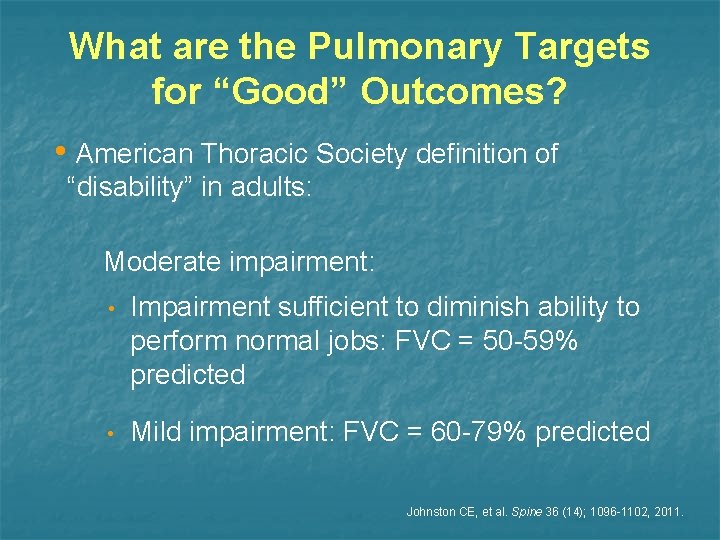
What are the Pulmonary Targets for “Good” Outcomes? • American Thoracic Society definition of “disability” in adults: Moderate impairment: • Impairment sufficient to diminish ability to perform normal jobs: FVC = 50 -59% predicted • Mild impairment: FVC = 60 -79% predicted Johnston CE, et al. Spine 36 (14); 1096 -1102, 2011.
Summary • Current surgical treatments increase lung volumes enough to almost keep up with somatic growth. • Early non-surgical interventions that also reduce rotation may preserve lung function better than surgical distraction alone. • New multi-disciplinary approaches are needed to recover lung function already lost due to scoliosis.
- Slides: 22