
What Every Patient Safety Officer Must Know Tapping
- Slides: 40
What Every Patient Safety Officer Must Know: Tapping into the Best Resources in the Country John R. Combes, MD Senior Medical Advisor Hospital and Healthsystem Association of Pennsylvania Harrisburg, PA The Hospital & Healthsystem Association of Pennsylvania
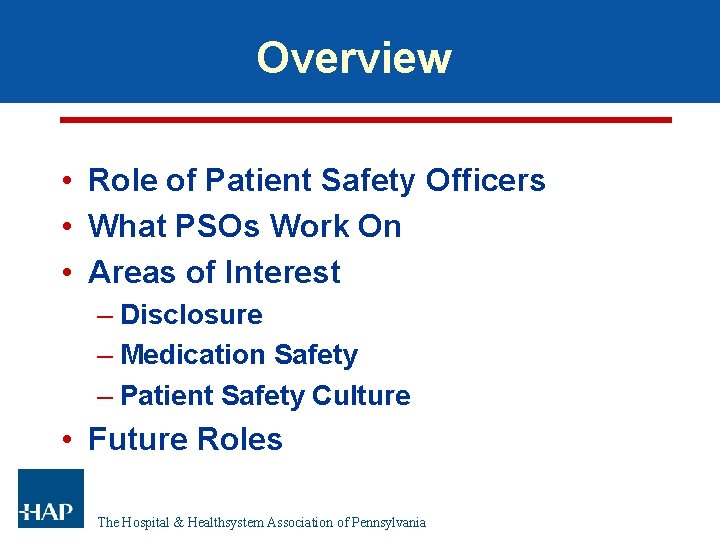
Overview • Role of Patient Safety Officers • What PSOs Work On • Areas of Interest – Disclosure – Medication Safety – Patient Safety Culture • Future Roles The Hospital & Healthsystem Association of Pennsylvania
PSO Roles The Hospital & Healthsystem Association of Pennsylvania
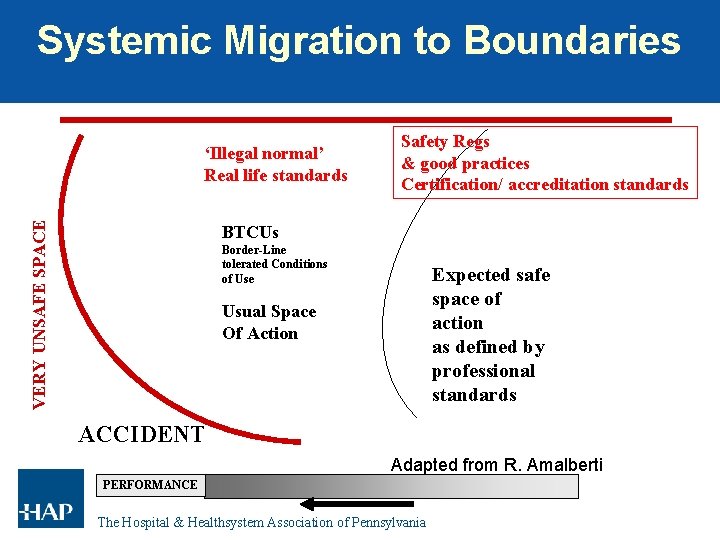
Systemic Migration to Boundaries VERY UNSAFE SPACE ‘Illegal normal’ Real life standards Safety Regs & good practices Certification/ accreditation standards BTCUs Border-Line tolerated Conditions of Use Expected safe space of action as defined by professional standards Usual Space Of Action ACCIDENT Adapted from R. Amalberti PERFORMANCE The Hospital & Healthsystem Association of Pennsylvania
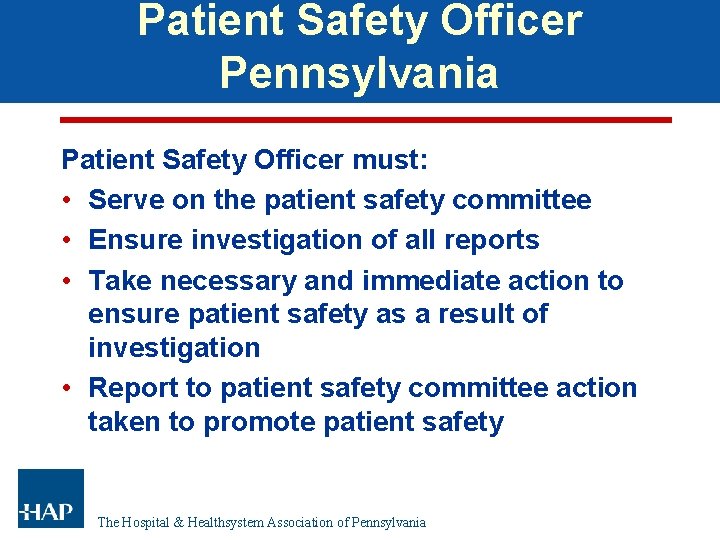
Patient Safety Officer Pennsylvania Patient Safety Officer must: • Serve on the patient safety committee • Ensure investigation of all reports • Take necessary and immediate action to ensure patient safety as a result of investigation • Report to patient safety committee action taken to promote patient safety The Hospital & Healthsystem Association of Pennsylvania
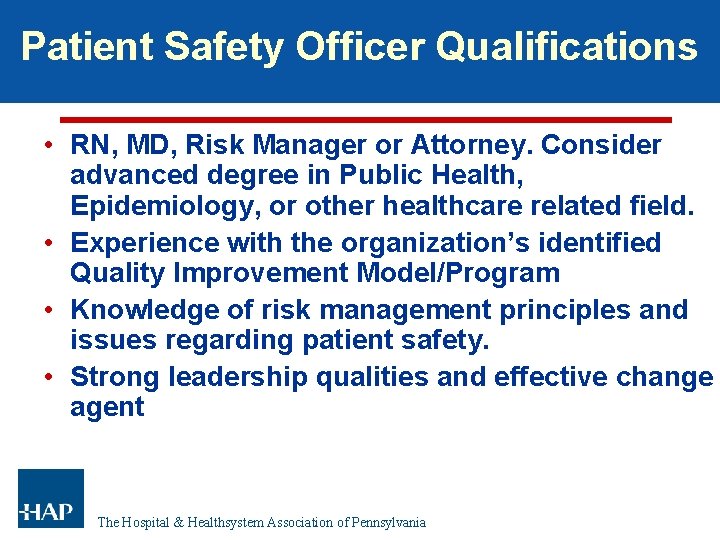
Patient Safety Officer Qualifications • RN, MD, Risk Manager or Attorney. Consider advanced degree in Public Health, Epidemiology, or other healthcare related field. • Experience with the organization’s identified Quality Improvement Model/Program • Knowledge of risk management principles and issues regarding patient safety. • Strong leadership qualities and effective change agent The Hospital & Healthsystem Association of Pennsylvania
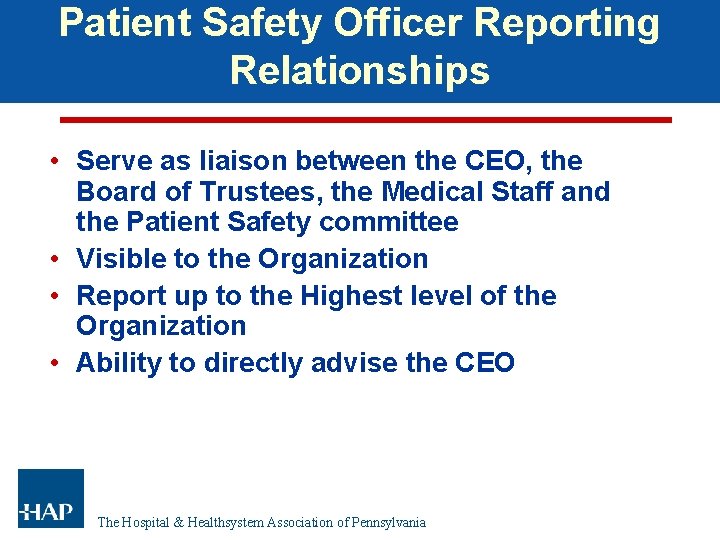
Patient Safety Officer Reporting Relationships • Serve as liaison between the CEO, the Board of Trustees, the Medical Staff and the Patient Safety committee • Visible to the Organization • Report up to the Highest level of the Organization • Ability to directly advise the CEO The Hospital & Healthsystem Association of Pennsylvania
Areas of Responsibility The Hospital & Healthsystem Association of Pennsylvania
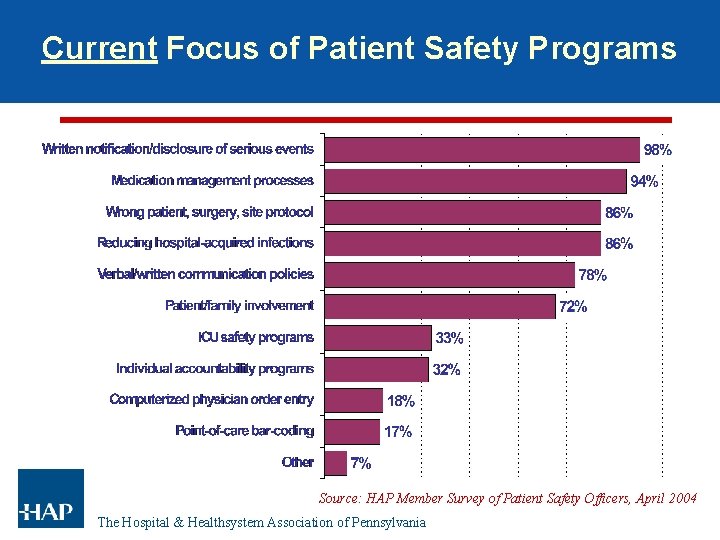
Current Focus of Patient Safety Programs Source: HAP Member Survey of Patient Safety Officers, April 2004 The Hospital & Healthsystem Association of Pennsylvania
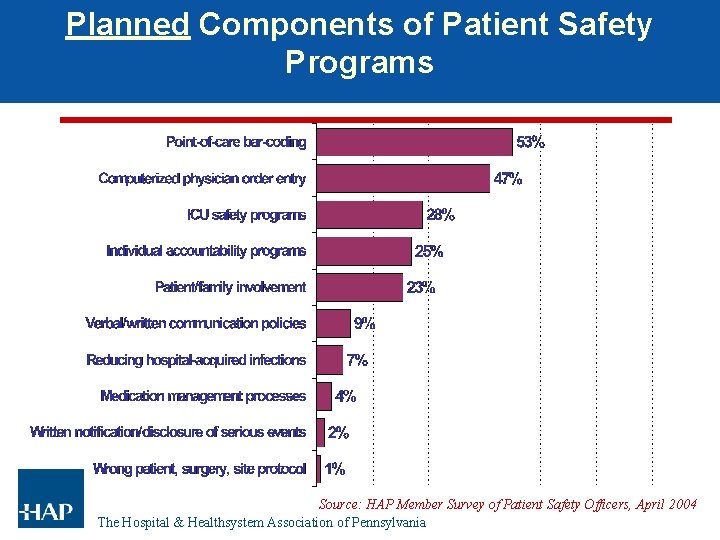
Planned Components of Patient Safety Programs Source: HAP Member Survey of Patient Safety Officers, April 2004 The Hospital & Healthsystem Association of Pennsylvania
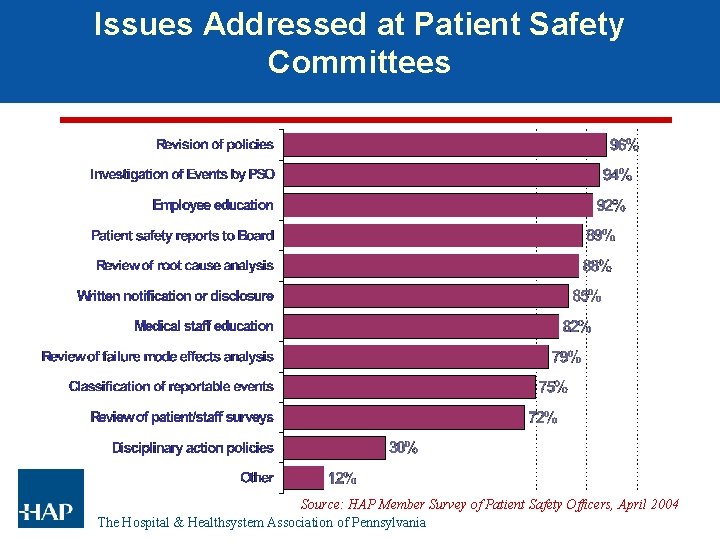
Issues Addressed at Patient Safety Committees Source: HAP Member Survey of Patient Safety Officers, April 2004 The Hospital & Healthsystem Association of Pennsylvania
Disclosure of Unanticipated Events The Hospital & Healthsystem Association of Pennsylvania
General Considerations… Disclosure – – Not an admission of liability Not easy on provider/patient/family/staff Provide education for providers on “how to” Allow for situations where disclosure may be more harmful than beneficial for patient – Stress importance of informed consent as a risk reduction tool The Hospital & Healthsystem Association of Pennsylvania
…General Considerations… Disclosure – Physician generally best person – Circumstances may require a substitute • if decide other than MD - rethink decision - it may send a message different than what intended • should be individual who can convey concern sincerely • who decides substitute and what criteria used to decide? • how respond to questions about future care needed as result of medical mistake if not physician? • how ensure physician not implicated in discussion? The Hospital & Healthsystem Association of Pennsylvania
…General Considerations Disclosure • If do not yet know the reason why the mistake occurred or don’t have an answer – be honest – Admit do not have all the answers yet willing to share them with patient when known – Avoid putting patient in spot where they speculate and provide their own answers – can be worse than reality • May need to ask patient/family to trust you to do your job – to get to the bottom of the matter The Hospital & Healthsystem Association of Pennsylvania
Steps in Disclosing Medical Errors… • “Show up” in a Timely Manner • Begin by Expressing Empathy for the Patient/Family Experience Accurately Describe the Situation, the Error and How You Believe It Impacted the Patient • Offer an Apology (Apology begins the process of re-affiliation with the patient) The Hospital & Healthsystem Association of Pennsylvania
…Steps in Disclosing Medical Errors • Explain Steps to Prevent Recurrence • Arrange Congenial and Thorough Followup, Sharing this Decision with Patient/Family • Communicate Closely with Other Providers about What You Believe Has Happened and What Steps are Needed Now to Restore Patient to Health • Arrange for Bills Related to Care to Be Handled and Assure Patient of This The Hospital & Healthsystem Association of Pennsylvania
Resources • ASHRM’s Perspective on Disclosure of Unanticipated Outcome Information Found At http: //www. aha. org/aha/key_issues/p atient_safety/contents/unanticipated outcomes. pdf The Hospital & Healthsystem Association of Pennsylvania
Medication Safety The Hospital & Healthsystem Association of Pennsylvania
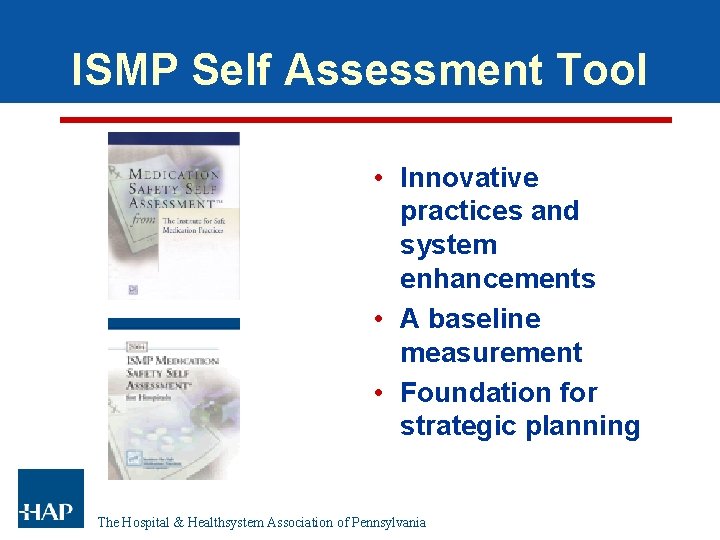
ISMP Self Assessment Tool • Innovative practices and system enhancements • A baseline measurement • Foundation for strategic planning The Hospital & Healthsystem Association of Pennsylvania
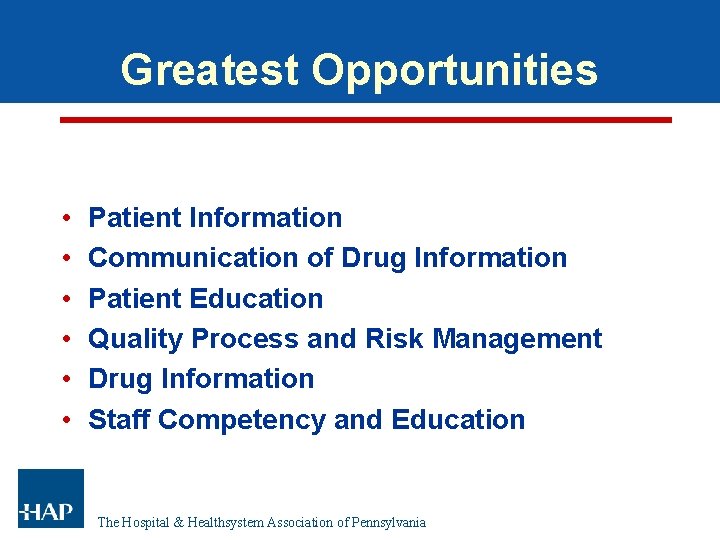
Greatest Opportunities • • • Patient Information Communication of Drug Information Patient Education Quality Process and Risk Management Drug Information Staff Competency and Education The Hospital & Healthsystem Association of Pennsylvania
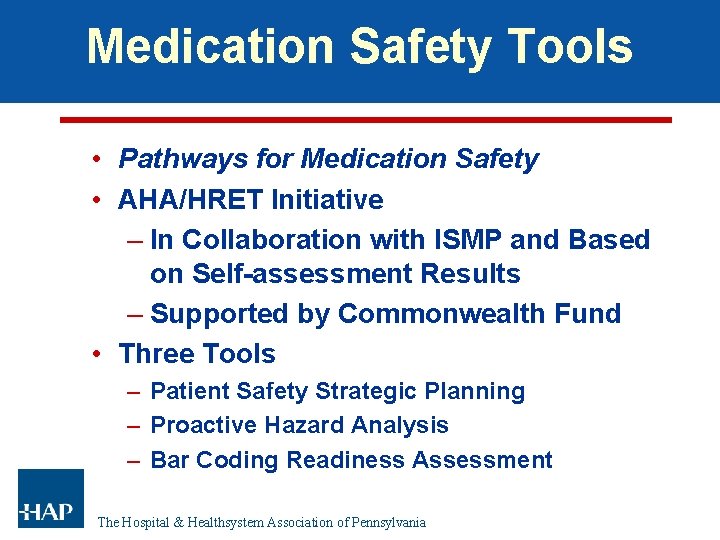
Medication Safety Tools • Pathways for Medication Safety • AHA/HRET Initiative – In Collaboration with ISMP and Based on Self-assessment Results – Supported by Commonwealth Fund • Three Tools – Patient Safety Strategic Planning – Proactive Hazard Analysis – Bar Coding Readiness Assessment The Hospital & Healthsystem Association of Pennsylvania
For More Information • Pathways for Medication Safety www. medpathways. info • Free tools available for download off the web • Please send questions to medpathways@aha. org The Hospital & Healthsystem Association of Pennsylvania
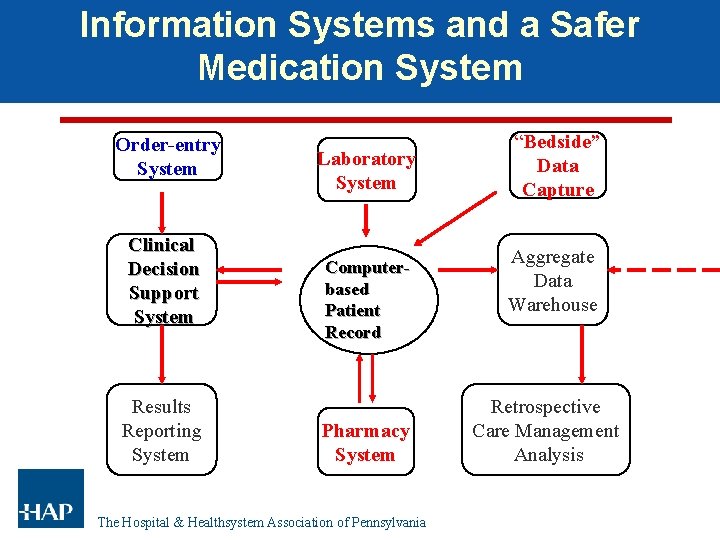
Information Systems and a Safer Medication System Order-entry System Clinical Decision Support System Results Reporting System Laboratory System Computerbased Patient Record Pharmacy System The Hospital & Healthsystem Association of Pennsylvania “Bedside” Data Capture Aggregate Data Warehouse Retrospective Care Management Analysis
Assessing Bedside Bar-Coding Readiness • Explains the role of bar coding technology from a health care context. • Describes benefits and challenges of implementation. • Includes a self-assessment tool to evaluate an organization’s “readiness” for implementation. The Hospital & Healthsystem Association of Pennsylvania
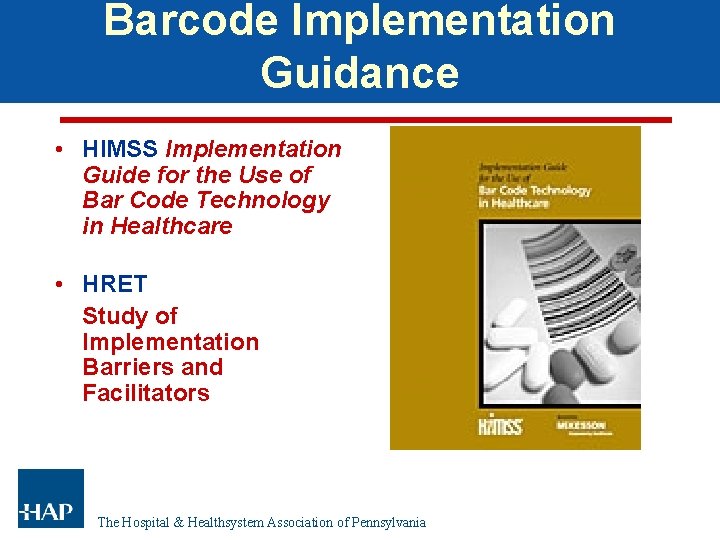
Barcode Implementation Guidance • HIMSS Implementation Guide for the Use of Bar Code Technology in Healthcare • HRET Study of Implementation Barriers and Facilitators The Hospital & Healthsystem Association of Pennsylvania
CPOE Resources • A Primer on Physician Order Entry California Health. Care Foundation September 2000 • Computerized Physician Order Entry: Costs, Benefits and Challenges First Consulting Group, AHA, Federation of American Hospitals January 2003 The Hospital & Healthsystem Association of Pennsylvania
Expanded Culture of Safety The Hospital & Healthsystem Association of Pennsylvania
What is “Culture”? • “Shared values (what is important) and beliefs (how things work) that interact with an organization’s structures and control systems to produce behavioral norms (the way we do things around here)” B. Uttal, Fortune, 17 October, 1983 The Hospital & Healthsystem Association of Pennsylvania
Current Concepts of Safety Culture in Healthcare • Health care has discussed a “safety culture” primarily as issues of {per Reason}: – A non-punitive “just culture” – A “reporting culture” • These are important, but they ignore other crucial aspects of a culture of safety The Hospital & Healthsystem Association of Pennsylvania
Culture of Safety • Based on the Concept of Mindfulness “the combination of ongoing scrutiny of existing expectations, continuous refinement…based on newer experience, willingness and capability to invent new expectations…, a more nuanced appreciation of context…[resulting in] improve(d) foresight and current functioning” Weick and Sutcliffe The Hospital & Healthsystem Association of Pennsylvania
Culture of Safety • Anticipating – Preoccupation with Failure – Reluctance to Simplify Interpretations – Sensitivity to Operations • Containing – Commitment to Resilience – Deference to Expertise Weick and Sutcliffe The Hospital & Healthsystem Association of Pennsylvania
The Case for Leadership • Lessons from Human Space Flight and Aviation • Skills and Competencies to Manage Hazard – Human Factors – Behavioral Norms – Communication and Teamwork – Crisis Management – Proactively Managing Hazard – Training for the Unexpected The Hospital & Healthsystem Association of Pennsylvania
Identified Skill Gaps • Incorporating Human Factors in Design • Teamwork and Communications • Training for the Unexpected – Simulation Training • Skills • Resiliency The Hospital & Healthsystem Association of Pennsylvania
Summary • Creating Systemic “Mindfulness” about Safety • Transforming Healthcare Organizations into HROs • Creating Individual, Team and Organizational Awareness and Resiliency • New Leadership Skills Required The Hospital & Healthsystem Association of Pennsylvania
Supplementary Reading Gaba D: Structural and Organizational Issues in Patient Safety: A Comparison of Health Care to Other High-Hazard Industries. California Management Review, Fall 2000 Reason J: Managing the risks of organizational accidents. Aldershot, England, Ashgate Publishing Limited, 1997 Sagan S: The Limits of Safety. Princeton, Princeton University Press, 1993 The Hospital & Healthsystem Association of Pennsylvania
Supplementary Reading Singer SJ, et al. : The culture of safety: results of an organization-wide survey in 15 California hospitals. Qual Saf Health Care 2003; 12: 112 -118 Weick K, Sutcliffe KM: Managing the unexpected. San Francisco, Jossey-Bass, 2001 The Hospital & Healthsystem Association of Pennsylvania
Future Activities The Hospital & Healthsystem Association of Pennsylvania
Safety Initiative: Future Activities • Nosocomial Infections as Safety Issues • Team and Reliability Training – techniques – e. g. simulators • Communication Skills for Clinicians – Improved compliance – Better clinical outcomes • IT Infrastructure The Hospital & Healthsystem Association of Pennsylvania
Sharing Knowledge • Web Site at www. aha. org • Key Issues: Quality and Patient Safety – Tools and Resources – IOM’s Six Goals The Hospital & Healthsystem Association of Pennsylvania