
What Elements Create Drama Feature Menu Dramatic Structure

- Slides: 49
What Elements Create Drama? Feature Menu Dramatic Structure Dramatic Elements Tragedy Tragic Heroes The Words Characters Speak Character Foil Stage Directions Tragic Plots Elements of Staging Stage Set Lighting Costumes and Props Dramatic Irony Comedy Characters in Comedy Conflicts in Comedy Your Turn
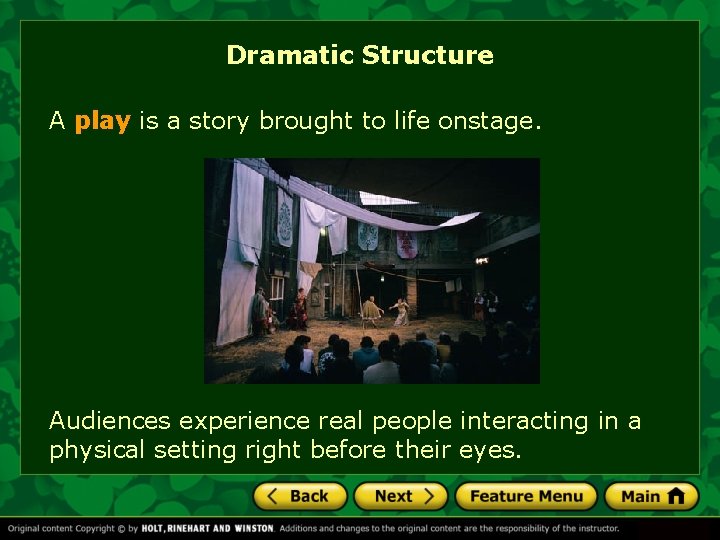
Dramatic Structure A play is a story brought to life onstage. Audiences experience real people interacting in a physical setting right before their eyes.
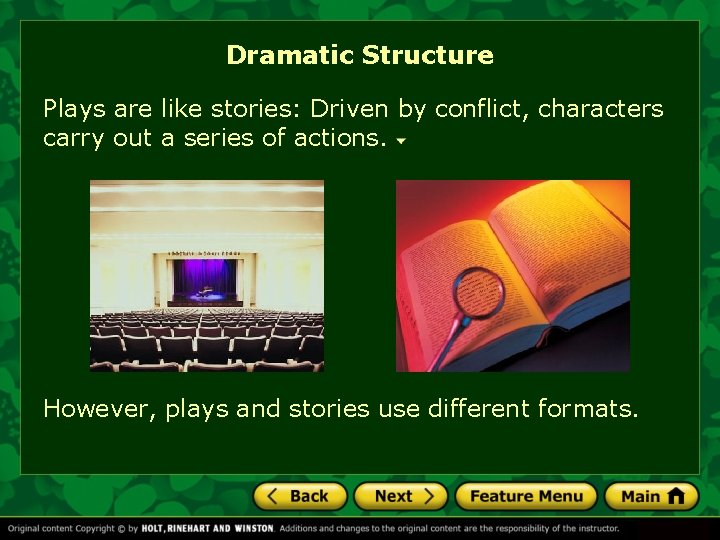
Dramatic Structure Plays are like stories: Driven by conflict, characters carry out a series of actions. However, plays and stories use different formats.
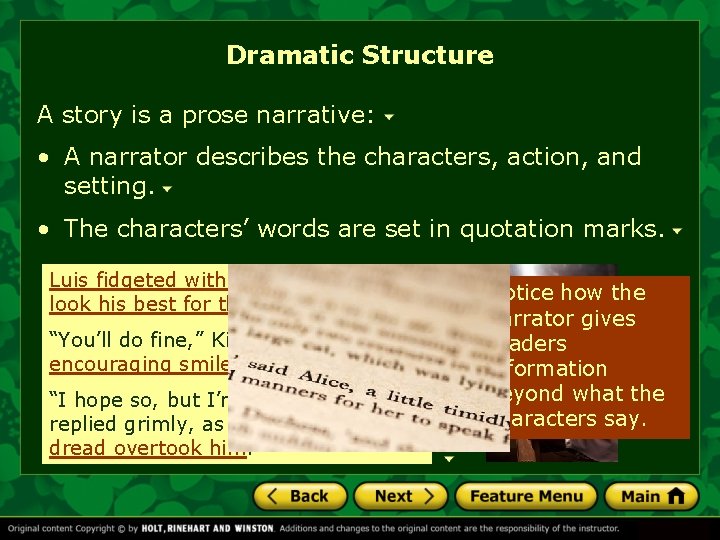
Dramatic Structure A story is a prose narrative: • A narrator describes the characters, action, and setting. • The characters’ words are set in quotation marks. Luis fidgeted with his tie, wanting to look his best for the speech. “You’ll do fine, ” Kim said, offering an encouraging smile. “I hope so, but I’m not so sure, ” he replied grimly, as a feeling of utter dread overtook him. Notice how the narrator gives readers information beyond what the characters say.
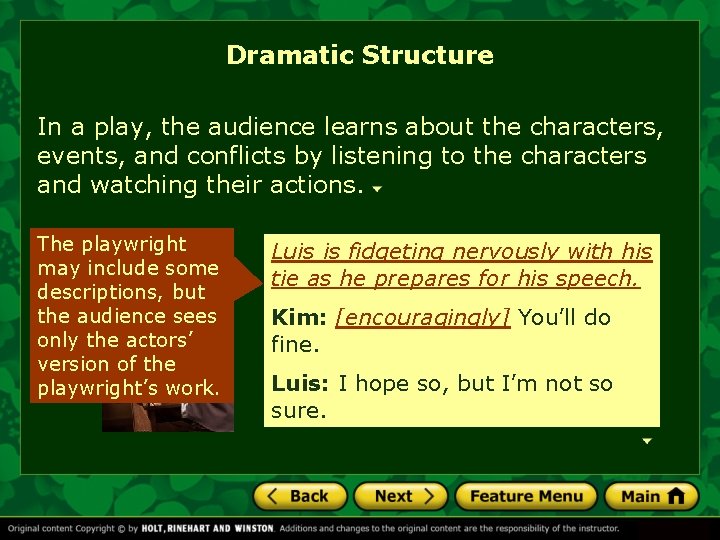
Dramatic Structure In a play, the audience learns about the characters, events, and conflicts by listening to the characters and watching their actions. The playwright may include some descriptions, but the audience sees only the actors’ version of the playwright’s work. Luis is fidgeting nervously with his tie as he prepares for his speech. Kim: [encouragingly] You’ll do fine. Luis: I hope so, but I’m not so sure.
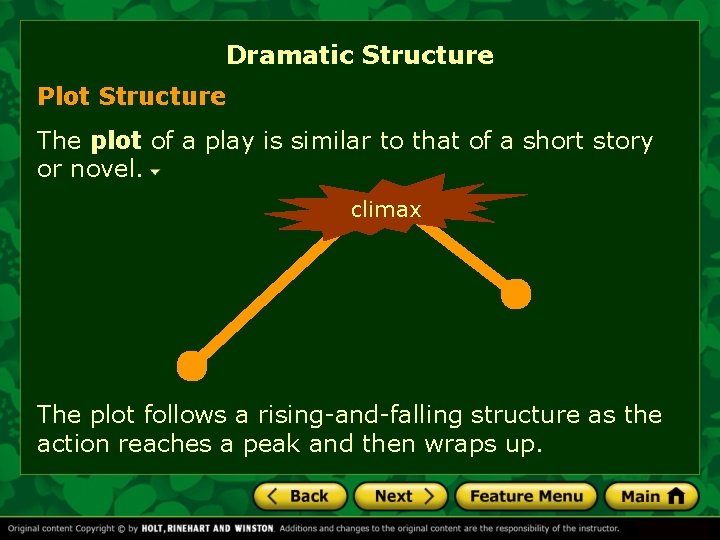
Dramatic Structure Plot Structure The plot of a play is similar to that of a short story or novel. climax The plot follows a rising-and-falling structure as the action reaches a peak and then wraps up.
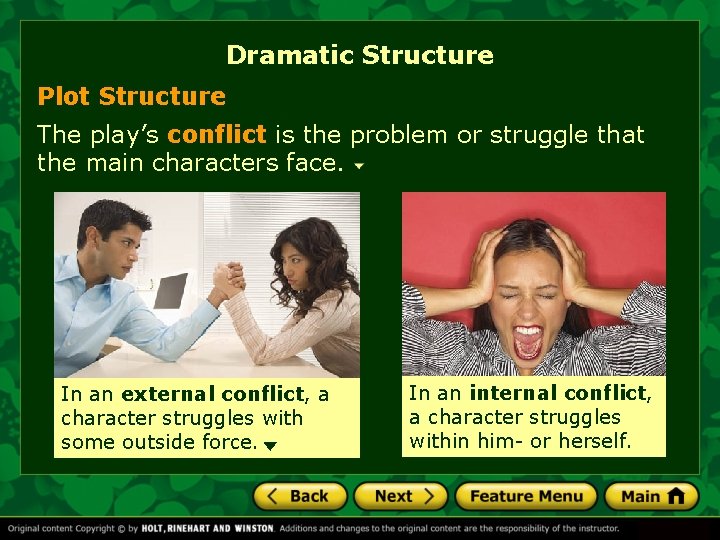
Dramatic Structure Plot Structure The play’s conflict is the problem or struggle that the main characters face. In an external conflict, a character struggles with some outside force. In an internal conflict, a character struggles within him- or herself.
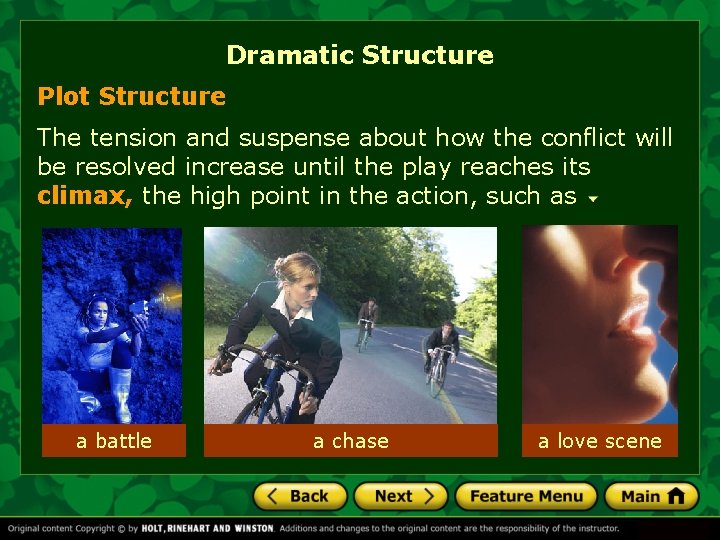
Dramatic Structure Plot Structure The tension and suspense about how the conflict will be resolved increase until the play reaches its climax, the high point in the action, such as a battle a chase a love scene
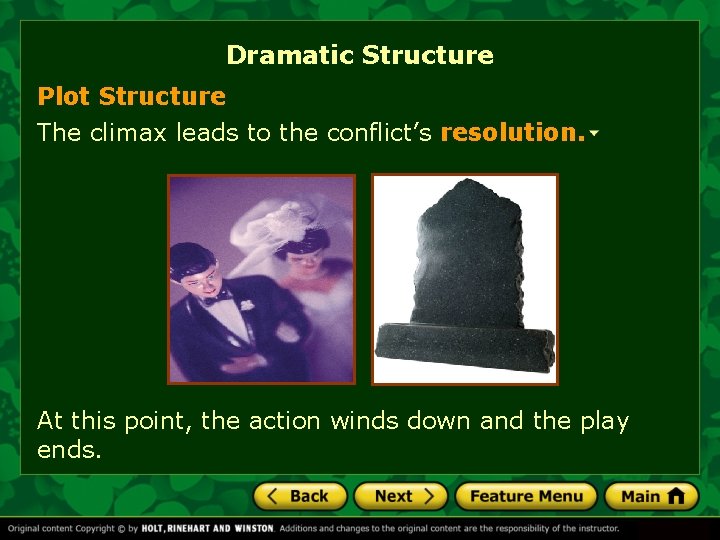
Dramatic Structure Plot Structure The climax leads to the conflict’s resolution. At this point, the action winds down and the play ends.
Dramatic Structure Quick Check Based on this summary of a play, what type of conflict does Juan face? Juan is a quiet boy, often shy around people he doesn’t know well. He is, however, an amazing singer—when he is driving alone in the car. Though he knows he has talent, he feels incapable of sharing it with anyone What might you other than his family. After much prodding by his older brother, Juan finally decides to show off his voice to the world by singing the national anthem at the championship basketball game. expect the climax of the play to be? [End of Section]
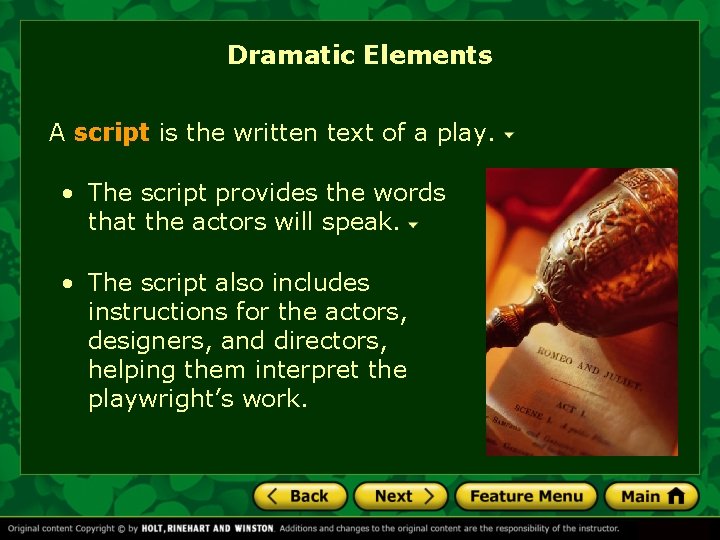
Dramatic Elements A script is the written text of a play. • The script provides the words that the actors will speak. • The script also includes instructions for the actors, designers, and directors, helping them interpret the playwright’s work.
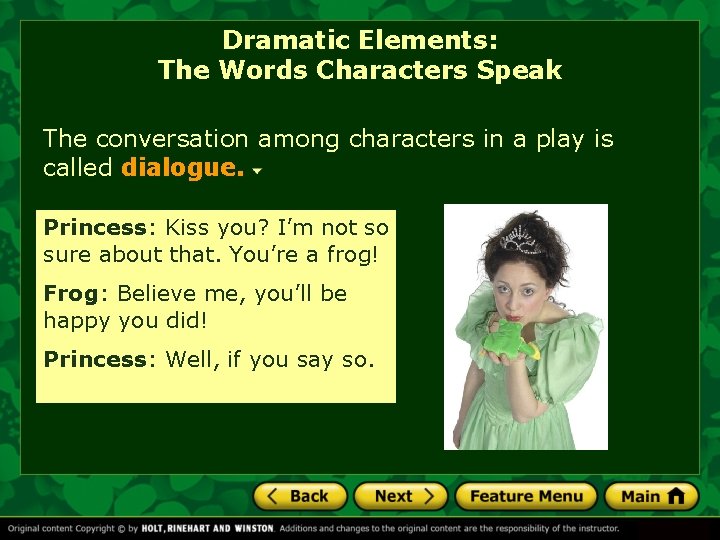
Dramatic Elements: The Words Characters Speak The conversation among characters in a play is called dialogue. Princess: Kiss you? I’m not so sure about that. You’re a frog! Frog: Believe me, you’ll be happy you did! Princess: Well, if you say so.
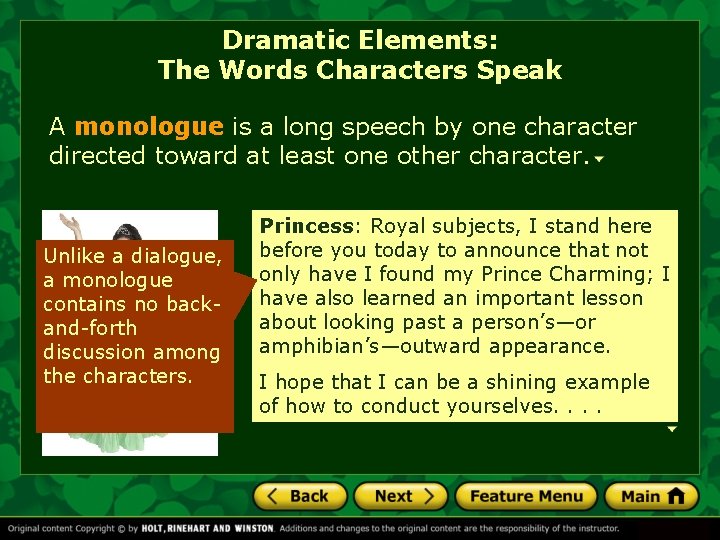
Dramatic Elements: The Words Characters Speak A monologue is a long speech by one character directed toward at least one other character. Unlike a dialogue, a monologue contains no backand-forth discussion among the characters. Princess: Royal subjects, I stand here before you today to announce that not only have I found my Prince Charming; I have also learned an important lesson about looking past a person’s—or amphibian’s—outward appearance. I hope that I can be a shining example of how to conduct yourselves. .
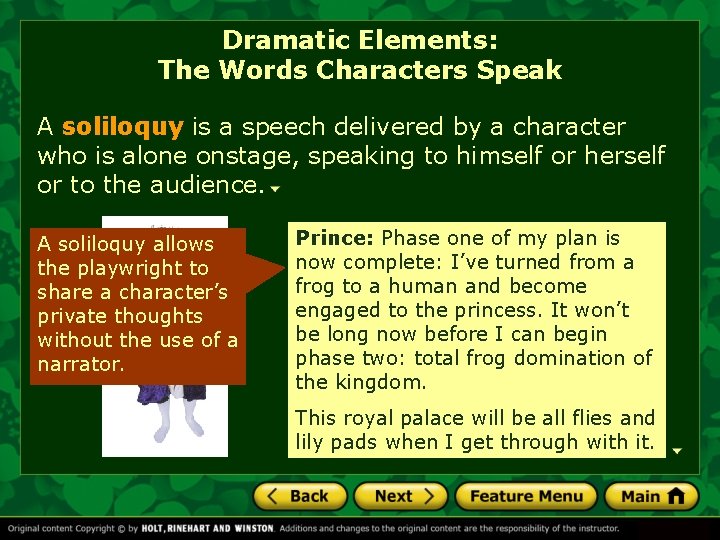
Dramatic Elements: The Words Characters Speak A soliloquy is a speech delivered by a character who is alone onstage, speaking to himself or herself or to the audience. A soliloquy allows the playwright to share a character’s private thoughts without the use of a narrator. Prince: Phase one of my plan is now complete: I’ve turned from a frog to a human and become engaged to the princess. It won’t be long now before I can begin phase two: total frog domination of the kingdom. This royal palace will be all flies and lily pads when I get through with it.
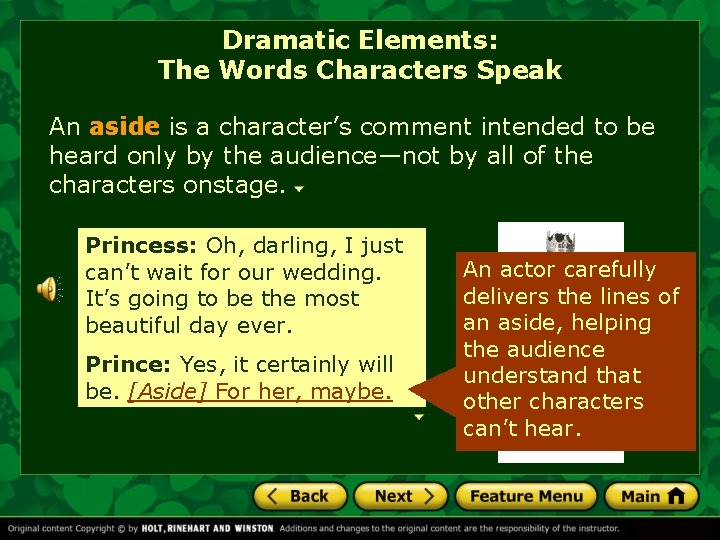
Dramatic Elements: The Words Characters Speak An aside is a character’s comment intended to be heard only by the audience—not by all of the characters onstage. Princess: Oh, darling, I just can’t wait for our wedding. It’s going to be the most beautiful day ever. Prince: Yes, it certainly will be. [Aside] For her, maybe. An actor carefully delivers the lines of an aside, helping the audience understand that other characters can’t hear.
Dramatic Elements: Stage Directions In addition to the characters’ words, scripts also contain stage directions. Stage directions can describe what the audience sees on the stage. A deserted hallway. JULIE is slumped against her locker. Allison: Julie, you look terrible! What’s wrong? [hanging her head] Julie: [hanging I failed my driver’s license test. I’m doomed to a lifetime of riding the bus. They can also indicate how characters move and speak.
Dramatic Elements: Stage Directions Actors, directors, and designers usually regard stage directions as suggestions rather than strict rules. A talent competition. KAT sings on a stage in front of a closed curtain. Her performance is filled with emotion. Different productions of a play can offer very different interpretations of the stage directions.
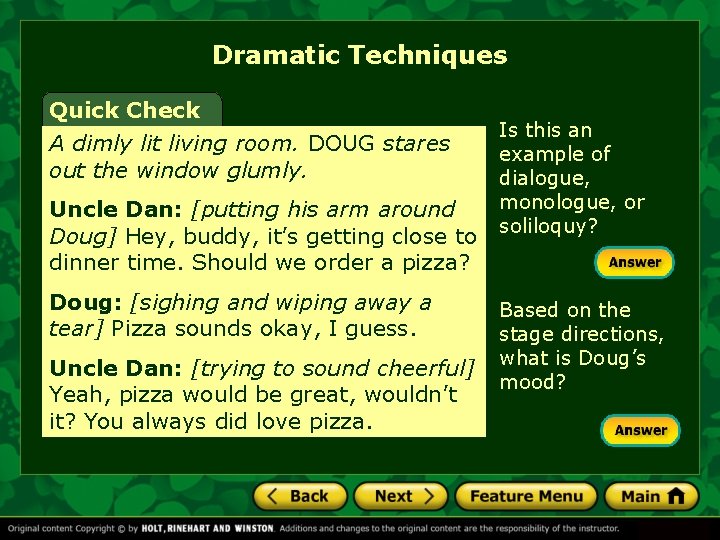
Dramatic Techniques Quick Check A dimly lit living room. DOUG stares out the window glumly. Uncle Dan: [putting his arm around Doug] Hey, buddy, it’s getting close to dinner time. Should we order a pizza? Doug: [sighing and wiping away a tear] Pizza sounds okay, I guess. Uncle Dan: [trying to sound cheerful] Yeah, pizza would be great, wouldn’t it? You always did love pizza. Is this an example of dialogue, monologue, or soliloquy? Based on the stage directions, what is Doug’s mood?
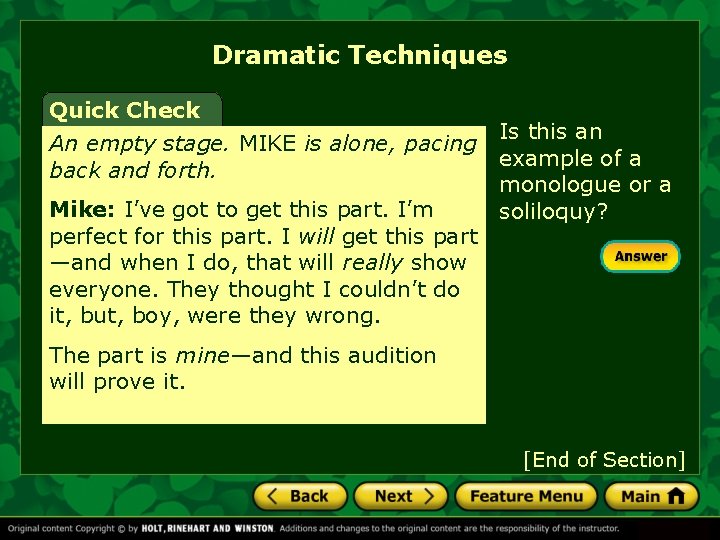
Dramatic Techniques Quick Check An empty stage. MIKE is alone, pacing back and forth. Mike: I’ve got to get this part. I’m perfect for this part. I will get this part —and when I do, that will really show everyone. They thought I couldn’t do it, but, boy, were they wrong. Is this an example of a monologue or a soliloquy? The part is mine—and this audition will prove it. [End of Section]
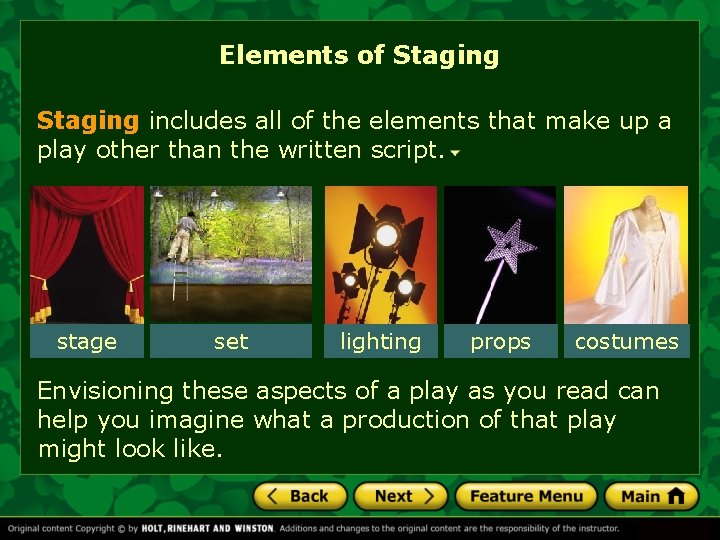
Elements of Staging includes all of the elements that make up a play other than the written script. stage set lighting props costumes Envisioning these aspects of a play as you read can help you imagine what a production of that play might look like.
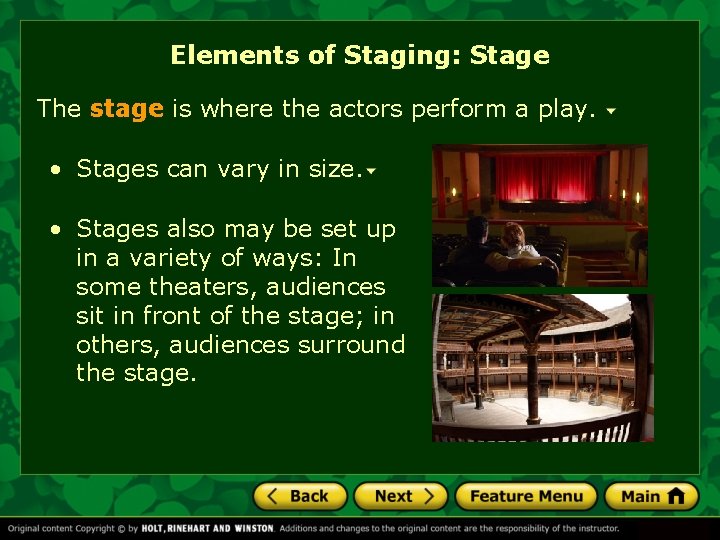
Elements of Staging: Stage The stage is where the actors perform a play. • Stages can vary in size. • Stages also may be set up in a variety of ways: In some theaters, audiences sit in front of the stage; in others, audiences surround the stage.
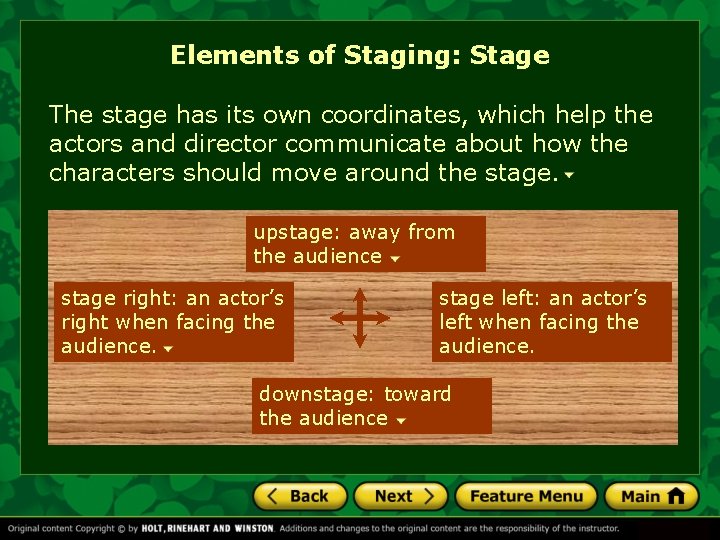
Elements of Staging: Stage The stage has its own coordinates, which help the actors and director communicate about how the characters should move around the stage. upstage: away from the audience stage right: an actor’s right when facing the audience. stage left: an actor’s left when facing the audience. downstage: toward the audience
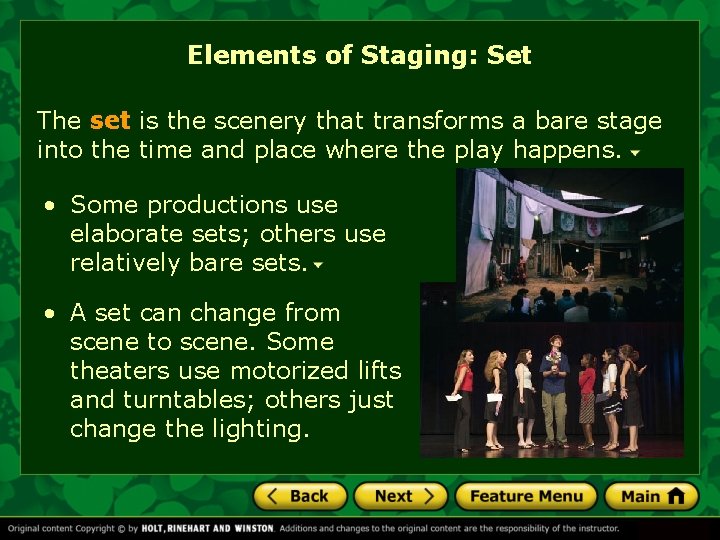
Elements of Staging: Set The set is the scenery that transforms a bare stage into the time and place where the play happens. • Some productions use elaborate sets; others use relatively bare sets. • A set can change from scene to scene. Some theaters use motorized lifts and turntables; others just change the lighting.
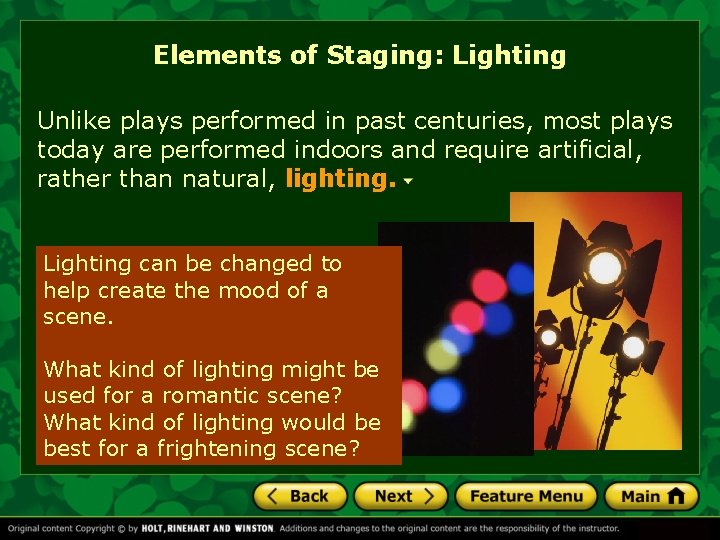
Elements of Staging: Lighting Unlike plays performed in past centuries, most plays today are performed indoors and require artificial, rather than natural, lighting. Lighting can be changed to help create the mood of a scene. What kind of lighting might be used for a romantic scene? What kind of lighting would be best for a frightening scene?
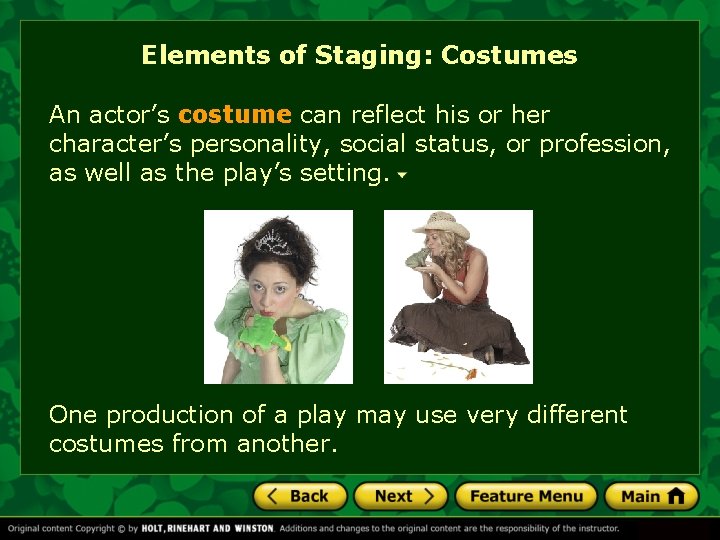
Elements of Staging: Costumes An actor’s costume can reflect his or her character’s personality, social status, or profession, as well as the play’s setting. One production of a play may use very different costumes from another.
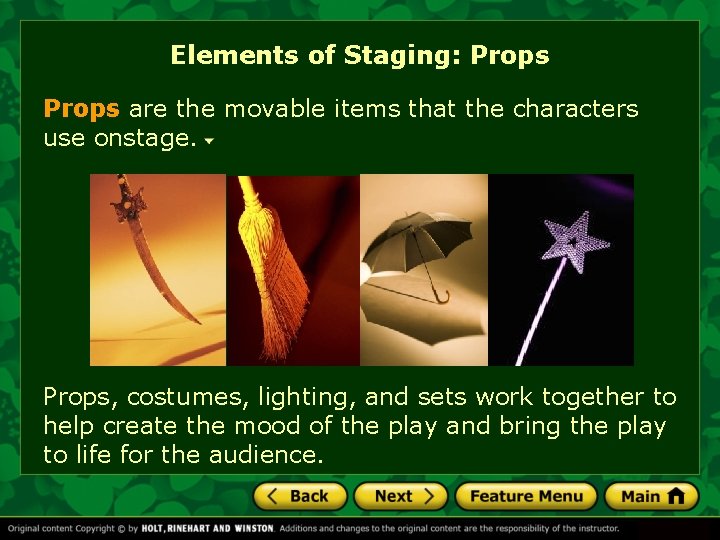
Elements of Staging: Props are the movable items that the characters use onstage. Props, costumes, lighting, and sets work together to help create the mood of the play and bring the play to life for the audience.
Elements of Staging Quick Check Nighttime in a deserted parking lot. HELENA is standing beneath a streetlight, talking on the phone. Helena: I know it’s late, sir, but I’m desperate. My car won’t start, and I need a tow. [pause] I’ll write you a check for double your usual rate if you’ll just help me out. Jimmy: Mommy, are we going home soon? Helena: [covering the phone] Soon, honey, soon. Based on this script, what kind of lighting might be necessary in this scene? What props might this scene require? [End of Section]
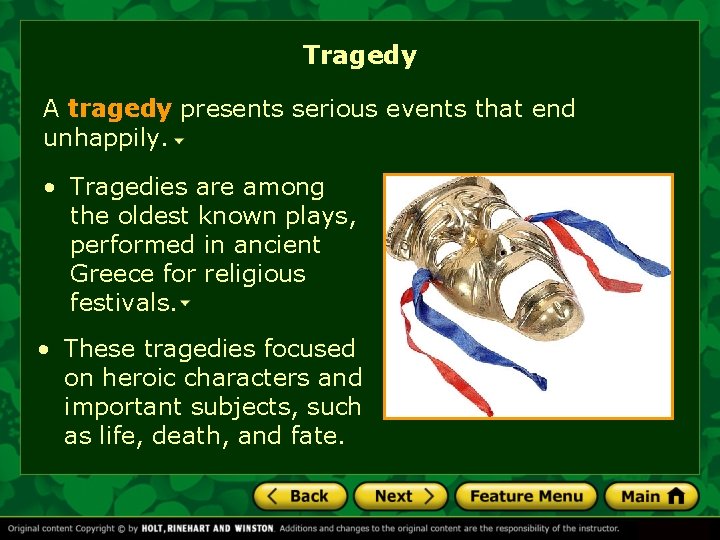
Tragedy A tragedy presents serious events that end unhappily. • Tragedies are among the oldest known plays, performed in ancient Greece for religious festivals. • These tragedies focused on heroic characters and important subjects, such as life, death, and fate.
Tragedy: Tragic Heroes Most tragedies focus on a tragic hero, a noble character with a lot to lose, who has a personal weakness that leads to his or her downfall. Evelyn had worked long and hard to succeed in the business world, and now she was at at the top, running her own billion-dollar company with thousands of of employees working for her. Despite her success, Evelyn still found herself lacking confidence at times. Her hard work shows her to be noble, worthy of admiration. She is successful, so she has a lot to lose. There is a failing in her personality that may cause a downfall.
Tragedy: Tragic Heroes A tragic flaw is a character weakness that brings about the tragic hero’s unhappy ending. Evelyn’s lack of confidence made her afraid to trust anyone, yet left her desperate to prove herself successful. This led her to make a very large and foolish investment, against the advice of everyone around her. Her company went bankrupt, and she lost everything she had. Evelyn’s fall was brought about by her insecurity. Other possible tragic flaws include pride, ambition, rebelliousness, and passion.
Tragedy: Character Foil A foil is a character who is used to contrast another character. In a tragedy, a foil may draw attention to the hero’s tragic flaw. Ann: Wow, what a beautiful sunny day! Zoe: Great, now I have to worry about getting a sunburn. Ann: Just look at all the lovely flowers blooming, though. Zoe: Yeah, I guess I can count on my allergies acting up today. Zoe’s negative outlook is a foil to Ann’s positive outlook. Each character’s viewpoint contrasts with the other’s.
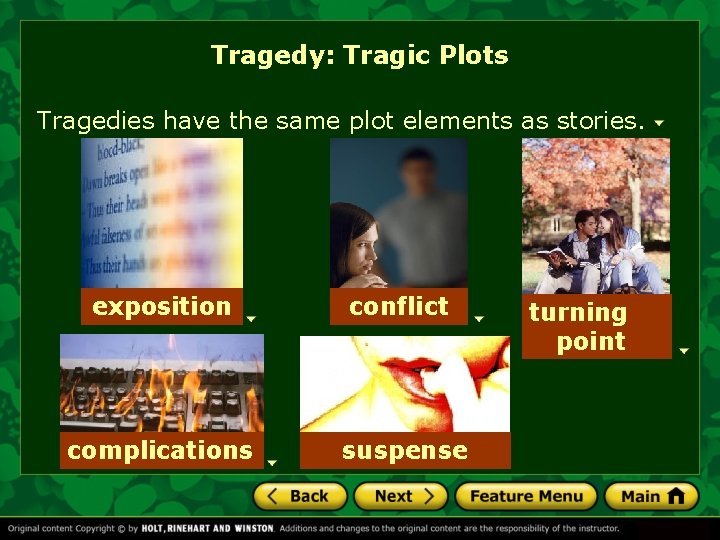
Tragedy: Tragic Plots Tragedies have the same plot elements as stories. exposition conflict complications suspense turning point
Tragedy: Tragic Plots The exposition introduces some background information about the characters and their situation. Mr. West: That Jack Preston is at it again. He’s been spreading rumors about me around town, trying to hurt my campaign for mayor. He’s been jealous of me since high school. Mrs. West: Say, Jess, isn’t his son in your class? Jessica: Um, yeah, I think so. Mr. West: Stay away from him. This scene reveals Mr. West’s history with Jack Preston and also points out to the audience that Preston’s son is in Jessica’s class.
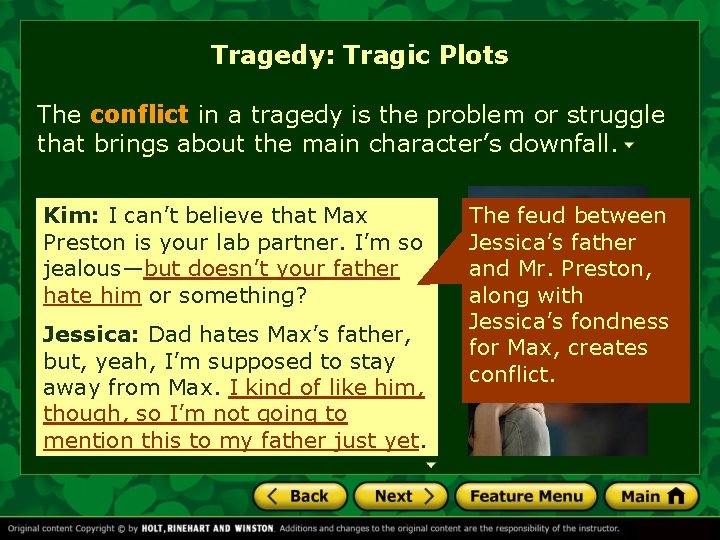
Tragedy: Tragic Plots The conflict in a tragedy is the problem or struggle that brings about the main character’s downfall. Kim: I can’t believe that Max Preston is your lab partner. I’m so jealous—but doesn’t your father hate him or something? Jessica: Dad hates Max’s father, but, yeah, I’m supposed to stay away from Max. I kind of like him, though, so I’m not going to mention this to my father just yet. The feud between Jessica’s father and Mr. Preston, along with Jessica’s fondness for Max, creates conflict.
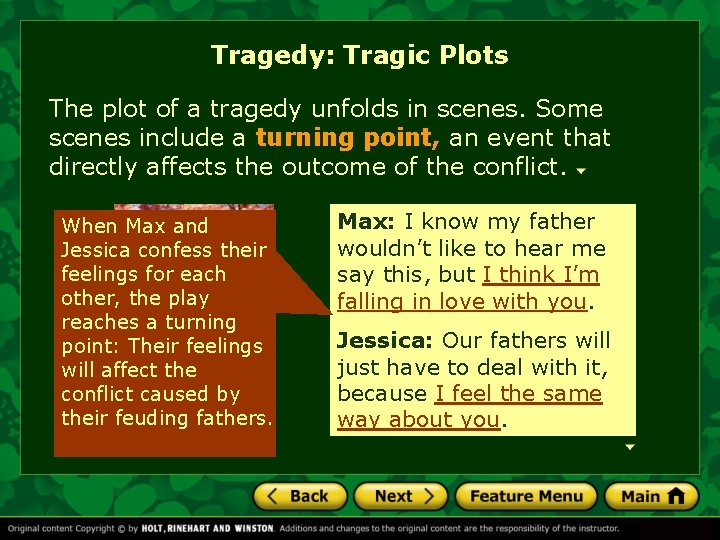
Tragedy: Tragic Plots The plot of a tragedy unfolds in scenes. Some scenes include a turning point, an event that directly affects the outcome of the conflict. When Max and Jessica confess their feelings for each other, the play reaches a turning point: Their feelings will affect the conflict caused by their feuding fathers. Max: I know my father wouldn’t like to hear me say this, but I think I’m falling in love with you. Jessica: Our fathers will just have to deal with it, because I feel the same way about you.
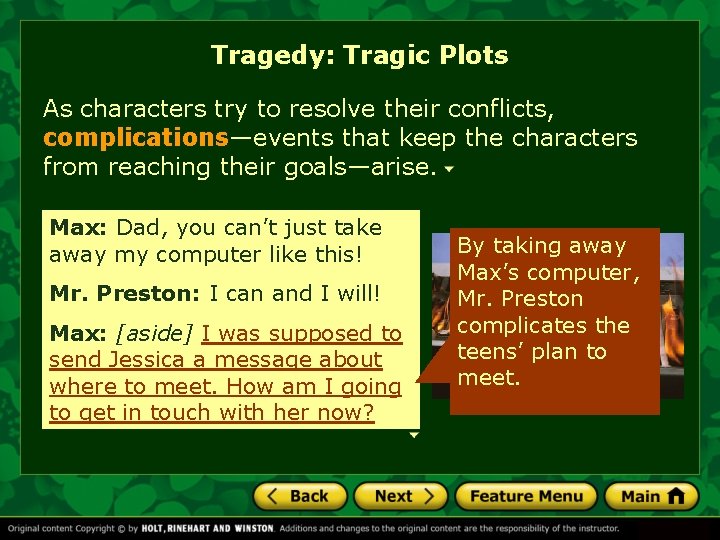
Tragedy: Tragic Plots As characters try to resolve their conflicts, complications—events that keep the characters from reaching their goals—arise. Max: Dad, you can’t just take away my computer like this! Mr. Preston: I can and I will! Max: [aside] I was supposed to send Jessica a message about where to meet. How am I going to get in touch with her now? By taking away Max’s computer, Mr. Preston complicates the teens’ plan to meet.
Tragedy: Tragic Plots Suspense is the audience’s feeling of uncertainty or anxiety about what will happen next. How are they ever going to get themselves out of this mess? Even when audience members already know a tragedy’s outcome, they may feel suspense as they await the tragic end.
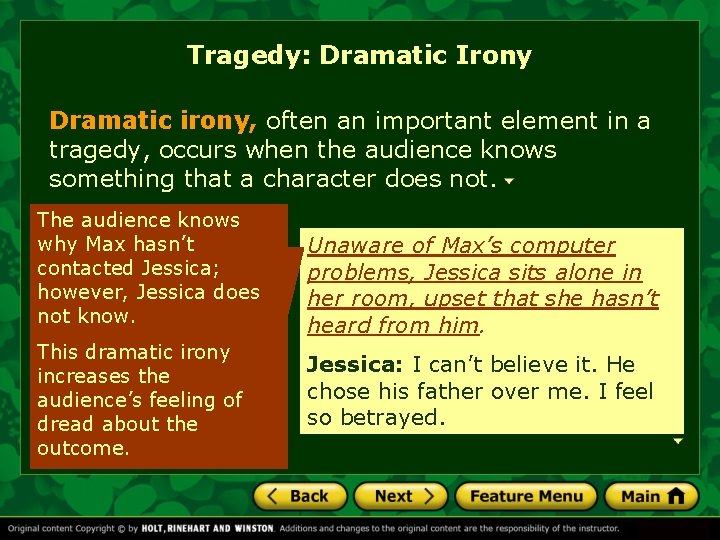
Tragedy: Dramatic Irony Dramatic irony, often an important element in a tragedy, occurs when the audience knows something that a character does not. The audience knows why Max hasn’t contacted Jessica; however, Jessica does not know. This dramatic irony increases the audience’s feeling of dread about the outcome. Unaware of Max’s computer problems, Jessica sits alone in her room, upset that she hasn’t heard from him. Jessica: I can’t believe it. He chose his father over me. I feel so betrayed.
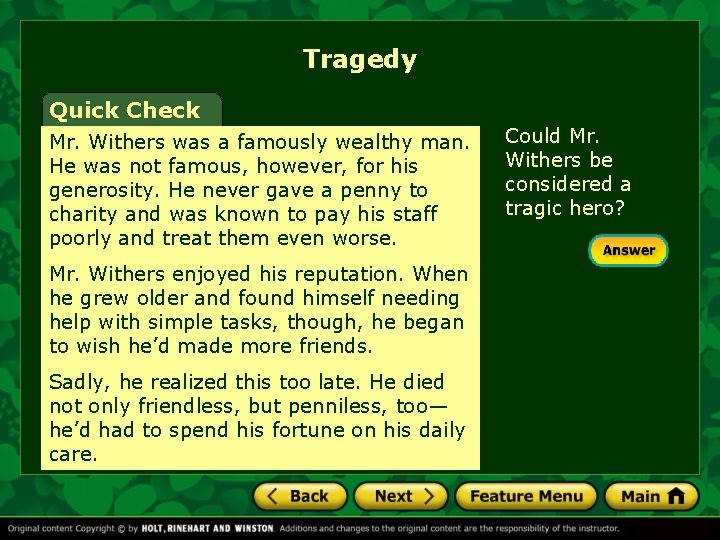
Tragedy Quick Check Mr. Withers was a famously wealthy man. He was not famous, however, for his generosity. He never gave a penny to charity and was known to pay his staff poorly and treat them even worse. Mr. Withers enjoyed his reputation. When he grew older and found himself needing help with simple tasks, though, he began to wish he’d made more friends. Sadly, he realized this too late. He died not only friendless, but penniless, too— he’d had to spend his fortune on his daily care. Could Mr. Withers be considered a tragic hero?
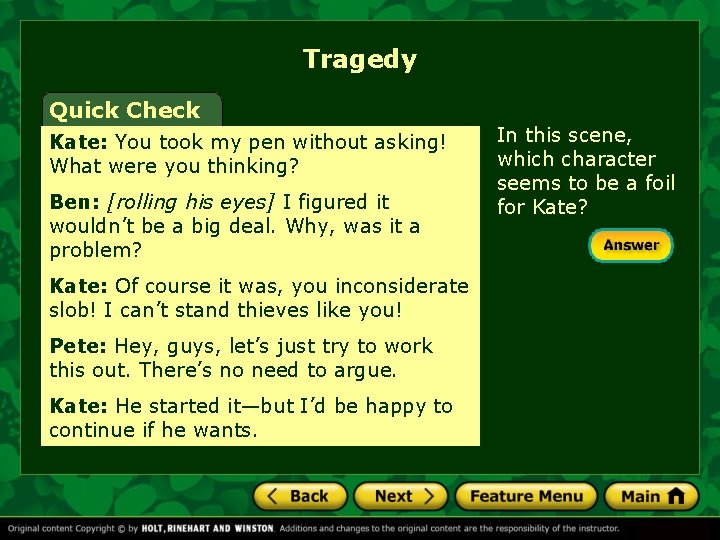
Tragedy Quick Check Kate: You took my pen without asking! What were you thinking? Ben: [rolling his eyes] I figured it wouldn’t be a big deal. Why, was it a problem? Kate: Of course it was, you inconsiderate slob! I can’t stand thieves like you! Pete: Hey, guys, let’s just try to work this out. There’s no need to argue. Kate: He started it—but I’d be happy to continue if he wants. In this scene, which character seems to be a foil for Kate?
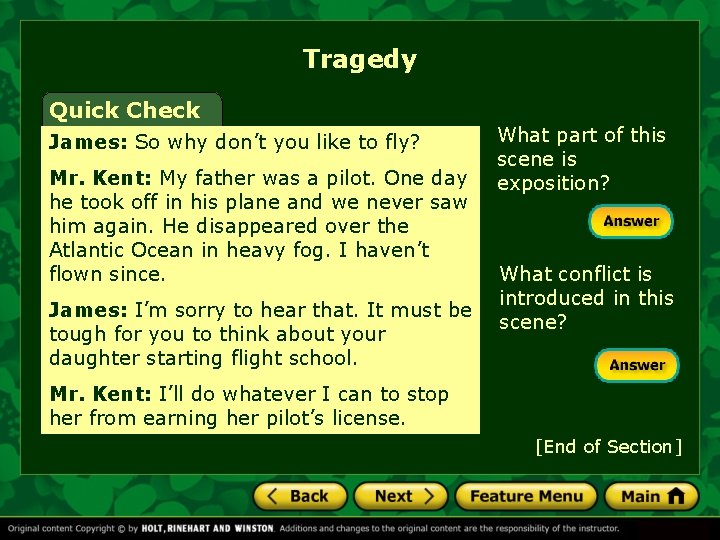
Tragedy Quick Check James: So why don’t you like to fly? Mr. Kent: My father was a pilot. One day he took off in his plane and we never saw him again. He disappeared over the Atlantic Ocean in heavy fog. I haven’t flown since. James: I’m sorry to hear that. It must be tough for you to think about your daughter starting flight school. What part of this scene is exposition? What conflict is introduced in this scene? Mr. Kent: I’ll do whatever I can to stop her from earning her pilot’s license. [End of Section]
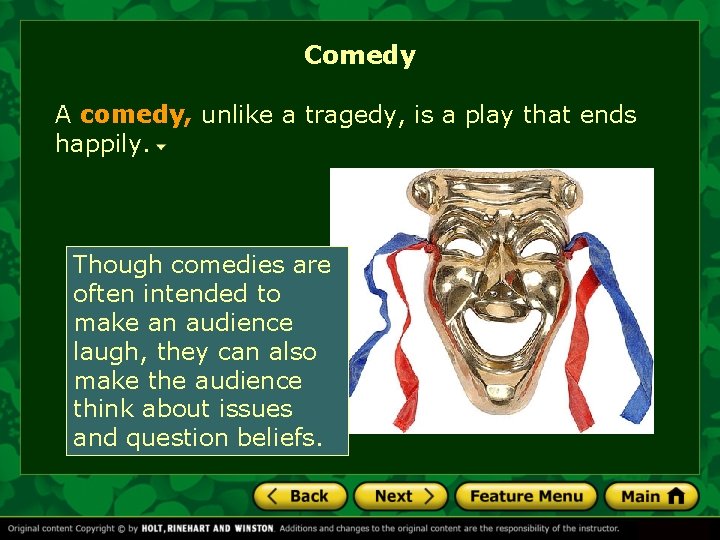
Comedy A comedy, unlike a tragedy, is a play that ends happily. Though comedies are often intended to make an audience laugh, they can also make the audience think about issues and question beliefs.
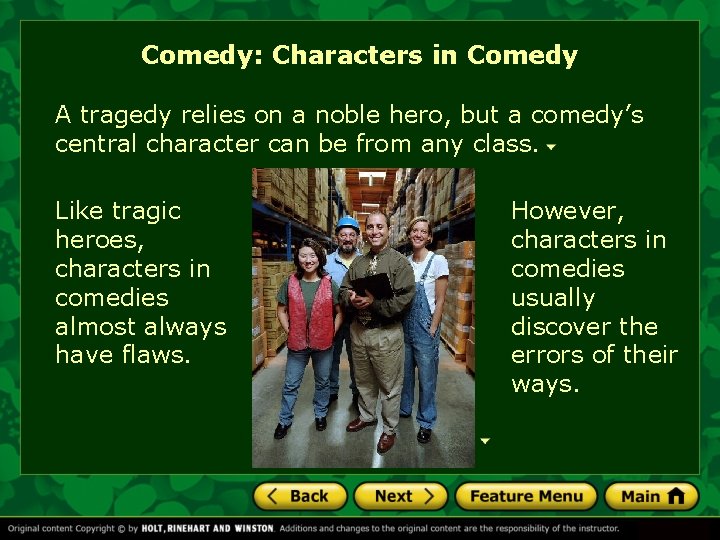
Comedy: Characters in Comedy A tragedy relies on a noble hero, but a comedy’s central character can be from any class. Like tragic heroes, characters in comedies almost always have flaws. However, characters in comedies usually discover the errors of their ways.
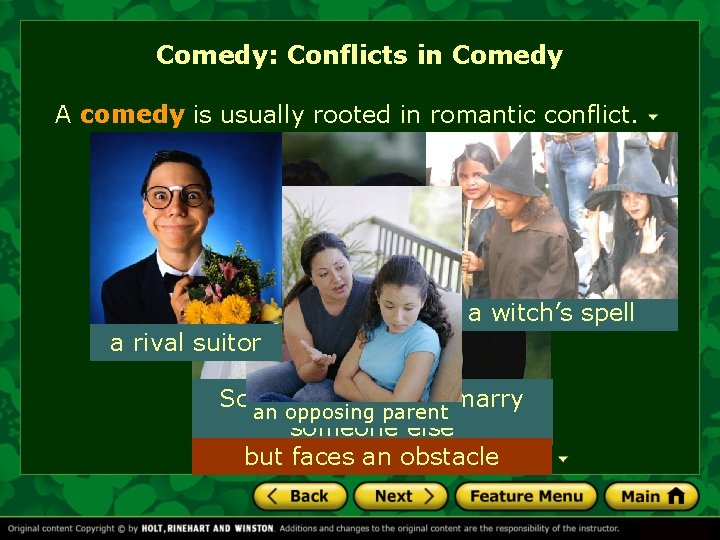
Comedy: Conflicts in Comedy A comedy is usually rooted in romantic conflict. a witch’s spell a rival suitor Someone wants to marry an opposing parent someone else but faces an obstacle
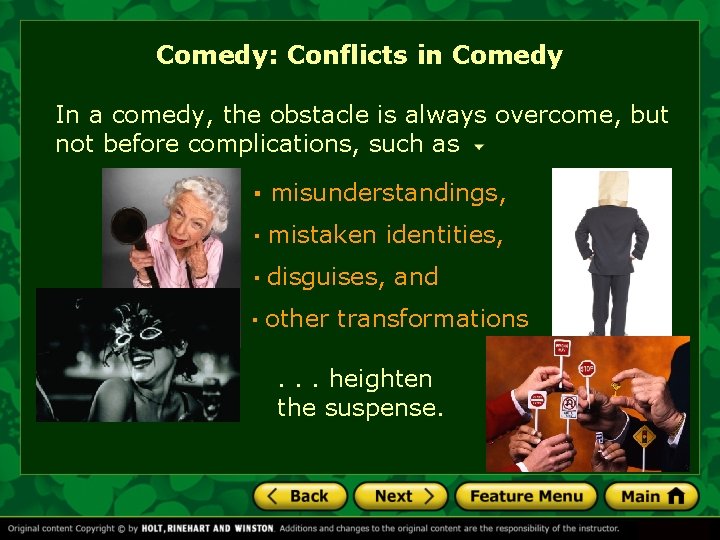
Comedy: Conflicts in Comedy In a comedy, the obstacle is always overcome, but not before complications, such as · misunderstandings, · mistaken identities, · disguises, and · other transformations. . . heighten the suspense.
Analyze Drama Your Turn Choose a play or movie you remember seeing. Follow these steps to analyze its dramatic elements. 1. Describe the set (or sets). Were they realistic? How did they contribute to the presentation? 2. List at least two costumes worn by the actors. What did the costumes tell you about the characters? 3. Tell what you remember about the dialogue. Was it convincing? clever? emotional? Do you recall any monologues or asides?
Analyze Drama Your Turn Choose a play or movie you remember seeing. Follow these steps to analyze its dramatic elements. 4. Would you classify the work as a tragedy, a comedy, or a mixture of the two? Why? 5. Could you describe the main character as a tragic hero? Why or why not? 6. What characters acted as foils to provide contrast with the main character?
Analyze Drama Your Turn Choose a play or movie you remember seeing. Follow these steps to analyze its dramatic elements. 7. Describe one turning point in the work. What complications developed as a result? 8. How did the work build suspense? What happened in the climax? [End of Section]
The End