
What Drives Venture Capital A Perspective From Both

What Drives Venture Capital? A Perspective From Both Sides of the Table Paul Vroomen 1
Agenda 1. Introduction 2. How Venture Capital Works – The Impact of Internal Rate of Return Expectations 3. Case Study: Sandbridge Technologies, Inc. – A $15 M Powerpoint Presentation 4. The Future of Venture Capital – Big Changes Coming…. 2
Thought Experiment You are an entrepreneur…. – You have worked for 10 to 12 hours per day, often 7 days a week for the past 3 years, – You have risked your entire personal savings, – You have endangered your marriage, – You see your kids mostly just before they fall asleep, – You have questioned your own sanity, But, you finally have a working prototype…. 3
The Entrepreneur’s View What? ? – They want 10 X return on their money? – They want 65% ownership of my company? – They want a controlling vote on the Board of Directors? – They want to be paid their money first before anyone else gets anything, even me, the founder, if we sell the company? Vulture Capitalists!! 4
The Venture Capitalists View This guy has a good idea , BUT: – He has no CEO track record and has never run a company before – His executive team has significant holes (especially in marketing) – The company’s business plan is way too optimistic, especially given that it has missed critical milestones, twice – They have one significant customer, but that customer is known for collaborating with innovative start-ups and then doing their own thing I will ensure that our term sheet enables me to protect my capital and is structured so that I can direct the CEO to correct the issues with the company or replace 5 him with someone that can if he does not!
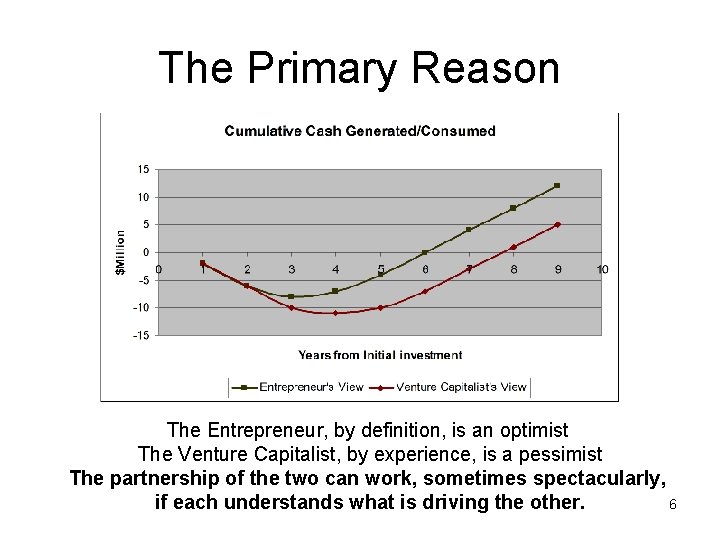
The Primary Reason The Entrepreneur, by definition, is an optimist The Venture Capitalist, by experience, is a pessimist The partnership of the two can work, sometimes spectacularly, 6 if each understands what is driving the other.
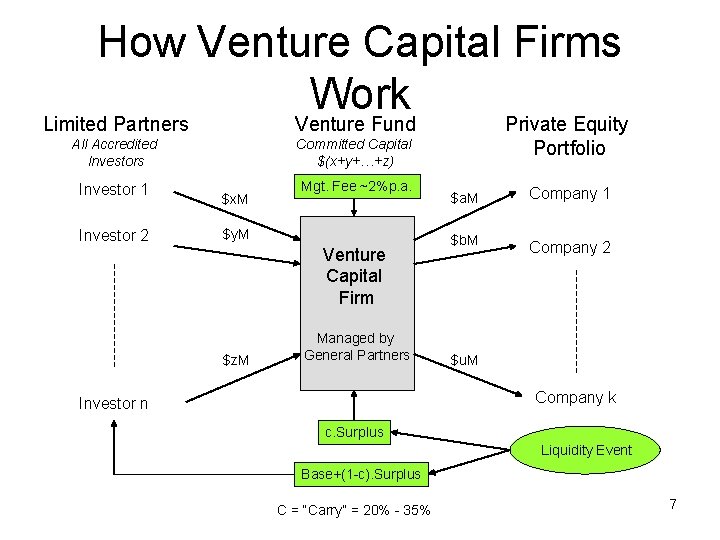
How Venture Capital Firms Work Private Equity Limited Partners Venture Fund All Accredited Investors Committed Capital $(x+y+…+z) Investor 1 Mgt. Fee ~2%p. a. Investor 2 $x. M $y. M Venture Capital Firm $z. M Managed by General Partners Portfolio $a. M Company 1 $b. M Company 2 $u. M Company k Investor n c. Surplus Liquidity Event Base+(1 -c). Surplus C = “Carry” = 20% - 35% 7

EBO and VC Historical Performance Source: US Venture Capital Index and Selected Benchmark Statistics, June 2014, Cambridge Associates, LLC IRR: Net cash on cash returns to Limited Partners (after deduction of management fees and carry percentages) AVERAGE IRR (1999 -2009) Electronics: -0. 54% Financial Services: 14. 42% Bio. Tech: 16. 04% AVERAGE IRR (1999 -2009) Information Technology: - Internet-Business: - Internet-Commerce: 24. 23% 23. 2% 37. 8% 8
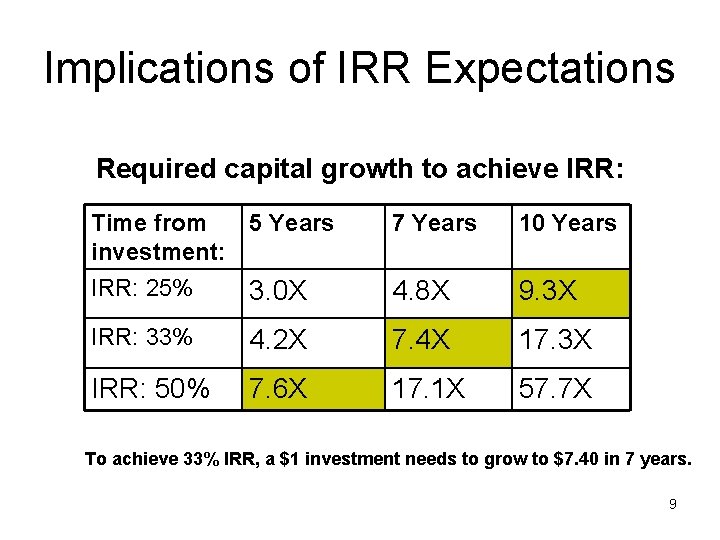
Implications of IRR Expectations Required capital growth to achieve IRR: Time from 5 Years investment: IRR: 25% 3. 0 X 7 Years 10 Years 4. 8 X 9. 3 X IRR: 33% 4. 2 X 7. 4 X 17. 3 X IRR: 50% 7. 6 X 17. 1 X 57. 7 X To achieve 33% IRR, a $1 investment needs to grow to $7. 40 in 7 years. 9
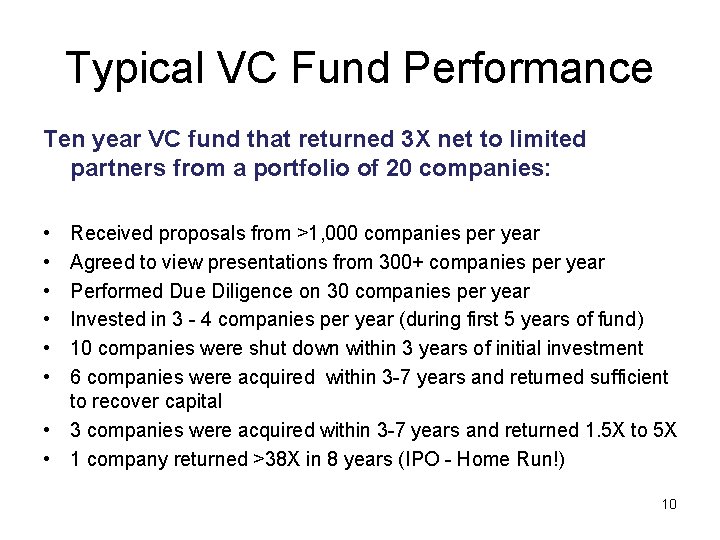
Typical VC Fund Performance Ten year VC fund that returned 3 X net to limited partners from a portfolio of 20 companies: • • • Received proposals from >1, 000 companies per year Agreed to view presentations from 300+ companies per year Performed Due Diligence on 30 companies per year Invested in 3 - 4 companies per year (during first 5 years of fund) 10 companies were shut down within 3 years of initial investment 6 companies were acquired within 3 -7 years and returned sufficient to recover capital • 3 companies were acquired within 3 -7 years and returned 1. 5 X to 5 X • 1 company returned >38 X in 8 years (IPO - Home Run!) 10
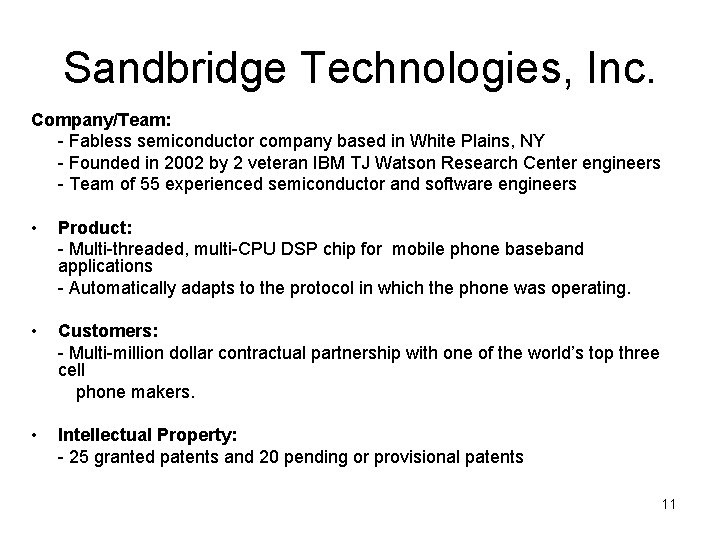
Sandbridge Technologies, Inc. Company/Team: - Fabless semiconductor company based in White Plains, NY - Founded in 2002 by 2 veteran IBM TJ Watson Research Center engineers - Team of 55 experienced semiconductor and software engineers • Product: - Multi-threaded, multi-CPU DSP chip for mobile phone baseband applications - Automatically adapts to the protocol in which the phone was operating. • Customers: - Multi-million dollar contractual partnership with one of the world’s top three cell phone makers. • Intellectual Property: - 25 granted patents and 20 pending or provisional patents 11
By late 2008, Sandbridge had consumed $53 M in 3 VC funding rounds and needed a further $15 M for the commercialization phase The $15 M Presentation… 12
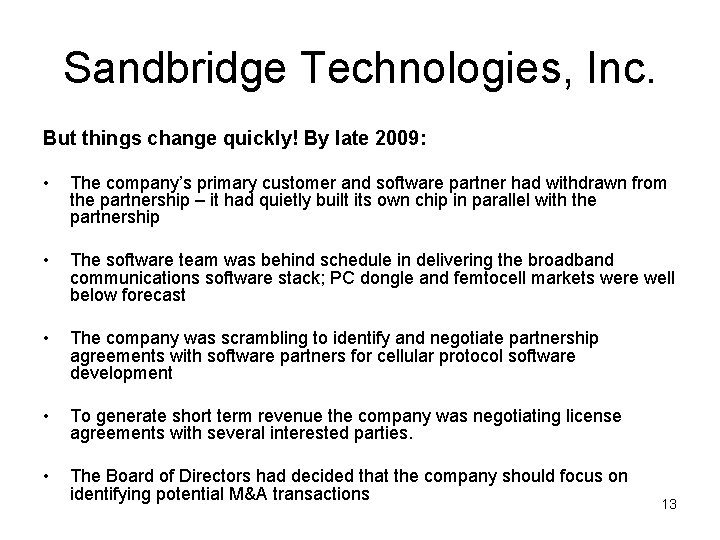
Sandbridge Technologies, Inc. But things change quickly! By late 2009: • The company’s primary customer and software partner had withdrawn from the partnership – it had quietly built its own chip in parallel with the partnership • The software team was behind schedule in delivering the broadband communications software stack; PC dongle and femtocell markets were well below forecast • The company was scrambling to identify and negotiate partnership agreements with software partners for cellular protocol software development • To generate short term revenue the company was negotiating license agreements with several interested parties. • The Board of Directors had decided that the company should focus on identifying potential M&A transactions 13
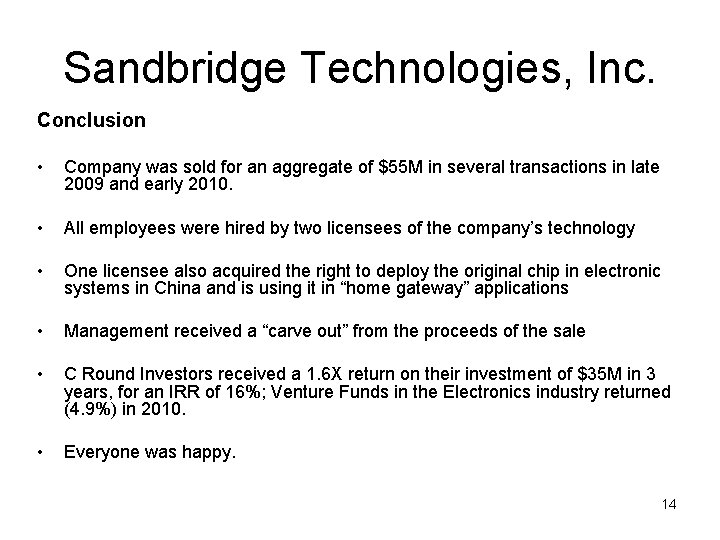
Sandbridge Technologies, Inc. Conclusion • Company was sold for an aggregate of $55 M in several transactions in late 2009 and early 2010. • All employees were hired by two licensees of the company’s technology • One licensee also acquired the right to deploy the original chip in electronic systems in China and is using it in “home gateway” applications • Management received a “carve out” from the proceeds of the sale • C Round Investors received a 1. 6 X return on their investment of $35 M in 3 years, for an IRR of 16%; Venture Funds in the Electronics industry returned (4. 9%) in 2010. • Everyone was happy. 14

Big Changes Are Coming to the Private Equity Investment World…. 15
Why? Security Token Offerings (STO) create a new asset class in private equity: Crowd Funding (CF) 16
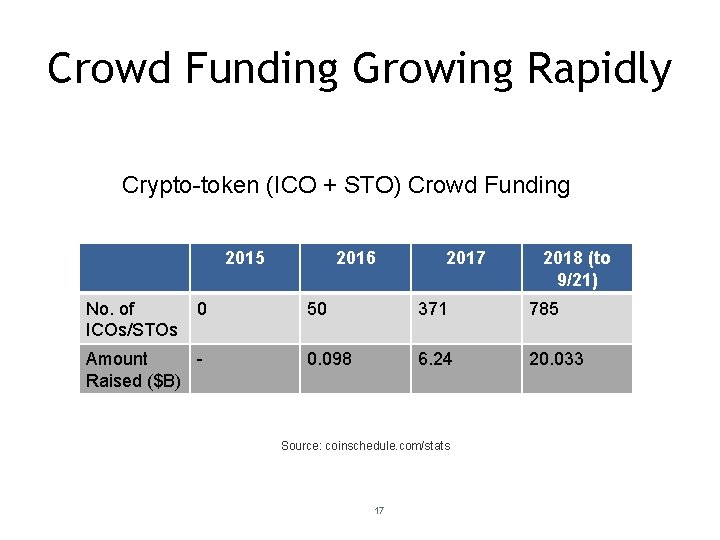
Crowd Funding Growing Rapidly Crypto-token (ICO + STO) Crowd Funding 2015 No. of ICOs/STOs 0 Amount Raised ($B) 2016 2017 2018 (to 9/21) 50 371 785 0. 098 6. 24 20. 033 Source: coinschedule. com/stats 17
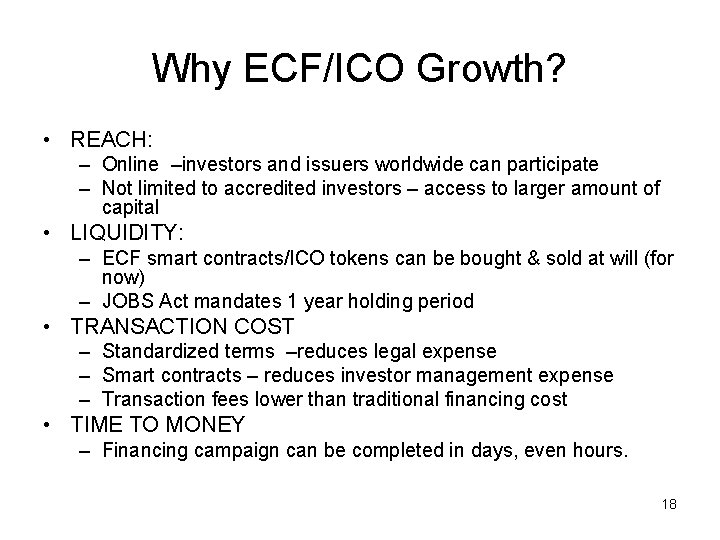
Why ECF/ICO Growth? • REACH: – Online –investors and issuers worldwide can participate – Not limited to accredited investors – access to larger amount of capital • LIQUIDITY: – ECF smart contracts/ICO tokens can be bought & sold at will (for now) – JOBS Act mandates 1 year holding period • TRANSACTION COST – Standardized terms –reduces legal expense – Smart contracts – reduces investor management expense – Transaction fees lower than traditional financing cost • TIME TO MONEY – Financing campaign can be completed in days, even hours. 18
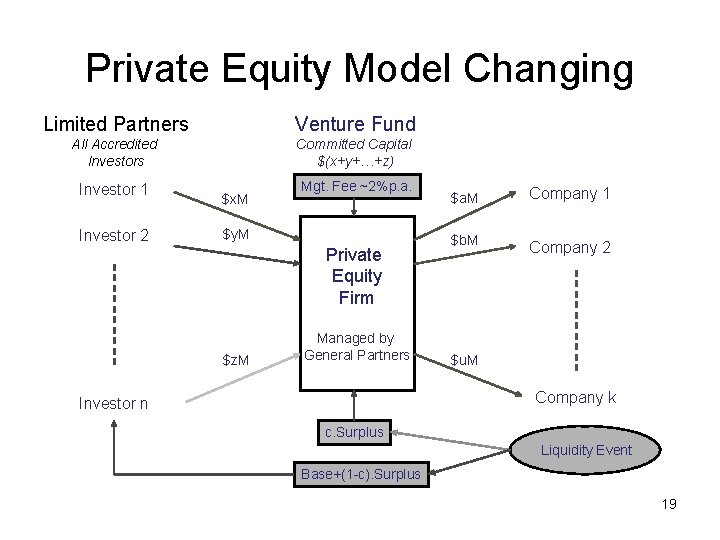
Private Equity Model Changing Limited Partners Venture Fund All Accredited Investors Committed Capital $(x+y+…+z) Investor 1 Mgt. Fee ~2%p. a. Investor 2 $x. M $y. M Private Equity Firm $z. M Managed by General Partners Private Equity Portfolio $a. M Company 1 $b. M Company 2 $u. M Company k Investor n c. Surplus Liquidity Event Base+(1 -c). Surplus C = “Carry” = 20% - 35% 19
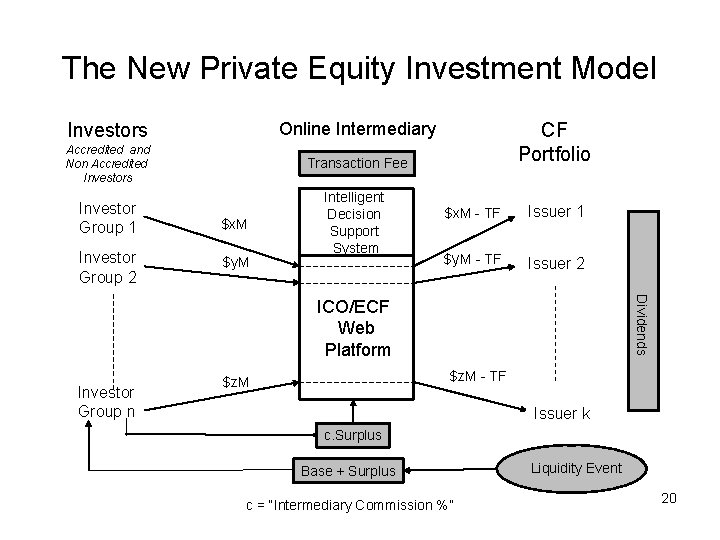
The New Private Equity Investment Model Investors Online Intermediary Accredited and Non Accredited Investors Transaction Fee Investor Group 1 $x. M Investor Group 2 $y. M Intelligent Decision Support System CF Portfolio $x. M - TF Issuer 1 $y. M - TF Issuer 2 Dividends ICO/ECF Web Platform Investor Group n $z. M - TF $z. M Issuer k c. Surplus Base + Surplus c = “Intermediary Commission %” Liquidity Event 20
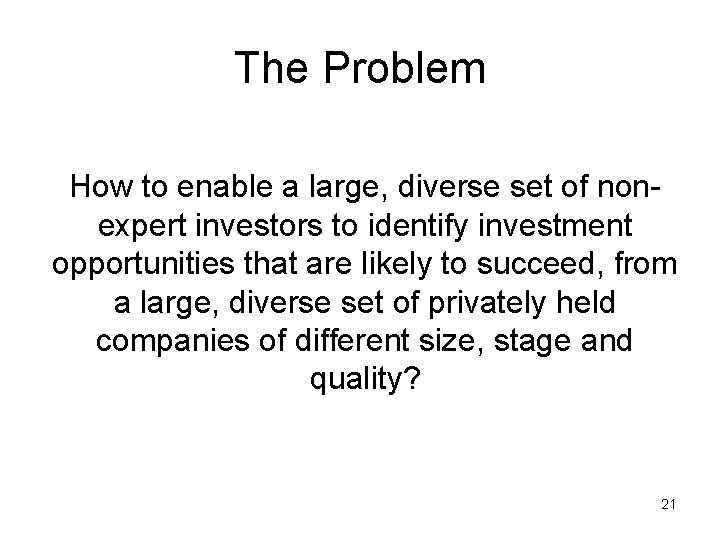
The Problem How to enable a large, diverse set of nonexpert investors to identify investment opportunities that are likely to succeed, from a large, diverse set of privately held companies of different size, stage and quality? 21
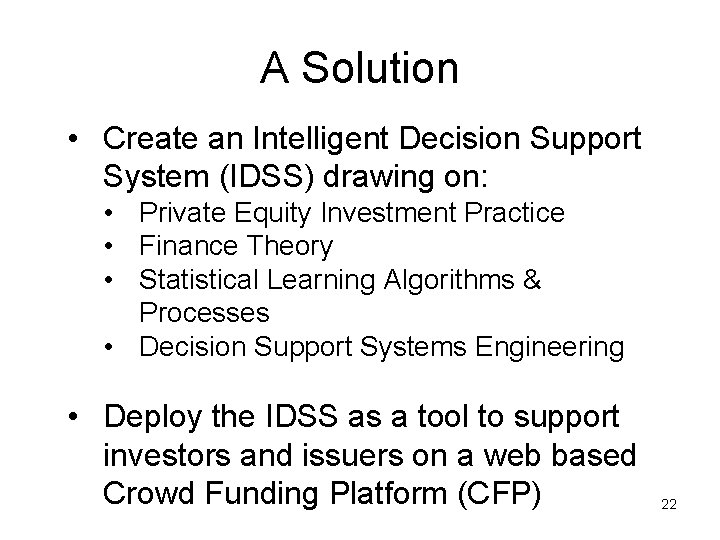
A Solution • Create an Intelligent Decision Support System (IDSS) drawing on: • Private Equity Investment Practice • Finance Theory • Statistical Learning Algorithms & Processes • Decision Support Systems Engineering • Deploy the IDSS as a tool to support investors and issuers on a web based Crowd Funding Platform (CFP) 22
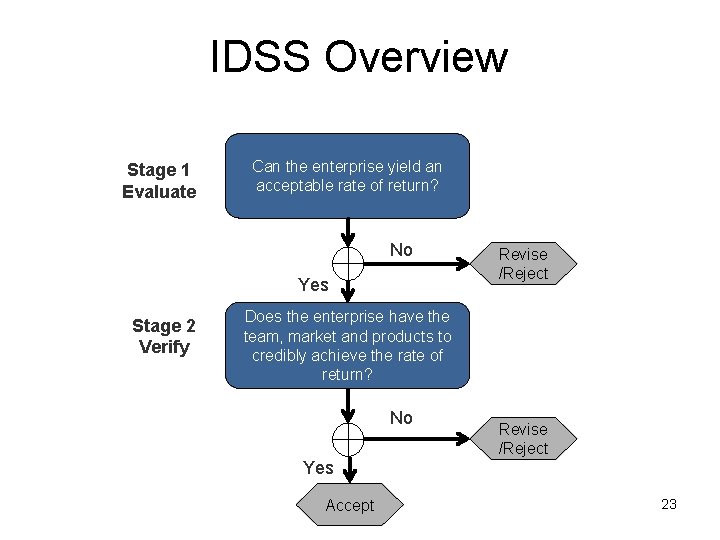
IDSS Overview Stage 1 Evaluate Can the enterprise yield an acceptable rate of return? No Yes Stage 2 Verify Revise /Reject Does the enterprise have the team, market and products to credibly achieve the rate of return? No Revise /Reject Yes Accept 23
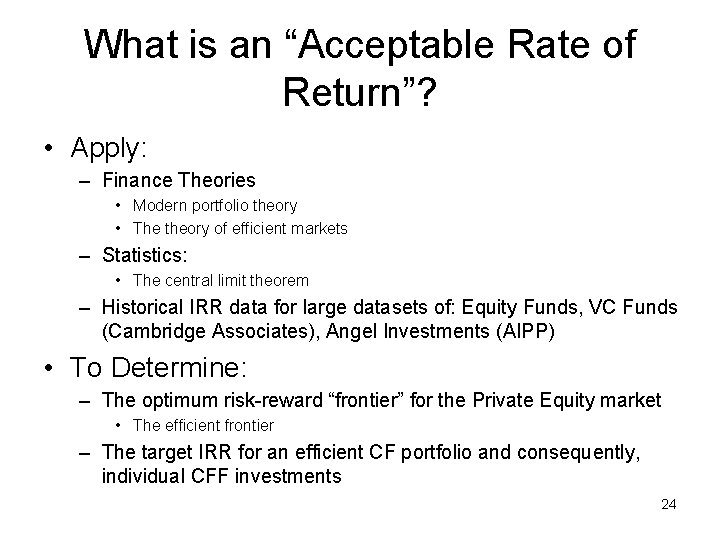
What is an “Acceptable Rate of Return”? • Apply: – Finance Theories • Modern portfolio theory • The theory of efficient markets – Statistics: • The central limit theorem – Historical IRR data for large datasets of: Equity Funds, VC Funds (Cambridge Associates), Angel Investments (AIPP) • To Determine: – The optimum risk-reward “frontier” for the Private Equity market • The efficient frontier – The target IRR for an efficient CF portfolio and consequently, individual CFF investments 24
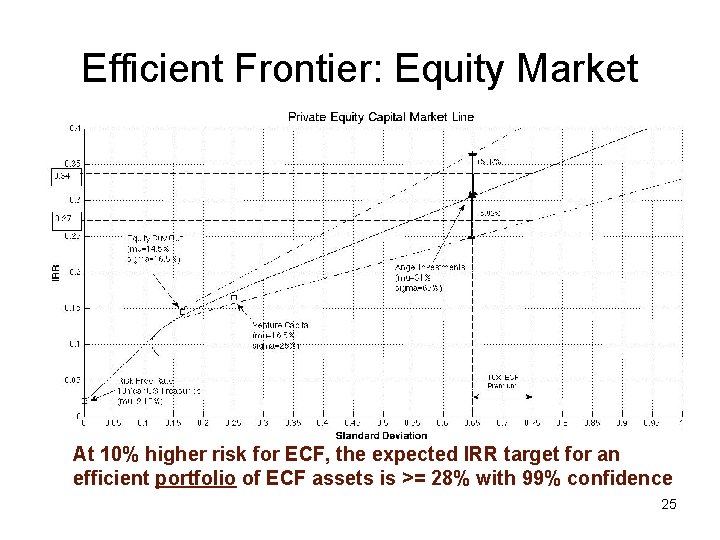
Efficient Frontier: Equity Market At 10% higher risk for ECF, the expected IRR target for an efficient portfolio of ECF assets is >= 28% with 99% confidence 25
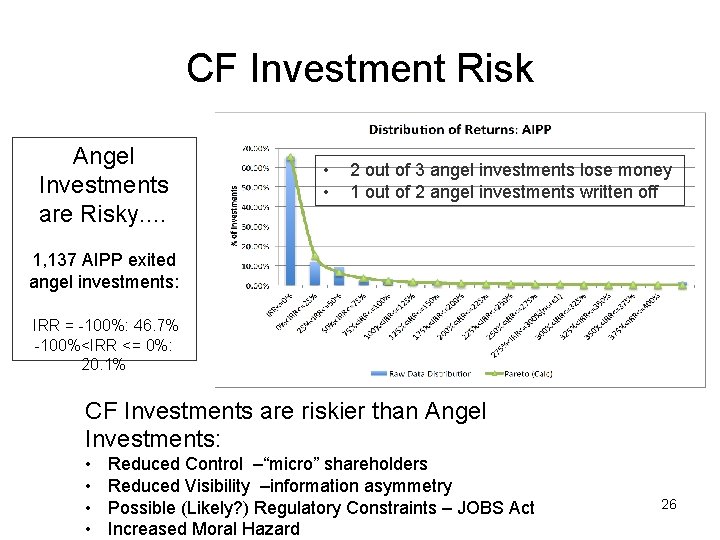
CF Investment Risk Angel Investments are Risky. … • • 2 out of 3 angel investments lose money 1 out of 2 angel investments written off 1, 137 AIPP exited angel investments: 26 IRR = -100%: 46. 7% -100%<IRR <= 0%: 20. 1% CF Investments are riskier than Angel Investments: • • Reduced Control –“micro” shareholders Reduced Visibility –information asymmetry Possible (Likely? ) Regulatory Constraints – JOBS Act Increased Moral Hazard 26
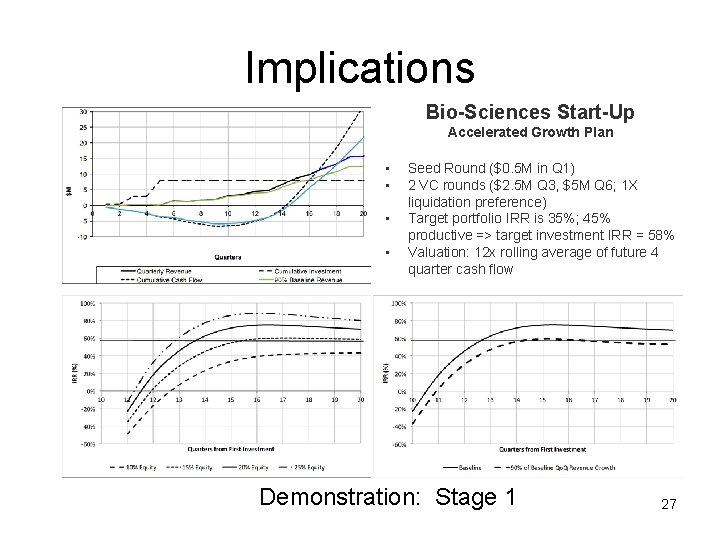
Implications Bio-Sciences Start-Up Accelerated Growth Plan • • Seed Round ($0. 5 M in Q 1) 2 VC rounds ($2. 5 M Q 3, $5 M Q 6; 1 X liquidation preference) Target portfolio IRR is 35%; 45% productive => target investment IRR = 58% Valuation: 12 x rolling average of future 4 quarter cash flow Demonstration: Stage 1 27
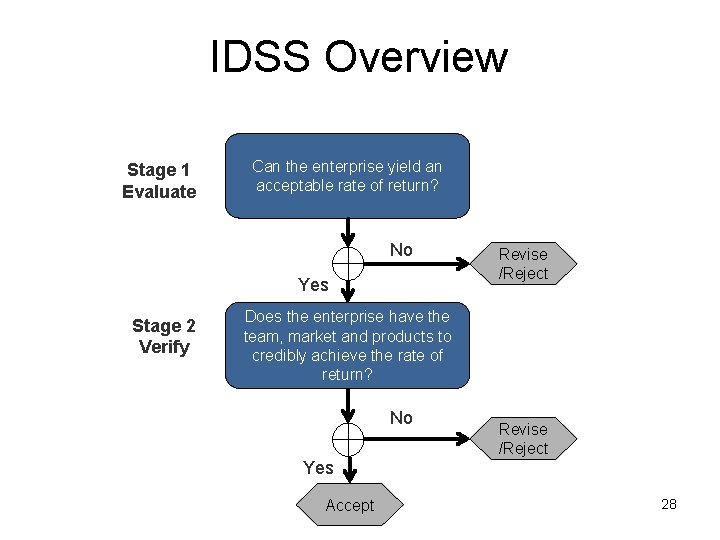
IDSS Overview Stage 1 Evaluate Can the enterprise yield an acceptable rate of return? No Yes Stage 2 Verify Revise /Reject Does the enterprise have the team, market and products to credibly achieve the rate of return? No Revise /Reject Yes Accept 28
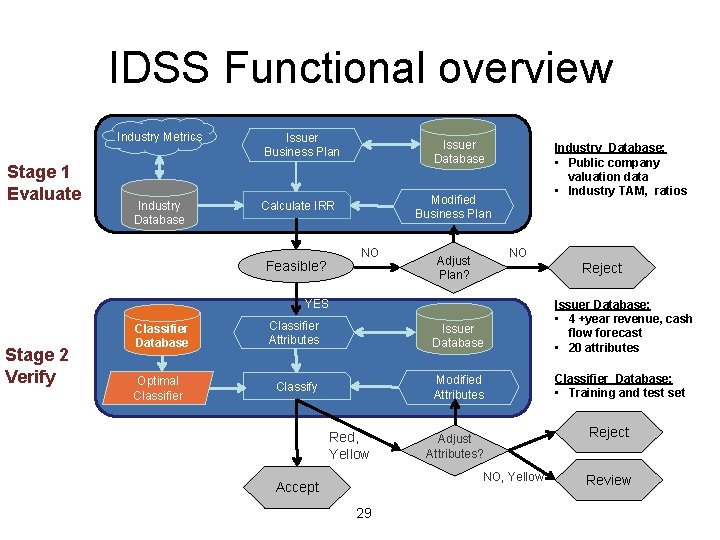
IDSS Functional overview Industry Metrics Stage 1 Evaluate Industry Database Issuer Business Plan Issuer Database Industry Database: • Public company valuation data • Industry TAM, ratios Modified Business Plan Calculate IRR YES Feasible? NO NO Adjust Plan? Reject YES Stage 2 Verify Classifier Database Optimal Classifier Attributes Issuer Database: • 4 +year revenue, cash flow forecast • 20 attributes Classify Modified Attributes Classifier Database: • Training and test set Green Red, Yellow YES NO, Red Adjust Attributes? NO, Yellow Accept 29 Reject Review
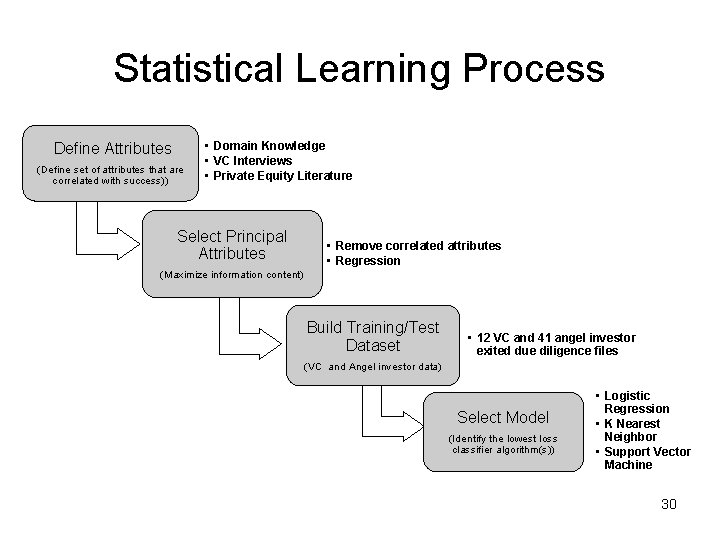
Statistical Learning Process Define Attributes (Define set of attributes that are correlated with success)) • Domain Knowledge • VC Interviews • Private Equity Literature Select Principal Attributes • Remove correlated attributes • Regression (Maximize information content) Build Training/Test Dataset • 12 VC and 41 angel investor exited due diligence files (VC and Angel investor data) Select Model (Identify the lowest loss classifier algorithm(s)) • Logistic Regression • K Nearest Neighbor • Support Vector Machine 30
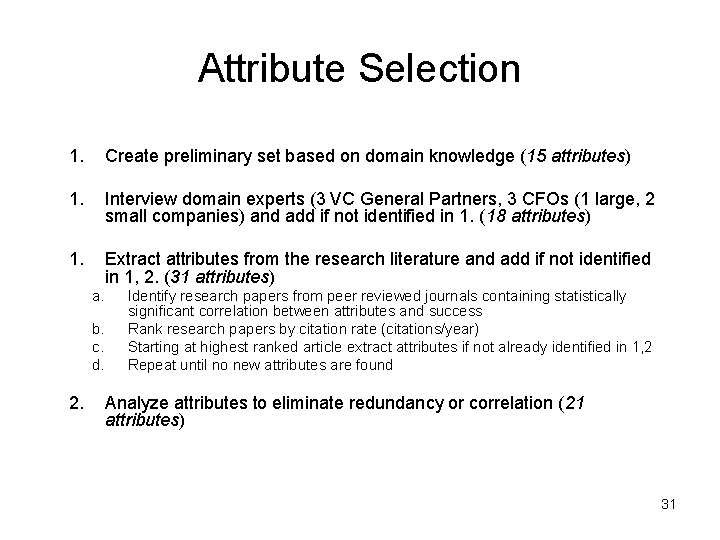
Attribute Selection 1. Create preliminary set based on domain knowledge (15 attributes) 1. Interview domain experts (3 VC General Partners, 3 CFOs (1 large, 2 small companies) and add if not identified in 1. (18 attributes) 1. Extract attributes from the research literature and add if not identified in 1, 2. (31 attributes) a. b. c. d. 2. Identify research papers from peer reviewed journals containing statistically significant correlation between attributes and success Rank research papers by citation rate (citations/year) Starting at highest ranked article extract attributes if not already identified in 1, 2 Repeat until no new attributes are found Analyze attributes to eliminate redundancy or correlation (21 attributes) 31
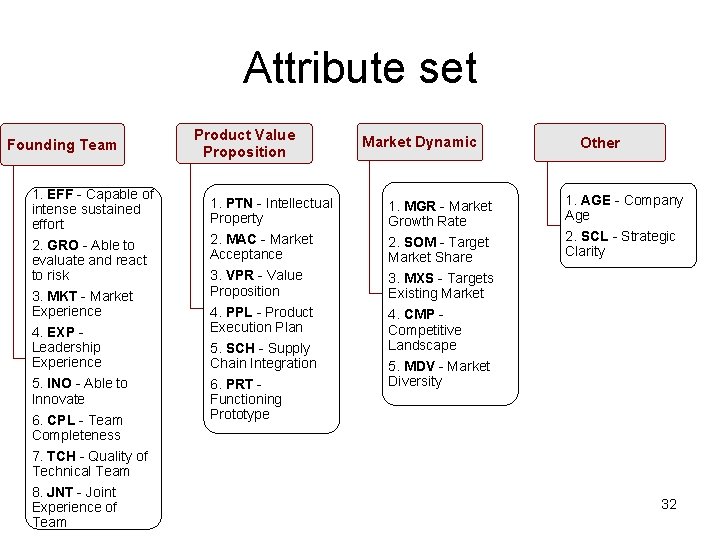
Attribute set Founding Team 1. EFF - Capable of intense sustained effort 2. GRO - Able to evaluate and react to risk 3. MKT - Market Experience 4. EXP Leadership Experience 5. INO - Able to Innovate 6. CPL - Team Completeness 7. TCH - Quality of Technical Team 8. JNT - Joint Experience of Team Product Value Proposition 1. PTN - Intellectual Property 2. MAC - Market Acceptance 3. VPR - Value Proposition 4. PPL - Product Execution Plan 5. SCH - Supply Chain Integration 6. PRT Functioning Prototype Market Dynamic 1. MGR - Market Growth Rate 2. SOM - Target Market Share 3. MXS - Targets Existing Market 4. CMP Competitive Landscape 5. MDV - Market Diversity Other 1. AGE - Company Age 2. SCL - Strategic Clarity 32
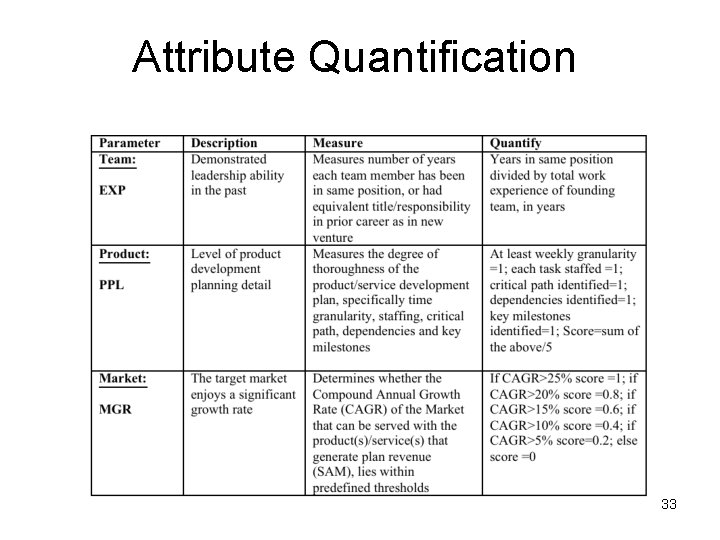
Attribute Quantification 33
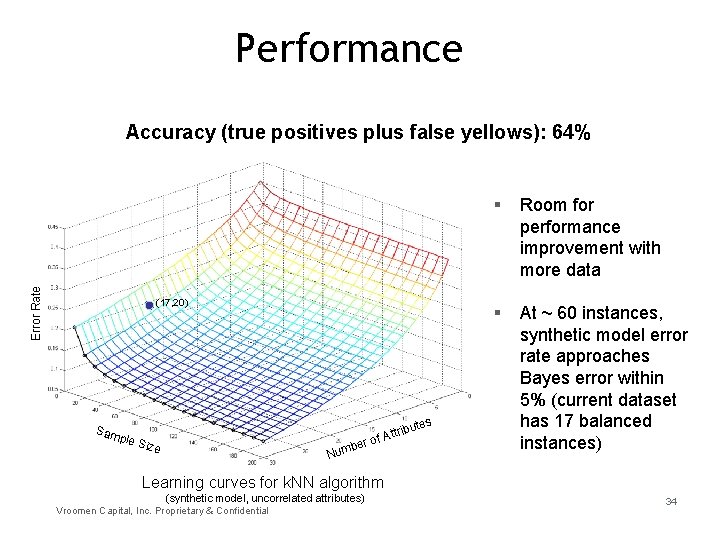
Performance Error Rate Accuracy (true positives plus false yellows): 64% (17, 20) s Sam ple S ber ize Num o te ribu f Att § Room for performance improvement with more data § At ~ 60 instances, synthetic model error rate approaches Bayes error within 5% (current dataset has 17 balanced instances) Learning curves for k. NN algorithm (synthetic model, uncorrelated attributes) Vroomen Capital, Inc. Proprietary & Confidential 34
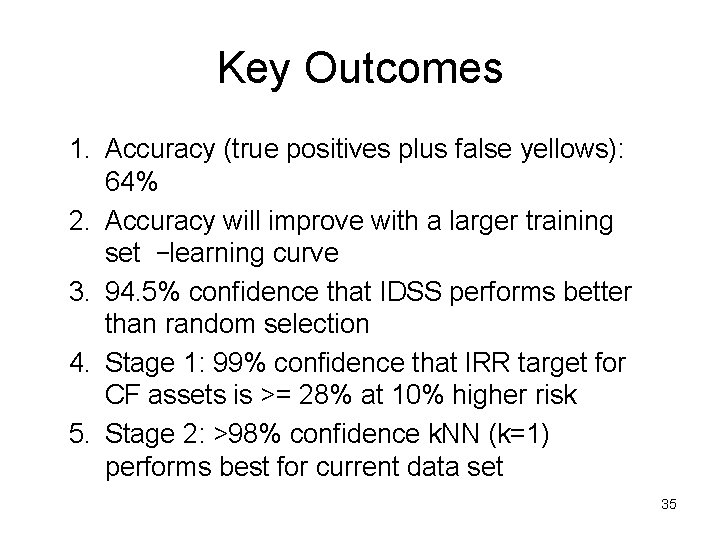
Key Outcomes 1. Accuracy (true positives plus false yellows): 64% 2. Accuracy will improve with a larger training set –learning curve 3. 94. 5% confidence that IDSS performs better than random selection 4. Stage 1: 99% confidence that IRR target for CF assets is >= 28% at 10% higher risk 5. Stage 2: >98% confidence k. NN (k=1) performs best for current data set 35
Conclusion The private equity industry is on the verge of facing the same disruption that the Internet has brought to the music industry, the airline industry, the hotel industry, the car rental industry, …. . . 36
Appendix 37
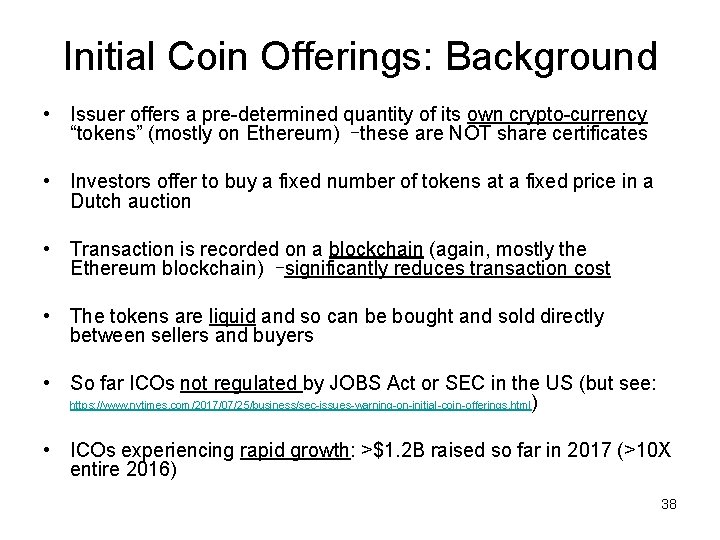
Initial Coin Offerings: Background • Issuer offers a pre-determined quantity of its own crypto-currency “tokens” (mostly on Ethereum) –these are NOT share certificates • Investors offer to buy a fixed number of tokens at a fixed price in a Dutch auction • Transaction is recorded on a blockchain (again, mostly the Ethereum blockchain) –significantly reduces transaction cost • The tokens are liquid and so can be bought and sold directly between sellers and buyers • So far ICOs not regulated by JOBS Act or SEC in the US (but see: https: //www. nytimes. com/2017/07/25/business/sec-issues-warning-on-initial-coin-offerings. html) • ICOs experiencing rapid growth: >$1. 2 B raised so far in 2017 (>10 X entire 2016) 38
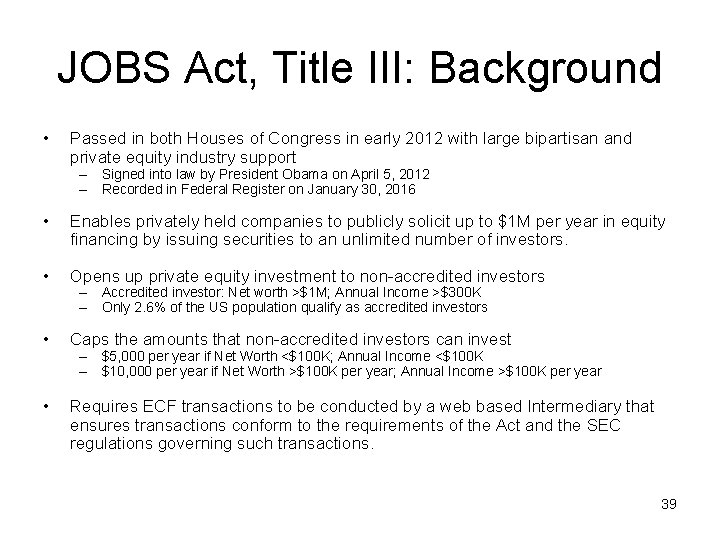
JOBS Act, Title III: Background • Passed in both Houses of Congress in early 2012 with large bipartisan and private equity industry support – Signed into law by President Obama on April 5, 2012 – Recorded in Federal Register on January 30, 2016 • Enables privately held companies to publicly solicit up to $1 M per year in equity financing by issuing securities to an unlimited number of investors. • Opens up private equity investment to non-accredited investors • Caps the amounts that non-accredited investors can invest • Requires ECF transactions to be conducted by a web based Intermediary that ensures transactions conform to the requirements of the Act and the SEC regulations governing such transactions. – Accredited investor: Net worth >$1 M; Annual Income >$300 K – Only 2. 6% of the US population qualify as accredited investors – $5, 000 per year if Net Worth <$100 K; Annual Income <$100 K – $10, 000 per year if Net Worth >$100 K per year; Annual Income >$100 K per year 39
Biography – Paul Vroomen • MSEE, MBA, Ph. D (Technology & Information Management, UCSC) • Chip Designer - first 7 years out of college • Business Unit VP/GM - 3 Public Companies Zilog, Inc. – Microprocessors; VLSI Technology, Inc. – Satellite TV. ; Oak Technology, Inc. – HDTV/DVD. • President/CEO - 3 Venture funded Start-ups Sand. Craft, Inc. - Datacom; Connex Inc. - HDTV; Sandbridge Inc. – Mobile Phone • Executive-In-Residence Tallwood Venture Capital, LLP • Raised $73 M in Venture Capital funding • Co-Board and Board member at 7 companies • Currently working on next start-up – Fintech (ICO/Equity Crowdfunding Platform); Member of Sand Hill Angels 40
- Slides: 40