
What DRG versions available in CHIA Inpatient Case
What DRG versions available in CHIA Inpatient Case Mix Data?
Review: Definition of DRG Diagnosis Related Group A classification system that groups patients according to diagnosis, type of treatment, age, and other relevant criteria. Under the prospective payment system, hospitals are paid a set fee for treating patients in a single DRG category, regardless of the actual cost of care for the individual. Source: CMS http: //www. cms. gov/apps/glossary/default. asp
Over the Past 30 years Multiple Versions of DRGs have been Created and Refined The Three Most Commonly Used DRGs Decade (2004 -2015) in HDD • All Patients Diagnosis Related Groups AP-DRG • All Patients Refined Diagnosis Related Groups APR-DRG • Medicare (CMS) Diagnosis Related Groups CMS-DRG
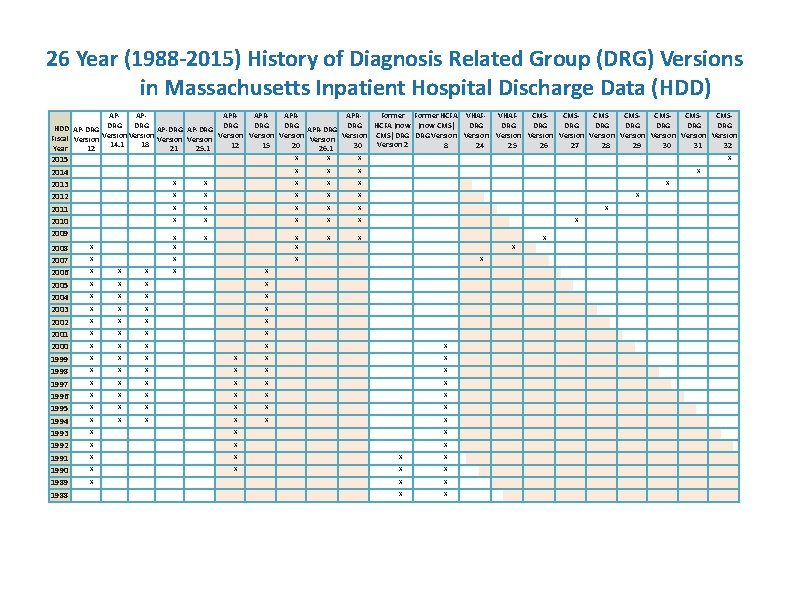
26 Year (1988 -2015) History of Diagnosis Related Group (DRG) Versions in Massachusetts Inpatient Hospital Discharge Data (HDD) APAPAPRAPRFormer HCFA VHAF- VHAFCMSCMSCMSCMSDRG AP-DRG DRG APR-DRG HCFA (now CMS) DRG DRG DRG HDD AP-DRG Fiscal Version Version Version CMS) DRG Version Version Version 2 14. 1 18 12 15 20 30 8 24 25 26 27 28 29 30 31 32 Year 12 21 25. 1 26. 1 2015 2014 2013 2012 2011 2010 2009 2008 2007 2006 2005 2004 2003 2002 2001 2000 1999 1998 1997 1996 1995 1994 1993 1992 1991 1990 1989 1988 X X X X X X X X X X X X X X X X X X X X X X X X X X X X X X X X X
What is the difference between the DRG versions?
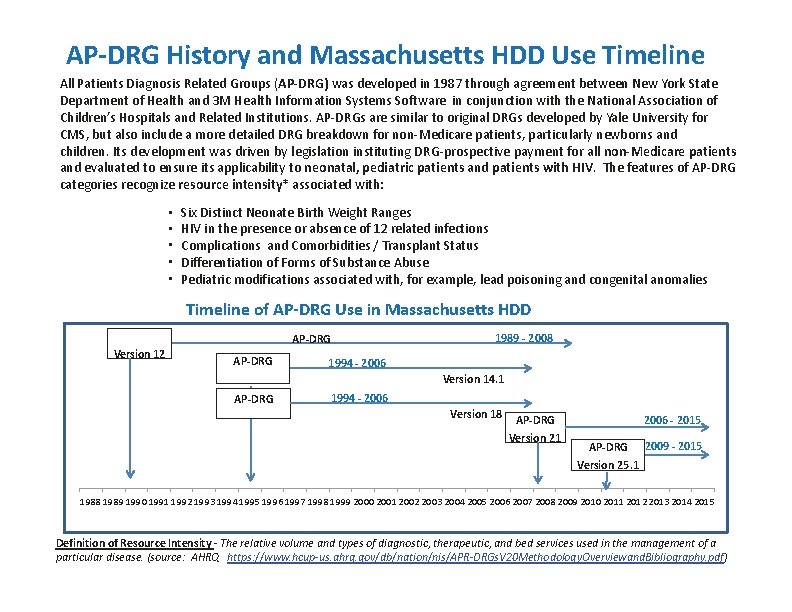
AP-DRG History and Massachusetts HDD Use Timeline All Patients Diagnosis Related Groups (AP-DRG) was developed in 1987 through agreement between New York State Department of Health and 3 M Health Information Systems Software in conjunction with the National Association of Children’s Hospitals and Related Institutions. AP-DRGs are similar to original DRGs developed by Yale University for CMS, but also include a more detailed DRG breakdown for non-Medicare patients, particularly newborns and children. Its development was driven by legislation instituting DRG-prospective payment for all non-Medicare patients and evaluated to ensure its applicability to neonatal, pediatric patients and patients with HIV. The features of AP-DRG categories recognize resource intensity* associated with: • • • Six Distinct Neonate Birth Weight Ranges HIV in the presence or absence of 12 related infections Complications and Comorbidities / Transplant Status Differentiation of Forms of Substance Abuse Pediatric modifications associated with, for example, lead poisoning and congenital anomalies Timeline of AP-DRG Use in Massachusetts HDD AP-DRG Version 12 AP-DRG 1989 - 2008 1994 - 2006 Version 14. 1 AP-DRG 1994 - 2006 Version 18 AP-DRG Version 21 2006 - 2015 AP-DRG 2009 - 2015 Version 25. 1 1988 1989 1990 1991 1992 1993 1994 1995 1996 1997 1998 1999 2000 2001 2002 2003 2004 2005 2006 2007 2008 2009 2010 2011 2012 2013 2014 2015 Definition of Resource Intensity - The relative volume and types of diagnostic, therapeutic, and bed services used in the management of a particular disease. (source: AHRQ https: //www. hcup-us. ahrq. gov/db/nation/nis/APR-DRGs. V 20 Methodology. Overviewand. Bibliography. pdf)
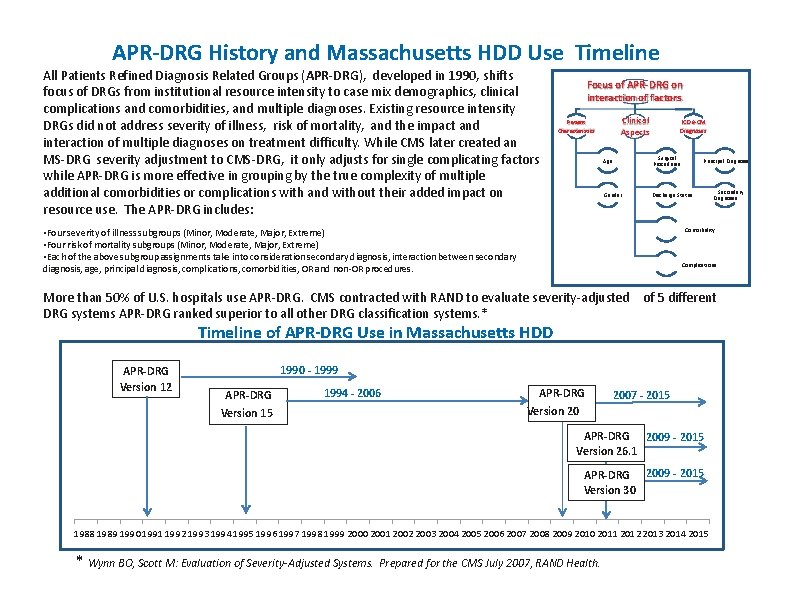
APR-DRG History and Massachusetts HDD Use Timeline All Patients Refined Diagnosis Related Groups (APR-DRG), developed in 1990, shifts focus of DRGs from institutional resource intensity to case mix demographics, clinical complications and comorbidities, and multiple diagnoses. Existing resource intensity DRGs did not address severity of illness, risk of mortality, and the impact and interaction of multiple diagnoses on treatment difficulty. While CMS later created an MS-DRG severity adjustment to CMS-DRG, it only adjusts for single complicating factors while APR-DRG is more effective in grouping by the true complexity of multiple additional comorbidities or complications with and without their added impact on resource use. The APR-DRG includes: Focus of APR-DRG on interaction of factors Clinical Aspects Patient Characteristics ICD-9 -CM Diagnoses Age Surgical Procedures Gender Discharge Status Principal Diagnosis Secondary Diagnoses Comorbidity • Four severity of illness subgroups (Minor, Moderate, Major, Extreme) • Four risk of mortality subgroups (Minor, Moderate, Major, Extreme) • Each of the above subgroup assignments take into consideration secondary diagnosis, interaction between secondary diagnosis, age, principal diagnosis, complications, comorbidities, OR and non-OR procedures. Complications More than 50% of U. S. hospitals use APR-DRG. CMS contracted with RAND to evaluate severity-adjusted of 5 different DRG systems APR-DRG ranked superior to all other DRG classification systems. * Timeline of APR-DRG Use in Massachusetts HDD APR-DRG Version 12 1990 - 1999 APR-DRG Version 15 1994 - 2006 APR-DRG Version 20 2007 - 2015 APR-DRG 2009 - 2015 Version 26. 1 APR-DRG 2009 - 2015 Version 30 1988 1989 1990 1991 1992 1993 1994 1995 1996 1997 1998 1999 2000 2001 2002 2003 2004 2005 2006 2007 2008 2009 2010 2011 2012 2013 2014 2015 * Wynn BO, Scott M: Evaluation of Severity-Adjusted Systems. Prepared for the CMS July 2007, RAND Health.
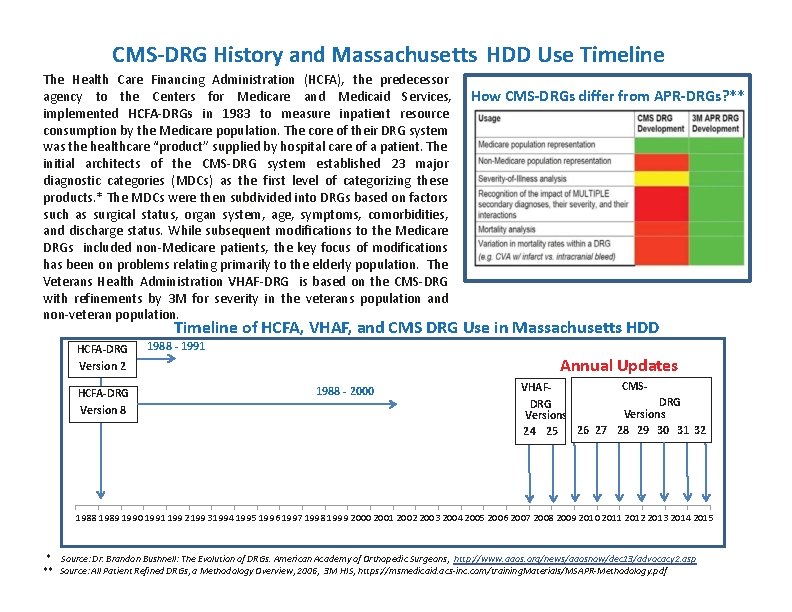
CMS-DRG History and Massachusetts HDD Use Timeline The Health Care Financing Administration (HCFA), the predecessor agency to the Centers for Medicare and Medicaid Services, implemented HCFA-DRGs in 1983 to measure inpatient resource consumption by the Medicare population. The core of their DRG system was the healthcare “product” supplied by hospital care of a patient. The initial architects of the CMS-DRG system established 23 major diagnostic categories (MDCs) as the first level of categorizing these products. * The MDCs were then subdivided into DRGs based on factors such as surgical status, organ system, age, symptoms, comorbidities, and discharge status. While subsequent modifications to the Medicare DRGs included non-Medicare patients, the key focus of modifications has been on problems relating primarily to the elderly population. The Veterans Health Administration VHAF-DRG is based on the CMS-DRG with refinements by 3 M for severity in the veterans population and non-veteran population. How CMS-DRGs differ from APR-DRGs? ** Timeline of HCFA, VHAF, and CMS DRG Use in Massachusetts HDD HCFA-DRG Version 2 HCFA-DRG Version 8 1988 - 1991 Annual Updates 1988 - 2000 CMSVHAFDRG Versions 26 27 28 29 30 31 32 24 25 1988 1989 1990 1991 1992 1993 1994 1995 1996 1997 1998 1999 2000 2001 2002 2003 2004 2005 2006 2007 2008 2009 2010 2011 2012 2013 2014 2015 * Source: Dr. Brandon Bushnell: The Evolution of DRGs. American Academy of Orthopedic Surgeons, http: //www. aaos. org/news/aaosnow/dec 13/advocacy 2. asp ** Source: All Patient Refined DRGs, a Methodology Overview, 2006, 3 M HIS, https: //msmedicaid. acs-inc. com/training. Materials/MSAPR-Methodology. pdf
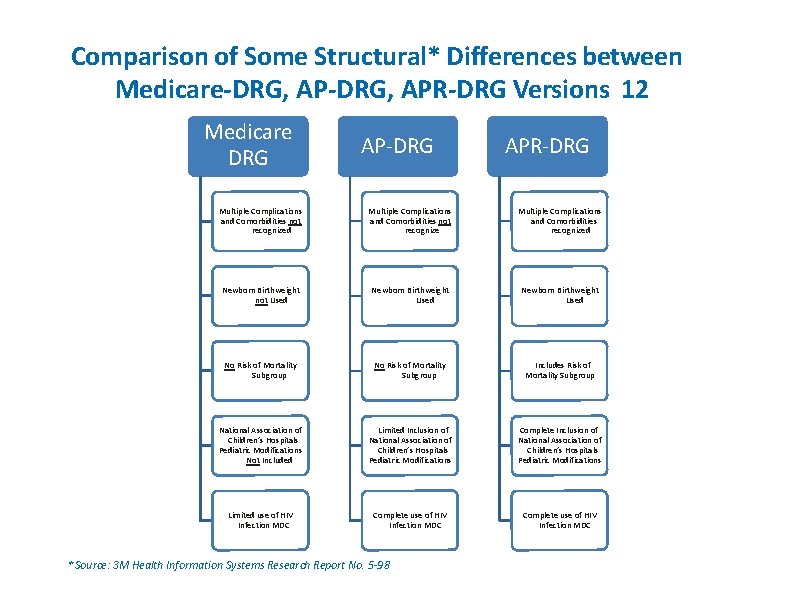
Comparison of Some Structural* Differences between Medicare-DRG, APR-DRG Versions 12 Medicare DRG AP-DRG APR-DRG Multiple Complications and Comorbidities not recognized Multiple Complications and Comorbidities not recognize Multiple Complications and Comorbidities recognized Newborn Birthweight not Used Newborn Birthweight Used No Risk of Mortality Subgroup Includes Risk of Mortality Subgroup National Association of Children’s Hospitals Pediatric Modifications Not Included Limited Inclusion of National Association of Children’s Hospitals Pediatric Modifications Complete Inclusion of National Association of Children’s Hospitals Pediatric Modifications Limited use of HIV Infection MDC Complete use of HIV Infection MDC * Source: 3 M Health Information Systems Research Report No. 5 -98
- Slides: 9