
What Does Your Data Mean Tables Data collected
What Does Your Data Mean?
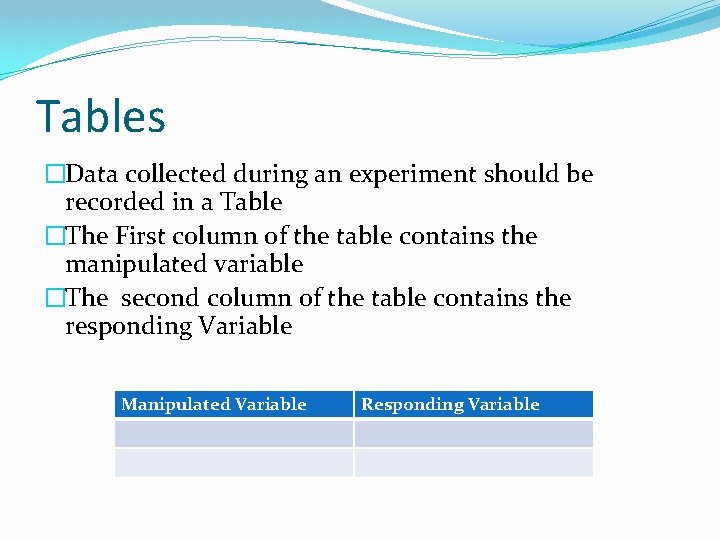
Tables �Data collected during an experiment should be recorded in a Table �The First column of the table contains the manipulated variable �The second column of the table contains the responding Variable Manipulated Variable Responding Variable
Tables �Your table should also have an title to describe what it is illustrating. �Example: �The effect of the brand of the gum on the bubble’s circumference �The effect of the temperature of the gum on the length of stretch. �The effect of the time gum is chewed on the mass of the gum.

Interpreting Data Tables �Step One – Read the Title, if there is one �Try to figure out the relationships between the different columns and rows Characteristics of the Outer Planets Planet Diameter (Km) Period of Average Period of Rotation distance from Revolution (Earth Sum (Earth Days) years) Number of Moons Jupiter 142, 800 . 41 778, 000 12 17 Saturn 120, 540 . 43 1, 427, 000 29 19 Uranus 51, 200 . 72 2, 871, 000 84 18 Neptune 49, 500 . 67 4, 497, 000 165 8 Pluto 2, 200 6. 4 5, 913, 000 248 1

Graphs �The independent variable is plotted on the x-axis �The dependent variable is plotted on the y-axis
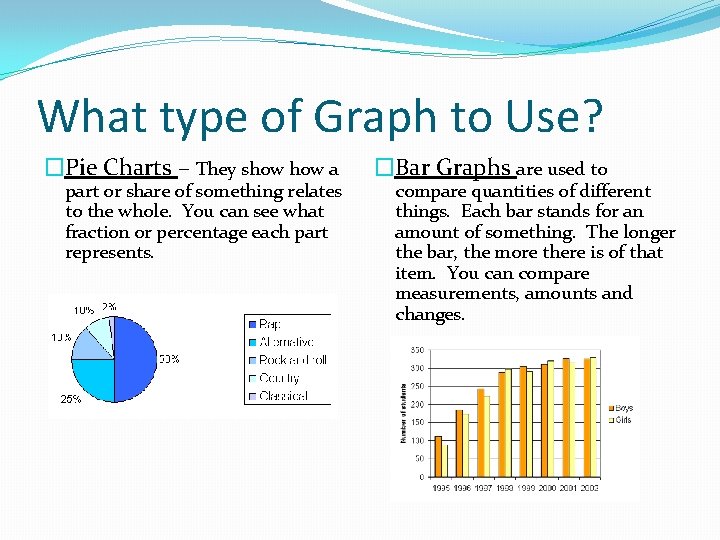
What type of Graph to Use? �Pie Charts – They show a part or share of something relates to the whole. You can see what fraction or percentage each part represents. �Bar Graphs are used to compare quantities of different things. Each bar stands for an amount of something. The longer the bar, the more there is of that item. You can compare measurements, amounts and changes.
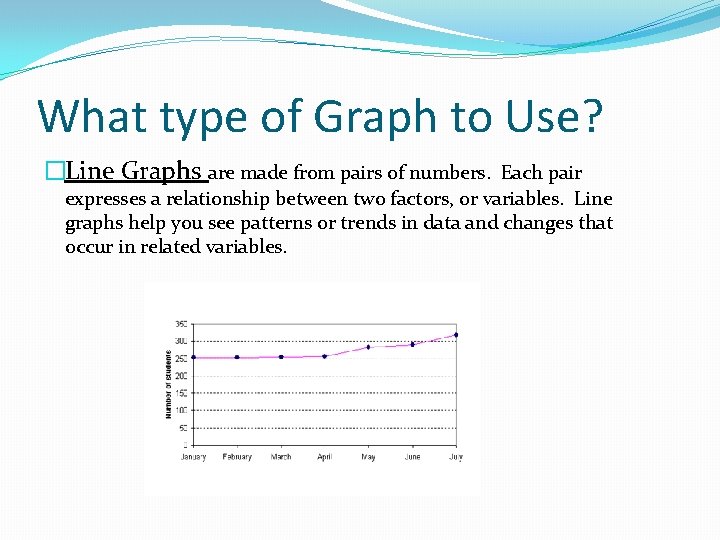
What type of Graph to Use? �Line Graphs are made from pairs of numbers. Each pair expresses a relationship between two factors, or variables. Line graphs help you see patterns or trends in data and changes that occur in related variables.
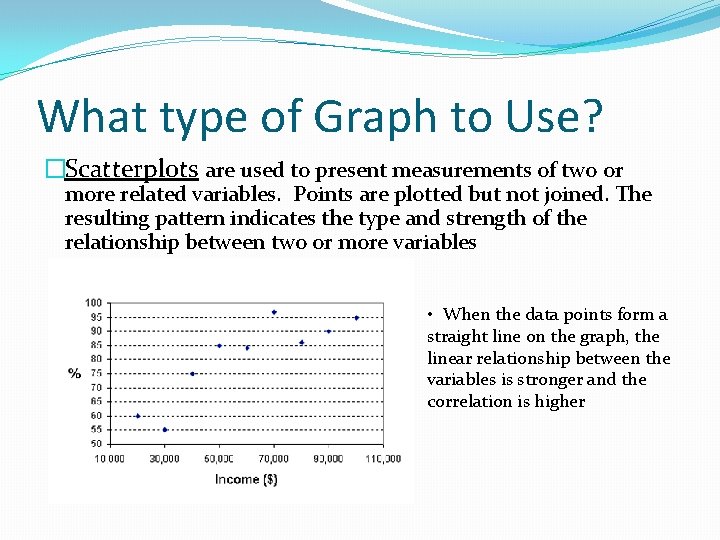
What type of Graph to Use? �Scatterplots are used to present measurements of two or more related variables. Points are plotted but not joined. The resulting pattern indicates the type and strength of the relationship between two or more variables • When the data points form a straight line on the graph, the linear relationship between the variables is stronger and the correlation is higher
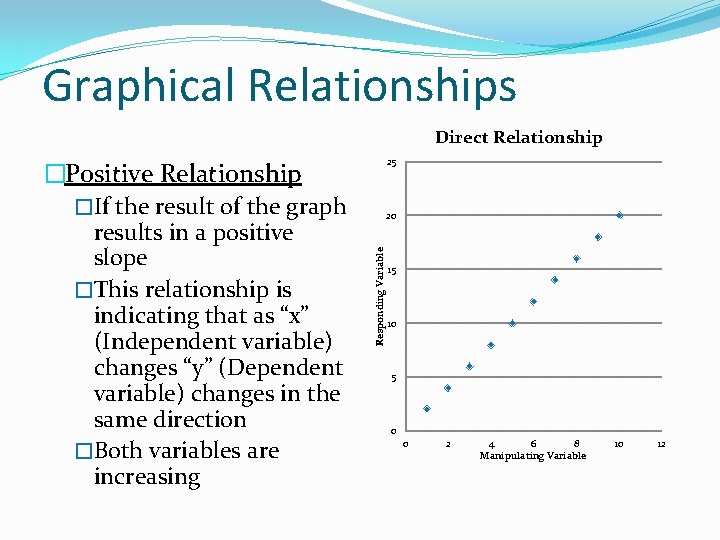
Graphical Relationships Direct Relationship 20 Responding Variable �Positive Relationship �If the result of the graph results in a positive slope �This relationship is indicating that as “x” (Independent variable) changes “y” (Dependent variable) changes in the same direction �Both variables are increasing 25 15 10 5 0 0 2 4 6 8 Manipulating Variable 10 12
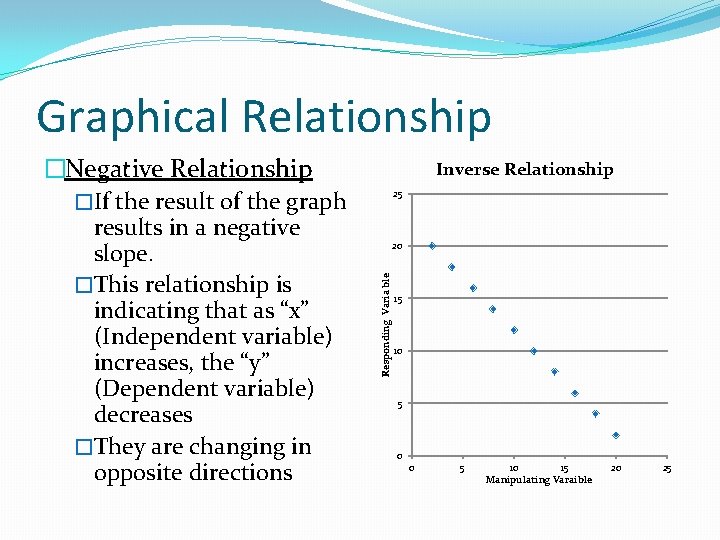
Graphical Relationship Inverse Relationship 25 20 Responding Varia ble �Negative Relationship �If the result of the graph results in a negative slope. �This relationship is indicating that as “x” (Independent variable) increases, the “y” (Dependent variable) decreases �They are changing in opposite directions 15 10 5 0 0 5 10 15 Manipulating Varaible 20 25
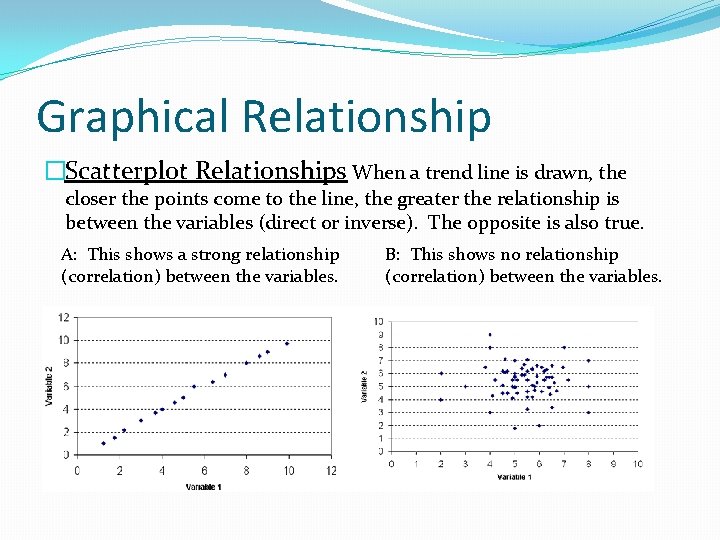
Graphical Relationship �Scatterplot Relationships When a trend line is drawn, the closer the points come to the line, the greater the relationship is between the variables (direct or inverse). The opposite is also true. A: This shows a strong relationship (correlation) between the variables. B: This shows no relationship (correlation) between the variables.
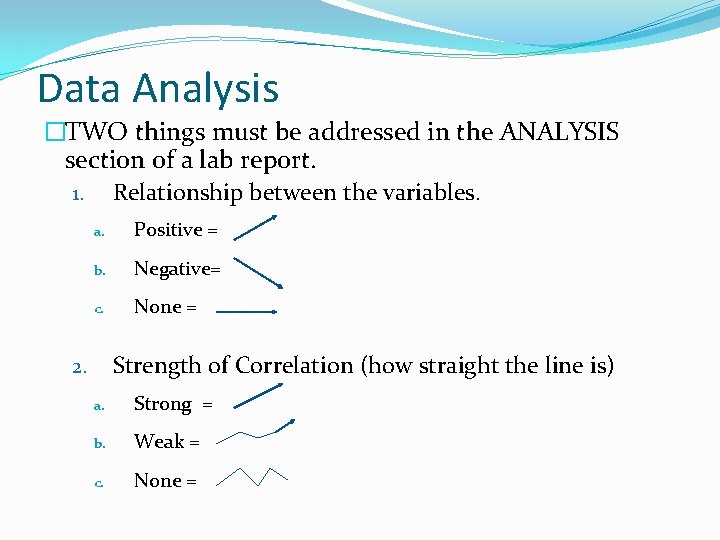
Data Analysis �TWO things must be addressed in the ANALYSIS section of a lab report. 1. Relationship between the variables. a. Positive = b. Negative= c. None = Strength of Correlation (how straight the line is) 2. a. Strong = b. Weak = c. None =
Data Analysis �Use data to support analysis. �Ex: According to my data I found a positive relationship between the time we chewed the gum and the length we stretched the gum. As you can see from my graph, after 1 minute of chewing, the gum only stretched 5 cm, but as we increased the chewing time to 5 minutes, we were able to stretch the gum to 20 cm. Because the increase of stretch was very consistent, the line on the line graph is straight showing a strong correlation between the two variables.
Reliability and Validity �Reliability = Reliability is the extent to which an experiment, test, or any measuring procedure yields the same result on repeated trials. �Validity =Validity refers to the degree to which a study accurately reflects or assesses the specific concept that the researcher is attempting to measure. There should be no bias. While reliability is concerned with the accuracy of the actual measuring instrument or procedure, validity is concerned with the study's success at measuring what the researchers set out to measure.
Further Study �What is “Further Study”? �It is. . . � Where you are going to go next to continue to study this topic. � Ex: Mythbusters found the butter side to land up more often. However, they are now hypothesizing that it is because of the dent in the bread. FURTHER STUDY would be to test which caused the bread to land up, the dent or the butter. �It is NOT. . . � What I could do to improve the test I already ran
- Slides: 15