
What does you mean BY Local Multipoint Distribution
What does you mean BY Local Multipoint Distribution Service ? Ø Local Multipoint Distribution Service (LMDS) : v Local indicates that the signals range limit. v Multipoint in v dicates a broadcast signal from the subscribers. v Distribution defines the wide range of data that can be transmitted. v Service involves the relationship between operators and users. Ø It provides high capacity point to multipoint data access that is
History Ø LMDS showed great promise in the late 1990 s. Ø The Federal Communications Commission auctioned spectrum for LMDS in 1998 and 1999. IMPORTANCE OF LMDS ØPoint-to-point fixed wireless network has been commonly deployed to offer highspeed dedicated links between high-density nodes in a network. Ø LMDS provides an effective last-mile solution for the incumbent service provider.
BENEFITS OF LMDS ØLower entry and deployment costs ØEase and speed of deployment ØFast realization of revenue ØCost, shift from fixed to variable components. ØNo stranded capital when customers churn. ØCost-effective network maintenance, management, and operating costs.
TECHNICAL BASICS ØLMDS, uses low powered, high frequency (25 -31 GHz) signals over a short distance. ØLMDS systems are cellular because they send these very high frequency signals over short line-of-sight distances. ØThese cells are typically spaced 4 -5 kilometres (2. 5 - 3. 1 miles) apart.
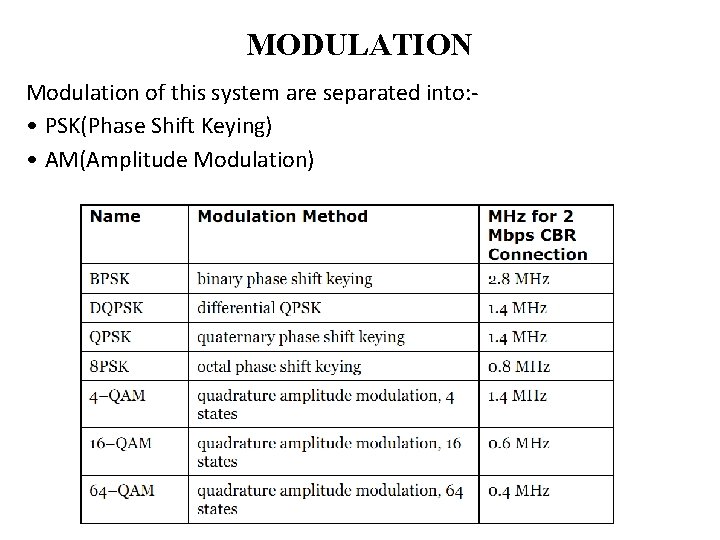
MODULATION Modulation of this system are separated into: • PSK(Phase Shift Keying) • AM(Amplitude Modulation)
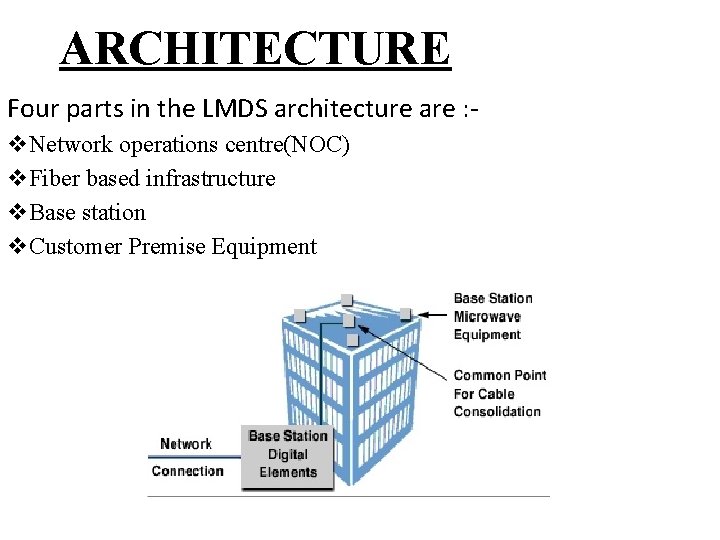
ARCHITECTURE Four parts in the LMDS architecture are : v. Network operations centre(NOC) v. Fiber based infrastructure v. Base station v. Customer Premise Equipment
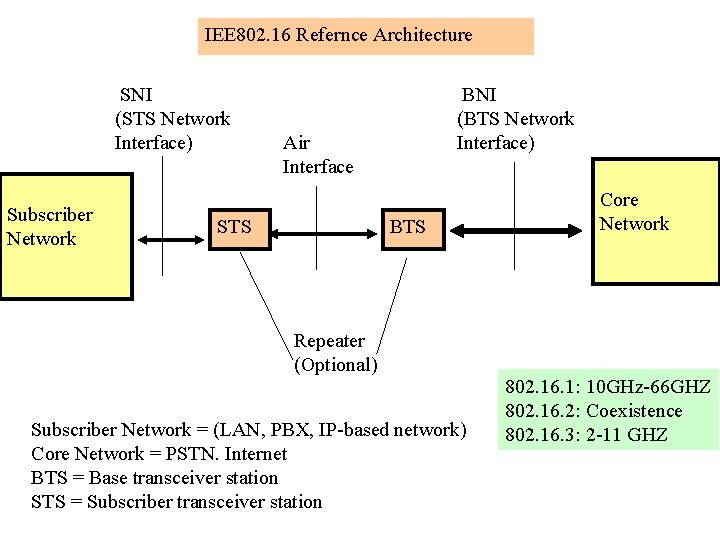
IEE 802. 16 Refernce Architecture SNI (STS Network Interface) Subscriber Network BNI (BTS Network Interface) Air Interface STS BTS Repeater (Optional) Subscriber Network = (LAN, PBX, IP-based network) Core Network = PSTN. Internet BTS = Base transceiver station STS = Subscriber transceiver station Core Network 802. 16. 1: 10 GHz-66 GHZ 802. 16. 2: Coexistence 802. 16. 3: 2 -11 GHZ
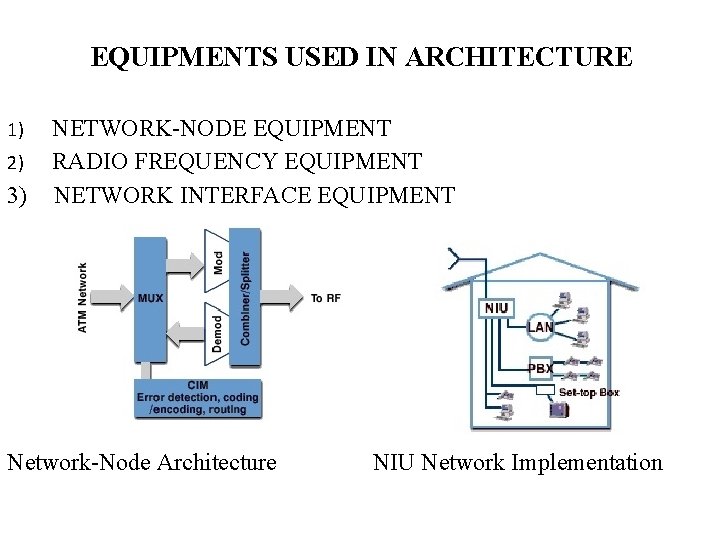
EQUIPMENTS USED IN ARCHITECTURE 1) 2) 3) NETWORK-NODE EQUIPMENT RADIO FREQUENCY EQUIPMENT NETWORK INTERFACE EQUIPMENT Network-Node Architecture NIU Network Implementation
Frequency Reuse Optimization ØMinimization of multipathing and cross-polarization by using highly directional antennas and positioning them as high as possible. ØMaximization of the directivity of the cell antennas by sectoring the distribution system. ØMaximization of the isolation between the adjacent sectors through polarization
Requirement For Network Management Ø Fault Management Ø Configuration Management Ø Accounting Management Ø Performance Management ØSecurity Management
APPLICATIONS OF LMDS ØWireless LAN. ØIt offers wide range of one way and two-way voice, video and data service transmission capabilities with a very large capacity, better than what many current services offer. ØAsynchronous Transfer Mode (ATM) can transport among others, voice, data and even video. Ø The Broadband Wireless Local Loop (B-WLL). ØThat are tending to merge the telecommunication and the networking industries.
- Slides: 11