
What does violence look like In the space


- Slides: 106
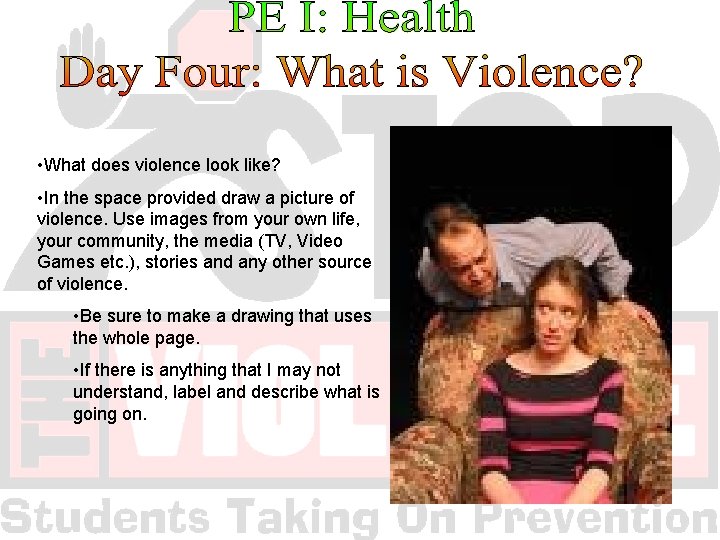
• What does violence look like? • In the space provided draw a picture of violence. Use images from your own life, your community, the media (TV, Video Games etc. ), stories and any other source of violence. • Be sure to make a drawing that uses the whole page. • If there is anything that I may not understand, label and describe what is going on.
• Answer the following questions in the space provided: 1. Describe your drawing. What is in it? What do these things mean? Where does your drawing take place? 2. Are the people in your drawing happy? Why or why not? 3. What do you think causes violence? 4. Is violence a good thing or a bad thing? Explain why you believe this to be true. 5. How can you prevent violence? 6. How does Violence Start?
Section 7. 1 What Is Violence? Objectives Describe all of the costs related to violence. Identify five risk factors for violence. Slide 4 of 21
Myth Most acts of violence are committed by strangers, often as part of robberies or other crimes. Fact In the United States, most acts of violence are done by people who know their victims. Why do you think that many people believe strangers commit most violent acts? Slide 5 of 21
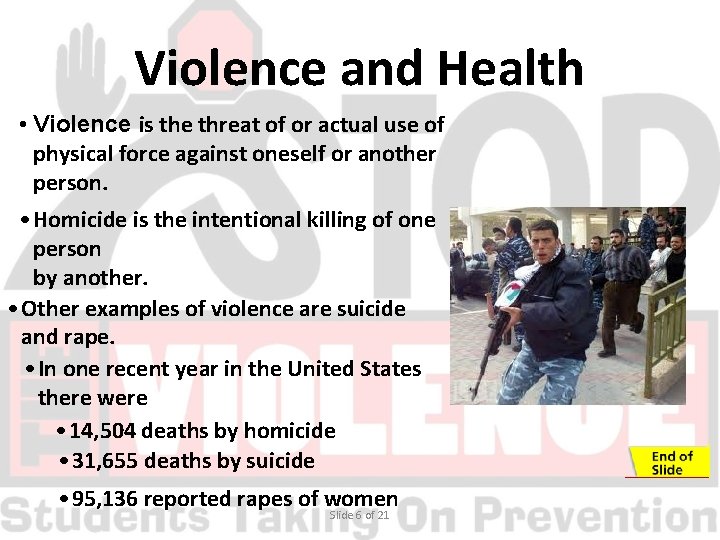
Violence and Health • Violence is the threat of or actual use of physical force against oneself or another person. • Homicide is the intentional killing of one person by another. • Other examples of violence are suicide and rape. • In one recent year in the United States there were • 14, 504 deaths by homicide • 31, 655 deaths by suicide • 95, 136 reported rapes of women Slide 6 of 21
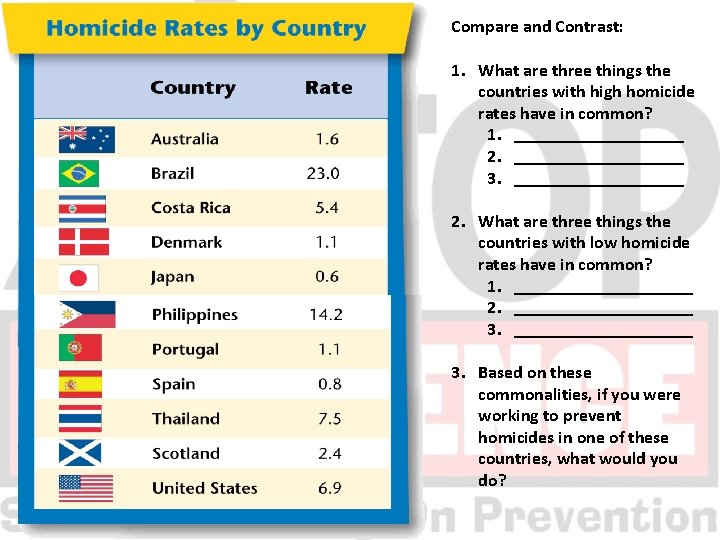
Compare and Contrast: 1. What are three things the countries with high homicide rates have in common? 1. __________ 2. __________ 3. __________ 2. What are three things the countries with low homicide rates have in common? 1. __________ 2. ____________________ 3. Based on these commonalities, if you were working to prevent homicides in one of these countries, what would you do? Slide 7 of 21
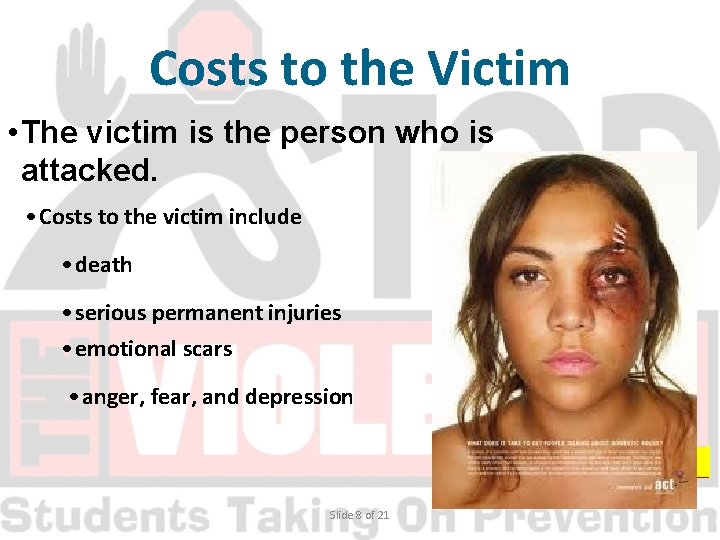
Costs to the Victim • The victim is the person who is attacked. • Costs to the victim include • death • serious permanent injuries • emotional scars • anger, fear, and depression Slide 8 of 21
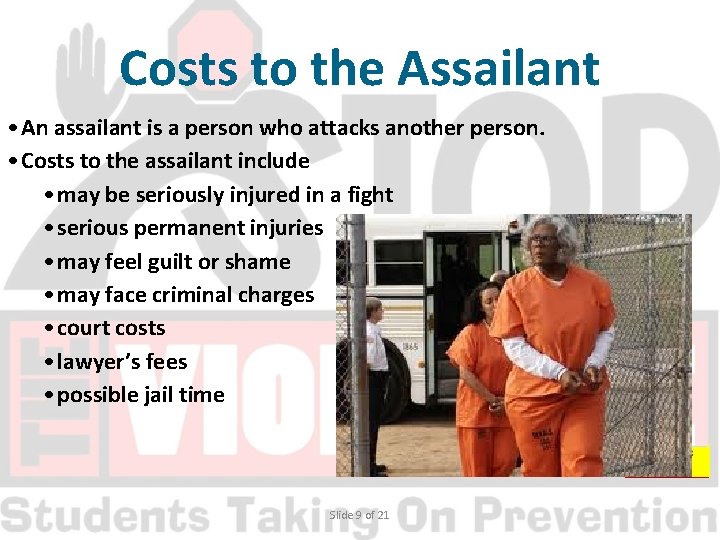
Costs to the Assailant • An assailant is a person who attacks another person. • Costs to the assailant include • may be seriously injured in a fight • serious permanent injuries • may feel guilt or shame • may face criminal charges • court costs • lawyer’s fees • possible jail time Slide 9 of 21
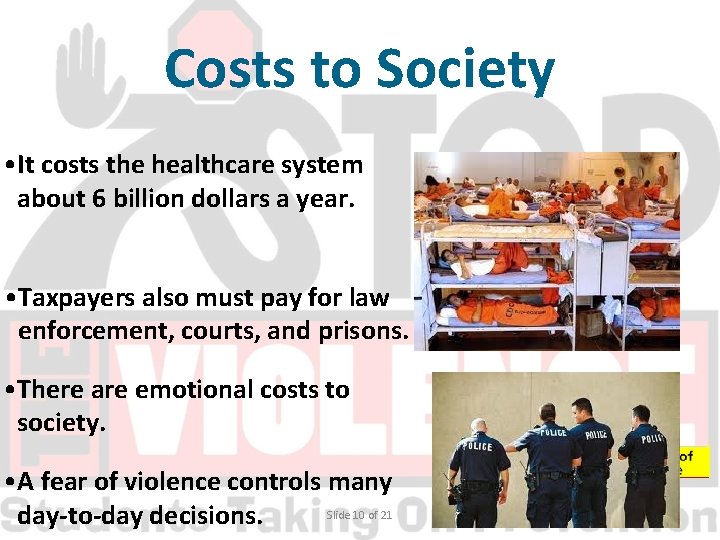
Costs to Society • It costs the healthcare system about 6 billion dollars a year. • Taxpayers also must pay for law enforcement, courts, and prisons. • There are emotional costs to society. • A fear of violence controls many Slide 10 of 21 day-to-day decisions.
Using the “homicide rates by country table”, about how many times greater is the homicide rate in the Philippines than the United States? Homicide rate in the Philippines: Homicide rate in the US:
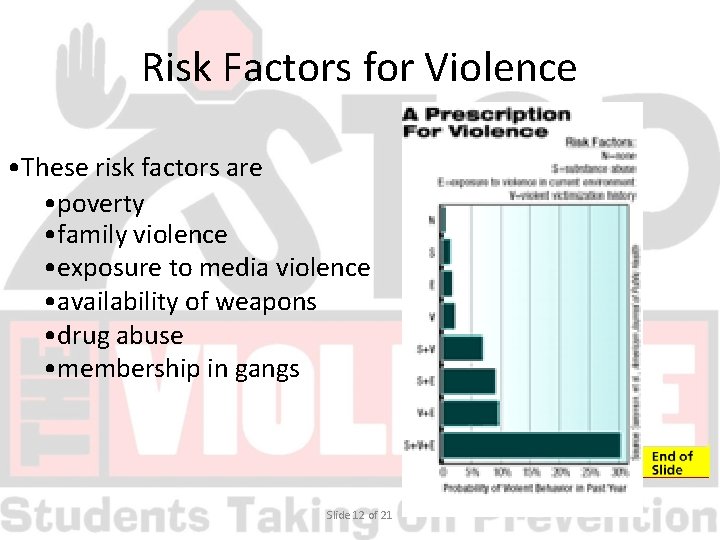
Risk Factors for Violence • These risk factors are • poverty • family violence • exposure to media violence • availability of weapons • drug abuse • membership in gangs Slide 12 of 21
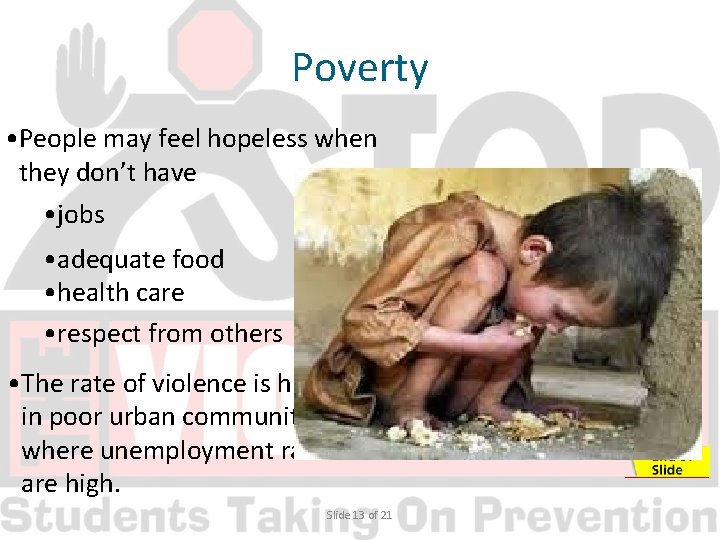
Poverty • People may feel hopeless when they don’t have • jobs • adequate food • health care • respect from others • The rate of violence is highest in poor urban communities where unemployment rates are high. Slide 13 of 21
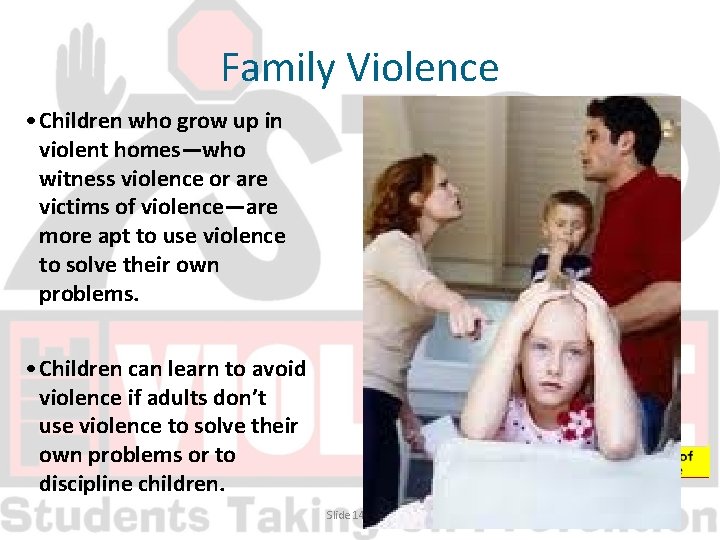
Family Violence • Children who grow up in violent homes—who witness violence or are victims of violence—are more apt to use violence to solve their own problems. • Children can learn to avoid violence if adults don’t use violence to solve their own problems or to discipline children. Slide 14 of 21
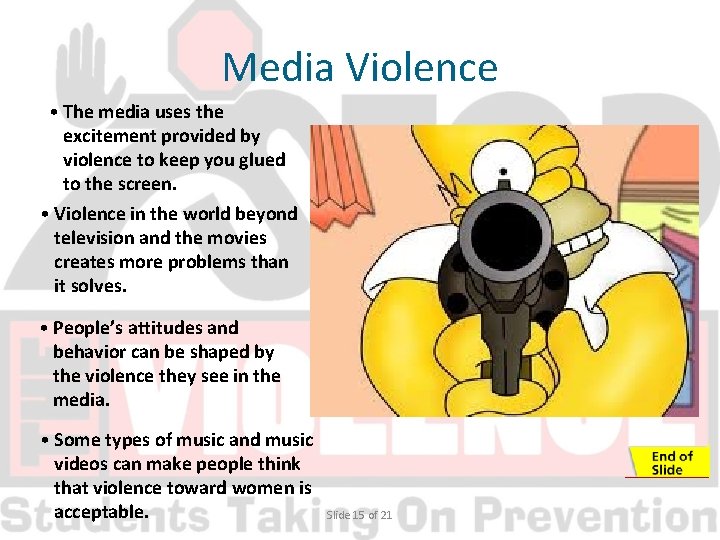
Media Violence • The media uses the excitement provided by violence to keep you glued to the screen. • Violence in the world beyond television and the movies creates more problems than it solves. • People’s attitudes and behavior can be shaped by the violence they see in the media. • Some types of music and music videos can make people think that violence toward women is acceptable. Slide 15 of 21
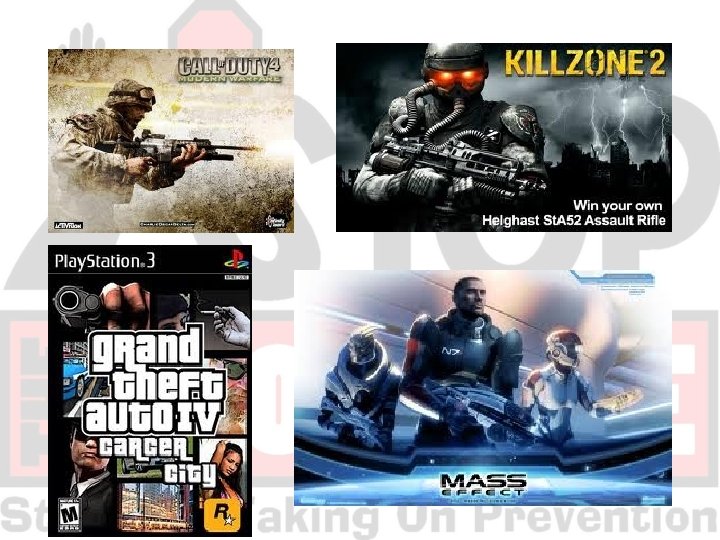
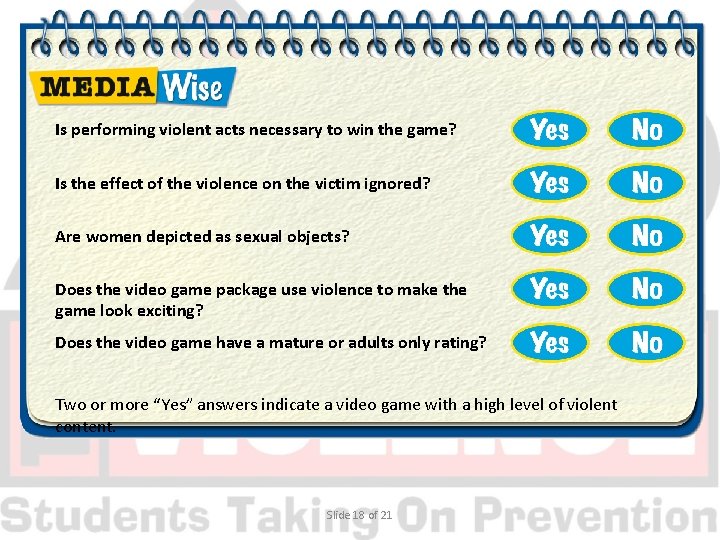
Violence in Video Games While playing violent video games, players often take on the role of assailants. What effect might identifying with an assailant have on players? Studies have linked violent video games to an increase in a player’s level of aggression. Use this checklist to evaluate the content of a video game. Slide 16 of 21
Is performing violent acts necessary to win the game? Is the effect of the violence on the victim ignored? Are women depicted as sexual objects? Does the video game package use violence to make the game look exciting? Does the video game have a mature or adults only rating? Two or more “Yes” answers indicate a video game with a high level of violent content. Slide 18 of 21
Violence in Video Games Look at the packaging for a few video games that have a mature rating. Is violence used to sell these games? Provide some examples to support your answer. Do the text and visuals make you want to play the game? Slide 19 of 21
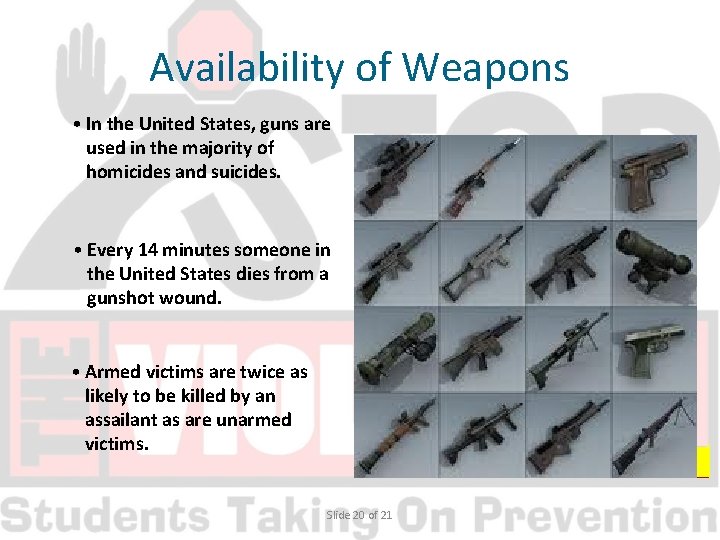
Availability of Weapons • In the United States, guns are used in the majority of homicides and suicides. • Every 14 minutes someone in the United States dies from a gunshot wound. • Armed victims are twice as likely to be killed by an assailant as are unarmed victims. Slide 20 of 21
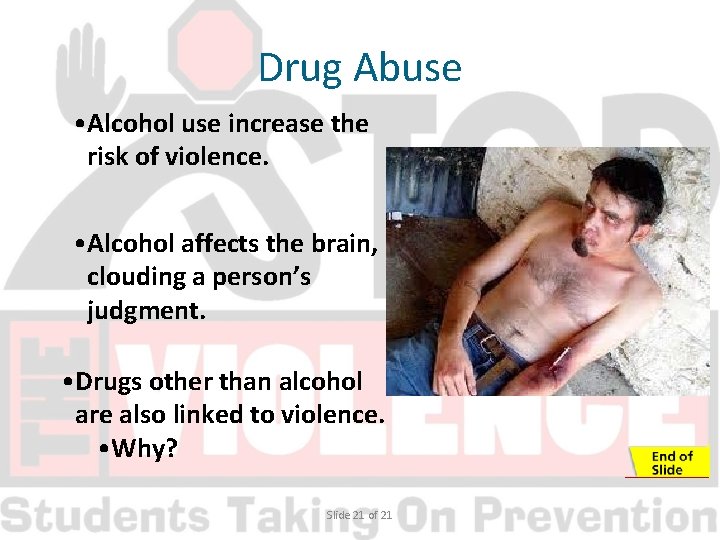
Drug Abuse • Alcohol use increase the risk of violence. • Alcohol affects the brain, clouding a person’s judgment. • Drugs other than alcohol are also linked to violence. • Why? Slide 21 of 21
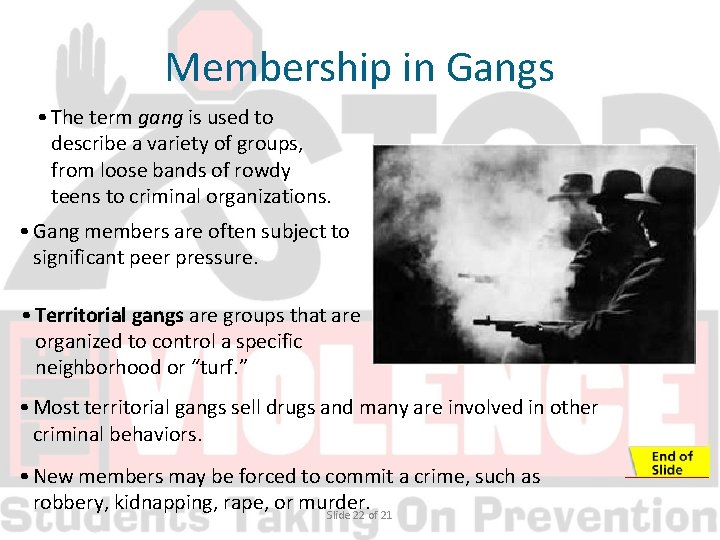
Membership in Gangs • The term gang is used to describe a variety of groups, from loose bands of rowdy teens to criminal organizations. • Gang members are often subject to significant peer pressure. • Territorial gangs are groups that are organized to control a specific neighborhood or “turf. ” • Most territorial gangs sell drugs and many are involved in other criminal behaviors. • New members may be forced to commit a crime, such as robbery, kidnapping, rape, or murder. Slide 22 of 21
Vocabulary violence The threat of or actual use of physical force against oneself or another person. homicide The intentional killing of one person by another. victim The person who is attacked during a violent act. assailant territorial gang A person who attacks another person. A group that is organized to control a specific neighborhood or “turf. ” Slide 23 of 21
Chapter 7, Section 1 describes what violence is, how it affects health and the risk factors for violence. Read, complete the note taking guide and section quiz.
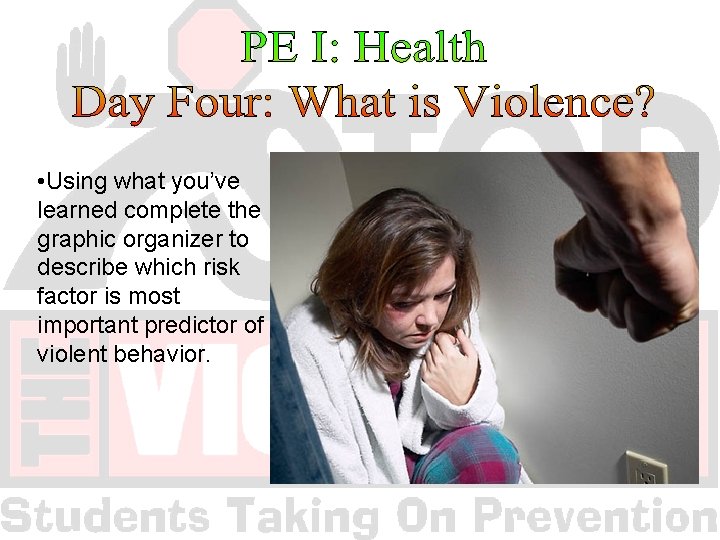
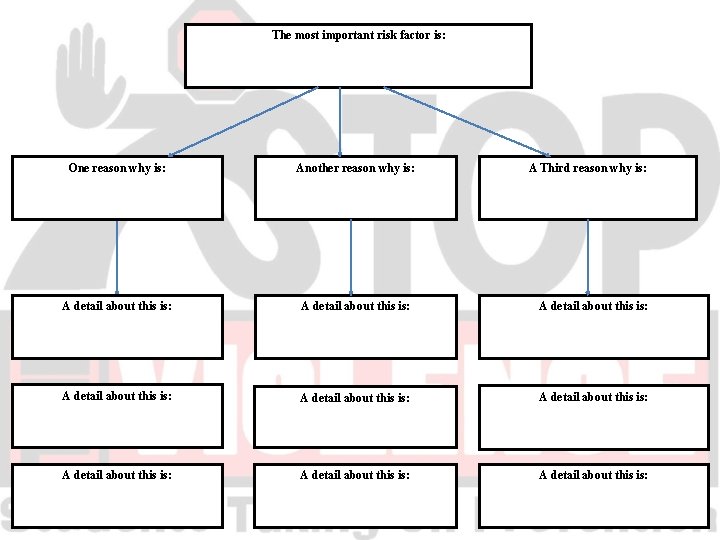
• Using what you’ve learned complete the graphic organizer to describe which risk factor is most important predictor of violent behavior.
The most important risk factor is: One reason why is: Another reason why is: A Third reason why is: A detail about this is: A detail about this is: A detail about this is:
• Read the following news article. Answer the questions afterward Kwame Kilpatrik: Former Mayor of Detroit
1. What are the physical costs to the victim? 2. What are the potential emotional costs to the victim? 3. What are the monetary costs to the victim/ victims’ family? 4. What are the physical costs to the assailant? 5. What are the potential emotional costs to the assailant? 6. What are the monetary costs to the assailant?
From time to time you may be asked / forced to act as a mediator between two people in conflict. During this exercise you will practice, with a partner, how to mediate a conflict using the six following steps.
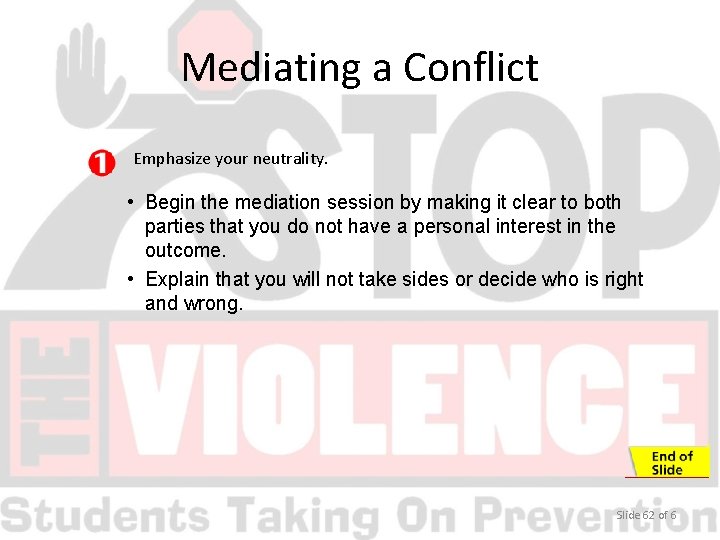
Mediating a Conflict Emphasize your neutrality. • Begin the mediation session by making it clear to both parties that you do not have a personal interest in the outcome. • Explain that you will not take sides or decide who is right and wrong. Slide 30 of 6
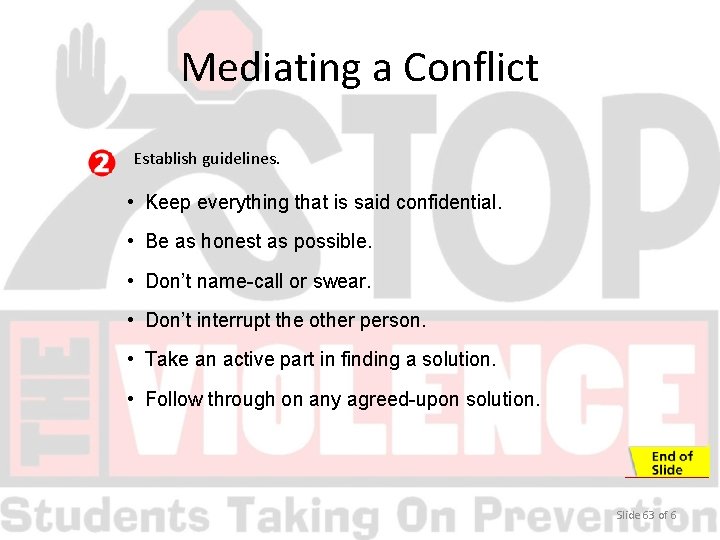
Mediating a Conflict Establish guidelines. • Keep everything that is said confidential. • Be as honest as possible. • Don’t name-call or swear. • Don’t interrupt the other person. • Take an active part in finding a solution. • Follow through on any agreed-upon solution. Slide 31 of 6
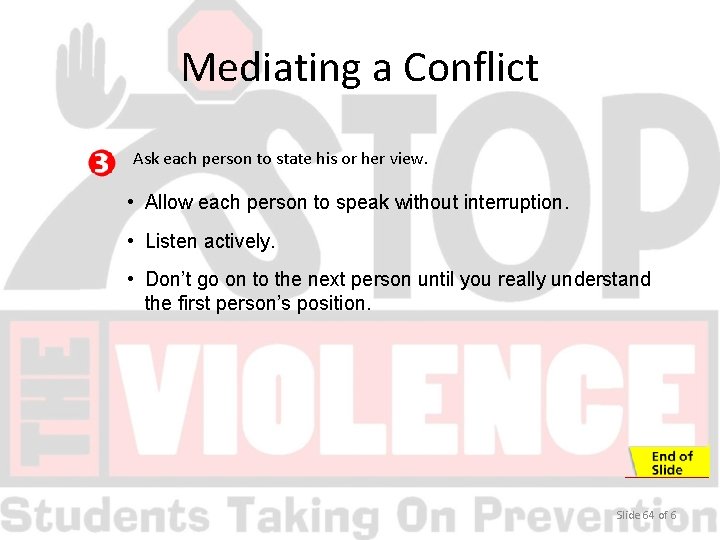
Mediating a Conflict Ask each person to state his or her view. • Allow each person to speak without interruption. • Listen actively. • Don’t go on to the next person until you really understand the first person’s position. Slide 32 of 6
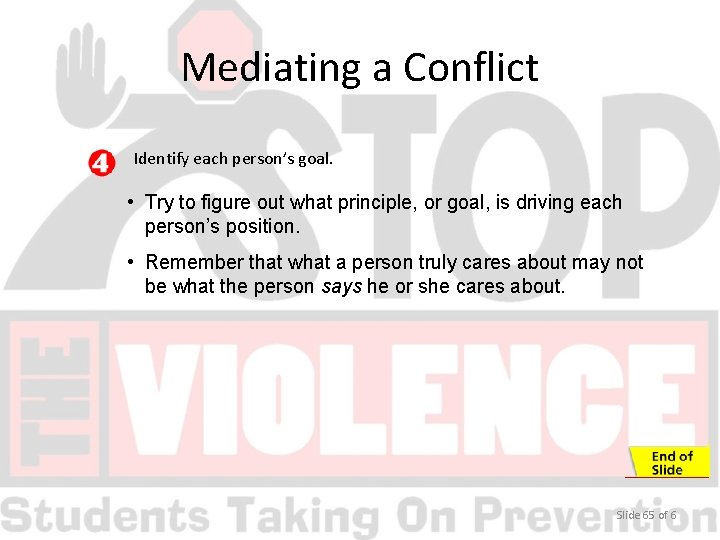
Mediating a Conflict Identify each person’s goal. • Try to figure out what principle, or goal, is driving each person’s position. • Remember that what a person truly cares about may not be what the person says he or she cares about. Slide 33 of 6
Mediating a Conflict Explore possible solutions. • If the participants seem relaxed, ask them to work together to brainstorm a list of possible solutions. • If the participants are tense or hostile, help them explore solutions one at a time. Slide 34 of 6
Mediating a Conflict Don’t give up. • Focus on what the parties agree on. • Keep the participants involved in the process. • If you are unable to find an agreeable solution, ask for help from an adult who has the respect and trust of both participants. Slide 35 of 6
Section 7. 2 Violence In Schools Objectives Explain the relationship between harassment and the use of weapons in school. Describe effective ways to reduce bullying, hazing, sexual harassment, and hate violence in schools. Slide 36 of 22
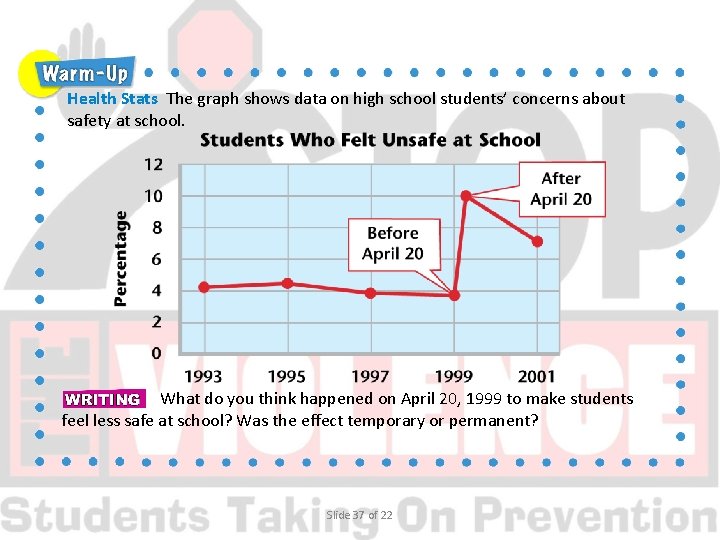
Health Stats The graph shows data on high school students’ concerns about safety at school. What do you think happened on April 20, 1999 to make students feel less safe at school? Was the effect temporary or permanent? Slide 37 of 22
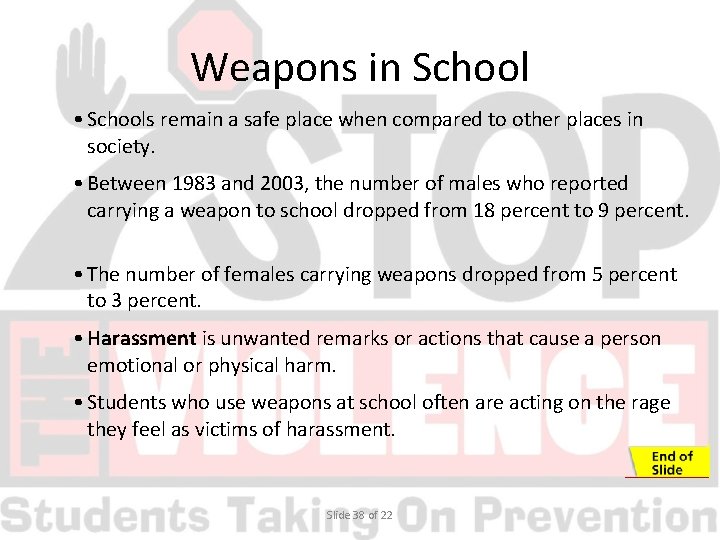
Weapons in School • Schools remain a safe place when compared to other places in society. • Between 1983 and 2003, the number of males who reported carrying a weapon to school dropped from 18 percent to 9 percent. • The number of females carrying weapons dropped from 5 percent to 3 percent. • Harassment is unwanted remarks or actions that cause a person emotional or physical harm. • Students who use weapons at school often are acting on the rage they feel as victims of harassment. Slide 38 of 22
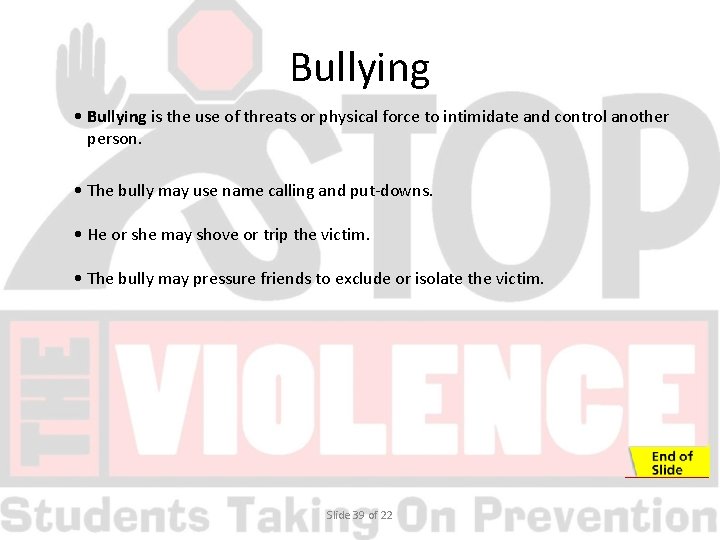
Bullying • Bullying is the use of threats or physical force to intimidate and control another person. • The bully may use name calling and put-downs. • He or she may shove or trip the victim. • The bully may pressure friends to exclude or isolate the victim. Slide 39 of 22
Cyber Bullying that takes place by e-mail, instant messaging, text messaging, or at Web sites is called cyber bullying. Slide 40 of 22
Cause and Effects • As a child, a bully may have learned to feel good at the expense of others. • Bullying produces a climate of fear and disrespect at schools. • The most effective way to stop bullying is to get bystanders involved. Slide 41 of 22
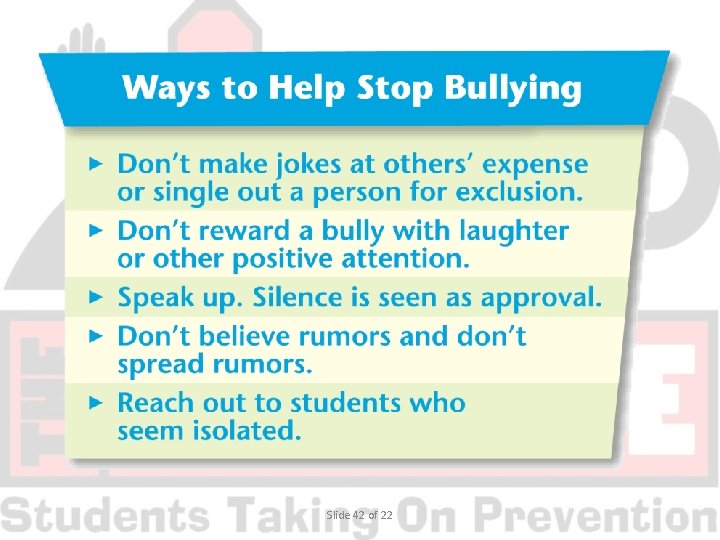
Slide 42 of 22
Hazing is requiring a person to do degrading, risky, or illegal acts in order to join a group. Slide 43 of 22
Gender and Hazing • Almost half of all high school students on school teams or clubs report being hazed. • Male teens are more likely to report being beaten. • Female teens are more likely to report emotional abuse. Slide 44 of 22
Preventing Hazing • In most states, hazing is illegal at both high schools and colleges. • School administrators and teachers need to take the lead in the prevention of hazing. Slide 45 of 22
Sexual Harassment • Sexual harassment is any uninvited and unwelcome sexual remark or sexual advance. • Some examples of sexual harassment include • making comments about a person’s body parts • unwanted touching • spreading rumors about someone’s sexual behavior • telling crude jokes Slide 46 of 22
What Schools Must Do • Sexual harassment in schools is illegal. • The administration at a school is required by law to respond quickly and forcefully when students complain about sexual harassment. Slide 47 of 22
What You Can Do • Speak up assertively. • Use your refusal skills. • Avoid having to be alone with someone you don’t trust. • Report behavior that you think is sexual harassment. Slide 48 of 22
Hate Violence • Hate violence is speech or behavior that is aimed at a person or group based on personal characteristics. • A person might be targeted because of race, ethnicity, gender, or religion. Slide 49 of 22
Prejudice and Intolerance • Prejudice is negative feelings about a group based on stereotypes. • A stereotype is an exaggerated belief or overgeneralization about an entire group of people. • Prejudice can lead to intolerance. • Intolerance is a lack of acceptance of another person’s opinions, beliefs, or actions. Slide 50 of 22
Discrimination • Frequently, intolerance leads to discrimination. • Discrimination is the unfair treatment of a person or group based on prejudice. Slide 51 of 22
Reducing Intolerance The most effective way to deal with violence based on hate is through education. Slide 52 of 22
Vandalism is intentionally damaging or destroying another person’s property. Slide 53 of 22
Vocabulary harassment bullying cyber bullying hazing Unwanted remarks or actions that cause a person emotional or physical harm. The use of threats or physical force to intimidate and control another person. Bullying that takes place by e-mail, instant messaging, text messaging, or at Web sites. Requiring a person to do degrading, risky, or illegal acts in order to join a group. sexual harassment Any uninvited and unwelcome sexual remark or sexual advance. hate violence Speech or behavior that is aimed at a person or group based on personal characteristics. Slide 54 of 22
Vocabulary prejudice Negative feelings about a group based on stereotypes. stereotype An exaggerated belief or overgeneralization about an entire group of people. intolerance A lack of acceptance of another person’s opinions, beliefs, or actions. discrimination vandalism The unfair treatment of a person or group based on prejudice. Intentionally damaging or destroying another person’s property. Slide 55 of 22
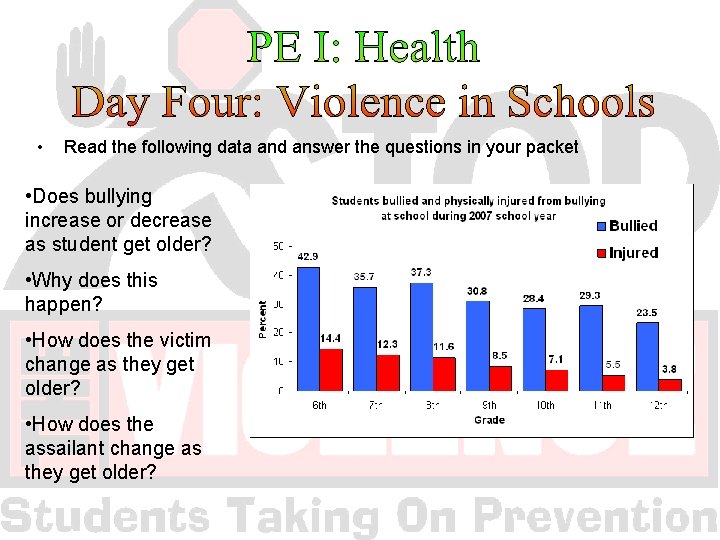
• Read the following data and answer the questions in your packet • Does bullying increase or decrease as student get older? • Why does this happen? • How does the victim change as they get older? • How does the assailant change as they get older?
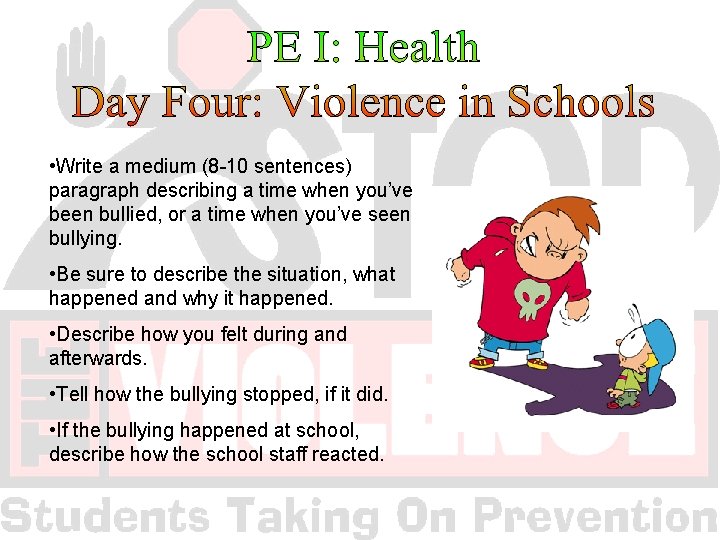
• Write a medium (8 -10 sentences) paragraph describing a time when you’ve been bullied, or a time when you’ve seen bullying. • Be sure to describe the situation, what happened and why it happened. • Describe how you felt during and afterwards. • Tell how the bullying stopped, if it did. • If the bullying happened at school, describe how the school staff reacted.
Chapter 7, Section 2 describes violence in school, and specifically bullying. Read this chapter, take notes and answer the questions (1 -6) on page 173
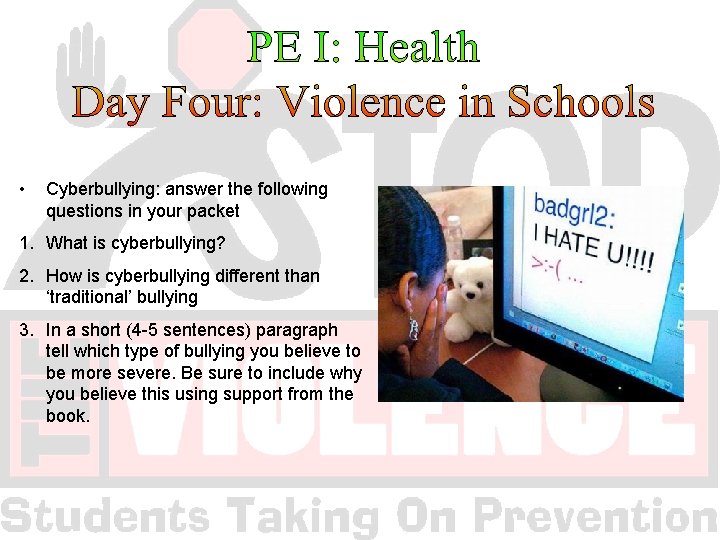
• Cyberbullying: answer the following questions in your packet 1. What is cyberbullying? 2. How is cyberbullying different than ‘traditional’ bullying 3. In a short (4 -5 sentences) paragraph tell which type of bullying you believe to be more severe. Be sure to include why you believe this using support from the book.
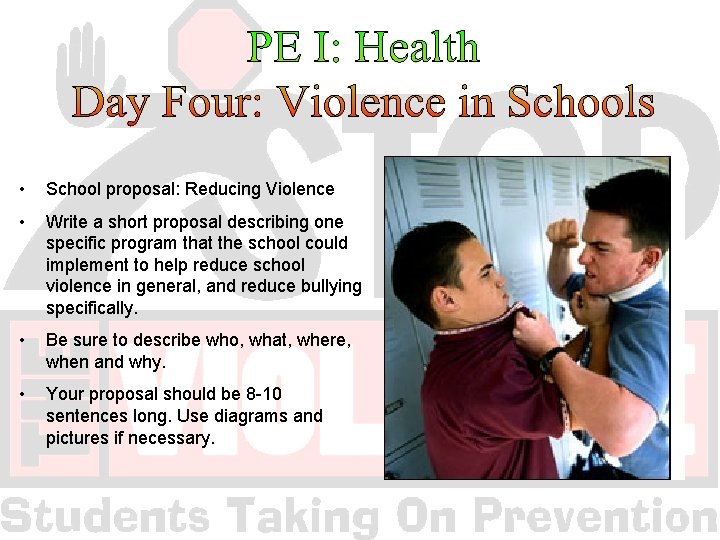
• School proposal: Reducing Violence • Write a short proposal describing one specific program that the school could implement to help reduce school violence in general, and reduce bullying specifically. • Be sure to describe who, what, where, when and why. • Your proposal should be 8 -10 sentences long. Use diagrams and pictures if necessary.
Mediating a Conflict Emphasize your neutrality. • Begin the mediation session by making it clear to both parties that you do not have a personal interest in the outcome. • Explain that you will not take sides or decide who is right and wrong. Slide 62 of 6
Mediating a Conflict Establish guidelines. • Keep everything that is said confidential. • Be as honest as possible. • Don’t name-call or swear. • Don’t interrupt the other person. • Take an active part in finding a solution. • Follow through on any agreed-upon solution. Slide 63 of 6
Mediating a Conflict Ask each person to state his or her view. • Allow each person to speak without interruption. • Listen actively. • Don’t go on to the next person until you really understand the first person’s position. Slide 64 of 6
Mediating a Conflict Identify each person’s goal. • Try to figure out what principle, or goal, is driving each person’s position. • Remember that what a person truly cares about may not be what the person says he or she cares about. Slide 65 of 6
Mediating a Conflict Explore possible solutions. • If the participants seem relaxed, ask them to work together to brainstorm a list of possible solutions. • If the participants are tense or hostile, help them explore solutions one at a time. Slide 66 of 6
Mediating a Conflict Don’t give up. • Focus on what the parties agree on. • Keep the participants involved in the process. • If you are unable to find an agreeable solution, ask for help from an adult who has the respect and trust of both participants. Slide 67 of 6
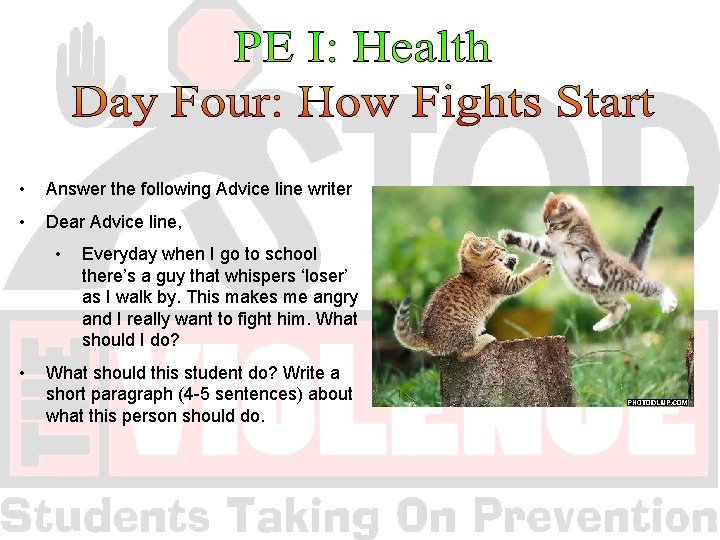
• Answer the following Advice line writer • Dear Advice line, • • Everyday when I go to school there’s a guy that whispers ‘loser’ as I walk by. This makes me angry and I really want to fight him. What should I do? What should this student do? Write a short paragraph (4 -5 sentences) about what this person should do.
Section 7. 3 How Fights Start Objectives Explain how anger and a desire for revenge can lead to fights. Describe the role that friends and bystanders play in fights. Explain the relationship between a need for control and violence. Slide 69 of 12
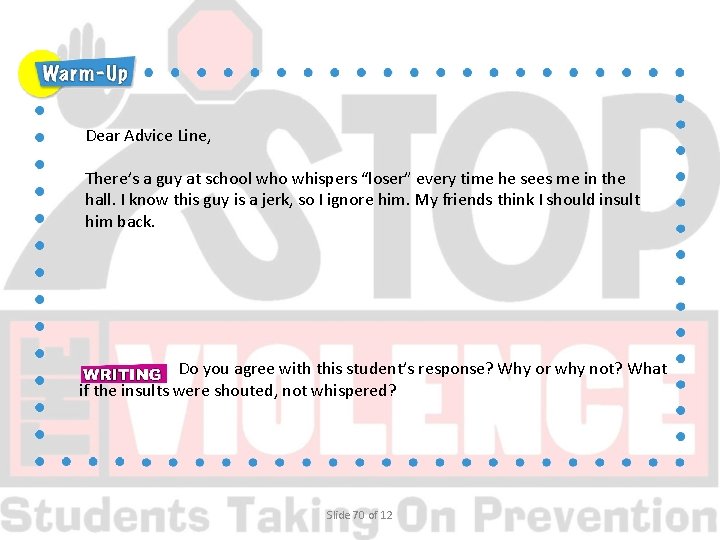
Dear Advice Line, There’s a guy at school who whispers “loser” every time he sees me in the hall. I know this guy is a jerk, so I ignore him. My friends think I should insult him back. Do you agree with this student’s response? Why or why not? What if the insults were shouted, not whispered? Slide 70 of 12
Arguments • Anger is at the root of most arguments and of many fights. • About 40% of all homicides stem directly from arguments. Slide 71 of 12
Anger • The body reacts to anger the same way it does to stress. • Physical changes include tensed muscles, and increased heart and breathing rates. • You can control your overall reaction to anger. • By choosing not to fight, you do not let the other person control you. Slide 72 of 12
Hurt Pride and Embarrassment • It is not surprising that hurt pride and embarrassment lead to fighting. • When your pride is hurt or you become embarrassed, you may become angry. Slide 73 of 12
Revenge • The desire for revenge leads to a dangerous cycle of fighting. • In cases where revenge is the motive for a fight, the fighting can quickly escalate or grow more intense. • Revenge is a common motive in fights between territorial gangs. Slide 74 of 12
Peer Pressure It is often more difficult for a person to avoid a fight when friends or bystanders are present. Slide 75 of 12
The Role of Friends • Friends who urge you to fight are acting as instigators. • Instigators are people who encourage fighting between others while staying out of the fight themselves. The Role of Bystanders The people who gather do so hoping to see a fight. Slide 76 of 12
Control • One person’s desire to have control over another is the main reason for domestic violence and dating violence. • There are laws that protect women in abusive relationships. • There also groups that try to help abusers learn to control their violent behavior. Slide 77 of 12
Vocabulary escalate instigator To grow more intense. A person who encourages fighting between others while staying out of the fight himself or herself. Slide 78 of 12
Read Chapter 7, Section 3 to learn more about how fights start. Take notes and complete the questions (1 -8) on page 177
Fighting in School Benefits Negatives • Complete a risk/ benefit chart for fighting in school • After completing your chart answer the following question: Is it worth it to fight in school?
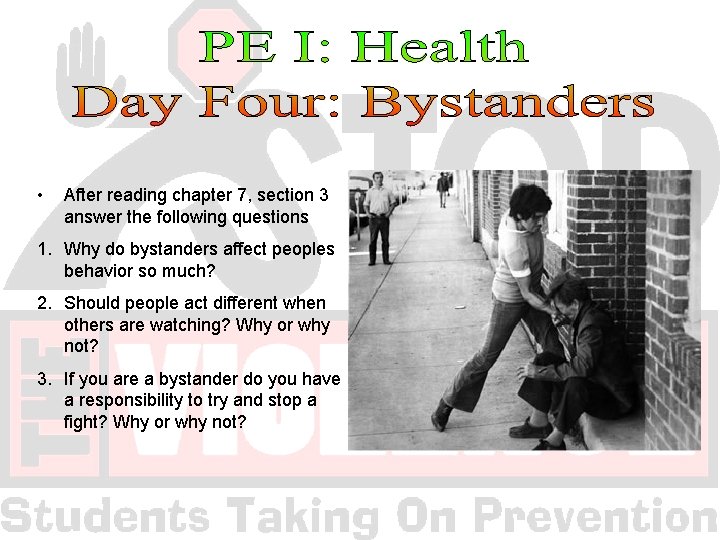
• After reading chapter 7, section 3 answer the following questions 1. Why do bystanders affect peoples behavior so much? 2. Should people act different when others are watching? Why or why not? 3. If you are a bystander do you have a responsibility to try and stop a fight? Why or why not?
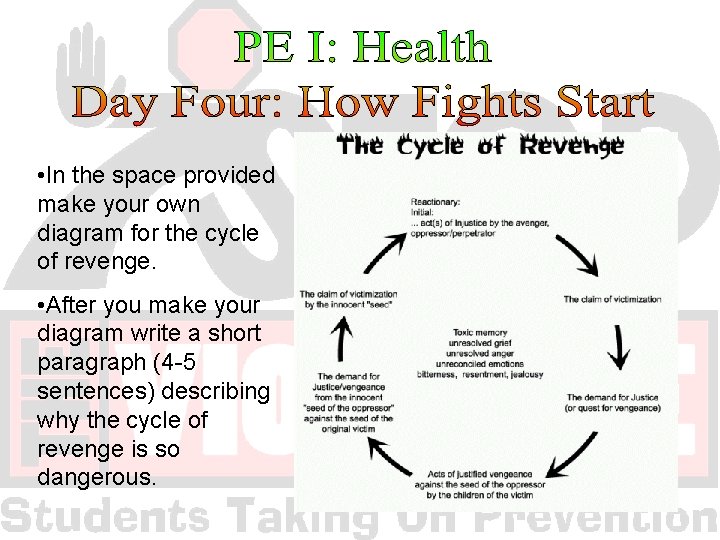
• In the space provided make your own diagram for the cycle of revenge. • After you make your diagram write a short paragraph (4 -5 sentences) describing why the cycle of revenge is so dangerous.
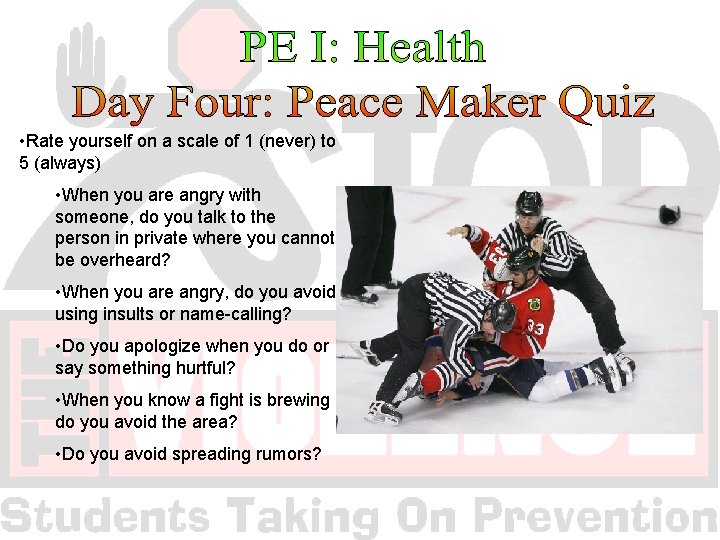
• Rate yourself on a scale of 1 (never) to 5 (always) • When you are angry with someone, do you talk to the person in private where you cannot be overheard? • When you are angry, do you avoid using insults or name-calling? • Do you apologize when you do or say something hurtful? • When you know a fight is brewing do you avoid the area? • Do you avoid spreading rumors?
Section 7. 4 Preventing Fights Objectives Describe two general approaches for resolving conflicts. Explain why safety should be a person’s first concern in any conflict. List how to confront a person wisely. Identify ways to help others avoid fighting. Slide 84 of 20
Quick Quiz For each statement, rate yourself on this scale. When I am upset with someone, I talk to the person in private where we cannot be overheard. When I am angry, I avoid using insults or name-calling. I apologize when I do or say something hurtful. I avoid spreading rumors. The higher your total score, the better your skills as a peacemaker. In which area would you most want to improve? Explain. Switch to Quick. Take version of the quiz. Slide 85 of 20
Choosing Not to Fight Once you recognize that a conflict exists, there are two general approaches you can take. • you can ignore the conflict • you can confront the person Slide 86 of 20
Ignoring a Conflict • Some people think that ignoring a conflict is a sign of cowardice. • It is actually a sign of maturity and self-control. Slide 87 of 20
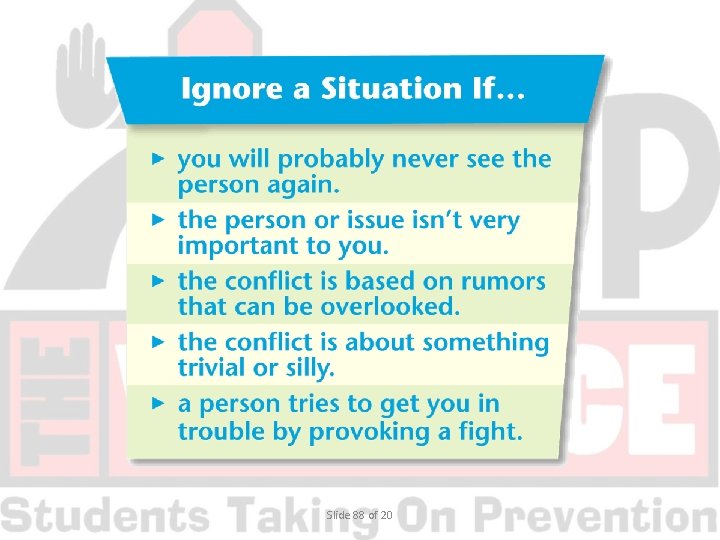
Slide 88 of 20
Be Flexible • Deciding to ignore the conflict could make the other person angrier. • Be prepared to try a new tactic if ignoring the conflict could make things worse. • In deciding how to deal with any conflict, your safety should always be your first concern. Slide 89 of 20
Learn to Control Your Anger • Learning to control your anger is an important skill to master if you want to avoid conflicts. • If you are not satisfied with the way you now deal with anger, many people can help you. • parents • teachers • coaches • school counselors • members of the clergy Slide 90 of 20
Confronting a Person Wisely To confront a person wisely, you need to • choose the right time and place • stay calm • negotiate a solution Slide 91 of 20
Choose the Time and Place Carefully • When you need to confront a person, pick a time when you can talk face-to-face. • It is best to meet in a public area. • If you suspect the other person is under the influence of drugs, postpone your discussion. Slide 92 of 20
Stay Calm • People have different techniques for keeping calm under pressure. • Rehearse the confrontation beforehand. • Use deep breathing or count to 20. Slide 93 of 20
Negotiate a Solution • Communication style can affect the outcome. • Do the Unexpected If, instead of being hostile, you are friendly, confident, and caring, the other person may relax his or her guard. • Provide a Way Out Present the other person with compromise solutions that you both can live with. • Be Willing to Apologize Sometimes a sincere apology can be the quickest way to defuse the situation. Slide 94 of 20
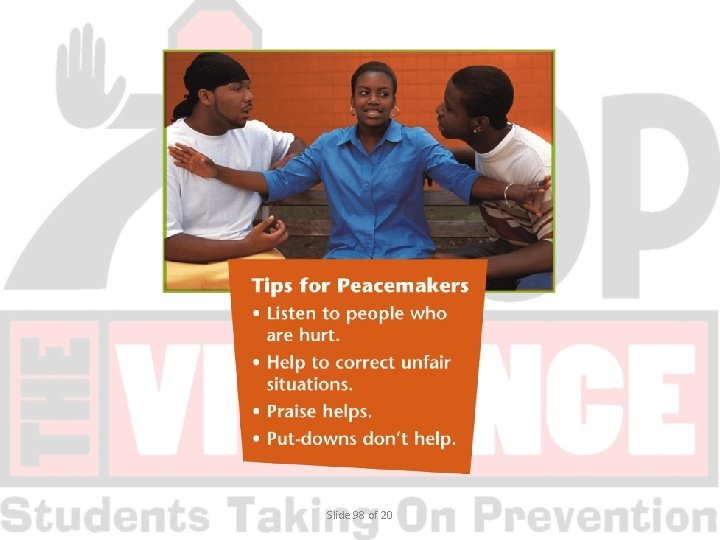
Helping Others to Avoid Fights You can help prevent fighting through • mediation • your role as a bystander • involving an adult Slide 95 of 20
Mediation A process for resolving conflicts that involves a neutral third party is called mediation. Slide 96 of 20
Your Role as a Bystander • As a bystander, you can use the following strategies to show your disapproval of fighting as a way to resolve conflicts. • Ignore those people who make negative remarks about other people. • Refuse to spread rumors. • Do not relay a threat or insult from one person to another. • Stay away from any area where you expect a fight could take place. Slide 97 of 20
Slide 98 of 20
When to Involve an Adult • If a friend reveals plans of violence to you, it is important to ask for help. • It is never easy to break a friend’s confidence. • Nevertheless, it is critical to share your friend’s plans for violence with a trusted adult. Slide 99 of 20
Vocabulary mediation A process for resolving conflicts that involves a neutral third party. Slide 100 of 20
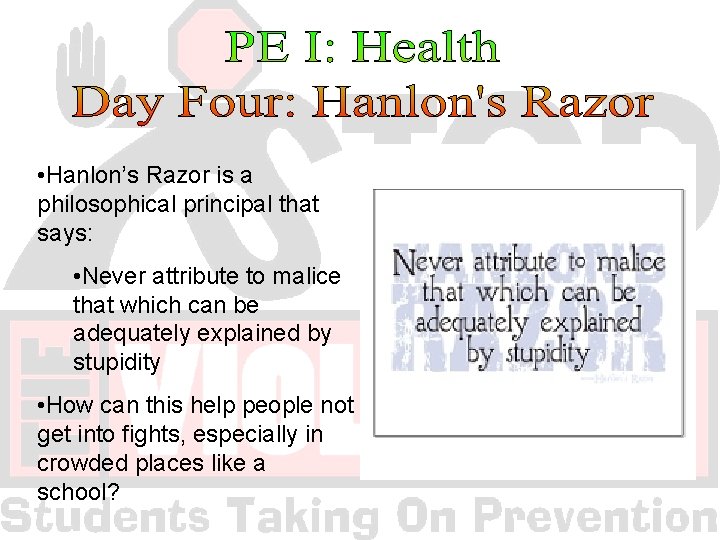
• Hanlon’s Razor is a philosophical principal that says: • Never attribute to malice that which can be adequately explained by stupidity • How can this help people not get into fights, especially in crowded places like a school?
Read Chapter 7, Section 4 to learn about how to prevent fights. Take notes and complete the questions (1 -7) on page 184
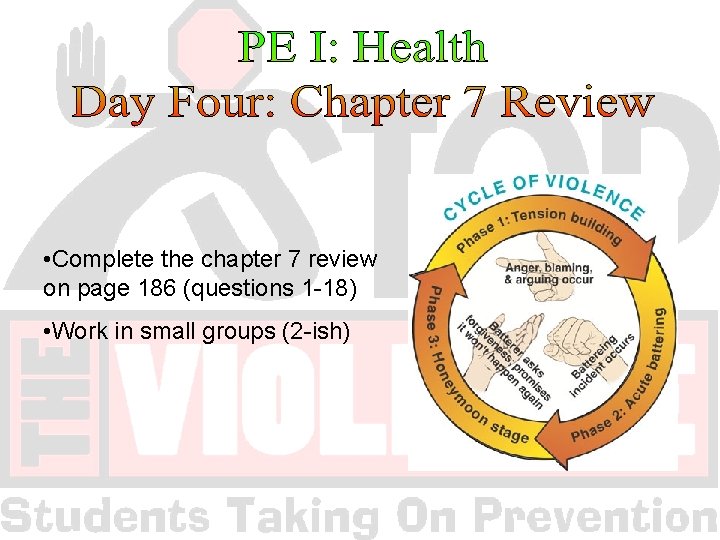
• Complete the chapter 7 review on page 186 (questions 1 -18) • Work in small groups (2 -ish)
• You have this time to study for your unit test. Use your notes, your packets and your book. If you would like to work in a small group you may. • Your test will be graded on a curve. This means that the total percent will be based on the highest number of correct answers. For example: • Highest grade- 95/100 • Your grade- 80/100 • Your percentage= (80/95)*100=84. 2%
• Test Rules: • One person per desk, use the cubbys for more space. • No notes, books, etc • You may wear headphones, as long as they cannot be heard by anyone else. • I will collect all the tests at once. When you finish double check your answers and relax till the test is over. • You will have 45 minutes to complete the test.