
WHAT DOES THE NEXT GENERATION SYSTEM LOOK LIKE
- Slides: 38
WHAT DOES THE NEXT GENERATION SYSTEM LOOK LIKE? AALL Local Systems Roundtable Marshall Breeding Independent Consult, Author, Founder and Publisher, Library Technology Guides http: //www. librarytechnology. org/ http: //twitter. com/mbreeding July 23, 2012 American Association of Law Libraries 2012
Discussion Topic A discussion of the development of the next generation library systems. What are the trends of the new library systems being developed by Ex Libris, III, Serials Solutions and others. What is the current stage of development? When can we expect these systems to be deployed? What is the impact of these systems living in the cloud? How will the new systems change library staff workflows? Is open source another option to be considered?
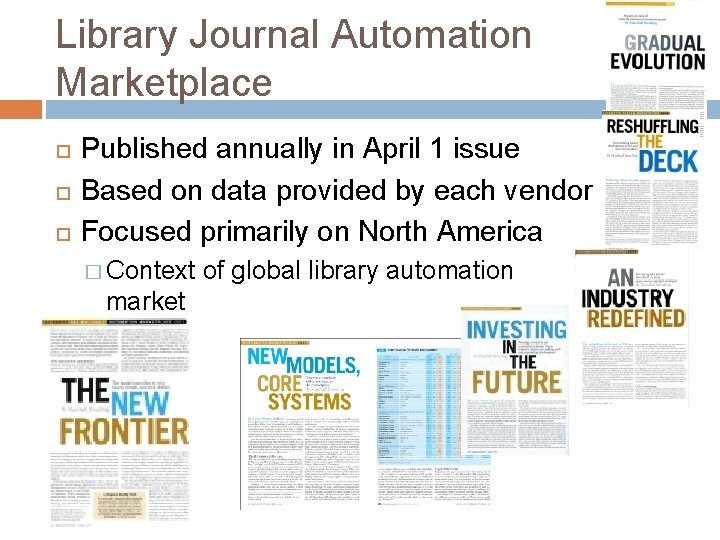
Library Journal Automation Marketplace Published annually in April 1 issue Based on data provided by each vendor Focused primarily on North America � Context market of global library automation
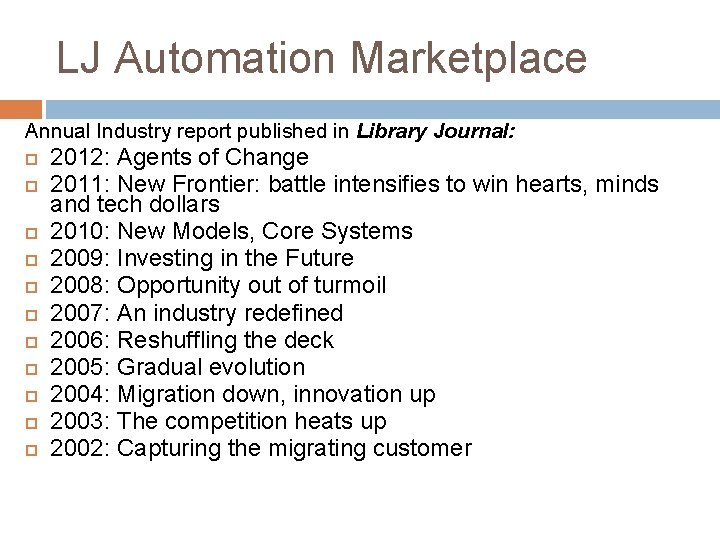
LJ Automation Marketplace Annual Industry report published in Library Journal: 2012: Agents of Change 2011: New Frontier: battle intensifies to win hearts, minds and tech dollars 2010: New Models, Core Systems 2009: Investing in the Future 2008: Opportunity out of turmoil 2007: An industry redefined 2006: Reshuffling the deck 2005: Gradual evolution 2004: Migration down, innovation up 2003: The competition heats up 2002: Capturing the migrating customer
Agents of Change… As development efforts near completion on a new slate of automation products, vendors are beginning to pull out all the stops to monetize them. A new round of competition is heating up to place these new products in libraries, replacing their own legacy products and aiming to displace those of other companies.
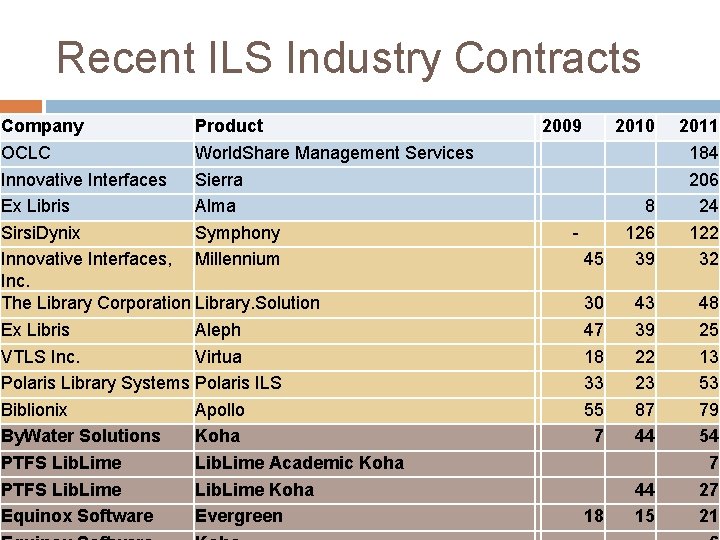
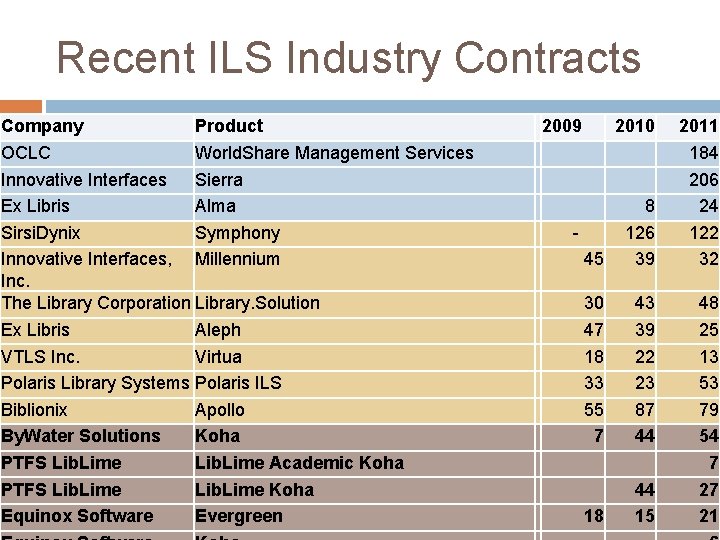
Recent ILS Industry Contracts Company Product OCLC World. Share Management Services Innovative Interfaces Sierra Ex Libris Alma Sirsi. Dynix Symphony Innovative Interfaces, Millennium Inc. The Library Corporation Library. Solution Ex Libris Aleph VTLS Inc. Virtua Polaris Library Systems Polaris ILS Biblionix Apollo By. Water Solutions Koha PTFS Lib. Lime Academic Koha PTFS Lib. Lime Koha Equinox Software Evergreen 2009 2010 45 8 126 39 30 47 18 33 55 7 43 39 22 23 87 44 18 44 15 2011 184 206 24 122 32 48 25 13 53 79 54 7 27 21
Appropriate Automation Infrastructure Current automation products out of step with current realities Majority of library collection funds spent on electronic content Majority of automation efforts support print activities Management of e-content continues with inadequate supporting infrastructure New discovery solutions help with access to econtent Library users expect more engaging socially aware interfaces for Web and mobile
“Paradigm Shift” Thomas S. Kuhn � The Structure of Scientific Revolutions (1962) Properly used to describe the major transitions such as that from the Ptolemaic view to that of Copernicus Used less properly to designate less grand shifts in science, culture, or technology
Transition to Web-scale Technologies Web-scale: a characterization or marketing tag that denotes a comprehensive, highly-scalable, globally shared model Web-scale: One of the key characteristics of emerging library management and discovery services Displaces applications or data models targeting individual libraries in isolation Discovery: index-based search Management: Library Services Platforms
New-generation Library Management
Cloud Computing Major trend in Information Technology Term “in the cloud” has devolved into marketing hype, but cloud computing in the form of multi-tenant software as a service offers libraries opportunities to break out of individual silos of automation and engage in widely shared cooperative systems Opportunities for libraries to leverage their combined efforts into large-scale systems with more end-user impact and organizational efficiencies
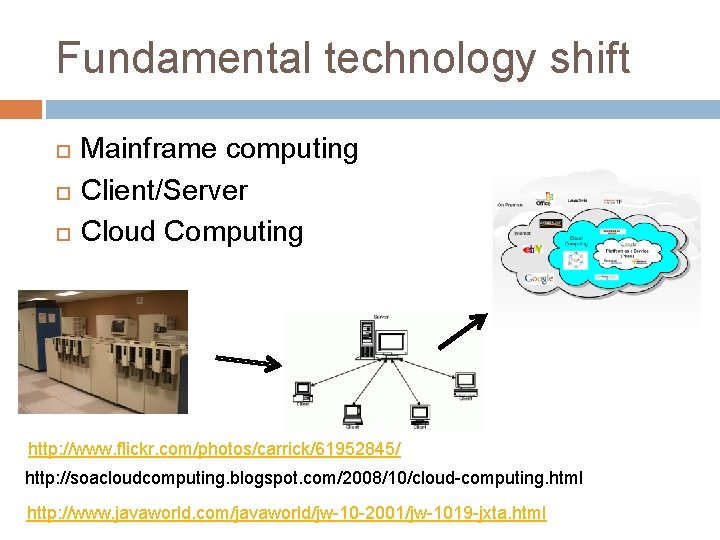
Fundamental technology shift Mainframe computing Client/Server Cloud Computing http: //www. flickr. com/photos/carrick/61952845/ http: //soacloudcomputing. blogspot. com/2008/10/cloud-computing. html http: //www. javaworld. com/javaworld/jw-10 -2001/jw-1019 -jxta. html
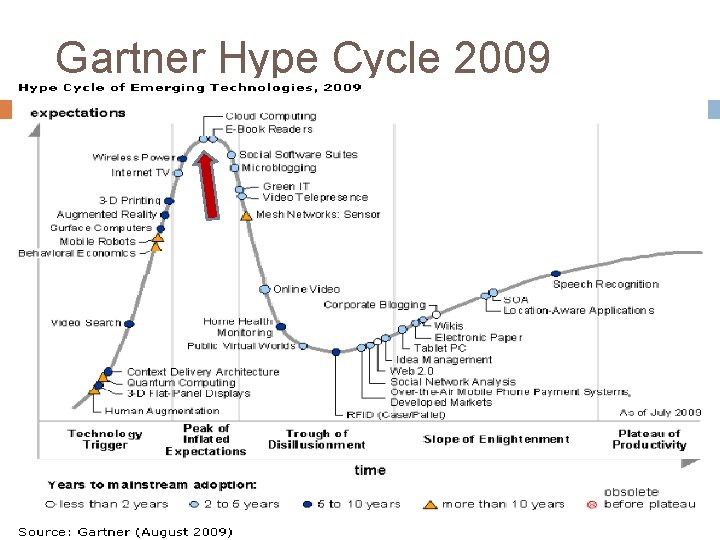
Gartner Hype Cycle 2009
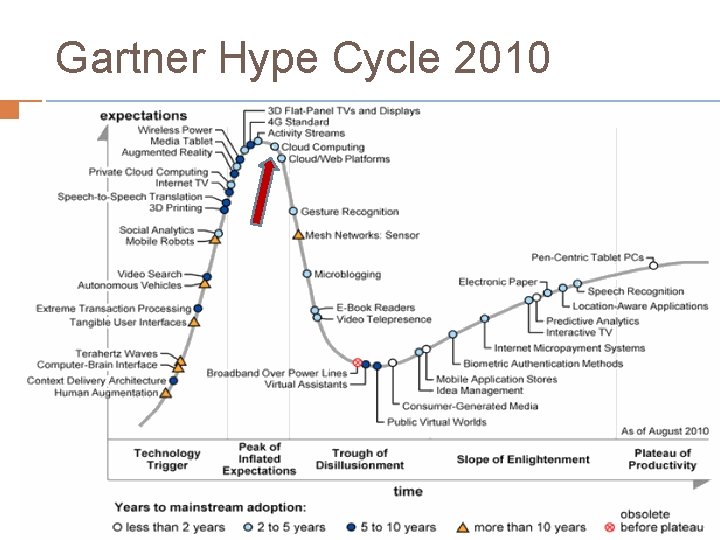
Gartner Hype Cycle 2010
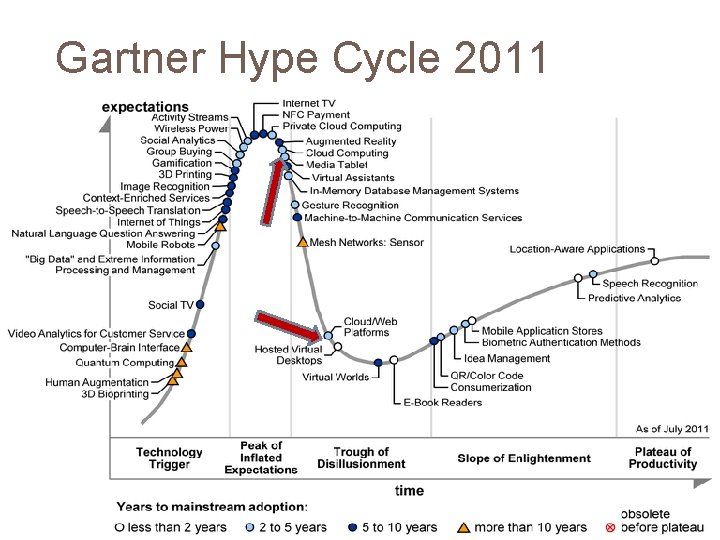
Gartner Hype Cycle 2011
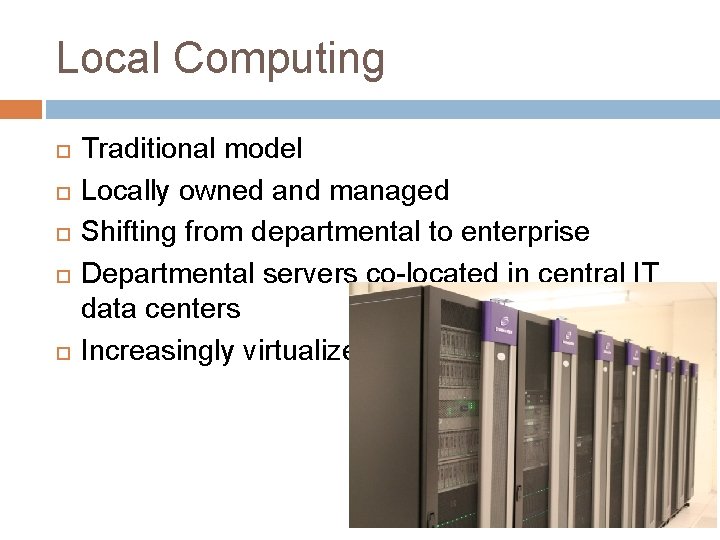
Local Computing Traditional model Locally owned and managed Shifting from departmental to enterprise Departmental servers co-located in central IT data centers Increasingly virtualized
Library Automation in the Cloud Almost all library automation vendors offer some form of “cloud-based” services Server management moves from library to Vendor Subscription-based business model Comprehensive annual subscription payment � Offsets local server purchase and maintenance � Offsets some local technology support
Software as a Service Multi Tennant Saa. S is the modern approach � One Software functionality delivered entirely through Web interfaces � No copy of the code base serves multiple sites workstation clients Upgrades and fixes deployed universally � Usually in small increments
Data as a service Saa. S provides opportunity for highly shared data models World. Cat: one globally shared copy that serves all libraries Primo Central: central index of articles maintained by Ex Libris shared by all libraries implementing Primo / Primo Central Knowledge. Works database of e-journal holdings shared among all customers of Serials Solutions products General opportunity to move away from library-bylibrary metadata management to globally shared workflows
Leveraging the Cloud Moving legacy systems to hosted services provides some savings to individual institutions but does not result in dramatic transformation Globally shared data and metadata models have the potential to achieve new levels of operational efficiencies and more powerful discovery and automation scenarios that improve the position of libraries overall.
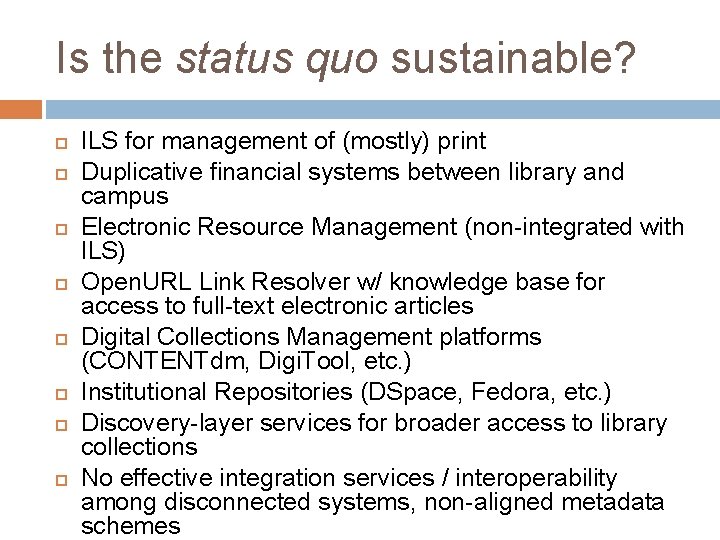
Is the status quo sustainable? ILS for management of (mostly) print Duplicative financial systems between library and campus Electronic Resource Management (non-integrated with ILS) Open. URL Link Resolver w/ knowledge base for access to full-text electronic articles Digital Collections Management platforms (CONTENTdm, Digi. Tool, etc. ) Institutional Repositories (DSpace, Fedora, etc. ) Discovery-layer services for broader access to library collections No effective integration services / interoperability among disconnected systems, non-aligned metadata schemes
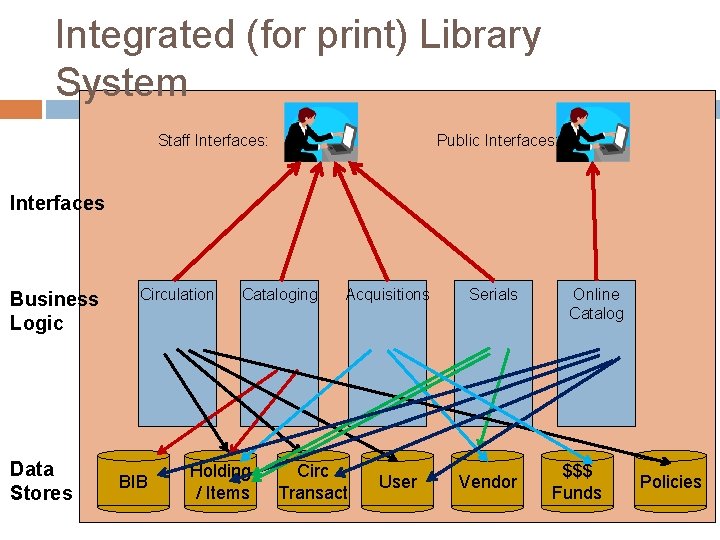
Integrated (for print) Library System Public Interfaces: Staff Interfaces: Interfaces Business Logic Data Stores Circulation BIB Cataloging Holding / Items Acquisitions Circ Transact User Serials Vendor Online Catalog $$$ Funds Policies
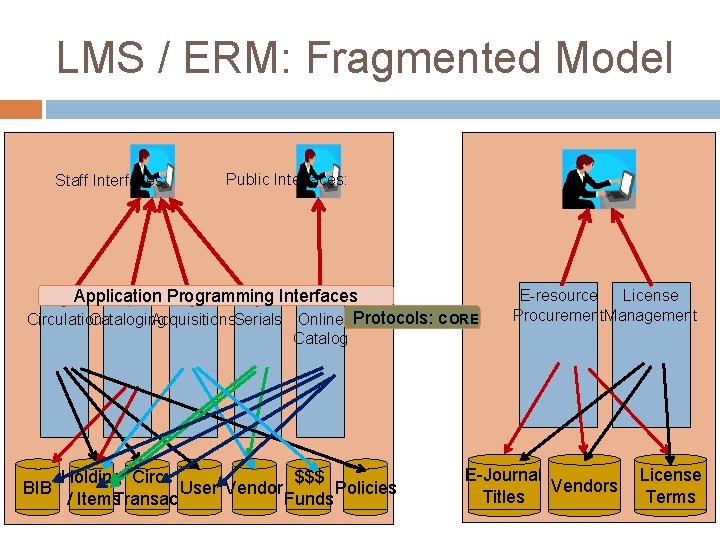
LMS / ERM: Fragmented Model Staff Interfaces: Public Interfaces: Application Programming Interfaces Circulation Cataloging Acquisitions. Serials Online Protocols: CORE ` E-resource License Procurement. Management Catalog BIB Holding Circ $$$ User Vendor Policies / Items. Transact Funds E-Journal Vendors Titles License Terms
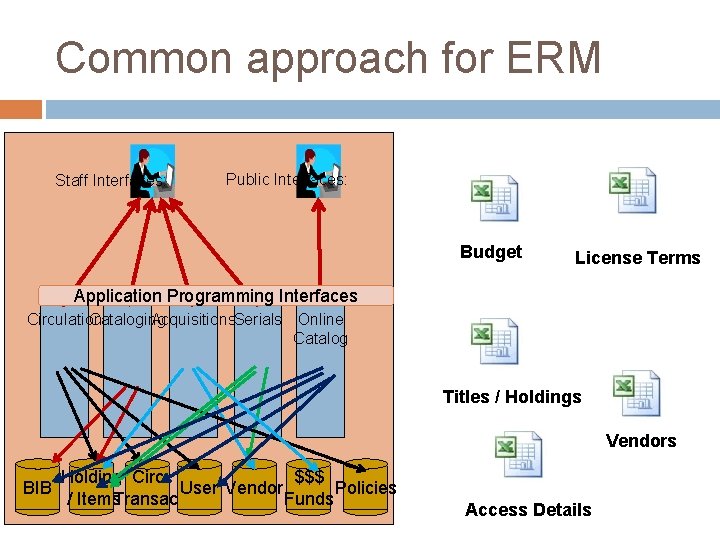
Common approach for ERM Staff Interfaces: Public Interfaces: Budget License Terms Application Programming Interfaces Circulation Cataloging Acquisitions. Serials Online Catalog Titles / Holdings Vendors BIB Holding Circ $$$ User Vendor Policies / Items. Transact Funds Access Details
Comprehensive Resource Management No longer sensible to use different software platforms for managing different types of library materials ILS + ERM + Open. URL Resolver + Digital Asset management, etc. very inefficient model Flexible platform capable of managing multiple type of library materials, multiple metadata formats, with appropriate workflows
Libraries need a new model of library automation Not an Integrated Library System or Library Management System The ILS/LMS was designed to help libraries manage print collections Generally did not evolve to manage electronic collections Other library automation products evolved: � Electronic Resource Management Systems – Open. URL Link Resolvers – Digital Library Management Systems -- Institutional Repositories
Library Services Platform Library-specific software. Designed to help libraries automate their internal operations, manage collections, fulfillment requests, and deliver services Service oriented architecture � Exposes Web services and other API’s � Facilitates the services libraries offer to their users � Platform General infrastructure for library automation � Consistent with the concept of Platform as a Service � Library programmers address the APIs of the platform to extend functionality, create connections with other systems, dynamically interact with data �
Library Services Platform Characteristics Highly Shared data models � Knowledgebase architecture � Some may take hybrid approach to accommodate local data stores Delivered through software as a service � Multi-tenant Unified workflows across formats and media Flexible metadata management � MARC – Dublin Core – VRA – MODS – ONIX � New structures not yet invented Open APIs for extensibility and interoperability
Open Systems Achieving openness has risen as the key driver behind library technology strategies Libraries need to do more with their data Ability to improve customer experience and operational efficiencies Demand for Interoperability Open source – full access to internal program of the application Open API’s – expose programmatic interfaces to data and functionality
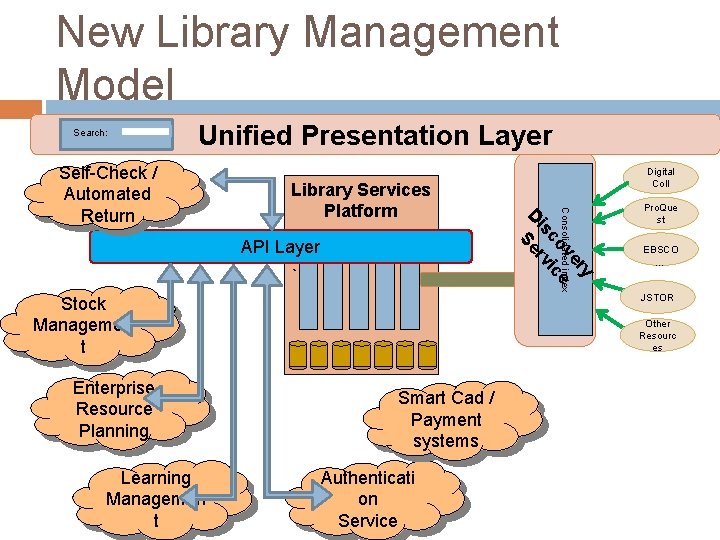
New Library Management Model Search: Unified Presentation Layer Library Services Platform API Layer ` Stock Managemen t Enterprise Resource Planning Learning Managemen t Digital Coll y er Consolidated ov index ce sc vi Di Ser Self-Check / Automated Return Pro. Que st EBSCO … JSTOR Other Resourc es Smart Cad / Payment systems Authenticati on Service
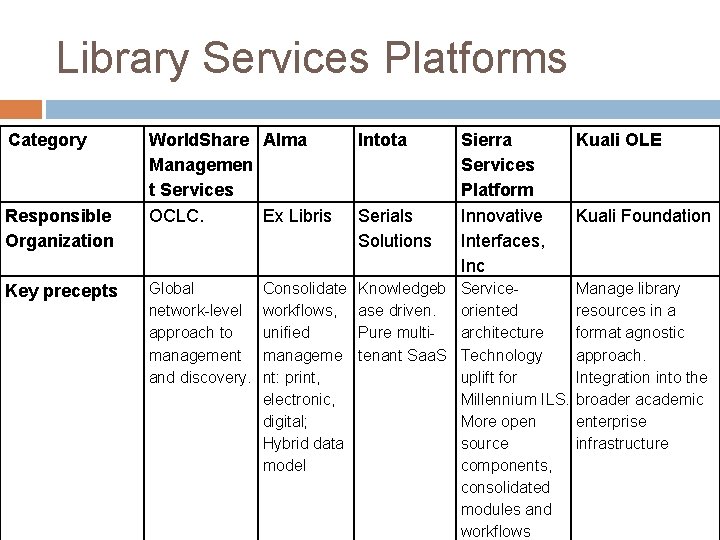
Library Services Platforms Category Responsible Organization Key precepts World. Share Alma Managemen t Services OCLC. Ex Libris Intota Global network-level approach to management and discovery. Knowledgeb ase driven. Pure multitenant Saa. S Consolidate workflows, unified manageme nt: print, electronic, digital; Hybrid data model Serials Solutions Sierra Services Platform Innovative Interfaces, Inc Kuali OLE Serviceoriented architecture Technology uplift for Millennium ILS. More open source components, consolidated modules and workflows Manage library resources in a format agnostic approach. Integration into the broader academic enterprise infrastructure Kuali Foundation
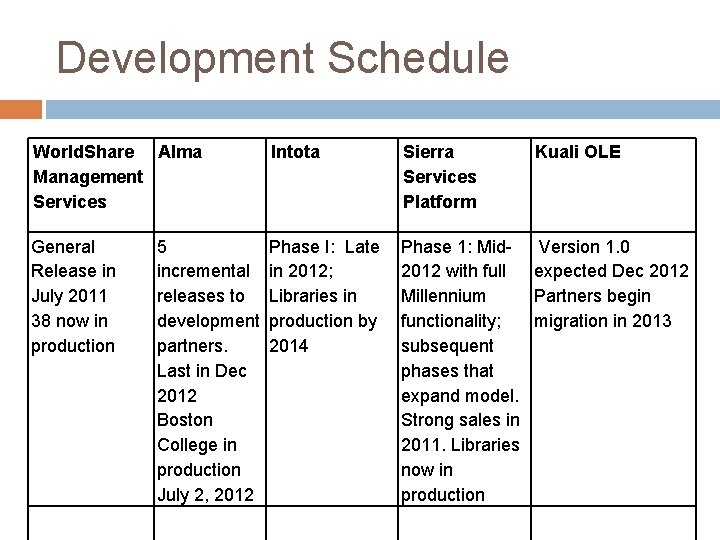
Development Schedule World. Share Alma Management Services Intota Sierra Services Platform General Release in July 2011 38 now in production Phase I: Late in 2012; Libraries in production by 2014 Phase 1: Mid- Version 1. 0 2012 with full expected Dec 2012 Millennium Partners begin functionality; migration in 2013 subsequent phases that expand model. Strong sales in 2011. Libraries now in production 5 incremental releases to development partners. Last in Dec 2012 Boston College in production July 2, 2012 Kuali OLE
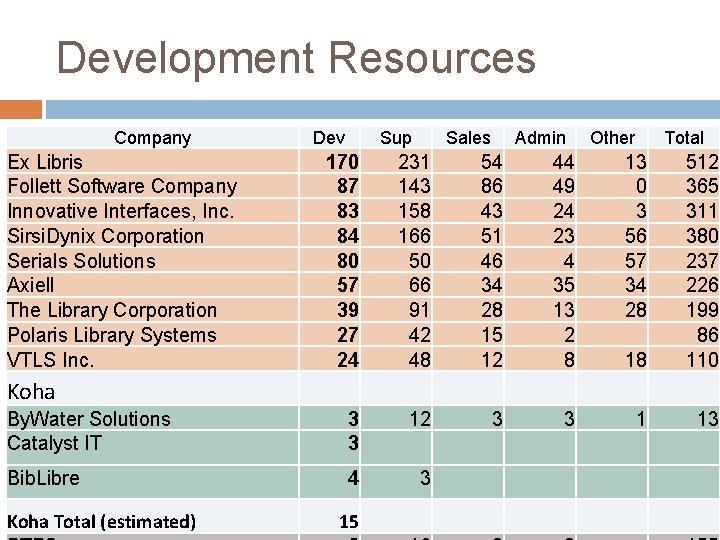
Development Resources Company Ex Libris Follett Software Company Innovative Interfaces, Inc. Sirsi. Dynix Corporation Serials Solutions Axiell The Library Corporation Polaris Library Systems VTLS Inc. Dev Sup Sales Admin Other Total 170 87 83 84 80 57 39 27 24 231 143 158 166 50 66 91 42 48 54 86 43 51 46 34 28 15 12 44 49 24 23 4 35 13 2 8 13 0 3 56 57 34 28 18 512 365 311 380 237 226 199 86 110 By. Water Solutions Catalyst IT 3 3 12 3 3 1 13 Bib. Libre 4 3 Koha Total (estimated) 15
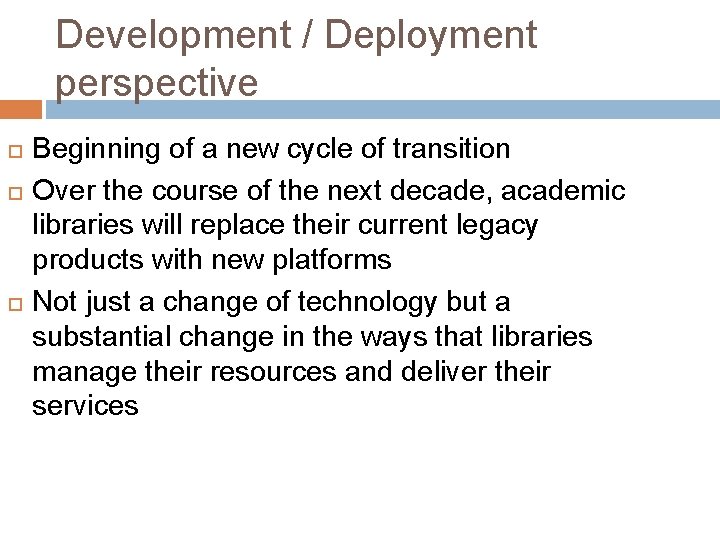
Development / Deployment perspective Beginning of a new cycle of transition Over the course of the next decade, academic libraries will replace their current legacy products with new platforms Not just a change of technology but a substantial change in the ways that libraries manage their resources and deliver their services
Recent ILS Industry Contracts Company Product OCLC World. Share Management Services Innovative Interfaces Sierra Ex Libris Alma Sirsi. Dynix Symphony Innovative Interfaces, Millennium Inc. The Library Corporation Library. Solution Ex Libris Aleph VTLS Inc. Virtua Polaris Library Systems Polaris ILS Biblionix Apollo By. Water Solutions Koha PTFS Lib. Lime Academic Koha PTFS Lib. Lime Koha Equinox Software Evergreen 2009 2010 45 8 126 39 30 47 18 33 55 7 43 39 22 23 87 44 18 44 15 2011 184 206 24 122 32 48 25 13 53 79 54 7 27 21
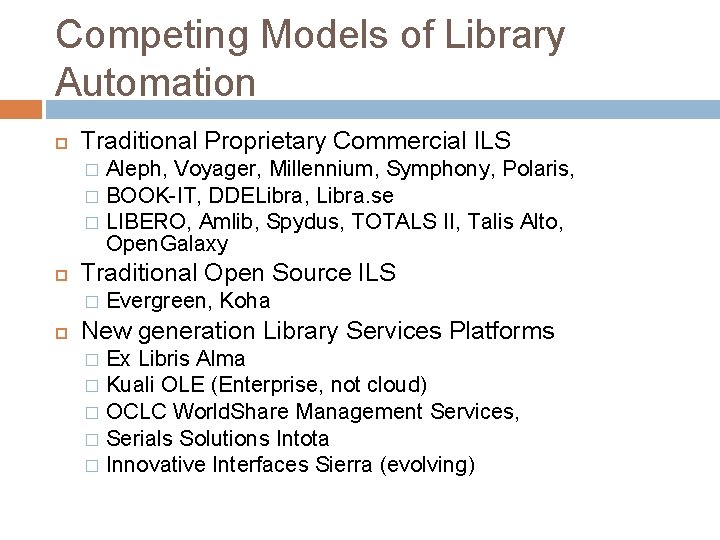
Competing Models of Library Automation Traditional Proprietary Commercial ILS Aleph, Voyager, Millennium, Symphony, Polaris, � BOOK-IT, DDELibra, Libra. se � LIBERO, Amlib, Spydus, TOTALS II, Talis Alto, Open. Galaxy � Traditional Open Source ILS � Evergreen, Koha New generation Library Services Platforms Ex Libris Alma � Kuali OLE (Enterprise, not cloud) � OCLC World. Share Management Services, � Serials Solutions Intota � Innovative Interfaces Sierra (evolving) �
Convergence Discovery and Management solutions will increasingly be implemented as matched sets � Ex Libris: Primo / Alma � Serials Solutions: Summon / Intota � OCLC: World. Cat Local / World. Share Platform � Except: Kuali OLE, EBSCO Discovery Service Both depend on an ecosystem of interrelated knowledge bases API’s exposed to mix and match, but efficiencies and synergies are lost
Questions and discussion