
What does Science look like at Sacred Heart
- Slides: 1
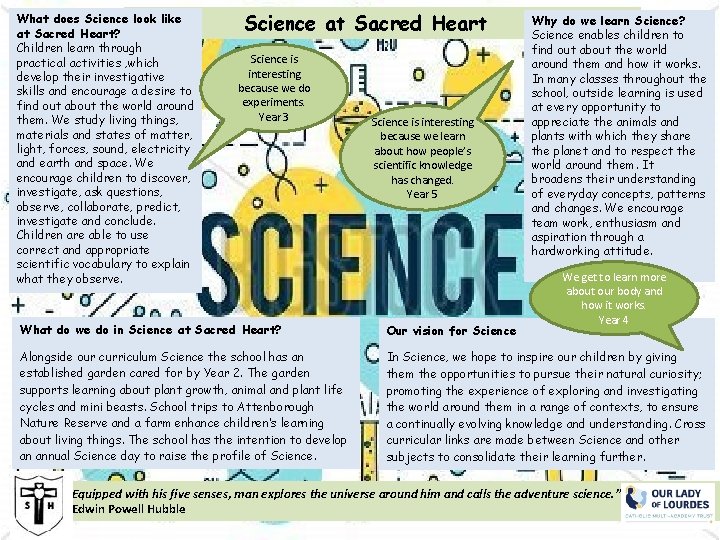
What does Science look like at Sacred Heart? Children learn through practical activities , which develop their investigative skills and encourage a desire to find out about the world around them. We study living things, materials and states of matter, light, forces, sound, electricity and earth and space. We encourage children to discover, investigate, ask questions, observe, collaborate, predict, investigate and conclude. Children are able to use correct and appropriate scientific vocabulary to explain what they observe. Science at Sacred Heart Science is interesting because we do experiments. Year 3 Science is interesting because we learn about how people’s scientific knowledge has changed. Year 5 Why do we learn Science? Science enables children to find out about the world around them and how it works. In many classes throughout the school, outside learning is used at every opportunity to appreciate the animals and plants with which they share the planet and to respect the world around them. It broadens their understanding of everyday concepts, patterns and changes. We encourage team work, enthusiasm and aspiration through a hardworking attitude. We get to learn more about our body and how it works. Year 4 What do we do in Science at Sacred Heart? Our vision for Science Alongside our curriculum Science the school has an established garden cared for by Year 2. The garden supports learning about plant growth, animal and plant life cycles and mini beasts. School trips to Attenborough Nature Reserve and a farm enhance children’s learning about living things. The school has the intention to develop an annual Science day to raise the profile of Science. In Science, we hope to inspire our children by giving them the opportunities to pursue their natural curiosity; promoting the experience of exploring and investigating the world around them in a range of contexts, to ensure a continually evolving knowledge and understanding. Cross curricular links are made between Science and other subjects to consolidate their learning further. Equipped with his five senses, man explores the universe around him and calls the adventure science. ” Edwin Powell Hubble