
What Does Random Look Like http www math
- Slides: 4
What Does Random Look Like? http: //www. math. uh. edu/~jmorgan/hollyer Suppose you perform the following experiment: Flip a fair coin 100 times. What do you expect to see? Activity: Send one student out of the room. Then divide the remaining students into groups A and B. Record the names of the students in each group, and give the students the following task. Group A: Each student will flip a fair coin 100 times, recording the results in the order they occur by writing an H for “heads” and a T for “tails. ” Group B: Each student will simulate the task of flipping a coin 100 times by writing H for “heads” and T for “tails” on a sheet of paper in the manner they think the flips will occur. Now invite the student back into the room. Have them view the student H/T lists and guess their group.
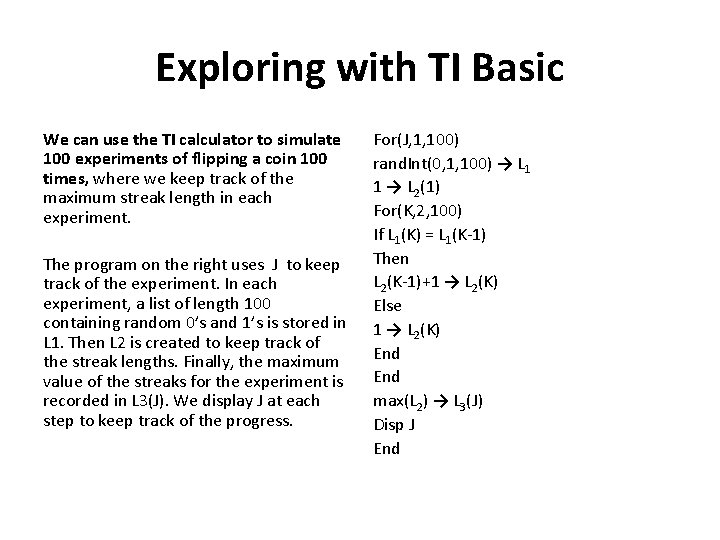
Exploring with TI Basic We can use the TI calculator to simulate 100 experiments of flipping a coin 100 times, where we keep track of the maximum streak length in each experiment. The program on the right uses J to keep track of the experiment. In each experiment, a list of length 100 containing random 0’s and 1’s is stored in L 1. Then L 2 is created to keep track of the streak lengths. Finally, the maximum value of the streaks for the experiment is recorded in L 3(J). We display J at each step to keep track of the progress. For(J, 1, 100) rand. Int(0, 1, 100) → L 1 1 → L 2(1) For(K, 2, 100) If L 1(K) = L 1(K-1) Then L 2(K-1)+1 → L 2(K) Else 1 → L 2(K) End max(L 2) → L 3(J) Disp J End
What Does Random Look Like? (Part II) Create 3 points in the xy plane and label them A, B and C. Then pick a point P in the plane (at random) and plot it. Now pick a random integer from the set {1, 2, 3}. If the number selected is 1, then plot the midpoint between P and A. If the number selected is 2, then plot the midpoint between P and B. Otherwise, plot the midpoint between P and C. Whichever point you plot, call this new point P (removing the name from the old point P), and repeat the process MANY times (e. g. thousands of times). Question: Will any pattern appear, or will the resulting sketch look like a complete mess?
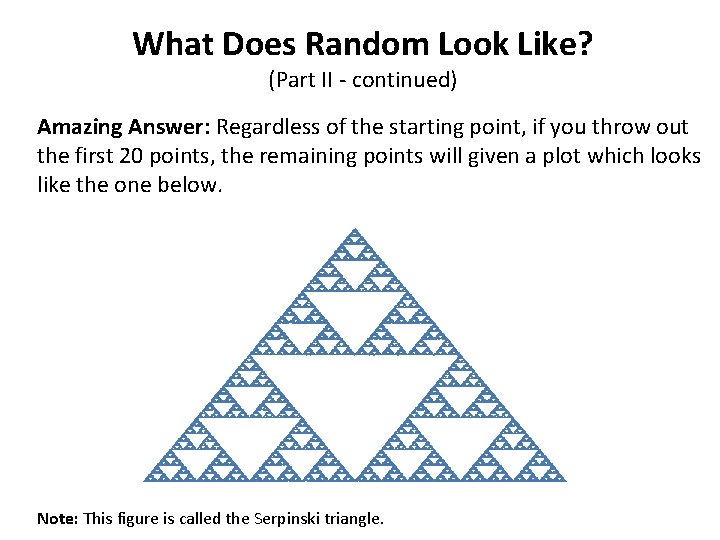
What Does Random Look Like? (Part II - continued) Amazing Answer: Regardless of the starting point, if you throw out the first 20 points, the remaining points will given a plot which looks like the one below. Note: This figure is called the Serpinski triangle.