
What Does Optometry Have to Do to Survive
- Slides: 19
What Does Optometry Have to Do to Survive? Thomas F. Freddo, O. D. , Ph. D. , F. A. A. O. Senior Fulbright Fellow Adjunct Professor MCP Health Sciences University Worcester, MA, USA
My Background • B. A. Zoology, University of Connecticut • O. D. New England College of Optometry, Boston, MA • Ph. D. Anatomy/Pathology, Boston University School of Medicine • Fellowship in Surgical Ophthalmic Pathology, Mallory Institute of Pathology, Boston, MA • Professor of Ophthalmology, Pathology and Anatomy, Boston University School of Medicine • First optometrist Vice-Chair of an academic ophthalmology department in the US • Director, Surgical Ophthalmic Pathology Services, Boston Medical Center Hospitals • Professor and Director, University of Waterloo School of Optometry, Canada • Ran part time, hospital based practice of medical optometry for 25 years • Ran active federally funded research programme in glaucoma and
My International Experience • First Optometrist President, International Society for Eye Research • TPA Course contributor – Australia • Sabbatical at University of Auckland, NZ, helping to develop plans for TPA curricular changes • External Academic Counselor, Hong Kong Polytechnical University – annual visits for 5 years to help move curriculum toward TPA • Director of the only English speaking school of Optometry in Canada during the transition to TPA • Contributor to academic programmes for 20 years – Graduate Institute of Optometry, South Africa • Senior Fulbright Scholar visit to Univ of Johannesburg to discuss and provide thoughts on transitioning to a TPA curriculum and the dilemma created by the 4+1 model
Optometry’s Constant Refrain with World Health ORGANIZATION • “Uncorrected refractive error is the largest cause of treatable blindness in the world” • While this has brought attention to unmet need for refractive error correction around the world, optometry has done a singularly poor job of emphasizing the risks of doing refractions that are NOT a part of a comprehensive eye exam. • And the British term “eye test” has only worsened the situation. Refraction is a test, not a comprehensive eye exam and so merely the use of that to describe what optometrists do adds to the notion that all optometrists do are tests and not examinations.
NO CASE • Certainly no jurisdiction will not succumb to the pressure of the optical lobby to permit refractions to be done as a stand alone test that could render a valid prescription for eyeglasses or contact lenses without a comprehensive eye exam
Historical Perspective on that Notion • In 1900 a brilliant New York optician, well-trained in optics in Germany, concluded that he knew more optics than US ophthalmologists. And given that he had invented the first standardized method for measuring prism power, he was probably right. • He had the audacity to begin preforming refractions as a stand-alone procedure and then selling glasses pursuant to his prescription. When he charged his clients for this test, he was sued by the NY Ophthalmological Association, which maintained that doing refraction as a stand alone procedure, rather than as a part of comprehensive examination, was dangerous to the public health and that this brazen optician must be prevented from continuing this dangerous practice.
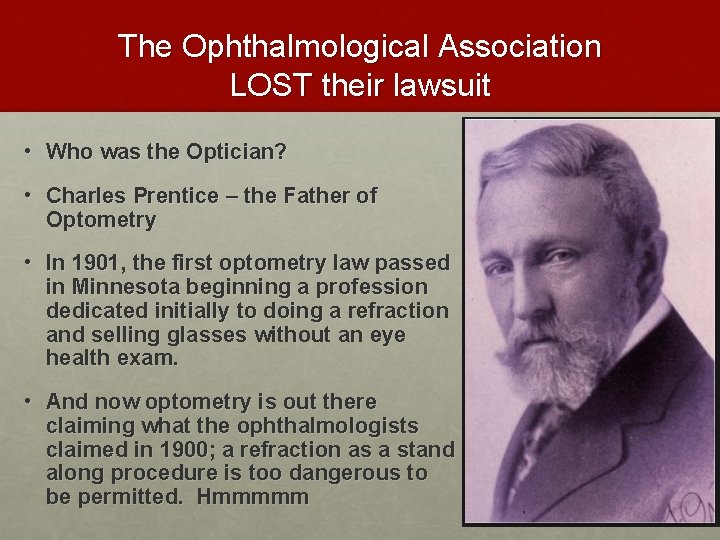
The Ophthalmological Association LOST their lawsuit • Who was the Optician? • Charles Prentice – the Father of Optometry • In 1901, the first optometry law passed in Minnesota beginning a profession dedicated initially to doing a refraction and selling glasses without an eye health exam. • And now optometry is out there claiming what the ophthalmologists claimed in 1900; a refraction as a stand along procedure is too dangerous to be permitted. Hmmmmm 250 × 44
So, what is the future? • Online refraction technology will ultimately be good enough that governments will succumb and permit it. • As soon as this happens, pressure will come that a fully qualified optometrist is no longer needed to do a simple refraction and chains will replace optometrists with technicians or opticians as a cost saving measure • Contact lenses have already become commoditized and patients will eventually be able to buy contact lenses online with just their eyeglass prescription and no professional visits.
PLEASE NOTE • I am not, for one minute arguing that optometry abandon holding onto everything it has but every former British Commonwealth country is struggling to abandon the British model of optometry (except in the UK itself) and replace it with a program that safely permits optometrists to take on a significant role in the delivery of medical eyecare, in addition to providing quality well-patient eyecare, whether that includes refraction or not.
The struggle to provide a therapeutics background starting from the British model • The British model works for Medicine because training does not end upon conferring the degree at the end of 4 years after high school. For optometry, 4 years is just simply not enough time to produce a competent medical optometrist after high school. • Canada ultimately adopted the US model and requires an undergrad degree before embarking upon a four year program leading to an O. D. degree. • Australia adopted a 5 year program leading somehow to an O. D. degree. • Hong Kong is working toward having TPA certification be within a Masters programme, like a 4+1. • South Africa is currently being compelled to create a 4+1 instead of holding out for nothing less that than a 5 year programme on par with Dentistry.
What is the most common mistake other Countries have made in the TPA transition? • Optometry is currently an optics based profession that includes a bit of psychology and a little bit of biology • The biggest mistake optometry has made in producing people truly prepared to independently manage disease is to just tack on a bit more biology but leave optics as the
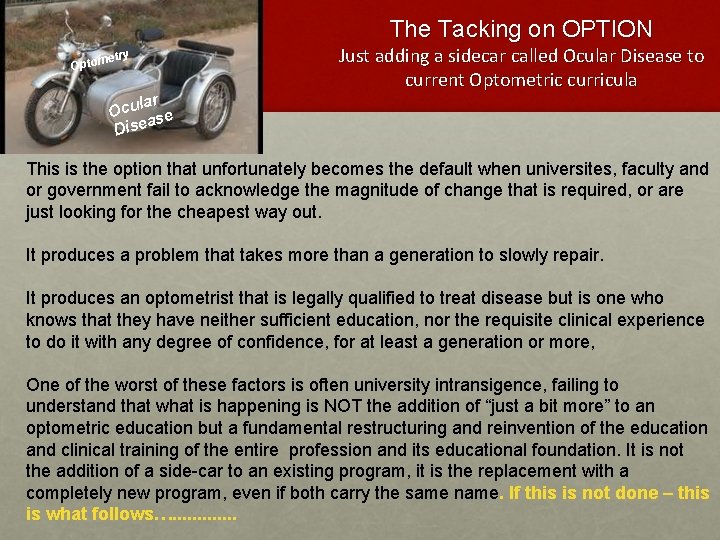
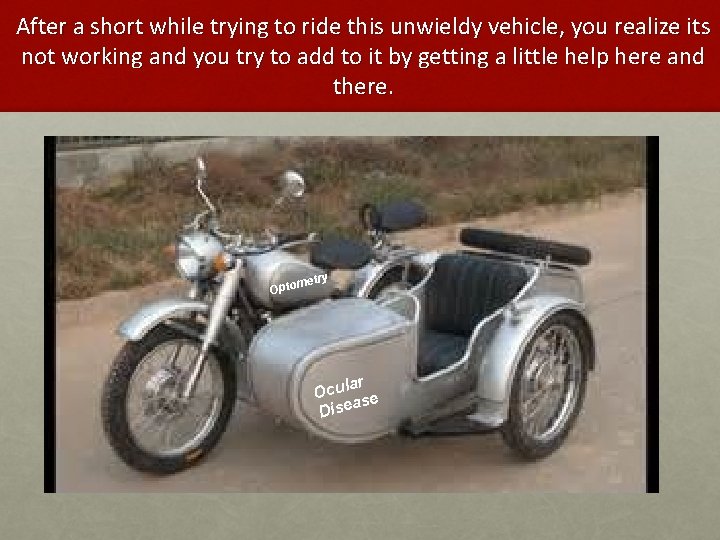
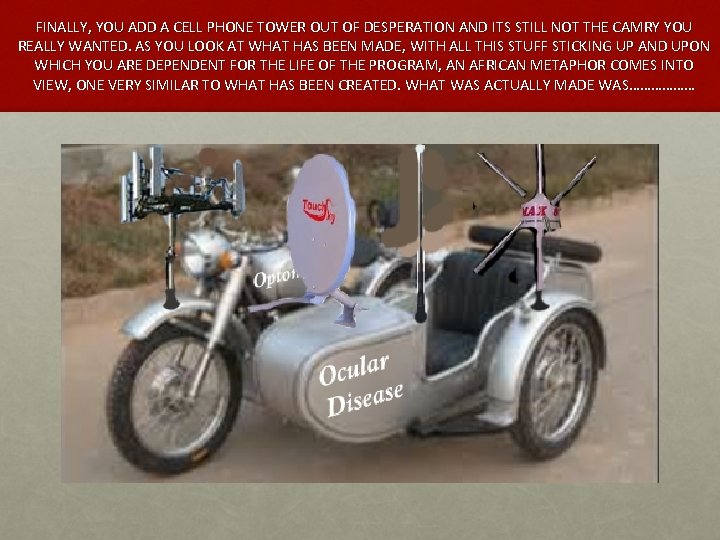
The Tacking on OPTION metry Opto lar Ocu se a Dise Just adding a sidecar called Ocular Disease to current Optometric curricula This is the option that unfortunately becomes the default when universites, faculty and or government fail to acknowledge the magnitude of change that is required, or are just looking for the cheapest way out. It produces a problem that takes more than a generation to slowly repair. It produces an optometrist that is legally qualified to treat disease but is one who knows that they have neither sufficient education, nor the requisite clinical experience to do it with any degree of confidence, for at least a generation or more, One of the worst of these factors is often university intransigence, failing to understand that what is happening is NOT the addition of “just a bit more” to an optometric education but a fundamental restructuring and reinvention of the education and clinical training of the entire profession and its educational foundation. It is not the addition of a side-car to an existing program, it is the replacement with a completely new program, even if both carry the same name. If this is not done – this is what follows…. . .
After a short while trying to ride this unwieldy vehicle, you realize its not working and you try to add to it by getting a little help here and there. metry Opto ar Ocul e as Dise
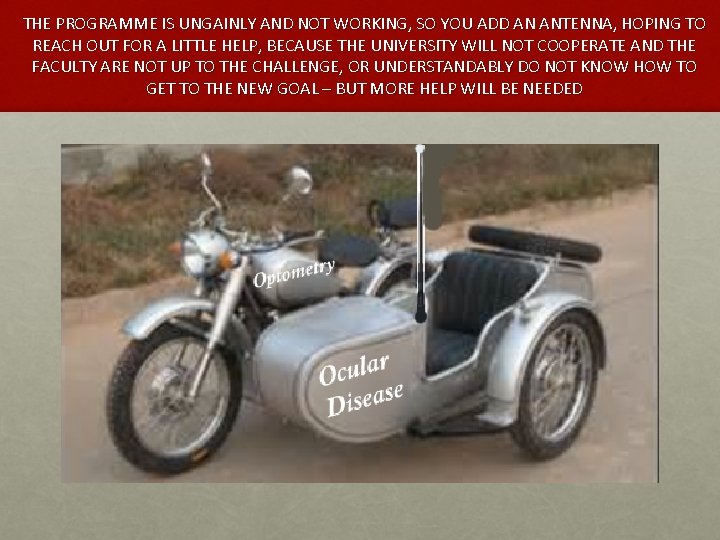
THE PROGRAMME IS UNGAINLY AND NOT WORKING, SO YOU ADD AN ANTENNA, HOPING TO REACH OUT FOR A LITTLE HELP, BECAUSE THE UNIVERSITY WILL NOT COOPERATE AND THE FACULTY ARE NOT UP TO THE CHALLENGE, OR UNDERSTANDABLY DO NOT KNOW HOW TO GET TO THE NEW GOAL – BUT MORE HELP WILL BE NEEDED
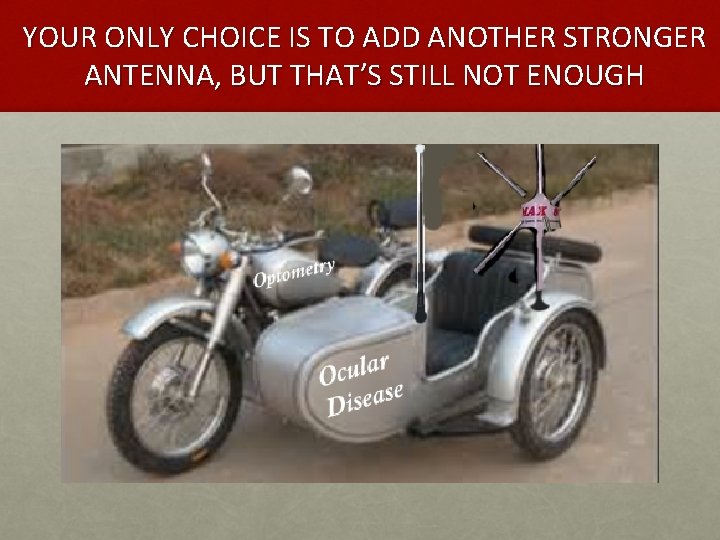
YOUR ONLY CHOICE IS TO ADD ANOTHER STRONGER ANTENNA, BUT THAT’S STILL NOT ENOUGH
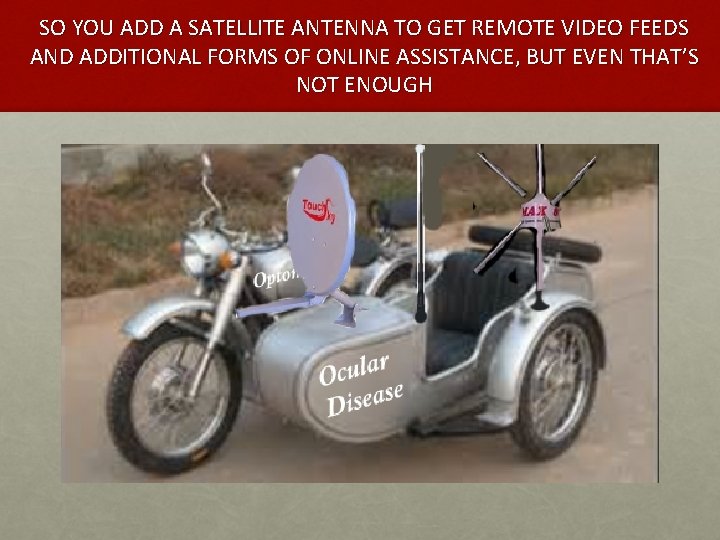
SO YOU ADD A SATELLITE ANTENNA TO GET REMOTE VIDEO FEEDS AND ADDITIONAL FORMS OF ONLINE ASSISTANCE, BUT EVEN THAT’S NOT ENOUGH
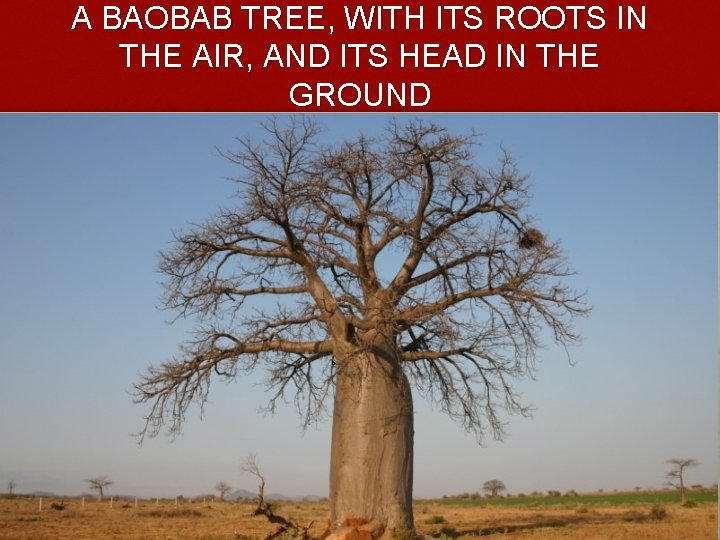
FINALLY, YOU ADD A CELL PHONE TOWER OUT OF DESPERATION AND ITS STILL NOT THE CAMRY YOU REALLY WANTED. AS YOU LOOK AT WHAT HAS BEEN MADE, WITH ALL THIS STUFF STICKING UP AND UPON WHICH YOU ARE DEPENDENT FOR THE LIFE OF THE PROGRAM, AN AFRICAN METAPHOR COMES INTO VIEW, ONE VERY SIMILAR TO WHAT HAS BEEN CREATED. WHAT WAS ACTUALLY MADE WAS………………
A BAOBAB TREE, WITH ITS ROOTS IN THE AIR, AND ITS HEAD IN THE GROUND
Make Optometry Look as Much Like Dentistry As you Can • This option leaves optometry as an autonomous profession, outside of medicine, but fundamentally restructures optometric training from one based largely in physics, optics and psychophysics to one based primarily in the biomedical sciences, while retaining enough training in optics and traditional vision science to ensure that the quality of refractive, low vision and contact lens care is not diminished significantly. This may require development of post-grad speciailties in such areas as low vision, medical contact lenses, etc. • The challenges to this option will not come solely from medicine. • Universities will NOT want to change the wholly inappropriate pigeon-hole into which they have placed optometry within their rigid hierarchies. This option should require universities and government to begin to view optometry as most similar in type and length of training required as that which occurs in dentistry. • Dentistry is a study programme over five years, followed by one year of compulsory community service. • Training this new optometrist cannot be done properly in 4 years. An additional, well-supervised postgrad year, added to four years of a redesigned optometry programme should be the goal, with optometry promoted in the university structure from departmental to at least faculty status-just like dentistry. • While optometry and medicine are both listed as undergraduate programs, requiring four years after secondary school education, completion of medical school is only a first step in a long road to the status of an independent specialist. Presently, for optometry, it is the sum-total of their education and training. In South Africa optometric training must include the traditional undergrad courses in physics,