
What does conflict mean and what can cause

- Slides: 8
What does ‘conflict’ mean and what can cause it? Religious Education The nature of conflict
OBJECTIVES ALL: Explain different examples of conflict that can take place on an individual or an international level MOST: Examine some definitions of conflict and what causes different types of conflict today SOME: Consider different possible solutions to conflict SMSC & BRITISH VALUES: Considering the rule of law and different groups who are affected by conflict LITERACY & NUMERACY: Summary notes and reading / writing Religious Education The nature of conflict
Starter: What can cause conflict? Create a mini mind -map with as many ideas as you can think of e. g. arguments over politics Stretch yourself by giving examples of specific conflicts e. g. the conflict in Syria Religious Education The nature of conflict
Literacy - Summarise some of the key points in your own words: ALL: Conflict can be defined as disagreement between groups or people, or violence between individuals or groups. People may be affected on an individual, national or international scale but, in each case, people are negatively affected. MOST: Religion has often been linked to conflict. Sam Harris, for instance, argues that religion is the main cause of conflict. Karen Armstrong, on the other hand, argues that conflict is usually about political motivations or a desire for more power or resources. SOME: Terrorism is defined as the unofficial use of violence or the threat of violence in the pursuit of political aims. An ideology is a set of beliefs held by a person or group and terrorists use threatening or violent methods to raise awareness of their ideologies. The media often links terrorism with religious ideologies (beliefs). However, many people would argue that the causes of conflict, including terrorism, are much more complex. Religious Education The nature of conflict
Think/Pair/Share: Think of a time when you have experienced conflict. • What caused it? • Who was affected? • Was it resolved and, if so, how? Religious Education The nature of conflict
Main activity: Read the different case studies. Sort the cards according to whether they represent individual/internal, national or international conflicts. Stretch Yourself: Pick 1 to 2 case studies and explain (a) the causes of the conflict; (b) the effects of the conflict; and (c) how such conflict could be prevented in future. Religious Education The nature of conflict
Feedback: What are the different causes of conflict e. g. human rights violations? Look back at the mind-map you created at the start of the lesson. Using the case studies, add 2 -5 more causes of conflict. How many conflicts could be linked to religion? Is this a fair link for scholars such as Sam Harris to make? Religious Education The nature of conflict
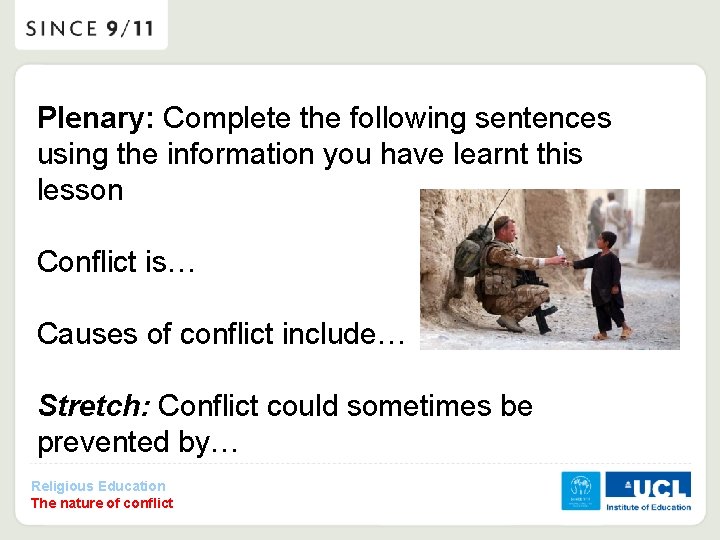
Plenary: Complete the following sentences using the information you have learnt this lesson Conflict is… Causes of conflict include… Stretch: Conflict could sometimes be prevented by… Religious Education The nature of conflict