
What documents make up the learning program documentation



- Slides: 21
What documents make up the learning program documentation? § § § § Units of competency, or other benchmarks, such as standards or codes, that are to be achieved A learner guide A learner workbook Supporting resources Learning objectives Unit plan Session Plan Risk assessment
Who sets the objectives in a work -based learning program? �The organisation �The manager/ supervisor �The trainer �Industry requirements
What effects can work-based training have in the workplace? � Employee remains available and productive to the employer � Provides professional development of employees for the employer for minimal disruption/ cost � Learners use the equipment and processes as will be required for the actual task � Employers do not need to provide temporary staff to fill positions � Learners engage in real-time activities and events, not simulated or out of date � Learners can relate new functions and skills to their existing task knowledge and experience � Support is available for learners through work colleagues and supervisors/ managers
What information and documentation can be used to find out about the needs of your learners? �Enrolment information, such as enrolment forms and student information sheets �Employee or personnel records (confidentiality protected) �Results of task analyses and organisational training needs analyses �Outcomes of recognition of current competency (RCC) or recognition of prior learning (RPL) assessment �Communication with individual learners
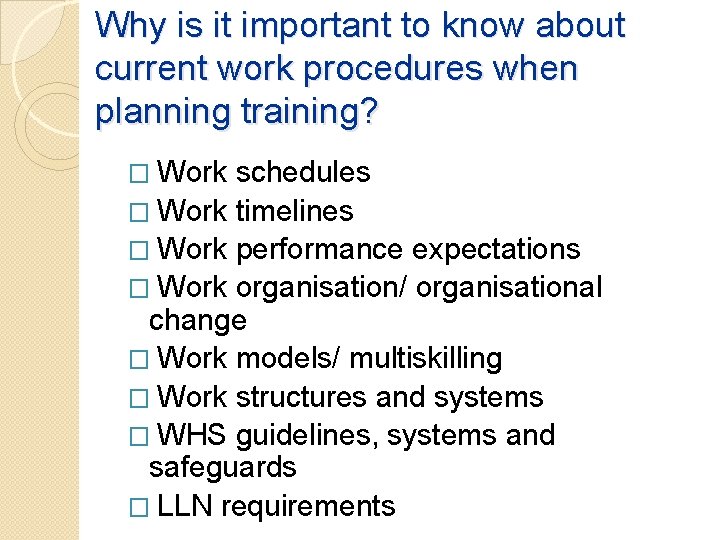
Why is it important to know about current work procedures when planning training? � Work schedules � Work timelines � Work performance expectations � Work organisation/ organisational change � Work models/ multiskilling � Work structures and systems � WHS guidelines, systems and safeguards � LLN requirements
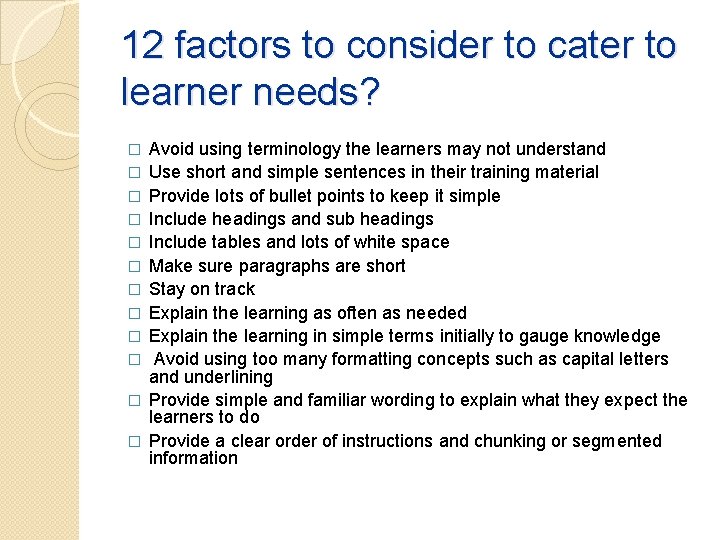
12 factors to consider to cater to learner needs? � � � Avoid using terminology the learners may not understand Use short and simple sentences in their training material Provide lots of bullet points to keep it simple Include headings and sub headings Include tables and lots of white space Make sure paragraphs are short Stay on track Explain the learning as often as needed Explain the learning in simple terms initially to gauge knowledge Avoid using too many formatting concepts such as capital letters and underlining Provide simple and familiar wording to explain what they expect the learners to do Provide a clear order of instructions and chunking or segmented information
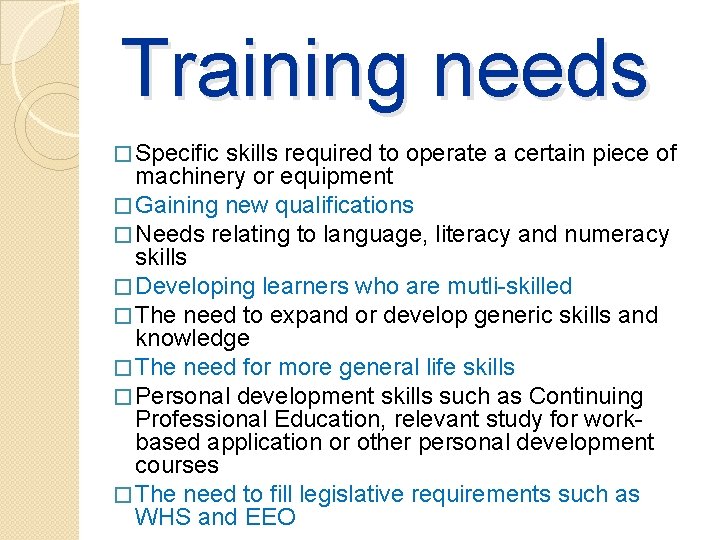
Training needs � Specific skills required to operate a certain piece of machinery or equipment � Gaining new qualifications � Needs relating to language, literacy and numeracy skills � Developing learners who are mutli-skilled � The need to expand or develop generic skills and knowledge � The need for more general life skills � Personal development skills such as Continuing Professional Education, relevant study for workbased application or other personal development courses � The need to fill legislative requirements such as WHS and EEO
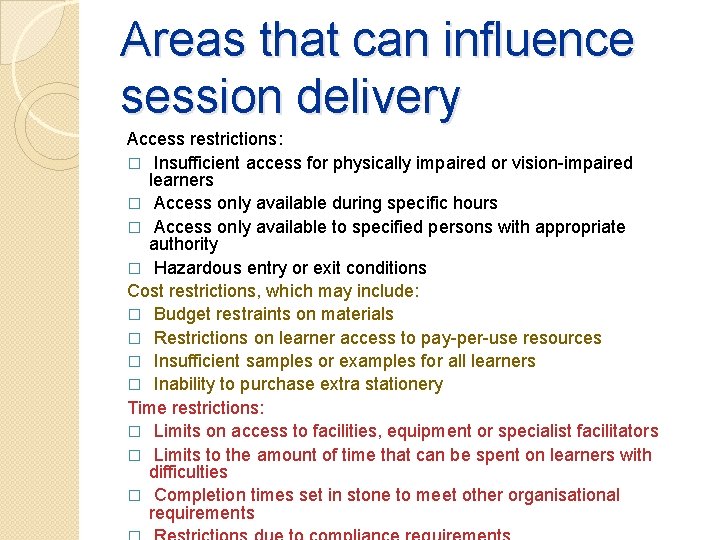
Areas that can influence session delivery Access restrictions: � Insufficient access for physically impaired or vision-impaired learners � Access only available during specific hours � Access only available to specified persons with appropriate authority � Hazardous entry or exit conditions Cost restrictions, which may include: � Budget restraints on materials � Restrictions on learner access to pay-per-use resources � Insufficient samples or examples for all learners � Inability to purchase extra stationery Time restrictions: � Limits on access to facilities, equipment or specialist facilitators � Limits to the amount of time that can be spent on learners with difficulties � Completion times set in stone to meet other organisational requirements
Legislation, regulations, codes and procedures �Work Health and Safety Act 2011 and Work Health and Safety Regulations 2011 �Privacy Act 1988 �Equal Opportunity Act 2010 (Vic) �Charter of Human Rights and Responsibilities Act 2006 (Vic) �Racial and Religious Tolerance Act 2001 (Vic) �Racial Discrimination Act 1975 (Commonwealth) �Sex Discrimination Act 1984 (Commonwealth) �Disability Discrimination Act 1992 (Commonwealth)
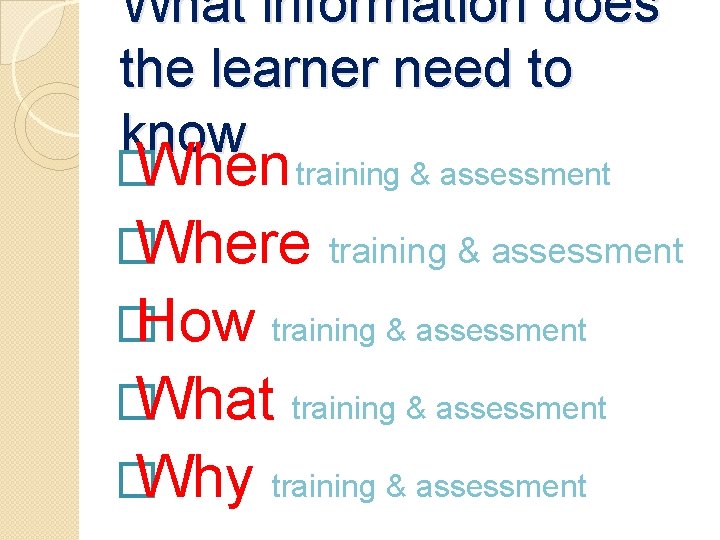
What information does the learner need to know � When training & assessment � Where � How training & assessment � What � Why training & assessment
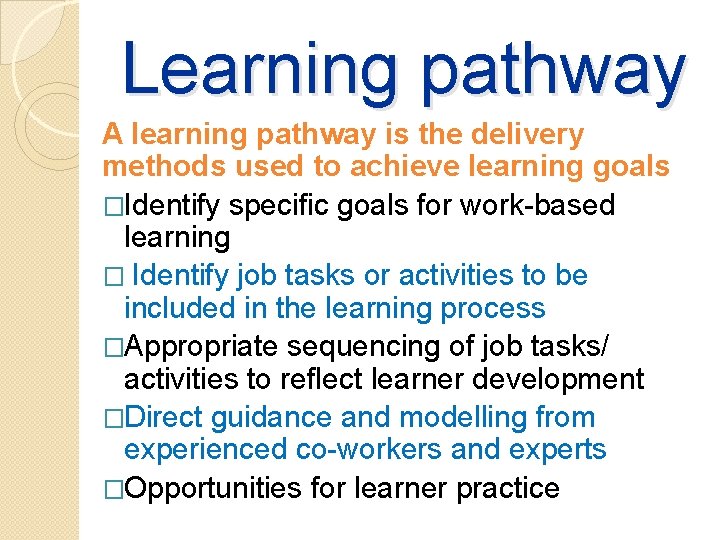
Learning pathway A learning pathway is the delivery methods used to achieve learning goals �Identify specific goals for work-based learning � Identify job tasks or activities to be included in the learning process �Appropriate sequencing of job tasks/ activities to reflect learner development �Direct guidance and modelling from experienced co-workers and experts �Opportunities for learner practice
Sequencing �Sequencing is about making the program progress in a smooth, logical order where skills and knowledge are practised and then built upon in successive sessions- it’s about planning and timing. �Your sequencing should present a logical progression of tasks: for example, tasks to develop underlying knowledge are scheduled prior to those requiring practical application.
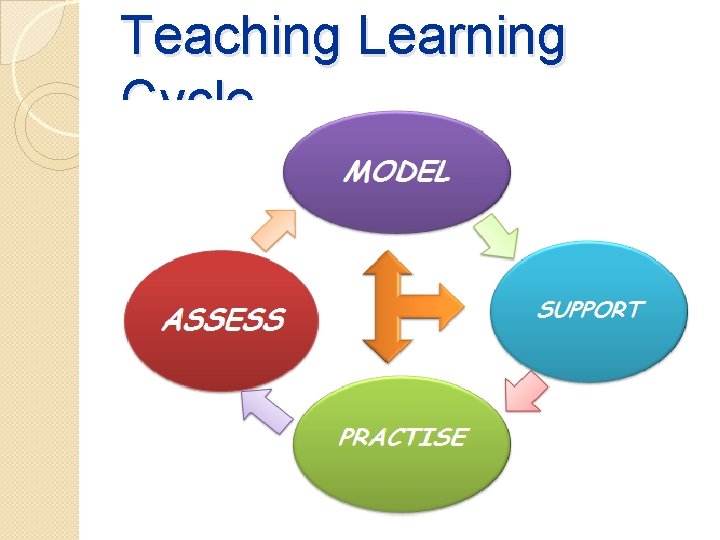
Teaching Learning Cycle
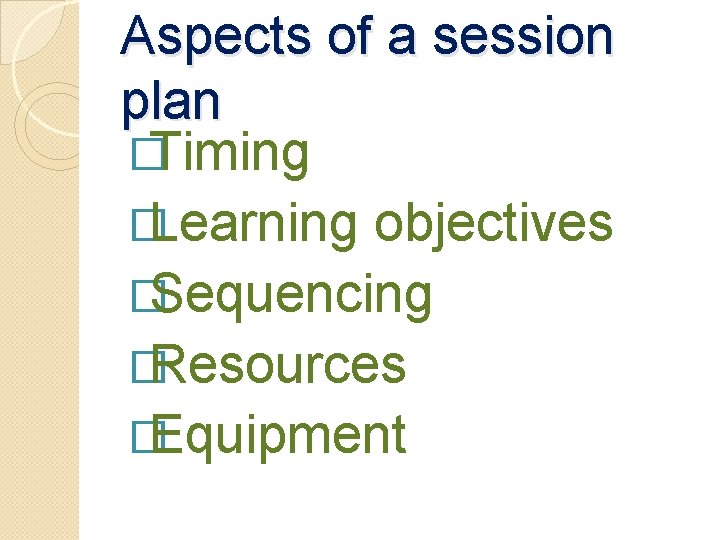
Aspects of a session plan �Timing �Learning objectives �Sequencing �Resources �Equipment
Learning materials Handouts � �Worksheets �Workbooks �Procedures �Role plays �Activities �Demonstrations �Realia
Learning objectives What is to be learnt? �Elements/Performance Criteria �Context �Marking Criteria �Collection of evidence
Trainer � � � � On time Prepared Professional Respectful Duty of care Fair Communication skills Flexible
Feedback from learners Can be gained by: � Formal discussion � Information discussion � Written questionnaire
Feedback because…? �The content of the training sessions �The resources used �The timing of the program �The assessment methods used �The way in which the program was delivered �The trainer
Reflection �How did you go? �What worked? �What didn’t work? Why? �How can it be improved? �How can I improve?
For Wednesday