
What do you think reading is What do

- Slides: 25
What do you think reading is? What do you read?
Teaching Reading in Today’s Elementary Schools THE READING ACT Chapter 1
THE IMPORTANCE OF READING Teaching reading in today’s schools is a challenging vocation. Teachers are expected to Prepare all students to do well on mandatory, high-stakes standardized tests Choose methods that are research based and represent best practices Work with an ever-changing array of technology Choose materials that are high quality, motivating and appropriate from a multitude of titles available Deal with an increasing diverse population of students-ELL learners and a variety of special instructional needs.
THE READING ACT- THE IMPORTANCE OF READING The ability to read is vital to functioning effectively in a literate society. Learning to read takes effort- easier for some than others Teachers show the importance of functional reading by demonstrating- point out that everyday life involves reading-menus, news, advertisements, labels, signs, road signs, etc. Think of an example that you could use to show the importance of functional reading for a Pre-K or K classroom. A grade 3 classroom.
THE READING ACT- THE IMPORTANCE OF READING Reading for enjoyment is the ultimate goal in teaching reading As a teacher you can help your students see reading as a pleasure by doing the following: Read to your students daily using a variety of genres, themes, topics Have many books available for students to look at and read and set aside time for self-selection Give students opportunities to share their reactions Encourage students to relate and connect to what they are reading Share the pleasure you get from reading with your studentsread during reading time
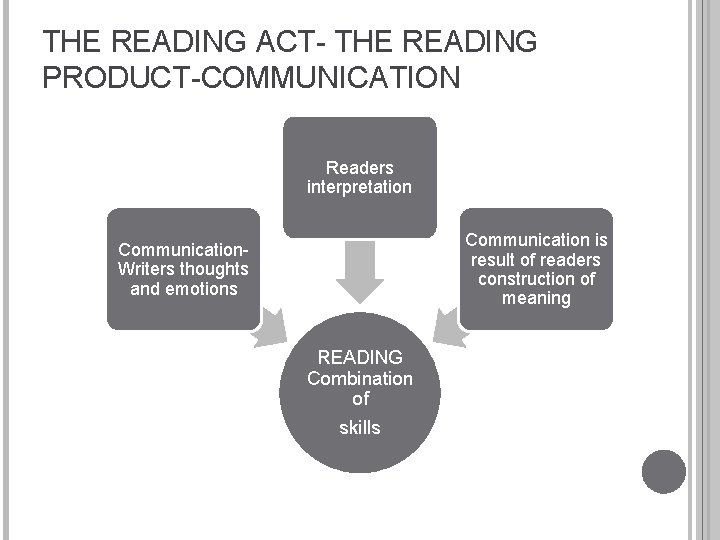
THE READING ACT- THE READING PRODUCT-COMMUNICATION Readers interpretation Communication is result of readers construction of meaning Communication. Writers thoughts and emotions READING Combination of skills
THE READING PROCESS Fluency is the ability to read with automaticity, appropriate rate, good expression, and good comprehension. Fluent reading results when the subskills are put together as an integrated whole. Performing subskills individually is not reading. Practice integrating the subskills as a whole is essential in the reading process. . You learn to read by reading.
THE READING PROCESS- THE READING BRAIN- FAST FOR WORD PROGRAM
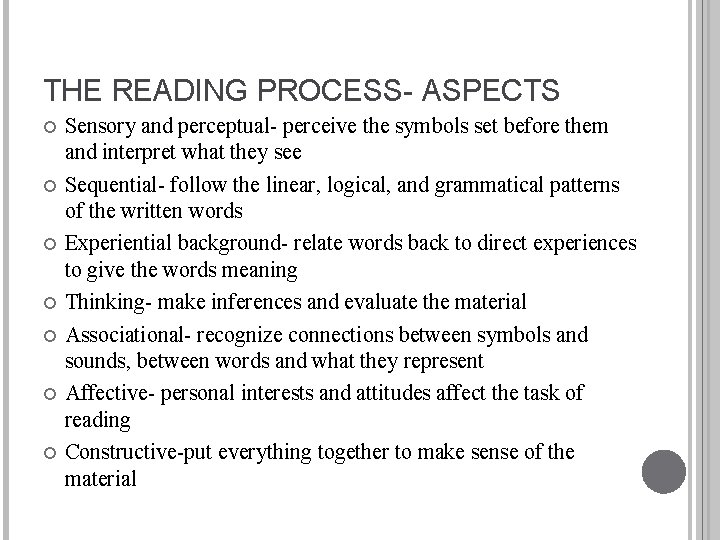
THE READING PROCESS Reading is an extremely complex process. When students read they must be able to use the following aspects Sensory and perceptual Sequential Experiential background Thinking Learning Associational Affective Constructive
THE READING PROCESS- ASPECTS Sensory and perceptual- perceive the symbols set before them and interpret what they see Sequential- follow the linear, logical, and grammatical patterns of the written words Experiential background- relate words back to direct experiences to give the words meaning Thinking- make inferences and evaluate the material Associational- recognize connections between symbols and sounds, between words and what they represent Affective- personal interests and attitudes affect the task of reading Constructive-put everything together to make sense of the material
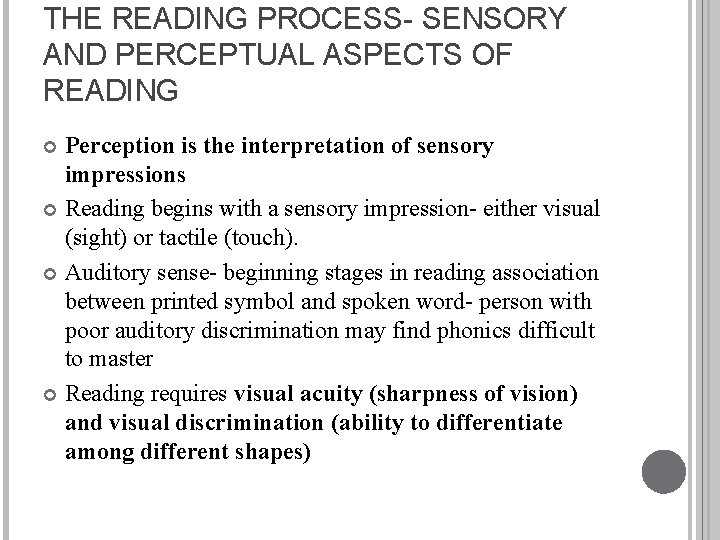
THE READING PROCESS- SENSORY AND PERCEPTUAL ASPECTS OF READING Perception is the interpretation of sensory impressions Reading begins with a sensory impression- either visual (sight) or tactile (touch). Auditory sense- beginning stages in reading association between printed symbol and spoken word- person with poor auditory discrimination may find phonics difficult to master Reading requires visual acuity (sharpness of vision) and visual discrimination (ability to differentiate among different shapes)
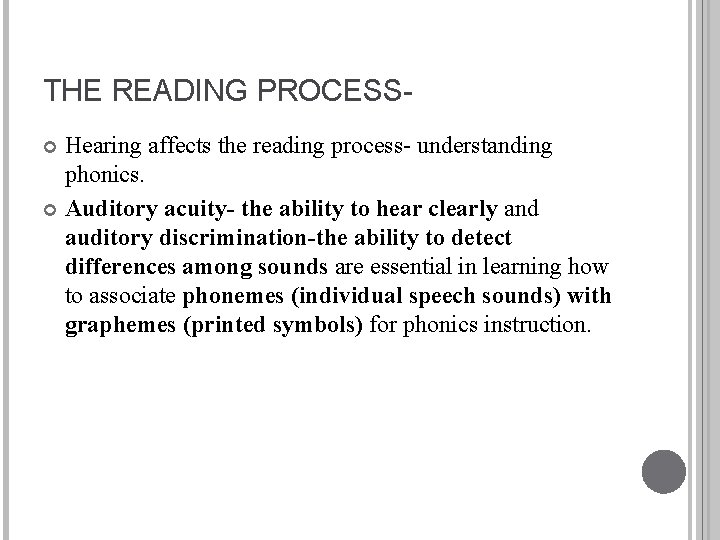
THE READING PROCESSHearing affects the reading process- understanding phonics. Auditory acuity- the ability to hear clearly and auditory discrimination-the ability to detect differences among sounds are essential in learning how to associate phonemes (individual speech sounds) with graphemes (printed symbols) for phonics instruction.
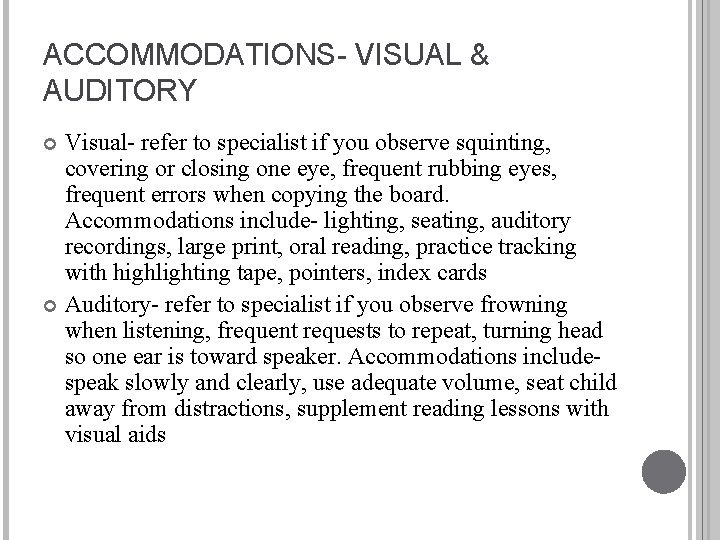
ACCOMMODATIONS- VISUAL & AUDITORY Visual- refer to specialist if you observe squinting, covering or closing one eye, frequent rubbing eyes, frequent errors when copying the board. Accommodations include- lighting, seating, auditory recordings, large print, oral reading, practice tracking with highlighting tape, pointers, index cards Auditory- refer to specialist if you observe frowning when listening, frequent requests to repeat, turning head so one ear is toward speaker. Accommodations includespeak slowly and clearly, use adequate volume, seat child away from distractions, supplement reading lessons with visual aids
THE READING PROCESS Sequential aspects of reading-readers must learn to follow the sequence and order in which printed material is arranged. Left to right- top to bottom Experiential background-readers integrate information with prior knowledge for understanding Schemata- clusters of information that people have developed about things, places, or ideas Prior knowledge gained through direct and indirect (vicarious) experiences.
THE READING PROCESS Reading and Thinking- recognizing and interpreting symbols, comprehending a reading selection requires a combination of thinking skills. Teachers help guide thinking by asking appropriate questions. Reading to Learning- increases success in school, helps coping with everyday situations outside of school, bestows status, provides recreation. Think and discuss- students “learn to read” in the primary grades and “read to learn” in intermediate and upper grades. Agree or disagree.
READING PROCESS Reading is an associational process- the more meaningful an association is to a student, the more rapidly he or she will learn it. Comprehension is easier when connections are made. Affective aspects of reading- interests, attitudes, and selfconcept- determine how hard students will work at a reading task. Motivation – the incentive to act Self-concept- opinion of one self affects the risks one is willing to take to succeed. Constructive- the reader puts together input from sensory and perceptual channels along with experiences and the printed word to gain meaning from the text.
READING PROCESS: SELECTED THEORIES SUBSKILL THEORIES Reading is a set of subskills that children must master and integrate Skills are mastered and used automatically. Automaticity is the ability to perform a task with little attention. Subskills are practiced in the context of actual reading to ensure integration Students master smaller units before larger ones and integrate them into larger units after mastery
READING PROCESS: SELECTED THEORIES INTERACTIVE THEORIESReading is a combination of two types of processing- top -down processing (reader based) and bottom-up processing (text based) in continuous interaction. In top-down processing, the act of reading begins with the reader generating a prediction In bottom-up processing, reading is initiated by examining the printed symbols. Readers must first sound out a word letter by letter, pronounce it and so on. Skilled readers use both simultaneously. Readers who cannot use clues from sentences or pictures cannot grasp the meaning.
READING PROCESS- SELECTED THEORIES TRANSACTIVE THEORIESEvery reading act is a transaction involving a particular reader and a text in a particular context with meaning coming into being during the transaction between the reader and the text. No two readings are likely to be identical The readers stances, beliefs, and attitudes affect their responses, as does the context Readers can comprehend a passage without having identified all the words in it. Fluent readers use semantic clues (meaning) and syntactic clues (word order) within the material
TRANSACTIVE THEORY Louis Rosenblatt- the transaction between reader and text is dynamic. Readers take one of two stances Efferent stance- focusing on obtaining information Aesthetic stance- focusing on the experience lived through during the reading, the feeling and images evoked, and the memories aroused by the text Reader chooses the appropriate stance
WHAT DO YOU THINK? Some people believe the meaning resides in the text Some believe that readers bring meaning to the text Some believe comprehension involves using both the information in the text and the information the reader brings to the text Let’s Read
TEACHER’S DILEMMA: TAKING A BALANCED APPROACH An approach in which teachers concentrate on providing both word recognition and comprehension strategy and skill instruction along with ample opportunities to read complete works of literature, to use reading materials to solve problems, and to explore nonfiction and fiction material. Organized learning- whole-class, small-group, and individualized instruction Use a variety of approaches to meet the needs of all learners
15 PRINCIPLES OF TEACHING READING 1. 2. 3. 4. 5. Reading is a complex act with many factors that must be considered Reading involves the construction of the meaning represented by the printed symbols There is no one correct way to teach reading Learning to read is a continuing process Students should be taught word-recognition strategies that will allow them to unlock pronunciations and meanings of unfamiliar words independently
15 PRINCIPLES OF TEACHING READING 6. The teacher should assess each student’s reading ability and use the assessment as a basis for planning instruction. 7. Reading and the other language arts are highly interrelated. 8. Using complete literature selections in the reading program is important 9. Reading is an integral part of all content area instruction within the educational program 10. The student needs to see that reading can be an enjoyable pursuit
THE 15 PRINCIPLES OF TEACHING READING 11. Sound teaching of all reading skills and strategies is important for all students 12. Reading should be taught in a way that allows each student to experience success 13. Encouraging self-direction and self-monitoring of reading is important 14. A supportive classroom organization can facilitate the teaching of reading 15. Teachers must help students develop facility in using technology to enhance their learning.