
What do you remember The Past Simple The
What do you remember? The Past Simple The Past Progressive (Continuous) The “used to” past Advertisement to advertise Affluence affluent Agenda
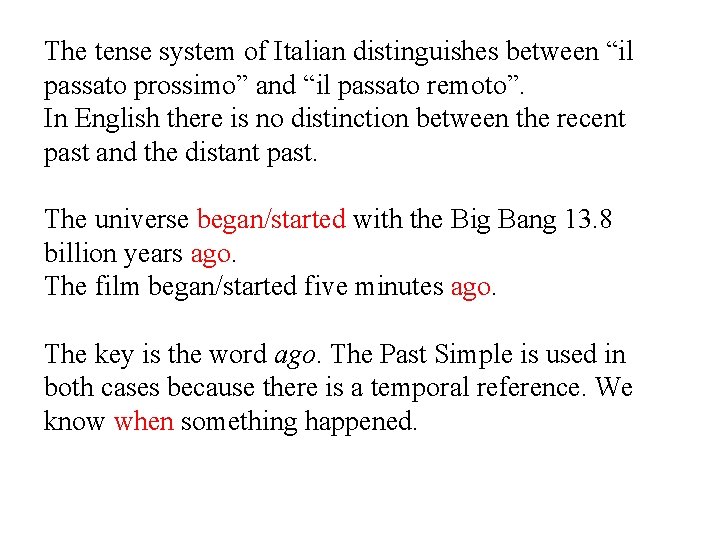
The tense system of Italian distinguishes between “il passato prossimo” and “il passato remoto”. In English there is no distinction between the recent past and the distant past. The universe began/started with the Big Bang 13. 8 billion years ago. The film began/started five minutes ago. The key is the word ago. The Past Simple is used in both cases because there is a temporal reference. We know when something happened.
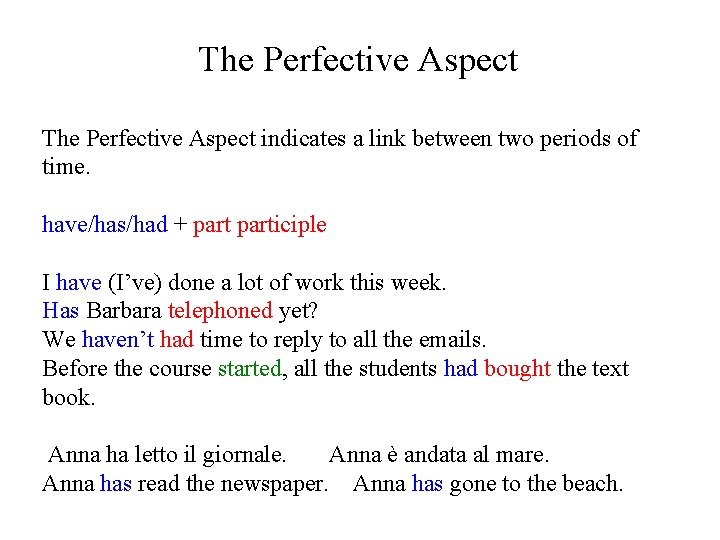
The Perfective Aspect indicates a link between two periods of time. have/has/had + participle I have (I’ve) done a lot of work this week. Has Barbara telephoned yet? We haven’t had time to reply to all the emails. Before the course started, all the students had bought the text book. Anna ha letto il giornale. Anna è andata al mare. Anna has read the newspaper. Anna has gone to the beach.
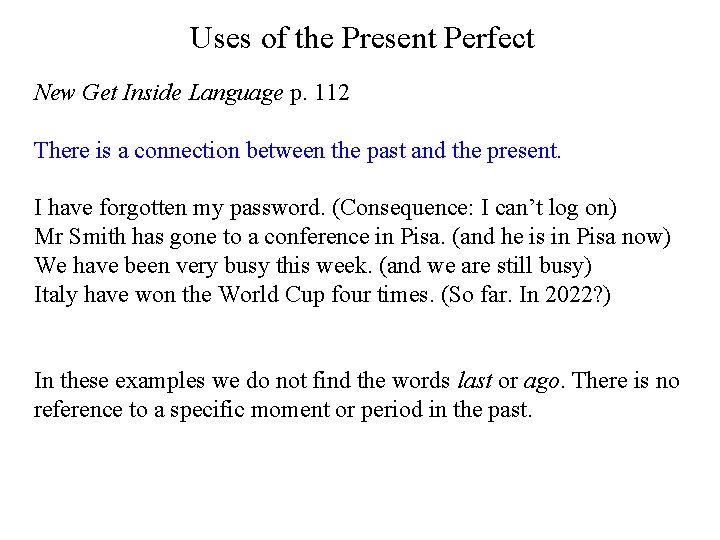
Uses of the Present Perfect New Get Inside Language p. 112 There is a connection between the past and the present. I have forgotten my password. (Consequence: I can’t log on) Mr Smith has gone to a conference in Pisa. (and he is in Pisa now) We have been very busy this week. (and we are still busy) Italy have won the World Cup four times. (So far. In 2022? ) In these examples we do not find the words last or ago. There is no reference to a specific moment or period in the past.
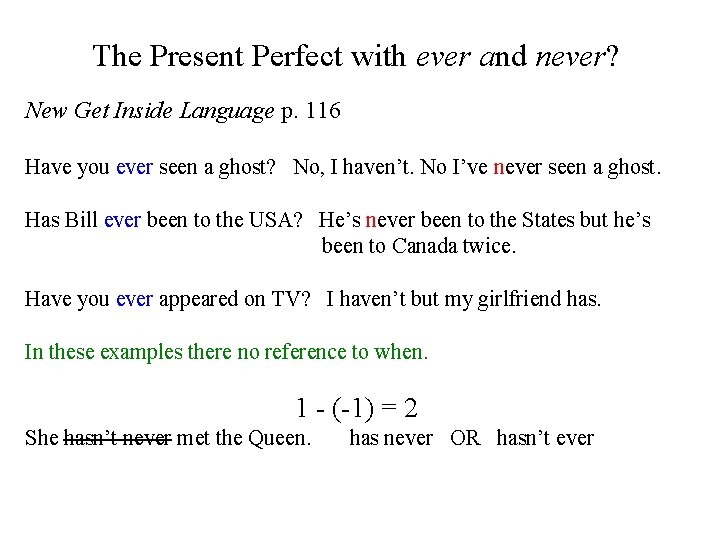
The Present Perfect with ever and never? New Get Inside Language p. 116 Have you ever seen a ghost? No, I haven’t. No I’ve never seen a ghost. Has Bill ever been to the USA? He’s never been to the States but he’s been to Canada twice. Have you ever appeared on TV? I haven’t but my girlfriend has. In these examples there no reference to when. 1 - (-1) = 2 She hasn’t never met the Queen. has never OR hasn’t ever
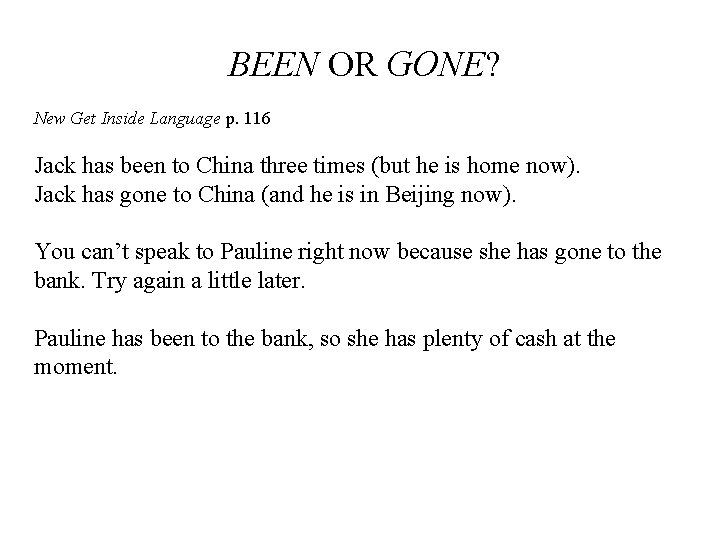
BEEN OR GONE? New Get Inside Language p. 116 Jack has been to China three times (but he is home now). Jack has gone to China (and he is in Beijing now). You can’t speak to Pauline right now because she has gone to the bank. Try again a little later. Pauline has been to the bank, so she has plenty of cash at the moment.

The Present Perfect with yet, already, just and so far New Get Inside Language p. 119 Have you seen Spielberg’s new film yet? No, I haven’t seen it yet. Yes, I’ve already seen it. She can’t graduate because she hasn’t passed the English exam yet. The United Kingdom hasn’t left the European Union yet. We are still waiting to find out what is going to happen. There is a tendency to use yet in interrogative and negative sentences and already in affirmative sentences but this is not a grammatical rule.
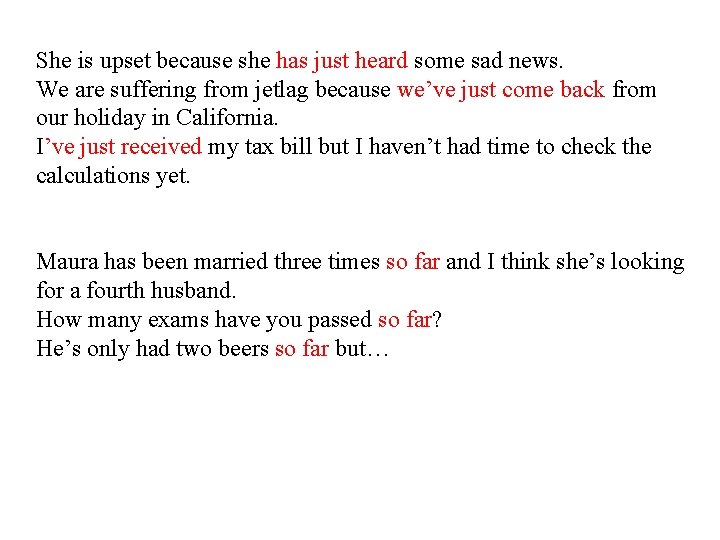
She is upset because she has just heard some sad news. We are suffering from jetlag because we’ve just come back from our holiday in California. I’ve just received my tax bill but I haven’t had time to check the calculations yet. Maura has been married three times so far and I think she’s looking for a fourth husband. How many exams have you passed so far? He’s only had two beers so far but…
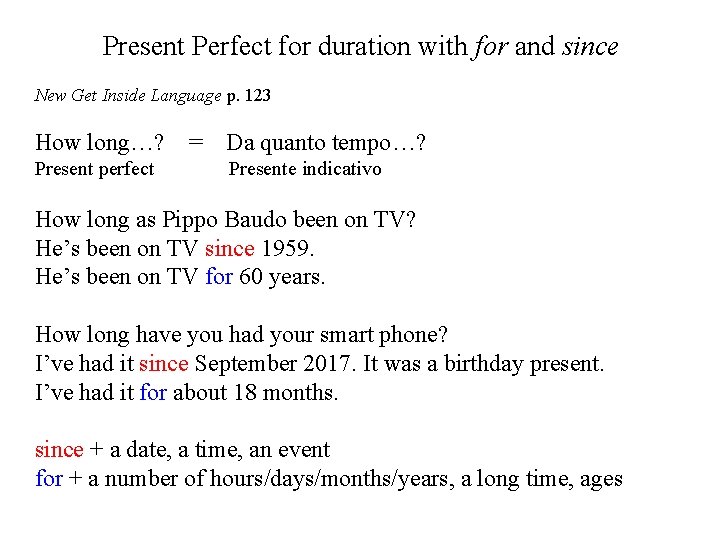
Present Perfect for duration with for and since New Get Inside Language p. 123 How long…? Present perfect = Da quanto tempo…? Presente indicativo How long as Pippo Baudo been on TV? He’s been on TV since 1959. He’s been on TV for 60 years. How long have you had your smart phone? I’ve had it since September 2017. It was a birthday present. I’ve had it for about 18 months. since + a date, a time, an event for + a number of hours/days/months/years, a long time, ages
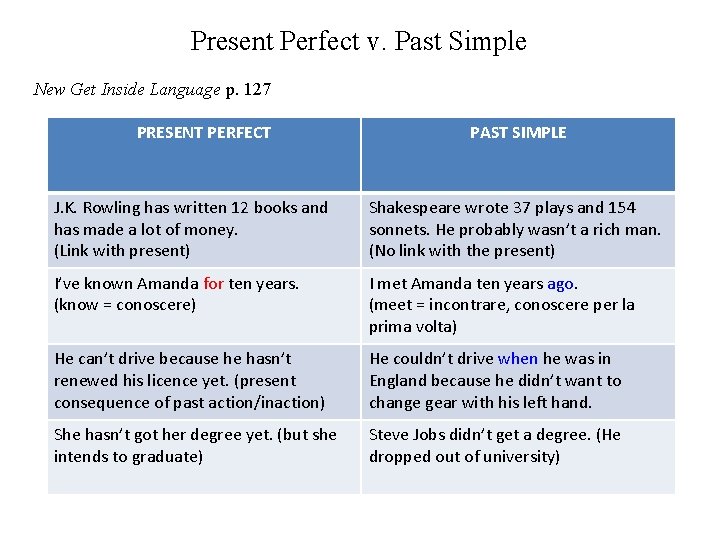
Present Perfect v. Past Simple New Get Inside Language p. 127 PRESENT PERFECT PAST SIMPLE J. K. Rowling has written 12 books and has made a lot of money. (Link with present) Shakespeare wrote 37 plays and 154 sonnets. He probably wasn’t a rich man. (No link with the present) I’ve known Amanda for ten years. (know = conoscere) I met Amanda ten years ago. (meet = incontrare, conoscere per la prima volta) He can’t drive because he hasn’t renewed his licence yet. (present consequence of past action/inaction) He couldn’t drive when he was in England because he didn’t want to change gear with his left hand. She hasn’t got her degree yet. (but she intends to graduate) Steve Jobs didn’t get a degree. (He dropped out of university)
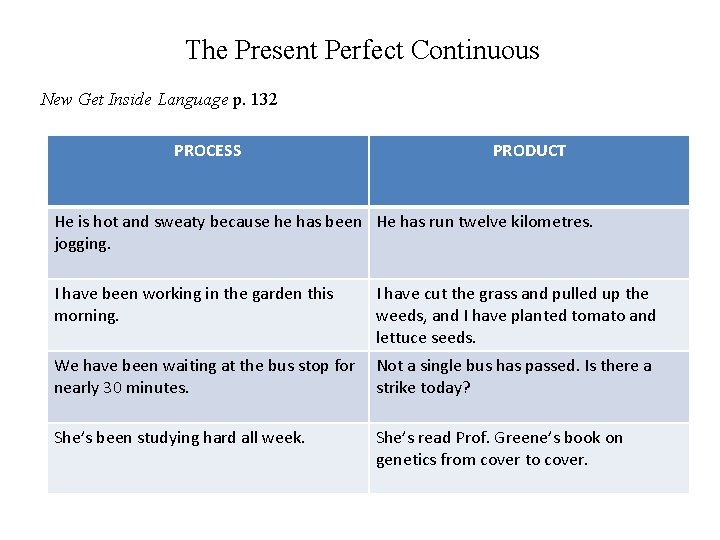
The Present Perfect Continuous New Get Inside Language p. 132 PROCESS PRODUCT He is hot and sweaty because he has been He has run twelve kilometres. jogging. I have been working in the garden this morning. I have cut the grass and pulled up the weeds, and I have planted tomato and lettuce seeds. We have been waiting at the bus stop for nearly 30 minutes. Not a single bus has passed. Is there a strike today? She’s been studying hard all week. She’s read Prof. Greene’s book on genetics from cover to cover.
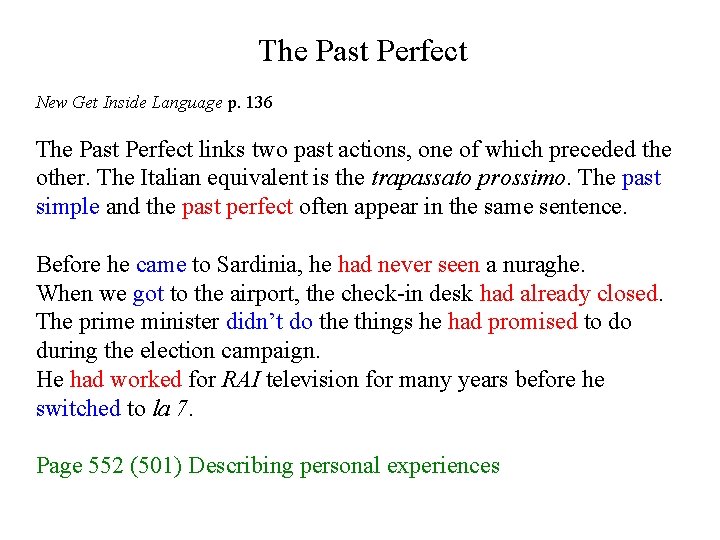
The Past Perfect New Get Inside Language p. 136 The Past Perfect links two past actions, one of which preceded the other. The Italian equivalent is the trapassato prossimo. The past simple and the past perfect often appear in the same sentence. Before he came to Sardinia, he had never seen a nuraghe. When we got to the airport, the check-in desk had already closed. The prime minister didn’t do the things he had promised to do during the election campaign. He had worked for RAI television for many years before he switched to la 7. Page 552 (501) Describing personal experiences
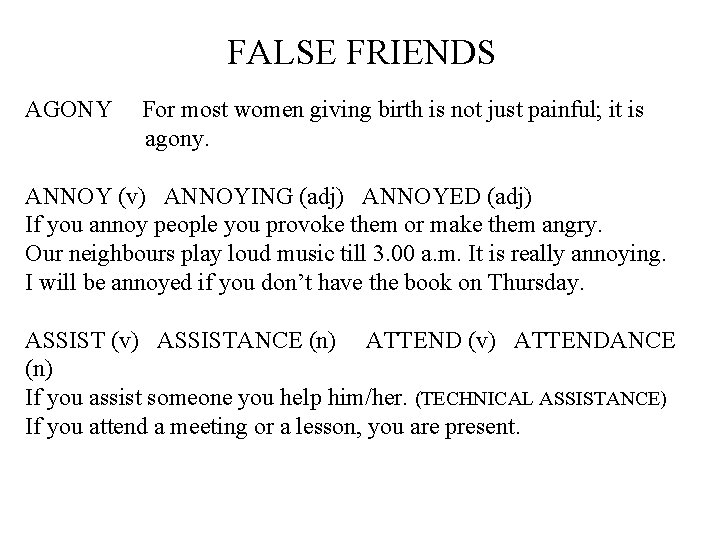
FALSE FRIENDS AGONY For most women giving birth is not just painful; it is agony. ANNOY (v) ANNOYING (adj) ANNOYED (adj) If you annoy people you provoke them or make them angry. Our neighbours play loud music till 3. 00 a. m. It is really annoying. I will be annoyed if you don’t have the book on Thursday. ASSIST (v) ASSISTANCE (n) ATTEND (v) ATTENDANCE (n) If you assist someone you help him/her. (TECHNICAL ASSISTANCE) If you attend a meeting or a lesson, you are present.
- Slides: 13