
What do you know about probability Probability is
What do you know about probability? • Probability is a number from 0 to 1 that tells you how likely something is to happen. • Probability can have two approaches -experimental probability -theoretical probability

Key Words • Experimental probability • Theoretical probability • Law of Large Numbers • Outcome • Event • Random Click here to check the words

Experimental vs. Theoretical Experimental probability: P(event) = number of times event occurs total number of trials Theoretical probability: P(E) = number of favorable outcomes total number of possible outcomes
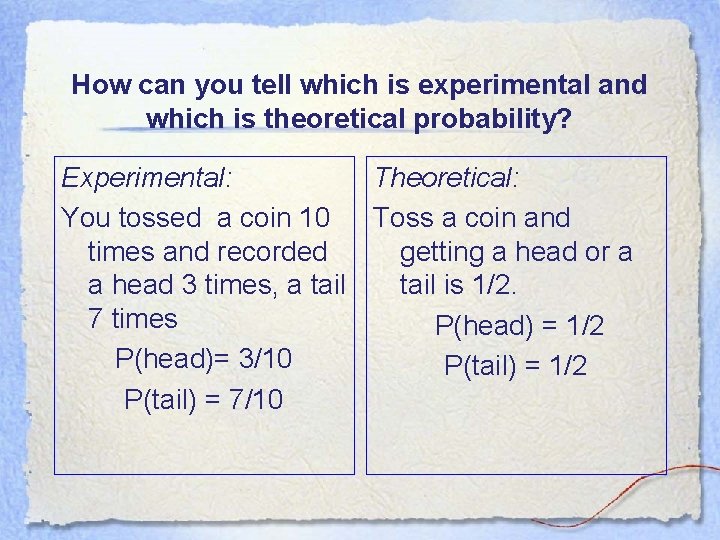
How can you tell which is experimental and which is theoretical probability? Experimental: Theoretical: You tossed a coin 10 Toss a coin and times and recorded getting a head or a a head 3 times, a tail is 1/2. 7 times P(head) = 1/2 P(head)= 3/10 P(tail) = 1/2 P(tail) = 7/10
Experimental probability is found by repeating an experiment and observing the outcomes. P(head)= 3/10 A head shows up 3 times out of 10 trials, P(tail) = 7/10 A tail shows up 7 times out of 10 trials

Theoretical probability HEADS TAILS P(head) = 1/2 P(tail) = 1/2 Since there are only two outcomes, you have 50/50 chance to get a head or a tail.
Compare experimental and theoretical probability Both probabilities are ratios that compare the number of favorable outcomes to the total number of possible outcomes P(head)= 3/10 P(tail) = 7/10 P(head) = 1/2 P(tail) = 1/2
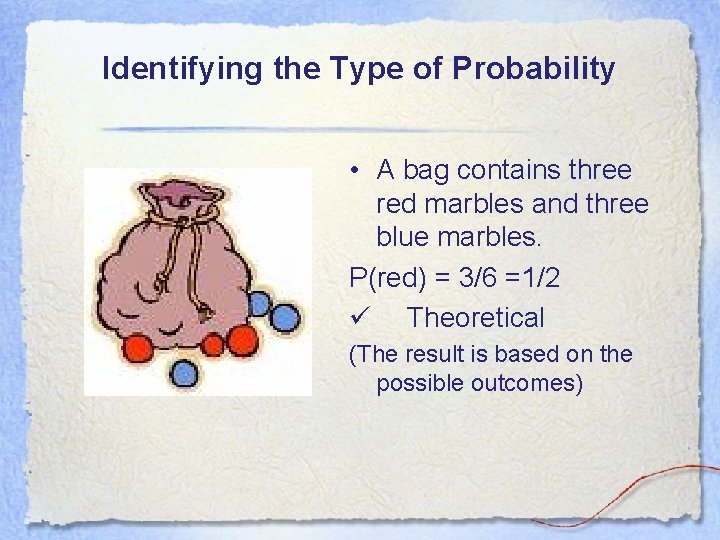
Identifying the Type of Probability • A bag contains three red marbles and three blue marbles. P(red) = 3/6 =1/2 ü Theoretical (The result is based on the possible outcomes)
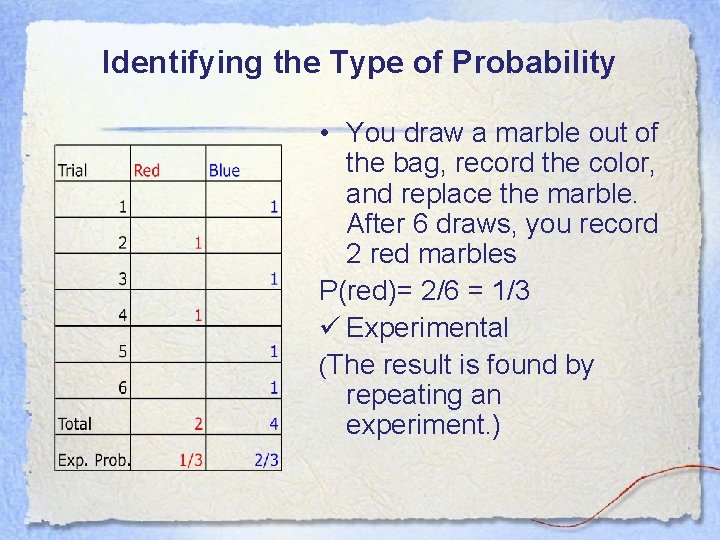
Identifying the Type of Probability • You draw a marble out of the bag, record the color, and replace the marble. After 6 draws, you record 2 red marbles P(red)= 2/6 = 1/3 ü Experimental (The result is found by repeating an experiment. )
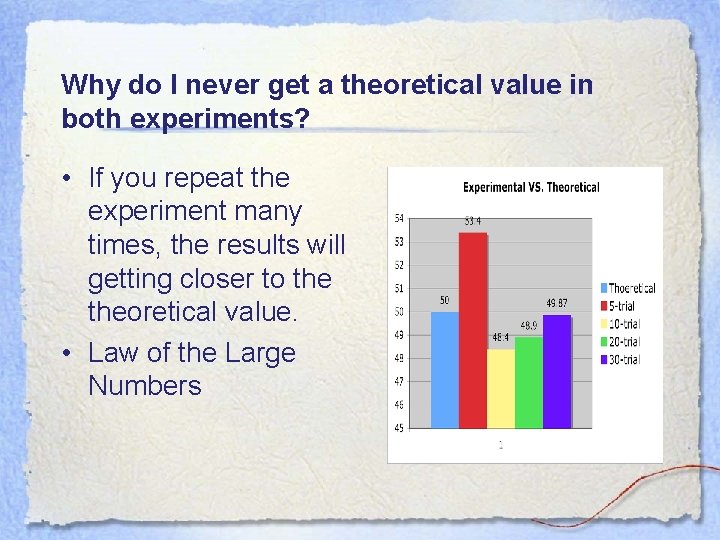
Why do I never get a theoretical value in both experiments? • If you repeat the experiment many times, the results will getting closer to theoretical value. • Law of the Large Numbers
Law of the Large Numbers • The Law of Large Numbers was first published in 1713 by Jocob Bernoulli. • It is a fundamental concept for probability and statistic. • As the number of trials increase, the experimental probability will get closer and closer to theoretical probability.
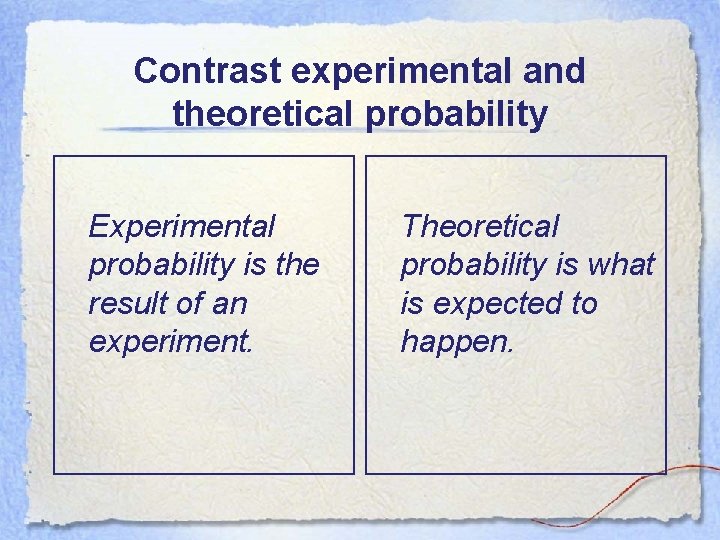
Contrast experimental and theoretical probability Experimental probability is the result of an experiment. Theoretical probability is what is expected to happen.
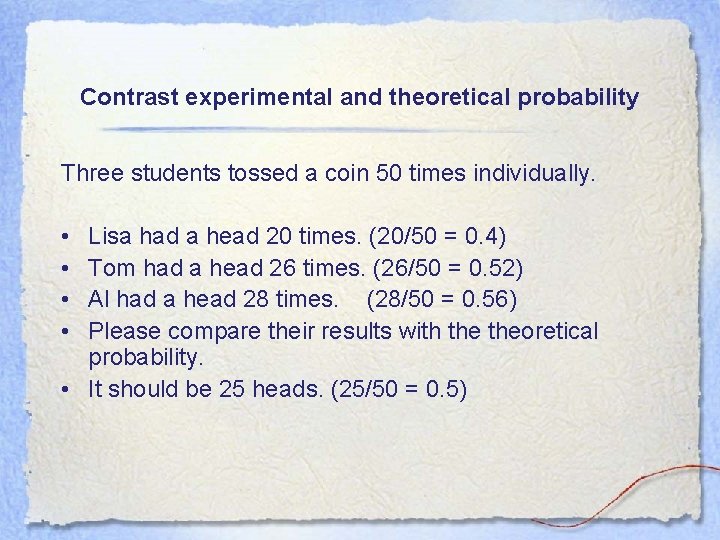
Contrast experimental and theoretical probability Three students tossed a coin 50 times individually. • • Lisa had a head 20 times. (20/50 = 0. 4) Tom had a head 26 times. (26/50 = 0. 52) Al had a head 28 times. (28/50 = 0. 56) Please compare their results with theoretical probability. • It should be 25 heads. (25/50 = 0. 5)
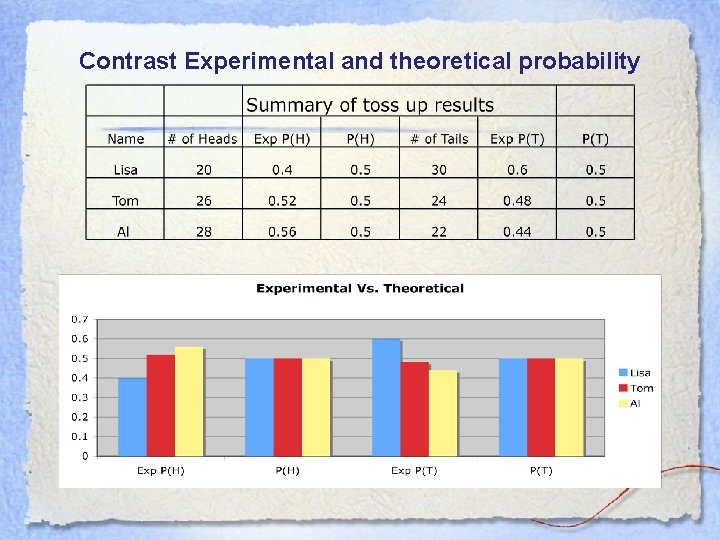
Contrast Experimental and theoretical probability
- Slides: 14