
What do you know about Cellular Respiration What
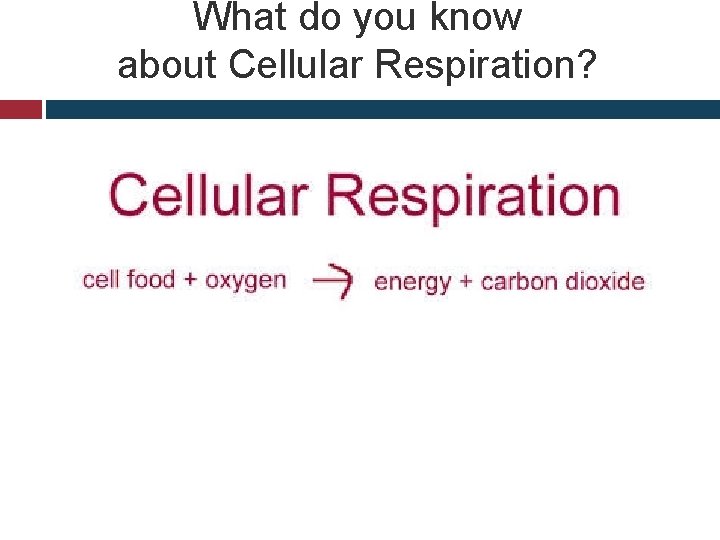
What do you know about Cellular Respiration?
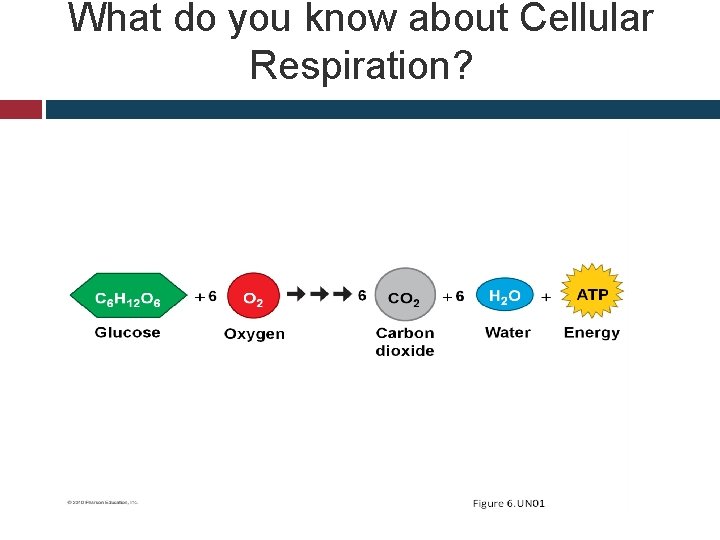
What do you know about Cellular Respiration?
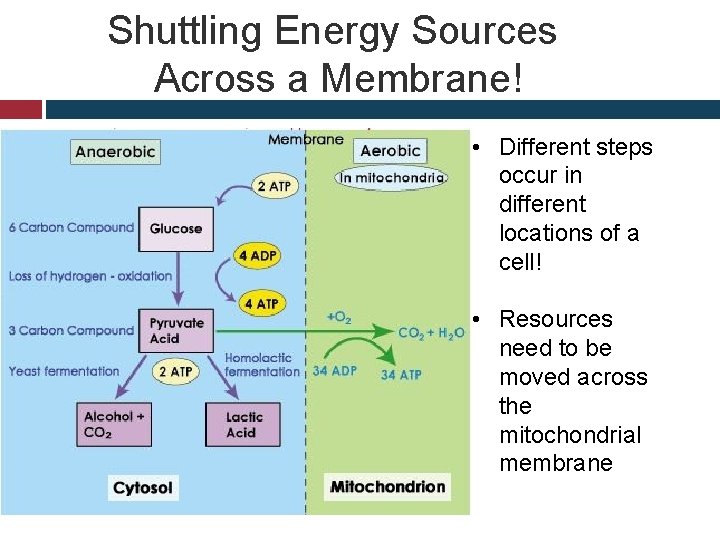
Shuttling Energy Sources Across a Membrane! • Different steps occur in different locations of a cell! • Resources need to be moved across the mitochondrial membrane
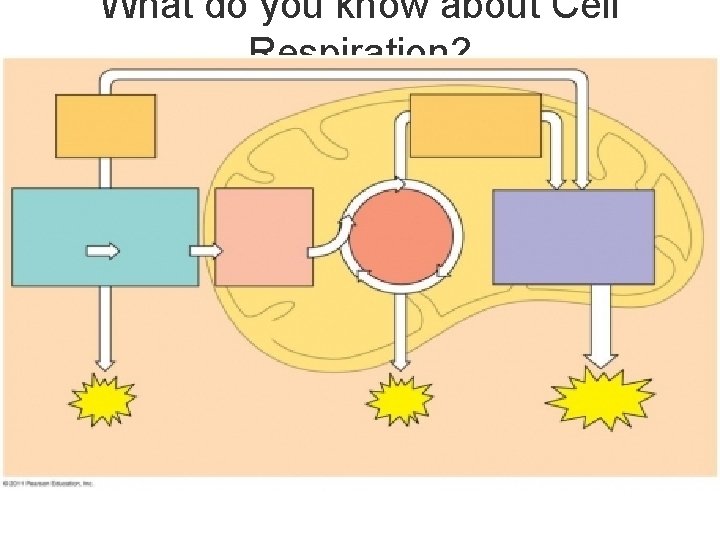
What do you know about Cell Respiration?
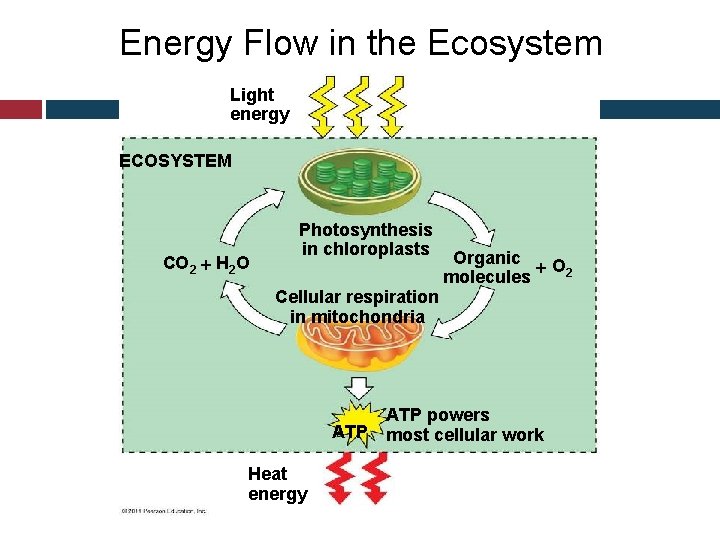
Energy Flow in the Ecosystem Light energy ECOSYSTEM CO 2 H 2 O Photosynthesis in chloroplasts Cellular respiration in mitochondria ATP Heat energy Organic O 2 molecules ATP powers most cellular work
Energy is generated by Catabolic pathways involved in oxidizing organic fuels
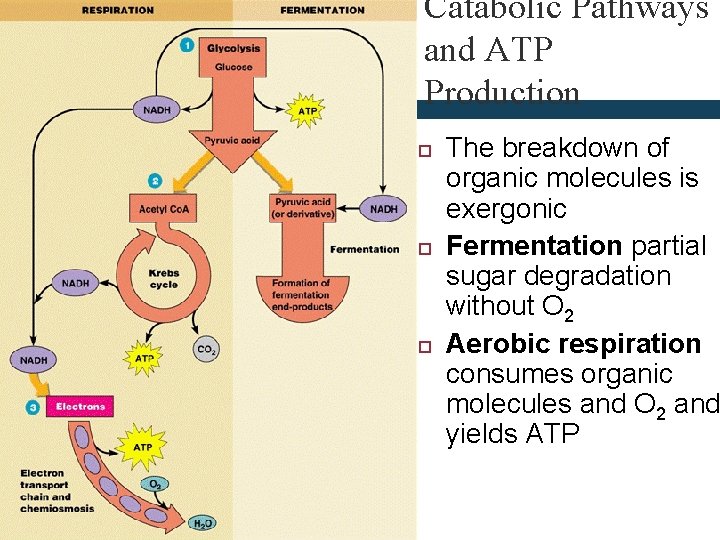
Catabolic Pathways and ATP Production The breakdown of organic molecules is exergonic Fermentation partial sugar degradation without O 2 Aerobic respiration consumes organic molecules and O 2 and yields ATP
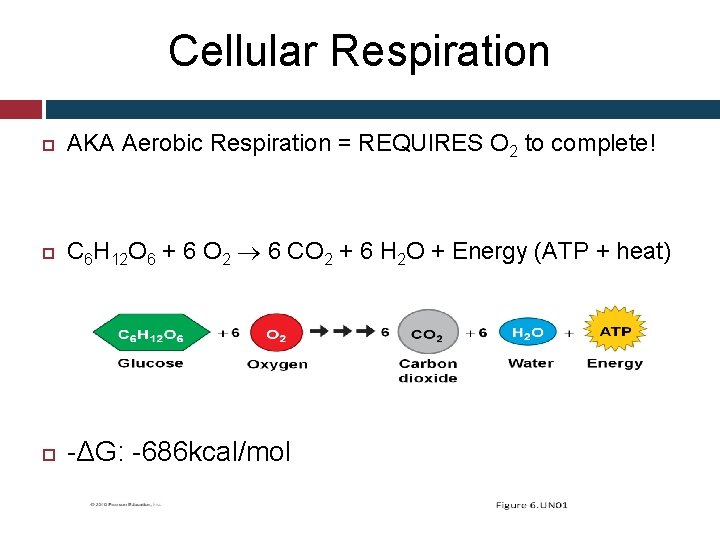
Cellular Respiration AKA Aerobic Respiration = REQUIRES O 2 to complete! C 6 H 12 O 6 + 6 O 2 6 CO 2 + 6 H 2 O + Energy (ATP + heat) -ΔG: -686 kcal/mol
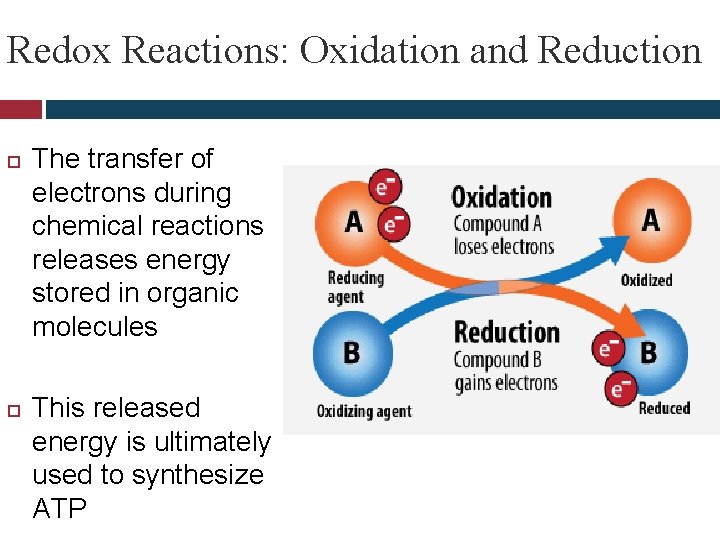
Redox Reactions: Oxidation and Reduction The transfer of electrons during chemical reactions releases energy stored in organic molecules This released energy is ultimately used to synthesize ATP
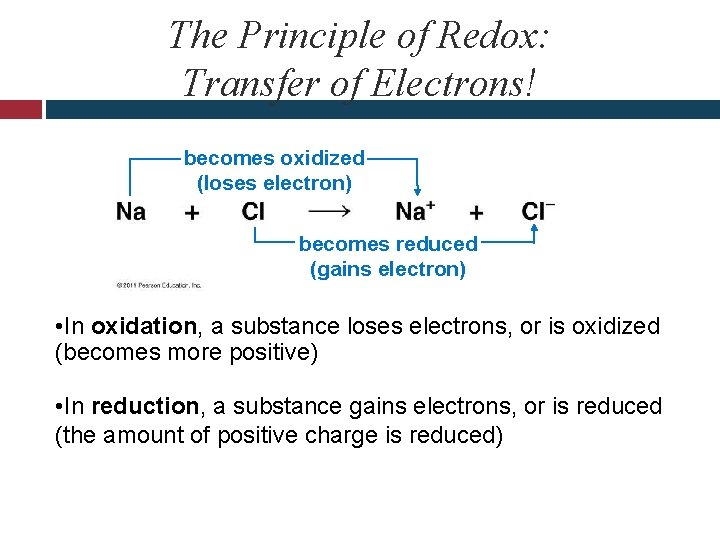
The Principle of Redox: Transfer of Electrons! becomes oxidized (loses electron) becomes reduced (gains electron) • In oxidation, a substance loses electrons, or is oxidized (becomes more positive) • In reduction, a substance gains electrons, or is reduced (the amount of positive charge is reduced)
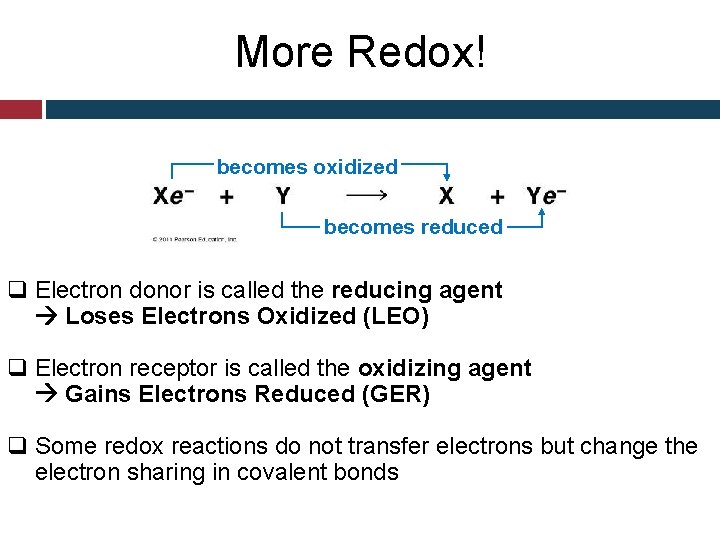
More Redox! becomes oxidized becomes reduced q Electron donor is called the reducing agent Loses Electrons Oxidized (LEO) q Electron receptor is called the oxidizing agent Gains Electrons Reduced (GER) q Some redox reactions do not transfer electrons but change the electron sharing in covalent bonds
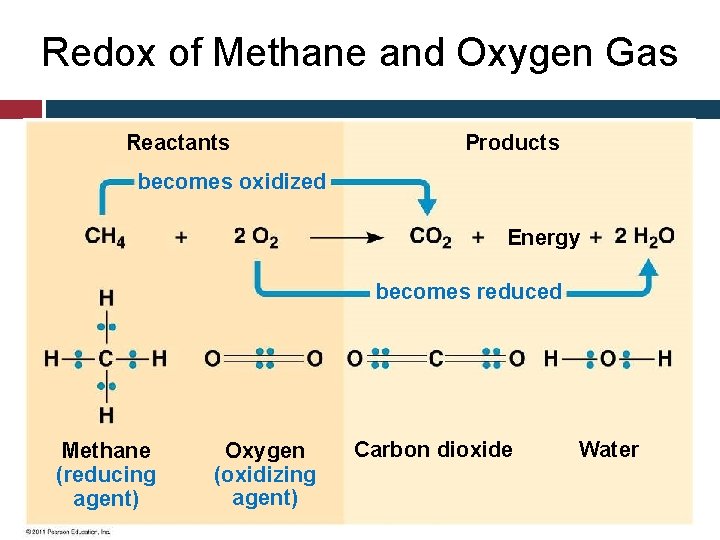
Redox of Methane and Oxygen Gas Reactants Products becomes oxidized Energy becomes reduced Methane (reducing agent) Oxygen (oxidizing agent) Carbon dioxide Water
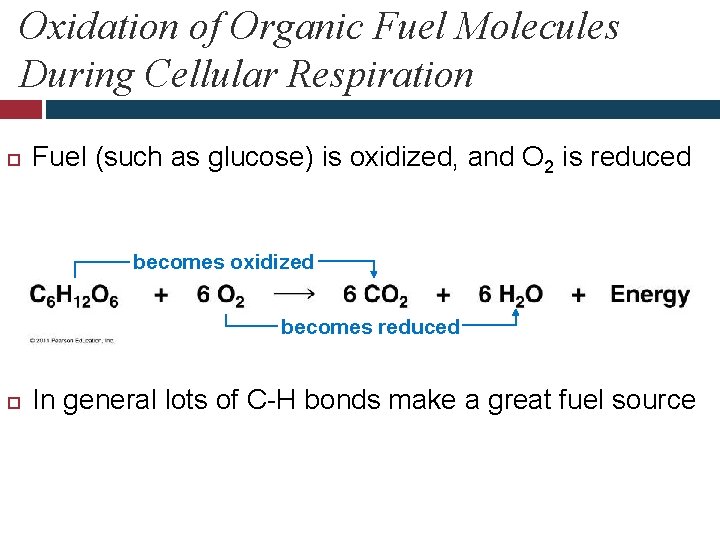
Oxidation of Organic Fuel Molecules During Cellular Respiration Fuel (such as glucose) is oxidized, and O 2 is reduced becomes oxidized becomes reduced In general lots of C-H bonds make a great fuel source
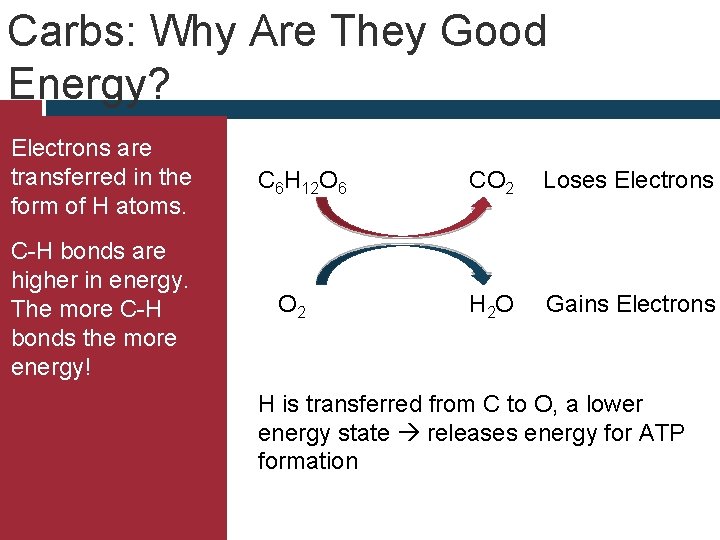
Carbs: Why Are They Good Energy? Electrons are transferred in the form of H atoms. C-H bonds are higher in energy. The more C-H bonds the more energy! C 6 H 12 O 6 O 2 CO 2 Loses Electrons H 2 O Gains Electrons H is transferred from C to O, a lower energy state releases energy for ATP formation
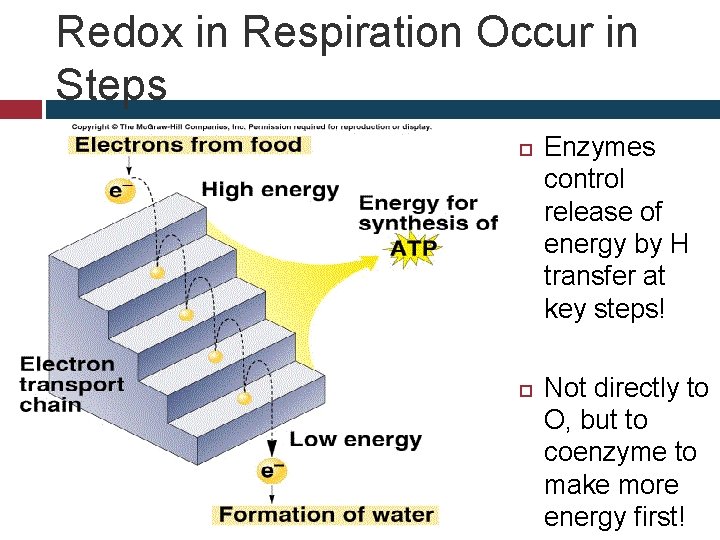
Redox in Respiration Occur in Steps Enzymes control release of energy by H transfer at key steps! Not directly to O, but to coenzyme to make more energy first!
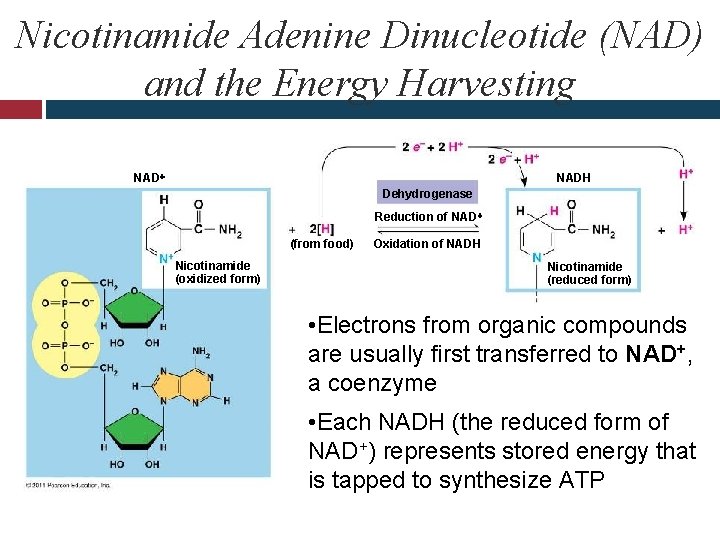
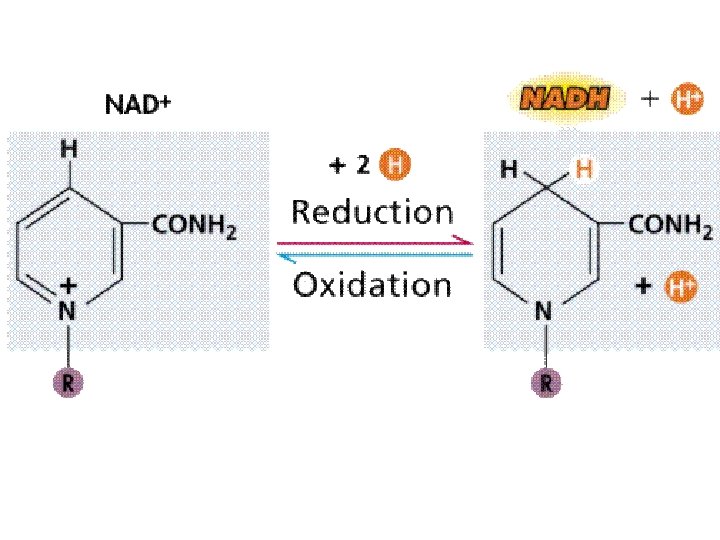
Nicotinamide Adenine Dinucleotide (NAD) and the Energy Harvesting NADH Dehydrogenase Reduction of NAD (from food) Nicotinamide (oxidized form) Oxidation of NADH Nicotinamide (reduced form) • Electrons from organic compounds are usually first transferred to NAD+, a coenzyme • Each NADH (the reduced form of NAD+) represents stored energy that is tapped to synthesize ATP
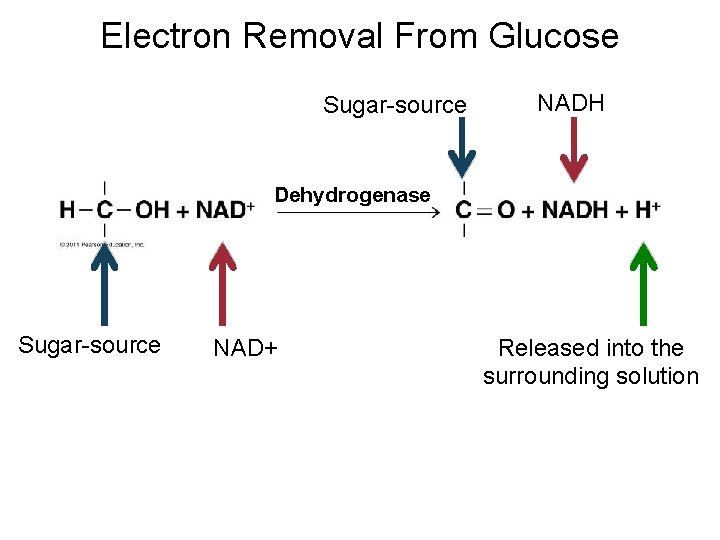
Electron Removal From Glucose Sugar-source NADH Dehydrogenase Sugar-source NAD+ Released into the surrounding solution
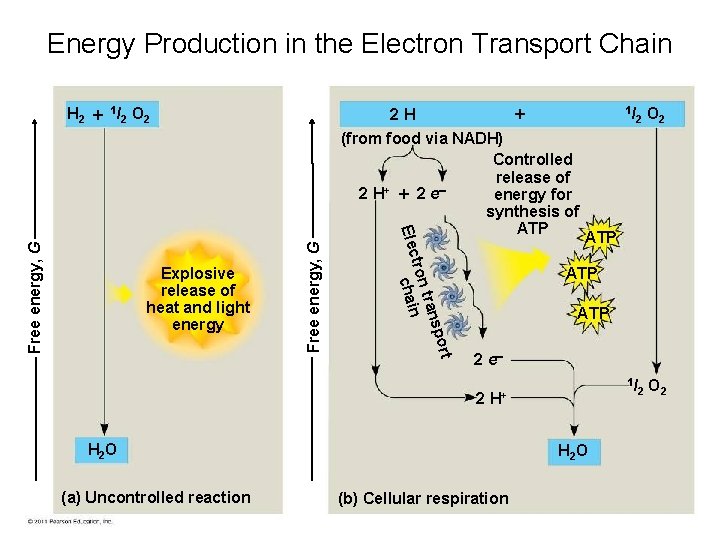
Energy Production in the Electron Transport Chain H 2 1 / 2 O 2 2 H 1/ rt Free energy, G ATP 2 e 2 1/ H+ H 2 O (a) Uncontrolled reaction O 2 ATP spo Free energy, G tran tron ain ch Explosive release of heat and light energy Elec (from food via NADH) Controlled release of + 2 H 2 e energy for synthesis of ATP 2 H 2 O (b) Cellular respiration 2 O 2
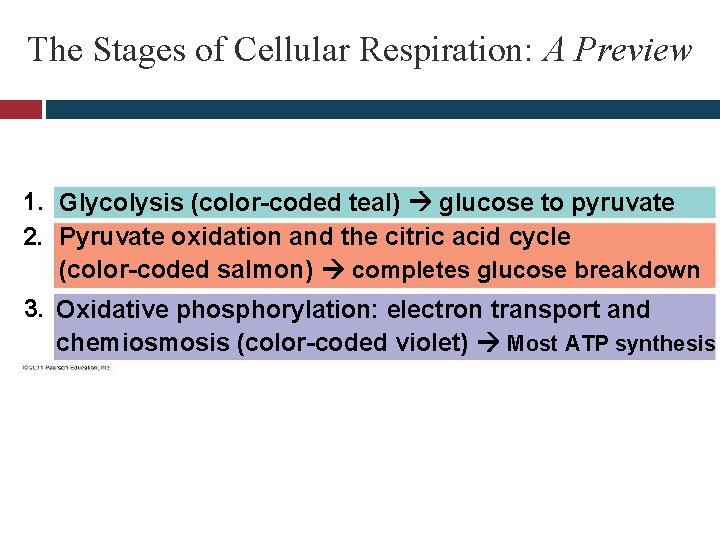
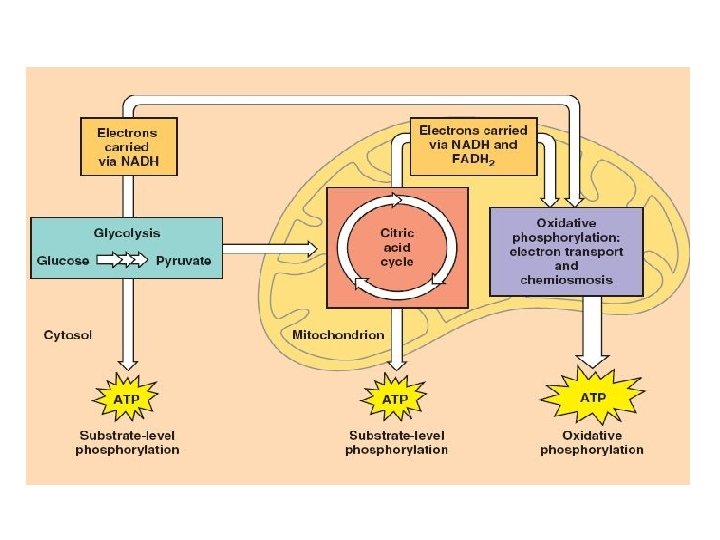
The Stages of Cellular Respiration: A Preview 1. Glycolysis (color-coded teal) glucose to pyruvate 2. Pyruvate oxidation and the citric acid cycle (color-coded salmon) completes glucose breakdown 3. Oxidative phosphorylation: electron transport and chemiosmosis (color-coded violet) Most ATP synthesis
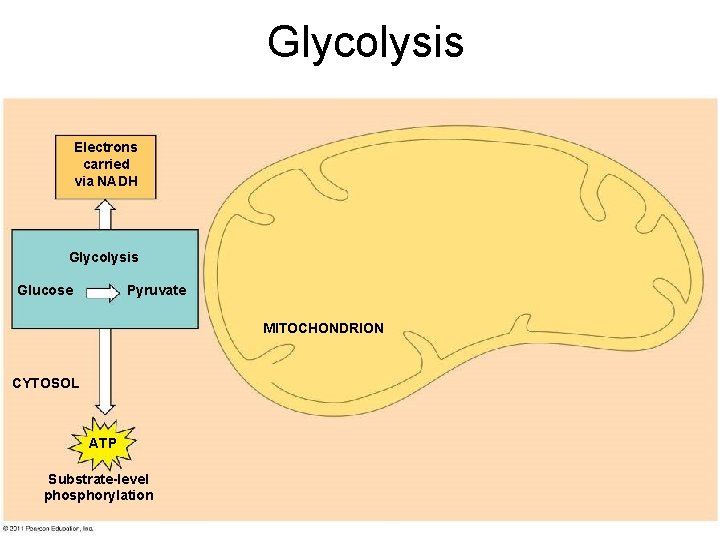
Glycolysis Electrons carried via NADH Glycolysis Glucose Pyruvate MITOCHONDRION CYTOSOL ATP Substrate-level phosphorylation
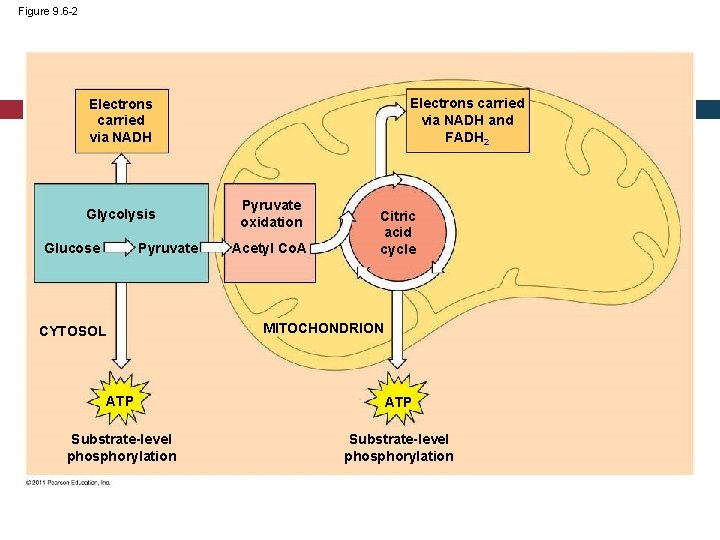
Figure 9. 6 -2 Electrons carried via NADH and FADH 2 Electrons carried via NADH Glycolysis Glucose Pyruvate CYTOSOL Pyruvate oxidation Acetyl Co. A Citric acid cycle MITOCHONDRION ATP Substrate-level phosphorylation
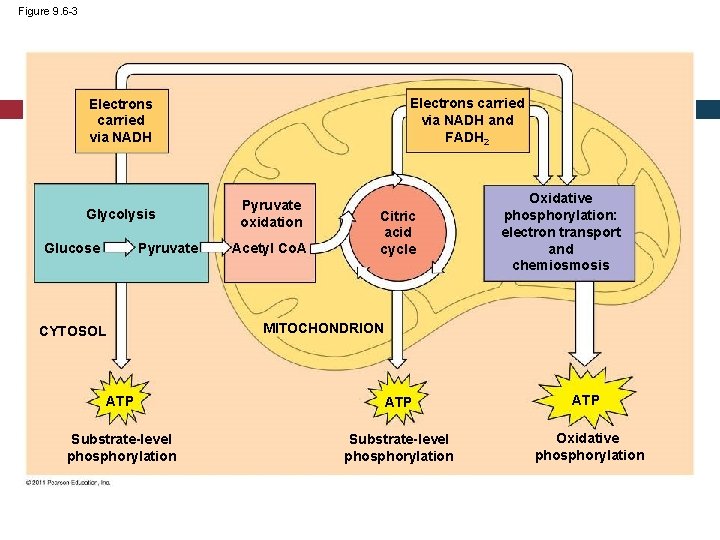
Figure 9. 6 -3 Electrons carried via NADH and FADH 2 Electrons carried via NADH Glycolysis Glucose Pyruvate CYTOSOL Pyruvate oxidation Acetyl Co. A Citric acid cycle Oxidative phosphorylation: electron transport and chemiosmosis MITOCHONDRION ATP ATP Substrate-level phosphorylation Oxidative phosphorylation
Bio. Flix: Cellular Respiration © 2011 Pearson Education, Inc.
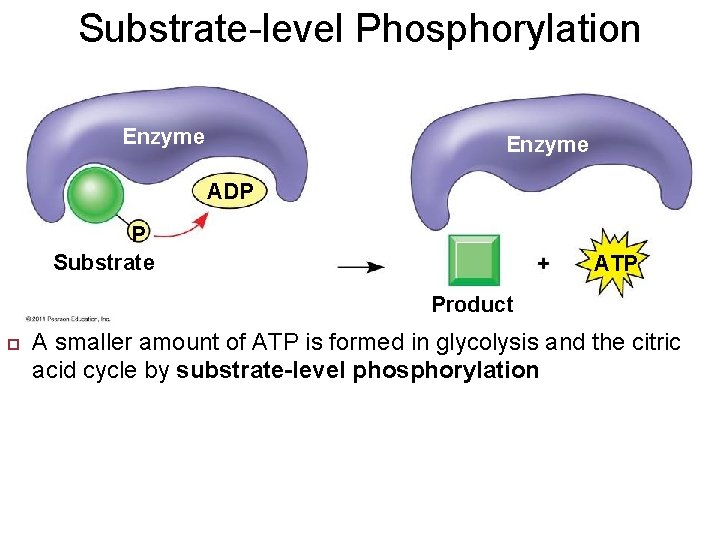
Substrate-level Phosphorylation Enzyme ADP P Substrate ATP Product A smaller amount of ATP is formed in glycolysis and the citric acid cycle by substrate-level phosphorylation
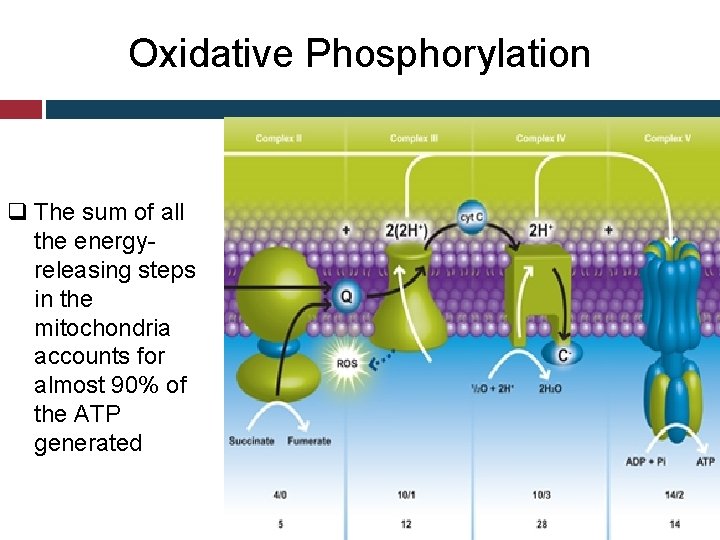
Oxidative Phosphorylation q The sum of all the energyreleasing steps in the mitochondria accounts for almost 90% of the ATP generated
Glycolysis harvests chemical energy by oxidizing glucose to pyruvate
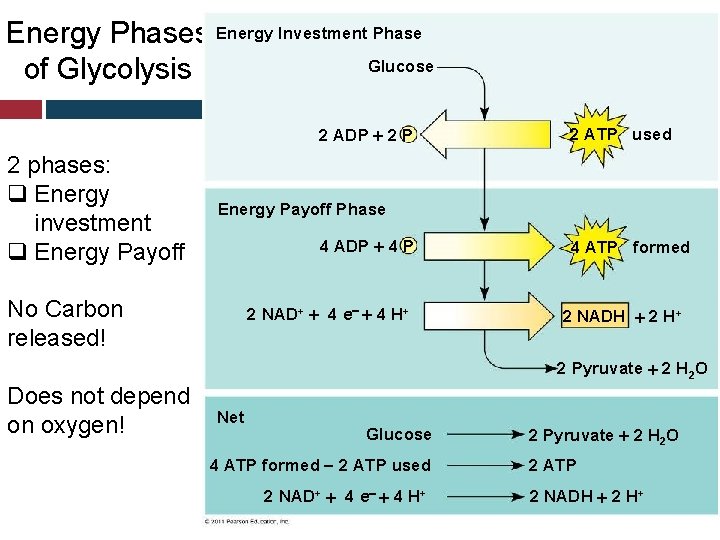
Energy Phases Energy Investment Phase Glucose of Glycolysis 2 ADP 2 P 2 phases: q Energy investment q Energy Payoff 2 ATP used Energy Payoff Phase 4 ADP 4 P No Carbon released! 2 NAD+ 4 e 4 H+ 4 ATP formed 2 NADH 2 H+ 2 Pyruvate 2 H 2 O Does not depend on oxygen! Net Glucose 4 ATP formed 2 ATP used 2 NAD+ 4 e 4 H+ 2 Pyruvate 2 H 2 O 2 ATP 2 NADH 2 H+
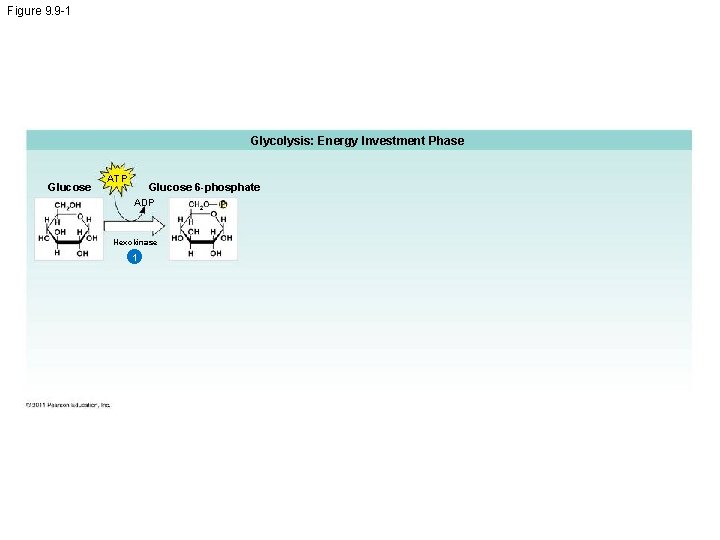
Figure 9. 9 -1 Glycolysis: Energy Investment Phase Glucose ATP Glucose 6 -phosphate ADP Hexokinase 1
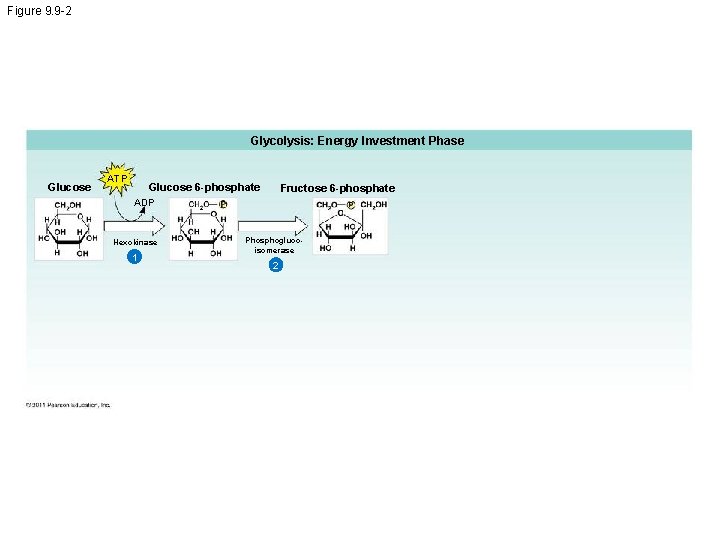
Figure 9. 9 -2 Glycolysis: Energy Investment Phase Glucose ATP Glucose 6 -phosphate Fructose 6 -phosphate ADP Hexokinase 1 Phosphoglucoisomerase 2
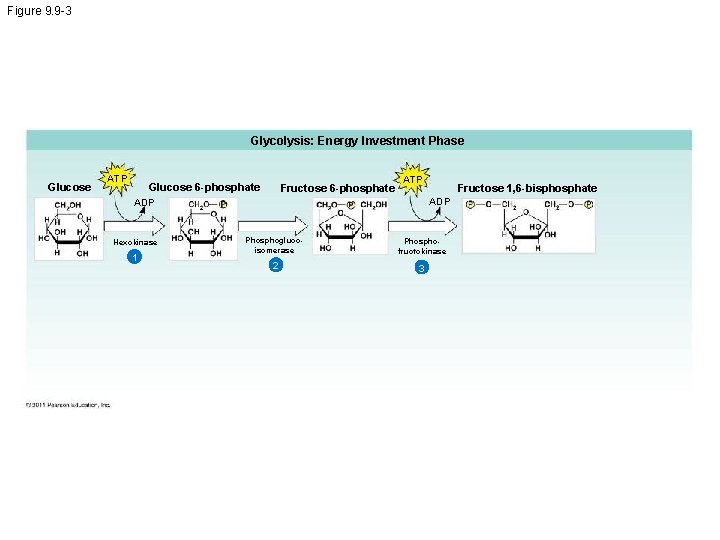
Figure 9. 9 -3 Glycolysis: Energy Investment Phase Glucose ATP Glucose 6 -phosphate Fructose 6 -phosphate ATP Hexokinase 1 Fructose 1, 6 -bisphosphate ADP Phosphoglucoisomerase Phosphofructokinase 2 3
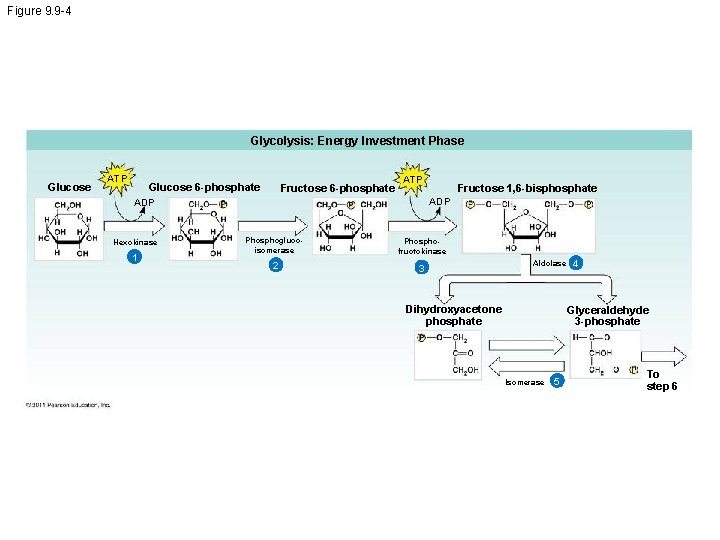
Figure 9. 9 -4 Glycolysis: Energy Investment Phase Glucose ATP Glucose 6 -phosphate Fructose 6 -phosphate ATP Hexokinase 1 Fructose 1, 6 -bisphosphate ADP Phosphoglucoisomerase Phosphofructokinase 2 3 Aldolase Dihydroxyacetone phosphate 4 Glyceraldehyde 3 -phosphate Isomerase 5 To step 6
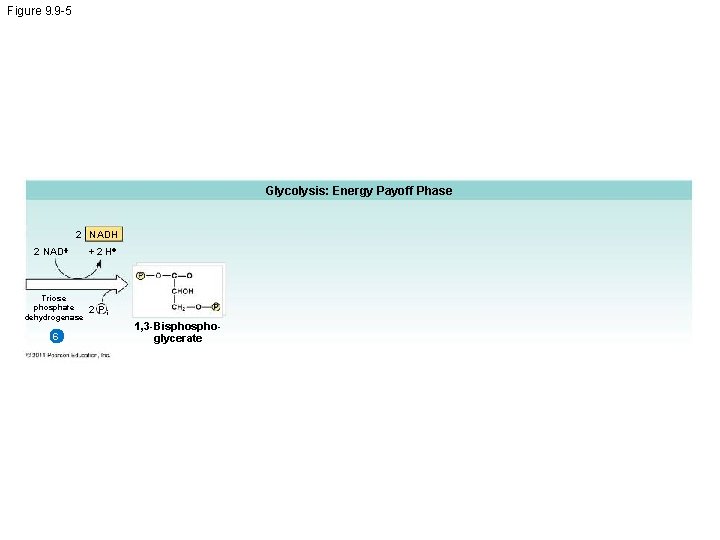
Figure 9. 9 -5 Glycolysis: Energy Payoff Phase 2 NADH 2 NAD Triose phosphate dehydrogenase 6 + 2 H 2 Pi 1, 3 -Bisphoglycerate
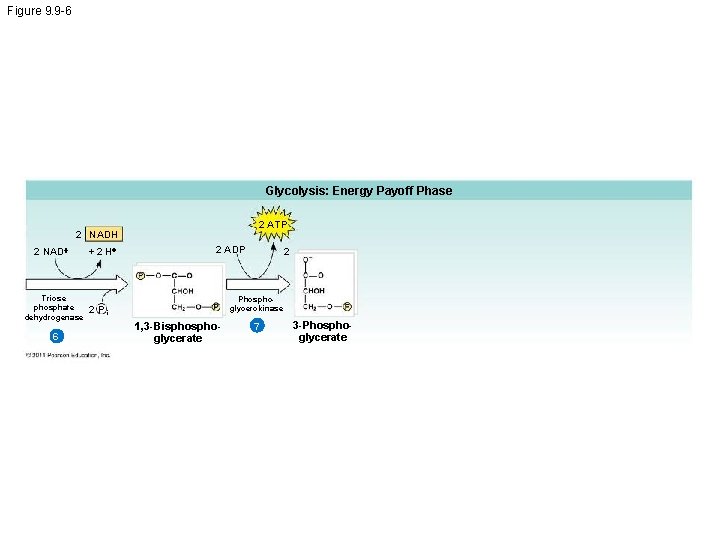
Figure 9. 9 -6 Glycolysis: Energy Payoff Phase 2 ATP 2 NADH 2 NAD Triose phosphate dehydrogenase 6 + 2 H 2 ADP 2 Phosphoglycerokinase 2 Pi 1, 3 -Bisphoglycerate 7 3 -Phosphoglycerate
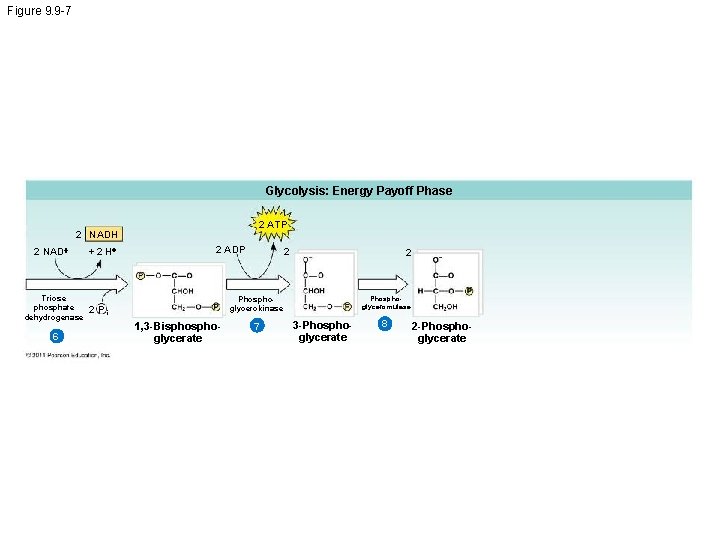
Figure 9. 9 -7 Glycolysis: Energy Payoff Phase 2 ATP 2 NADH 2 NAD Triose phosphate dehydrogenase 6 + 2 H 2 ADP 2 2 Phosphoglyceromutase Phosphoglycerokinase 2 Pi 1, 3 -Bisphoglycerate 7 3 -Phosphoglycerate 8 2 -Phosphoglycerate
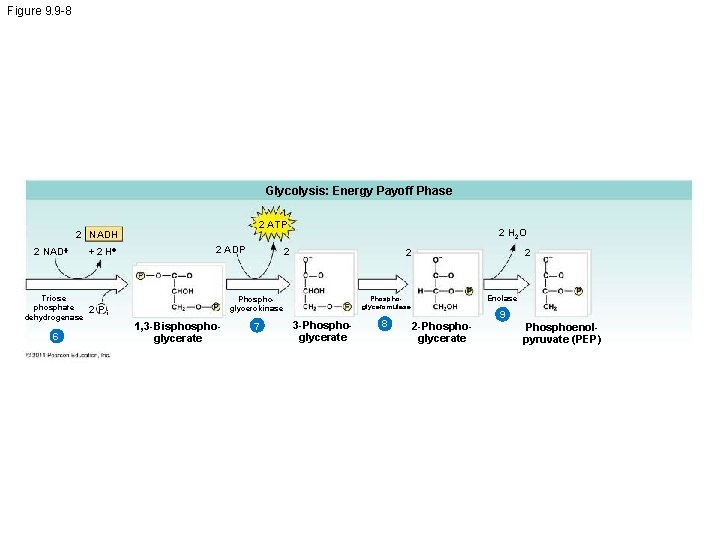
Figure 9. 9 -8 Glycolysis: Energy Payoff Phase 2 ATP 2 NADH 2 NAD Triose phosphate dehydrogenase 6 +2 H 2 ADP 2 H 2 O 2 2 1, 3 -Bisphoglycerate 7 Enolase Phosphoglyceromutase Phosphoglycerokinase 2 Pi 2 3 -Phosphoglycerate 8 2 -Phosphoglycerate 9 Phosphoenolpyruvate (PEP)
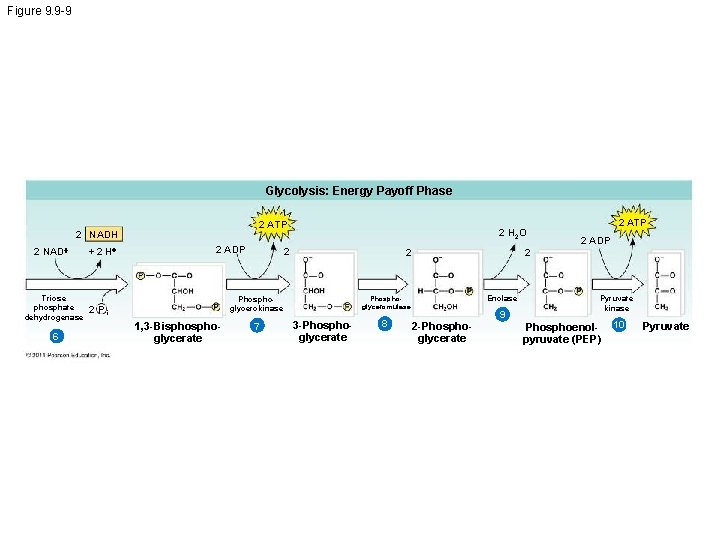
Figure 9. 9 -9 Glycolysis: Energy Payoff Phase 2 ATP 2 NADH 2 NAD Triose phosphate dehydrogenase 6 + 2 H 2 ADP 2 H 2 O 2 2 1, 3 -Bisphoglycerate 7 3 -Phosphoglycerate 8 2 ADP 2 Enolase Phosphoglyceromutase Phosphoglycerokinase 2 Pi 2 ATP 2 -Phosphoglycerate 9 Pyruvate kinase Phosphoenolpyruvate (PEP) 10 Pyruvate
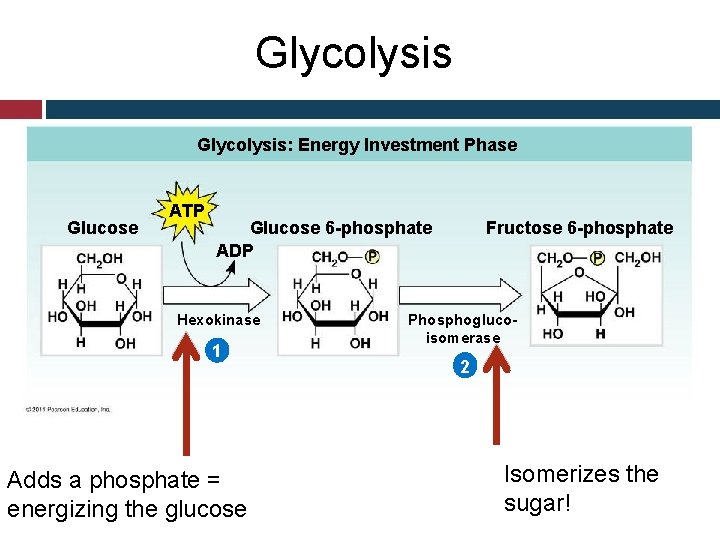
Glycolysis: Energy Investment Phase Glucose ATP Fructose 6 -phosphate Glucose 6 -phosphate ADP Hexokinase 1 Adds a phosphate = energizing the glucose Phosphoglucoisomerase 2 Isomerizes the sugar!
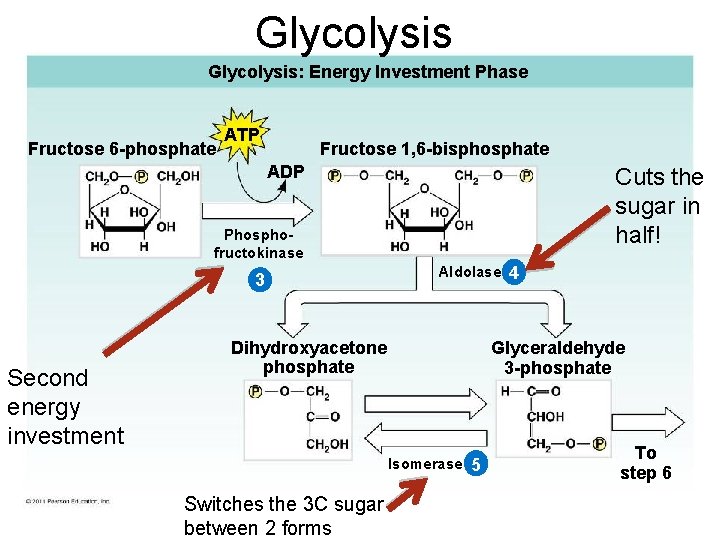
Glycolysis: Energy Investment Phase Fructose 6 -phosphate ATP Fructose 1, 6 -bisphosphate ADP Cuts the sugar in half! Phosphofructokinase 3 Second energy investment Aldolase Dihydroxyacetone phosphate Glyceraldehyde 3 -phosphate Isomerase Switches the 3 C sugar between 2 forms 4 5 To step 6
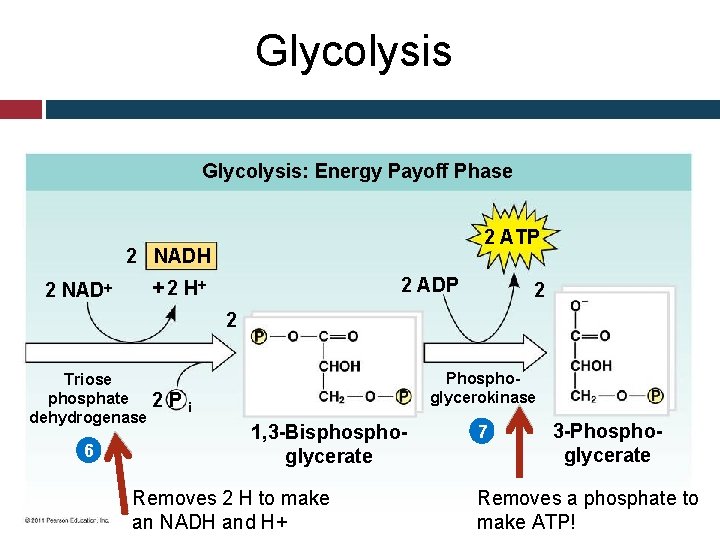
Glycolysis: Energy Payoff Phase 2 ATP 2 NADH 2 ADP + 2 H 2 NAD 2 2 Triose phosphate dehydrogenase 6 Phosphoglycerokinase 2 Pi 1, 3 -Bisphoglycerate Removes 2 H to make an NADH and H+ 7 3 -Phosphoglycerate Removes a phosphate to make ATP!
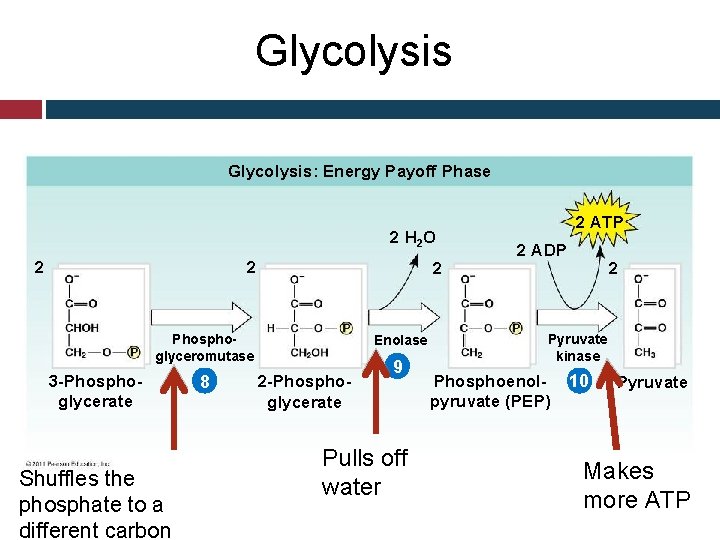
Glycolysis: Energy Payoff Phase 2 H 2 O 2 2 2 Phosphoglyceromutase 3 -Phosphoglycerate Shuffles the phosphate to a different carbon 8 Enolase 2 -Phosphoglycerate 9 Pulls off water 2 ATP 2 ADP 2 Pyruvate kinase Phosphoenolpyruvate (PEP) 10 Pyruvate Makes more ATP
Citric acid cycle completes the energy-yielding oxidation of organic molecules
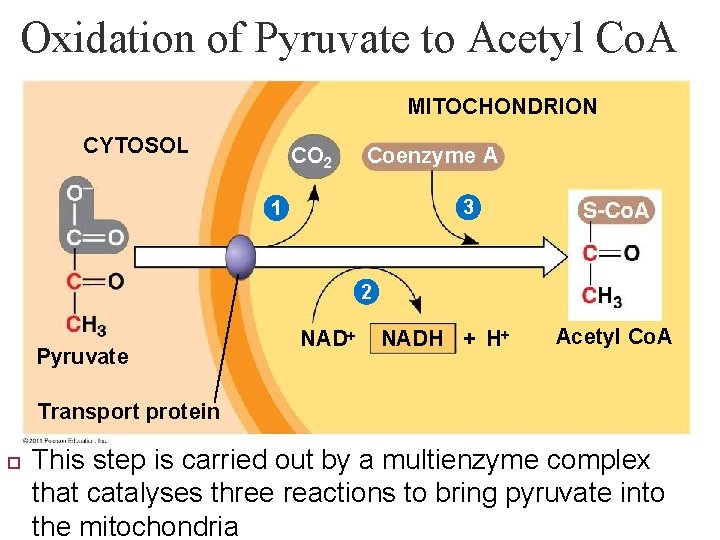
Oxidation of Pyruvate to Acetyl Co. A MITOCHONDRION CYTOSOL CO 2 Coenzyme A 3 1 2 Pyruvate NADH + H Acetyl Co. A Transport protein This step is carried out by a multienzyme complex that catalyses three reactions to bring pyruvate into the mitochondria
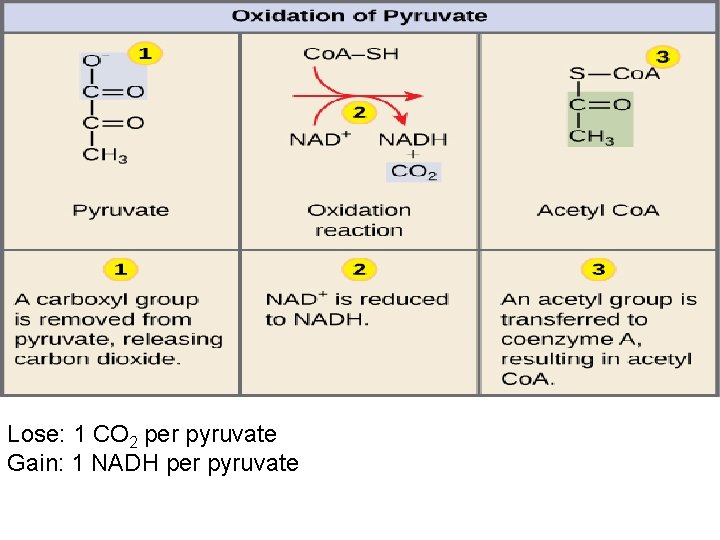
Lose: 1 CO 2 per pyruvate Gain: 1 NADH per pyruvate
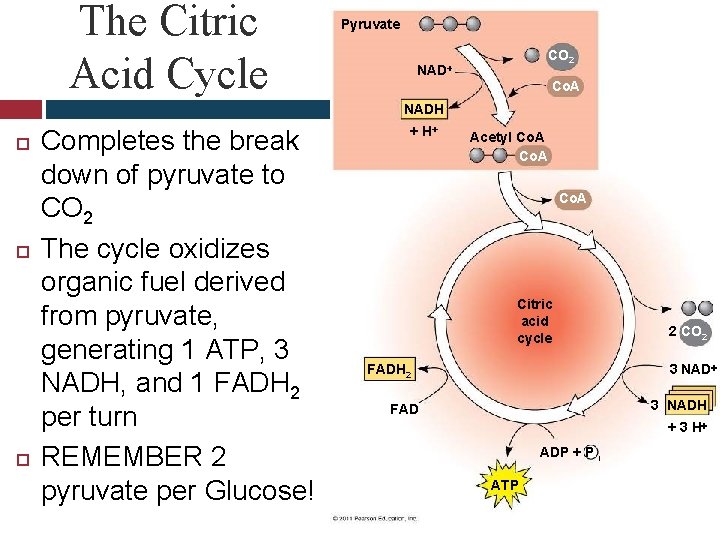
The Citric Acid Cycle Pyruvate CO 2 NAD Co. A NADH Completes the break down of pyruvate to CO 2 The cycle oxidizes organic fuel derived from pyruvate, generating 1 ATP, 3 NADH, and 1 FADH 2 per turn REMEMBER 2 pyruvate per Glucose! + H Acetyl Co. A Citric acid cycle 2 CO 2 3 NAD FADH 2 3 NADH FAD + 3 H ADP + P i ATP
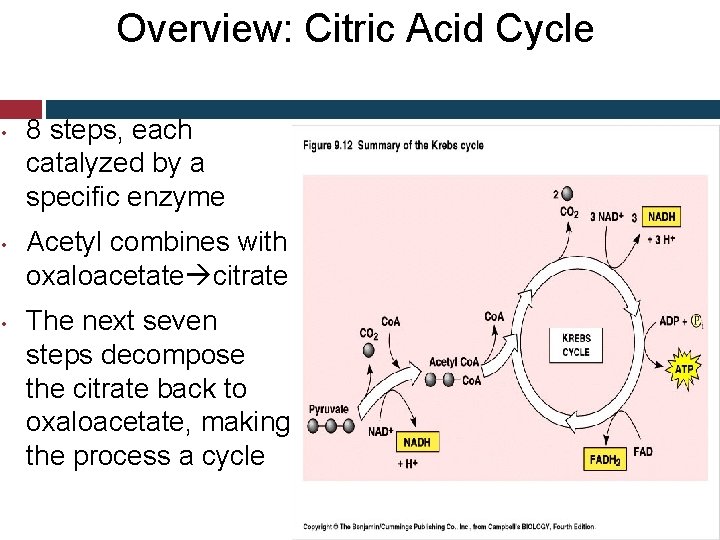
Overview: Citric Acid Cycle • • • 8 steps, each catalyzed by a specific enzyme Acetyl combines with oxaloacetate citrate The next seven steps decompose the citrate back to oxaloacetate, making the process a cycle
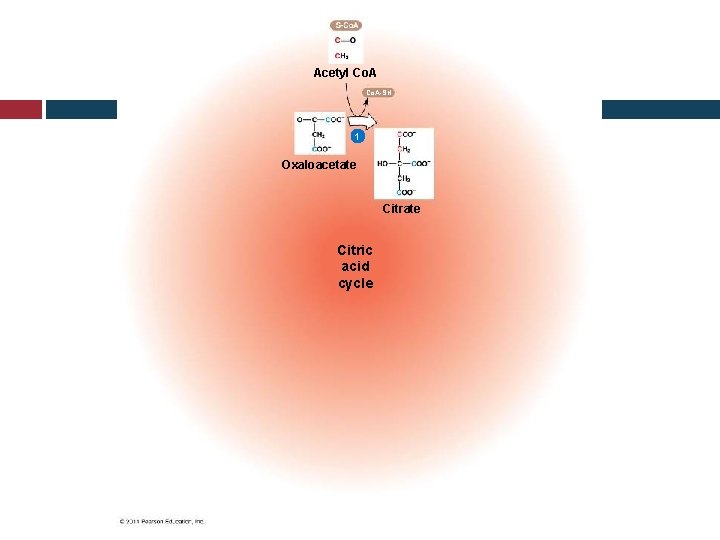
Acetyl Co. A-SH 1 Oxaloacetate Citric acid cycle
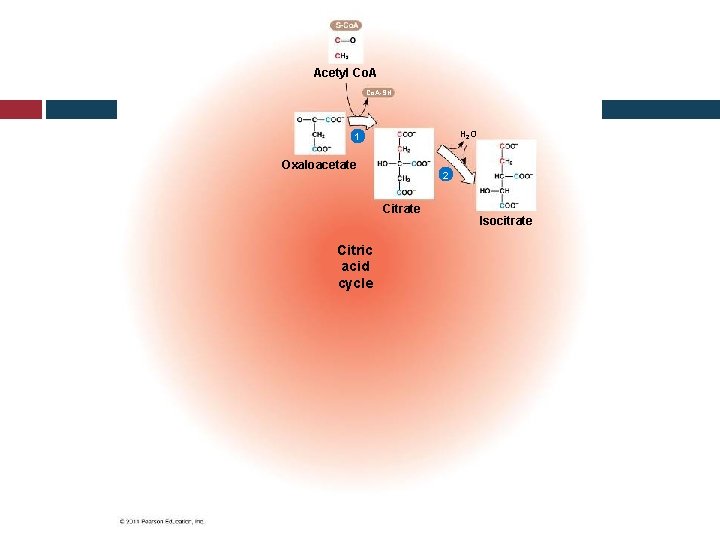
Acetyl Co. A-SH H 2 O 1 Oxaloacetate 2 Citrate Citric acid cycle Isocitrate
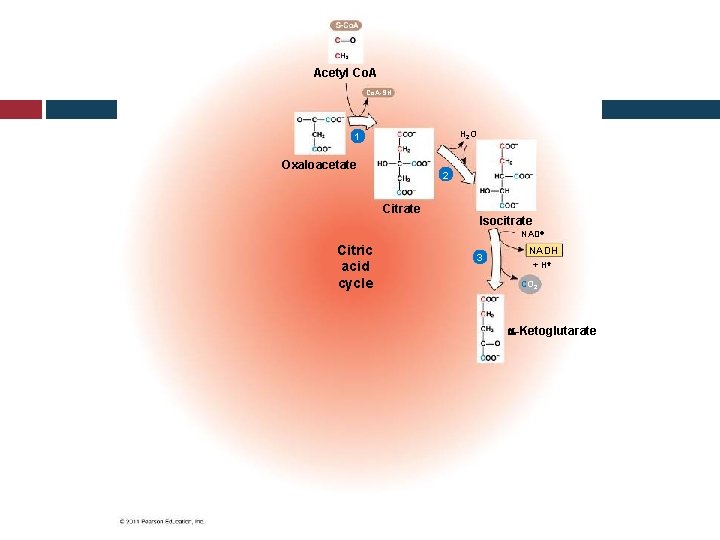
Acetyl Co. A-SH H 2 O 1 Oxaloacetate 2 Citrate Isocitrate NAD Citric acid cycle 3 NADH + H CO 2 -Ketoglutarate
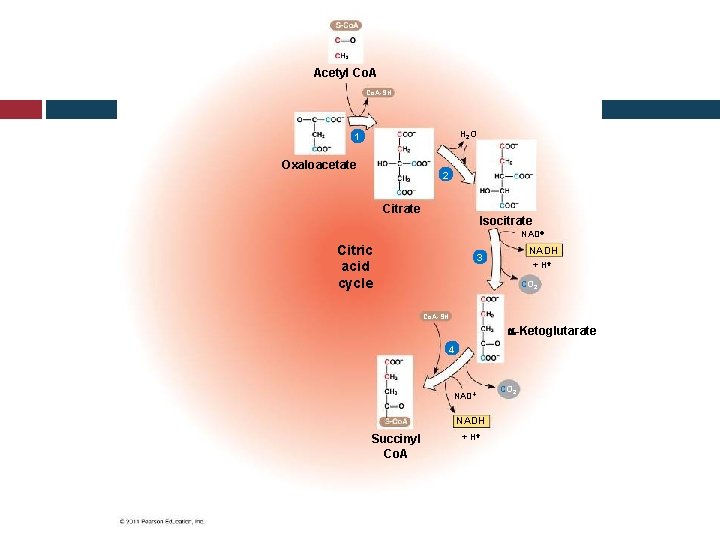
Acetyl Co. A-SH H 2 O 1 Oxaloacetate 2 Citrate Isocitrate NAD Citric acid cycle NADH 3 + H CO 2 Co. A-SH -Ketoglutarate 4 NADH Succinyl Co. A + H CO 2
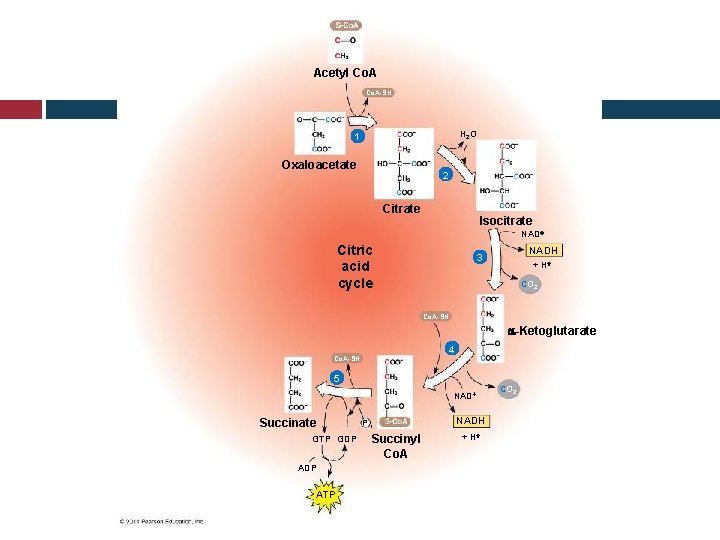
Acetyl Co. A-SH H 2 O 1 Oxaloacetate 2 Citrate Isocitrate NAD Citric acid cycle NADH 3 + H CO 2 Co. A-SH -Ketoglutarate 4 Co. A-SH 5 NAD Succinate GTP GDP ATP Pi Succinyl Co. A NADH + H CO 2
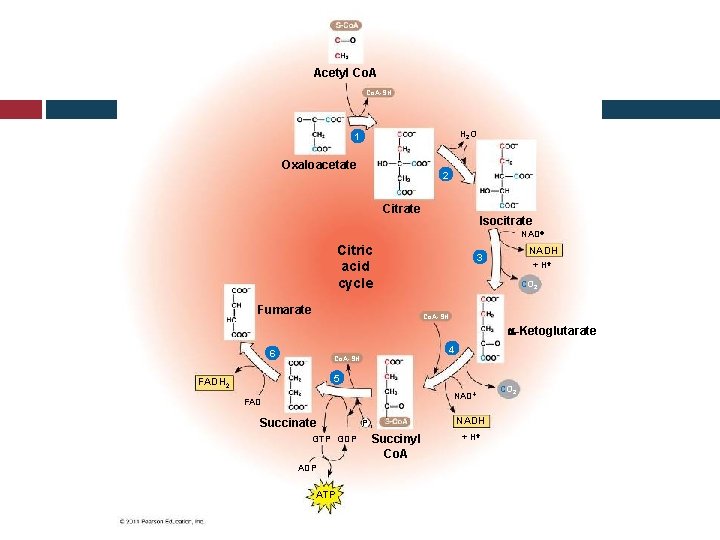
Acetyl Co. A-SH H 2 O 1 Oxaloacetate 2 Citrate Isocitrate NAD Citric acid cycle Fumarate NADH 3 + H CO 2 Co. A-SH -Ketoglutarate 6 4 Co. A-SH 5 FADH 2 NAD FAD Succinate GTP GDP ATP Pi Succinyl Co. A NADH + H CO 2
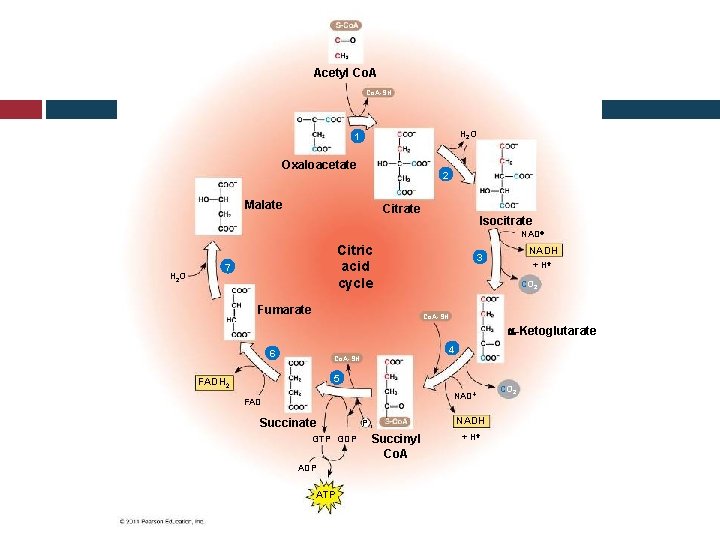
Acetyl Co. A-SH H 2 O 1 Oxaloacetate 2 Malate Citrate Isocitrate NAD H 2 O Citric acid cycle 7 Fumarate NADH 3 + H CO 2 Co. A-SH -Ketoglutarate 6 4 Co. A-SH 5 FADH 2 NAD FAD Succinate GTP GDP ATP Pi Succinyl Co. A NADH + H CO 2
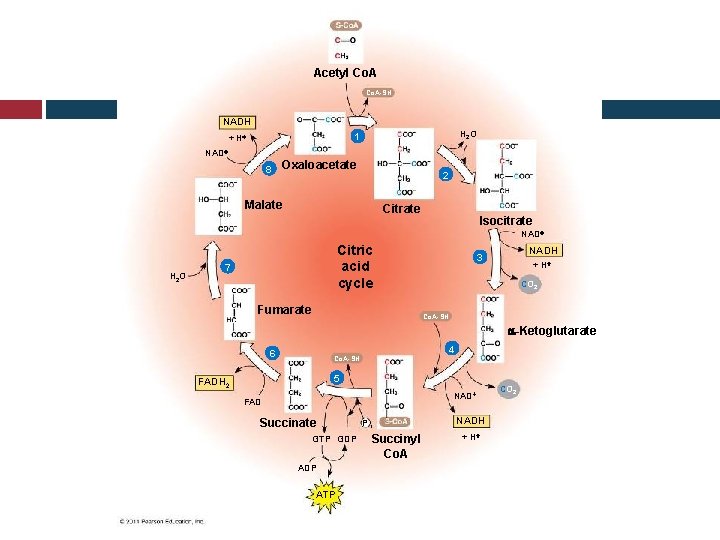
Acetyl Co. A-SH NADH H 2 O 1 + H NAD 8 Oxaloacetate 2 Malate Citrate Isocitrate NAD H 2 O Citric acid cycle 7 Fumarate NADH 3 + H CO 2 Co. A-SH -Ketoglutarate 6 4 Co. A-SH 5 FADH 2 NAD FAD Succinate GTP GDP ATP Pi Succinyl Co. A NADH + H CO 2
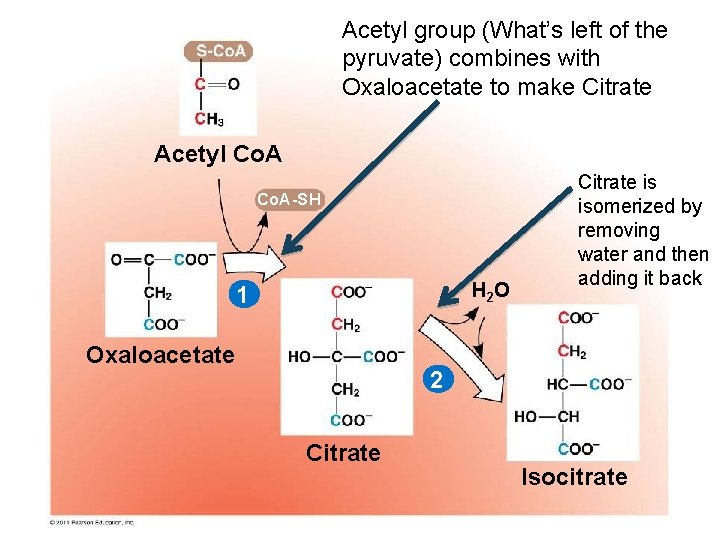
Acetyl group (What’s left of the pyruvate) combines with Oxaloacetate to make Citrate Acetyl Co. A-SH H 2 O 1 Oxaloacetate Citrate is isomerized by removing water and then adding it back 2 Citrate Isocitrate
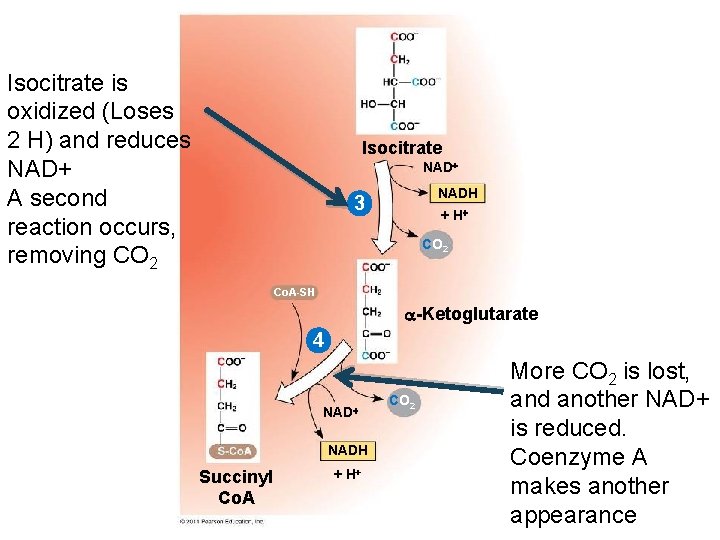
Isocitrate is oxidized (Loses 2 H) and reduces NAD+ A second reaction occurs, removing CO 2 Isocitrate NADH 3 + H CO 2 Co. A-SH -Ketoglutarate 4 NADH Succinyl Co. A + H CO 2 More CO 2 is lost, and another NAD+ is reduced. Coenzyme A makes another appearance
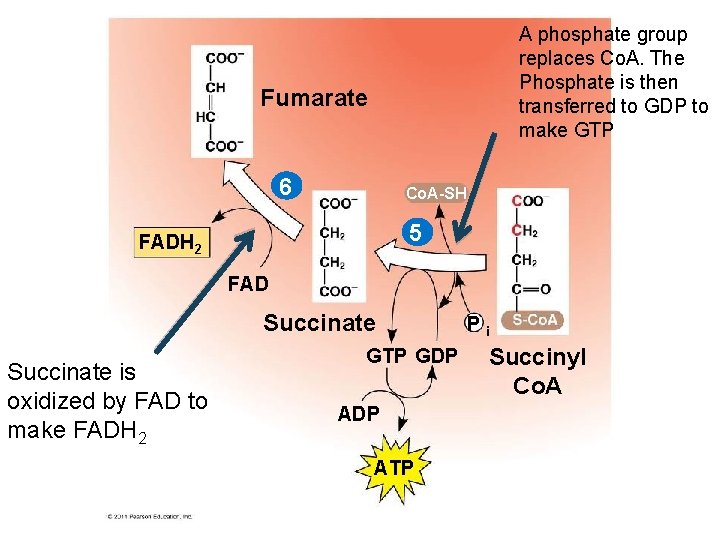
A phosphate group replaces Co. A. The Phosphate is then transferred to GDP to make GTP Fumarate 6 Co. A-SH 5 FADH 2 FAD Succinate is oxidized by FAD to make FADH 2 GTP GDP ATP Pi Succinyl Co. A
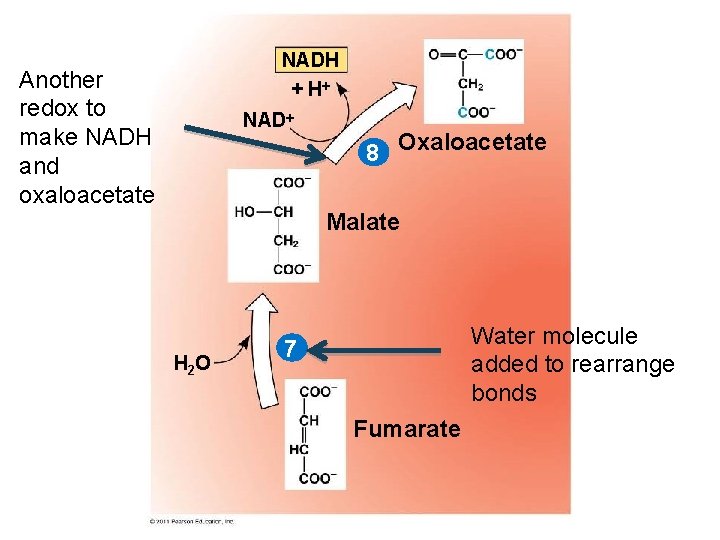
NADH + H Another redox to make NADH and oxaloacetate NAD 8 Oxaloacetate Malate H 2 O Water molecule added to rearrange bonds 7 Fumarate
During oxidative phosphorylation, chemiosmosis couples electron transport to ATP synthesis
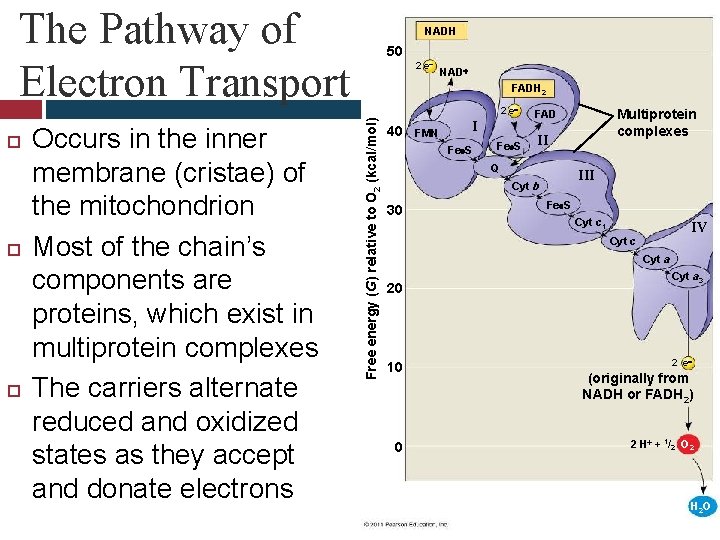
The Pathway of Electron Transport Occurs in the inner membrane (cristae) of the mitochondrion Most of the chain’s components are proteins, which exist in multiprotein complexes The carriers alternate reduced and oxidized states as they accept and donate electrons 50 2 e NAD FADH 2 2 e Free energy (G) relative to O 2 (kcal/mol) NADH 40 FMN I Fe S II Q III Cyt b 30 Multiprotein complexes FAD Fe S Cyt c 1 IV Cyt c Cyt a 20 10 0 Cyt a 3 2 e (originally from NADH or FADH 2) 2 H + 1/2 O 2 H 2 O
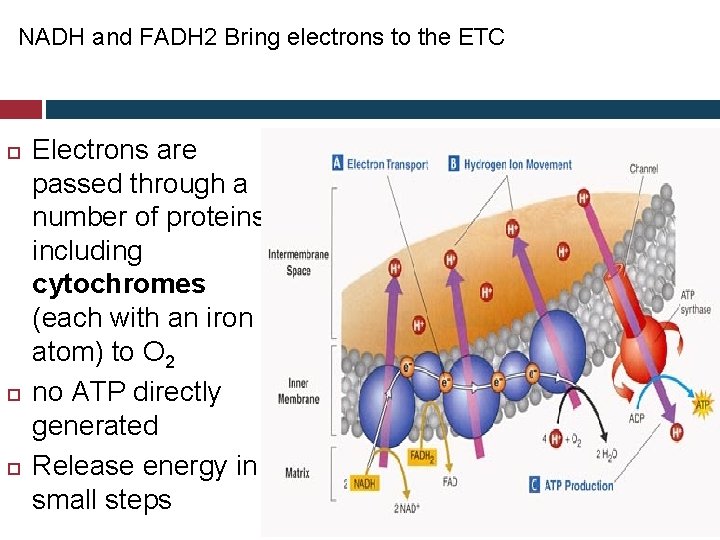
NADH and FADH 2 Bring electrons to the ETC Electrons are passed through a number of proteins including cytochromes (each with an iron atom) to O 2 no ATP directly generated Release energy in small steps
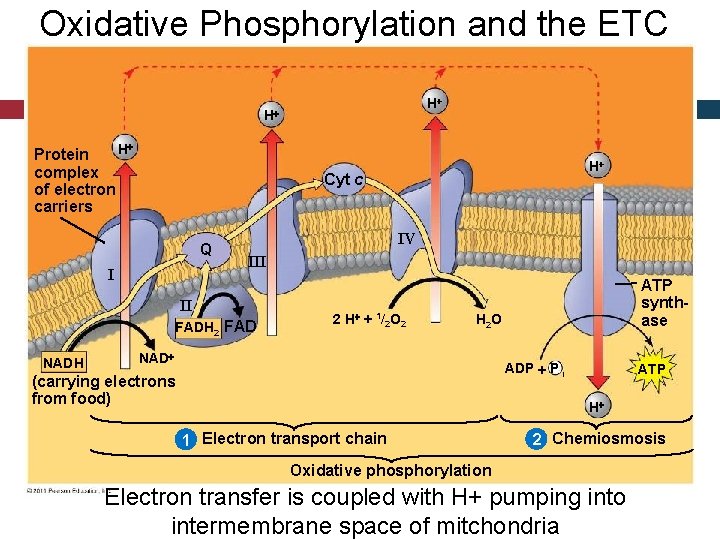
Oxidative Phosphorylation and the ETC H H H Protein complex of electron carriers Cyt c Q I IV III II FADH 2 FAD NADH H 2 H + 1/2 O 2 ATP synthase H 2 O NAD ADP P i (carrying electrons from food) ATP H 1 Electron transport chain 2 Chemiosmosis Oxidative phosphorylation Electron transfer is coupled with H+ pumping into intermembrane space of mitchondria
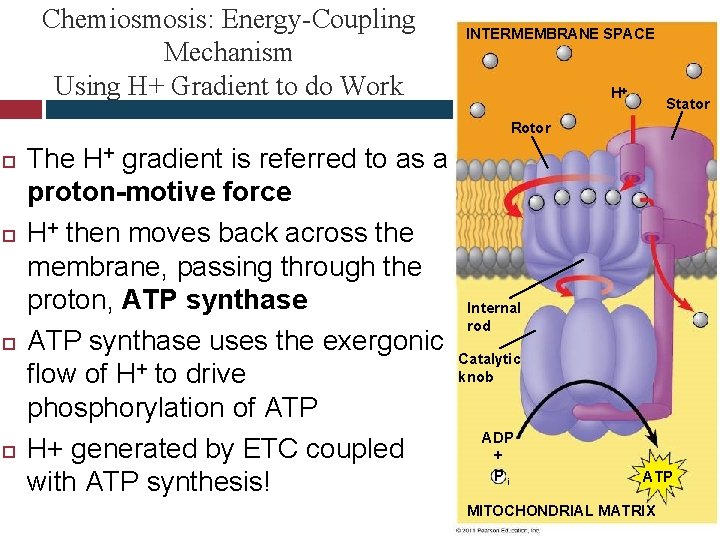
Chemiosmosis: Energy-Coupling Mechanism Using H+ Gradient to do Work INTERMEMBRANE SPACE H Stator Rotor The H+ gradient is referred to as a proton-motive force H+ then moves back across the membrane, passing through the proton, ATP synthase uses the exergonic flow of H+ to drive phosphorylation of ATP H+ generated by ETC coupled with ATP synthesis! Internal rod Catalytic knob ADP + Pi ATP MITOCHONDRIAL MATRIX
Accounting of ATP Production by Cellular Respiration During cellular respiration, most energy flows in this sequence: glucose NADH electron transport chain proton-motive force ATP About 34% of the energy in a glucose molecule is transferred to ATP during cellular respiration, making about 32 -36 ATP There are several reasons why the number of ATP is not known exactly
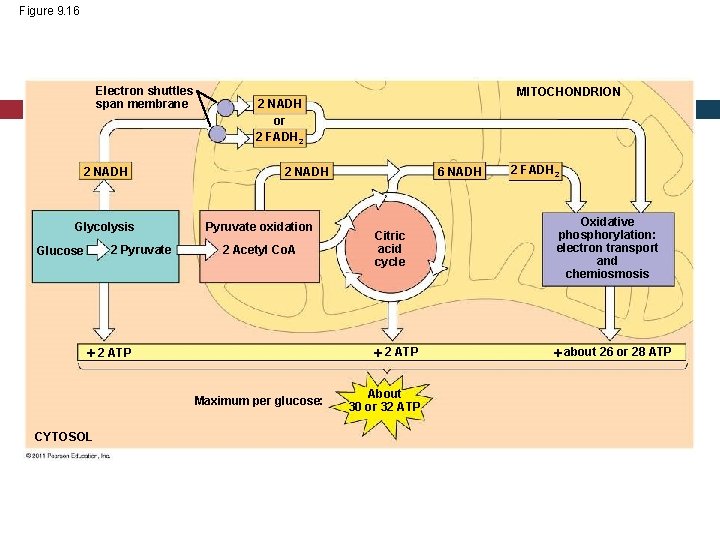
Figure 9. 16 Electron shuttles span membrane 2 NADH Glycolysis 2 Pyruvate Glucose 2 NADH or 2 FADH 2 2 NADH Pyruvate oxidation 2 Acetyl Co. A 2 ATP Maximum per glucose: CYTOSOL MITOCHONDRION 6 NADH 2 FADH 2 Citric acid cycle Oxidative phosphorylation: electron transport and chemiosmosis 2 ATP about 26 or 28 ATP About 30 or 32 ATP
Fermentation and anaerobic respiration enable cells to produce ATP without the use of oxygen
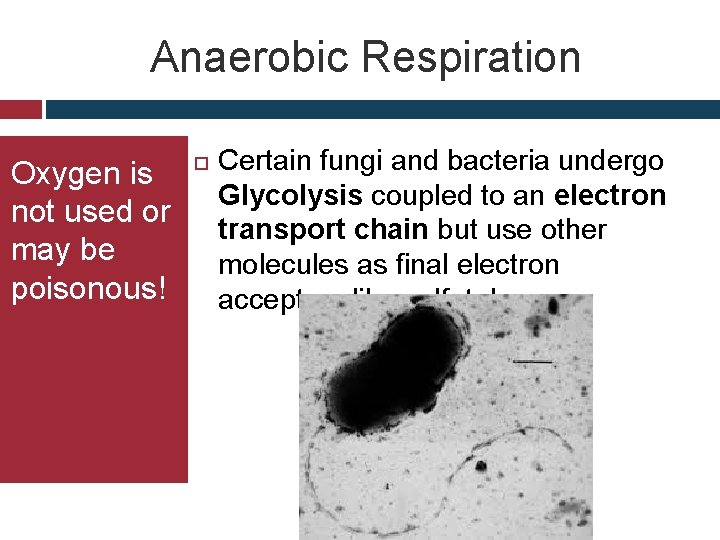
Anaerobic Respiration Oxygen is not used or may be poisonous! Certain fungi and bacteria undergo Glycolysis coupled to an electron transport chain but use other molecules as final electron acceptors like sulfate!
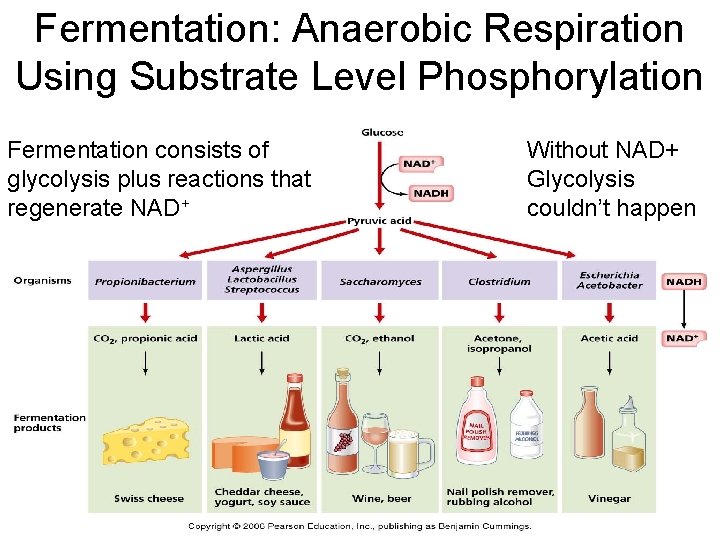
Fermentation: Anaerobic Respiration Using Substrate Level Phosphorylation Fermentation consists of glycolysis plus reactions that regenerate NAD+ Without NAD+ Glycolysis couldn’t happen
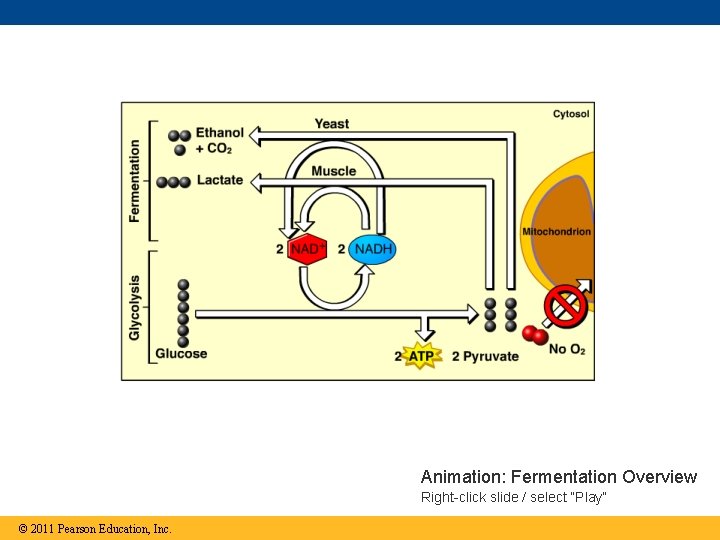
Animation: Fermentation Overview Right-click slide / select “Play” © 2011 Pearson Education, Inc.
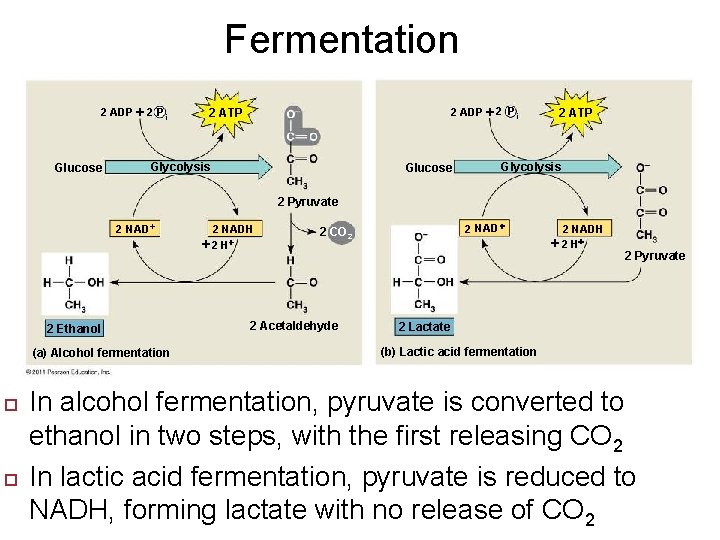
Fermentation 2 ADP 2 P i Glucose 2 ADP 2 P i 2 ATP Glycolysis Glucose 2 ATP Glycolysis 2 Pyruvate 2 NAD 2 Ethanol (a) Alcohol fermentation 2 NADH 2 NAD 2 CO 2 2 Acetaldehyde 2 NADH 2 Pyruvate 2 Lactate (b) Lactic acid fermentation In alcohol fermentation, pyruvate is converted to ethanol in two steps, with the first releasing CO 2 In lactic acid fermentation, pyruvate is reduced to NADH, forming lactate with no release of CO 2
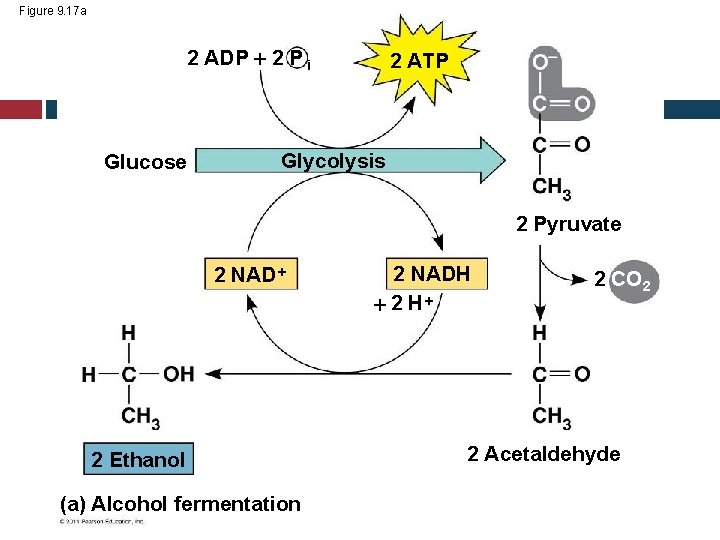
Figure 9. 17 a 2 ADP 2 P i Glucose 2 ATP Glycolysis 2 Pyruvate 2 NAD 2 Ethanol (a) Alcohol fermentation 2 NADH 2 CO 2 2 Acetaldehyde
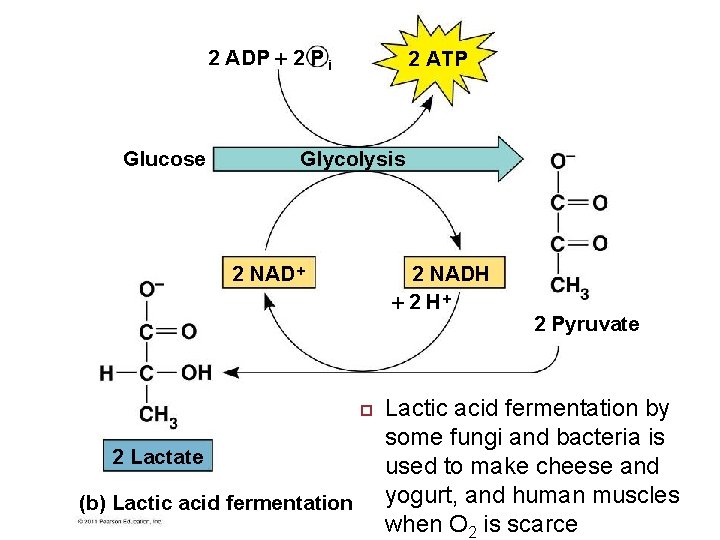
2 ADP 2 P i Glucose 2 ATP Glycolysis 2 NADH 2 H 2 Lactate (b) Lactic acid fermentation 2 Pyruvate Lactic acid fermentation by some fungi and bacteria is used to make cheese and yogurt, and human muscles when O 2 is scarce
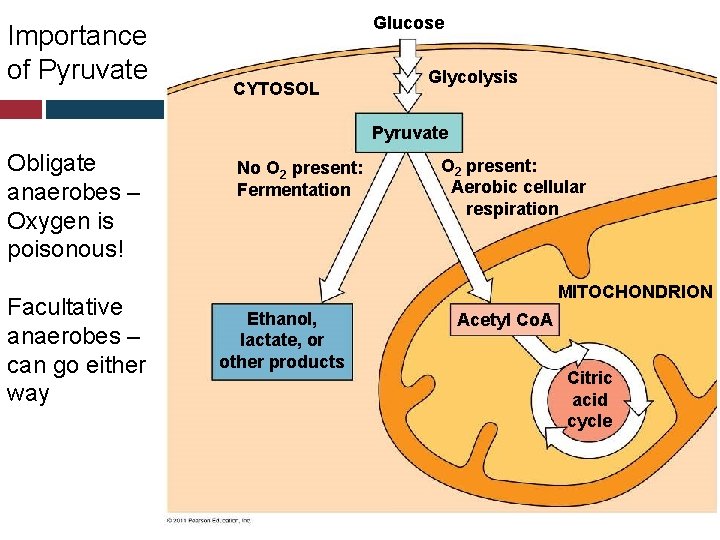
Importance of Pyruvate Glucose CYTOSOL Glycolysis Pyruvate Obligate anaerobes – Oxygen is poisonous! Facultative anaerobes – can go either way No O 2 present: Fermentation O 2 present: Aerobic cellular respiration MITOCHONDRION Ethanol, lactate, or other products Acetyl Co. A Citric acid cycle
Glycolysis and the citric acid cycle connect to many other metabolic pathways
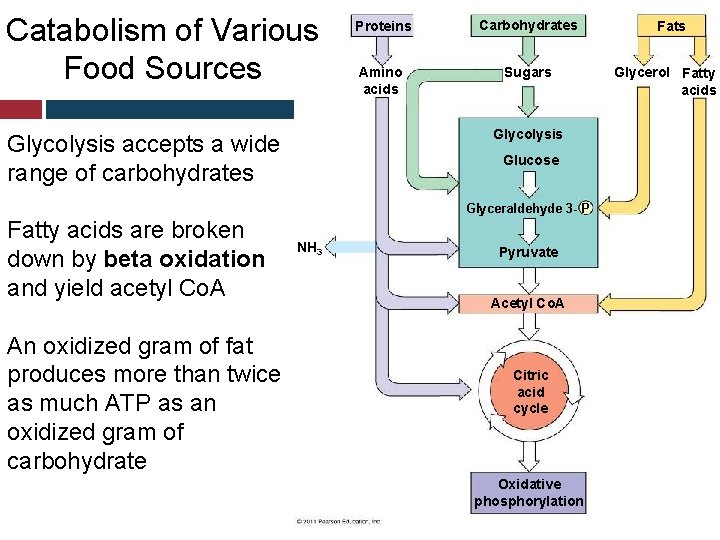
Catabolism of Various Food Sources Proteins Carbohydrates Amino acids Sugars Glycolysis accepts a wide range of carbohydrates Glucose Glyceraldehyde 3 - P Fatty acids are broken down by beta oxidation and yield acetyl Co. A An oxidized gram of fat produces more than twice as much ATP as an oxidized gram of carbohydrate NH 3 Pyruvate Acetyl Co. A Citric acid cycle Oxidative phosphorylation Fats Glycerol Fatty acids
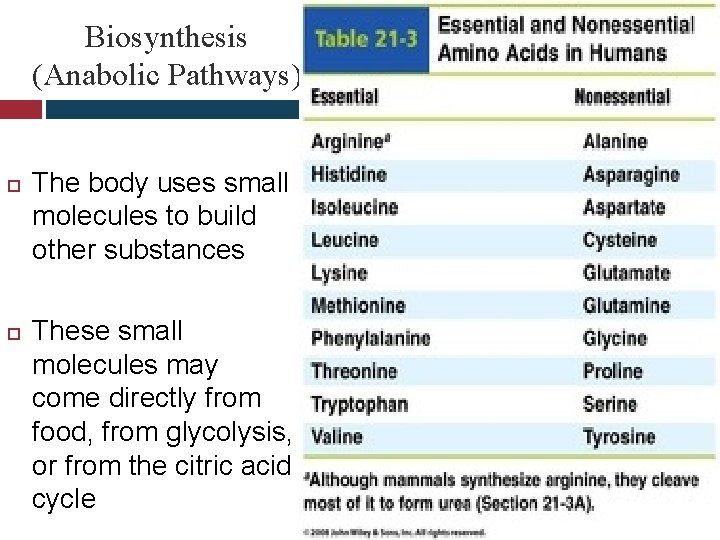
Biosynthesis (Anabolic Pathways) The body uses small molecules to build other substances These small molecules may come directly from food, from glycolysis, or from the citric acid cycle
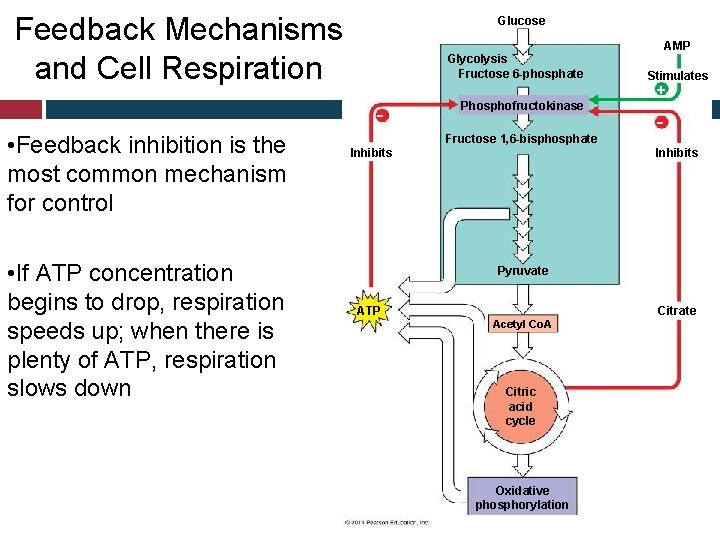
Feedback Mechanisms and Cell Respiration Glucose Glycolysis Fructose 6 -phosphate • Feedback inhibition is the most common mechanism for control • If ATP concentration begins to drop, respiration speeds up; when there is plenty of ATP, respiration slows down AMP Stimulates Phosphofructokinase Fructose 1, 6 -bisphosphate Inhibits Pyruvate ATP Citrate Acetyl Co. A Citric acid cycle Oxidative phosphorylation
Fermentation vs. Anaerobic vs. Aerobic Respiration All use glycolysis (net ATP = 2) to oxidize glucose and harvest chemical energy of food In all three, NAD+ is the oxidizing agent that accepts electrons during glycolysis The processes have different final electron acceptors: an organic molecule (such as pyruvate or acetaldehyde) in fermentation and O 2 in cellular respiration Cellular respiration produces 32 ATP per glucose molecule; fermentation produces 2 ATP per glucose molecule
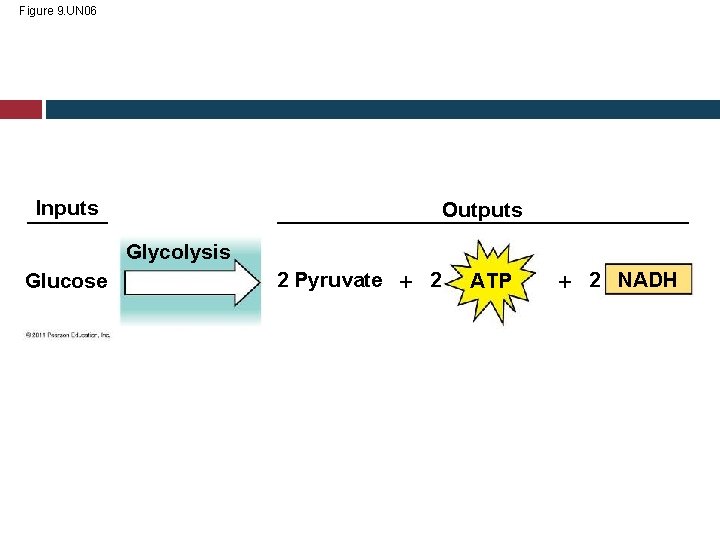
Figure 9. UN 06 Inputs Outputs Glycolysis Glucose 2 Pyruvate 2 ATP 2 NADH
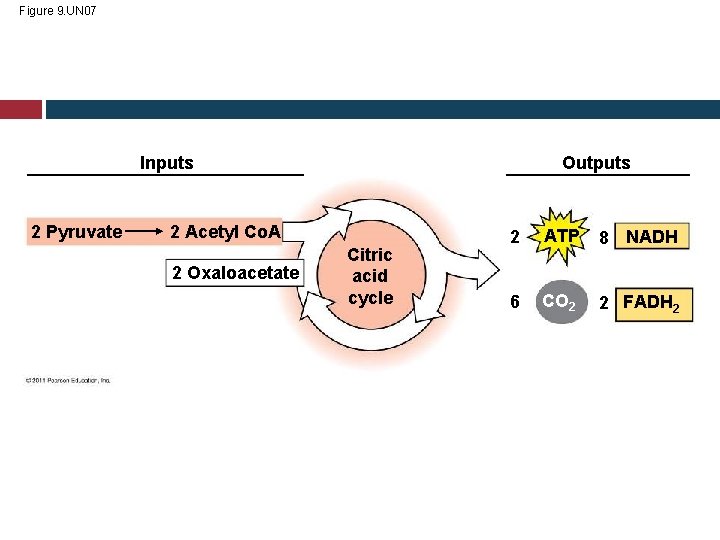
Figure 9. UN 07 Outputs Inputs 2 Pyruvate 2 Acetyl Co. A 2 Oxaloacetate Citric acid cycle 2 ATP 8 NADH 6 CO 2 2 FADH 2
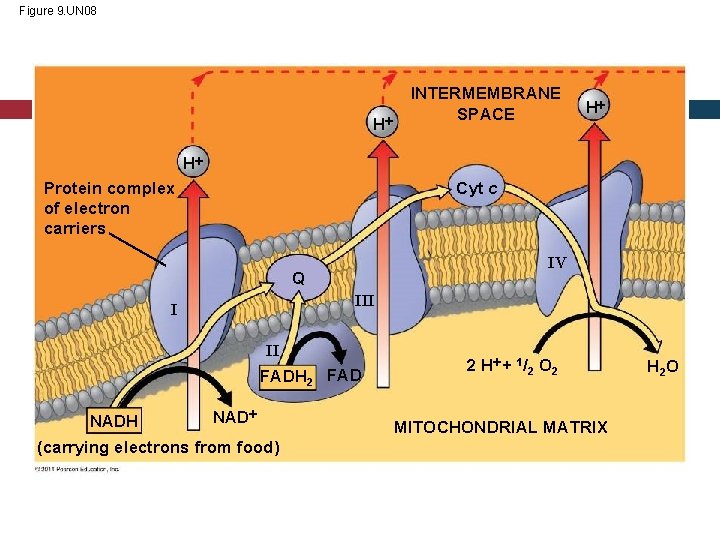
Figure 9. UN 08 H INTERMEMBRANE SPACE H H Cyt c Protein complex of electron carriers IV Q III I II FADH 2 FAD NADH (carrying electrons from food) 2 H + 1/2 O 2 MITOCHONDRIAL MATRIX H 2 O
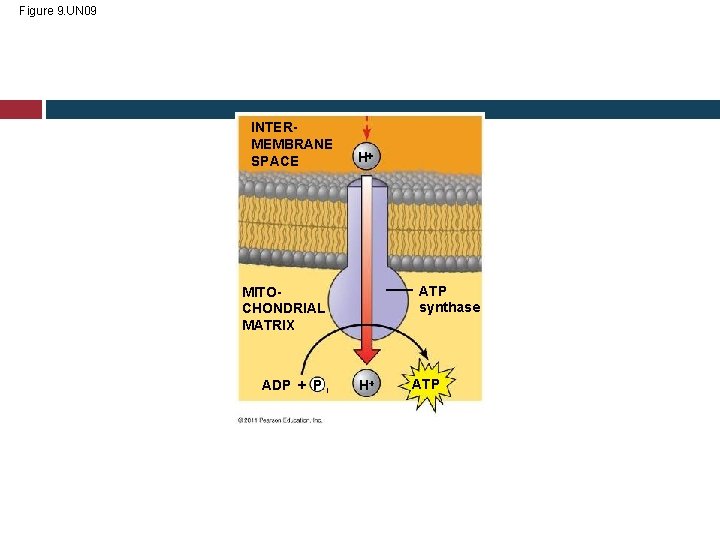
Figure 9. UN 09 INTERMEMBRANE SPACE H ATP synthase MITOCHONDRIAL MATRIX ADP + P i H ATP
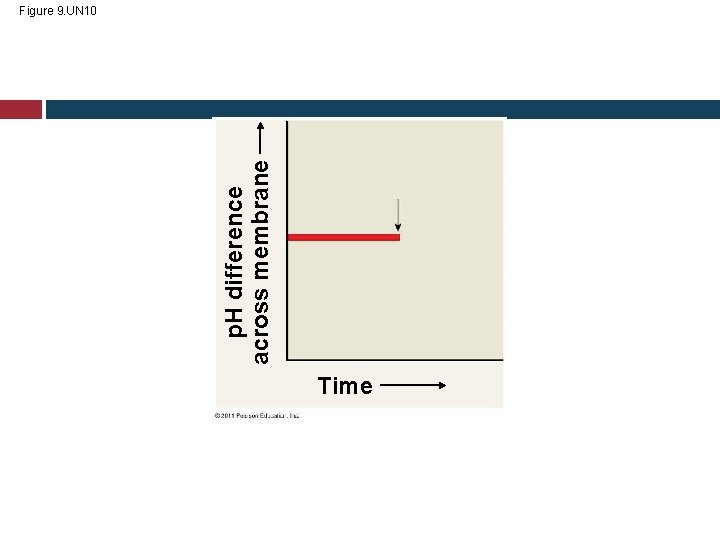
p. H difference across membrane Figure 9. UN 10 Time
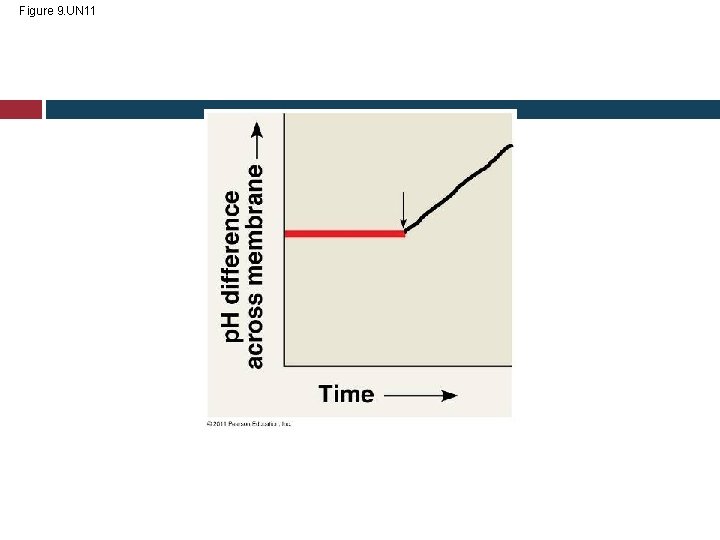
Figure 9. UN 11
- Slides: 85