
What Do We Want Students to Learn Developing
- Slides: 22
What Do We Want Students to Learn? Developing Focused Learning Targets A. C. Reynolds High School September 20, 2010
ACRHS Literacy Team 2009 -2010 § § § Participated in balanced literacy training Teamed with literacy coach to implement balanced literacy in our classes Surveyed faculty about instructional practices to determine professional development needs 2010 -2011 § § § Facilitate “Rounds” where we will observe our fellow Literacy Team colleagues and exchange professional dialogue and feedback Support learning target and formative assessment training Serve as a resource for our department colleagues
Word Splash l. With your table colleagues, discuss the concepts on the index cards located at your table. l. Arrange the cards in an order that shows the relationship of the terms. l If there are concepts your group is unsure about, place those cards to the side.
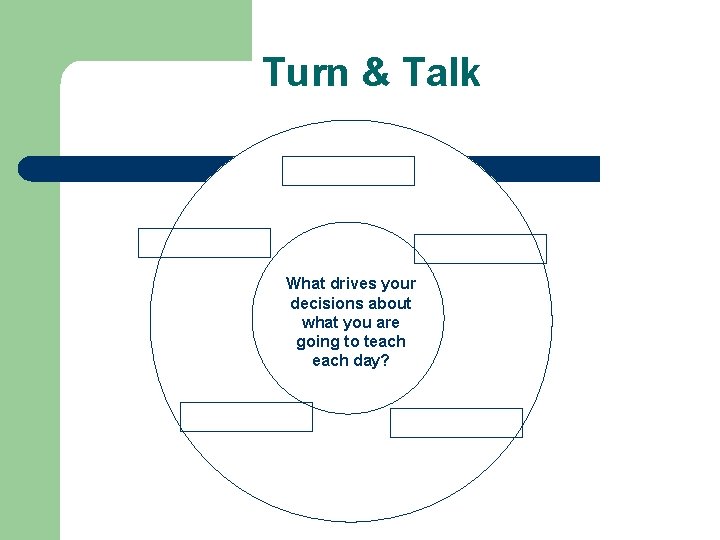
Turn & Talk What drives your decisions about what you are going to teach day?
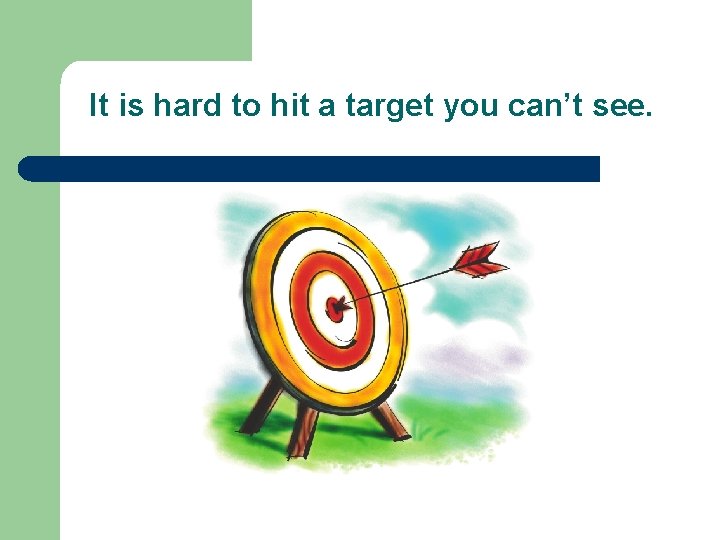
It is hard to hit a target you can’t see.
Students who can identify what they are learning significantly outscore those who cannot. l Robert Marzano
Intentional Teaching Means: All instruction and classroom activities are aimed at specific learning targets.
Learning Targets for Instruction l Learning targets are focused outcomes for student learning that guide instruction and assessment.
Today’s Learning Targets • • Teachers will be able to deconstruct NCSCS objectives by finding the verb or verb indicator to determine the level of thinking required and then turn them into student, parent, and teacher -friendly language. Teachers will be able to make teaching more intentional and effective by using curriculum and learning targets to guide instruction and assessment.
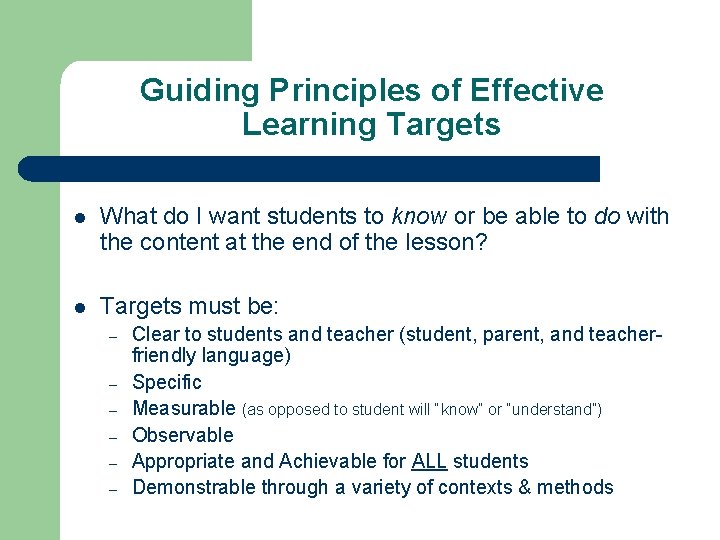
Guiding Principles of Effective Learning Targets l What do I want students to know or be able to do with the content at the end of the lesson? l Targets must be: – – – Clear to students and teacher (student, parent, and teacherfriendly language) Specific Measurable (as opposed to student will “know” or “understand”) Observable Appropriate and Achievable for ALL students Demonstrable through a variety of contexts & methods
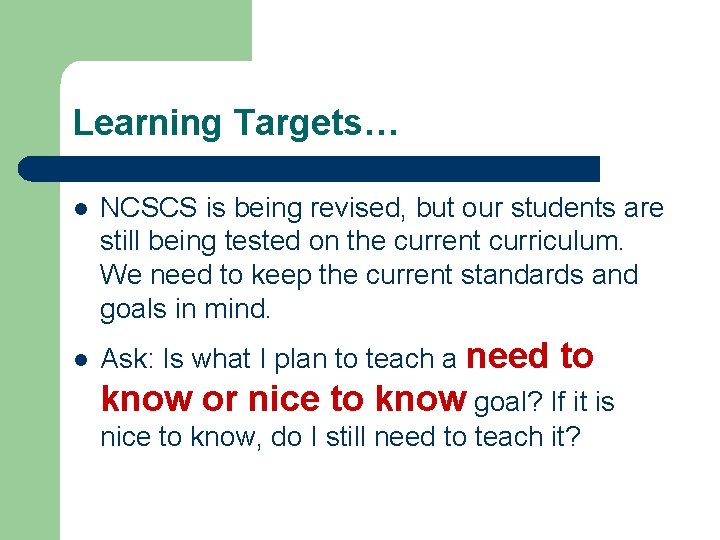
Learning Targets… l l NCSCS is being revised, but our students are still being tested on the current curriculum. We need to keep the current standards and goals in mind. Ask: Is what I plan to teach a need to know or nice to know goal? If it is nice to know, do I still need to teach it?
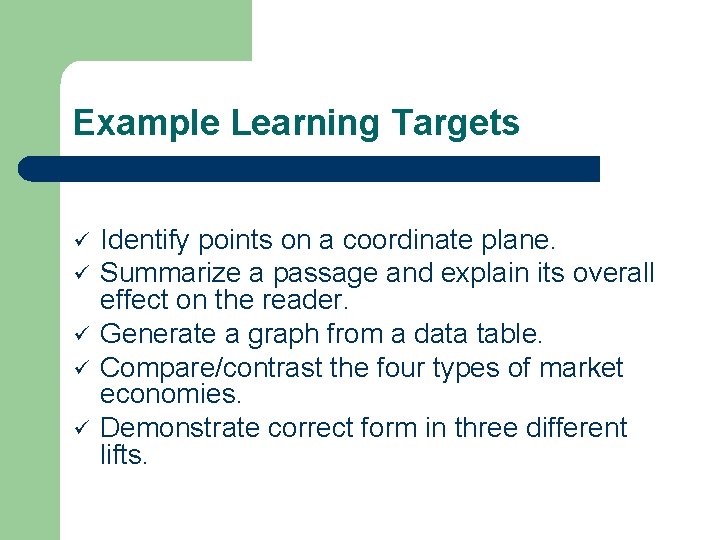
Example Learning Targets ü ü ü Identify points on a coordinate plane. Summarize a passage and explain its overall effect on the reader. Generate a graph from a data table. Compare/contrast the four types of market economies. Demonstrate correct form in three different lifts.
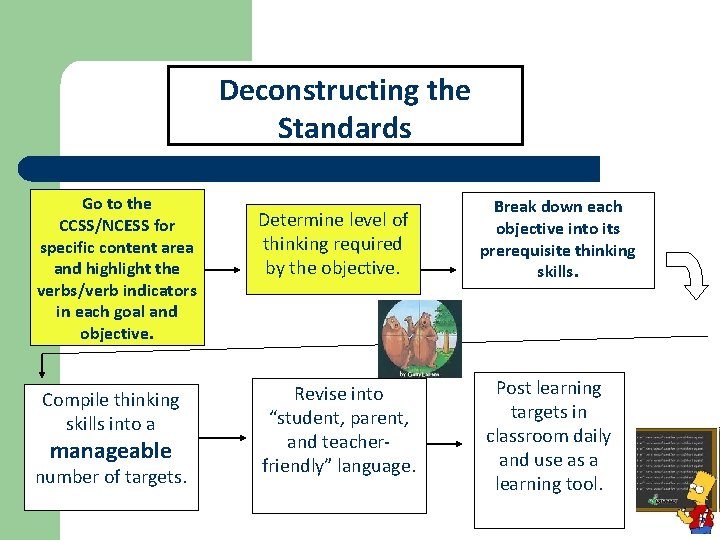
Deconstructing the Standards Go to the CCSS/NCESS for specific content area and highlight the verbs/verb indicators in each goal and objective. Compile thinking skills into a manageable number of targets. Determine level of thinking required by the objective. Revise into “student, parent, and teacherfriendly” language. Break down each objective into its prerequisite thinking skills. Post learning targets in classroom daily and use as a learning tool.
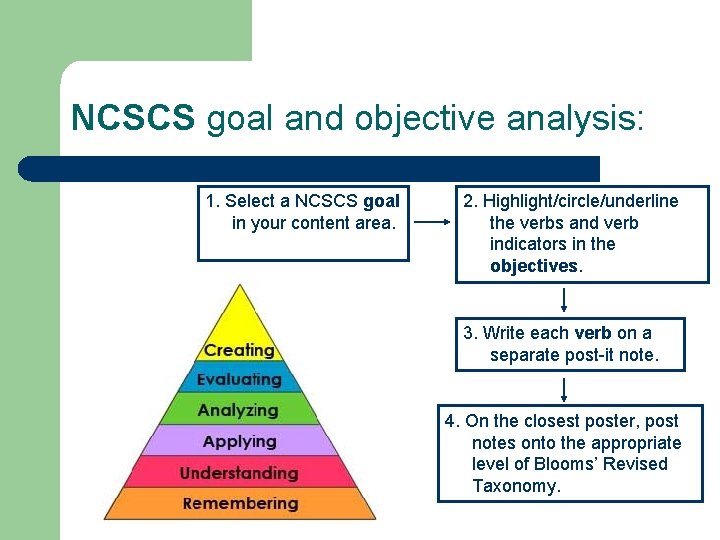
NCSCS goal and objective analysis: 1. Select a NCSCS goal in your content area. 2. Highlight/circle/underline the verbs and verb indicators in the objectives. 3. Write each verb on a separate post-it note. 4. On the closest poster, post notes onto the appropriate level of Blooms’ Revised Taxonomy.
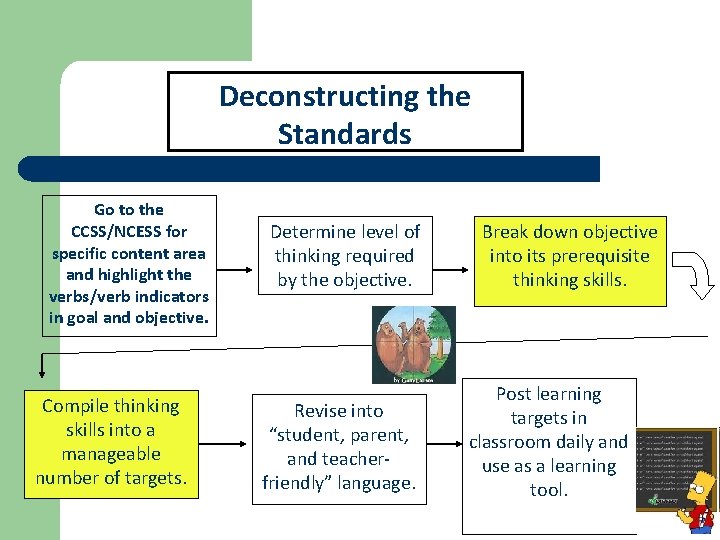
Deconstructing the Standards Go to the CCSS/NCESS for specific content area and highlight the verbs/verb indicators in goal and objective. Compile thinking skills into a manageable number of targets. Determine level of thinking required by the objective. Revise into “student, parent, and teacherfriendly” language. Break down objective into its prerequisite thinking skills. Post learning targets in classroom daily and use as a learning tool.
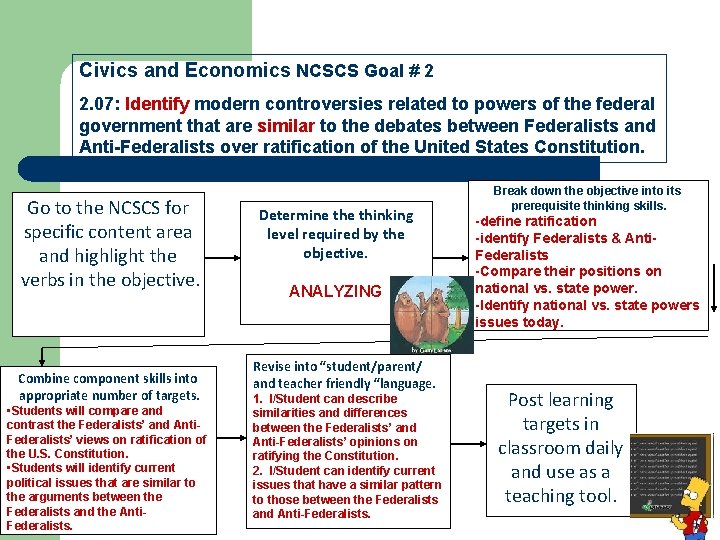
Civics and Economics NCSCS Goal # 2 2. 07: Identify modern controversies related to powers of the federal government that are similar to the debates between Federalists and Anti-Federalists over ratification of the United States Constitution. Go to the NCSCS for specific content area and highlight the verbs in the objective. Combine component skills into appropriate number of targets. • Students will compare and contrast the Federalists’ and Anti. Federalists’ views on ratification of the U. S. Constitution. • Students will identify current political issues that are similar to the arguments between the Federalists and the Anti. Federalists. Determine thinking level required by the objective. ANALYZING Revise into “student/parent/ and teacher friendly “language. 1. I/Student can describe similarities and differences between the Federalists’ and Anti-Federalists’ opinions on ratifying the Constitution. 2. I/Student can identify current issues that have a similar pattern to those between the Federalists and Anti-Federalists. Break down the objective into its prerequisite thinking skills. -define ratification -identify Federalists & Anti. Federalists -Compare their positions on national vs. state power. -Identify national vs. state powers issues today. Post learning targets in classroom daily and use as a teaching tool.
How Do We Know if Students Have (or Haven’t) Learned It? l l l How will I know students met the target? How will students know they met the target? What will I ask students to write, make, say, or do today to prove they met the target? (formative assessment) – – – Exit slip Turn and talk Journal Thinking Map/Graphic Organizer Return to pre-instruction strategy (circle map, anticipation guide, KWL, etc. ) Turn & Talk: What other ways can we assess if our students met the target?
Rubrics l How can I assess learning targets for various levels of mastery? (see rubric sample in handouts)
How are ACRHS content teams currently developing learning targets? l l l Biology Civics Others?
Content Teams l Using the chart and your standard course of study, develop two learning targets you plan to implement with students soon: – – 1 with content team 1 for your individual classroom
Word Splash l Now that we have thought more about learning targets, review/re-arrange the word splash concepts, inserting the cards your group put aside previously.
Next steps. . . l Change/Add/Keep Card l Literacy Menus