
What Do We Mean By Included Engaged and
What Do We Mean By Included, Engaged and Involved? Youth Justice Conference Wednesday 15 th June 2016 Transforming lives through learning
Included, Engaged and Involved • Background and context to relationships and behaviour policy and practice in Scotland • Exclusions Statistics 2015 • New Exclusion Policy-A Positive Approach to Preventing and Managing Exclusions • Your role in supporting the policy development at a national level • Your role in supporting the implementation of the policy at a local level Transforming lives through learning
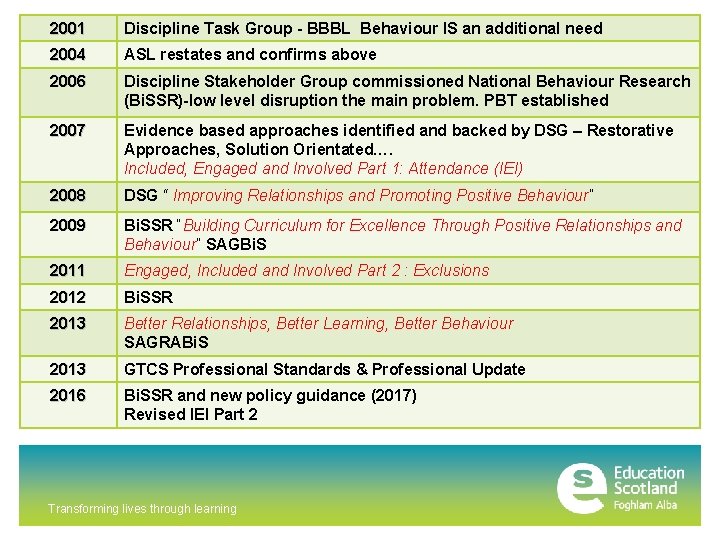
2001 Discipline Task Group - BBBL Behaviour IS an additional need 2004 ASL restates and confirms above 2006 Discipline Stakeholder Group commissioned National Behaviour Research (Bi. SSR)-low level disruption the main problem. PBT established 2007 Evidence based approaches identified and backed by DSG – Restorative Approaches, Solution Orientated…. Included, Engaged and Involved Part 1: Attendance (IEI) 2008 DSG “ Improving Relationships and Promoting Positive Behaviour” 2009 Bi. SSR “Building Curriculum for Excellence Through Positive Relationships and Behaviour” SAGBi. S 2011 Engaged, Included and Involved Part 2 : Exclusions 2012 Bi. SSR 2013 Better Relationships, Better Learning, Better Behaviour SAGRABi. S 2013 GTCS Professional Standards & Professional Update 2016 Bi. SSR and new policy guidance (2017) Revised IEI Part 2 Transforming lives through learning
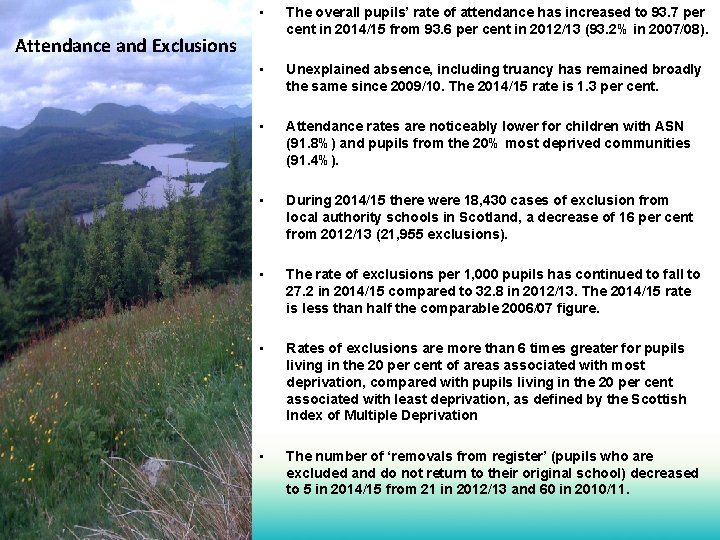
• The overall pupils’ rate of attendance has increased to 93. 7 per cent in 2014/15 from 93. 6 per cent in 2012/13 (93. 2% in 2007/08). • Unexplained absence, including truancy has remained broadly the same since 2009/10. The 2014/15 rate is 1. 3 per cent. • Attendance rates are noticeably lower for children with ASN (91. 8%) and pupils from the 20% most deprived communities (91. 4%). • During 2014/15 there were 18, 430 cases of exclusion from local authority schools in Scotland, a decrease of 16 per cent from 2012/13 (21, 955 exclusions). • The rate of exclusions per 1, 000 pupils has continued to fall to 27. 2 in 2014/15 compared to 32. 8 in 2012/13. The 2014/15 rate is less than half the comparable 2006/07 figure. • Rates of exclusions are more than 6 times greater for pupils living in the 20 per cent of areas associated with most deprivation, compared with pupils living in the 20 per cent associated with least deprivation, as defined by the Scottish Index of Multiple Deprivation • The number of ‘removals from register’ (pupils who are excluded and do not return to their original school) decreased to 5 in 2014/15 from 21 in 2012/13 and 60 in 2010/11. Attendance and Exclusions
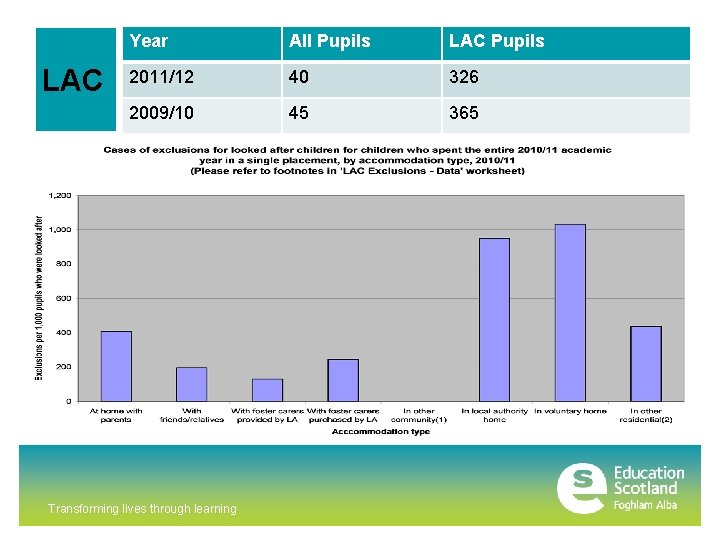
LAC Year All Pupils LAC Pupils 2011/12 40 326 2009/10 45 365 Transforming lives through learning
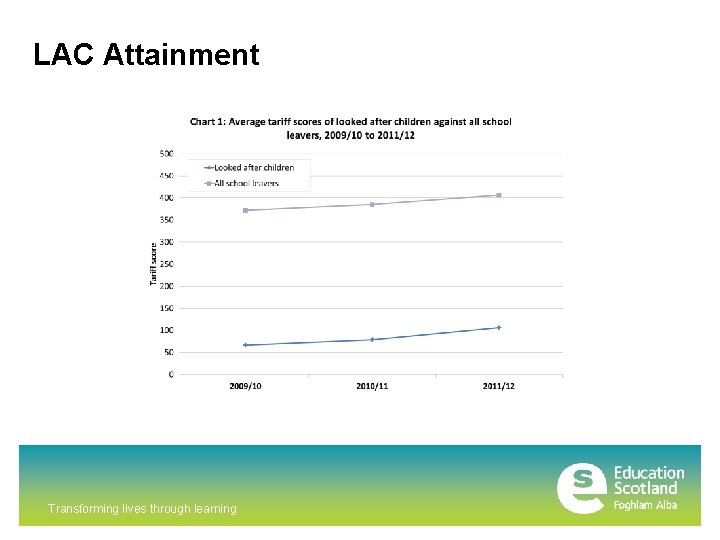
LAC Attainment Transforming lives through learning
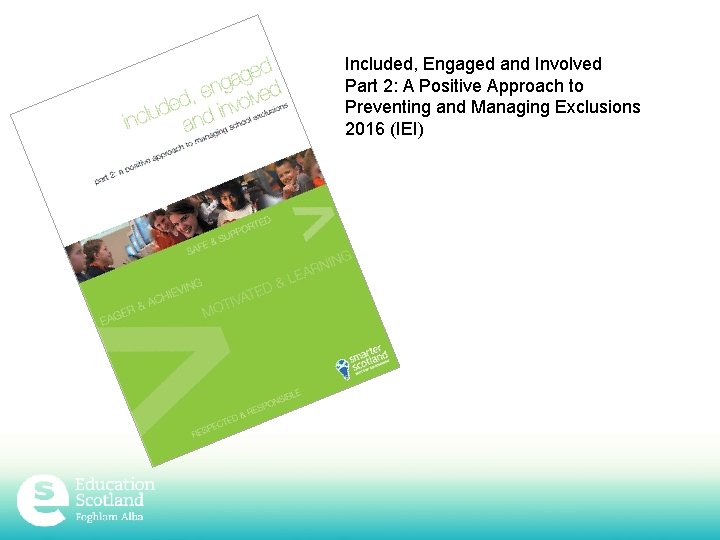
Included, Engaged and Involved Part 2: A Positive Approach to Preventing and Managing Exclusions 2016 (IEI)
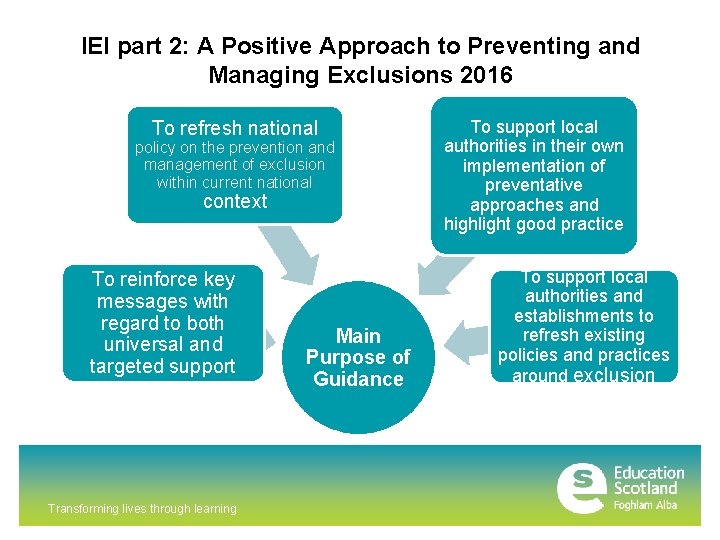
IEI part 2: A Positive Approach to Preventing and Managing Exclusions 2016 To refresh national policy on the prevention and management of exclusion within current national context To reinforce key messages with regard to both universal and targeted support Transforming lives through learning Main Purpose of Guidance To support local authorities in their own implementation of preventative approaches and highlight good practice To support local authorities and establishments to refresh existing policies and practices around exclusion
IEI part 2: A Positive Approach to Preventing and Managing Exclusions 2016 Why refresh? • • Policy context – C&YP Scotland Act 2015, GIRFEC, National Improvement Framework (NIF) The Scottish Attainment Challenge (SAC) New Behaviour Research 2012 Align with wider relationships and behaviour policy Concerns around some aspects of implementation TOO LONG! Transforming lives through learning
Why refresh? • Strengthen some areas Ø All exclusions are formal and must be recorded – sending home without excluding is not acceptable Ø ‘Assurance of good behaviour’ contracts are not required before readmission Ø Local Authority role in monitoring and ensuring appropriate support is in place Ø Individual circumstances – LAC, CP register, ASN Ø Flexible Packages Ø Support/Provision during an exclusion Transforming lives through learning
What’s different? • Policy and reform context has been updated • New recording code on SEEMIS for C&YP returning to school on a phased basis • New checklists to support management of exclusion • Flowcharts to support the process of exclusion • Guidance on de-escalation, risk assessment and duty of care (physical intervention) • Structure • More streamlined • Stronger focus on UNCRC and Children’s Rights • Impact of exclusion Transforming lives through learning
Impact of Exclusion and Anti-social/Offending Behaviour • Important predictor of criminal record status is school exclusion by the third year of Secondary school (Edinburgh Study of Youth Transitions and Crime) • Pathways into offending – 80% of young people in Polmont had been excluded from school (Smith, Dyer and Connelly, 2014) • Young people permanently excluded from school are at greater risk of social exclusion, anti-social behaviour, crime, drug taking and suicide (Rabie and Howard, 2013) Transforming lives through learning
Impact of Exclusion - Links between exclusion and emotional wellbeing • Exclusion can increase children’s already high levels of shame and fear (Taransaud, 2011) • Exclusion can impact on school connectedness which is a key feature in positive outcomes for children and young people (Learner and Kruger, 1997, Bergen and Bergen, 2008) • Excluding young people from stable routines of school and leaving them in a chaotic home background can worsen behaviour (Barnardo’s, 2010) Transforming lives through learning
Impact of Exclusion The following findings are from Scottish Government figures that look at the attainment of S 4/S 5 and S 6 pupils in the year 2012/13. • • • 5. 7% of pupils who had been excluded in that school year, achieved Level 6 or above in terms of qualifications, whilst 57. 7% of pupils who had no exclusions, achieved Level 6 or above. 4. 5% of pupils who had been excluded in that school year went on to achieve no qualifications, whilst only 1. 3% of pupils who had not been excluded in that school year, went on to achieve no qualifications. 11. 1% of pupils who had 5 exclusions gained no qualifications, compared to 3. 4% of pupils who had 1 exclusion. Transforming lives through learning
What’s remained? • The strong focus on prevention • The need for a clear relationships and behaviour policy in schools • The need for schools to engage in restorative, solution orientated approaches to prevent and support readmission processes • Legal Regulations are unchanged Transforming lives through learning
Timescales 2015 – working group established and calendar of meetings Feb – June 2016 – Opportunity to comment at national events Comments used to update document – final publication August 2016 Transforming lives through learning
Implementation Phase • • Launch and publication of policy guidance Letter to schools Education Scotland Inclusion Team meetings with Local Authorities Establishment of working groups to develop policy guidance at local level • Development of practice guidance – collate innovative, interesting practice • Use of GLOW learning communities to share practice Transforming lives through learning
Your contribution to the refreshed guidance and your role in supporting the implementation of the guidance at a local level What are the barriers that prevent full implementation of the guidance? What can Youth Justice practitioners do to support the implementation of the new guidance to ensure children and young people are included, engaged and involved in their education? • On an individual case basis • On an authority basis Transforming lives through learning
Individual case basis • • • Involvement in all planning and support meetings Contribute to the delivery and content of flexible packages Reinforce positive strategies in place to avoid same behaviours Support home/school links ……. Transforming lives through learning
On an authority basis • Involvement in strategy review group • Advocate for clear, strong messages around individual circumstances – LAC, CP register, number of days…. • Advocate for transparent monitoring and reviewing by the authority to support individual cases and provide the right supports • Involvement in implementation plan for the authority Transforming lives through learning
Wider work Pathways into offending – 80% of young people in HM YOI Polmont had been excluded from school (Smith, Dyer and Connelly, 2014). Resulting in: • Direct support to HM YOI Polmont in developing their learning environment, ensuring young people have access to their senior phase entitlements. Capacity building with Prison Officers e. g. Social, Emotional, Health and Wellbeing. • Strategic support to the Scottish Prison Service e. g. their first SPS Learning and Skills Strategy. Transforming lives through learning
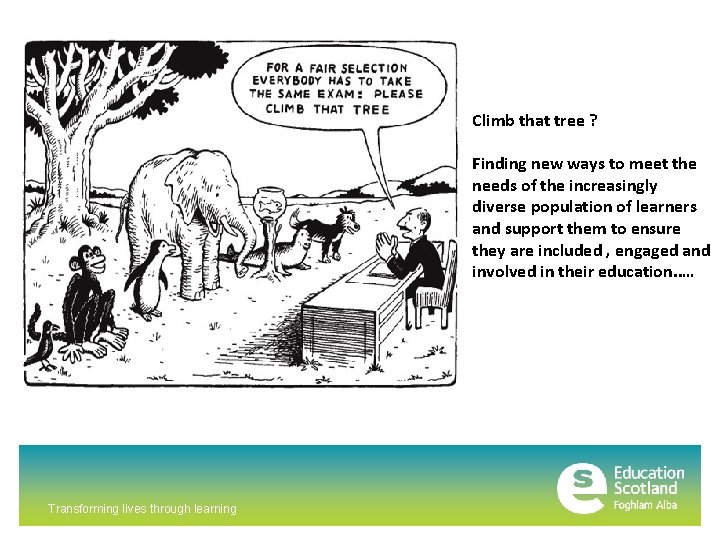
Climb that tree ? Finding new ways to meet the needs of the increasingly diverse population of learners and support them to ensure they are included , engaged and involved in their education. . … Transforming lives through learning
Maggie Fallon maggie. fallon@educationscotland. gsi. gov. uk Ann Kivlin Ann. kivlin@educationscotland. gsi. gov. uk Transforming lives through learning
- Slides: 23