
What do we mean by EAP teachers Reflections
What do we mean by EAP teachers? Reflections on practice, pedagogy and professional development. BALEAP Conference 2019 Damian Fitzpatrick (University of the Arts, London) Tracey Costley (University of Essex) Parvaneh Tavakoli (The University of Reading)
Overview • Study – Methodology • Findings – Practice/Pedagogy – Professional Development • Implications – Expertise • Questions

Why Research EAP Teachers? • Emerged from previous study on EAP writing (Costley, Tavakoli & Fitzpatrick, In press) • ‘a notable lack of attention given to those who teach EAP, its practitioners and practitioner-related issues in the existing literature of the field’ (Ding and Bruce, 2017, p. 1). • Some studies on EAP practitioners (e. g. Alexander (2012); Campion (2016); Ding and Bruce (2017)) but also a ‘dearth of literature on EAP professional development’ (Blaj-Ward, 2014, p. 113).
Aims/Research Questions Aims • To better understand what it means to be an EAP teacher from EAP teachers’ perspectives Research Questions • What do we do as practitioners? • What does ‘EAP’ mean to us? • What challenges do we face in our day-to-day roles? • How do we develop professionally?
Methodology: Data Collection • Semi-structured interviews – Phase one: (n=10) – Phase two: (n=4) • Online questionnaire (Google Forms) – 41 questions covering: Teaching Context, Professional Development, Understanding EAP, Challenges, Teaching Writing – Sent out to colleagues/professional bodies (e. g. EATAW, BALEAP and BAAL) – Participants (n=169) • Observations/Ethnographic data collection
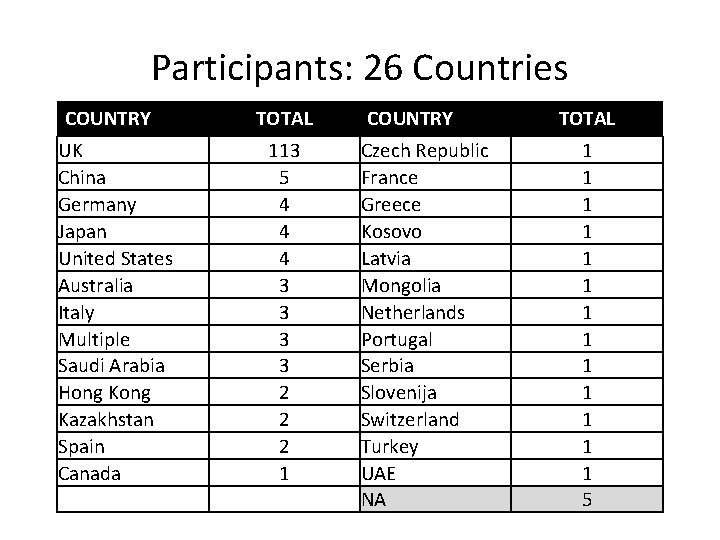
Participants: 26 Countries COUNTRY UK China Germany Japan United States Australia Italy Multiple Saudi Arabia Hong Kazakhstan Spain Canada TOTAL 113 5 4 4 4 3 3 2 2 2 1 COUNTRY Czech Republic France Greece Kosovo Latvia Mongolia Netherlands Portugal Serbia Slovenija Switzerland Turkey UAE NA TOTAL 1 1 1 1 5
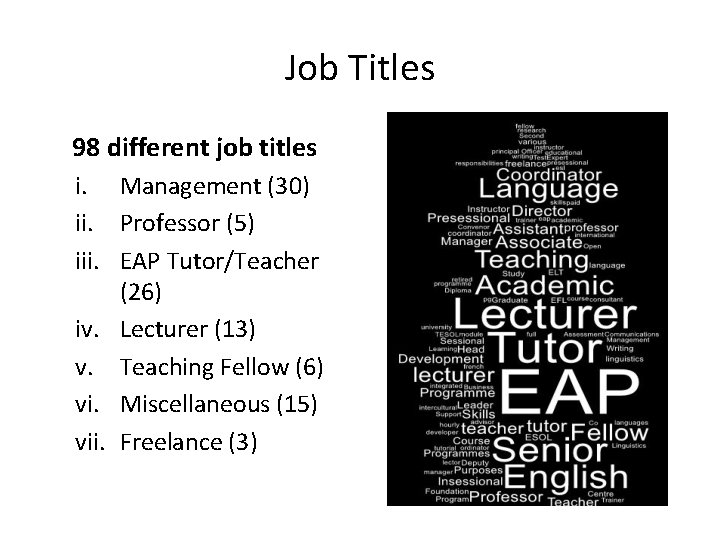
Job Titles 98 different job titles i. Management (30) ii. Professor (5) iii. EAP Tutor/Teacher (26) iv. Lecturer (13) v. Teaching Fellow (6) vi. Miscellaneous (15) vii. Freelance (3)

Teaching Experience Length Teaching EAP Teaching Over 10 years 89. 3% 55. 6% 6 -10 years 7. 7% 26. 6% 2 -5 years 1. 8% 13. 6% 0 -1 years 1. 2% 4. 1%
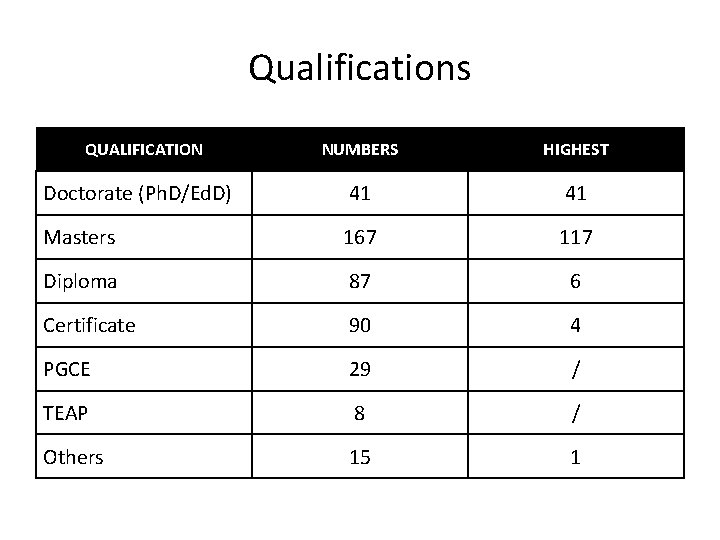
Qualifications QUALIFICATION NUMBERS HIGHEST Doctorate (Ph. D/Ed. D) 41 41 Masters 167 117 Diploma 87 6 Certificate 90 4 PGCE 29 / TEAP 8 / Others 15 1
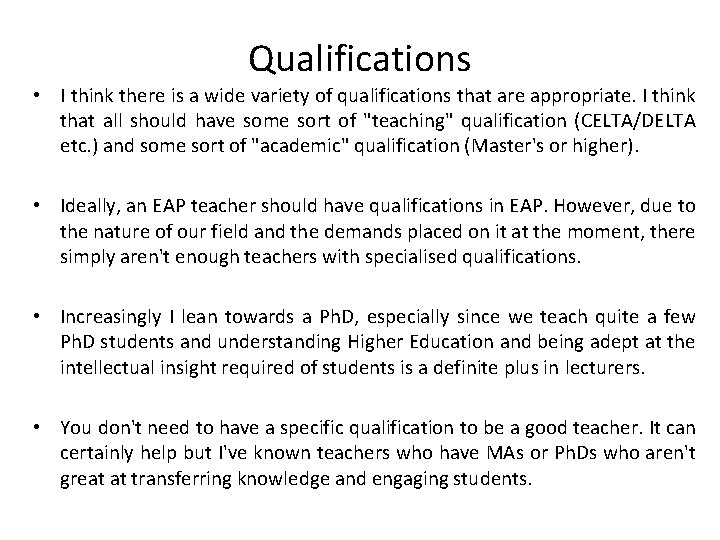
Qualifications • I think there is a wide variety of qualifications that are appropriate. I think that all should have some sort of "teaching" qualification (CELTA/DELTA etc. ) and some sort of "academic" qualification (Master's or higher). • Ideally, an EAP teacher should have qualifications in EAP. However, due to the nature of our field and the demands placed on it at the moment, there simply aren't enough teachers with specialised qualifications. • Increasingly I lean towards a Ph. D, especially since we teach quite a few Ph. D students and understanding Higher Education and being adept at the intellectual insight required of students is a definite plus in lecturers. • You don't need to have a specific qualification to be a good teacher. It can certainly help but I've known teachers who have MAs or Ph. Ds who aren't great at transferring knowledge and engaging students.
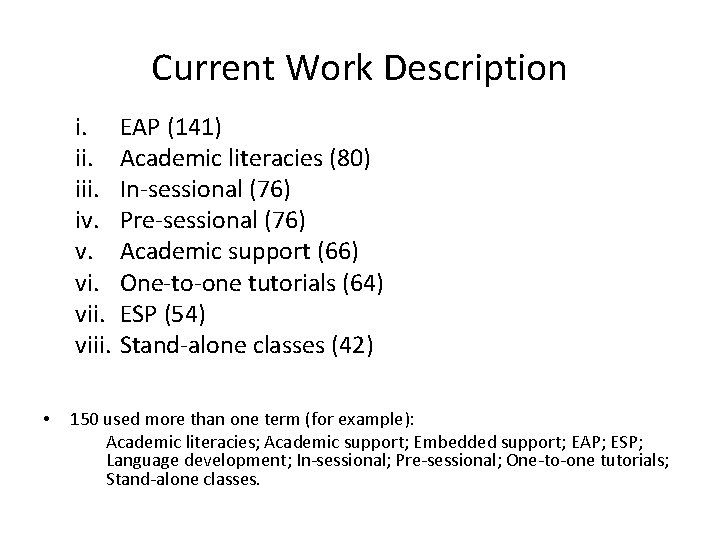
Current Work Description i. iii. iv. v. viii. • EAP (141) Academic literacies (80) In-sessional (76) Pre-sessional (76) Academic support (66) One-to-one tutorials (64) ESP (54) Stand-alone classes (42) 150 used more than one term (for example): Academic literacies; Academic support; Embedded support; EAP; ESP; Language development; In-sessional; Pre-sessional; One-to-one tutorials; Stand-alone classes.
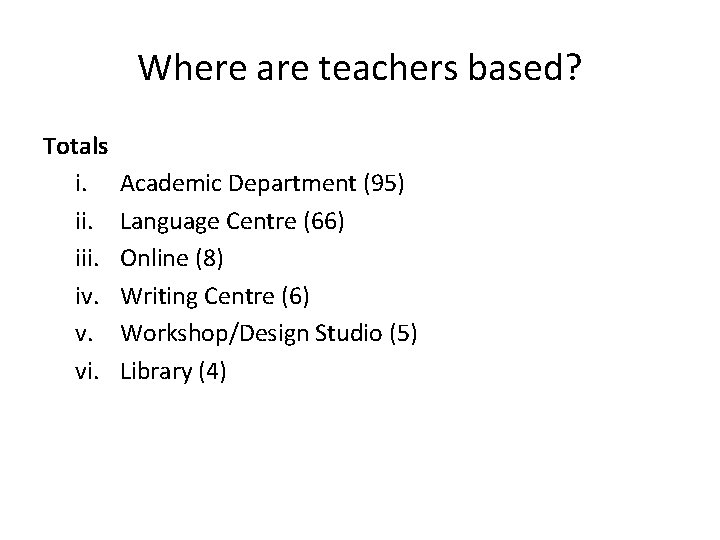
Where are teachers based? Totals i. iii. iv. v. vi. Academic Department (95) Language Centre (66) Online (8) Writing Centre (6) Workshop/Design Studio (5) Library (4)
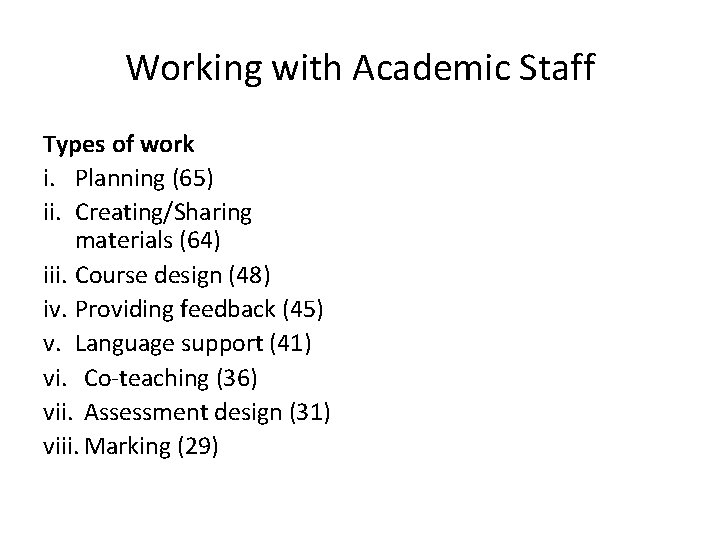
Working with Academic Staff Types of work i. Planning (65) ii. Creating/Sharing materials (64) iii. Course design (48) iv. Providing feedback (45) v. Language support (41) vi. Co-teaching (36) vii. Assessment design (31) viii. Marking (29)
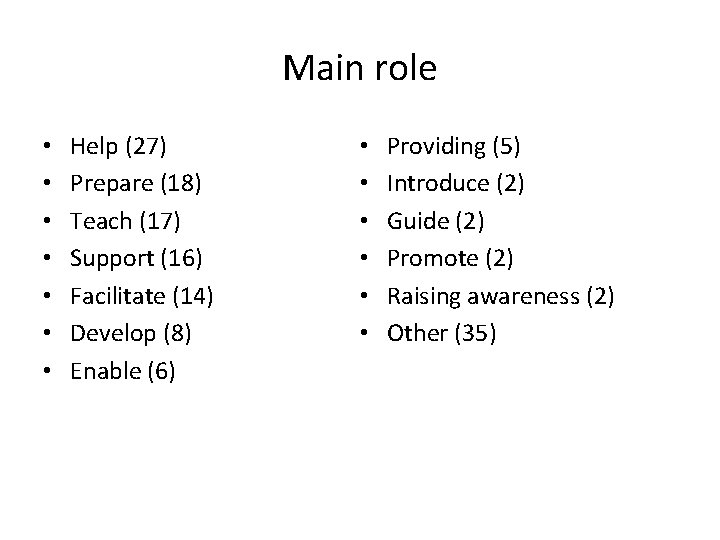
Main role • • Help (27) Prepare (18) Teach (17) Support (16) Facilitate (14) Develop (8) Enable (6) • • • Providing (5) Introduce (2) Guide (2) Promote (2) Raising awareness (2) Other (35)
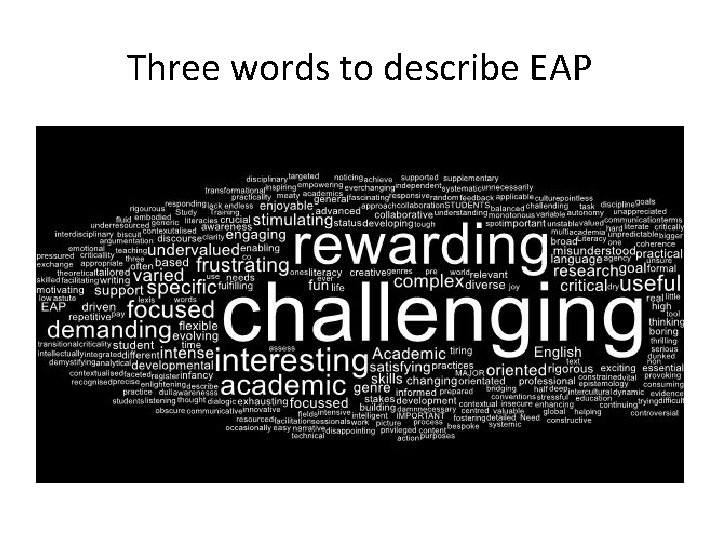
Three words to describe EAP

Challenges What are some of the challenges you face when teaching EAP? • Mixed-ability classes (86) • Students’ level of language (75) • Different disciplinary conventions across different departments (64)
Challenges: Disciplines • … trying to get your own head around all of the different expectations from the disciplines themselves, particularly as discipline tutors themselves don’t seem to have a very explicit sense of… what it is they want or how to articulate what it is they want. (Niall) • I mean luckily working here because I’ve got an interest (and a background) in (Subject). I find that it is quite stimulating. But if I were doing something out of my comfort zone like law or medicine or business or engineering then I think that would be more of a challenge. (Siobhan)
How do we become EAP teachers? • Through our experiences of, and reflections on, doing the job • Through interactions with our peers • Through conferences and professional development
Professional Development From both the Questionnaire and the Interviews the data as a profession seems to show: • Clear commitment to a wide variety of on-going professional development • High value placed on peer observations and peer mentoring • High value placed on attending conferences and workshops • High value placed on hearing from ‘experts’ • A real concern with keeping up-to-date and on track
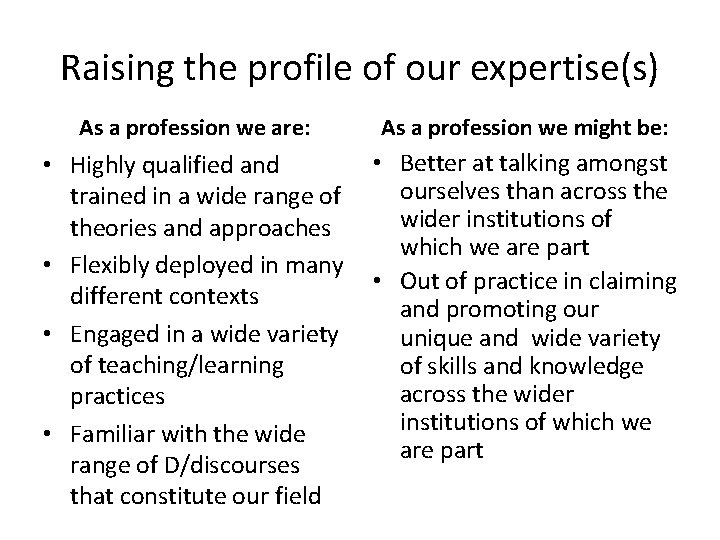
Raising the profile of our expertise(s) As a profession we are: As a profession we might be: • Highly qualified and trained in a wide range of theories and approaches • Flexibly deployed in many different contexts • Engaged in a wide variety of teaching/learning practices • Familiar with the wide range of D/discourses that constitute our field • Better at talking amongst ourselves than across the wider institutions of which we are part • Out of practice in claiming and promoting our unique and wide variety of skills and knowledge across the wider institutions of which we are part
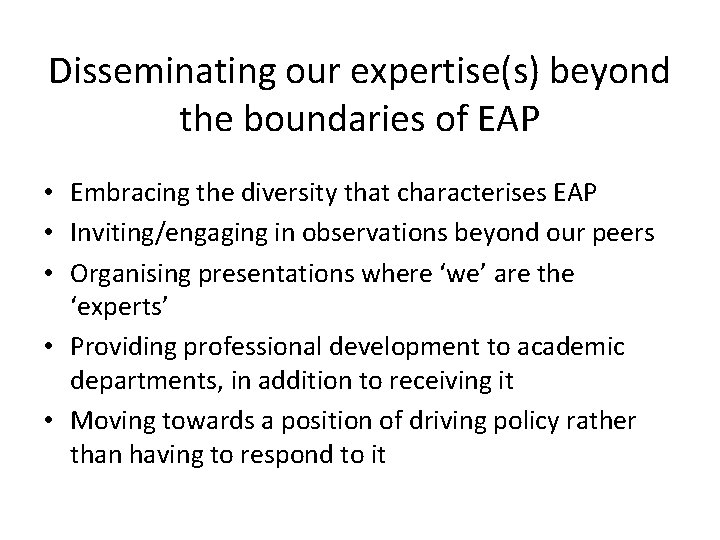
Disseminating our expertise(s) beyond the boundaries of EAP • Embracing the diversity that characterises EAP • Inviting/engaging in observations beyond our peers • Organising presentations where ‘we’ are the ‘experts’ • Providing professional development to academic departments, in addition to receiving it • Moving towards a position of driving policy rather than having to respond to it
Thank you for listening, any questions? d. fitzpatrick@arts. ac. uk tcostley@essex. ac. uk p. tavakoli@reading. ac. uk
References Alexander, O. (2012). Exploring teacher beliefs in teaching EAP at low proficiency levels. Journal of English for Academic Purposes, 11(2), 99 -111. Blaj-Ward, L. (2014). Researching contexts, practices and pedagogies in English for academic purposes. UK: Palgrave Macmillan. Bruce, I. (2011). Theory and concepts of English for academic purposes. UK: Palgrave Macmillan. Campion, G. C. (2016). ‘The learning never ends’: Exploring teachers’ views on the transition from General English to EAP. Journal of English for Academic Purposes, 23, 59 -70. Costley, T. , Tavakoli, P. & Fitzpatrick, D. (In press). Lessons from the classroom: What makes a good writing teacher? In C. Griffiths, Z. Tajeddin and A. Brown (Eds. ) Lessons from good language teachers. Cambridge: CUP. Ding, A. , & Bruce, I. (2017). The English for academic purposes practitioner. UK: Palgrave Macmillan. Ding, A. , & Bruce, I. (2017). Developing EAP Practitioners. In I. Bruce & A. Ding (Eds. ) The English for academic purposes practitioner (pp. 117 -177). UK: Palgrave Macmillan. Ding, A. , & Campion, G. (2016). EAP teacher development. In K. Hyland & P. Shaw (Eds. ) The Routledge handbook of English for academic purposes (pp. 571 -583). Routledge. Hyland, K. (2018). Sympathy for the devil? A defence of EAP. Language Teaching, 51(3), 383 -399.
- Slides: 23