
What do we have How do we communicate
- Slides: 3
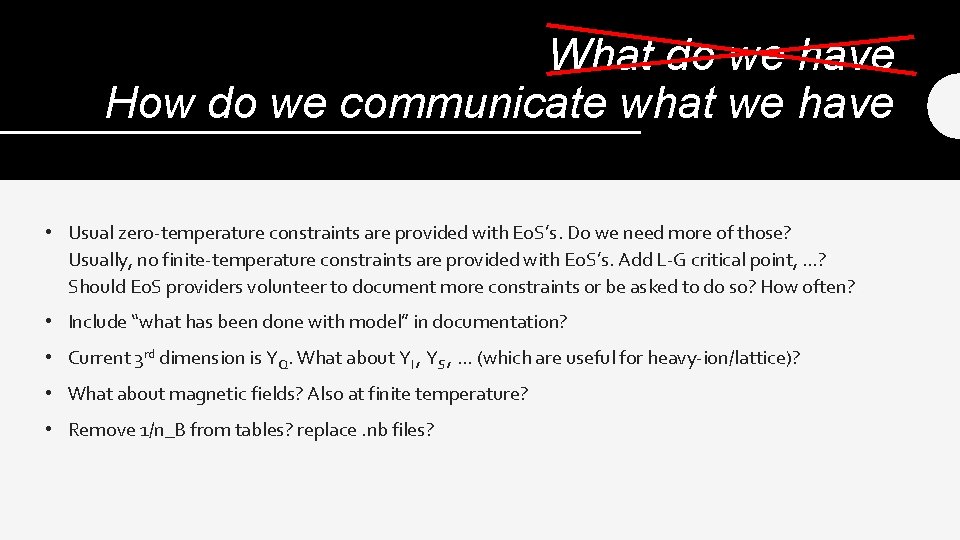
What do we have How do we communicate what we have • Usual zero-temperature constraints are provided with Eo. S’s. Do we need more of those? Usually, no finite-temperature constraints are provided with Eo. S’s. Add L-G critical point, …? Should Eo. S providers volunteer to document more constraints or be asked to do so? How often? . • Include “what has been done with model” in documentation? • Current 3 rd dimension is YQ. What about YI , YS , … (which are useful for heavy-ion/lattice)? • What about magnetic fields? Also at finite temperature? • Remove 1/n_B from tables? replace. nb files?
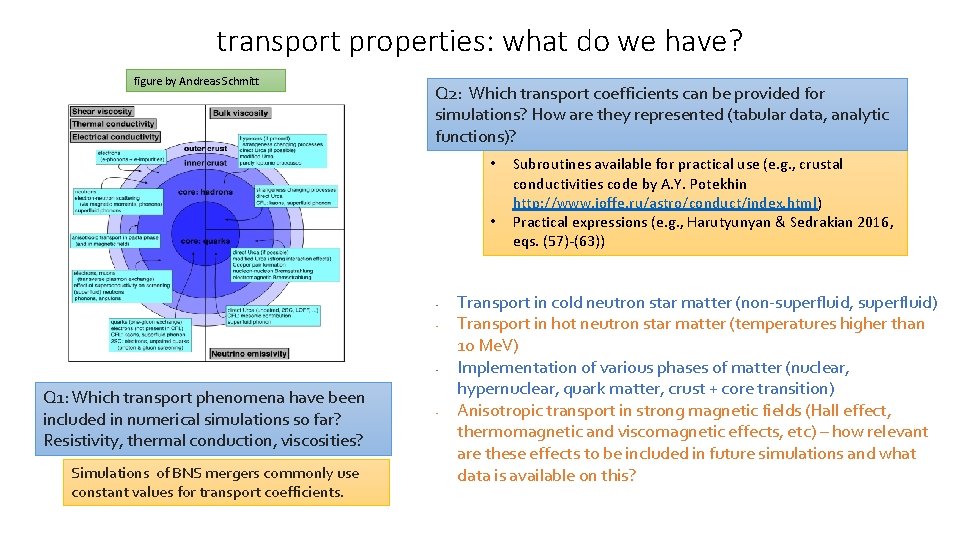
transport properties: what do we have? figure by Andreas Schmitt Q 2: Which transport coefficients can be provided for simulations? How are they represented (tabular data, analytic functions)? • • • Q 1: Which transport phenomena have been included in numerical simulations so far? Resistivity, thermal conduction, viscosities? Simulations of BNS mergers commonly use constant values for transport coefficients. • Subroutines available for practical use (e. g. , crustal conductivities code by A. Y. Potekhin http: //www. ioffe. ru/astro/conduct/index. html) Practical expressions (e. g. , Harutyunyan & Sedrakian 2016, eqs. (57)-(63)) Transport in cold neutron star matter (non-superfluid, superfluid) Transport in hot neutron star matter (temperatures higher than 10 Me. V) Implementation of various phases of matter (nuclear, hypernuclear, quark matter, crust + core transition) Anisotropic transport in strong magnetic fields (Hall effect, thermomagnetic and viscomagnetic effects, etc) – how relevant are these effects to be included in future simulations and what data is available on this?
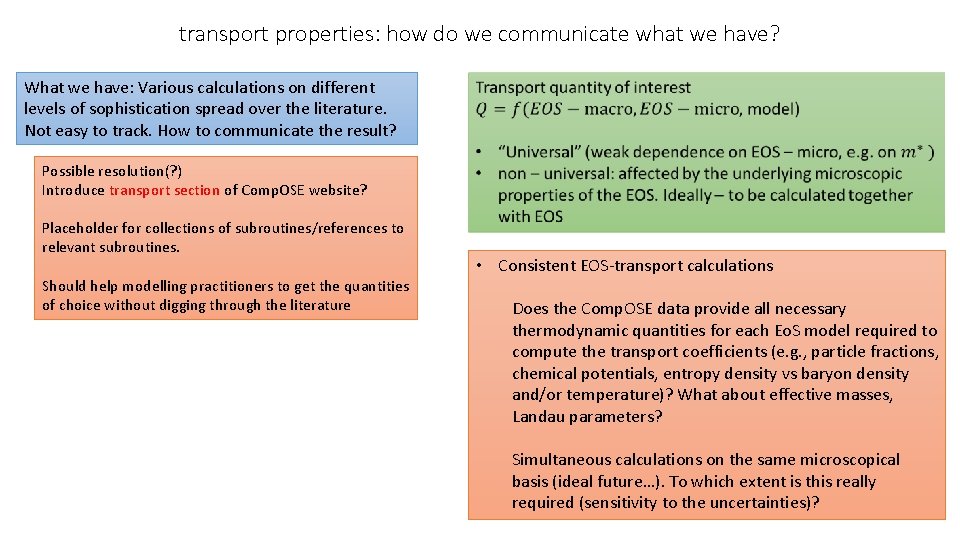
transport properties: how do we communicate what we have? What we have: Various calculations on different levels of sophistication spread over the literature. Not easy to track. How to communicate the result? Possible resolution(? ) Introduce transport section of Comp. OSE website? Placeholder for collections of subroutines/references to relevant subroutines. Should help modelling practitioners to get the quantities of choice without digging through the literature • Consistent EOS-transport calculations Does the Comp. OSE data provide all necessary thermodynamic quantities for each Eo. S model required to compute the transport coefficients (e. g. , particle fractions, chemical potentials, entropy density vs baryon density and/or temperature)? What about effective masses, Landau parameters? Simultaneous calculations on the same microscopical basis (ideal future…). To which extent is this really required (sensitivity to the uncertainties)?