
What do these four pictures have in common
- Slides: 24
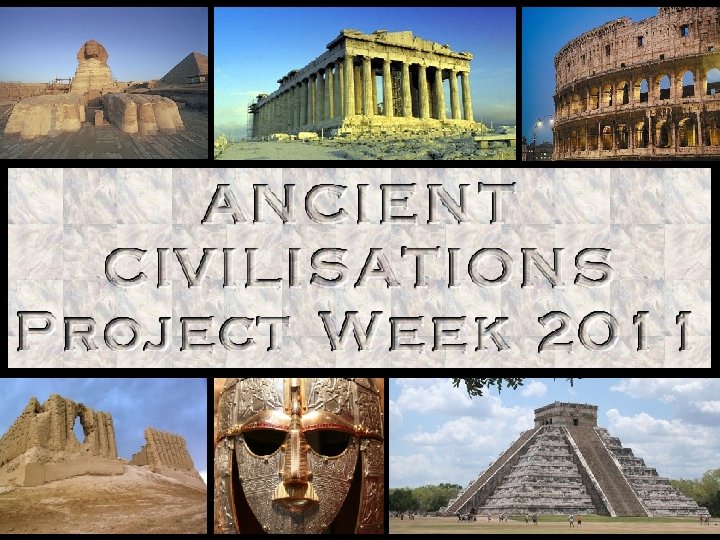
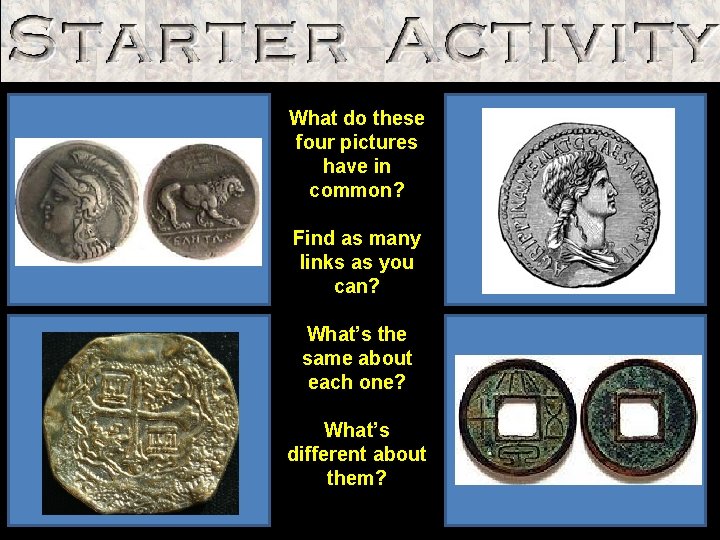
What do these four pictures have in common? Find as many links as you can? What’s the same about each one? What’s different about them?
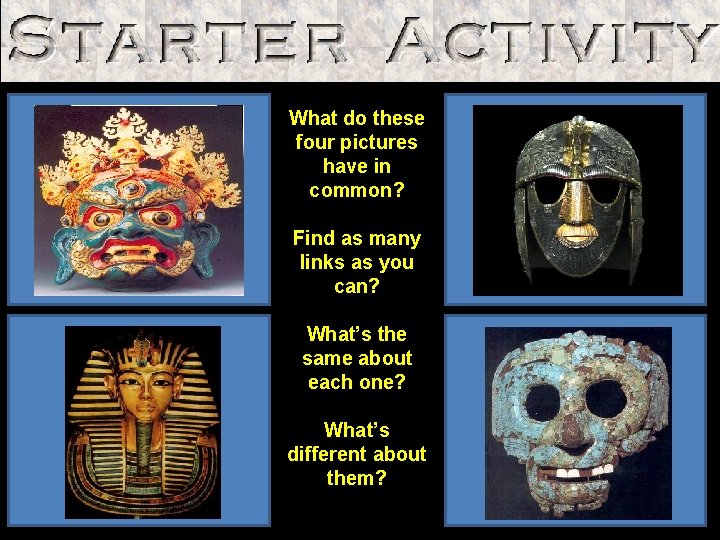
What do these four pictures have in common? Find as many links as you can? What’s the same about each one? What’s different about them?
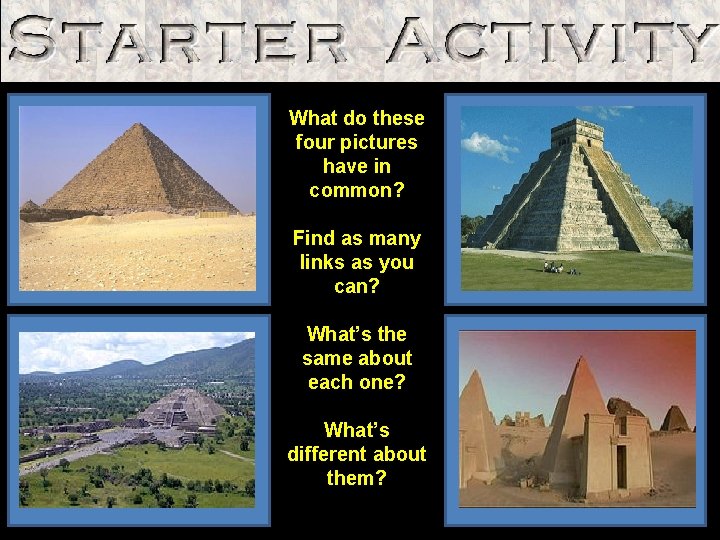
What do these four pictures have in common? Find as many links as you can? What’s the same about each one? What’s different about them?
W. A. L. T What are ancient civilisations? W. I. L. F By the end of the lesson can you… …name at least six ancient civilisations? …name at least 4 of the seven Ancient Wonders of the World? …use information to put ancient civilisations in order to answer a question? …explain why ancient civilisations are important to us today?
A civilisation is a group of people who work together to build a society. They share technology, wealth and experience with each other. They work together as a whole to make life as good as possible for all members of the civilisation. The term ancient means that it is something that occurred a long time ago, way back in history.
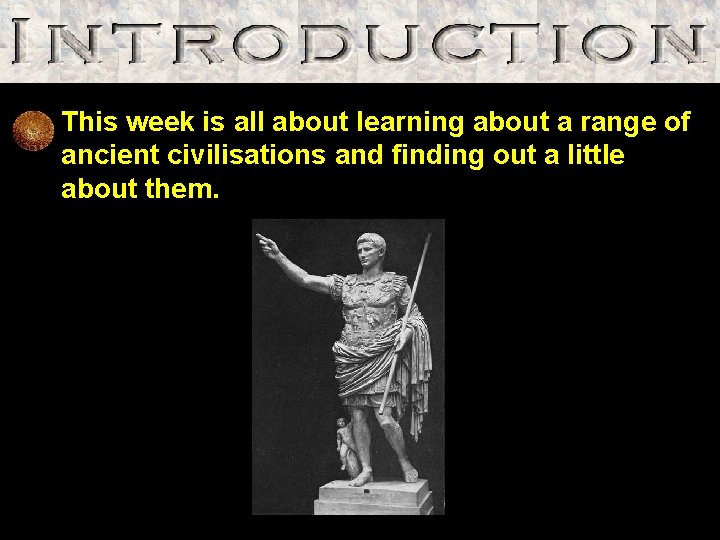
This week is all about learning about a range of ancient civilisations and finding out a little about them.
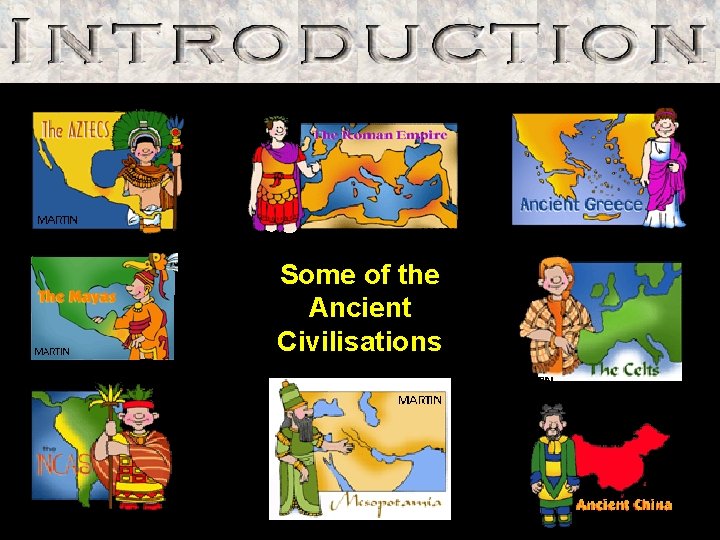
Some of the Ancient Civilisations
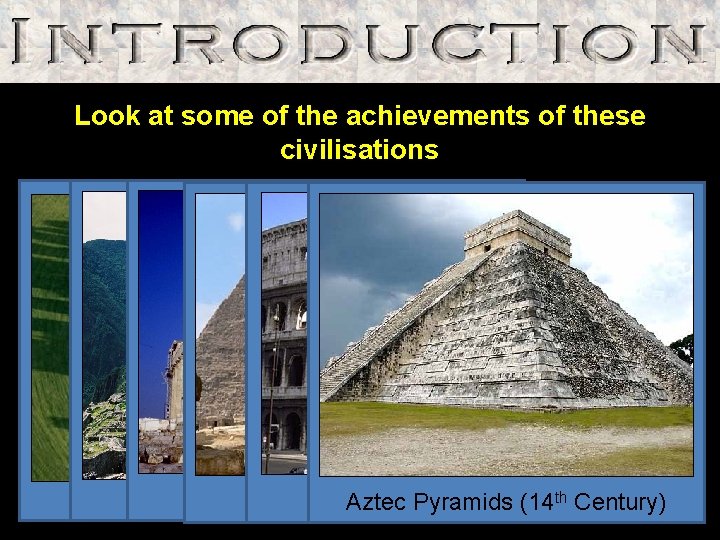
Look at some of the achievements of these civilisations Machu Picchu Stonehenge The Parthenon Sphinx and The Roman Pyramids Coliseum Aztec Pyramids (14 th Century)
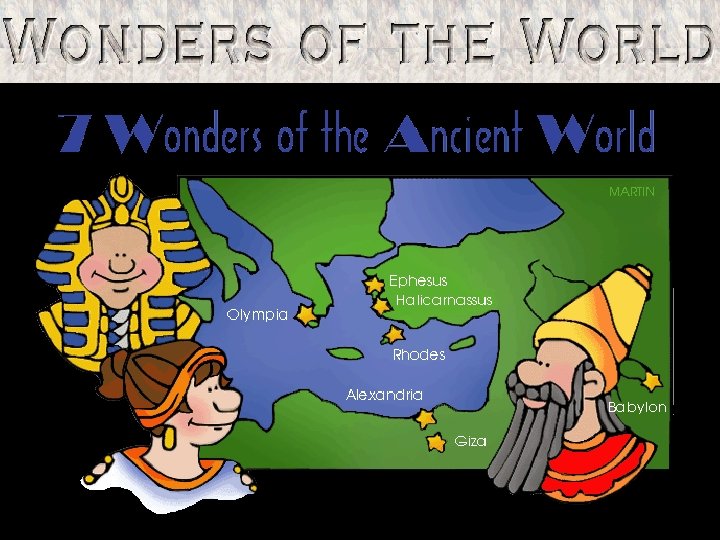
Whilst there were many great achievements from many civilisations, there are 7 that are considered the best examples. These were called the seven Wonders of the Ancient World. Lets have a look at these in more detail.
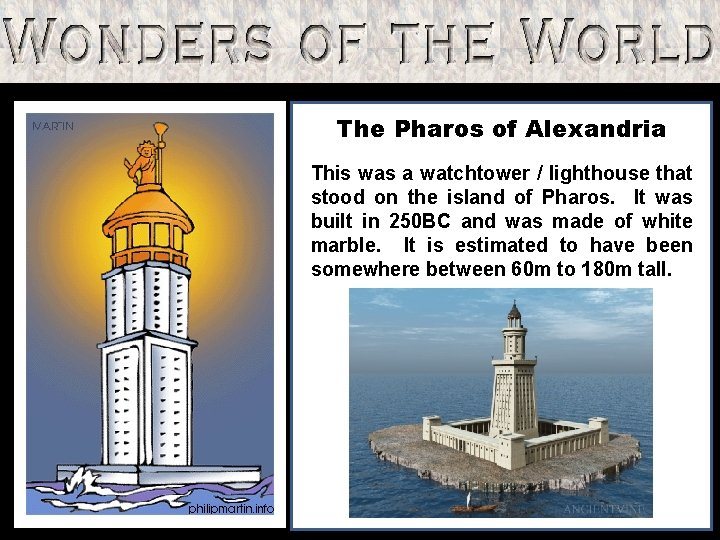
The Pharos of Alexandria This was a watchtower / lighthouse that stood on the island of Pharos. It was built in 250 BC and was made of white marble. It is estimated to have been somewhere between 60 m to 180 m tall.
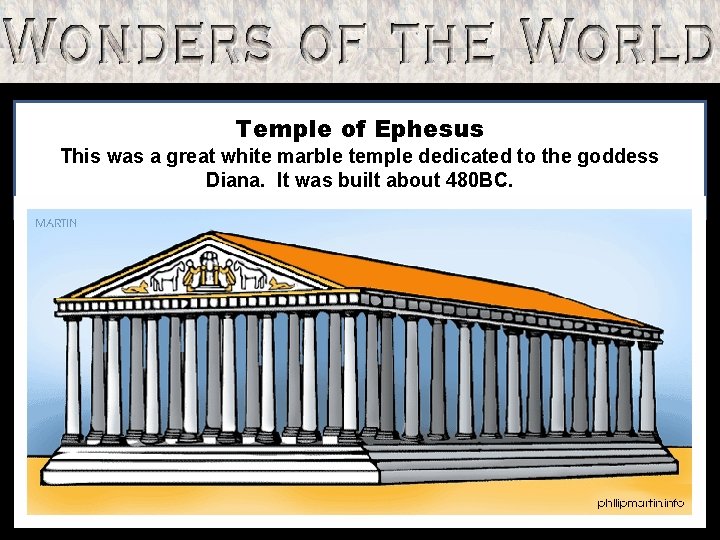
Temple of Ephesus This was a great white marble temple dedicated to the goddess Diana. It was built about 480 BC.
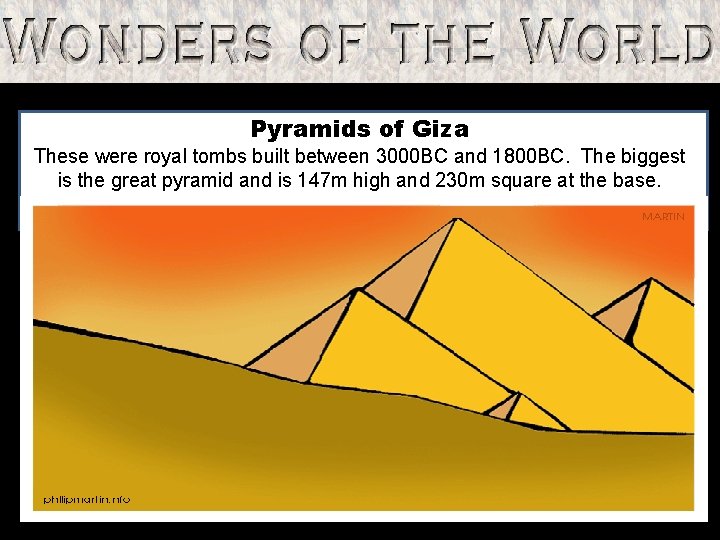
Pyramids of Giza These were royal tombs built between 3000 BC and 1800 BC. The biggest is the great pyramid and is 147 m high and 230 m square at the base.
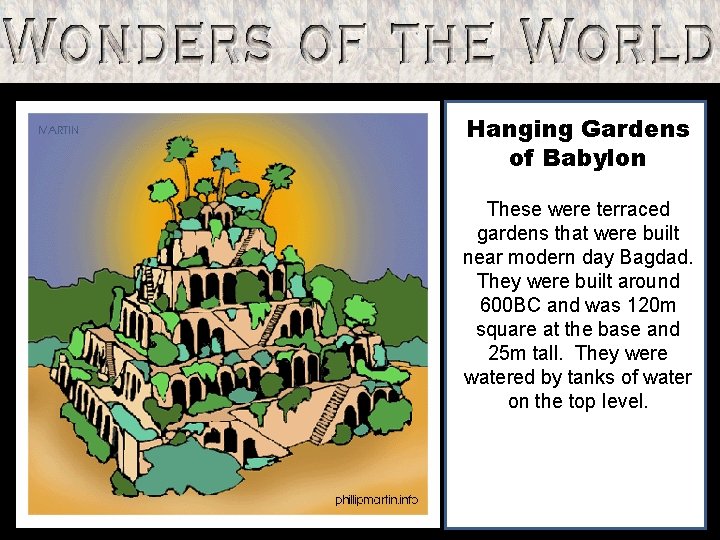
Hanging Gardens of Babylon These were terraced gardens that were built near modern day Bagdad. They were built around 600 BC and was 120 m square at the base and 25 m tall. They were watered by tanks of water on the top level.
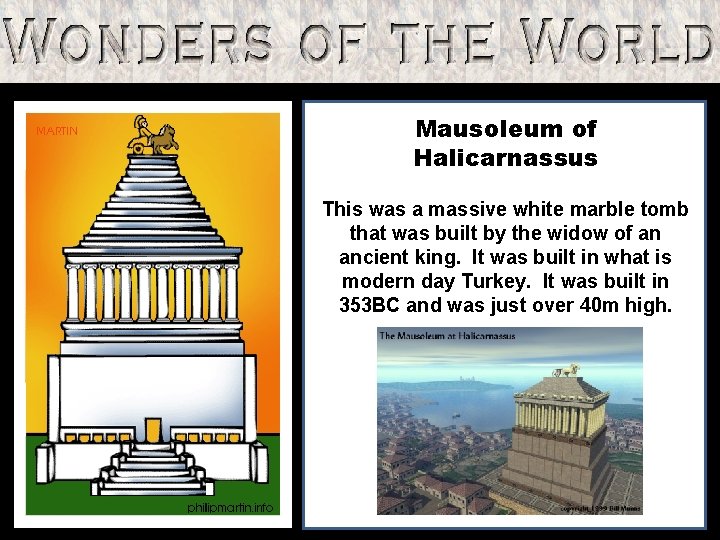
Mausoleum of Halicarnassus This was a massive white marble tomb that was built by the widow of an ancient king. It was built in what is modern day Turkey. It was built in 353 BC and was just over 40 m high.
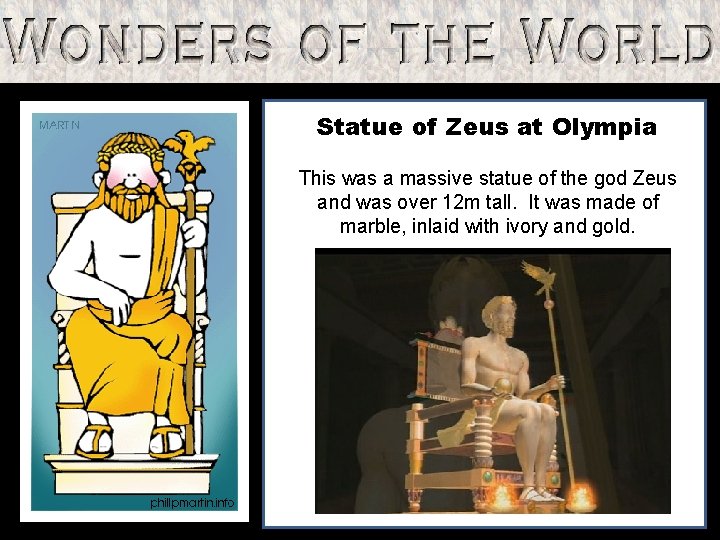
Statue of Zeus at Olympia This was a massive statue of the god Zeus and was over 12 m tall. It was made of marble, inlaid with ivory and gold.
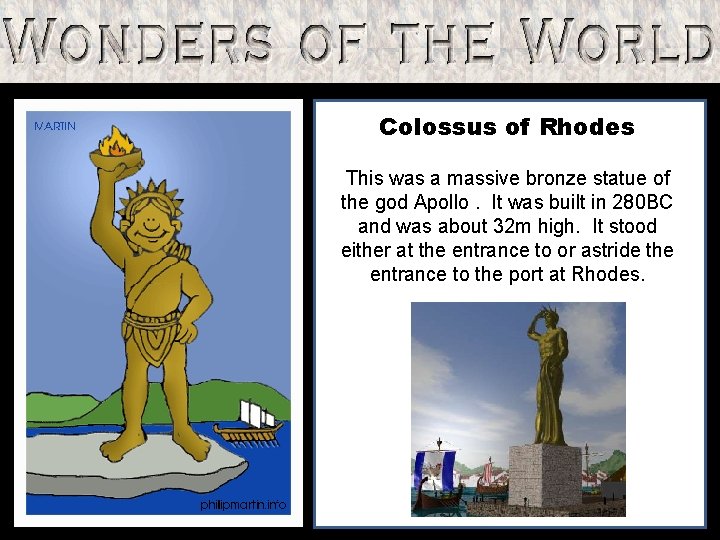
Colossus of Rhodes This was a massive bronze statue of the god Apollo. It was built in 280 BC and was about 32 m high. It stood either at the entrance to or astride the entrance to the port at Rhodes.
Only one of these seven still exists today. Which one? Question for discussion I want you to pretend that we are now 1000 years in the future and a group of school children are looking at the new 7 wonders of the ‘Old’ World (today). What 7 things do you think might be picked to be the best examples of modern civilisation?
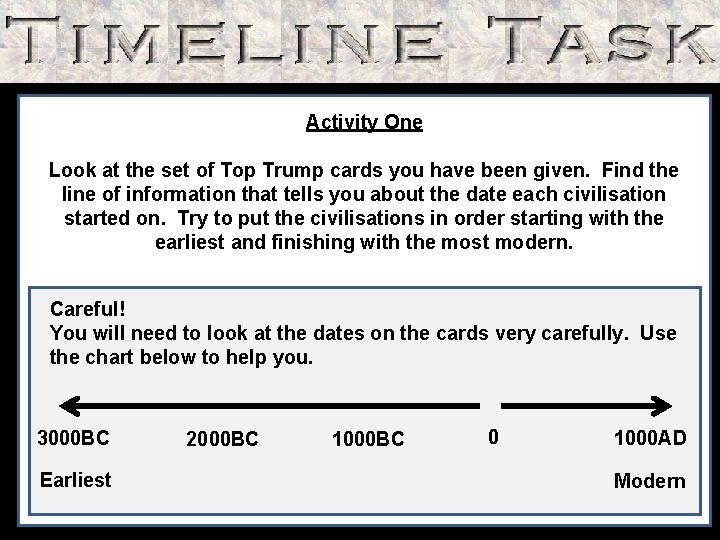
Activity One Look at the set of Top Trump cards you have been given. Find the line of information that tells you about the date each civilisation started on. Try to put the civilisations in order starting with the earliest and finishing with the most modern. Careful! You will need to look at the dates on the cards very carefully. Use the chart below to help you. 3000 BC Earliest 2000 BC 1000 BC 0 1000 AD Modern
Activity Two Look at the set of Top Trump cards you have been given. Find the line of information that tells you about how long each civilisation was in existence for. Arrange your cards in order and use them to answer these questions. 1. How many of the civilisations lasted for more than 1000 Years? 2. Which ancient civilisation existed for the longest amount of time? 3. Which ancient civilisation existed for the shortest amount of time?
Activity Three Look at the set of Top Trump cards you have been given. Find the line of information that tells you about how big civilisations were (the population). Arrange them in order of size, biggest to smallest. 1. Which civilisation had the biggest population size? 2. Why don’t we know the size of some of the ancient civilisations? To help you compare the sizes. . . … the current population of the U. K is 59, 000 people … the current population of the World is 6. 92 billion people The Entire Population of the World in 0 AD was only 200, 000 people.
Start Year ~ The approximate date the civilisation was formed. End Year ~ The approximate date the civilisation stopped. Length of Time ~ The number of years that the civilisation existed for. Where ~ The place in the current world where the civilisation was. Population ~ The maximum size of the civilisation. All dates and numbers are approximate and estimations based on historical evidence.
W. A. L. T What are ancient civilisations? W. I. L. F By the end of the lesson can you… …name at least six ancient civilisations? …name at least 4 of the seven Ancient Wonders of the World? …use information to put ancient civilisations in order to answer a question? …explain why ancient civilisations are important to us today?