
What do the Terms in Health Insurance Mean
- Slides: 5
What do the Terms in Health Insurance Mean for Patients’ Cost of Care A Product of The Robert Wood Johnson Foundations Funded Project “Clear on the Cost: Patients and Providers Co-authoring the Care Plans” by Migrant Clinicians Network, Inc. Douglas D Bradham, Dr. PH, MA, MPH – Principal Investigator Deliana Garcia, MA – Project Director, and Bilingual Interviewer Alma Galván, MHC – Bilingual Interviewer Corey Erb, BS – Operations Assistant
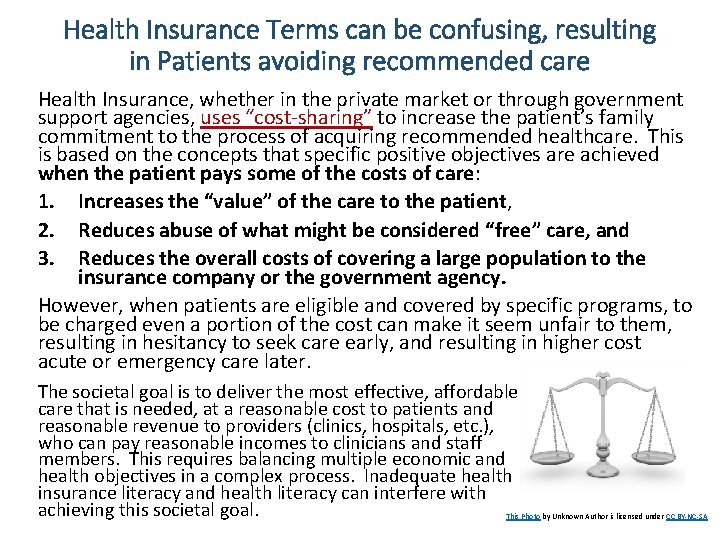
Health Insurance Terms can be confusing, resulting in Patients avoiding recommended care Health Insurance, whether in the private market or through government support agencies, uses “cost-sharing” to increase the patient’s family commitment to the process of acquiring recommended healthcare. This is based on the concepts that specific positive objectives are achieved when the patient pays some of the costs of care: 1. Increases the “value” of the care to the patient, 2. Reduces abuse of what might be considered “free” care, and 3. Reduces the overall costs of covering a large population to the insurance company or the government agency. However, when patients are eligible and covered by specific programs, to be charged even a portion of the cost can make it seem unfair to them, resulting in hesitancy to seek care early, and resulting in higher cost acute or emergency care later. The societal goal is to deliver the most effective, affordable care that is needed, at a reasonable cost to patients and reasonable revenue to providers (clinics, hospitals, etc. ), who can pay reasonable incomes to clinicians and staff members. This requires balancing multiple economic and health objectives in a complex process. Inadequate health insurance literacy and health literacy can interfere with achieving this societal goal. This Photo by Unknown Author is licensed under CC BY-NC-SA
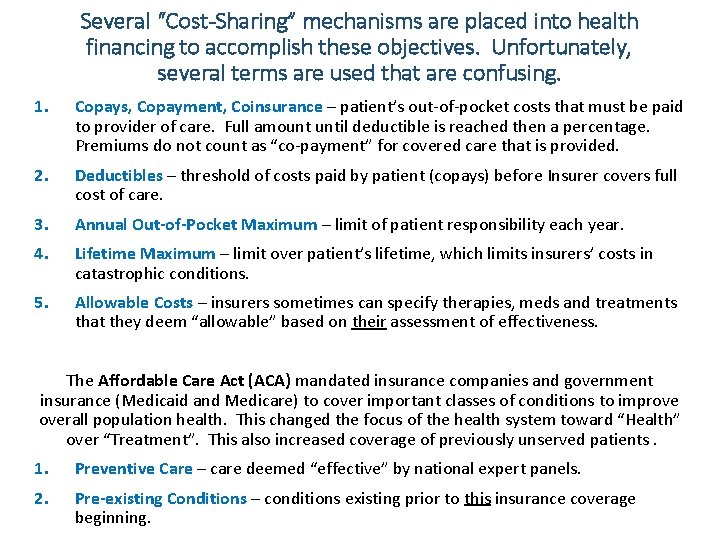
Several “Cost-Sharing” mechanisms are placed into health financing to accomplish these objectives. Unfortunately, several terms are used that are confusing. 1. Copays, Copayment, Coinsurance – patient’s out-of-pocket costs that must be paid to provider of care. Full amount until deductible is reached then a percentage. Premiums do not count as “co-payment” for covered care that is provided. 2. Deductibles – threshold of costs paid by patient (copays) before Insurer covers full cost of care. 3. Annual Out-of-Pocket Maximum – limit of patient responsibility each year. 4. Lifetime Maximum – limit over patient’s lifetime, which limits insurers’ costs in catastrophic conditions. 5. Allowable Costs – insurers sometimes can specify therapies, meds and treatments that they deem “allowable” based on their assessment of effectiveness. The Affordable Care Act (ACA) mandated insurance companies and government insurance (Medicaid and Medicare) to cover important classes of conditions to improve overall population health. This changed the focus of the health system toward “Health” over “Treatment”. This also increased coverage of previously unserved patients. 1. Preventive Care – care deemed “effective” by national expert panels. 2. Pre-existing Conditions – conditions existing prior to this insurance coverage beginning.
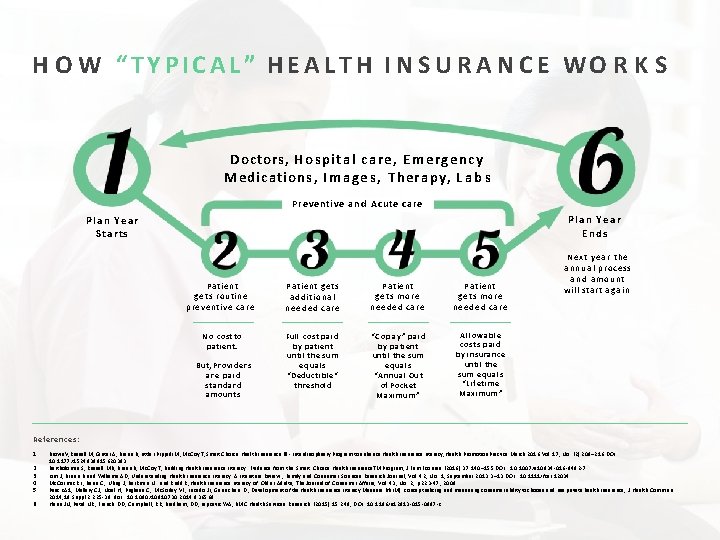
H O W “ T Y P I C A L ” H E A L T H I N S U R A N C E WO R K S Doctors, Hospital care, Emergency Medications, I m a g e s , Therapy, L a b s Preventive a n d Acute care Plan Year Ends Plan Year Starts Patient gets routine preventive care Patient gets additional n e e d e d care Patient gets more n e e d care N o cost to patient. Full cost p a i d by patient until the s u m equals “Deductible“ threshold “Copay” paid by patient until the s u m equals “ A n n u a l Ou t of Pocket Maximum” Allowable costs p a i d by insurance until the sum equals “Lifetime Maximum” But, Providers are paid standard amounts Next year the a n n u a l process a n d amount will start a g a i n References: 1. 2. 3. 4. 5. 6. Brown V, Russell M, Ginter A, Braun B, Little L Pippidi M, Mc. Coy T, Smart Choice Health Insurance © - Interdisciplinary Program to enhance Health Insurance Literacy, Health Promotion Practice March 2016 Vol. 17, No. (2) 209– 216 DOI: 10. 1177/1524839915620393. Bartholomae S, Russell MB, Braun B, Mc. Coy T, Building Health Insurance Literacy: Evidence from the Smart Choice Health Insurance. TM Program, J Fam Econ Iss (2016) 37: 140– 155 DOI 10. 1007/s 10834 -016 -9482 -7. Kim J, Braun B and Williams AD, Understanding Health Insurance Literacy: A Literature Review , Family and Consumer Sciences Research Journal, Vol. 42, No. 1, September 2013 3– 13 DOI: 10. 1111/fcsr. 12034. Mc. Cormack L, Bann C , Uhrig J, Berkman N and Rudd R, Health Insurance Literacy of Older Adults, The Journal of Consumer Affairs, Vol. 43, No. 2, p 223 -47, 2009. Paez KA 1, Mallery CJ, Noel H, Pugliese C , Mc. Sorley VE, Lucado JL, Ganachari D. , Development of the Health Insurance Literacy Measure (HILM): conceptualizing and measuring consumer ability to choose and use private health insurance, J Health Commun. 2014; 19 Suppl 2: 225 -39. doi: 10. 1080/10810730. 2014. 936568. Haun JN, Patel NR, French DD, Campbell, RR, Bradham, DD, Lapcevic WA, BMC Health Services Research (2015) 15: 249, DOI 10. 1186/s 12913 -015 -0887 -z
References 1. Brown V, Russell M, Ginter A, Braun B, Little L Pippidi M, Mc. Coy T, Smart Choice Health Insurance © - Interdisciplinary Program to enhance Health Insurance Literacy, Health Promotion Practice March 2016 Vol. 17, No. (2) 209– 216 DOI: 10. 1177/1524839915620393. 2. Bartholomae S, Russell MB, Braun B, Mc. Coy T, Building Health Insurance Literacy: Evidence from the Smart Choice Health Insurance. TM Program, J Fam Econ Iss (2016) 37: 140– 155 DOI 10. 1007/s 10834 -016 -9482 -7. 3. Kim J, Braun B and Williams AD, Understanding Health Insurance Literacy: A Literature Review , Family and Consumer Sciences Research Journal, Vol. 42, No. 1, September 2013 3– 13 DOI: 10. 1111/fcsr. 12034. Mc. Cormack L, Bann C, Uhrig J, Berkman N and Rudd R, Health Insurance Literacy of Older Adults, The Journal of Consumer Affairs, Vol. 43, No. 2, p 223 -47, 2009. 5. Paez KA 1, Mallery CJ, Noel H, Pugliese C, Mc. Sorley VE, Lucado JL, Ganachari D. , Development of the Health Insurance Literacy Measure (HILM): conceptualizing and measuring consumer ability to choose and use private health insurance, J Health Commun. 2014; 19 Suppl 2: 225 -39. doi: 10. 1080/10810730. 2014. 936568. 6. Haun JN, Patel NR, French DD, Campbell, RR, Bradham, DD, Lapcevic WA, BMC Health Services Research (2015) 15: 249, DOI 10. 1186/s 12913 -015 -0887 -z