
What do the spectral breaks in CR spectrum

What do the spectral breaks in CR spectrum tell us? One Century Later Triumph of the High Resolution Measurements Serap Tilav Bartol Research Institute University of Delaware
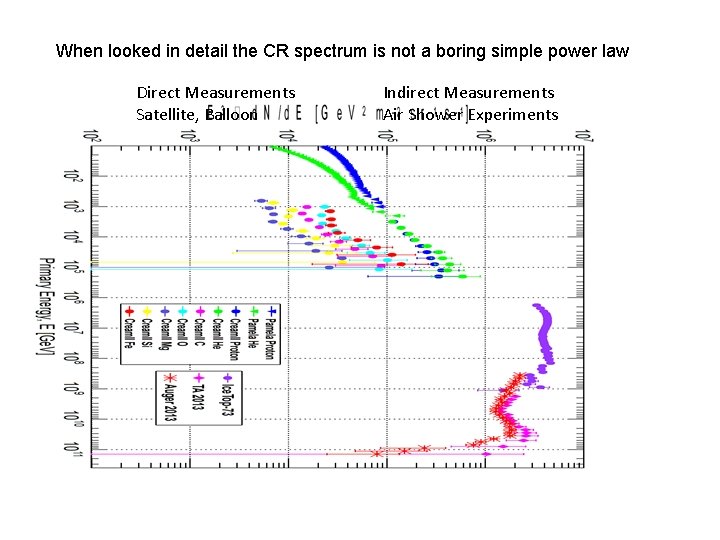
When looked in detail the CR spectrum is not a boring simple power law Direct Measurements Satellite, Balloon Indirect Measurements Air Shower Experiments
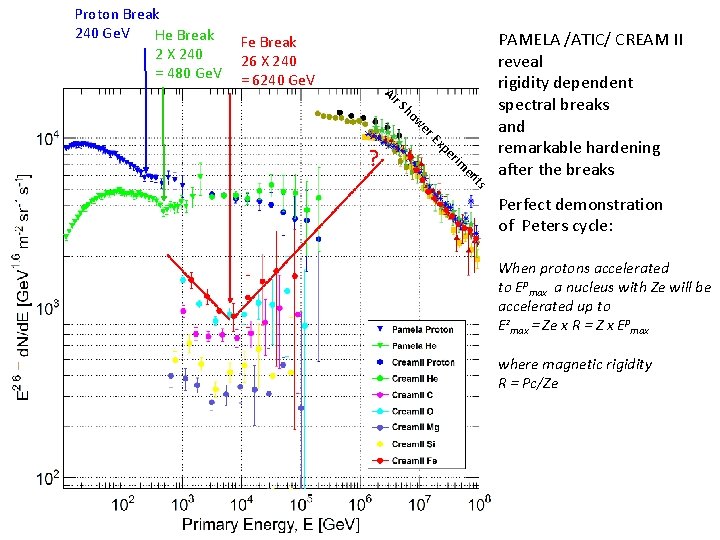
Proton Break 240 Ge. V He Break 2 X 240 = 480 Ge. V Fe Break 26 X 240 = 6240 Ge. V Ai r. S ? ho w er Ex pe rim en ts PAMELA /ATIC/ CREAM II reveal rigidity dependent spectral breaks and remarkable hardening after the breaks Perfect demonstration of Peters cycle: When protons accelerated to Epmax a nucleus with Ze will be accelerated up to Ezmax = Ze x R = Z x Epmax where magnetic rigidity R = Pc/Ze
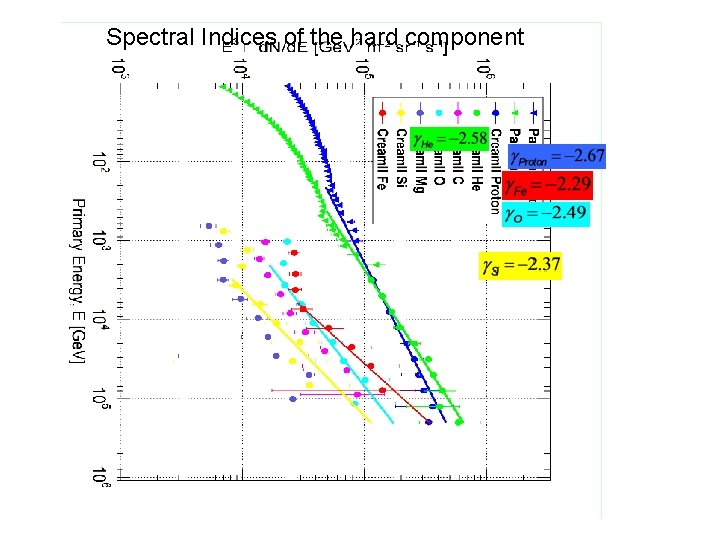
Spectral Indices of the hard component
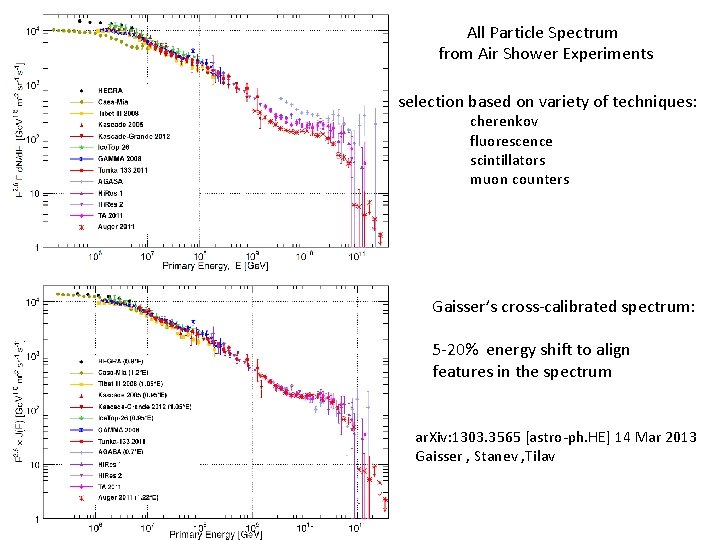
All Particle Spectrum from Air Shower Experiments selection based on variety of techniques: cherenkov fluorescence scintillators muon counters Gaisser’s cross-calibrated spectrum: 5 -20% energy shift to align features in the spectrum ar. Xiv: 1303. 3565 [astro-ph. HE] 14 Mar 2013 Gaisser , Stanev , Tilav
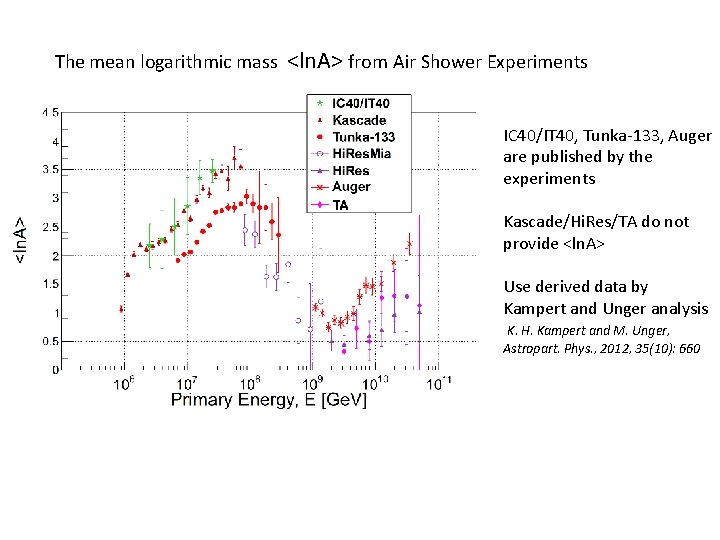
The mean logarithmic mass <ln. A> from Air Shower Experiments IC 40/IT 40, Tunka-133, Auger are published by the experiments Kascade/Hi. Res/TA do not provide <ln. A> Use derived data by Kampert and Unger analysis K. H. Kampert and M. Unger, Astropart. Phys. , 2012, 35(10): 660

Fit the combined spectrum with Gaisser’s formulation of Peters cycle elements Amplitude spectral index Z dependent cutoff energy
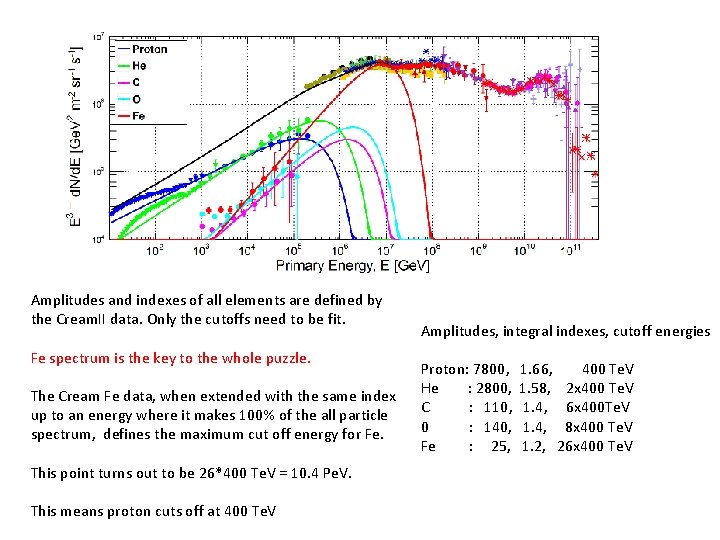
Amplitudes and indexes of all elements are defined by the Cream. II data. Only the cutoffs need to be fit. Fe spectrum is the key to the whole puzzle. The Cream Fe data, when extended with the same index up to an energy where it makes 100% of the all particle spectrum, defines the maximum cut off energy for Fe. This point turns out to be 26*400 Te. V = 10. 4 Pe. V. This means proton cuts off at 400 Te. V Amplitudes, integral indexes, cutoff energies Proton: 7800, He : 2800, C : 110, 0 : 140, Fe : 25, 1. 66, 400 Te. V 1. 58, 2 x 400 Te. V 1. 4, 6 x 400 Te. V 1. 4, 8 x 400 Te. V 1. 2, 26 x 400 Te. V
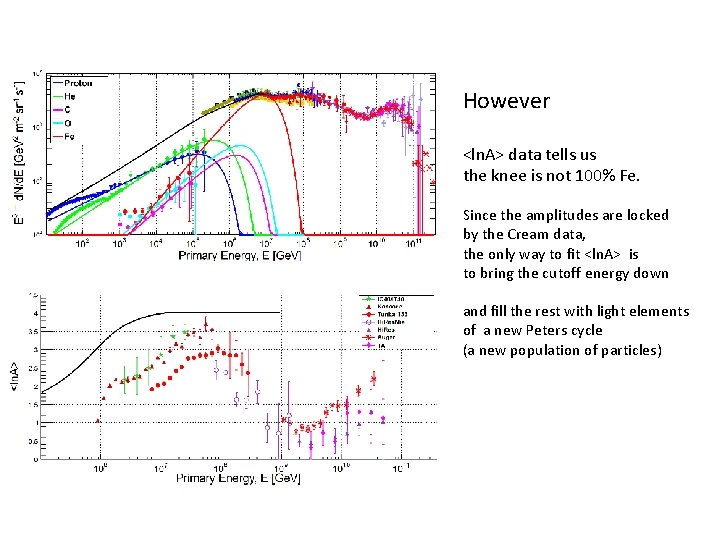
However <ln. A> data tells us the knee is not 100% Fe. Since the amplitudes are locked by the Cream data, the only way to fit <ln. A> is to bring the cutoff energy down and fill the rest with light elements of a new Peters cycle (a new population of particles)
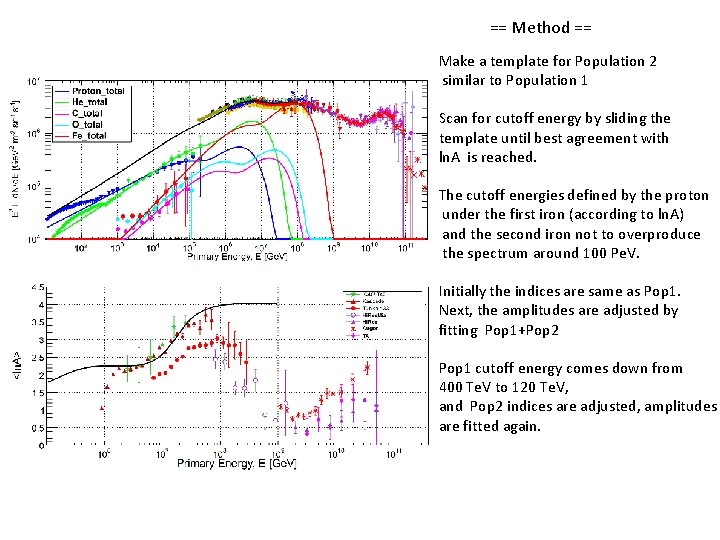
== Method == Make a template for Population 2 similar to Population 1 Scan for cutoff energy by sliding the template until best agreement with ln. A is reached. The cutoff energies defined by the proton under the first iron (according to ln. A) and the second iron not to overproduce the spectrum around 100 Pe. V. Initially the indices are same as Pop 1. Next, the amplitudes are adjusted by fitting Pop 1+Pop 2 Pop 1 cutoff energy comes down from 400 Te. V to 120 Te. V, and Pop 2 indices are adjusted, amplitudes are fitted again.
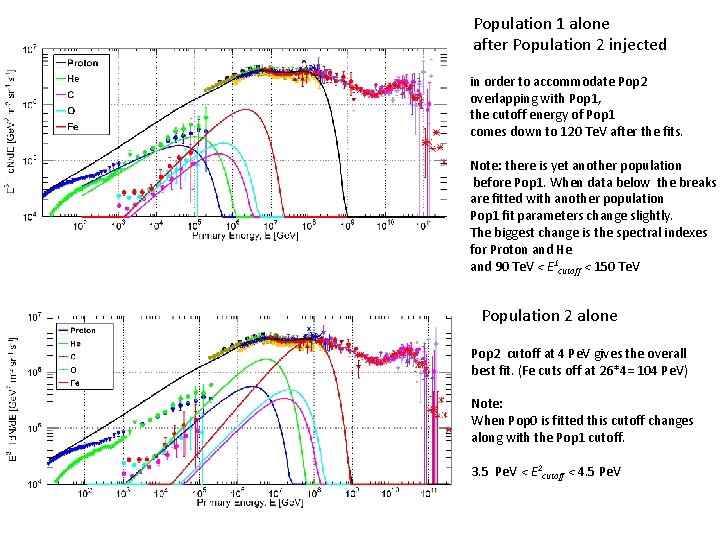
Population 1 alone after Population 2 injected in order to accommodate Pop 2 overlapping with Pop 1, the cutoff energy of Pop 1 comes down to 120 Te. V after the fits. Note: there is yet another population before Pop 1. When data below the breaks are fitted with another population Pop 1 fit parameters change slightly. The biggest change is the spectral indexes for Proton and He and 90 Te. V < E 1 cutoff < 150 Te. V Population 2 alone Pop 2 cutoff at 4 Pe. V gives the overall best fit. (Fe cuts off at 26*4= 104 Pe. V) Note: When Pop 0 is fitted this cutoff changes along with the Pop 1 cutoff. 3. 5 Pe. V < E 2 cutoff < 4. 5 Pe. V
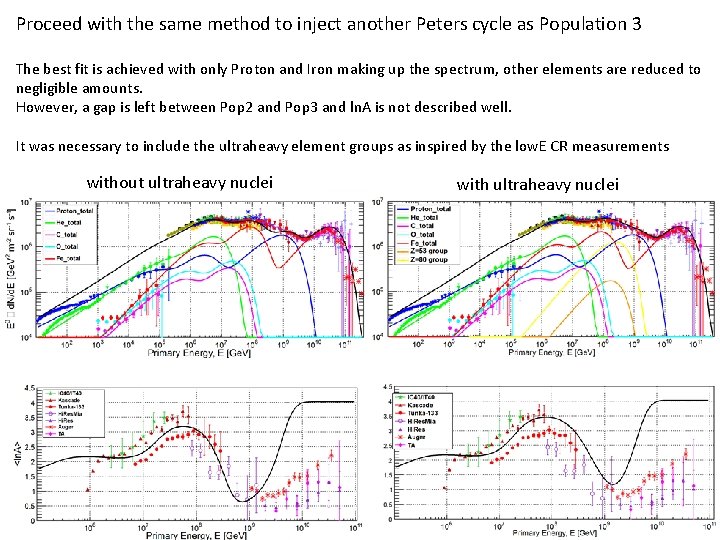
Proceed with the same method to inject another Peters cycle as Population 3 The best fit is achieved with only Proton and Iron making up the spectrum, other elements are reduced to negligible amounts. However, a gap is left between Pop 2 and Pop 3 and ln. A is not described well. It was necessary to include the ultraheavy element groups as inspired by the low. E CR measurements without ultraheavy nuclei with ultraheavy nuclei
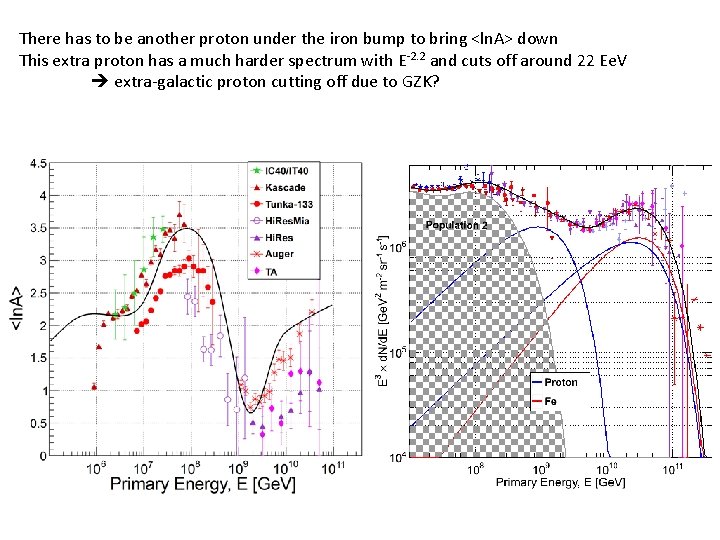
There has to be another proton under the iron bump to bring <ln. A> down This extra proton has a much harder spectrum with E-2. 2 and cuts off around 22 Ee. V extra-galactic proton cutting off due to GZK?
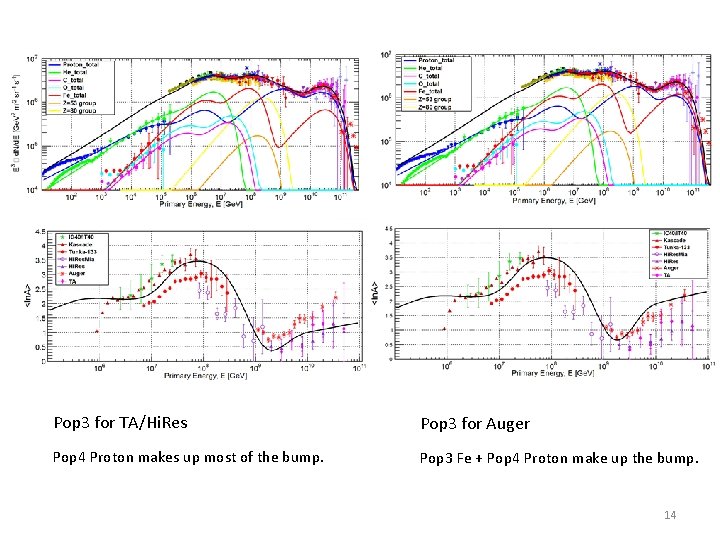
Pop 3 for TA/Hi. Res Pop 3 for Auger Pop 4 Proton makes up most of the bump. Pop 3 Fe + Pop 4 Proton make up the bump. 14
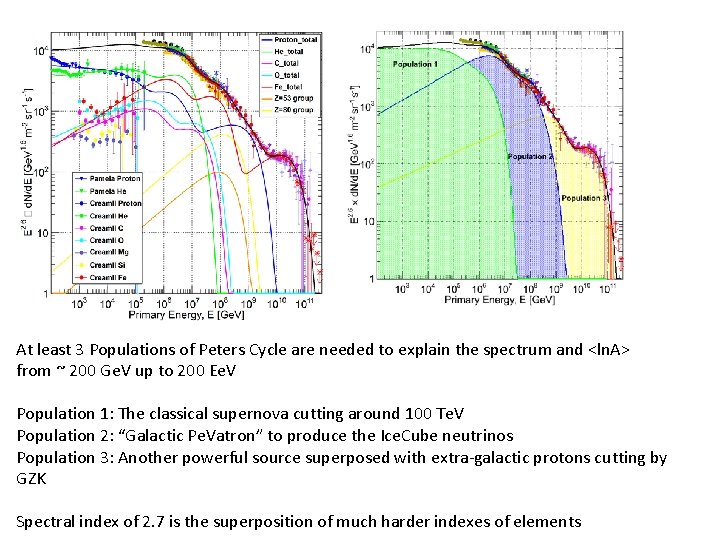
At least 3 Populations of Peters Cycle are needed to explain the spectrum and <ln. A> from ~ 200 Ge. V up to 200 Ee. V Population 1: The classical supernova cutting around 100 Te. V Population 2: “Galactic Pe. Vatron” to produce the Ice. Cube neutrinos Population 3: Another powerful source superposed with extra-galactic protons cutting by GZK Spectral index of 2. 7 is the superposition of much harder indexes of elements
- Slides: 15