
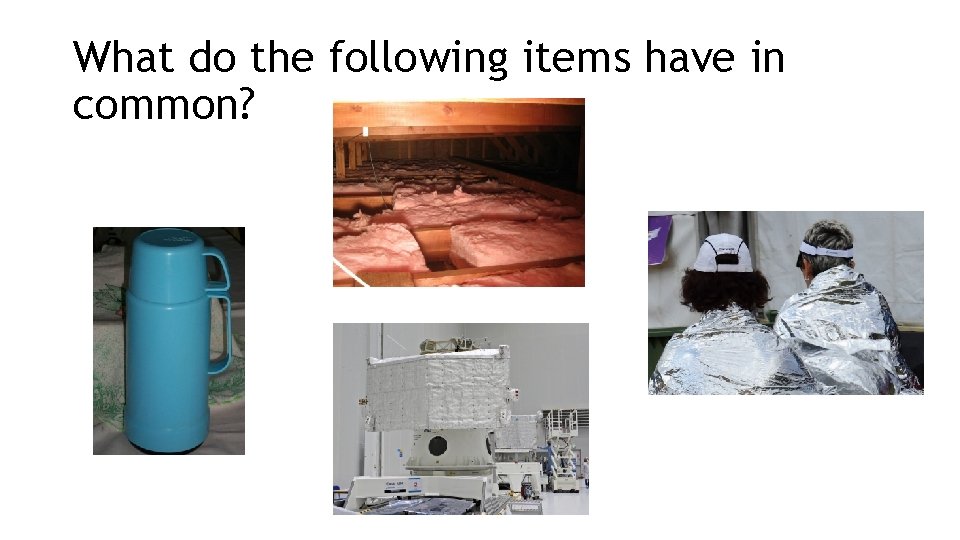
What do the following items have in common

- Slides: 22
What do the following items have in common?
James Webb Space Telescope Design Challenge Surviving Space Temperatures
Objectives • Explore the James Webb Space Telescope (JWST) and understand its mission. • Develop understanding of how JWST can be kept cool while exposed to heat from the Sun’s rays. • Investigate the relationship between layers of sunshield material and heat proofing. • Understand the work of people who work in hot and cold environments.
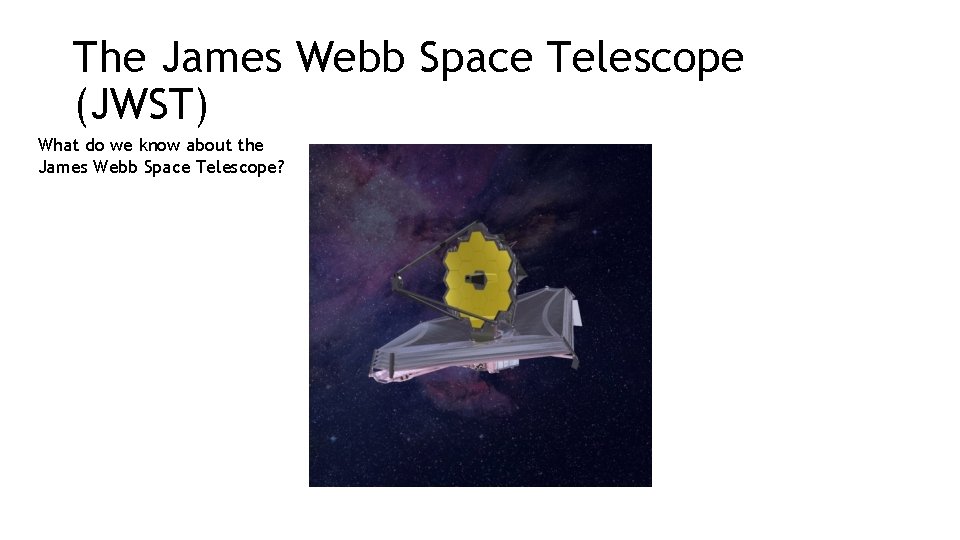
The James Webb Space Telescope (JWST) What do we know about the James Webb Space Telescope?
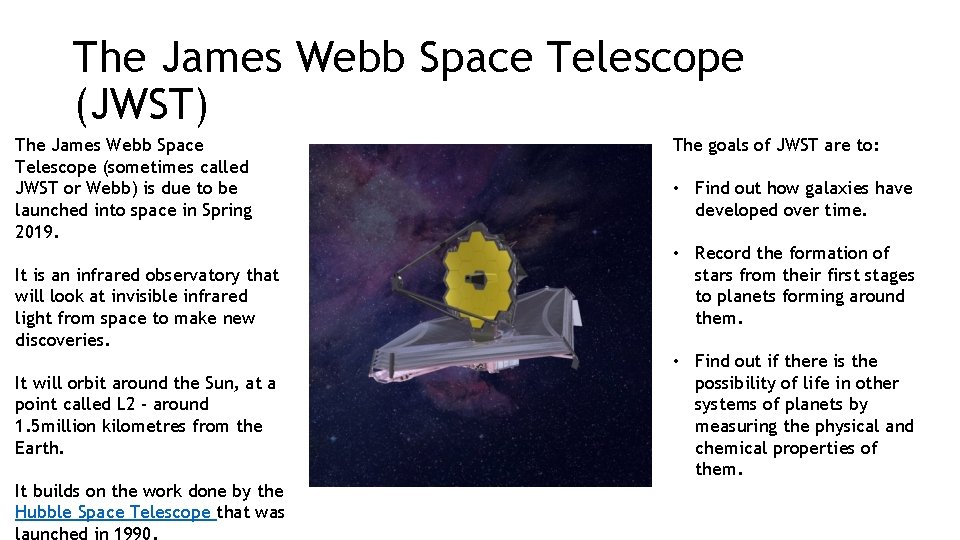
The James Webb Space Telescope (JWST) The James Webb Space Telescope (sometimes called JWST or Webb) is due to be launched into space in Spring 2019. It is an infrared observatory that will look at invisible infrared light from space to make new discoveries. It will orbit around the Sun, at a point called L 2 - around 1. 5 million kilometres from the Earth. It builds on the work done by the Hubble Space Telescope that was launched in 1990. The goals of JWST are to: • Find out how galaxies have developed over time. • Record the formation of stars from their first stages to planets forming around them. • Find out if there is the possibility of life in other systems of planets by measuring the physical and chemical properties of them.
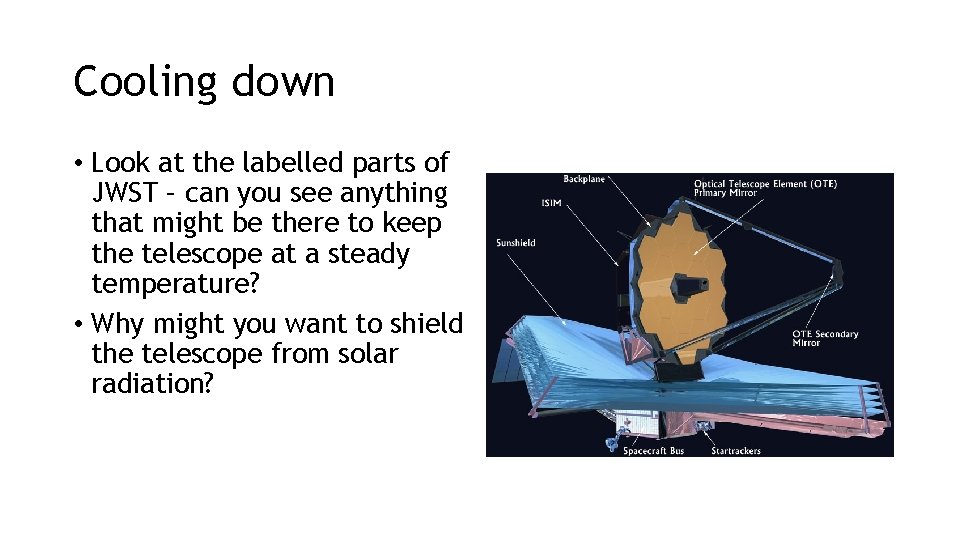
Cooling down • Look at the labelled parts of JWST – can you see anything that might be there to keep the telescope at a steady temperature? • Why might you want to shield the telescope from solar radiation?
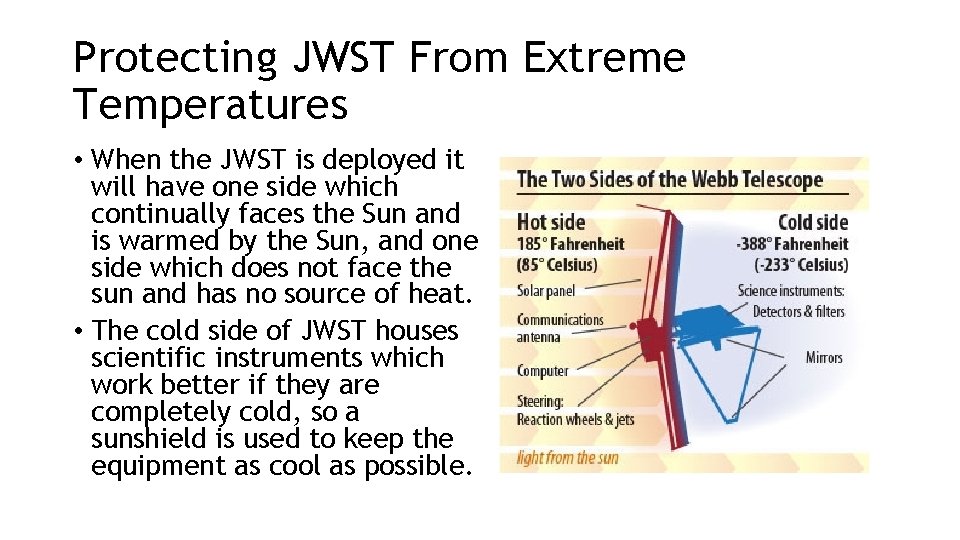
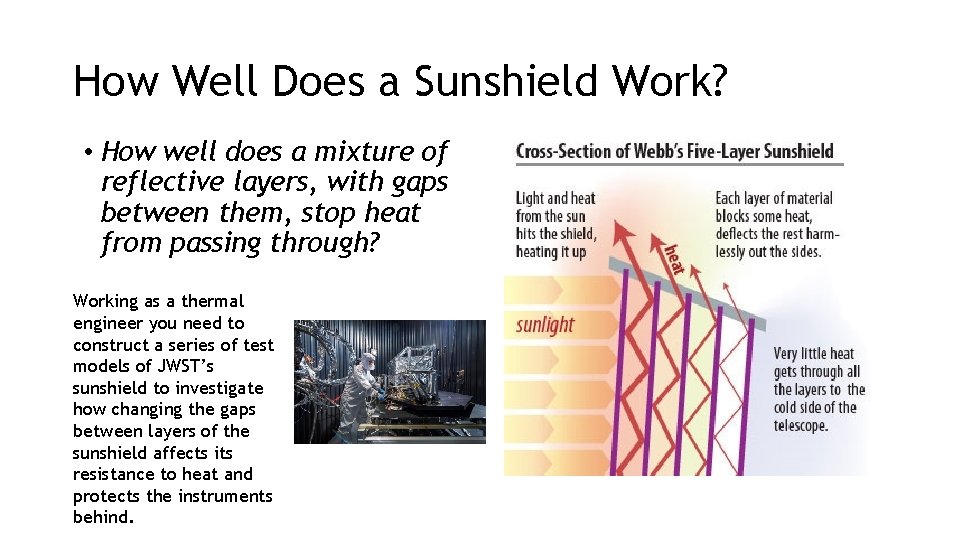
Protecting JWST From Extreme Temperatures • When the JWST is deployed it will have one side which continually faces the Sun and is warmed by the Sun, and one side which does not face the sun and has no source of heat. • The cold side of JWST houses scientific instruments which work better if they are completely cold, so a sunshield is used to keep the equipment as cool as possible.
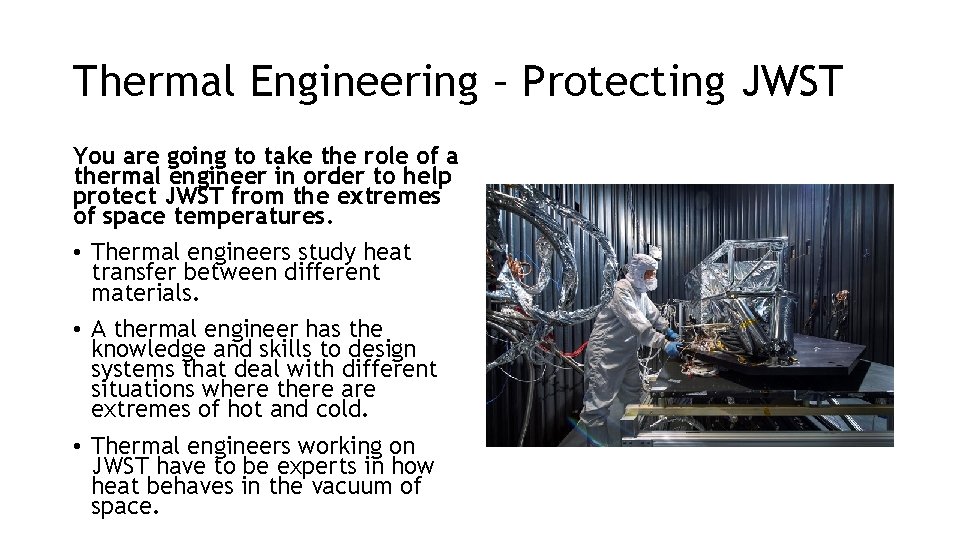
Thermal Engineering – Protecting JWST You are going to take the role of a thermal engineer in order to help protect JWST from the extremes of space temperatures. • Thermal engineers study heat transfer between different materials. • A thermal engineer has the knowledge and skills to design systems that deal with different situations where there are extremes of hot and cold. • Thermal engineers working on JWST have to be experts in how heat behaves in the vacuum of space.
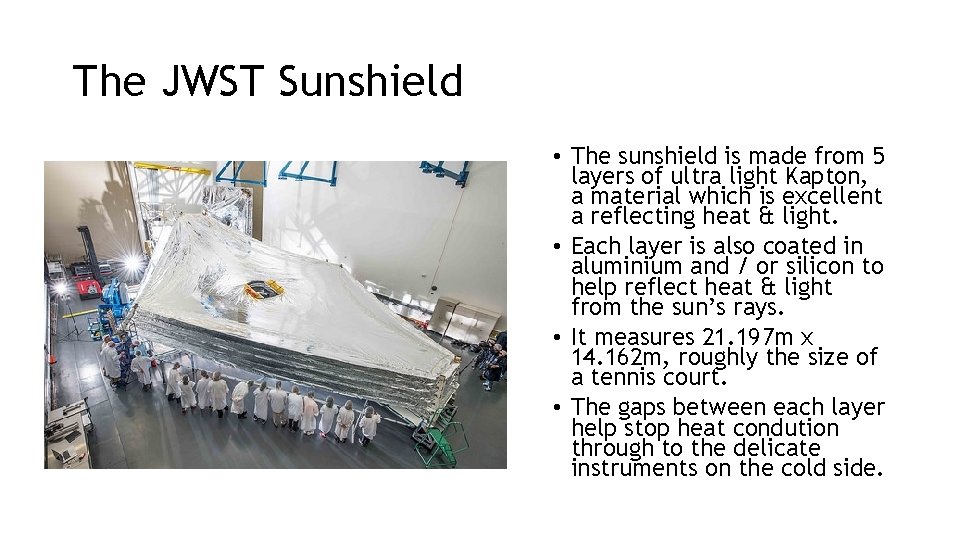
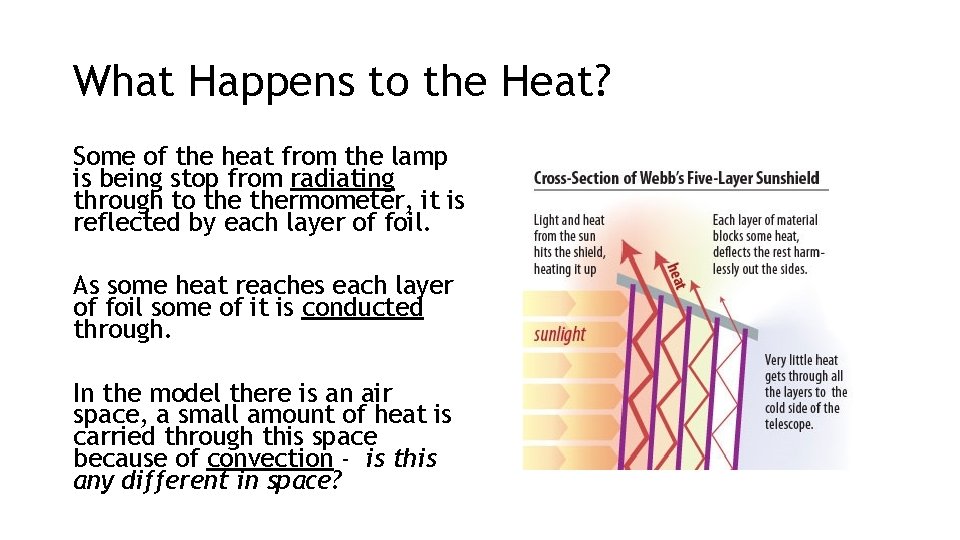
The JWST Sunshield • The sunshield is made from 5 layers of ultra light Kapton, a material which is excellent a reflecting heat & light. • Each layer is also coated in aluminium and / or silicon to help reflect heat & light from the sun’s rays. • It measures 21. 197 m x 14. 162 m, roughly the size of a tennis court. • The gaps between each layer help stop heat condution through to the delicate instruments on the cold side.
How Well Does a Sunshield Work? • How well does a mixture of reflective layers, with gaps between them, stop heat from passing through? Working as a thermal engineer you need to construct a series of test models of JWST’s sunshield to investigate how changing the gaps between layers of the sunshield affects its resistance to heat and protects the instruments behind.
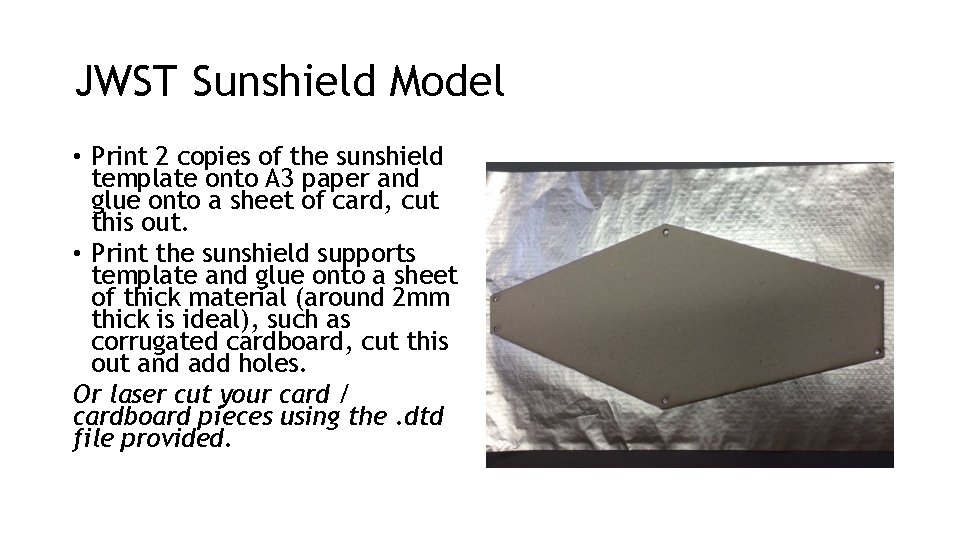
JWST Sunshield Model • Print 2 copies of the sunshield template onto A 3 paper and glue onto a sheet of card, cut this out. • Print the sunshield supports template and glue onto a sheet of thick material (around 2 mm thick is ideal), such as corrugated cardboard, cut this out and add holes. Or laser cut your card / cardboard pieces using the. dtd file provided.
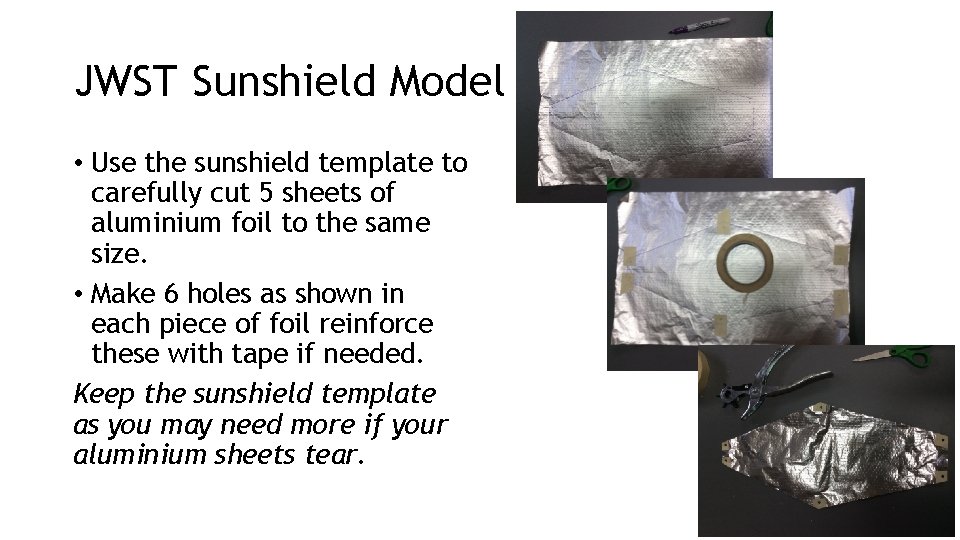
JWST Sunshield Model • Use the sunshield template to carefully cut 5 sheets of aluminium foil to the same size. • Make 6 holes as shown in each piece of foil reinforce these with tape if needed. Keep the sunshield template as you may need more if your aluminium sheets tear.
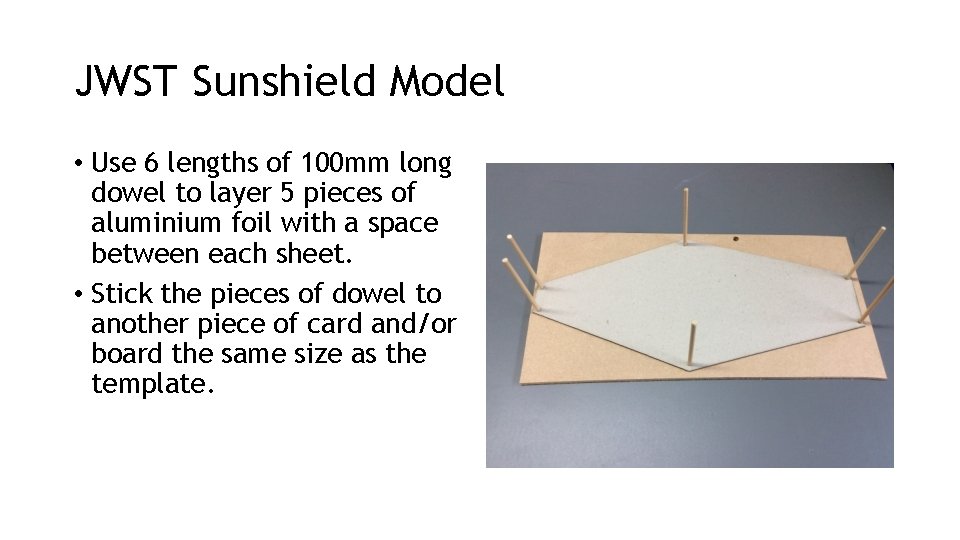
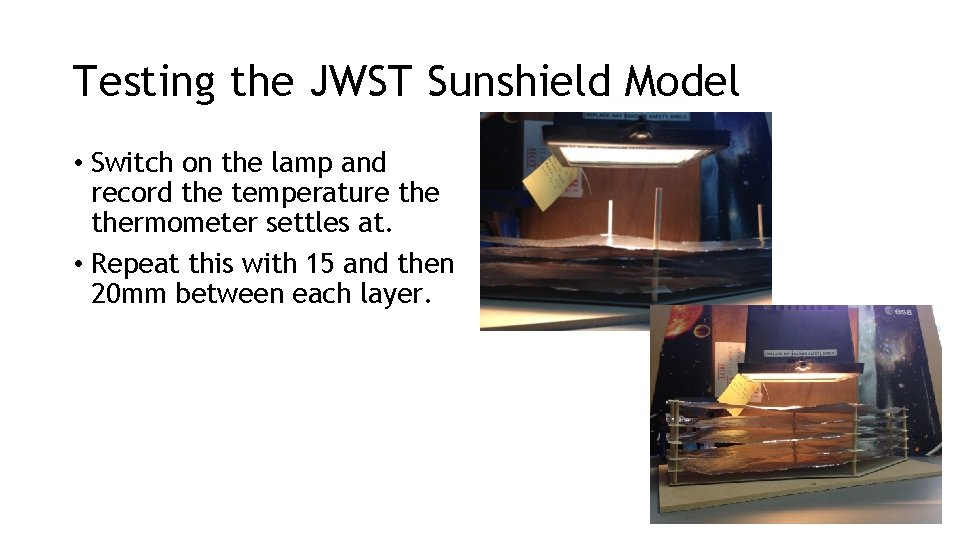
JWST Sunshield Model • Use 6 lengths of 100 mm long dowel to layer 5 pieces of aluminium foil with a space between each sheet. • Stick the pieces of dowel to another piece of card and/or board the same size as the template.
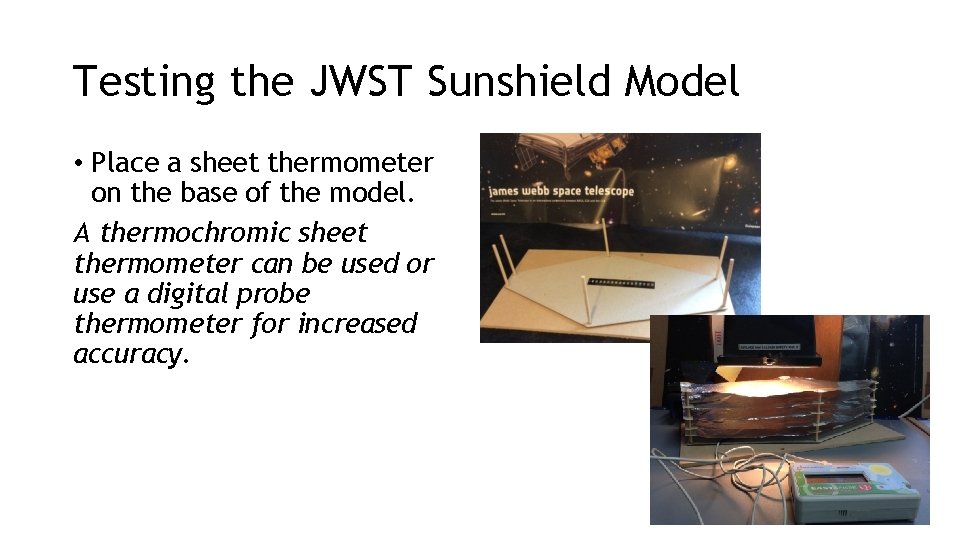
Testing the JWST Sunshield Model • Place a sheet thermometer on the base of the model. A thermochromic sheet thermometer can be used or use a digital probe thermometer for increased accuracy.
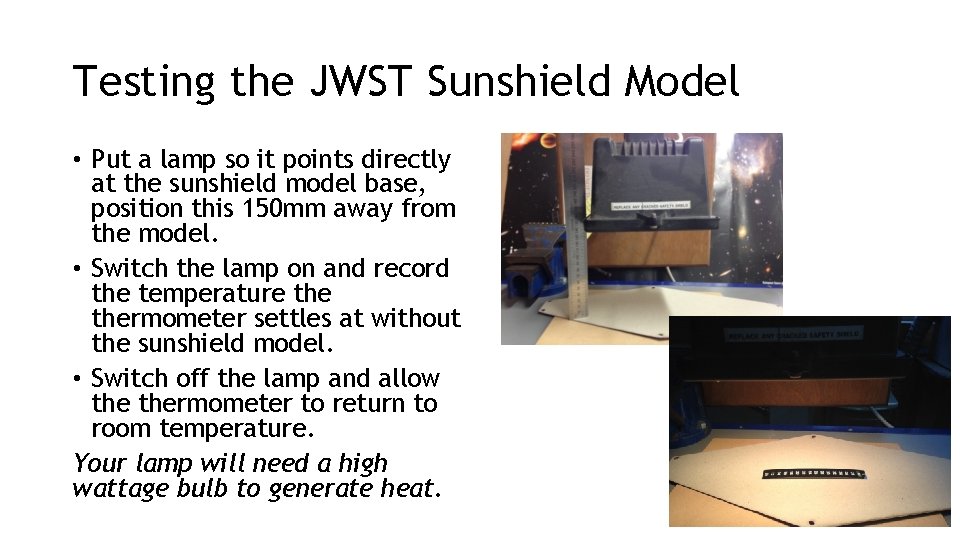
Testing the JWST Sunshield Model • Put a lamp so it points directly at the sunshield model base, position this 150 mm away from the model. • Switch the lamp on and record the temperature thermometer settles at without the sunshield model. • Switch off the lamp and allow thermometer to return to room temperature. Your lamp will need a high wattage bulb to generate heat.
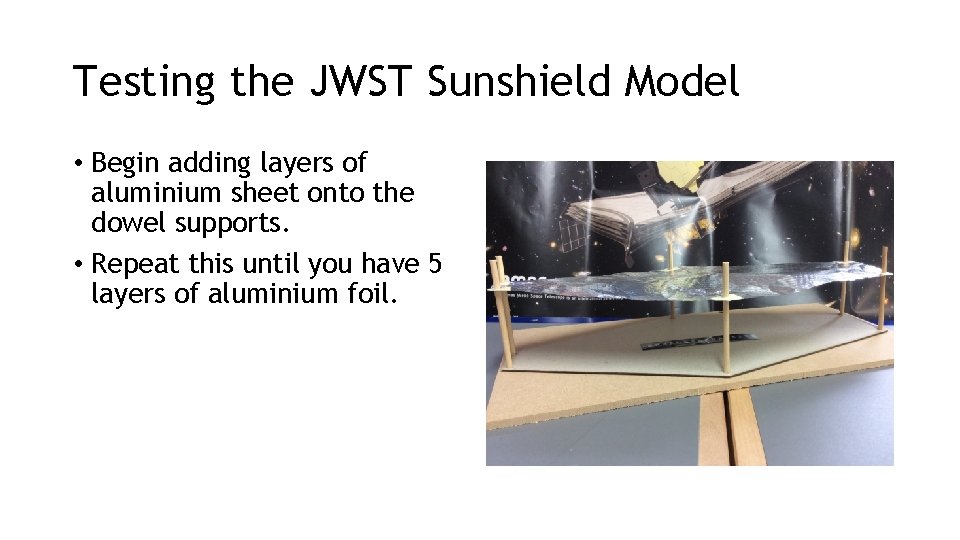
Testing the JWST Sunshield Model • Begin adding layers of aluminium sheet onto the dowel supports. • Repeat this until you have 5 layers of aluminium foil.
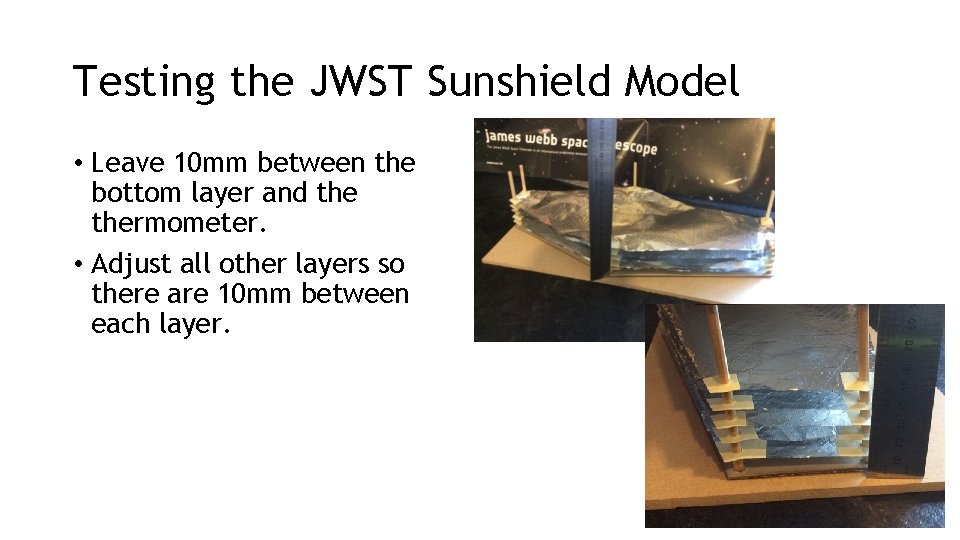
Testing the JWST Sunshield Model • Leave 10 mm between the bottom layer and thermometer. • Adjust all other layers so there are 10 mm between each layer.
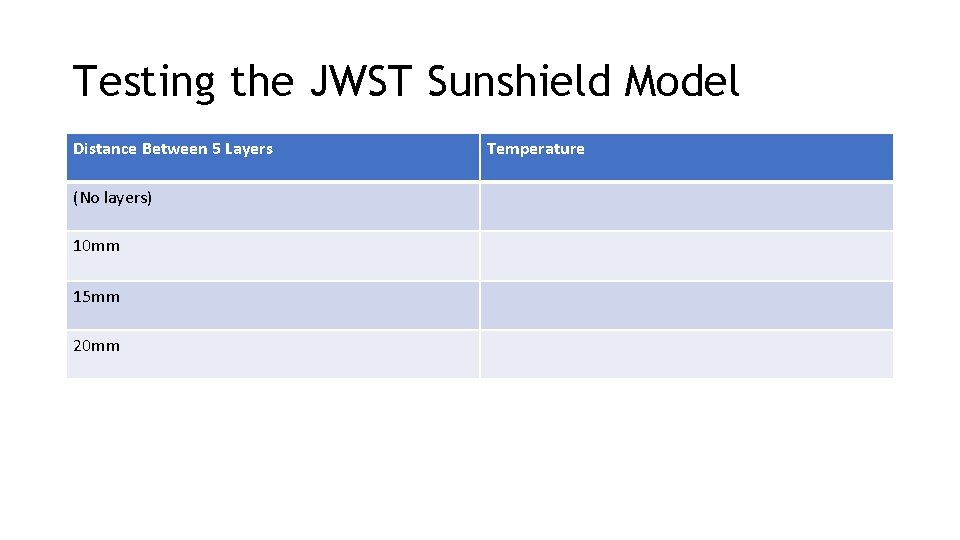
Testing the JWST Sunshield Model • Switch on the lamp and record the temperature thermometer settles at. • Repeat this with 15 and then 20 mm between each layer.
Testing the JWST Sunshield Model Distance Between 5 Layers (No layers) 10 mm 15 mm 20 mm Temperature
What Happens to the Heat? Some of the heat from the lamp is being stop from radiating through to thermometer, it is reflected by each layer of foil. As some heat reaches each layer of foil some of it is conducted through. In the model there is an air space, a small amount of heat is carried through this space because of convection - is this any different in space?
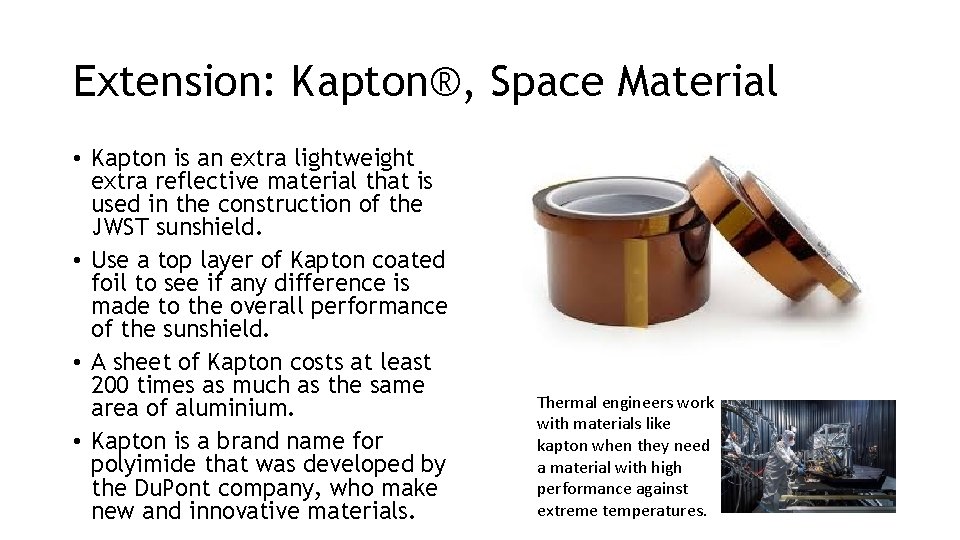
Extension: Kapton®, Space Material • Kapton is an extra lightweight extra reflective material that is used in the construction of the JWST sunshield. • Use a top layer of Kapton coated foil to see if any difference is made to the overall performance of the sunshield. • A sheet of Kapton costs at least 200 times as much as the same area of aluminium. • Kapton is a brand name for polyimide that was developed by the Du. Pont company, who make new and innovative materials. Thermal engineers work with materials like kapton when they need a material with high performance against extreme temperatures.
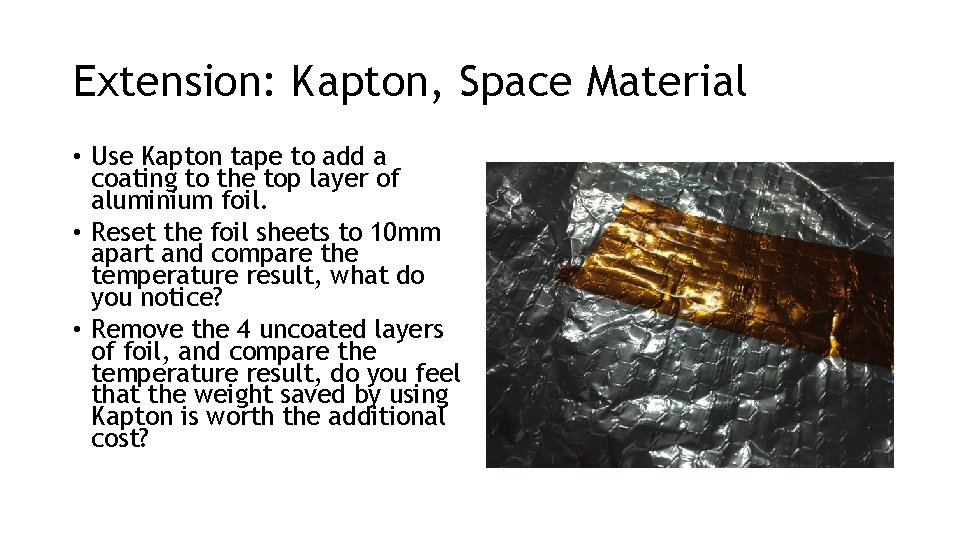
Extension: Kapton, Space Material • Use Kapton tape to add a coating to the top layer of aluminium foil. • Reset the foil sheets to 10 mm apart and compare the temperature result, what do you notice? • Remove the 4 uncoated layers of foil, and compare the temperature result, do you feel that the weight saved by using Kapton is worth the additional cost?