
What comes to mind when you hear the

- Slides: 17
What comes to mind when you hear the phrase “evaluating information”?
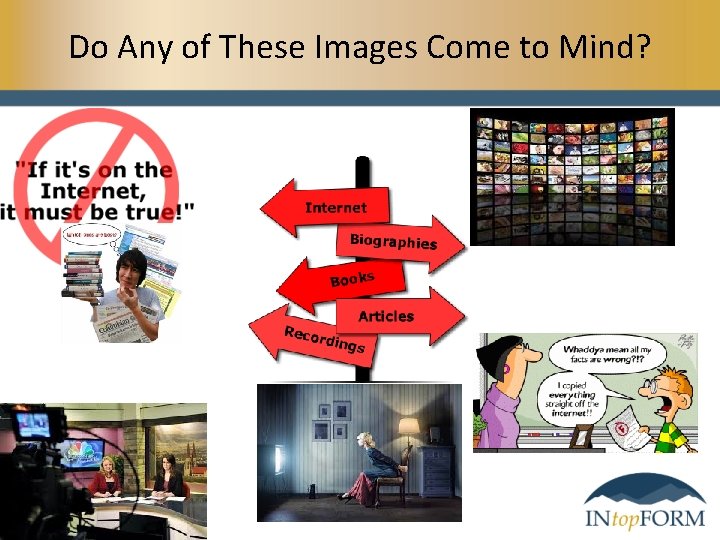
Do Any of These Images Come to Mind?
Evaluation • Students apply critical thinking in evaluating sources, information, and search processes. • What bearing on the whole process of information fluency does evaluation really have? Is it really that important? ?
Evaluation • Evaluation entails – Analyzing the reliability of sources – Picking up on bias and identifying underlying assumptions – both the sources and their own – Synthesizing information and discussing the implications – which requires comprehension – Identifying questions that arise from the information • What about validity? • “Evaluative reasoning skills enable [students] to assess the credibility of sources of information and the claims they make. They use these skills to determine the strength or weakness of arguments” (CCTST).
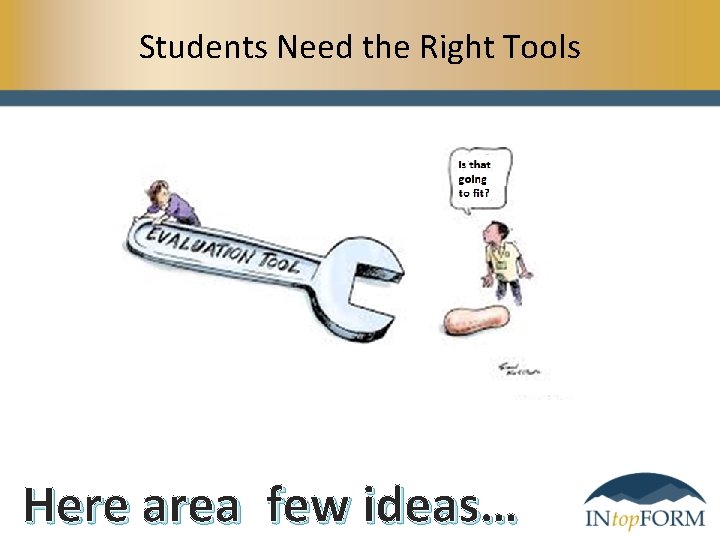
Students Need the Right Tools Here area few ideas…
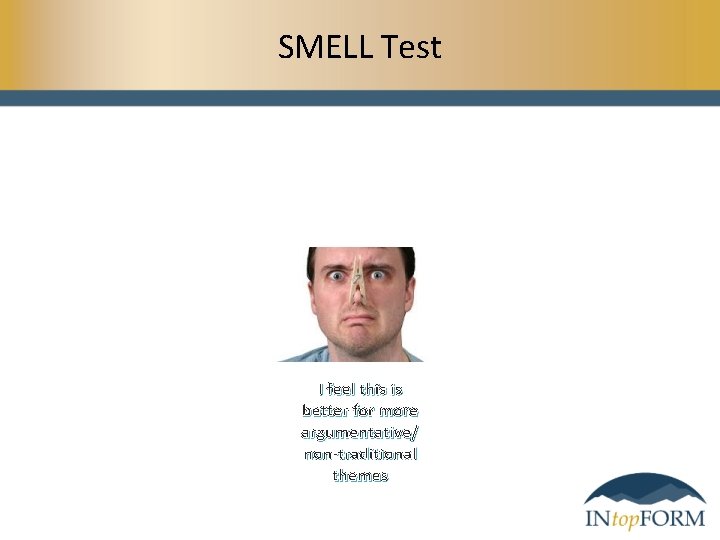
SMELL Test I feel this is better for more argumentative/ non-traditional themes
The Smell Test • SOURCE: Who is providing the information? • MOTIVATION: Why are they telling me this? • EVIDENCE: What evidence is provided for generalizations? • LOGIC: Do the facts logically compel the conclusions? • LEFT OUT: What’s missing that might change our interpretation of the information?
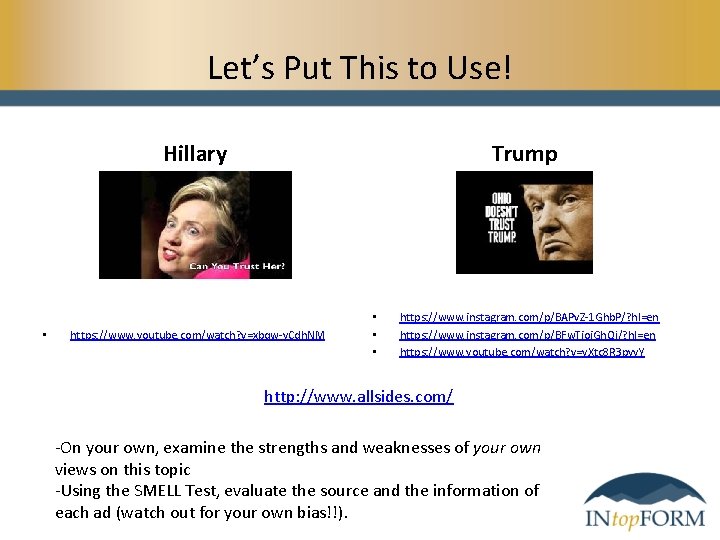
Let’s Put This to Use! Hillary • Trump https: //www. youtube. com/watch? v=xbqw-y. Cdh. NM • • • https: //www. instagram. com/p/BAPv. Z-1 Ghb. P/? hl=en https: //www. instagram. com/p/BFw. Tioi. Gh. Qj/? hl=en https: //www. youtube. com/watch? v=y. Xtc 8 R 3 pyy. Y http: //www. allsides. com/ -On your own, examine the strengths and weaknesses of your own views on this topic -Using the SMELL Test, evaluate the source and the information of each ad (watch out for your own bias!!).
Let’s Try One http: //screencast-o-matic. com/watch/c. Di. TY 8 i. Coy
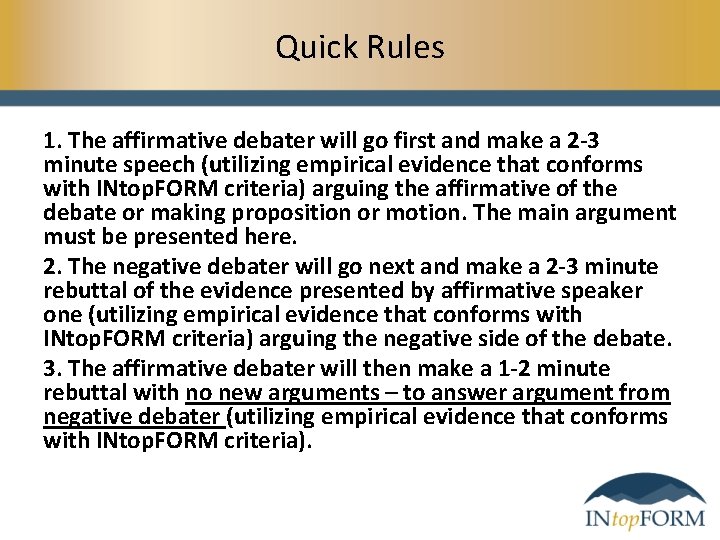
Quick Rules 1. The affirmative debater will go first and make a 2 -3 minute speech (utilizing empirical evidence that conforms with INtop. FORM criteria) arguing the affirmative of the debate or making proposition or motion. The main argument must be presented here. 2. The negative debater will go next and make a 2 -3 minute rebuttal of the evidence presented by affirmative speaker one (utilizing empirical evidence that conforms with INtop. FORM criteria) arguing the negative side of the debate. 3. The affirmative debater will then make a 1 -2 minute rebuttal with no new arguments – to answer argument from negative debater (utilizing empirical evidence that conforms with INtop. FORM criteria).
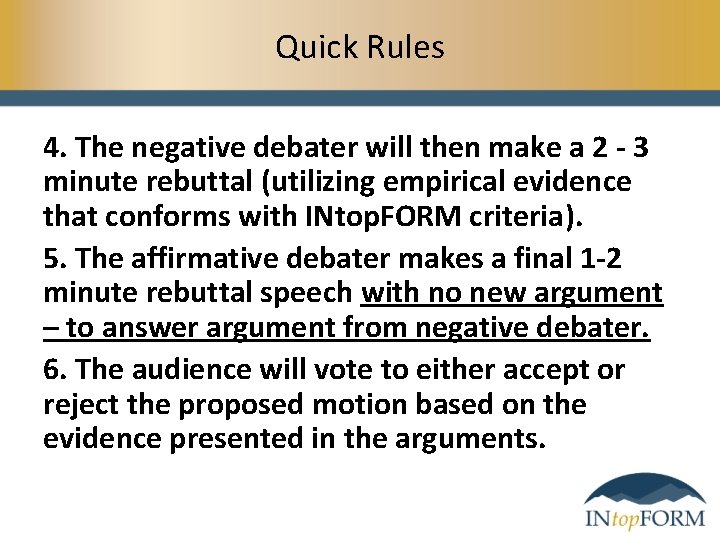
Quick Rules 4. The negative debater will then make a 2 - 3 minute rebuttal (utilizing empirical evidence that conforms with INtop. FORM criteria). 5. The affirmative debater makes a final 1 -2 minute rebuttal speech with no new argument – to answer argument from negative debater. 6. The audience will vote to either accept or reject the proposed motion based on the evidence presented in the arguments.
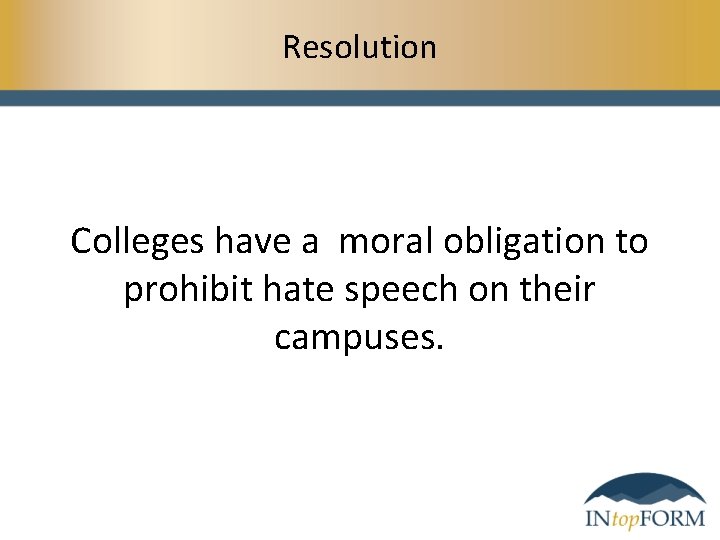
Resolution Colleges have a moral obligation to prohibit hate speech on their campuses.
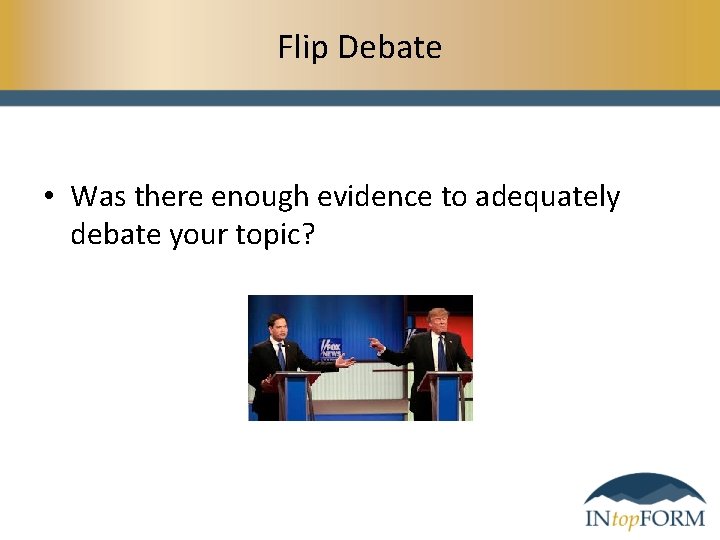
Flip Debate • Was there enough evidence to adequately debate your topic?
Describe a teaching idea you heard or thought about today that you want to use to teach your students evaluating skills. When and where do you plan to try this idea? How does it fit into the objectives of your course(s) (Worksheet, p. 5)
Practical Ideas • Students may: – Examine the strengths and weaknesses of their own views on a topic or issue – Analyze an idea, experience, or line of reasoning in depth by examining its individual parts – Evaluate a point of view, a decision, or a source of information – Evaluate what others have concluded from numerical information – Think critically and analytically – Analyze statistical and numerical information – NSSE Items Mapped to INtop. FORM Learning Objectives
Practical Ideas • What are some class assessments, activities, or projects that could be used for this learning objective? • How would it work in your class?