
What can zombies tell us about consciousness Henry
What can zombies tell us about consciousness? Henry Taylor jht 30@cam. ac. uk
Consciousness When you bite into some fish, there’s a particular taste that you experience. There’s a specific way that fish tastes.
Consciousness • It feels a certain way to taste fish.
Consciousness • Now think about a computer that is designed to test fish. • It tells you species, chemical consistency, age etc. • But it wouldn’t actually taste the fish, it wouldn’t have that specific experience of the taste of fish that we have.
Consciousness • You have something the computer doesn’t: you get the actual taste. • That taste is part of consciousness.
Consciousness • The computer is like sticks and stones: it can’t feel anything. • Humans can. • Other organisms? • Probably: dolphins, dogs, chimps, orangutans, bears, elephants. • Not sure: Snakes, bees, lizards, spiders, prawns. • Probably not: bacteria, coral, plants, fungi.
Consciousness • The senses: tastes, seeing, hearing, touching, balance, bodily co-ordination. • The emotions: anger, jealousy, hate, love, envy, happiness, glee. • Overall psychological conditions: depression. • Thoughts: thinking about Paris. • Mental actions: imagination, deliberation. • Pains: stubbing your toe, burning your hand.
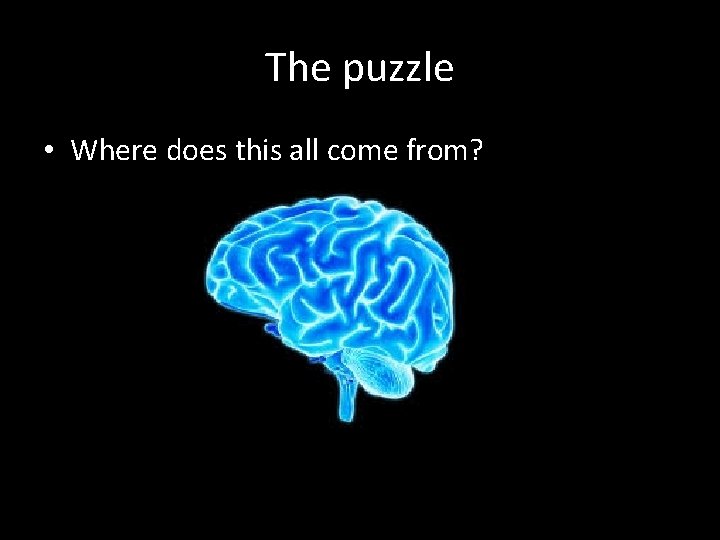
The puzzle • Where does this all come from?
The puzzle • • • But when we look at the brain, we find: Fat (60%) Water (75%) Electric signals Salts (Sodium and Potassium ions)
The puzzle • How could something that’s just a lump of fat and water produce consciousness: produce my experience of the taste of fish? • Or a feeling of love? • Or a state of depression? • Or a feeling of disappointment?
The puzzle • Well, the brain is really complicated. • Yes, but just saying it’s complicated doesn’t answer the question. • No matter how complicated it is, it is just as puzzling.
The puzzle • We don’t know how a lump of fat and water could produce consciousness. • But we know that somehow the brain has something to do with it.
The puzzle • • • Alcohol. Anaesthetics. Other drugs: opiates, mescaline, MDMA, LSD. Brain damage. Fiddling with people’s brains.
The puzzle • ‘I only know two things about consciousness: that the brain produces it and that’s completely impossible’ David Pitt • That’s the puzzle: the fact that we know that the brain has something to do with it, but we have no idea how it could.
Two views • Physicalists: consciousness is just a physical phenomenon. Somehow it’s all in the brain. • Dualists: Consciousness is somehow more than the physical: it’s different. • Quick poll.
Zombies • The ‘zombie’ argument: meant to show that physicalism is wrong. • Consciousness is something different from the brain.
Zombies • Imagine a universe that is just like this one in almost all physical respects. • It has chairs, desks, mountains, rain, stars, planets.
Zombies • It has all the same atoms, in all the same configurations, doing all the same stuff. • It has all the same chemical reactions: there is water, there is fat, there is electricity.
Zombies • There are creatures there with hearts, kidneys, livers, skin, blood… • In fact, there’s brains there too, and they work in the same way, are engaged in the same chemical reactions, and so on.
Zombies • But in this world there is no consciousness. • When the inhabitants of this world eat fish, their brains process information about the fish, their brain cells fire in just the same way ours do. • But there is no consciousness, they don’t get the taste of it, any more than a machine does.
Zombies • When they look at a sunset, the light enters their eye. • It gets processed in the visual cortex. • All the same neurons fire in all the same ways. • But they are not conscious. • It’s all lights off for them
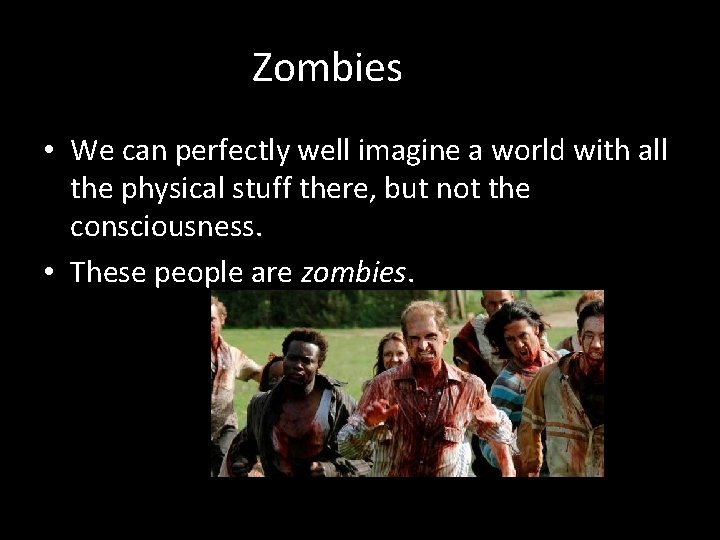
Zombies • We can perfectly well imagine a world with all the physical stuff there, but not the consciousness. • These people are zombies.
Zombies • We can’t do this with other stuff. • Think about a bike. • Imagine all the physical bits put together in the same way as a normal bike, and acting in the same way (handlebars, tyres, spokes, stem, saddle etc). • But try to imagine them doing all this without imagining a bike. • You can’t!
Zombies • Try it with other biological things. • Like a heart: imagine all the physical parts of a heart all working together in concert • The valves, the chambers, the muscles. • But try to imagine that without also imagining a heart.
Zombies • If consciousness just was the physical stuff doing its thing, then imagining the physical stuff should mean imagining consciousness. • This applies with stuff like the heart, and a bike: they’re just physical things. • Why not consciousness? • Because consciousness is something in addition to the physical stuff: it’s something more.
The basic idea • A heart is just physical stuff working in a certain way. • So when we imagine the physical stuff working a certain way, you imagine a heart. • But consciousness is not just physical stuff working in a certain way. • That’s why imagining all the physical stuff doesn’t entail imagining consciousness.
Zombies • No one is saying zombies are real. • Just that the fact that we can imagine them tells us something about consciousness.
Real cases? • Cases where people lose consciousness and still carry on as normal? • Blindsight? • Visual form agnosia? • Petit mal seizures?
Zombies • What do we think of the zombie argument? • First response: we should just do more science.
More science • • • What could more science tell us? More connections. More understanding of its functions. Better mapping of neurons and their relations. But we can imagine all of this extra stuff without consciousness.
Concepts? • Response 2: there’s something about the way we think about consciousness that is leading us astray. • Our concepts are somehow contributing to this idea that consciousness is something more than the brain. • And our other concepts are somehow not like this.
Concepts? • Is this plausible? • Our concepts of consciousness don’t seem weird. • ‘The taste of toothpaste’ seems like a normal concept, ‘the taste of fish’. • What seems weird is consciousness, not our concepts of consciousness!
A revolution? • Response 3: okay, what we need is a revolution. • If we want to understand consciousness, everything needs to change.
A revolution • Think about something like energy and mass. • They seem completely different things. • But with theory of general relativity, we now know that (in a sense) they’re the same thing. • E=mc 2
A revolution • We couldn’t understand how energy and mass were related until we had a revolution. • Maybe if we had a similar revolution, we would understand how consciousness and the brain are related.
Final thoughts • What would such a revolution even look like? • Why think we will have one? Couldn’t it just be mysterious forever?

Thank you!
- Slides: 37