
What can you learn from CT procedural planning
- Slides: 21
What can you learn from CT procedural planning João L. Cavalcante MD, FACC, FASE, FSCCT Director, Structural Cardiovascular Imaging and Core Lab University of Pittsburgh – UPMC joaocavalcantemd@gmail. com/ @Joao. LCavalcante www. cvinnovations. org
Disclosures: - Invest. Initiated Research Grant (Medtronic Inc. ) - Consulting (Circle, Medtronic Inc. , Mitralign) - Research Support (Medtronic Inc. , Mitralign, Tom. Tec Inc. ) www. cvinnovations. org
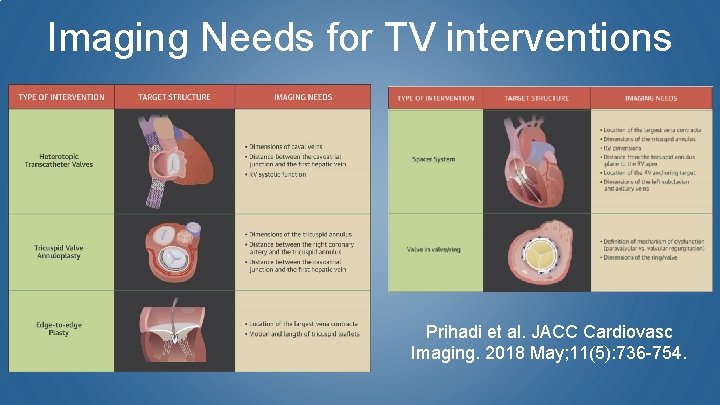
Imaging Needs for TV interventions Prihadi et al. JACC Cardiovasc Imaging. 2018 May; 11(5): 736 -754.
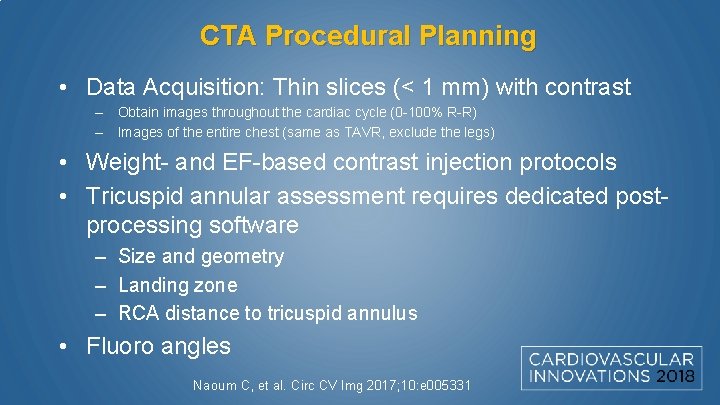
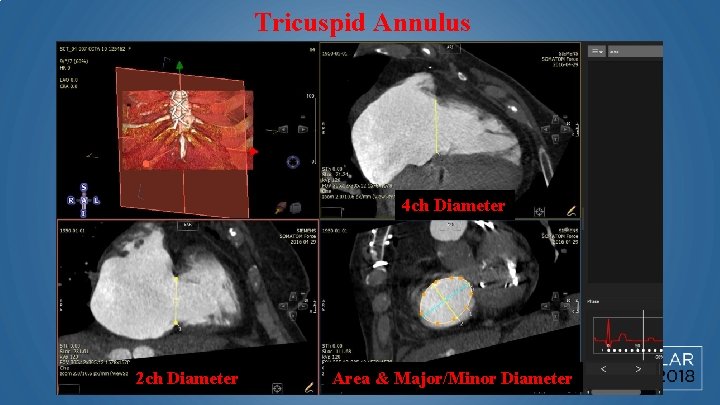
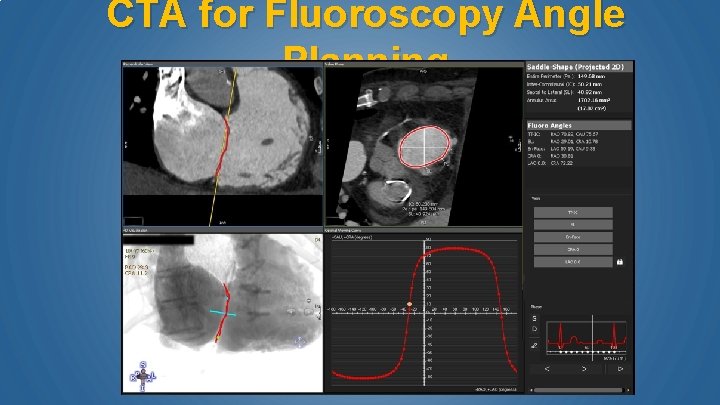
CTA Procedural Planning • Data Acquisition: Thin slices (< 1 mm) with contrast – Obtain images throughout the cardiac cycle (0 -100% R-R) – Images of the entire chest (same as TAVR, exclude the legs) • Weight- and EF-based contrast injection protocols • Tricuspid annular assessment requires dedicated postprocessing software – Size and geometry – Landing zone – RCA distance to tricuspid annulus • Fluoro angles Naoum C, et al. Circ CV Img 2017; 10: e 005331
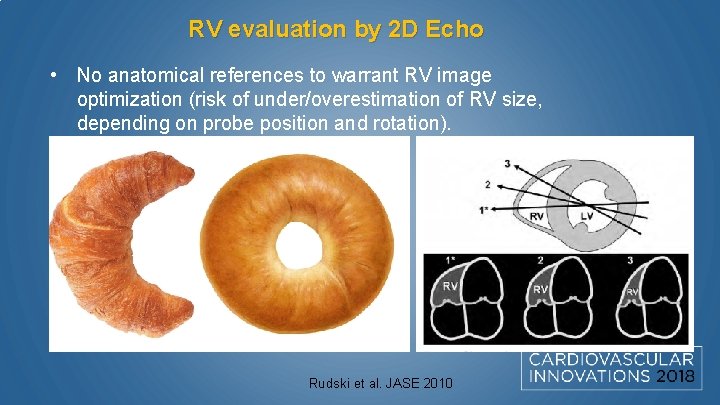
RV evaluation by 2 D Echo • No anatomical references to warrant RV image optimization (risk of under/overestimation of RV size, depending on probe position and rotation). Rudski et al. JASE 2010
Best Practices in CTA Scanning for RV/Tricuspid Valve www. cvinnovations. org
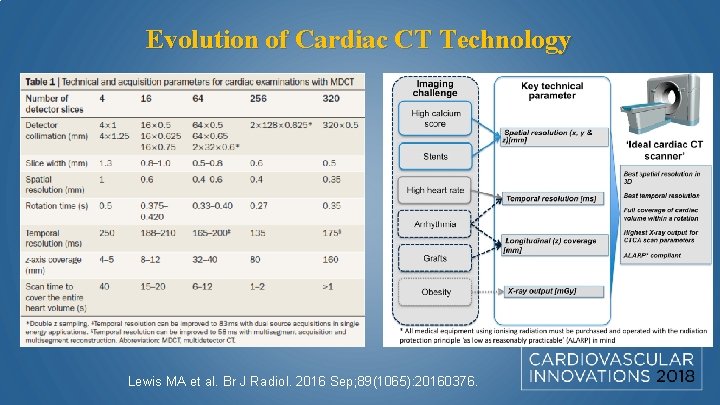
Evolution of Cardiac CT Technology Lewis MA et al. Br J Radiol. 2016 Sep; 89(1065): 20160376.
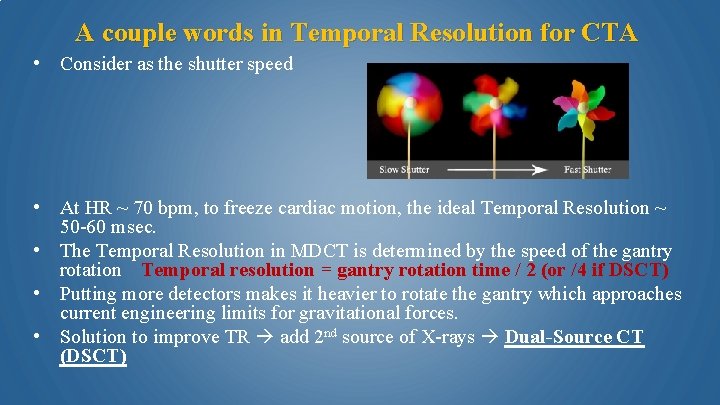
A couple words in Temporal Resolution for CTA • Consider as the shutter speed • At HR ~ 70 bpm, to freeze cardiac motion, the ideal Temporal Resolution ~ 50 -60 msec. • The Temporal Resolution in MDCT is determined by the speed of the gantry rotation Temporal resolution = gantry rotation time / 2 (or /4 if DSCT) • Putting more detectors makes it heavier to rotate the gantry which approaches current engineering limits for gravitational forces. • Solution to improve TR add 2 nd source of X-rays Dual-Source CT (DSCT)
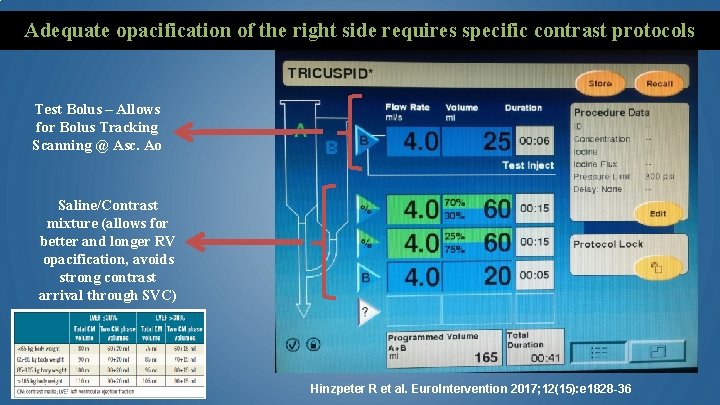
Adequate opacification of the right side requires specific contrast protocols Test Bolus – Allows for Bolus Tracking Scanning @ Asc. Ao Saline/Contrast mixture (allows for better and longer RV opacification, avoids strong contrast arrival through SVC) Hinzpeter R et al. Euro. Intervention 2017; 12(15): e 1828 -36
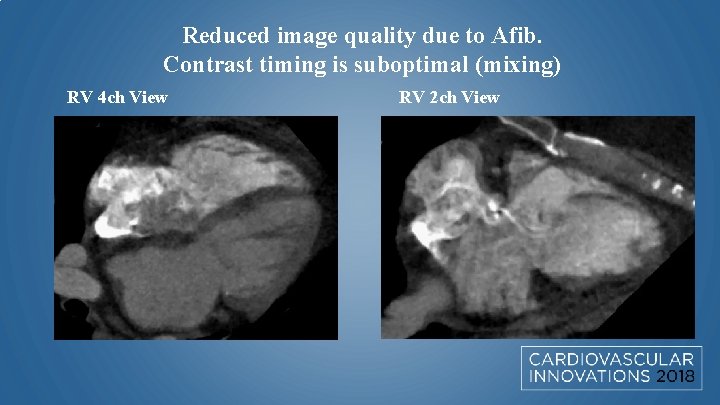
Reduced image quality due to Afib. Contrast timing is suboptimal (mixing) RV 4 ch View RV 2 ch View
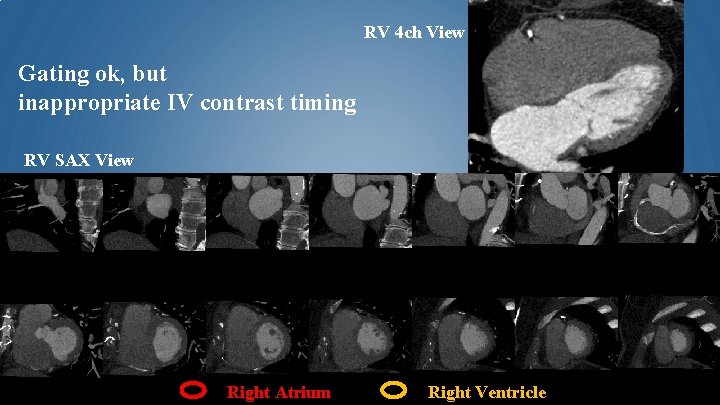
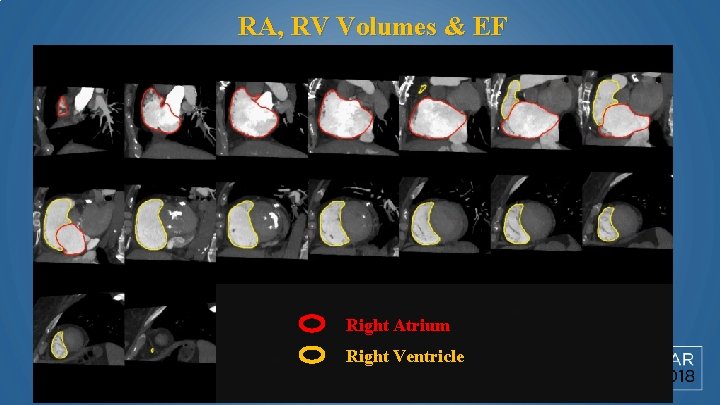
RV 4 ch View Gating ok, but inappropriate IV contrast timing RV SAX View Right Atrium Right Ventricle
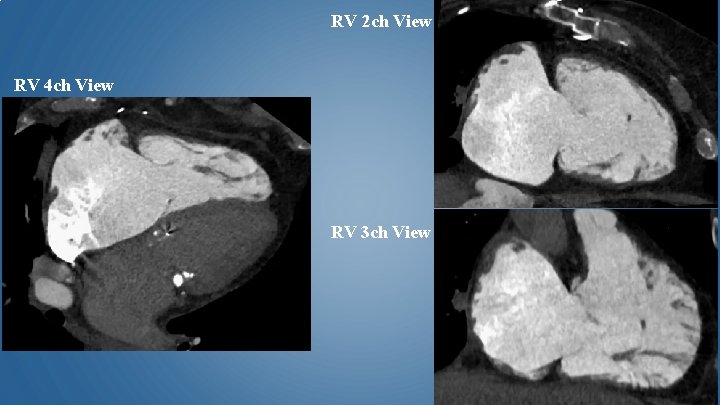
RV 2 ch View RV 4 ch View RV 3 ch View
RA, RV Volumes & EF RV SAX View Right Atrium Right Ventricle
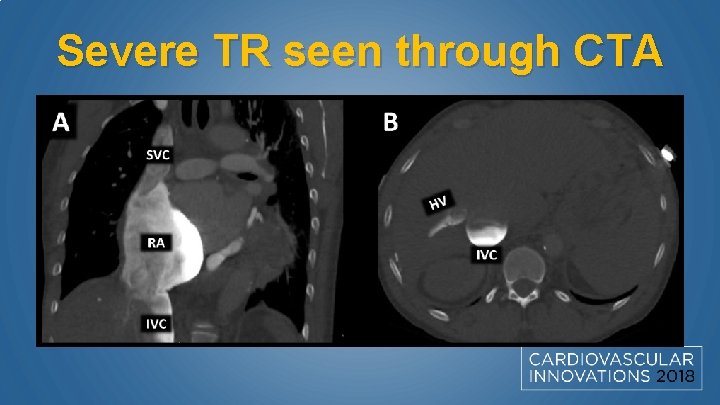
Severe TR seen through CTA
CT Anatomical Analysis www. cvinnovations. org
Tricuspid Annulus 4 ch Diameter 2 ch Diameter Area & Major/Minor Diameter
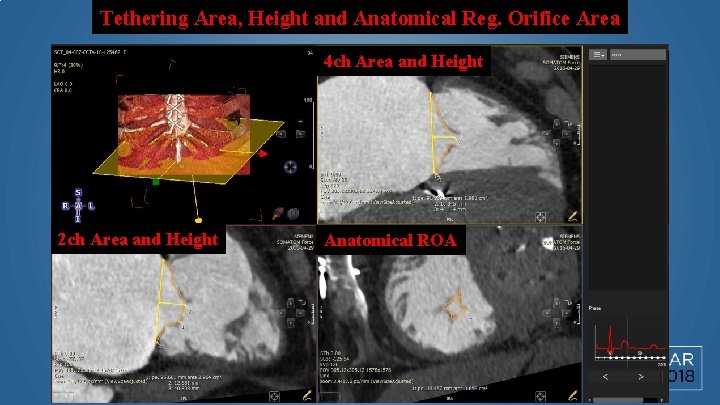
Tethering Area, Height and Anatomical Reg. Orifice Area 4 ch Area and Height 2 ch Area and Height Anatomical ROA
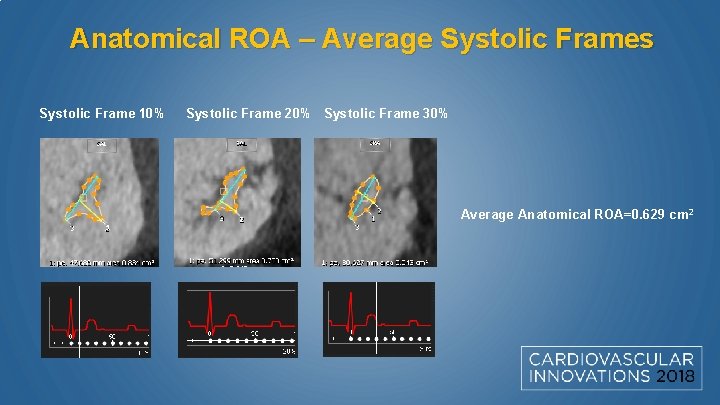
Anatomical ROA – Average Systolic Frames Systolic Frame 10% Systolic Frame 20% Systolic Frame 30% Average Anatomical ROA=0. 629 cm 2
CTA for Fluoroscopy Angle Planning
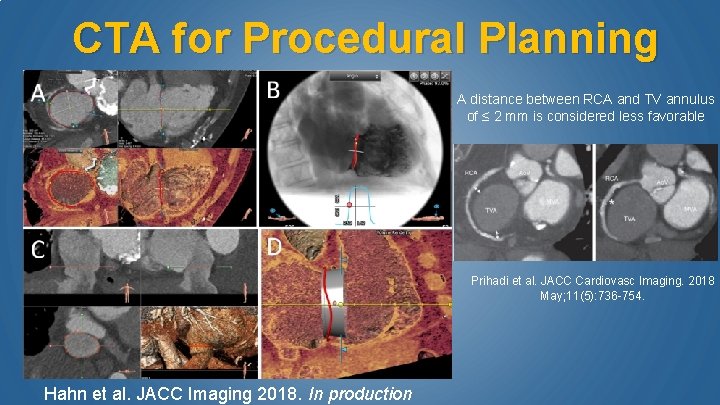
CTA for Procedural Planning A distance between RCA and TV annulus of ≤ 2 mm is considered less favorable Prihadi et al. JACC Cardiovasc Imaging. 2018 May; 11(5): 736 -754. Hahn et al. JACC Imaging 2018. In production
Conclusions • CTA planning to TV interventions requires specific acquisition protocol and measurements according to the device which will be used. • CTA quantification of RV volumes and RVEF is feasible provided adequate temporal resolution is achieved. • CMR should be integrated in the conventional risk assessment for VHD patients when uncertainty exists (discrepancies in symptoms vs severity). Most of the applications don’t require IV gadolinium. • Further education initiatives and valve trials integrating Cardiac MRI are needed to improve the understanding of valve-related myopathy and its relationship to outcomes individualizing patient selection to transcatheter therapies.